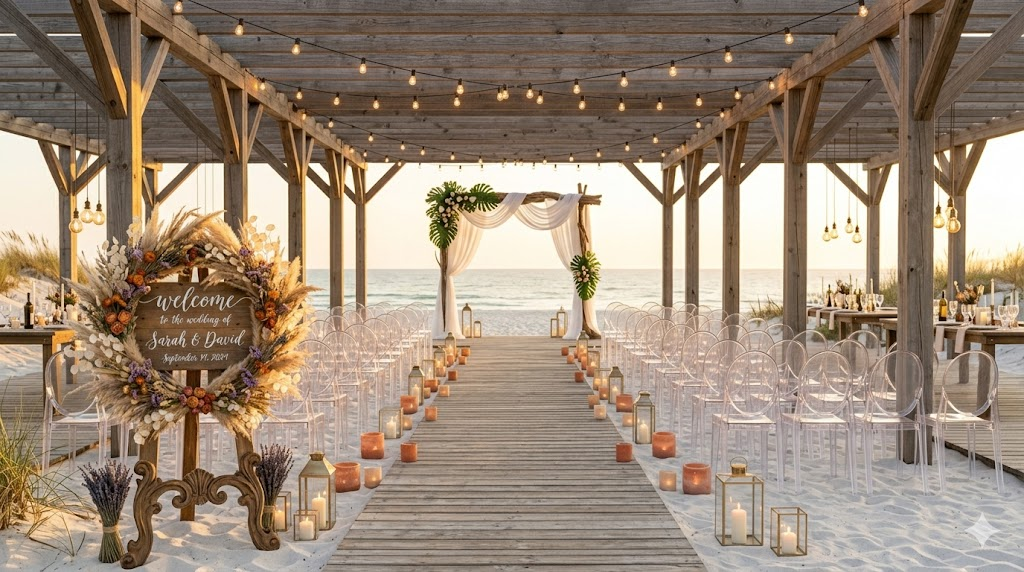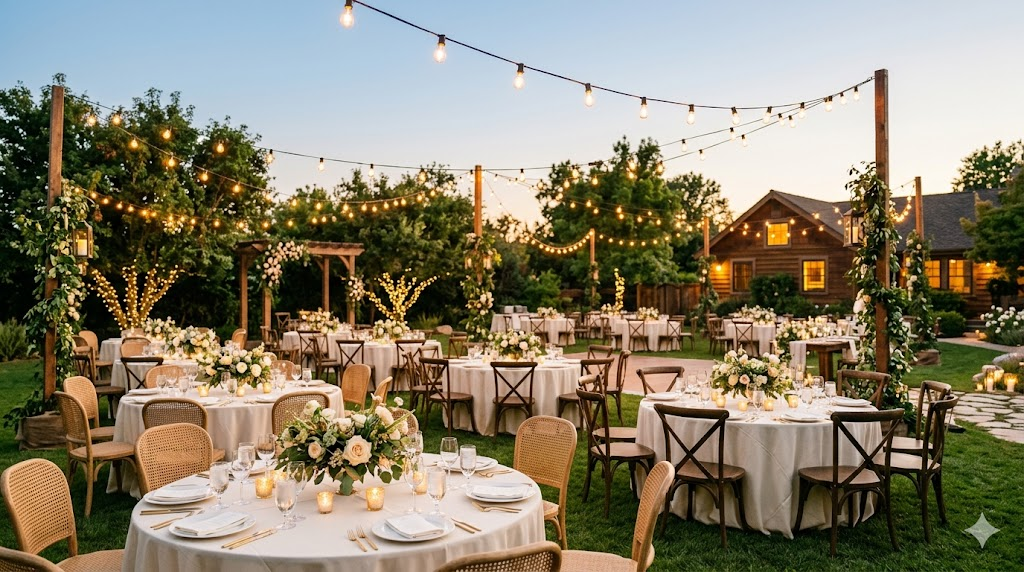
Most ceremony backdrops are chosen from photos taken at the photographer’s optimal angle — and couples only discover on the day that the same design feels different from where their guests are actually sitting.
Your backdrop has two audiences simultaneously: the photographer capturing it for an hour, and the guests experiencing it from 20 to 40 feet away for the full length of your ceremony.
Every decision below — shape, flower selection, proportion, positioning — is made with both audiences in mind, because the best backdrops serve both at once. For the structural and material foundation that comes before these decisions, the backdrop design fundamentals guide covers frame, fabric, and scale choices first.
1. Backdrop Shape Psychology: Curves vs. Geometry vs. Linear
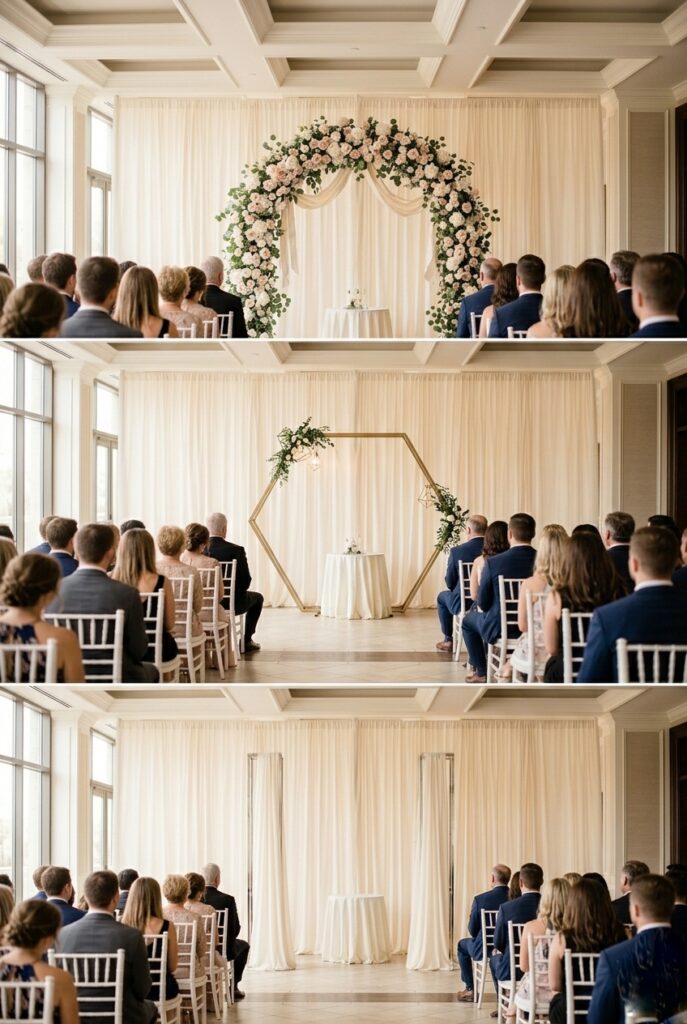
A curved arch psychologically holds the couple — your eye follows the curve and returns to the center, making the space feel intimate and contained — while a geometric arch frames without softening, which reads as modern and intentional from guest seats but hides flower wilting better because the structure remains intact even as individual blooms fade.
Linear backdrops — tall straight posts with minimal framing — elongate the space and make it feel taller and less enclosed, which works for outdoor ceremonies with strong natural surroundings but can read as austere in a small indoor room where guests are close enough to notice individual elements. For how each shape reads across different venue types and ceremony sizes, the wedding backdrop ideas guide covers the full range with specific venue pairing recommendations.
2. Flower Selection for Ceremony Longevity (Not Just Beauty)
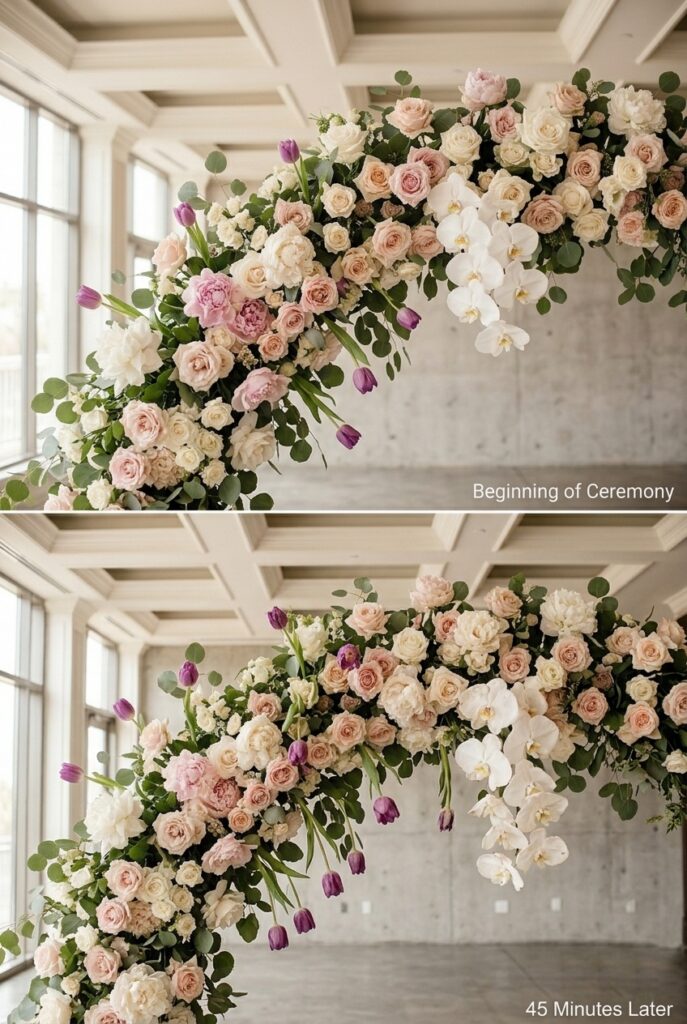
This is wPeonies, garden roses, ranunculus, and dahlias hold fresh for 60 minutes or more under 500-watt ceremony spotlights; tulips, orchids, lisianthus, and gardenia show visible wilting within 30–45 minutes under the same conditions — which means your flower selection is not just an aesthetic decision but a structural one that determines whether your vow exchange happens in front of a pristine installation or a tired one.
Ask your florist directly: “What is the heat output of our venue’s ceremony lighting, and how long will these specific stems hold under those conditions?” — florists who think this way will answer specifically, and the ones who cannot are designing around photos rather than the live ceremony. For how flower choice integrates with the full decoration layer, the ceremony flowers guide covers conditioning, hardiness, and same-day handling.
Budget Hack #1: Skip mixed-delicate bouquets and choose a single flower type or two complementary hardy varieties instead. A lush arch of 200 garden roses with eucalyptus ($1,800–$2,500) lasts pristinely through a 60-minute ceremony. A mixed arch with orchids, lisianthus, tulips, and roses ($2,000–$2,800) shows visible wilting by photo time. You save $200–$400, your flowers look better, and the design actually reads more sophisticated because it’s restrained rather than maximalist. Source: Tell your florist you want “ceremony-hardy flowers in a cohesive color palette.” Ask them to suggest the most durable options in your color scheme. This simple conversation shifts the entire design from “pretty but fragile” to “beautiful and practical.”
3. Proportion to Your Space: The Invisible Math Couples Skip
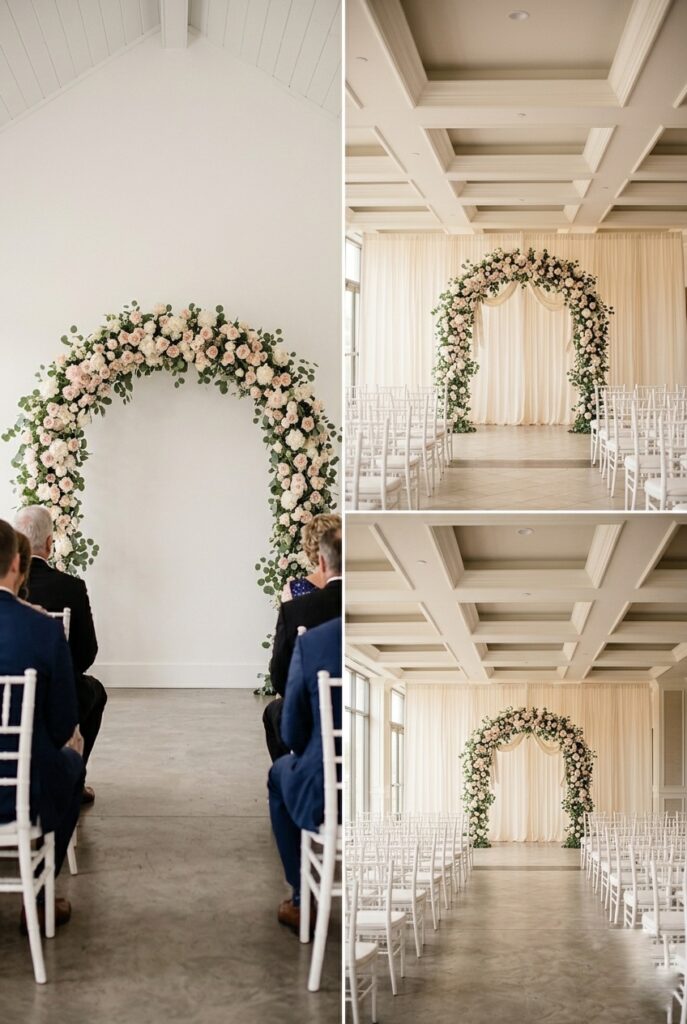
YourYour backdrop’s visual weight is determined by the ratio of backdrop width to room width, not its absolute size — an 8-foot arch in a 25-foot-wide chapel dominates and overwhelms, while the same arch in a 50-foot ballroom reads as understated and correctly scaled, so measure your ceremonial space width before designing anything.
For practical sizing: ceremonies in spaces under 40 feet wide need backdrops at 25–35% of room width, medium spaces of 40–60 feet need 30–40%, and large spaces above 60 feet need 35–50% — give your florist these dimensions explicitly rather than choosing an arch size from an inspiration photo taken in an unknown room. For how ceiling height interacts with this width proportion in indoor venues specifically, the indoor venue proportions guide covers both dimensions together.
4. Guest Sightline Positioning: The Perspective Nobody Considers

MoPosition your backdrop so flowers are concentrated at the top and sides of the arch and more open at the 5–7 foot range — the couple’s face height — so guests in every section see expressions and hands during the ring exchange rather than looking through a wall of blooms.
Before finalising any backdrop design, sit in a chair at the front row, then the side sections, then the back, and confirm the couple’s faces are clearly visible from each position; your photographer will work around the guest-optimal view, not the other way around. The backdrop positioning and sightline guide covers how distance from the front row and lateral guest positions change what is visible and what is obscured.
5. Fabric Draping: The Multiplier Effect on Visual Impact
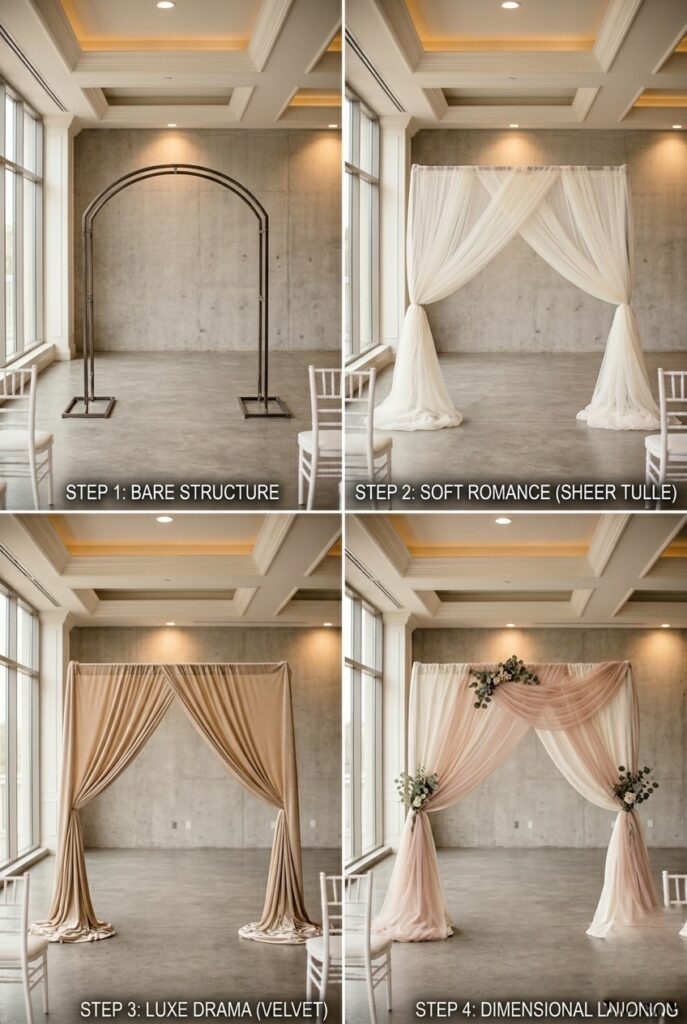
Sheer fabric — tulle or chiffon — adds romance without visual heaviness and photographs with a luminous glow as light passes through it, costing $100–$300 for enough material to dress an 8–10-foot arch; structured fabric — velvet, silk dupioni, heavyweight linen — adds elegance and visual drama but makes the space feel slightly smaller to guests in person because it creates solid visual boundaries rather than open ones.
The practical trade-off is that your photographer may strongly prefer a heavily draped design for its photographic texture and depth, while guests sitting 30 feet away may experience the same design as visually heavy — discuss this balance explicitly with your florist or designer before committing to a fabric choice, not after. For which specific fabric types hold up best under different installation methods, the backdrop decoration materials guide covers draping weight, attachment, and what to avoid on each frame type.
6. Lighting Strategy for Ceremony Freshness (Not Just Night Visibility)
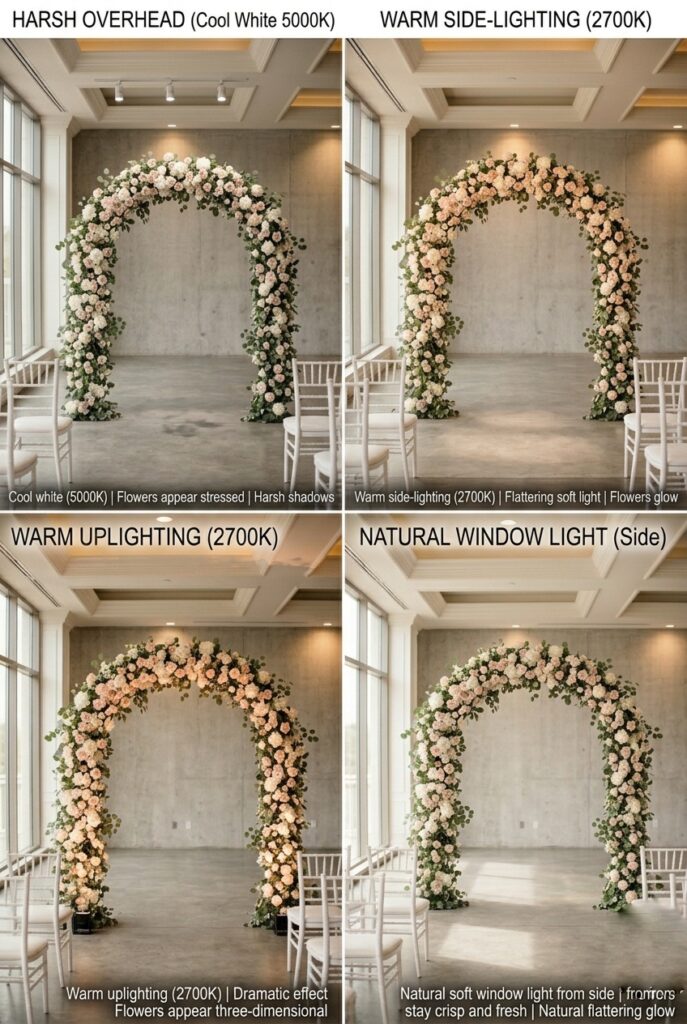
Warm white lighting at 2700K is flattering to flowers, fabric, and faces; cool white at 5000K or above makes everything read as clinical and causes flowers to appear stressed in photographs — and direct overhead spotlights create shadow under eyes and chins regardless of colour temperature, which is why uplighting angled upward from the base of the backdrop almost always produces better ceremony photographs than overhead lighting alone.
Tell your venue coordinator or lighting designer: “We want warm white side-lighting or uplighting rather than direct overhead spotlights during the ceremony, and we want it set up and tested before guests arrive” — this single conversation prevents both unflattering photos and accelerated flower wilting from concentrated overhead heat. For how this lighting strategy scales to an outdoor ceremony where natural light is the primary source, that guide covers shade positioning, timing, and hardy flower selection for direct-sun installations.
7. The Backdrop Location Decision: Ceremony vs. Reception Repositioning
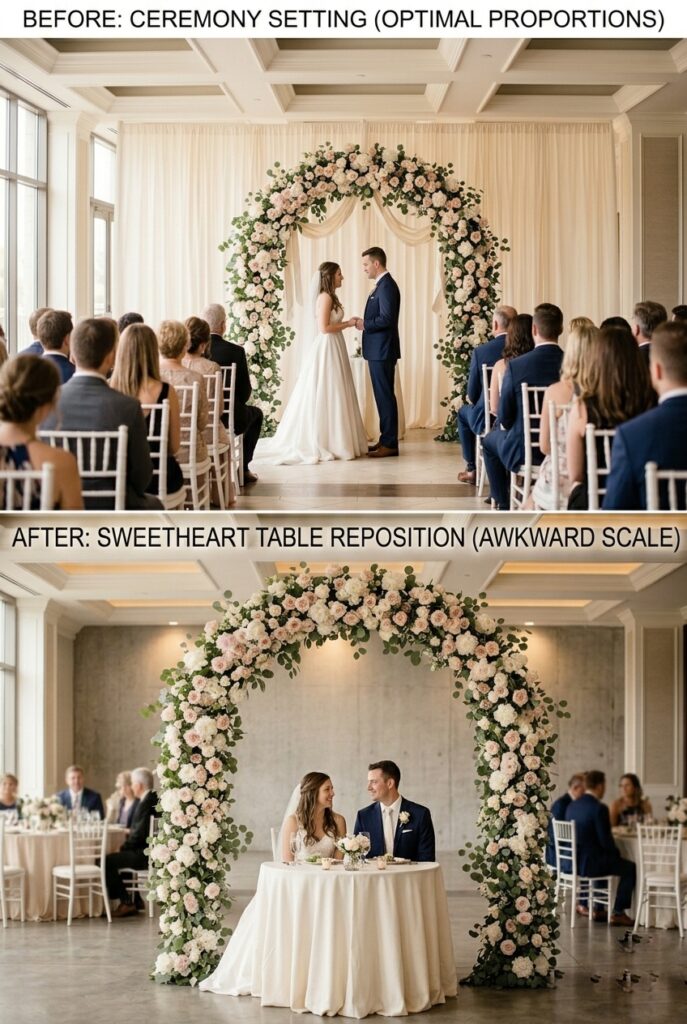
What frames a standing couple beautifully at the ceremony altar — typically an 8–10 foot arch at full height — often reads as oversized behind a seated couple at a sweetheart table, because the proportional relationship between the structure and the people in front of it changes entirely when your subjects shift from standing to seated.
If budget allows, design the ceremony backdrop for the ceremony first and build a separate, smaller statement piece for the sweetheart table at $200–$400 rather than repositioning one structure and compromising both uses; if repositioning is the plan, design with the reception context in mind from the start and budget $200–$500 to refresh florals between the two setups. The reception backdrop guide covers sweetheart table, head table, and photo area backdrop proportions separately from ceremony sizing.
8. Statement Single-Element Backdrops (When Less Is More)
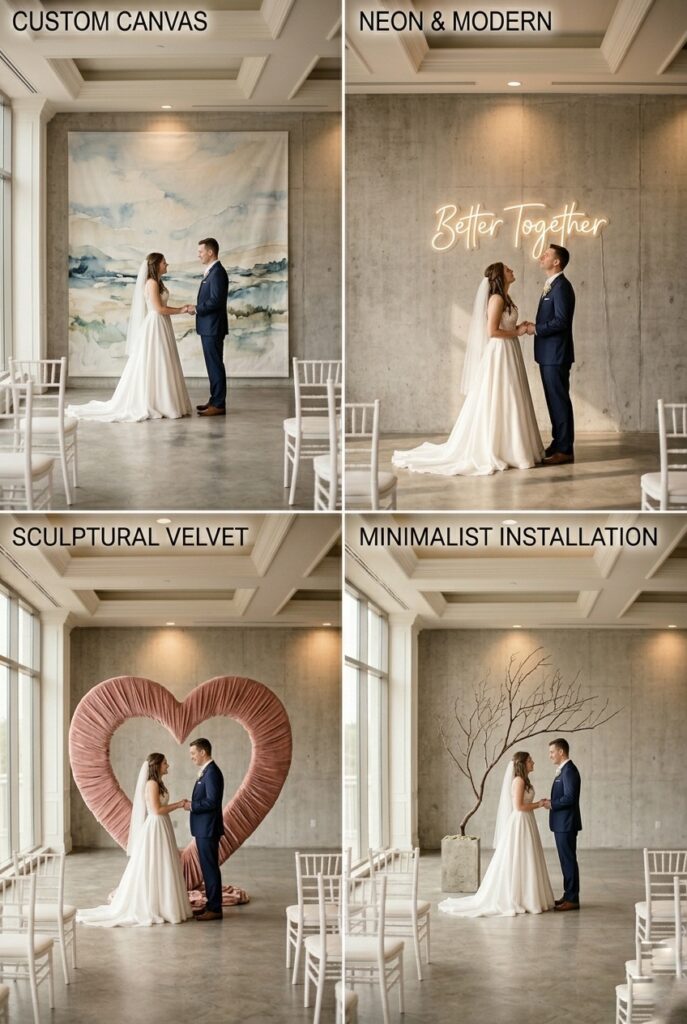
A custom-painted canvas backdrop at $400–$800 from a local artist reads as more personal and more photogenic than a mediocre floral arch at double the cost — it doesn’t wilt, you own it permanently, and it can be rented to other couples or repurposed as home décor after the wedding.
Neon signs, large sculptural shapes, and single large-scale natural elements work on the same principle: one bold, unexpected element almost always photographs more distinctively than a crowded arch full of flowers competing for attention, and guests experience it as art rather than event decoration. For a full DIY build approach to constructing the frame that supports any of these elements, that guide covers frame material, dimensions, and structural requirements.
Budget Hack #2: Commission a local artist to paint a custom backdrop on canvas (8×10 feet) for $400–$800 instead of renting a floral arch for $1,200–$2,000. You own it permanently, it doesn’t wilt, it’s completely unique, and you can repurpose it as home decor or rent it to other couples to recoup costs. Source: Search “canvas painter” or “wedding artist” on Etsy, or ask your coordinator for local recommendations. Request a proof before final painting and give clear direction on style, colors, and dimensions.
9. The Seasonal Flower Reality (Hardy vs. Seasonal)
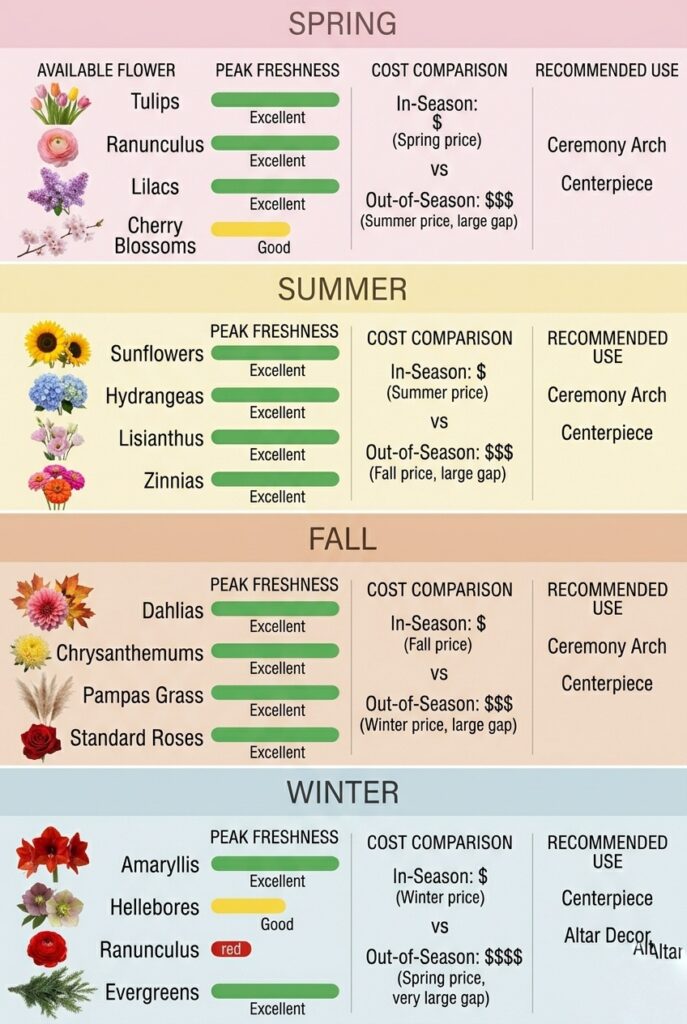
Peonies are abundant and affordable in May and June and nearly impossible to source freshly in November; roses are available year-round but in-season varieties are 30–50% cheaper and arrive fresher because they travel less distance — choosing your flowers around your wedding date rather than around an inspiration photo means better quality at lower cost.
If your date puts you outside the peak season for your preferred flower, budget 20–30% more for imported or greenhouse-grown alternatives, and confirm with your florist 6 weeks minimum before the wedding that they can guarantee freshness and availability — not the week before, when substitutions become the only option. For how seasonal choice interacts with the full flower approach across your reception tables, the simple ceremony backdrop guide covers which flower types work across all seasons for a streamlined build.
10. Ceremony Music + Backdrop Timing: The Overlooked Coordination
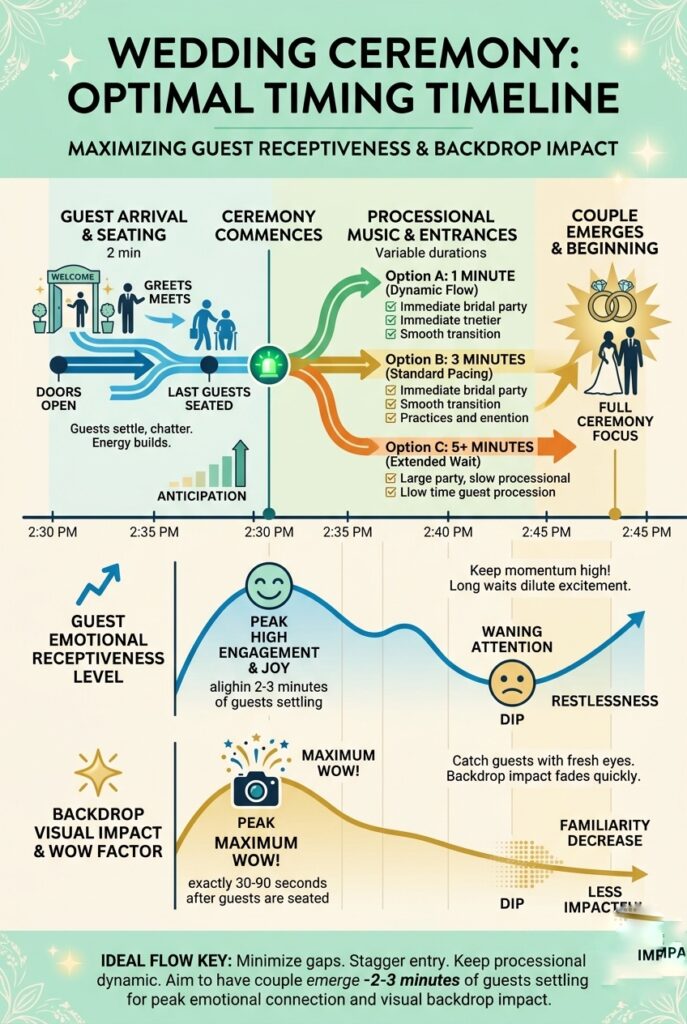
A 2–3 minute gap between guests being fully seated and the couple appearing is the window in which your backdrop does its visual work — long enough for guests to absorb it and build anticipation, short enough that the moment retains momentum and guests are still in a heightened emotional state when the couple walks in.
Coordinate with your officiant and musician before the day so the processional music timing lands the couple’s entrance within that window consistently, and confirm with your venue that ceremony lighting and any uplighting is set, tested, and running before the first guest is seated — not adjusted during the ceremony when there is no recovery time.
Design your ceremony backdrop for the person sitting in the third row from the side, not for the photographer’s camera angle — because guests carry the emotional memory of what they experienced in the room, and that memory is shaped more by what they saw clearly and felt spatially than by any photograph.
For elegant wedding decor that carries the same level of spatial intention from your ceremony backdrop through to your reception tables, that guide covers how to build cohesion across both spaces. For how the ceremony backdrop integrates into the full room design at your venue, the indoor wedding decor guide covers the complete spatial picture.