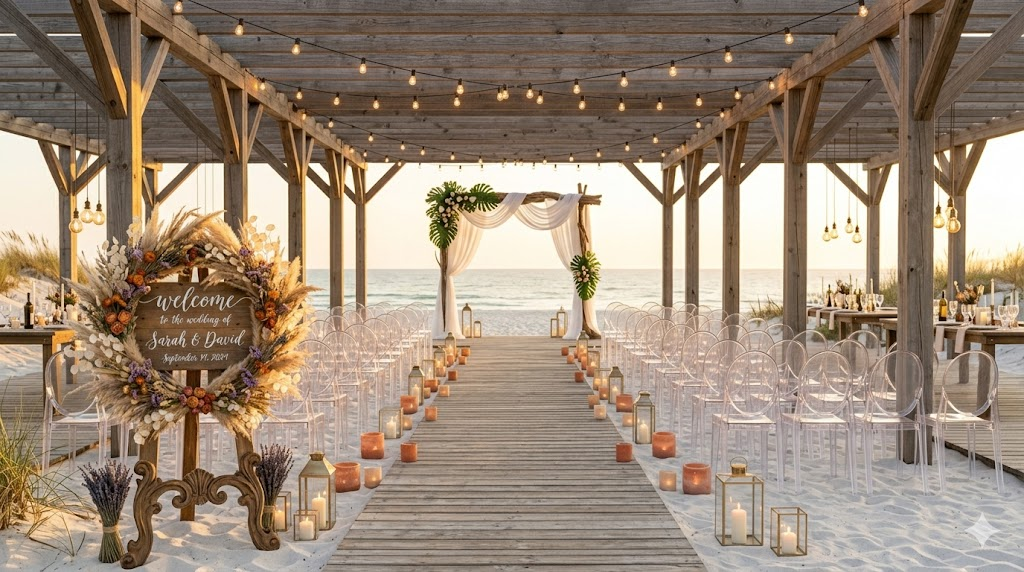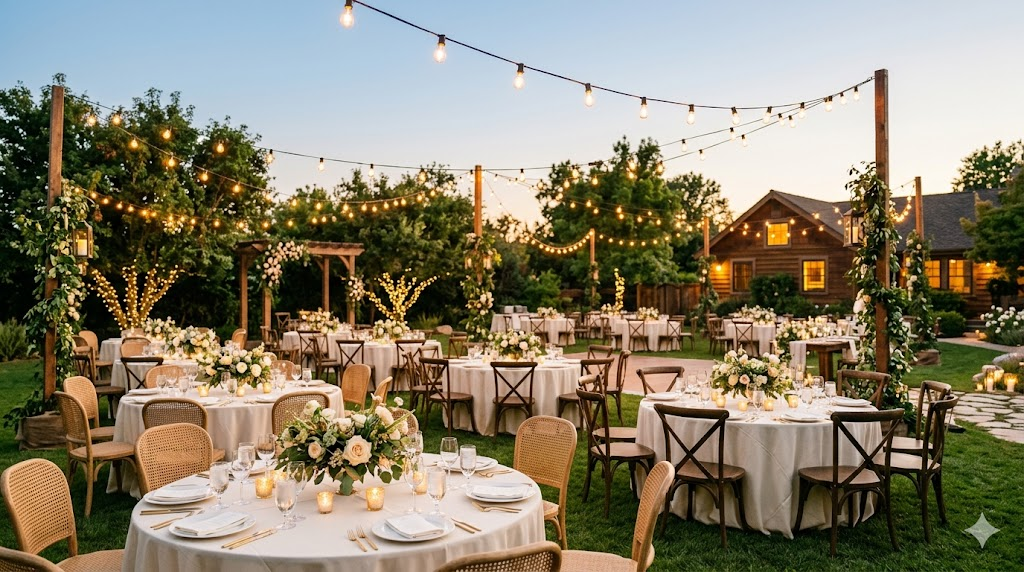
A ceremony backdrop does not need an arch — and most backdrops photograph better without one.
An arch is a three-dimensional object that your photographer must work around, that competes visually with your couple for the viewer’s eye, and that limits framing options for the full duration of your ceremony.
A clean fabric background or existing venue architecture gives your photographer freedom to frame from any position, keeps the couple as the undisputed visual centre, and in most cases costs significantly less. For how these background choices integrate into the full ceremony design — including shape, proportion, and guest sightlines — the ceremony backdrop design guide covers every decision in sequence.
1. Why Solid Backdrops Photograph Better Than Arches
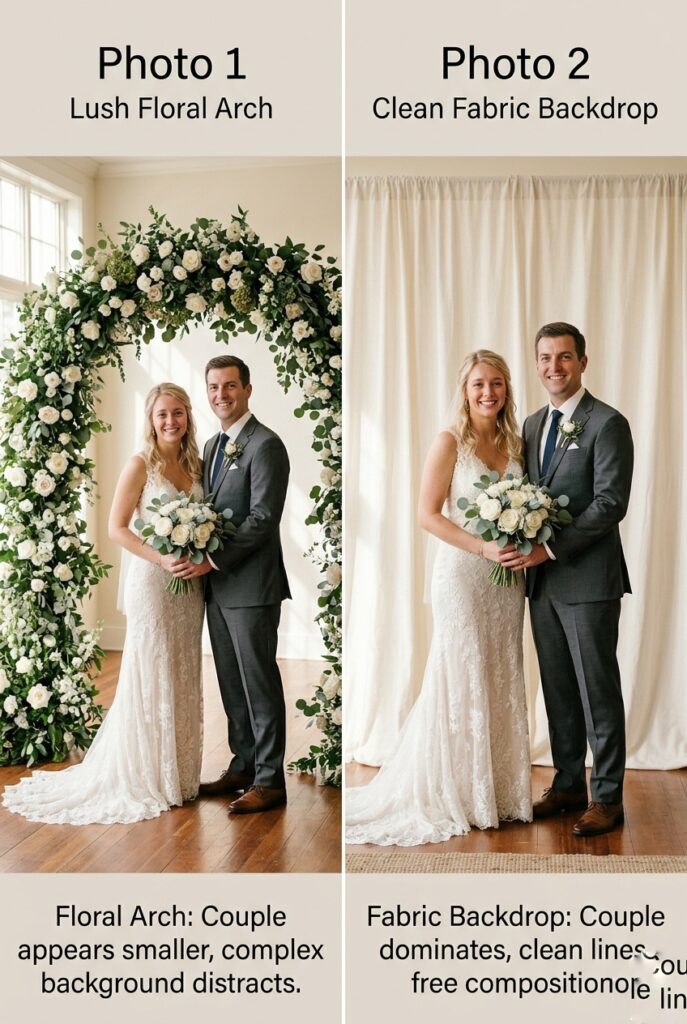
An arcAn arch forces your photographer to find angles where the support legs are hidden, where the arch structure doesn’t cast shadows on your faces, and where the couple doesn’t appear dwarfed by the surrounding frame — which means 60 minutes of ceremony photographs all share the same narrow range of workable angles.
A clean solid backdrop can be shot from any lateral position without losing the background, which means your photographer moves freely during the vow exchange and captures moments rather than managing structure; the visual result is that your faces fill the frame because nothing else is competing for the viewer’s attention. For the full range of what each backdrop type actually produces photographically, the wedding backdrop ideas guide covers every option with honest photography trade-offs for each.
2. Fabric Backdrop Options: Choosing What Works for Your Photos
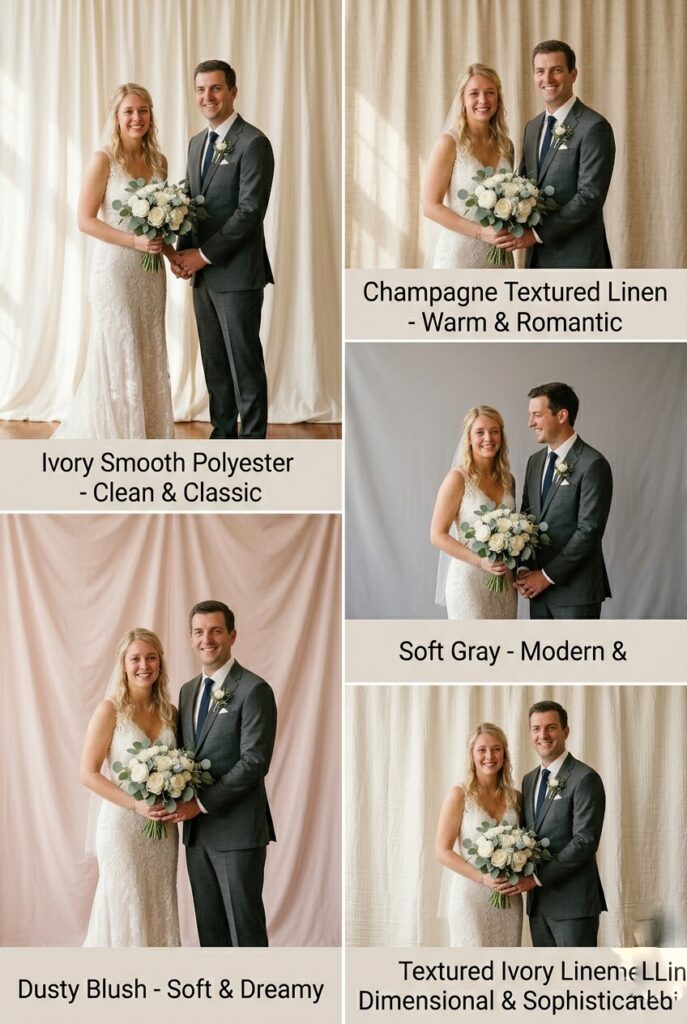
Ivory and cream photograph most consistently across lighting types because warm tones make skin glow in both natural and artificial light without competing with any wedding colour palette; champagne and warm white add subtle visual interest through texture or sheen without reading as busy, while soft grey works for modern aesthetics but needs testing under your venue’s specific lighting because cool-toned fabrics can read as flat under warm ballroom LEDs.
Avoid shiny satin and polyester blends regardless of colour — they catch venue light and photograph with a reflective sheen that reads as cheap regardless of price point, while matte linen and heavyweight cotton absorb light and read as intentional and textured at every budget level. For the full breakdown of which fabric types hold their appearance through installation, transport, and a full ceremony day, the fabric and material guide covers draping weight, finish, and sourcing for each option.
3. DIY Budget Backdrops That Photograph Better Than Rented Arches
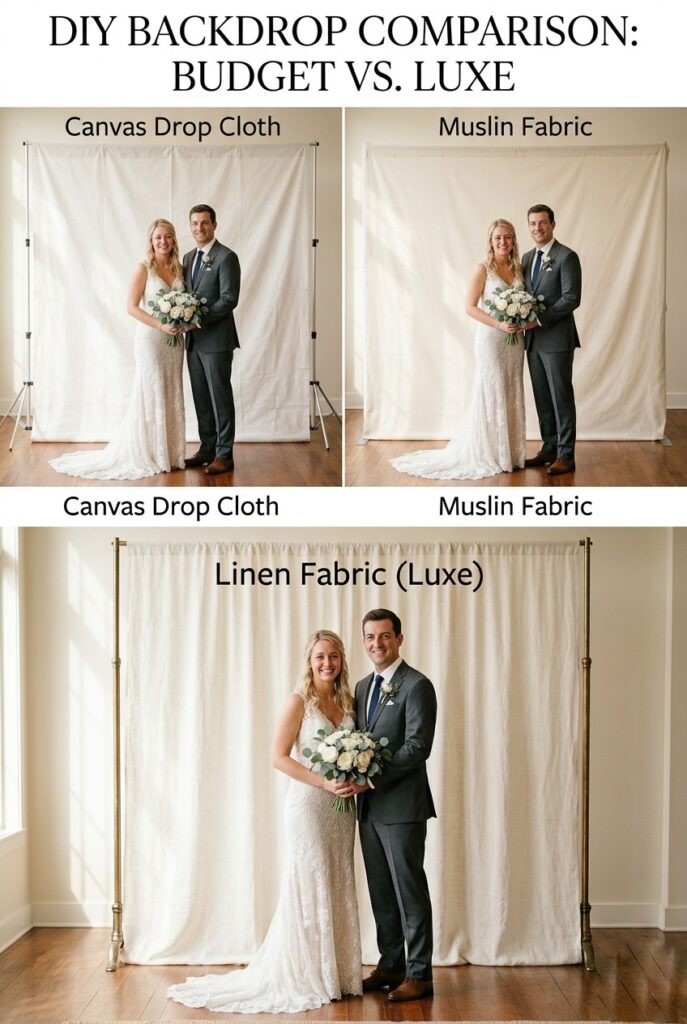
A white canvas drop cloth from a hardware store at $25–$40 draped on a portable stand or PVC frame photographs with the same matte texture quality as $300 linen if the lighting is warm and the fabric is hung with enough width — at least 8–10 feet — to frame the couple without appearing to be a sheet.
Muslin at $3–$5 per yard is the standard for professional photography studios because it is durable, photographs completely cleanly, and rehang without visible creasing; buy 60 yards, hem the edges, and you have a reusable backdrop for under $200 that will never be identified as budget in your photographs. If you are building the frame rather than renting it, the DIY backdrop build guide covers PVC, wood, and stand options with exact material lists and structural requirements.
4. Using Your Venue’s Existing Architecture (The Smartest Approach)
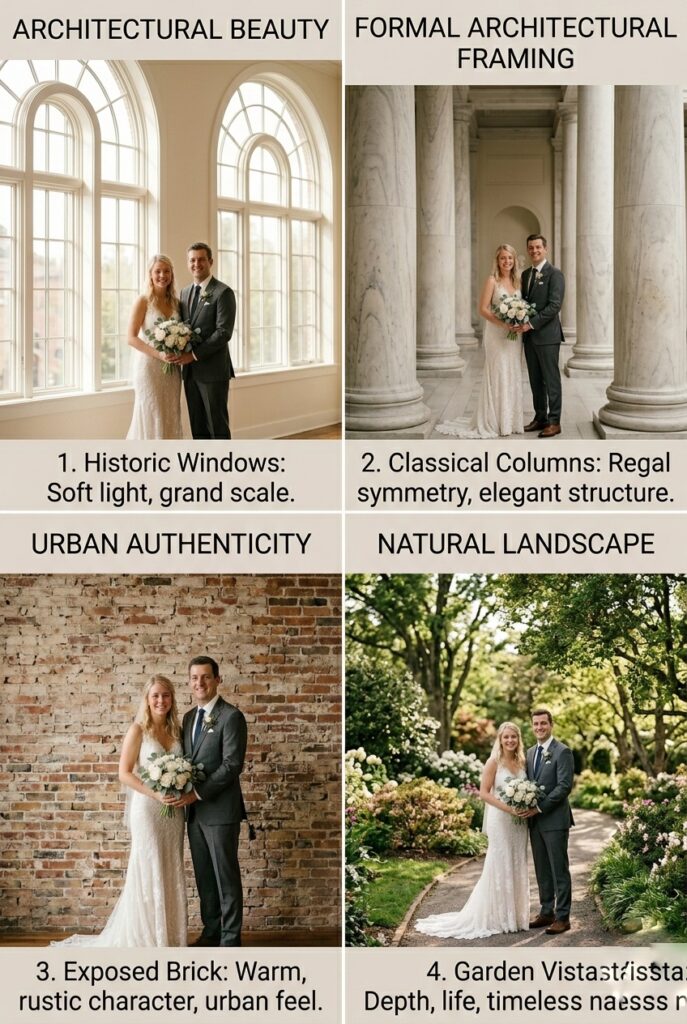
Tall windows, architectural columns, textured brick or stone walls, and outdoor tree lines are already designed by architects to be visually interesting at scale — which means they photograph with more depth and authenticity than any installed backdrop, and they cost nothing.
The practical rule is that side-window light is more flattering than back-window light — position the couple so windows are to their side rather than directly behind, which prevents the camera from exposing for the bright exterior and leaving your couple as silhouettes; for outdoor settings specifically, shade from overhead canopy or morning light before the sun is directly overhead gives you the most consistently flattering natural backdrop at no cost.
5. The Minimal Arch: If You Must Have Structure
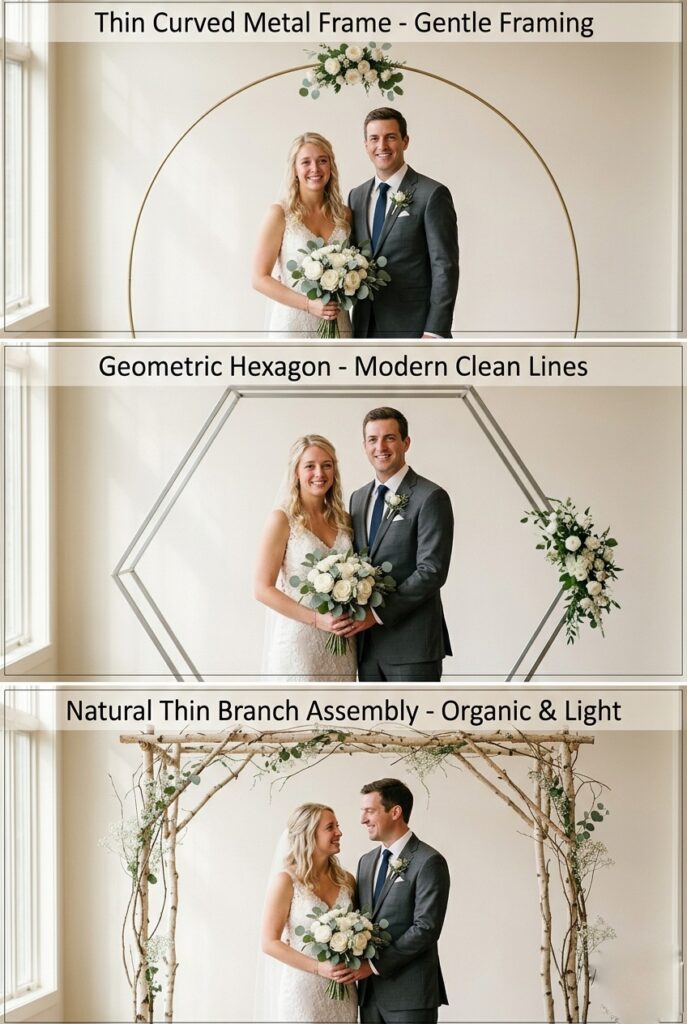
If structure matters to you — for the symbolism, for your venue’s sightline needs, or because your partner loves the look — a thin metal frame with minimal or no flowers at face height photographs cleanly because the structure is visually lightweight enough that it reads as framing rather than competing.
Ask your florist or rental company specifically for a frame that is under three-quarters of an inch in diameter for the uprights, and concentrate any floral additions at the very top of the arch only — leaving the 5–7 foot range open — so every guest has a clear view of the couple’s faces and your photographer can close in on expressions without the arch imposing on the frame. For how this minimal approach compares to a full absence of structure, the simple backdrop guide covers the lightest-touch options across each arch style.
6. Backdrop Placement: Wall vs. Free-Standing
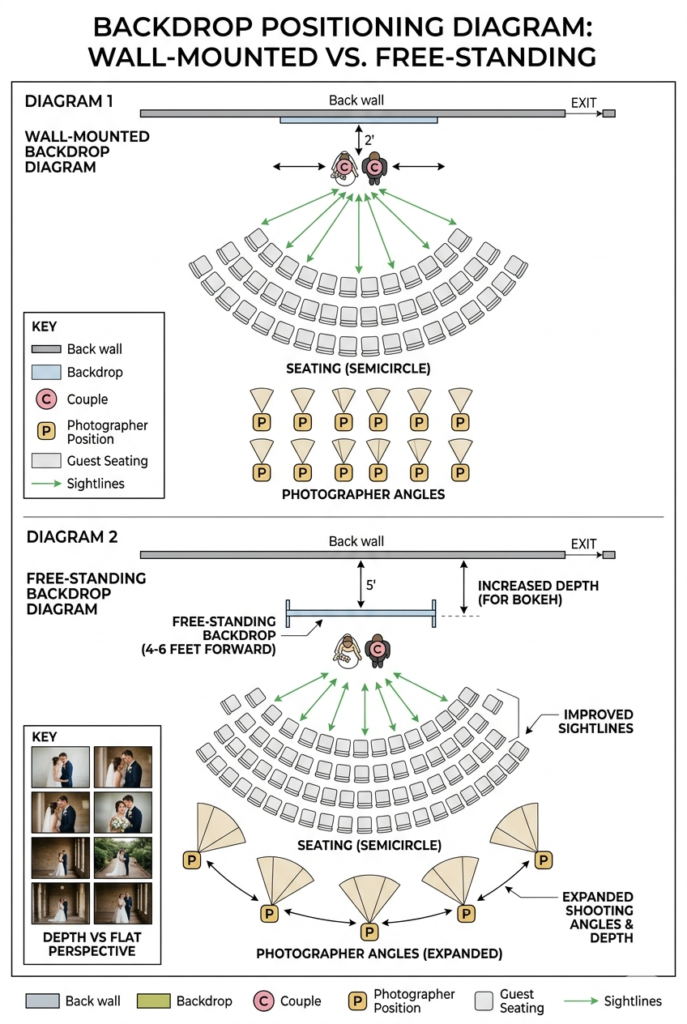
Positioning a free-standing backdrop 4–6 feet in front of the back wall rather than flush against it gives your photographer the ability to shoot from behind the backdrop and have your couple appear to emerge from it, and it creates a visible depth separation between the couple and the wall that reads as dimension in photographs — the same fabric that looks flat against a wall reads as an installation when it has open space behind it.
Wall-mounting is simpler logistically and costs nothing in additional hardware, but it limits your photographer to frontal angles only; choose free-standing if your venue has the floor space and your photographer prefers it — ask before the day, because they have strong views. For how these placement decisions interact with ceiling height and lighting angles in indoor venues, the indoor backdrop positioning guide covers both dimensions and their photographic consequences.
7. Lighting Your Backdrop (So It Doesn’t Disappear in Photos)
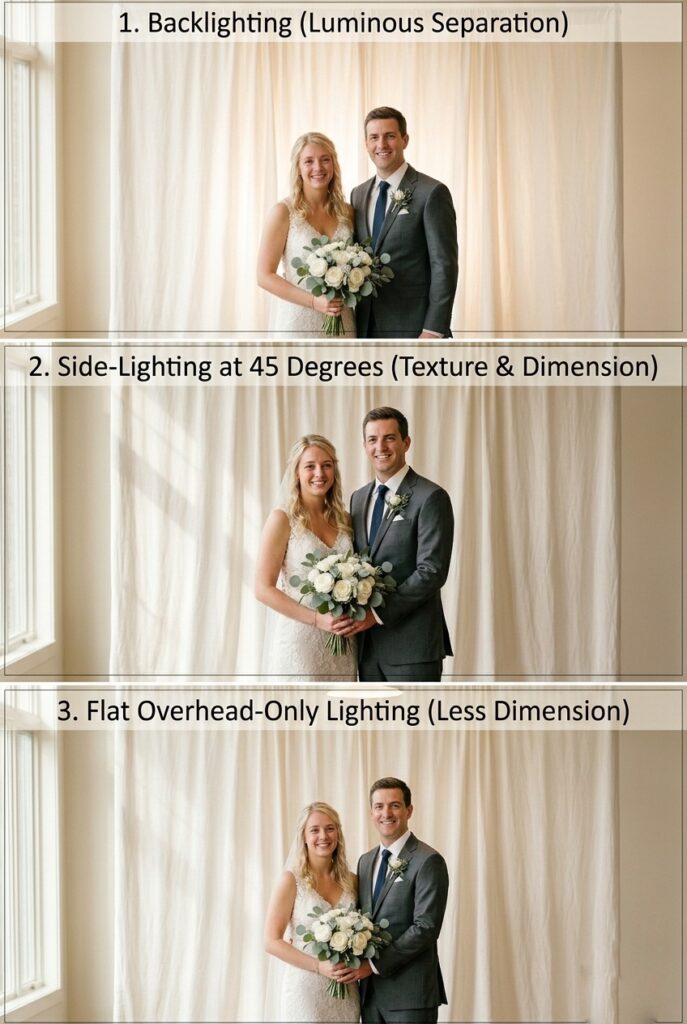
One additional light source — warm white at 2700K, positioned at a 45-degree angle to the side of the backdrop and aimed across the fabric surface — creates shadow and highlight variation that makes even plain linen read as dimensional and luxurious in photographs; without it, a fabric backdrop under flat overhead venue lighting often appears as a slightly lighter wall rather than an intentional design element.
Backlighting positioned behind and above the backdrop aimed toward the camera creates a separation glow effect around your couple that reads as cinematic in photographs, and battery-powered warm white lights make this achievable without electrical setup in venues with no accessible ceremony power points. For the full material context of which fabrics respond best to each lighting angle and why surface finish determines the result, the backdrop decoration and materials guide covers texture, sheen, and light interaction for every backdrop material type.
8. Backdrop Size Mistakes (Too Big or Too Small Kills the Photo)
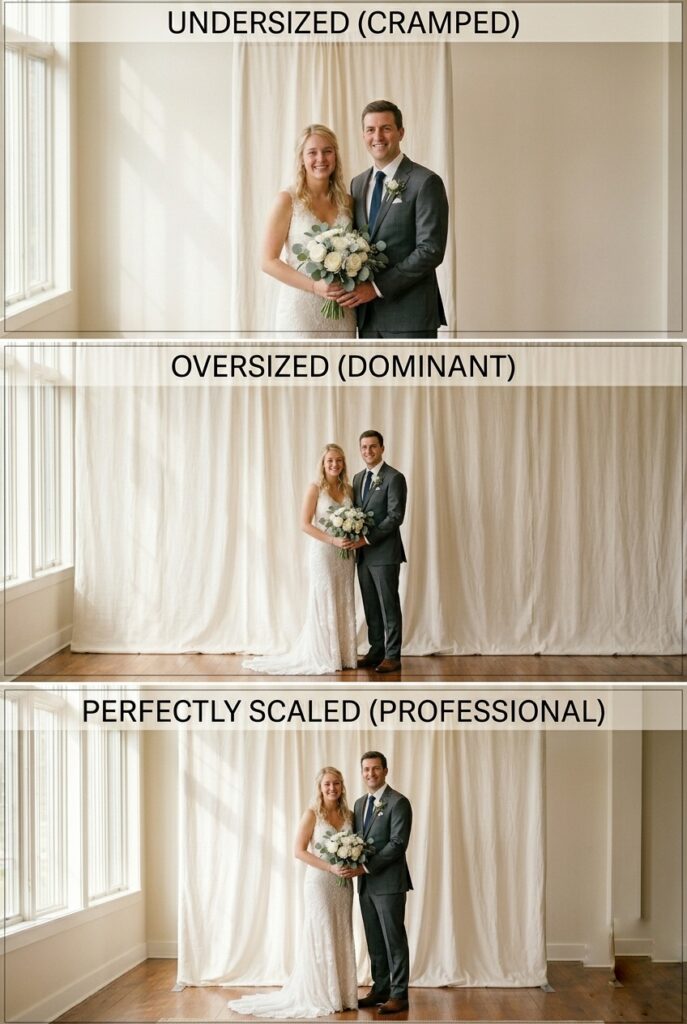
A backdrop narrower than 8 feet wide reads as a sheet rather than a designed element — the couple’s bodies extend visually past the edges of the background and the photographer cannot frame a clean wide shot without exposing the frame edges or the surrounding venue wall; a backdrop wider than 14 feet in an average-size ceremony space dominates the composition and makes the couple appear small within it.
The practical sizing rule is backdrop width at 25–35% of your ceremony space width — for a 40-foot ballroom, aim for 10–14 feet; for a 25-foot chapel or garden setting, aim for 7–9 feet — and confirm this measurement against your actual venue dimensions rather than choosing a size from an inspiration photo taken in a room with unknown dimensions. For how this scale rule interacts with arch height, ceiling height, and distance from guest seating simultaneously, the backdrop scale and positioning guide covers all three proportional decisions together.
9. No Backdrop at All (The Secret Professional Approach)
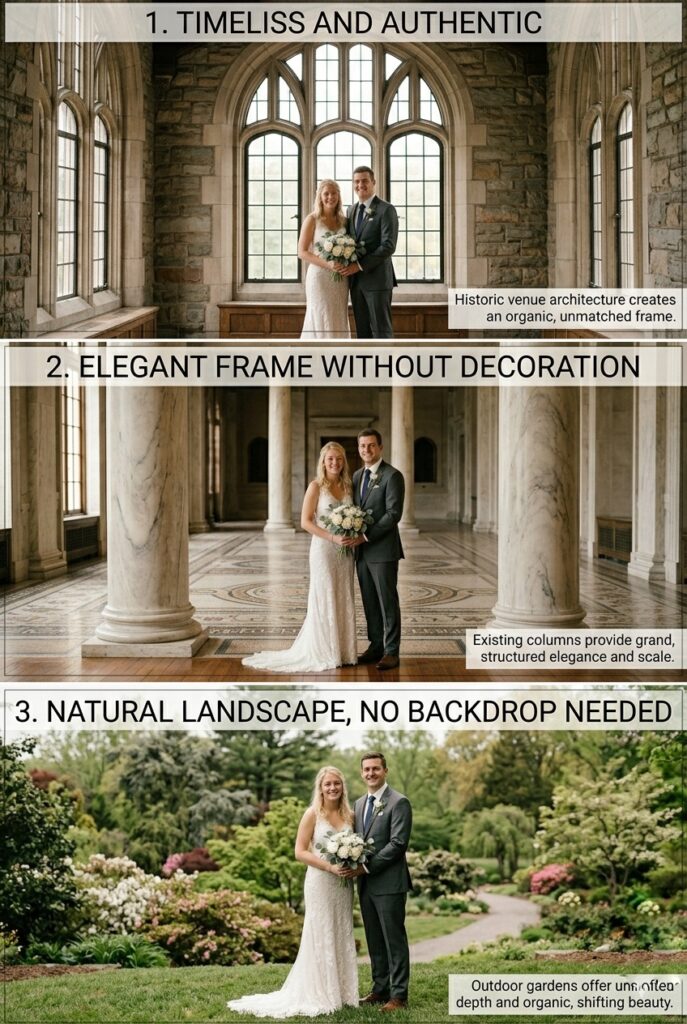
Some oIf your venue has architectural character — columns, windows, stone walls, a garden, exposed timber — the strongest photography choice is often no installed backdrop at all, because authentic space photographs with depth and texture that no installed fabric panel can replicate, and ceremony photographs without added decoration age better because they are not tied to a specific trend or period.
Your photographer will almost certainly have a view on this — ask them directly which approach they prefer in your specific venue, because experienced photographers know from hundreds of ceremonies which spaces benefit from a fabric backdrop and which are weakened by one; their answer will be more useful than any inspiration image you have found in a search.
10. Post-Ceremony Use: Making Your Backdrop Earn Its Cost
A backdrop that serves only the ceremony is a single-use rental — plan from the start for it to move to the sweetheart table behind the seated couple at the reception, to anchor a guest photo area, or to serve as the bridal party portrait station, so the cost divides across three distinct uses rather than one.
Quality fabric at $300–$500 stored properly after the wedding can be reused for anniversaries, vow renewals, or rented to other couples through wedding resale groups at $100–$150 per use, which brings the total out-of-pocket cost on a backdrop down significantly across multiple events. For how the repositioning specifically works behind a sweetheart table and in photo booth setups, the reception backdrop guide covers proportioning and styling for each reception use.
The backdrop that produces the best ceremony photographs is almost always the simplest one — either your venue’s existing architecture, a clean matte fabric panel, or a minimal arch with nothing above the couple’s eyeline. Design it to recede so your couple advances, and your photographer will do the rest.
For elegant wedding decor that carries this same restraint principle from the ceremony backdrop through to the full reception design, that guide covers how to build visual cohesion across both spaces without over-decorating either.