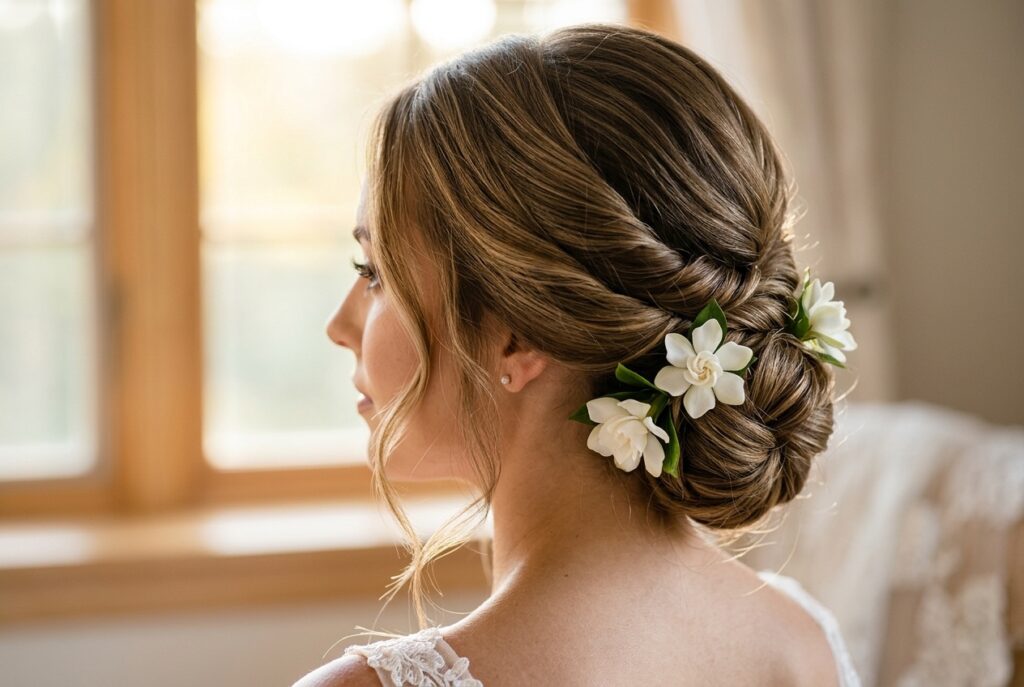
Square nails on a wedding day are either the sharpest architectural choice you make, or the reason you spent three hours at the reception afraid to catch your veil.
The difference between those two outcomes is a single filing decision, a technician who understands nail geometry, and a clear-eyed assessment of your own hand proportions before you commit to length or design.
1. Hard Square vs. Soft Square — The Decision That Changes Everything
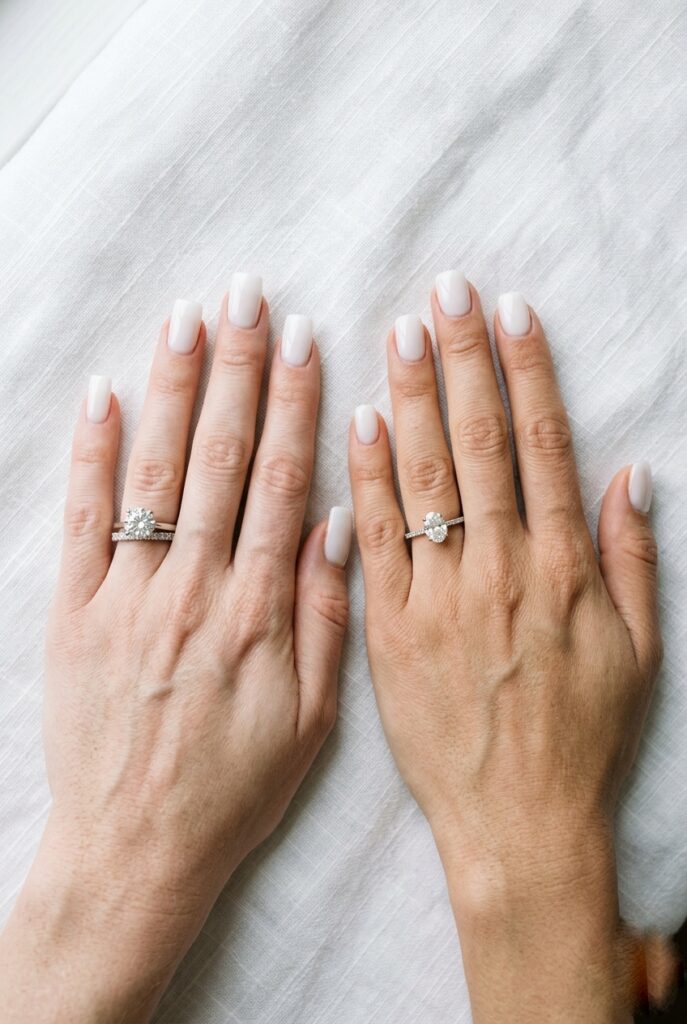
Hard square — perfectly flat tip with 90-degree corners — is precise and graphic, but those corners catch on lace, tulle, chiffon, and your own hair with a consistency that brides only discover once they are fully dressed for the ceremony.
Soft square (squoval) delivers the same flat-tip geometry with corners filed to approximately 80 degrees — it photographs nearly identically to hard square in almost every bridal image and removes the functional liability entirely, which is why the overwhelming majority of nails in square bridal inspiration galleries are actually soft square rather than true hard square — and for a complete breakdown of how shape interacts with every other nail decision, the bridal nail overview covers the full framework before you walk into any salon appointment.
2. The Milky White Square — Most-Photographed Bridal Combination
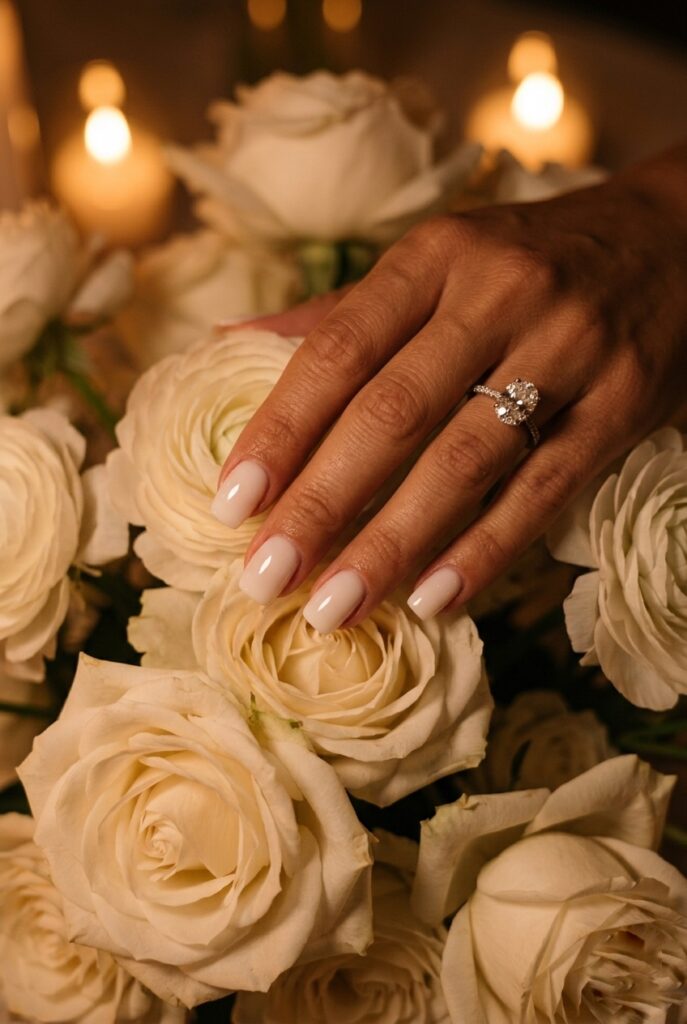
Milky white on a square nail — a sheer slightly opaque white-pink that scatters light across the nail surface rather than reflecting it as a hard point — photographs with a soft glow under flash and reads as luminous skin in candlelit reception images, which is why it consistently dominates bridal nail photography.
The flat tip of a square nail also creates a horizontal visual terminus to the finger that adds balancing width on long narrow hands, but brides with shorter or wider fingers should keep length to 3–4mm past the fingertip so that horizontal line does not visually abbreviate the finger further — the bridal nail ideas gallery shows how this same milky white formula reads across different hand shapes and lengths if you want to compare before deciding on yours.
3. Classic French on Square — The Width That Makes or Breaks It
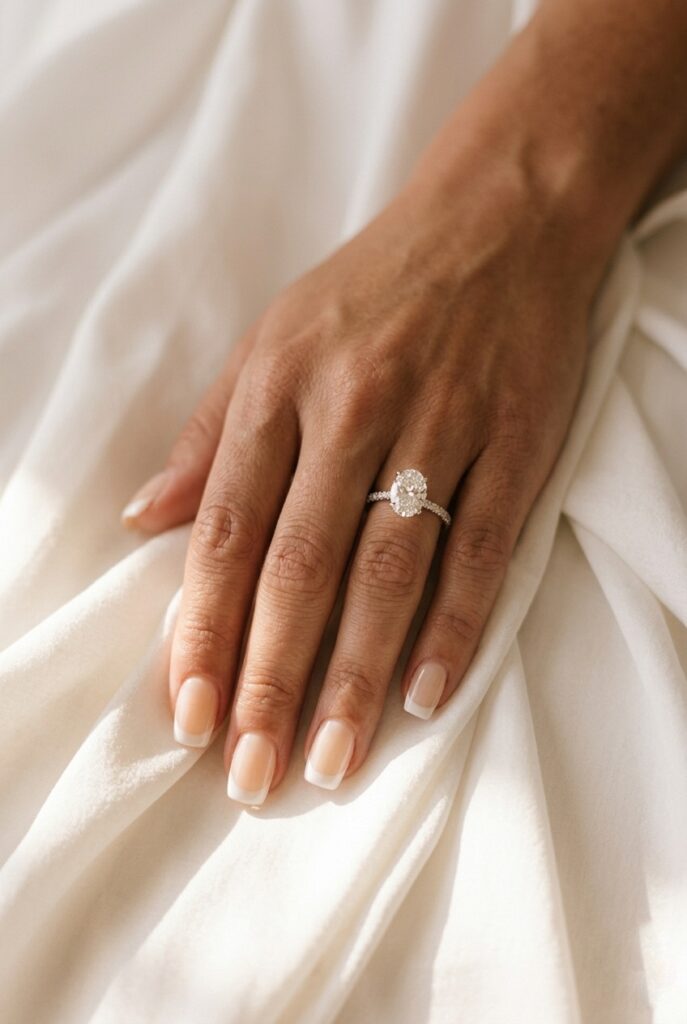
The flat tip of a square nail makes the white French line’s start and end points at the corners completely visible — which means filing asymmetry invisible from arm’s length becomes apparent in ring close-ups, and tip width that looked proportional in the salon reads dated in photographs.
A 1.5–2mm white tip on a champagne or skin-toned sheer base is the version that photographs as timeless; a 3–4mm bright-white tip on a pink base is the version with a strong association to an earlier era — so specify the tip width to your technician by millimeter rather than describing it verbally, and for every variable that determines whether a square French lands as refined or dated, the French bridal nails guide covers tip width by nail shape, champagne versus pink base, and the exact filing symmetry check to run before you leave the salon.
Budget Hack after Idea 3: Buy a set of French tip nail guides (Makartt French Nail Guide Stickers, $6 for 240 guides, Amazon) and bring them to your salon appointment. These adhesive stencils ensure perfectly even tip width across all ten nails — something even skilled technicians can find difficult to maintain perfectly by freehand. Your tech can use them in under five minutes and the result is a measurably more consistent tip line. Many brides don’t know you can bring your own tools; salons are generally happy to use them.
4. Chrome Square — The High-Gloss Version That Earns Its Price
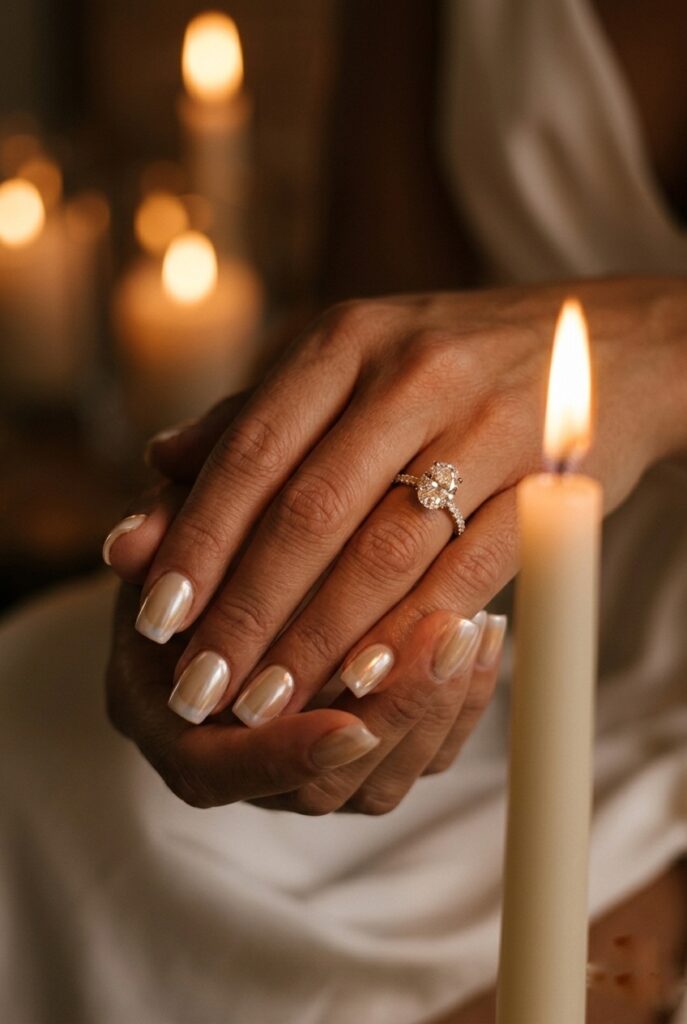
The flat surface area of a square tip is larger than almond or oval at the same length, which gives chrome powder more surface to refract light from — under reception candlelight and string lights, each nail becomes a small warm reflective plane rather than a single point of shine.
The only version worth doing is chrome powder applied after a full gel cure and sealed under a no-wipe top coat — chrome applied incorrectly dulls within hours and shows fingertip smudges by the reception — so before booking, ask your technician specifically whether they seal chrome with a no-wipe top coat, and if the answer is uncertain, treat that as a signal to find someone with a dedicated chrome portfolio alongside the elegant bridal nail options that work best as companions to this finish.
5. Short Square — The Most Underrated Bridal Choice on the Table
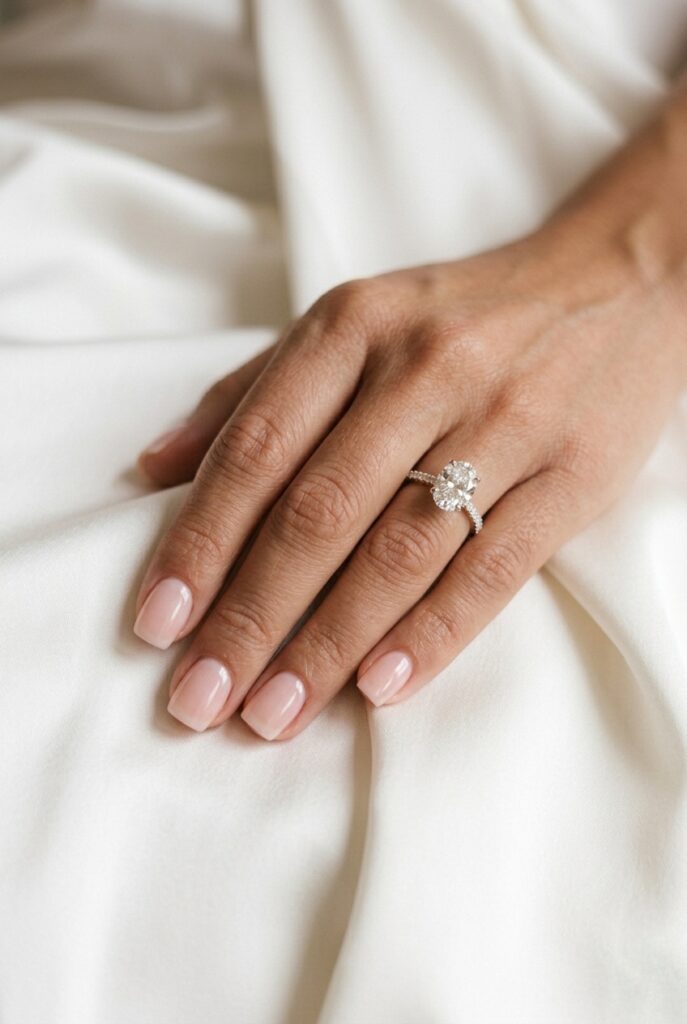
Short square nails — at or just past the natural fingertip with no extension — make the ring the entire visual story: when there is no nail competing for frame space, the stone fills it completely, and there is nothing to catch on the dress, nothing to maintain during a twelve-hour day, and nothing a photographer needs to work around in ring shots.
Skip this if you have naturally wide nail beds on short fingers, where very short square can look blunt rather than precise — in that case, 2–3mm of extension with a soft square shape creates the same clean geometry with slightly more proportion — and the full range of design choices specific to shorter nail lengths is covered in the short bridal nails guide.
Budget Hack after Idea 6: If you’re planning short natural square nails with a simple sheer or milky polish, this is the one bridal nail look that can be done affordably at a nail school rather than a full salon. Licensed cosmetology school clinics in most US cities charge $15–$30 for a gel manicure — often one-third the salon price — and work under licensed instructor supervision. Call ahead to ask about gel polish availability and experience level of the students. The trade-off is time (appointments run longer) and consistency (ask for a senior student or instructor-supervised session). For a clean monochrome short square, this is a legitimate option.
6. Pearl Detail on Square — One Bead, Maximum Effect
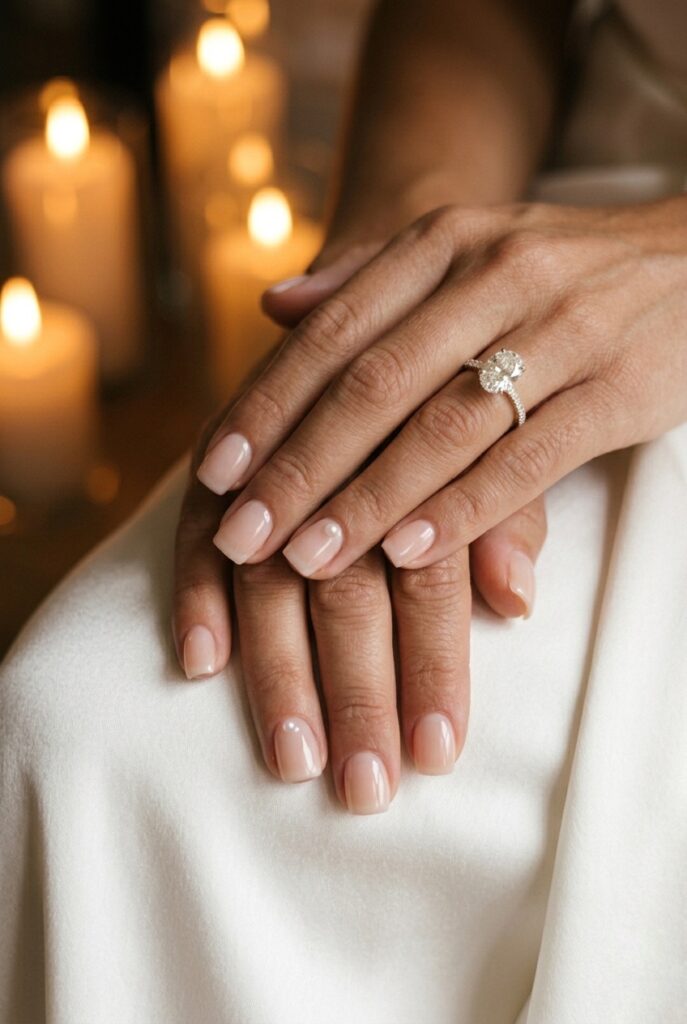
A single SS5 or SS6 pearl bead at the base of the ring finger nail on both hands creates a composed detail at the cuticle end of the finger while the ring anchors the far end — the flat geometry of a square nail gives the bead room to breathe in a way a curved nail shape cannot quite replicate.
The bead must be fully encapsulated within the gel top coat — not just adhered on the surface — because the flat corner of a square nail catching on lace or chiffon acts as a hook that will pull any raised embellishment away within hours of a wedding day, so ask your technician to confirm the bead is flush and sealed before you leave the salon, and for the full range of embellishment techniques that hold up under physical event-day stress, the bridal nail art guide covers encapsulation, sealing, and application methods worth verifying before you book.
7. Negative Space French on Square — The Architectural Move Most Brides Miss
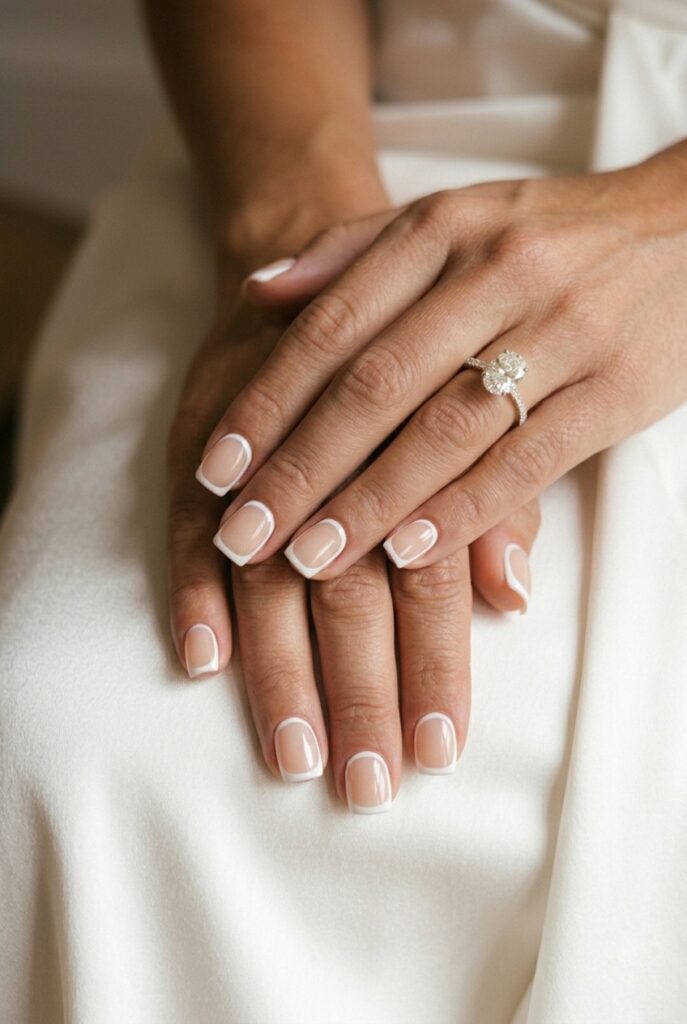
The negative space French — where only the outline of the tip is painted rather than a solid filled white line — is the square nail’s most architecturally distinctive option and is almost entirely absent from bridal nail content despite being one of the most photograph-forward designs available on this shape.
Because there is no solid color block to grow away from the tip line, slight growth reads as intentional negative space rather than as a French that needs a fill — which gives it meaningful functional longevity beyond most bridal nail designs — and for the full range of nail art techniques that require this level of freehand precision, the bridal nail art designs gallery shows what to look for in a technician portfolio before you book this specific look.
8. Tapered Square — The Elongating Compromise Nobody Names Properly
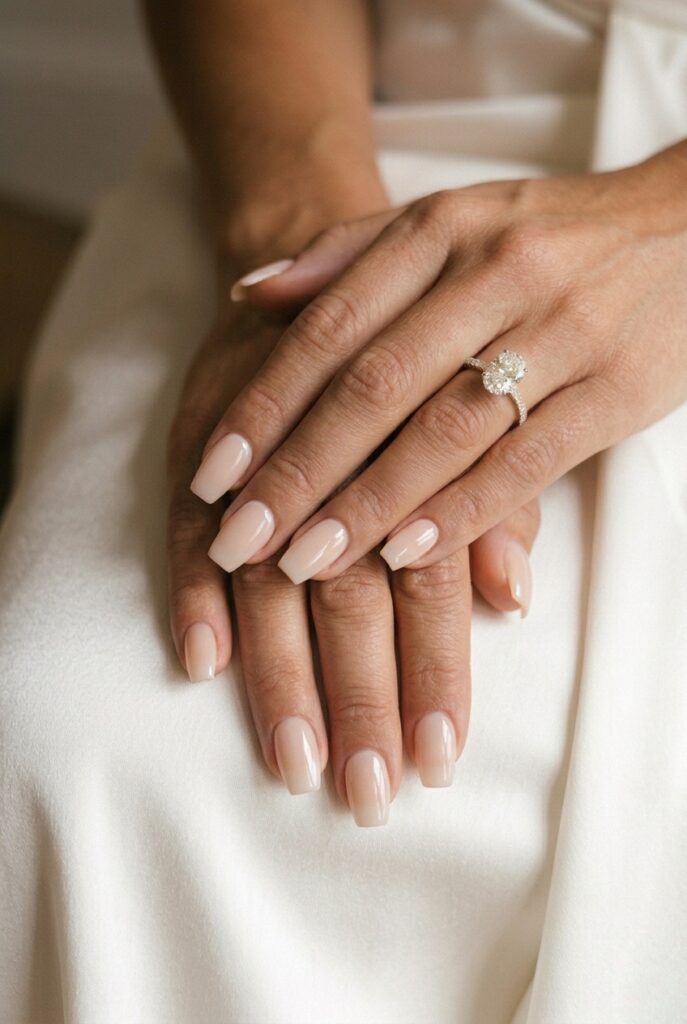
A tapered square — slightly wider at the cuticle, narrowing toward a flat tip — solves the finger-width problem that standard square creates without abandoning the square geometry, because the taper creates a visual elongation through the nail body while the flat tip maintains the signature square terminus.
For brides who want square nails but have shorter or wider fingers where a parallel-sided square visually abbreviates, this is the shape that delivers the aesthetic without the proportional trade-off — and it holds a French tip particularly well because the narrowing toward the tip makes the white line appear proportionally thinner at the corners automatically, without any change to tip width specification.
Budget Hack after Idea 9: For brides doing gel nails, ask your technician to apply two thin coats of Seche Vite Fast-Dry Top Coat ($10, Sally Beauty or Amazon) over your gel seal coat on your wedding day as a final protective layer. Unlike regular top coat, Seche Vite bonds to the gel surface and adds a measurable impact-resistant layer that reduces tip chipping significantly during the physical stress of a wedding day. Many salon technicians don’t mention it because it adds a product cost, but you can bring your own and ask for the application to take under three minutes.
9. White Tip With a Colored Base — The Two-Part French
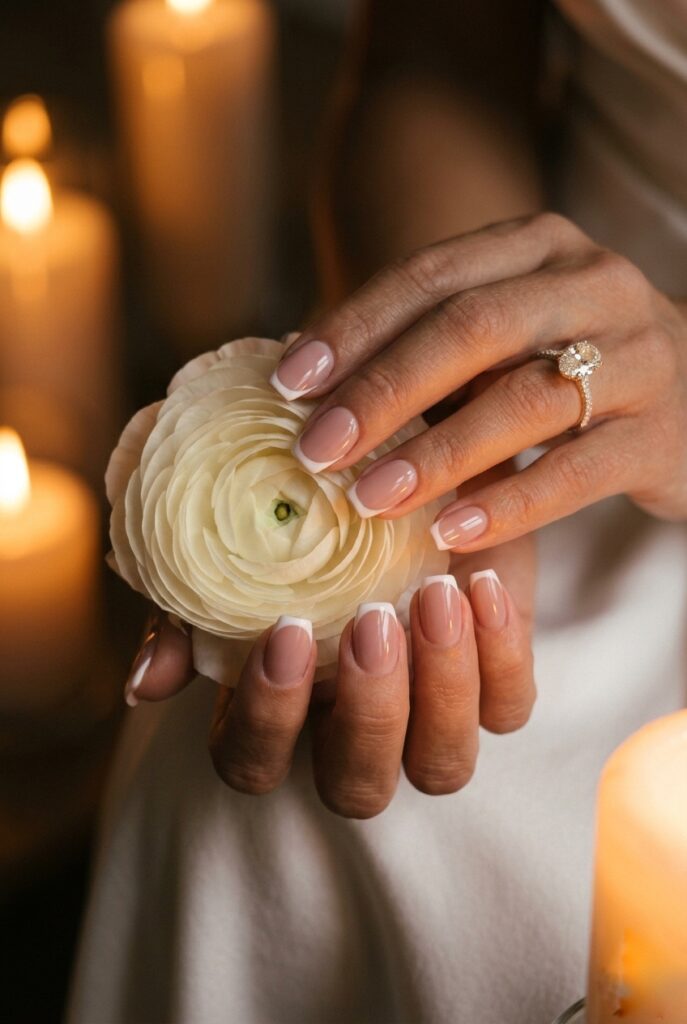
A softly pigmented blush, dusty rose, or sage base beneath a white French tip on a square nail reads as a two-part design decision rather than a default French — and on a square nail specifically, the flat tip means the white line sits as a deliberate horizontal edge over a visible wash of color that photographs as intentional and considered from every angle.
Keep the base within two shades of your natural skin tone — not in the sense of matching your wedding palette but in the sense that the base should remain skin-adjacent, because a base that departs too far from your actual hand color turns a bridal nail into a summer nail, and choosing the right base shade starts with your undertone, which the bridal nails by skin tone guide maps across every complexion from cool-fair to deep.
10. The Barely-There Square — All the Geometry, None of the Drama

A sheer barely-tinted gel with a mirror-level top coat on a clean soft square shape — no tip, no art, no embellishment — is the version that makes every ring photograph look editorial: the square shape gives the finger a precise polished termination point, the gloss provides photography quality, and the sheer tint adds just enough warmth to read as a manicure rather than bare skin.
This is the look photographers quietly prefer in ring shots because there is nothing to pull focus from the stone, and it is also the most naturally wearable of all ten options across a fourteen-hour wedding day — and for the full range of understated nail philosophies that operate on this same principle, the simple bridal nails guide covers every low-maintenance finish worth considering alongside this one.
Your square nail is only as good as the filing symmetry, the corner angle, and the length relative to your actual hand geometry — those three variables determine whether the result reads as designed or accidental.
Once your shape and design are confirmed, the elegant wedding decor ideas guide applies the same principle of intentional precision to the room around you, and for the full picture of how your nail decision fits within your complete wedding day look, the ultimate bridal look guide covers every visual element from hair and makeup through to your hands.