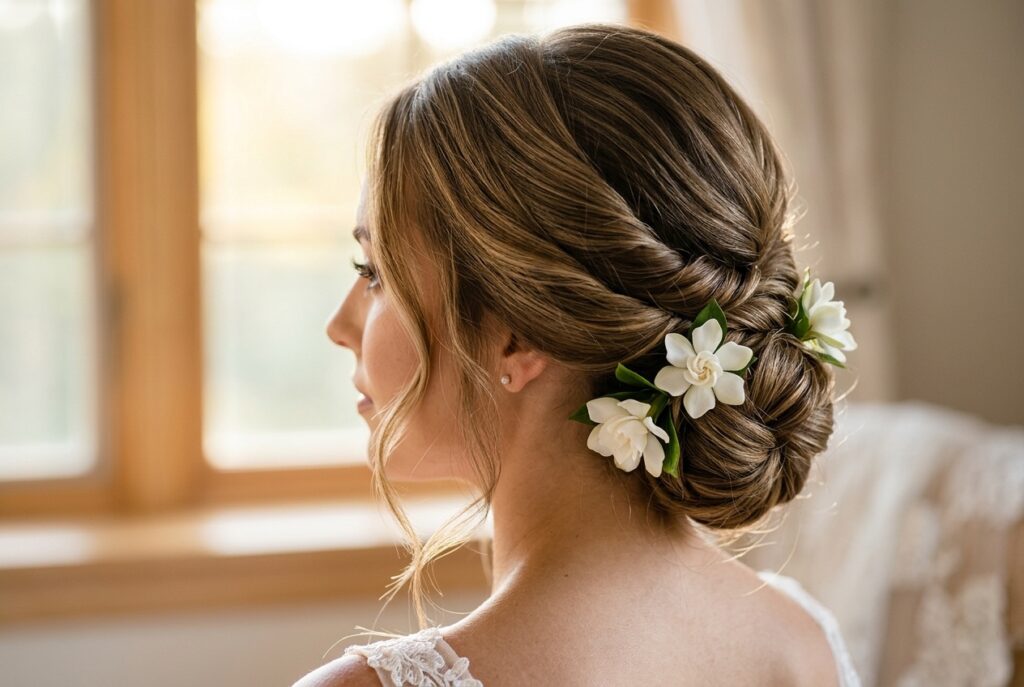
12 Bridal Nail Ideas Worth Stealing — Organized by the Bride You Actually Are!


HERO IMAGE / FEATURED IMAGE Alt text: Close-up of a bride's hand with an almond-shaped pearl chrome manicure resting on ivory silk wedding dress fabric, engagement ring catching the light Image prompt: Photorealistic close-up of a bride's hand with a soft pearl chrome opalescent manicure on medium-length almond-shaped nails, resting gently on draped ivory silk wedding dress fabric, a delicate oval diamond solitaire engagement ring visible on the ring finger, soft warm natural window light from the left side, shallow depth of field, editorial wedding photography aesthetic, no text overlays. Generate in horizontal landscape orientation, 3:2 aspect ratio, optimized for desktop display.

You picked your dress in a fitting room, probably over three months. You spent hours on florals.

Your nails get a 20-minute scroll at 11pm and a salon appointment booked too late.

That mismatch shows — and it shows specifically in the ring shots, the bouquet holds, and every detail photo where your hands are front and center.

Here’s the actual thought process for getting it right: organized not by trend name but by the kind of bride you are.

What follows is the guide I wish existed when I started watching hands get photographed at two hundred weddings.


The florist wound ribbon around the stems at 6am, her fingers smelling of ranunculus and cold water. The bride held the bouquet for the first time and her nails caught the window — a pale shell, an oyster light, nothing competing, nothing trying. The photographer said: that’s the one. Nobody had asked for that.


The Short Answer

Bridal nails fail when they’re chosen in isolation — a trend screenshot, a color swatch, a single beautiful photo with no context for where that photo was taken or on which hands.

The nail that works is the one chosen in relation to three things: your ring’s profile, your dress’s texture, and your venue’s lighting. Build outward from those three anchors and you won’t go wrong.


1. The No-Mani Mani: Sheer Tinted Nude for the Bride Who Wants Her Ring to Win
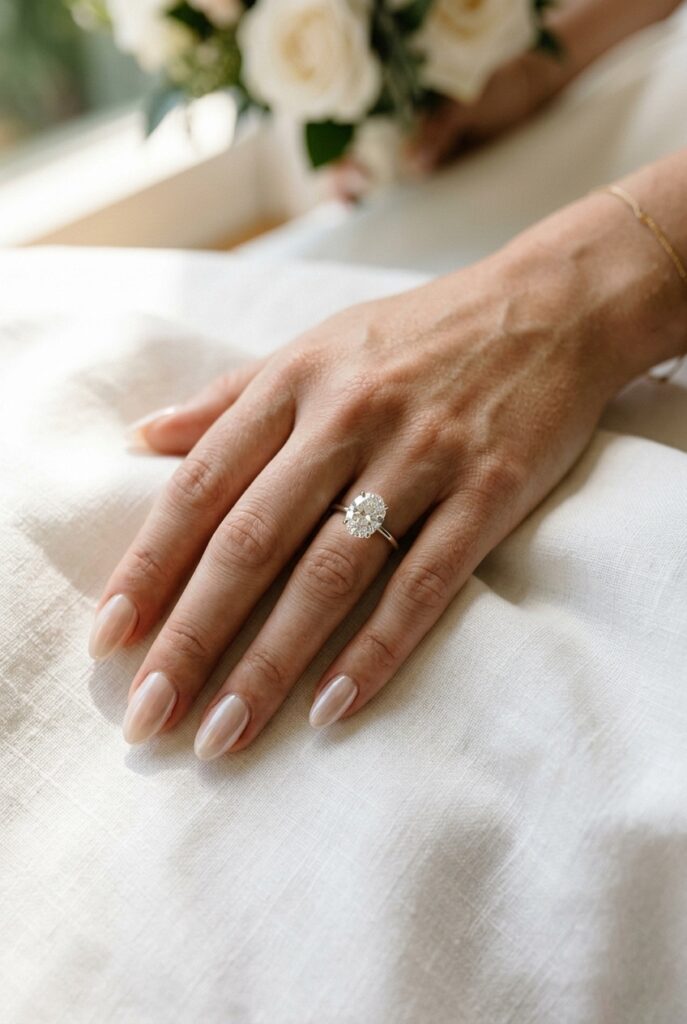
If the ring is the point, then the nail’s job is to disappear gracefully.

A sheer tinted nude — something with a whisper of pink or peach but not fully opaque — gives the hand a finished, polished look while drawing zero attention to itself.

OPI’s Bubble Bath ($11 on Amazon) is the standard bearer here, and it has been for a reason for decades. 

Only do this if your ring has genuine presence on its own: a large center stone, a high pavé band, a distinctive setting.

If your ring is dainty or minimalist, a sheer nude makes the whole hand disappear in photos. Go one half-step stronger — a soft opaque blush — to ensure both ring and nail register at the same time.

The cheap version of this look is a fully transparent clear coat over unprepared nails.

Without a tinted base, you get an unfinished appearance that reads as “didn’t book in time” rather than “intentionally minimal.”

The difference between sheer-tinted and bare-nailed is significant in photography.

Price range: $10–$55. OPI and Essie at Target, Amazon, or ULTA.


2. Milky White: The Off-Duty Model of Bridal Nails

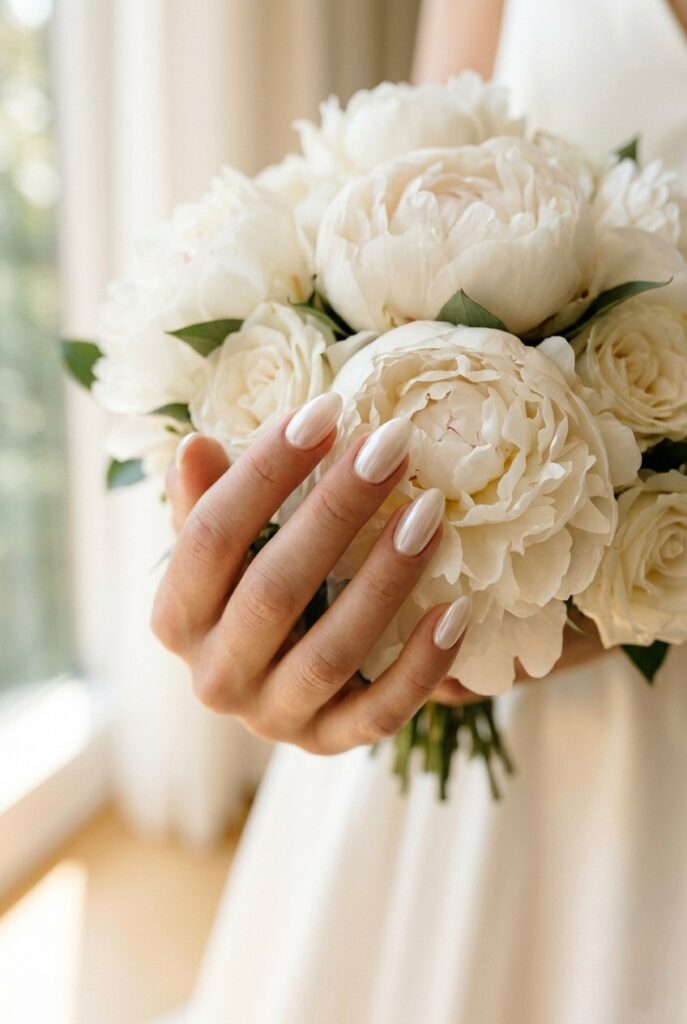
IMAGE 2 HERE Alt text: Bridal almond nails with milky white opaque glossy manicure held against a white peony bouquet Image prompt: Photorealistic close-up of a bride's hand with a milky opaque white glossy gel manicure on medium-length almond-shaped nails, fingers wrapped lightly around a full white peony bouquet with soft ivory and cream petals, soft warm natural window light, dreamy editorial bridal photography, no jewelry shown, no text overlays. Generate in vertical portrait orientation, 2:3 aspect ratio, optimized for mobile display.

Milky white is not regular white. Regular white is stark, salon-bright, and competes with everything.

Milky white has translucency built in — a soft, almost cloudy opacity that reads warm rather than clinical.

Against white florals and ivory gowns it creates a continuous softness; against a bold gemstone ring it recedes perfectly.

Build it with two coats of a white jelly gel or a BIAB milky base (The GelBottle’s BIAB in 19 BIAB is the exact shade, around $18 at thegelbottle.com).

Top with a glass-finish top coat and you get a luminous, three-dimensional look that cannot be replicated with opaque polish.

This is the design that photographs consistently well regardless of venue or lighting — it’s reliable in a way that more complex designs aren’t.

Price range: $18–$70. The GelBottle at thegelbottle.com; professional BIAB application at nail studios.


3. Pearl Chrome: The Upgrade That Justifies Itself in Every Photo
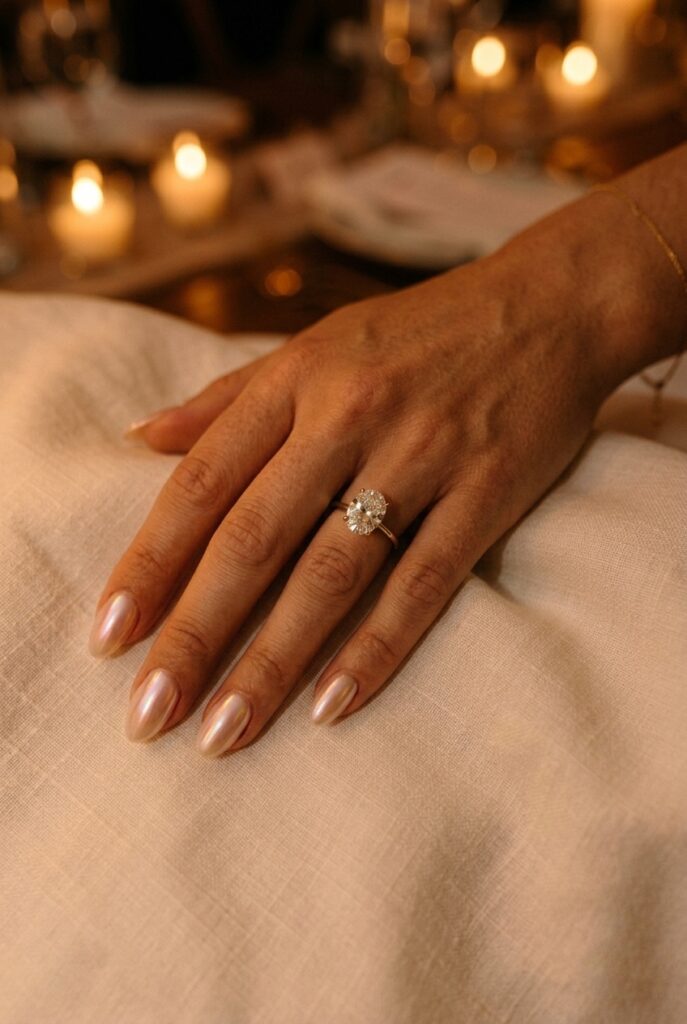
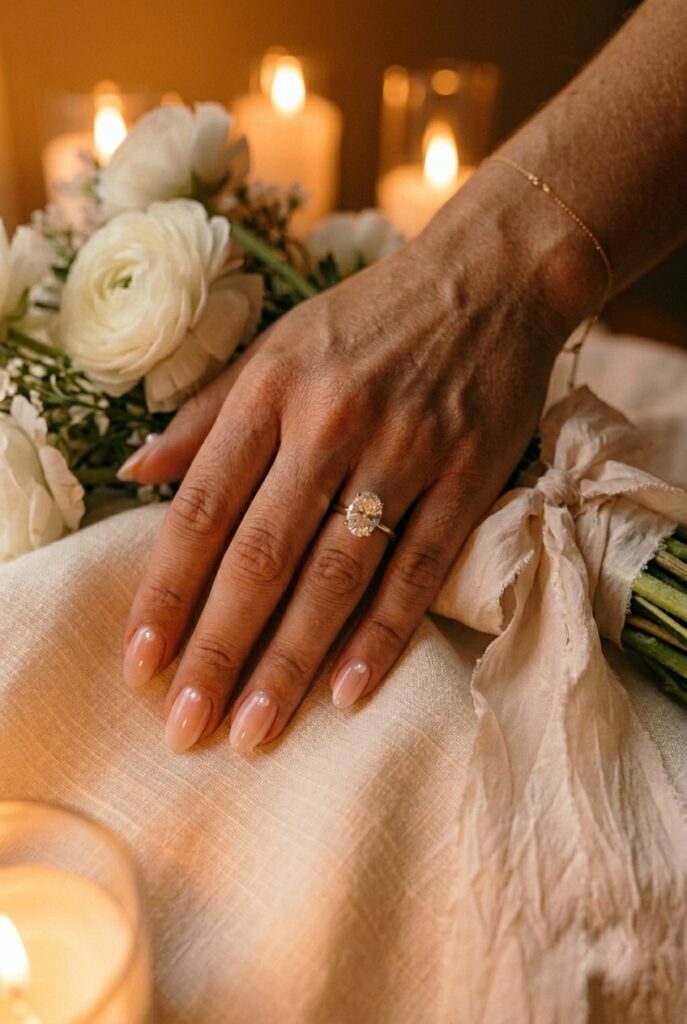
IMAGE 3 HERE Alt text: Bride's oval nails with soft pearl opalescent chrome finish shifting color in warm reception light Image prompt: Photorealistic close-up of a bride's hand with a pearl opalescent chrome manicure on oval nails, the chrome powder creating a soft iridescent pink-white shift, hand resting against cream satin fabric, warm amber candlelit atmosphere, the chrome surface catching multiple color tones simultaneously, editorial wedding photography style, no text overlays. Generate in vertical portrait orientation, 2:3 aspect ratio, optimized for mobile display.

Pearl chrome is the finish that looks different in every photo, which is what makes it so compelling for a wedding day with varied lighting.

Under morning window light it reads as soft silver-pink.

Under candlelight at the reception it shifts toward ivory and amber.

In flash photography it catches cleanly without blowing out. This is not a trend — it’s a finish with a specific optical property that happens to work extraordinarily well in the conditions of a wedding day.

Apply chrome powder over a sheer white or milky base gel ($12–$18 chrome powder on Amazon; professional application $65–$90 at nail studios). 

Skip this if your gown fabric is also iridescent or your dress has heavy metallic beading — two opalescent surfaces in the same frame create visual competition rather than harmony.

For receptions with elegant candlelit indoor settings, pearl chrome is one of the most photographically rewarding choices available.

Price range: $12–$90. Chrome powder kits on Amazon; professional salon application at nail studios.


💡 Budget Hack after Idea 3: Pearl chrome at a salon runs $65–$90 for the gel-plus-chrome service. The alternative: buy a chrome powder kit from Amazon ($12–$18, brands like Beetles or Born Pretty), bring it to your regular gel appointment, and ask your nail tech to apply it after the gel cures. Most techs are happy to use a client-supplied product and will charge labor only — keeping the total under $45. The final result is indistinguishable from a premium salon chrome application.


4. Micro French Tip: The Classic, Done Correctly for the First Time

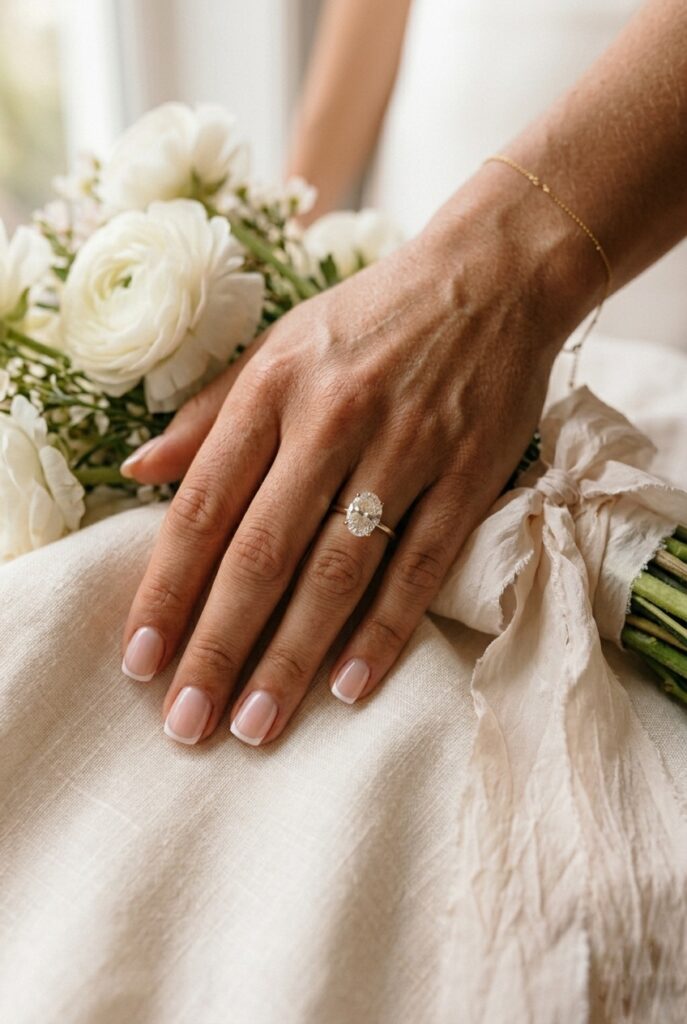
IMAGE 4 HERE Alt text: Close-up of squoval nails with a hairline micro French white tip on a soft pink base, ring and bouquet ribbon detail visible Image prompt: Photorealistic close-up of a bride's hand with a micro French tip manicure — a very thin, hairline white tip on short squoval nails over a soft sheer pink base — hand resting near a ribbon-tied bridal bouquet with white ranunculus, soft natural window light, crisp nail detail sharp in foreground, editorial bridal close-up, no text overlays. Generate in vertical portrait orientation, 2:3 aspect ratio, optimized for mobile display.

The thick white band of a traditional French tip has been replaced by something far more refined: a hairline tip, 1–2mm wide at most, that you almost don’t see until you look closely.

On short to medium nails this is a genuinely sophisticated choice.

On long nails it gets lost — scale it up proportionally or skip it.

The other critical update: the base should be a warm sheer pink, not the old-school clear base coat.
The warm blush base adds depth to the nail bed and stops the tip from reading as isolated white lines floating above nothing.

Essie’s Mademoiselle under a hand-painted white tip hits exactly the right balance.

Avoid the version where a nail tech uses a French tip guide sticker — those create a mechanical straight line that looks stamped rather than placed.

This matters in macro photographs.

Price range: $35–$65 salon application. Essie at Target ($9); custom painted tip adds $10–$20 to a standard gel appointment.


5. Soft Ombré: The Design That Actually Photographs Better Than It Looks in Person

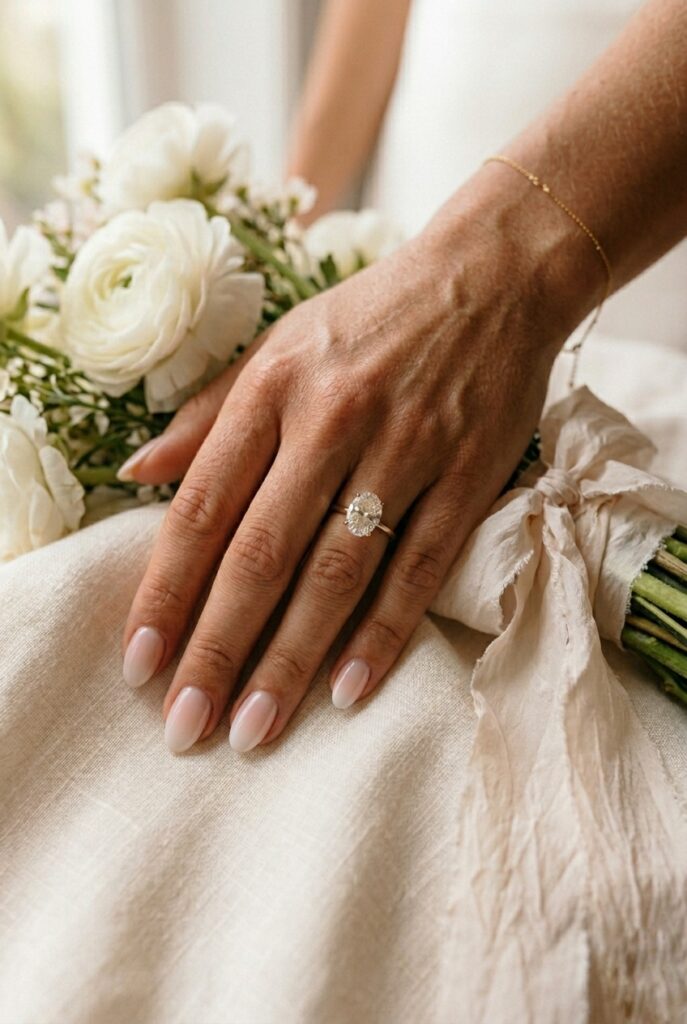
IMAGE 5 HERE Alt text: Bride's almond nails with a soft blush-to-white ombré gradient gel manicure, hand held over linen table runner Image prompt: Photorealistic close-up of a bride's hand with a soft blush-to-white gradient ombré gel manicure on almond-shaped nails, the gradient transitioning from barely-there blush at the base to milky white at the tip, hand resting on an ivory linen table runner, soft natural diffused window light, no harsh shadows, editorial wedding photography, no text overlays. Generate in vertical portrait orientation, 2:3 aspect ratio, optimized for mobile display.

Ombré is one of those designs where the camera does it more justice than the naked eye.

In-person a soft blush-to-white fade looks gentle and understated. In photographs, especially with macro or close-up lenses, the gradient reads with incredible depth and three-dimensionality.

The failure mode is when the gradient is too abrupt — a visible seam rather than a true fade, usually from a rushed application or a tech who doesn’t blend thoroughly.

Ask specifically for a sponge-blended ombré rather than a dip-blended one; sponge creates the softer transition that photographs cleanly.

This design suits brides who want something more visual than a solid color but aren’t ready to commit to nail art. For brides planning a garden wedding with soft floral arrangements, ombré nails tie in naturally to the diffused, blended aesthetic of that environment.

Price range: $45–$75 for professional gel ombré. Ask for sponge-blend technique specifically.


6. Delicate Pearl Accents: The Single Detail That Elevates Without Overwhelming

IMAGE 6 HERE Alt text: Bridal gel manicure with a single tiny flat pearl placed at the cuticle of each oval nail, warm candlelight setting Image prompt: Photorealistic close-up of a bride's hand with a sheer pink gel manicure on oval nails, a single small flat pearl accent placed at the base of each nail near the cuticle, hand photographed against cream silk fabric, warm amber candlelit atmosphere, the pearls catching the light softly, editorial bridal photography, no text overlays. Generate in vertical portrait orientation, 2:3 aspect ratio, optimized for mobile display.

One pearl per nail, placed at the cuticle. That’s the whole move. It transforms a standard pink or nude gel into something deliberately bridal without tipping into costume territory.

The key is flat nano-pearls, not dome pearls — raised dome pearls catch on fabric, snag veils, and fall off within days.

Flat nano-pearls sit flush against the nail surface and stay put through the entire wedding and honeymoon.

Nail Charm flat pearls on Amazon ($8–$12 for a set of 100) applied over cured gel with a dab of gel and sealed under top coat last three to four weeks without a single loss. 

Only do this if you’re wearing pearl earrings or a pearl hair piece — the cohesion between nail and jewelry detail is what makes this look intentional.

If your jewelry runs entirely modern or diamond-only, skip the pearls and choose chrome instead.

Price range: $8–$12 for DIY pearl kit (Amazon); $55–$80 for professional pearl gel application.


💡 Budget Hack after Idea 6: Apply pearl accents yourself at home the morning before your wedding, not at the salon. A gel tech applying individual pearls in a salon charges $20–$35 for the add-on. With a flat nano-pearl kit from Amazon ($8), a UV nail lamp ($15 on Amazon), and 10 minutes, you can apply and cure them yourself over an existing gel manicure without disturbing the underlying color. Doing this the day before gives them 24 hours to fully bond — they’ll survive a bouquet grip and every handshake on the wedding day.


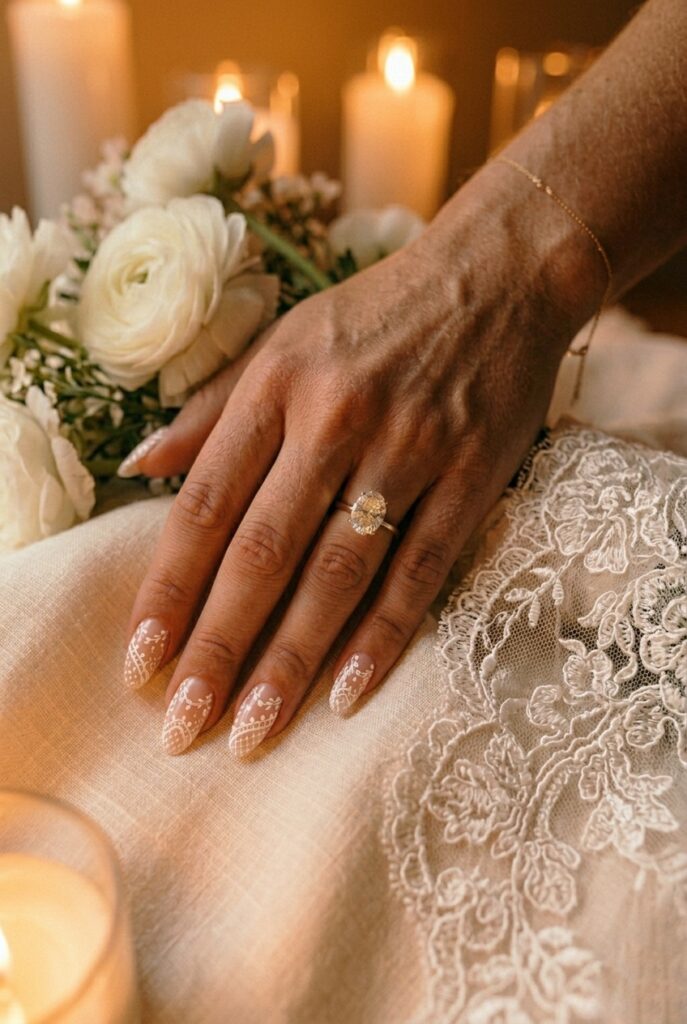
7. Lace Nail Art: Romantic and Venue-Specific — Know Before You Commit


IMAGE 7 HERE Alt text: Bride's long oval nails with delicate hand-painted white lace nail art design over a sheer pink base, held near lace wedding dress fabric Image prompt: Photorealistic close-up of a bride's hand with delicate white lace pattern nail art hand-painted over a sheer pink gel base on long oval nails, the lace design featuring fine dotwork and floral vine details, hand held near ivory lace wedding dress fabric that echoes the nail design, soft natural window light, editorial bridal close-up photography, no text overlays. Generate in vertical portrait orientation, 2:3 aspect ratio, optimized for mobile display.

[GAP IDEA 1 — Competitor Gap] Lace nail art only works when it directly mirrors something in your wedding.

If your dress has lace, your veil has lace, or your venue has genuine vintage architecture, lace nails read as cohesive and intentional.

On a bride in a clean modern satin column gown at a minimalist hotel venue, lace nails read as mismatched — like wearing a country blouse with a couture skirt.

Competitors list lace as a universal suggestion; it’s not. It’s a context-specific design that requires a visual through-line to justify its complexity.

The designs themselves are produced by specialty nail artists using ultra-fine detailing brushes — not available at every salon.

Use The Knot’s beauty vendor marketplace to find nail artists who specifically advertise bridal nail art, not just gel manicures. Expect $90–$150 for a lace art set.

Price range: $90–$150. Requires a specialist nail artist; verify their portfolio before booking.


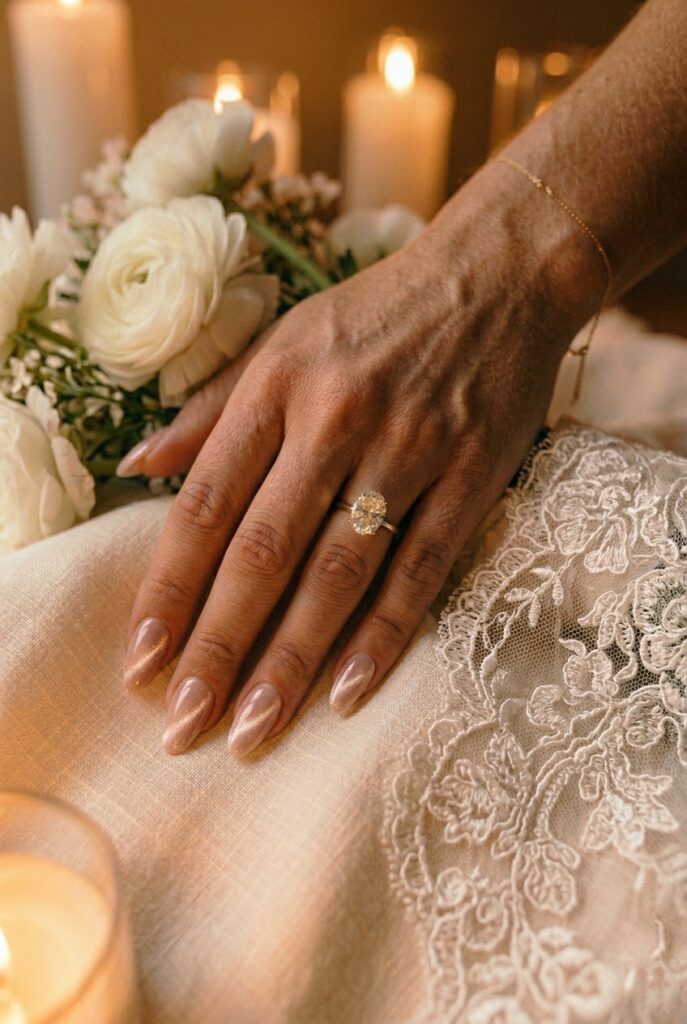
8. Velvet Cat Eye in Champagne or Blush: The Design That Signals You Know Nail Culture

IMAGE 8 HERE Alt text: Bride's almond nails with a blush velvet cat eye gel manicure showing a magnetic stripe effect in warm light Image prompt: Photorealistic close-up of a bride's hand with a blush-champagne velvet magnetic cat eye gel manicure on almond nails, the magnetic gel creating a soft diagonal shimmer stripe across each nail, hand resting against cream-colored satin fabric, warm natural window light picking up the magnetic effect, editorial bridal photography, no text overlays. Generate in vertical portrait orientation, 2:3 aspect ratio, optimized for mobile display.

Cat eye gel uses a magnetic polish and a magnet wand to pull iron particles into a visual stripe across the nail — the resulting effect is soft, dimensional, and shifts as the hand moves.

Bridal cat eye avoids the traditional dark cat eye (black, navy, deep emerald) in favor of champagne, blush, or ivory tones that give the same optical interest without departing from a bridal palette.

This is the nail design that signals a bride who is deeply tuned into nail culture without shouting it.

The wrong version: cat eye applied over too-dark a base, or with a stripe that’s too sharp and high-contrast — these read as evening nails, not ceremony nails.

Stick to ultra-soft tones and a subtler, wider stripe. The right products are from brands like LV GEL or Modelones ($14–$18 cat eye gel kits on Amazon). For unique wedding aesthetics that already lean slightly editorial, champagne cat eye is the exact right amount of unexpected.

Price range: $14–$18 DIY kit (Amazon); $55–$85 professional application.


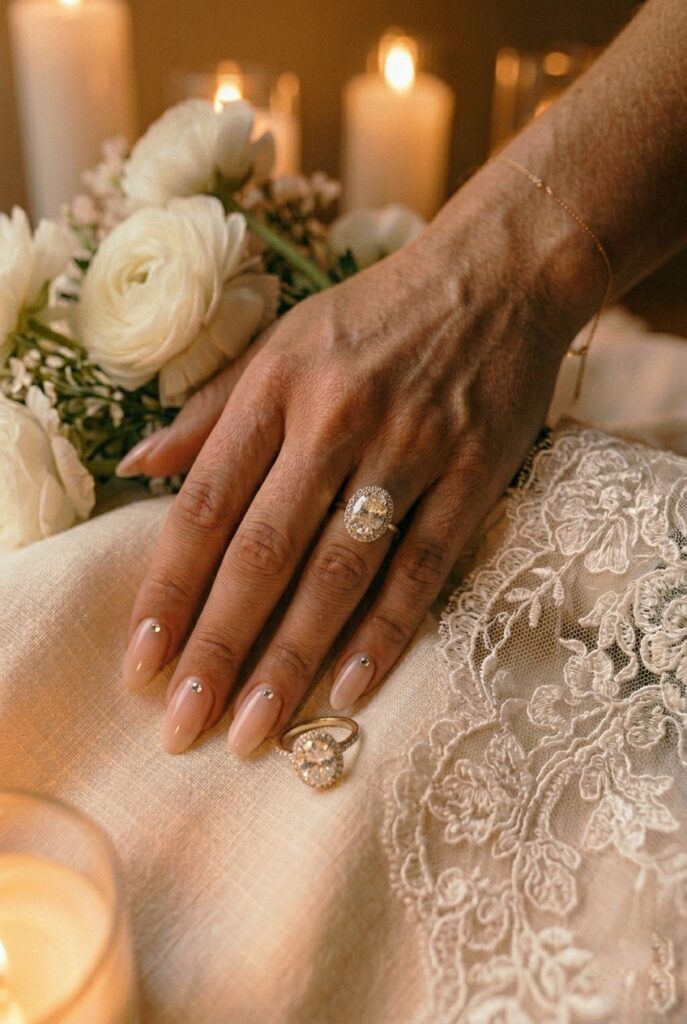
9. Rhinestone Accents: The Line Between Bridal and Costume Is Exactly Two Crystals

IMAGE 9 HERE Alt text: Bride's nails with minimal rhinestone accent — one crystal at each nail base — over a blush base gel, hand near wedding ring Image prompt: Photorealistic close-up of a bride's hand with a sheer blush gel manicure on oval nails with exactly one small clear AB rhinestone placed at the base cuticle area of each nail, hand resting near an oval-cut halo engagement ring, warm candlelit atmosphere with amber light making the crystal and ring stone glitter simultaneously, editorial bridal photography, no text overlays. Generate in vertical portrait orientation, 2:3 aspect ratio, optimized for mobile display.

One crystal per nail, clear AB stone, placed at the base — that’s the bridal version.

Four crystals clustered on the accent nail with smaller stones scattered on the remaining fingers — that’s the party version.

Brides consistently over-stone their nails and the result reads as too costume-y in formal wedding photography, especially when photographed beside a serious ring.

A single 3mm Swarovski AB flat-back crystal per nail (available at Amazon, $8–$12 for a pack of 100) creates captured light at the right scale.

The stones catch flash photography beautifully without drawing the eye away from the ring. 

Skip this entirely if your gown has heavy beading or crystal embellishment — crystal-on-crystal-on-ring is sensory overload in a photo that should read as composed.

Price range: $8–$12 DIY crystals (Amazon); $60–$90 professional crystal gel application.


💡 Budget Hack after Idea 9: Swarovski flat-back crystals from a craft supplier cost 60–80% less than the same stones added at a nail salon. Michael’s and Hobby Lobby both carry them in the craft jewelry section — a bag of 100 clear AB 3mm flat-backs runs $6–$10. Bring them to your gel appointment in a small zip bag and ask the tech to apply them while the gel is still tacky before curing. Application with no sourcing charge saves $15–$25 off the standard salon rhinestone add-on fee.


10. Bold Floral Nail Art: Earn It First
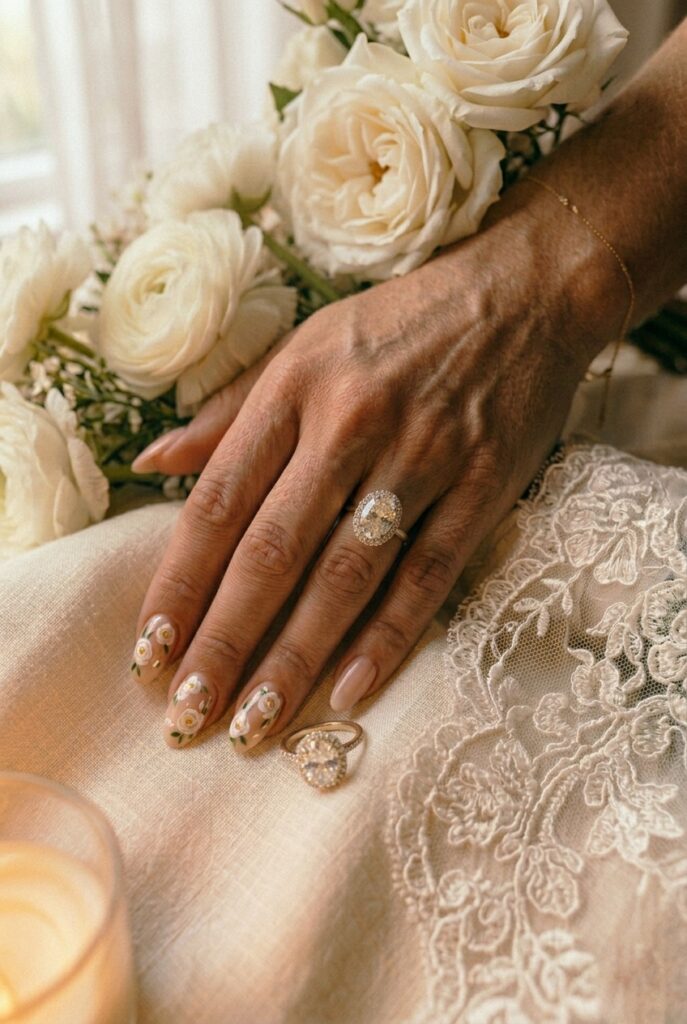
IMAGE 10 HERE Alt text: Bride's nails with hand-painted miniature white rose and green leaf nail art on a nude gel base, close-up detail shot Image prompt: Photorealistic close-up of a bride's hand with delicate hand-painted floral nail art on a sheer nude gel base — tiny white roses with soft yellow centers and small green leaves on three nails, remaining nails solid nude — on medium-length almond nails, hand positioned near a white garden rose bouquet with matching flowers visible, soft natural window light, editorial bridal photography, no text overlays. Generate in vertical portrait orientation, 2:3 aspect ratio, optimized for mobile display.

Floral nail art earns its complexity when it directly references a real flower in your bouquet.

White roses on the nail beside white roses in the hand — that’s a cohesive composition that photographers actively seek out for detail shots.

Peonies, ranunculus, garden roses, eucalyptus — all translate well to miniature hand-painting.

What fails: generic painted flowers that don’t reference anything specific, or overly detailed florals where the execution is slightly imperfect (visible under macro photography).

This design requires a nail artist with a strong portfolio in botanical nail art — use Zola’s beauty planning guide to find vetted vendors who specialize in bridal nail art in your area. Budget $100–$180 for the right artist.

Price range: $100–$180. Specialist artist required — verify botanical nail art portfolio specifically.


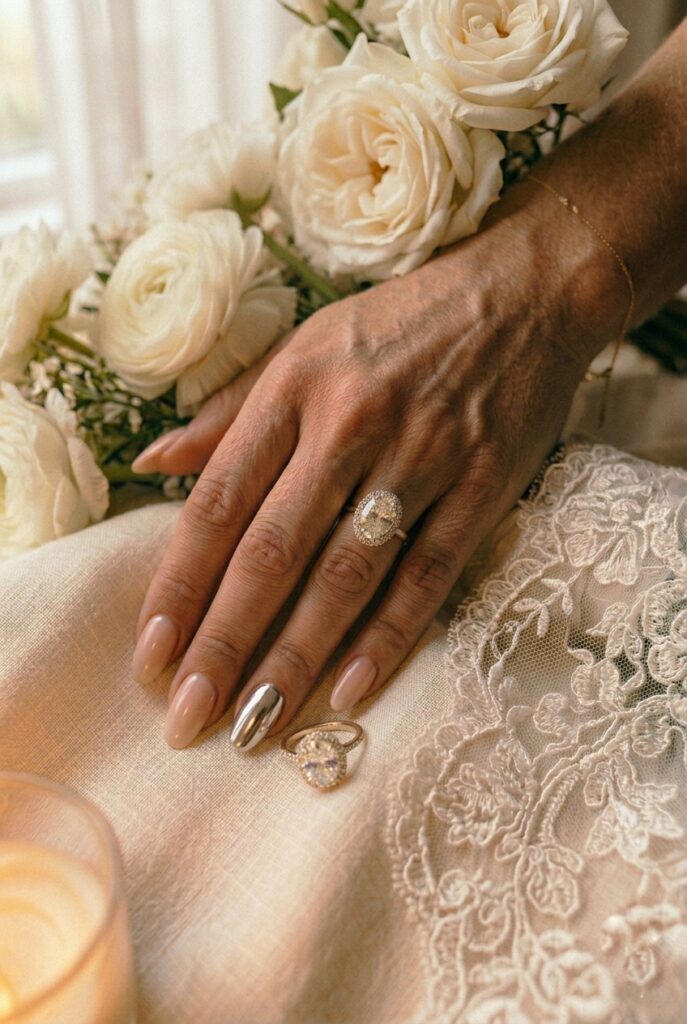
11. Single Accent Nail in Chrome: The Restraint Move That Actually Works

IMAGE 11 HERE Alt text: Bride's hand with four nude gel nails and one accent nail in mirror chrome on the ring finger, close-up with engagement ring Image prompt: Photorealistic close-up of a bride's hand with four sheer blush gel nails on four fingers and a mirror silver chrome accent nail on the ring finger, the chrome nail directly beside the diamond engagement ring creating a matching metallic moment, hand resting on ivory silk, soft natural window light, editorial wedding photography close-up, no text overlays. Generate in vertical portrait orientation, 2:3 aspect ratio, optimized for mobile display.

Nobody in the top ten results discusses the accent nail specifically as a compositional tool for the ring shot.

A single chrome accent nail on the ring finger — in a tone that directly mirrors your ring’s metal setting — creates a deliberate visual echo in ring photography.

Silver chrome beside a platinum or white gold setting; champagne or gold chrome beside a yellow gold band.

The remaining four nails in a clean nude or sheer blush keep the composition grounded.

This is a designer’s move: choosing one element for contrast and letting everything else recede.

It requires no elaborate skill from a nail tech — it’s a standard gel plus chrome application on a single nail, which most salons can execute for $45–$65.

For a bride who wants something interesting without the risk of a fully designed set, this is the most calculated option available.

Price range: $45–$65 for gel-plus-chrome accent nail at a standard salon.


12. Deep Tonal Nails for the Non-Traditional Bride: Berry, Oxblood, and Midnight Plum

IMAGE 12 HERE Alt text: Bride with deep burgundy gel manicure on almond nails holding a dark moody bouquet of burgundy ranunculus and eucalyptus Image prompt: Photorealistic close-up of a bride's hand with a deep burgundy gel manicure on medium-length almond nails, hand wrapped around a dramatic dark bouquet featuring burgundy ranunculus, dark plum anemones, and trailing eucalyptus, warm candlelit atmosphere with amber light from the right, the deep nail color and dark florals creating a rich moody composition, editorial bridal photography, no text overlays. Generate in vertical portrait orientation, 2:3 aspect ratio, optimized for mobile display.

The idea that bridal nails must be pale or neutral is a convention, not a rule — and it’s a convention that suits approximately one type of wedding.

For a bride planning a moody autumnal ceremony, a black-tie evening reception, or a vintage-aesthetic celebration with deep jewel tones, a deep berry or oxblood nail is compositionally correct in a way that a sheer pink isn’t.

The color should be chosen from the same family as the bouquet or the bridesmaid dresses — it needs a visual companion in the frame to read as intentional rather than contrary.

OPI’s Malaga Wine or Essie’s Bordeaux ($9–$11 at Target) are the starting polishes. In gel, any specialist salon can match the tone. 

Only do this if your broader wedding aesthetic supports it — this nail on a pastel garden wedding looks like a mismatch, not a statement.

Price range: $9–$65. Essie and OPI at Target or Amazon; gel application at professional salons.


Decision Filter

If your venue is garden, greenhouse, or outdoor ceremony with soft daylight: milky white, sheer nude, or soft ombré — all register beautifully in natural light without competing with florals.

If your reception is candlelit or amber-lit indoors, pearl chrome or velvet cat eye will actively get better as the evening progresses — they’re designed to do their best work under warm light.

If your ring is the primary visual statement in your detail shots, choose any design that recedes: sheer nude, milky white, micro French.

If your ring is dainty and delicate, the nail needs to match it in presence — soft blush or ombré, not a stark stark or heavy art set. For brides navigating a tight beauty budget, ideas 1, 2, and 4 all deliver high-quality results under $55 total.


The Real Reason Most Bridal Manicures Underperform in Photos

Here is what most brides don’t know until after they see the images: nail shape directly affects how the ring sits visually in a photograph.

A stiletto or extreme pointed nail next to a low-profile bezel-set stone creates a jarring diagonal clash — the nail’s aggressive angle fights the ring’s horizontal orientation.

Wedding photographers see this constantly and cannot fix it in post.

The safe shape for the widest range of ring styles is oval or soft almond — it echoes the curve of a round or oval stone, elongates the finger without aggression, and reads as refined rather than editorial in the context of formal photography.

Strong opinion: nail art has genuinely arrived in bridal contexts, and the brides who are dismissing it entirely because “it’s too much” are making an aesthetic decision from 10 years ago.

A well-executed single detail — one pearl, one crystal, one chrome stripe — is not “too much.” It’s considered design. What is too much is five competing elements on ten nails.

The insider observation that photographers know and rarely say to brides: they will deliberately photograph your non-dominant hand in ring shots because the knuckles are usually smoother and the nail growth is more even.

Your right hand, if left-handed, or your left if right-handed, likely has slightly better nail condition — your nail tech should know which hand the photographer will favor and apply additional care to that hand’s cuticle prep.


Mistakes to Avoid

Mistake 1: Skipping the nail trial. Every competitor article says “book a manicurist” and stops there.

Not one tells you to do a trial appointment four to six weeks before the wedding where you wear the exact design for 48 hours, photograph it against your dress fabric, and check how it looks in low-light and flash.

Skipping the trial is how you discover on your wedding morning that the shade you chose reads grayish under your venue’s lighting — with no time to change it.

A trial appointment runs $45–$70 and eliminates this entire category of regret.

Mistake 2: Booking the manicure a full week out to “be safe.” Gel regrowth becomes visible at the cuticle at seven to ten days. Booking a week before means visible grow-out in your ring shots.

Brides lose $45–$65 worth of manicure value in that final 48 hours before the wedding.

The correct window is three to five days out for gel, or morning-of for regular polish.

If you need maximum longevity, BIAB holds cleanly for three to four weeks with no visible regrowth and is worth the $65–$90 investment specifically for this reason.

Mistake 3: Choosing a nail color that works in the salon lighting. Fluorescent nail salon lighting strips warmth from every polish shade.

The peachy nude that looked correct under those lights will read slightly pink-purple in outdoor ceremony photos.

The cold white tip that looked pristine will blow out completely under reception flash.

Test your final shade under your venue’s lighting, or at minimum in natural daylight, before committing.

A $9 bottle of the candidate shade and a press-on test worn for 24 hours will tell you everything the salon swatch cannot.

Mistake 4: Matching your nails to your bridesmaids’ dresses instead of your own gown. You are in the foreground of every close-up photo. Your bridesmaids are background.

A nail color chosen to complement a dusty blue bridesmaid dress will look contextually wrong against your ivory gown in every solo and detail shot — which are the images that get framed.

Your dress, your bouquet, and your ring are the reference points for your manicure. The bridesmaid dresses are not.


FAQ

How far in advance should I book my bridal nail appointment?

Book your nail artist two to three months before the wedding for any specialist designs like lace art, florals, or chrome accents — these require a skilled technician with limited availability.

For standard gel or BIAB, book four to six weeks out to secure a trial appointment, then schedule the actual wedding appointment for three to five days before the ceremony.

What nail shape is most flattering for a wedding?

Oval and soft almond are the most consistently flattering shapes across all finger lengths and ring styles.

They elongate the finger, echo the curve of most diamond cuts, and read as refined rather than editorial in formal photography.

Avoid stiletto or coffin shapes unless your personal style already defaults to them — on an unfamiliar shape on your wedding day, discomfort shows.

Should bridal nails match the wedding colors?

Your nail color should harmonize with your gown and bouquet first — not the broader wedding palette.

You’re in the foreground of every detail photo while the reception decor is background.

A color that photographs beautifully against ivory silk and white peonies will automatically read as correct within the larger aesthetic.

For specific guidance on matching nail shades to your complexion and dress tone, see our complete bridal nail color guide by skin tone.

Is it worth hiring a dedicated nail artist for the wedding?

Yes, if your design has any complexity — lace art, florals, multi-chrome accents, or detailed rhinestone placement.

A general nail tech can execute a gel manicure and a simple chrome; they cannot execute hand-painted botanical nail art.

Look at portfolios specifically, not just the salon’s general reputation.

Use The Knot’s beauty vendor search to find nail artists who photograph their bridal work and actively advertise wedding-day services.


Budget Breakdown

Nail DesignDIY CostSalon CostLongevity
Sheer nude / no-mani mani$9–$15 (polish)$35–$55 (gel)2–3 weeks gel
Milky white BIAB$18 (product)$65–$853–4 weeks
Pearl chrome$12–$18 (kit)$65–$902–3 weeks
Micro French tip$9–$12 (polish)$35–$652–3 weeks
Soft ombréNot recommended DIY$45–$752–3 weeks
Pearl accent nails$8–$12 (pearls + DIY lamp)$55–$803–4 weeks
Lace nail artNot recommended DIY$90–$1502–3 weeks
Velvet cat eye$14–$18 (gel kit)$55–$852–3 weeks
Rhinestone accents$8–$12 (crystals)$60–$902–3 weeks
Floral nail artNot recommended DIY$100–$1802–3 weeks
Single chrome accent nail$12–$18 (chrome kit)$45–$652–3 weeks
Deep tonal (berry/oxblood)$9–$11 (polish)$35–$602–3 weeks

Your nails will be in more photographs than your shoes, your earrings, or your veil — because hands are always moving, always in frame, always part of the story.

The bride who treats this as a beauty afterthought and the bride who treats it as a deliberate design choice both end up in the same photos.

Only one of them is happy with what she sees.

Book your nail trial first — not your nail appointment. The trial is where you decide.

Once you know exactly what you want and how it photographs, everything from that point forward is just execution. Start there, not at the gallery.


Leave a Comment

Your email address will not be published. Required fields are marked *

Scroll to Top