
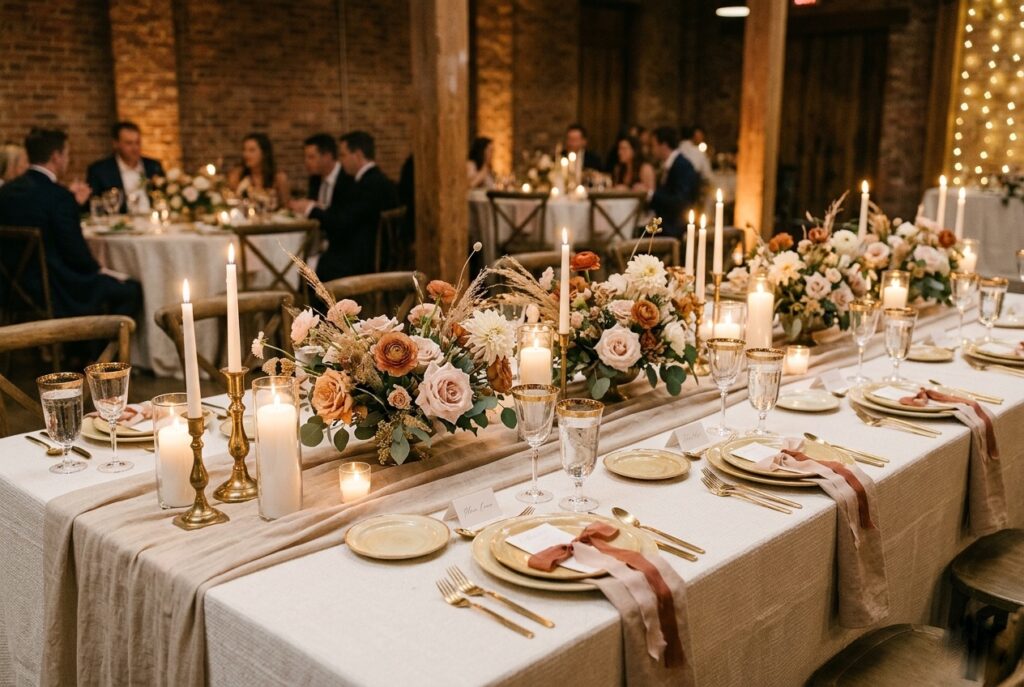
Most couples design their tables for photographs — and then their guests spend four hours sitting at them wondering why the centerpiece is blocking the person across from them.
A table that photographs well and a table that works are two completely different briefs, and the gap between them is where most of the wedding table budget quietly disappears.
Here is what actually holds up across both tests, what’s worth spending on right now, and what to skip entirely.
1. Linen as the Foundation, Not the Tablecloth
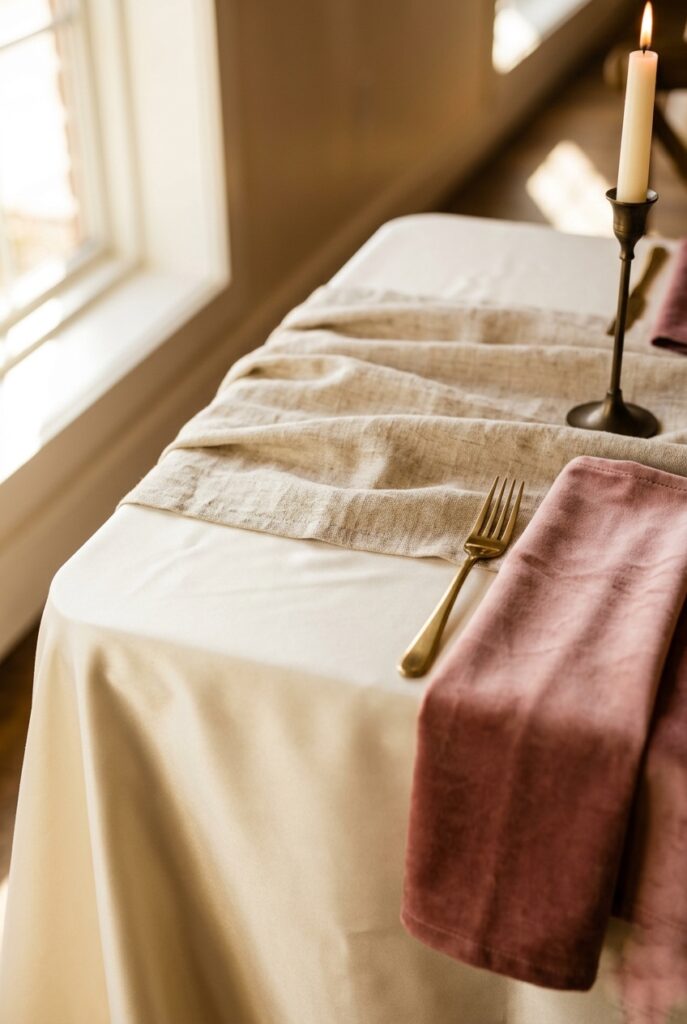
[COMPETITOR GAP IDEA #1] Every table decor article tells you to choose your centerpiece first, then pick a tablecloth to match. That is the exact wrong order.
Start with your linen — texture, weight, and color — and everything else will have something real to rest against.
A raw linen runner on a bare wood table costs $12–$18 per table from a restaurant linen supplier and photographs as designed and expensive.
A polyester tablecloth from a wedding rental company at the same price reads as a buffet. The difference is fabric texture, full stop.
Velvet napkins add depth and shadow under candlelight in a way that cotton napkins never do — All Cotton and Linen sells velvet napkin sets for $28–$40 per dozen on Amazon.
Boucle runners sourced from fabric wholesale sites like Mood Fabrics run $8–$14 per yard and can be cut to table length for under $20 per table.
Start with the linen, then decide on flowers. Event designers who do this consistently produce tables that look twice as expensive as their budget.
Only do this if you have round or rectangular tables where a runner makes geometric sense — oval tables are tricky and a full cloth works better.
2. Low Centerpieces That Let People See Each Other
Here is the thing nobody writes in a table decor article: tall centerpieces force guests to talk around them or move them entirely.
I have watched guests physically relocate centerpieces to the floor at every wedding with arrangements above 18 inches.
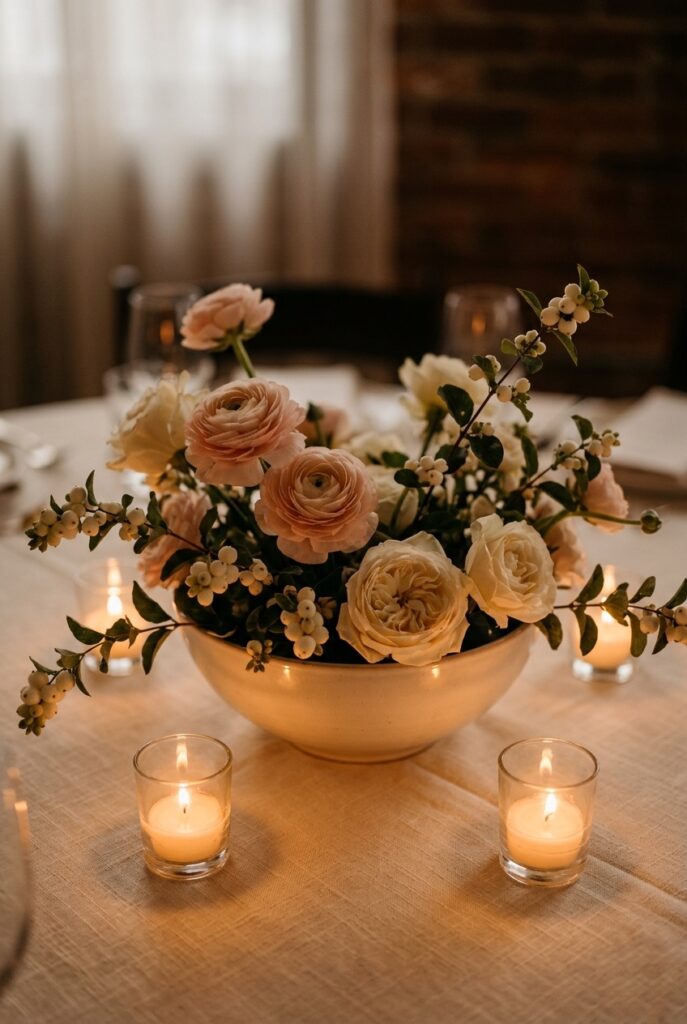
Low, wide, and sprawling is what actually works at the table level — it photographs as lush and full from the photographer’s standing vantage, and it doesn’t interrupt four hours of dinner conversation.
The cheap version of a low centerpiece is a single flower bunch from a grocery store dropped in a mason jar.
It reads as a rehearsal dinner afterthought. What you want is a wide ceramic or terracotta bowl ($14–$22 from IKEA’s TERNSLEV line or Amazon) packed tightly with ranunculus, sweet peas, or garden roses and allowed to sprawl slightly over the edge.
The organic overflow is what reads as intentional and costly. Stems from Sam’s Club or Costco wholesale floral run $35–$55 for enough to do four to five low arrangements. Budget $55–$90 per table at a florist, or $20–$30 DIY.
3. Pillar Candles Over Votives Every Time
Votive candles in glass holders at every table became the default wedding rental because they are cheap to stack and easy to transport.
They are also the single most visually forgettable choice in the entire table decor category.
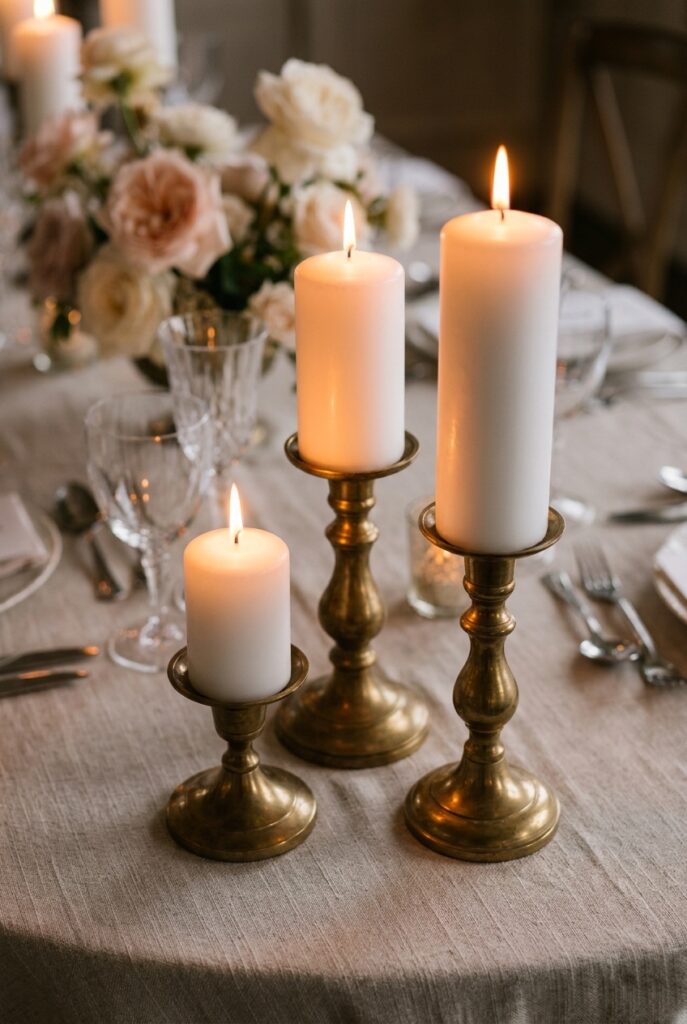
Pillar candles on varied-height brass candlestick holders do something votives cannot: they create visual architecture above the table surface, cast directional light with actual shadows, and photograph as something deliberately chosen rather than included in a venue package.
You need three heights per table — approximately 4″, 8″, and 12″ — grouped toward the center. Unscented white pillar candles from Ikea’s JUBILEUM line cost $4–$9 per candle.
Vintage brass candlestick holders in mixed heights are consistently available on Facebook Marketplace and thrift stores for $2–$8 each.
Or buy new on Amazon (Hoatai brass taper holders) for $12–$28 per set. Check with your venue before committing — many now require flameless candles for fire code compliance, in which case the Homemory brand flameless pillars on Amazon ($18–$26 per set of 3) replicate the aesthetic without the restriction.
BUDGET HACK #1: Rent candlestick holders from a local event rental company instead of buying them. Most couples don’t realize that equipment rental companies — not just wedding-specific vendors — carry brass, silver, and ceramic candlestick holders by the dozen. A set of 30 mixed brass holders rents for $40–$70 total from general party rental companies like Taylor Rental or local equivalents, compared to $90–$180 buying them new. Call ahead and ask specifically for “mismatched vintage-style candlestick holders.” Most rental inventories have them and they’re rarely listed online.
4. Table Lamps: The One Upgrade Nobody Expects
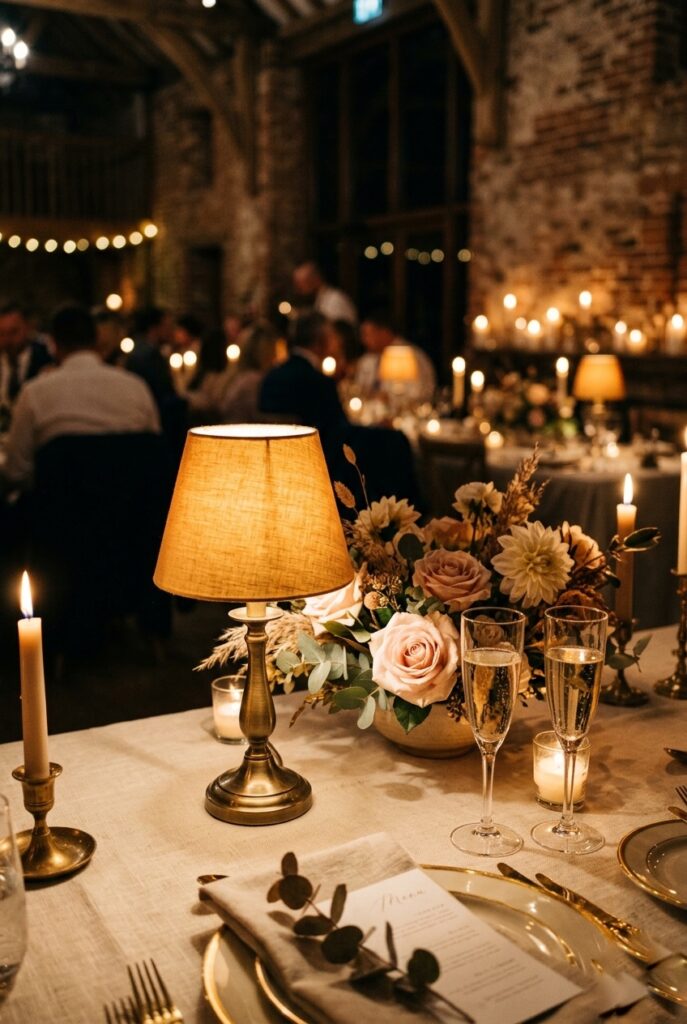
Table lamps on reception tables are one of those details that guests cannot articulate but always mention.
The effect is specific: they make a wedding reception feel like an upscale private dinner party rather than a catered event, which is exactly the distinction couples are paying their venue to achieve.
Three or four tables with a small lamp — not all of them, which tips from deliberate to overdone — creates the impression that the whole room is more considered than it is.
Look for small buffet lamps or cordless LED table lamps with a warm bulb.
The Brightech Sparq cordless lamp ($38–$55 on Amazon) runs 8–12 hours on a charge and replicates a genuine lamp glow with zero cord management.
Use on the sweetheart table and two or three guest tables within camera range of the sweetheart table for maximum photographic impact.
Skip this if your venue already has heavy chandeliers or intricate ambient lighting — in that context, the lamps read as competing rather than contributing.
5. The Sightline Test Before You Commit to Any Centerpiece
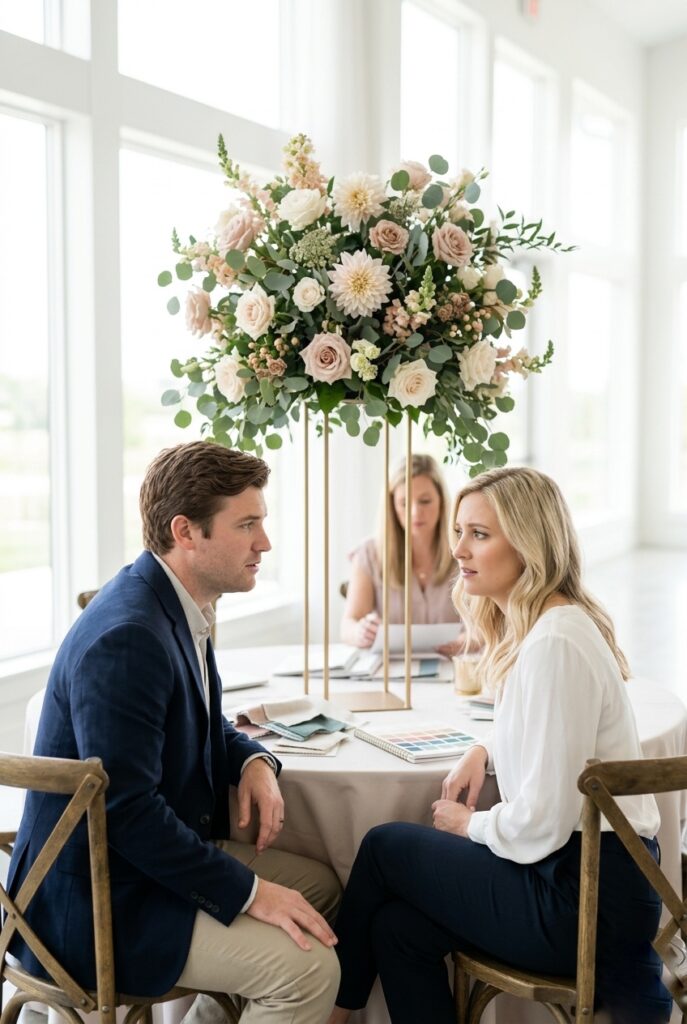
[COMPETITOR GAP IDEA #2] No table decor article tells you to sit down at the table.
Before you finalize any centerpiece — whether you’re doing a florist mock-up or setting up a DIY trial — pull a chair to that table, sit in it, and look across to the seat directly opposite.
If you can’t see that person’s face clearly, your centerpiece is too tall and your guests will move it.
The seated eye-level threshold is approximately 14–16 inches from the table surface.
Anything above that starts to interrupt conversation and sightlines.
This is what florists call the “sightline test” and they almost never mention it to clients unless asked — because tall arrangements cost more.
A centerpiece that passes the sightline test is either low and wide (under 14 inches) or dramatically tall and narrow (36 inches and above, clearing everyone’s eyeline entirely).
The dead zone is 16–34 inches: tall enough to block but not tall enough to clear.
Most wedding centerpieces from standard florists land exactly in the dead zone. Before you approve any mock-up, sit down first.
6. Sculptural Centerpieces for the Sweetheart Table
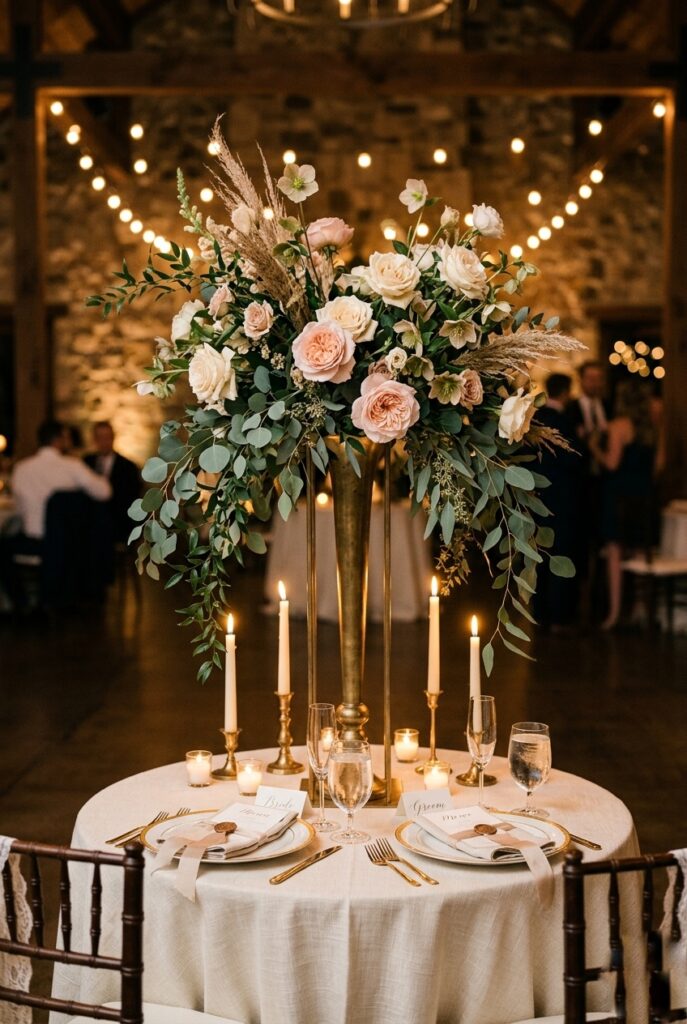
If you want one statement arrangement and are trying to manage the overall flower budget, put all of it on the sweetheart table.
This is the table that appears in the most photographs, that guests look toward the most during dinner, and that the couple actually sits at — so it earns the investment that a room full of identical round table centerpieces does not.
An architectural, asymmetrical sculptural arrangement on the sweetheart table with lower, simpler arrangements at guest tables is the correct budget allocation and also produces better photographs than attempting equal grandeur across 20 tables.
Florists are increasingly working in an ikebana-influenced aesthetic — asymmetrical, with intentional negative space and architectural stem work.
Anthuriums, poppies, and oversized garden roses in a tall ceramic column vase ($30–$50 from CB2 or Amazon) create this effect.
Full service from a florist: $200–$600 for the sweetheart arrangement alone. DIY from wholesale stems via FiftyFlowers.com: $60–$120 total including the vase.
BUDGET HACK #2: FiftyFlowers.com ships wholesale-grade fresh flowers directly to consumers in bulk boxes, the same supply channel florists use. A mixed box of garden roses, ranunculus, and lisianthus sufficient for a 10-table wedding runs $180–$260 delivered, versus $800–$1,400 at a retail florist for the same volume. Order 3 days before the wedding (not the week before, which stresses inventory), specify your delivery date at checkout, and condition the flowers in a cool room for 24 hours before arranging. The site includes a flower calculator that estimates stems needed by table count — use it before ordering.
7. Fruit and Produce as a Centerpiece Layer
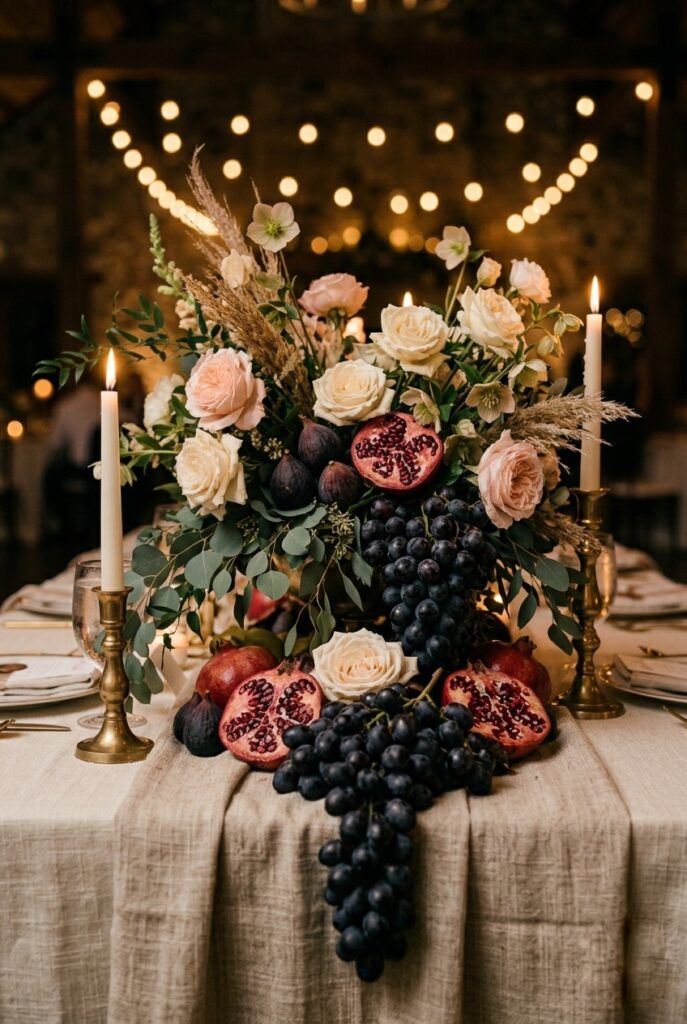
The fruit-at-the-table trend that moved through wedding design over the past two seasons has genuinely earned its place — not because it’s trendy, but because stone fruits and dark berry clusters add the depth, darkness, and texture that flowers alone cannot.
Pomegranates split to show their seeds, figs halved on the runner, clusters of dark concord grapes draped near candlelight — these give a table the opulence of a Flemish oil painting and cost almost nothing relative to additional flowers.
The wrong version of this is a casual pile of fruit that looks like a grocery display.
The version that works is intentional placement — two or three statement fruits tucked near the base of a flower arrangement or scattered along a linen runner with obvious deliberateness.
Whole pomegranates run $1.50–$3 each at Whole Foods or Trader Joe’s. Dark figs are $4–$6 for a small box.
Buy them the day before, split or score them the morning of, and nestle them against flower stems. Total cost per table: $6–$12, visual impact: significant.
This pairs particularly well with deep and moody wedding color palettesor indoor autumn and winter settings.
8. Place Settings as Part of the Decor Conversation
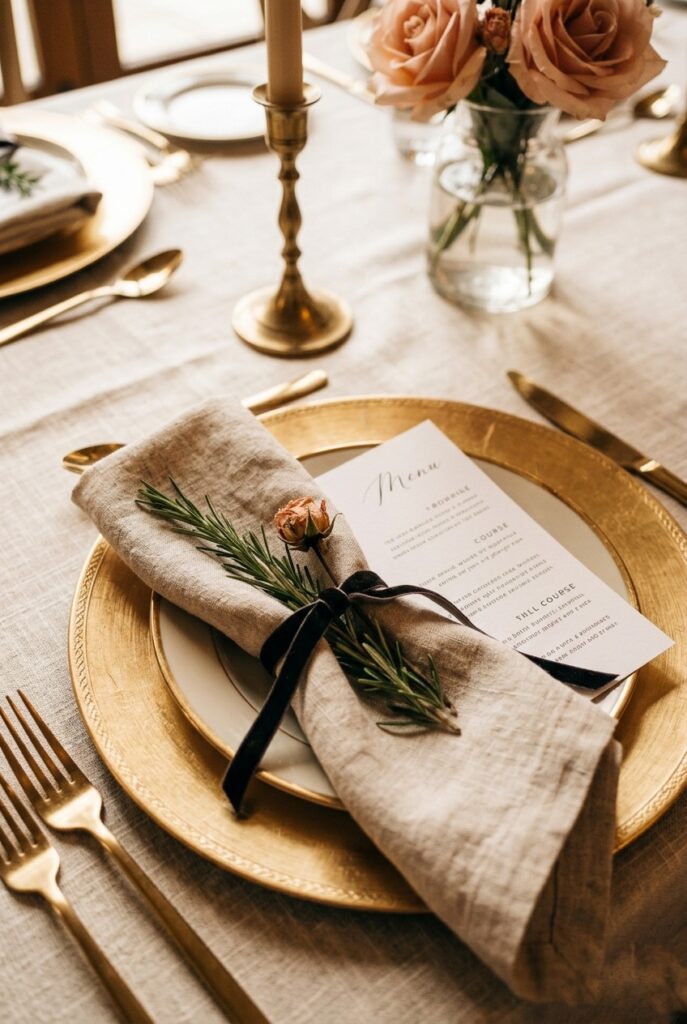
Most couples design the centerpiece and then treat the place setting as an afterthought — plate, fork, glass, done.
But what guests look at for the entirety of dinner is the surface directly in front of them, not the centerpiece three feet away.
A charger plate, a deliberate napkin fold, a small personalized menu card, and a single herb sprig tucked into the napkin ring costs $4–$8 per place setting in materials and elevates the perception of the entire table more than doubling the floral budget.
Brushed gold charger plates on Amazon (Koyal Wholesale, $18–$28 for a set of 4) add warmth and formality instantly. Natural linen napkins from All Cotton and Linen run $2–$3 each.
A fresh rosemary or eucalyptus sprig is effectively free if your florist is already sourcing greenery. Printed menu cards via Canva and a local print shop: $0.50–$1.50 per card.
The combined effect reads as a $200/table setting that cost $8. For a complete approach to this layering strategy, the elegant wedding table decor guide covers place setting hierarchy in full detail.
9. Bows — Done Right and Done Once
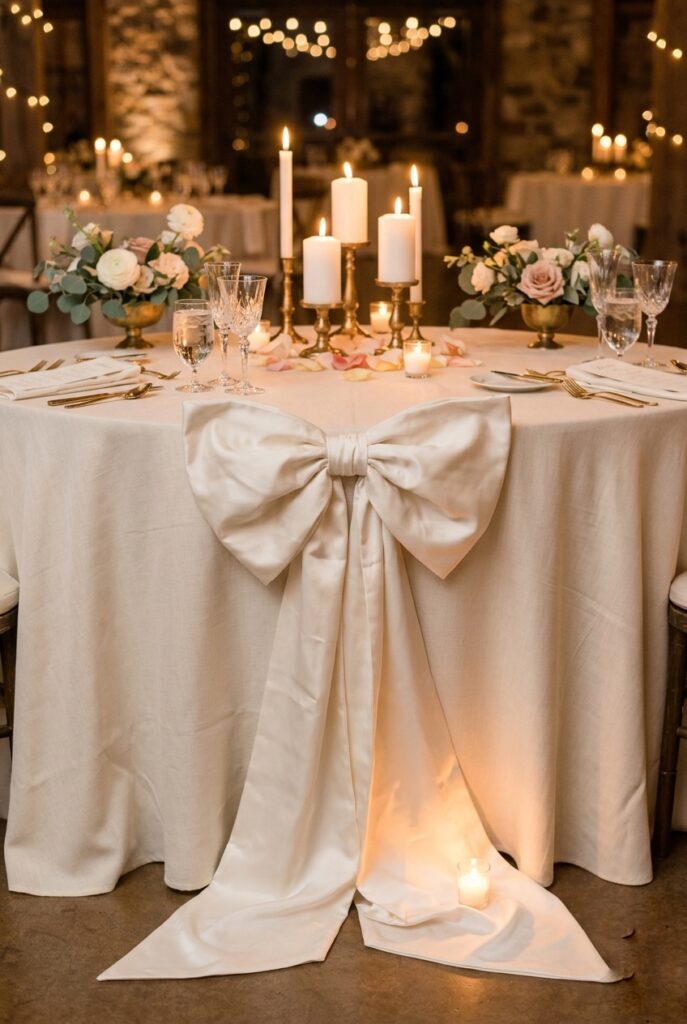
Bows on wedding tables are currently working — specifically oversized, loosely tied, fabric bows on the front of the sweetheart table or draped from the back of reception chairs.
The version that fails is a stiff pre-tied polyester bow clipped symmetrically to every chair, which reads as a hotel ballroom in the 1990s.
The version that works is a single large, deliberately imperfect satin, velvet, or grosgrain bow on one focal point — the sweetheart table’s front edge, or the couple’s chairs — treated as a sculpture rather than a decoration.
Wide satin ribbon from Michaels or JOANN Fabrics runs $4–$9 per yard. You need approximately 2–3 yards for a large sculptural bow.
Tie it loosely, adjust the loops for asymmetry, and let one tail fall longer than the other. Total cost: $12–$18 for a detail that photographs as a designer choice.
Skip this if your venue or table design already has strong decorative hardware — ornate chair frames, detailed table skirting — where a bow will compete rather than add.
BUDGET HACK #3: Wedding venues charge $2–$8 per chair for chair covers or sashes as an add-on rental. Skip the venue’s chair rental accessories entirely and instead buy wide grosgrain or satin ribbon by the roll from a fabric wholesaler or Michaels with a 40% off coupon. A 50-yard roll of 4-inch ribbon runs $14–$22 and ties approximately 25 chair sashes. That is $0.55–$0.90 per chair in ribbon cost versus $2–$8 per chair through the venue. Cut lengths the night before with fabric scissors, tie during venue setup, and collect them at the end of the night for resale on a wedding resale Facebook group.
10. Table Number Cards as a Design Element
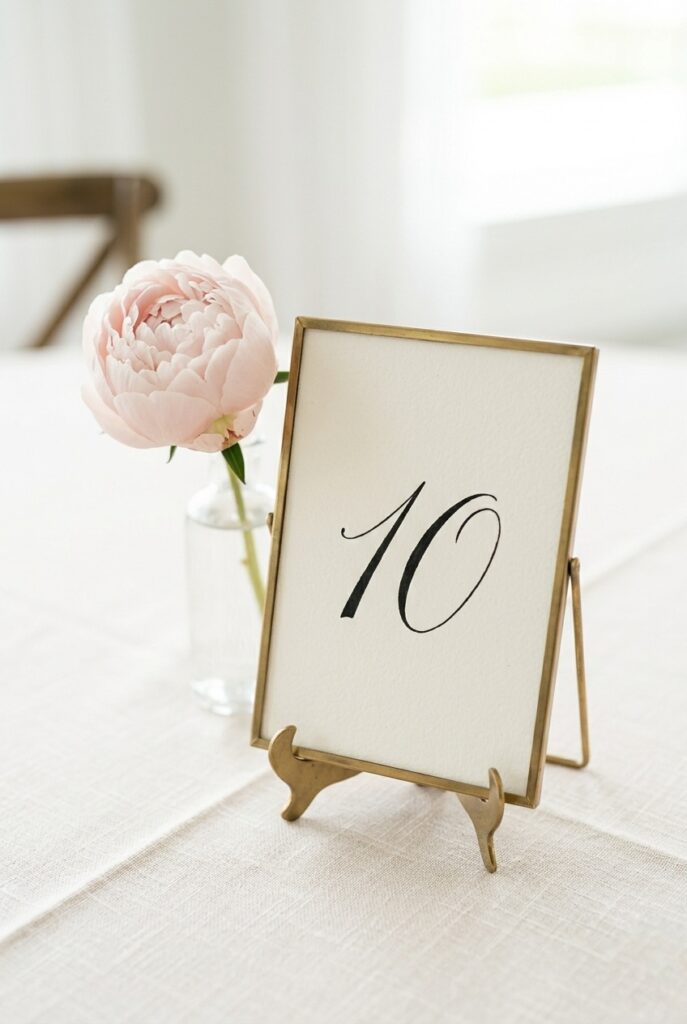
Table number cards are one of those details that couples often order from a wedding stationery site as an afterthought and then regret in photos.
The standard white tent card with a printed number in a generic font reads as a placeholder.
A handwritten number on thick card stock in a small brass easel frame costs approximately the same and reads as designed.
The frame also does double duty — it keeps the card vertical in any breeze and becomes a bud vase companion when a single stem is placed beside it.
Brass mini easel frames on Amazon (Iceyyyy brand) run $12–$18 for a set of 12.
Thick cream card stock for cutting and hand-lettering: $6–$10 for a pack sufficient for 20 tables.
If handwriting isn’t your strength, a Canva template printed at Staples on cardstock costs roughly $0.40–$0.80 per card printed on their matte card stock option.
Paired with a single stem bud vase ($6–$9 for a set of 6 from IKEA’s TIDVATTEN line), the total per-table investment is under $5 for a detail that significantly improves the overall table photograph.
Decision Filter
If your reception table count is under 12, concentrate spending on two or three statement elements done properly — a sculptural sweetheart arrangement, layered linens, and pillar candles — rather than spreading the budget thin across every table equally.
For ballroom or banquet hall venues with overhead chandeliers that already provide ambient light, skip the table lamps and invest that $40–$55 in better linen quality instead.
If your tables are round and 60 inches in diameter, low centerpieces between 10–14 inches are the sightline-safe choice; for long banquet tables over 8 feet, a runner of low arrangements spaced every 24 inches reads as more considered than a single centered arrangement and uses the same number of stems.
For truly tight budgets, visit budget wedding decor ideas before booking any vendor — the highest-ROI moves for tables are almost all DIY.
The Real Reason
The most common table decor mistake isn’t choosing the wrong flower — it’s allocating the budget in the wrong sequence.
Couples typically spend 60–70% of their table decor budget on floral arrangements, then fill the rest with whatever the venue provides as linen and rental.
Flipped, that ratio produces a dramatically better result: spend first on linen quality, candlelight hardware, and place setting details, then use remaining budget on flowers as layering rather than architecture.
The flowers do not need to carry the table. They need to complete it.
The bold opinion: identical centerpieces on every guest table are a missed opportunity and a waste of money.
Alternating between a low floral arrangement and a candle-only tablescape every other table costs less, reads as intentional, and is more visually dynamic from any angle of the room than wall-to-wall floral uniformity.
The insider observation, from event designers and wedding photographers who see tables at every stage: the most common specific mistake couples make is ordering white pillar candles in a single height — usually 6 inches — and placing three of them together in a cluster.
At identical height, grouped candles read as a hardware store display, not a table design. Height variation is what creates the visual rhythm that makes a grouping read as “styled.”
A photographer will move candles on your table before shooting it if they’re all the same height — which tells you everything you need to know about what that single adjustment does for a photograph.
Ask for three heights every time, without exception.
Mistakes to Avoid
Mistake 1: Booking your florist before deciding your linen. Nearly every competitor article recommends finding a florist as your first vendor decision after the venue.
The actual correct sequence is venue → linen rental → florist, because the linen color, texture, and weight changes what flowers read against it.
A florist who doesn’t know your linen will propose arrangements in a vacuum, and the combination often clashes in ways that only become obvious at the rehearsal setup.
Mistake 2: Spending $400+ on chair sashes across 150 chairs. At $2–$3 per chair through a venue rental company, 150 chairs cost $300–$450 in sashes that most guests never notice and that photograph as background blur at best.
That same $400 spent on better centerpiece vessels, upgraded linen for the head table, or additional candles produces objectively more visual impact per dollar than fabric tied around chair backs.
Mistake 3: Not seeing your venue under reception lighting before finalizing decor. Couples choose table decor in the context of showroom samples, vendor photos, or daylight visits to the venue.
Most weddings happen under dramatically different conditions — dimmer light, candlelight, mixed overhead fixtures.
A centerpiece that looks crisp and full in natural light can look muddy and flat under a ballroom’s warm LEDs.
Ask your venue coordinator to turn on the reception lighting during your site visit and bring at least one centerpiece element — a candle, a flower type, your linen sample — to see how it actually reads.
Almost no competitor article mentions this.
Mistake 4: Treating the sweetheart table as one table among many. Couples who apply the same centerpiece budget per-table uniformly across every table, including the sweetheart, systematically under-invest in the one table that appears in 40–60% of their reception photographs.
The sweetheart table deserves three to four times the investment of a standard guest table.
If your guest table budget is $80 in decor, your sweetheart table budget should be $250–$350 minimum. This reallocation costs nothing — it is a budget distribution decision, not an increase in total spend.
FAQ
What is the most popular style of wedding table decor right now?
Low, textural centerpieces with layered linens and mixed candlelight are dominating modern weddings right now.
The shift is away from tall, identical floral towers toward tablescapes that feel more like a designed dinner party — varied heights, tactile fabrics, and personal details at each place setting.
How much should I budget per table for wedding decor?
A realistic working budget is $75–$150 per guest table for a well-styled result that includes linen, candles, and a simple centerpiece.
Sweetheart and head tables should be budgeted separately at $200–$500 depending on floral ambition. According to Zola’s wedding budget tools, most couples underestimate table decor costs by 30–40% when planning early.
How do I make wedding tables look expensive without spending a lot?
Start with quality linen texture, not flowers.
A textured linen runner, pillar candles at varied heights, and a low bowl of seasonal flowers costs $30–$50 per table and photographs as a $200 design.
The table details closest to guests — napkins, charger plates, menu cards — have more effect on perceived quality than the centerpiece because guests look at them for hours.
What centerpiece height works best for round tables?
Either under 14 inches (low and wide, below seated sightline) or over 36 inches (tall and narrow, clearing the sightline entirely).
The dead zone of 15–34 inches blocks conversation without clearing eyelines and is the most common centerpiece mistake at round tables.
Confirm height with the sightline test: sit in a chair at your actual table before approving any arrangement.
Budget Table
| Element | What It Is | Vendor/Retail Cost | DIY / Budget Version |
|---|---|---|---|
| Linen Runner | Textured raw linen or boucle | Rental $12–$20/table | Mood Fabrics wholesale ~$8–$14/yd |
| Velvet Napkins | Depth and texture at place setting | All Cotton & Linen $28–$40/doz | IKEA TERNSLEV sets ~$12–$16/4pk |
| Low Floral Centerpiece | Wide bowl, sprawling seasonal blooms | Florist $55–$90/table | FiftyFlowers.com DIY ~$20–$30/table |
| Pillar Candles + Holders | 3 heights per table, brass candlesticks | Rental $40–$70/30 holders | IKEA + FB Marketplace ~$3–$8/holder |
| Sculptural Sweetheart Arrangement | Architectural asymmetrical focal piece | Florist $200–$600 | FiftyFlowers + CB2 vase ~$80–$140 |
| Table Lamp | Cordless, warm amber, 1 per 3–4 tables | Brightech Sparq ~$38–$55/lamp | — |
| Fruit Layer | Pomegranates, figs, grapes on runner | Whole Foods/Trader Joe’s $6–$12/table | — |
| Place Setting Extras | Charger, linen napkin, menu card, herb | ~$6–$10/place setting | Koyal Wholesale chargers + Canva cards |
| Bow Detail | Oversized satin or velvet on focal table | Fabric wholesale + DIY ~$12–$18 | Michaels with 40% off coupon |
| Table Number Cards | Brass easel + hand-lettered card | ~$4–$5/table | Iceyyyy frames + Canva print |
The Table Is Where the Wedding Actually Lives
The ceremony is seven minutes. The cocktail hour is sixty. Dinner is where your guests spend the majority of their time — sitting, talking, looking at what’s directly in front of them.
The table isn’t a backdrop for photos. It’s the experience itself, and the couples who understand that spend their decor budget completely differently than the ones who are designing for the photographer.
Pick one idea from this list that you aren’t currently planning and actually price it out this week — whether that’s upgrading your linen texture, ordering a set of brass candlestick holders, or running the sightline test at your venue.
Then, if you’re still building out the broader look, the round table decor guide and the DIY wedding decor ideas on this site will give you the next two decisions to make.