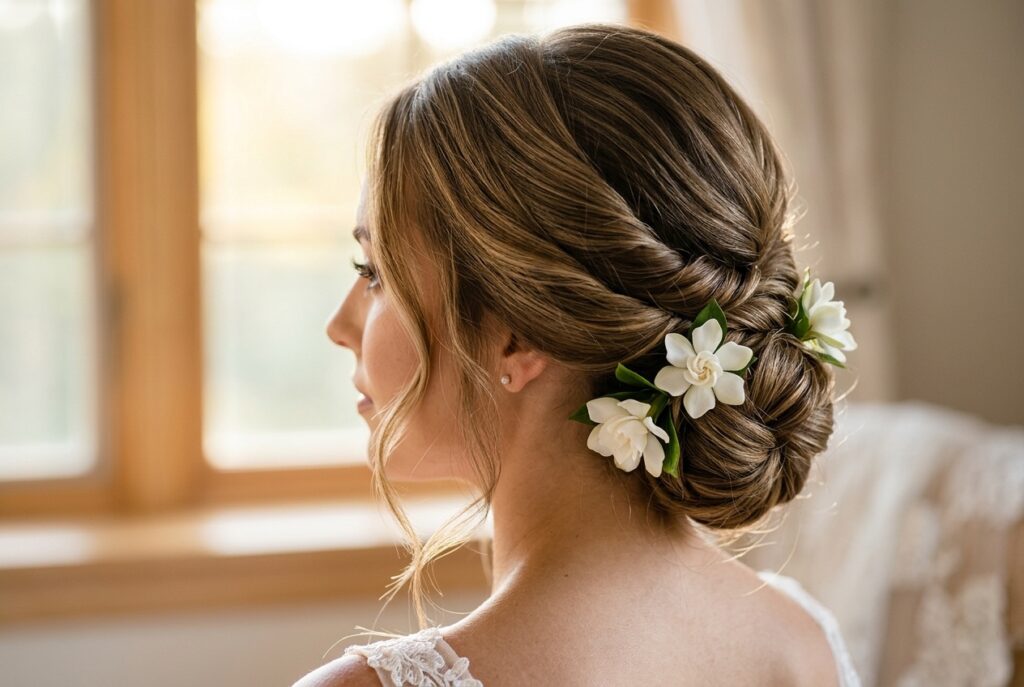
Most brides spend more time choosing their veil than they spend making a single decision about their nails — and then wonder why the close-up ring shots feel off.
French nails are not the safe default they’re marketed as; a bad French manicure is one of the most unforgiving things a camera can find on a wedding day.
But a great one — the right shape, the right tip width, done in the right product — disappears into elegance so completely that guests only notice your ring.
The silk ribbon cut off at the wrist, the cold edge of the basin water, the acetone smell on a Thursday afternoon — the technician drew a line so fine it caught the light without asking for it.
The Short Answer
French nails work for weddings precisely because they read as skin, not polish — but only when every variable is calibrated right.
The brides who regret their French manicure chose the wrong tip width for their nail shape, picked a product that photographed chalky, or skipped a trial appointment and found out on the morning of their wedding that their nails had lifted.
Nail decision-making is not about which style looks prettiest in someone else’s photo.
It’s about what holds up for fourteen hours, photographs true to color under mixed indoor and outdoor light, and still looks intact when you’re cutting cake at 10 p.m.
Start here, before you touch a single inspiration image: decide your nail shape first, your tip style second, your product third. Everything else is decoration.
1. The Micro French — Thin Is Not Just a Trend, It’s a Technical Upgrade
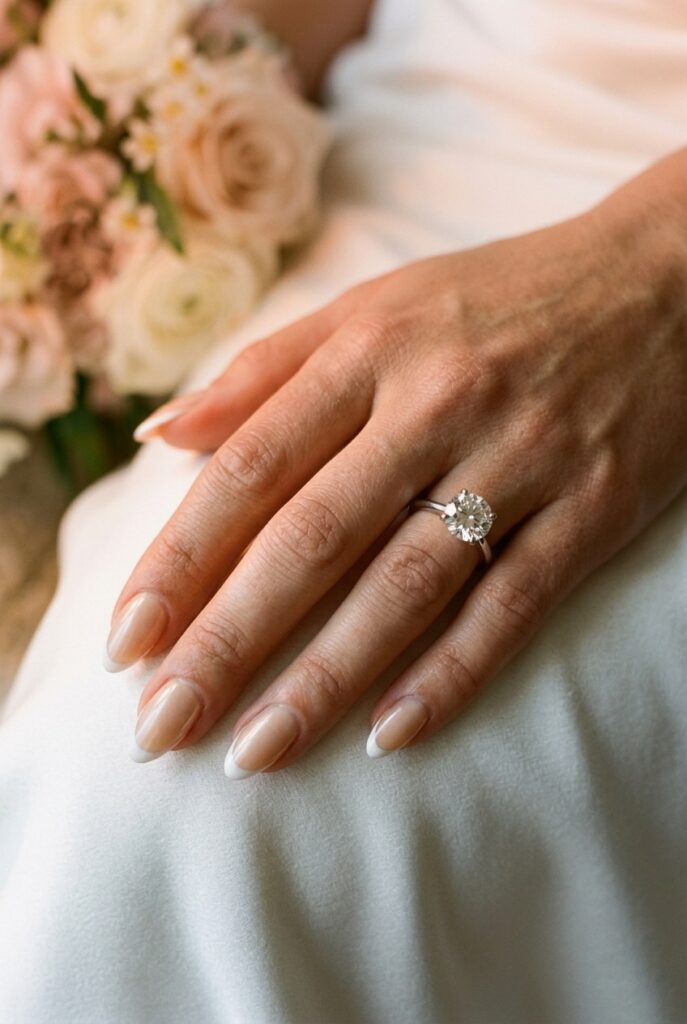
The micro French — a white tip line under 1.5mm wide — photographs differently than a traditional broad French tip, and not in a subtle way.
Traditional wide tips can flare under flash photography and create a visual “block” at the nail end that pulls the eye away from the ring.
A micro tip, by contrast, disappears into a luminous edge.
It reads as a well-groomed natural nail in most photos and only reveals itself as a manicure in close-up ring shots where you actually want the detail.
Only do this if your nail technician has done at least 20 micro French sets and can show you healed photos.
An imprecise micro French looks worse than a broad French because there is nowhere for the line to hide.
Ask to see their portfolio specifically for this style — not just “French tips.”
Available at most gel salons, $55–$90 depending on market. For at-home shaping before your appointment, the Makartt Nail File Set on Amazon runs about $8 and will save you from going in with uneven sidewalls that sabotage the result.
2. Almond vs. Square — The Shape Decision Nobody Explains Properly
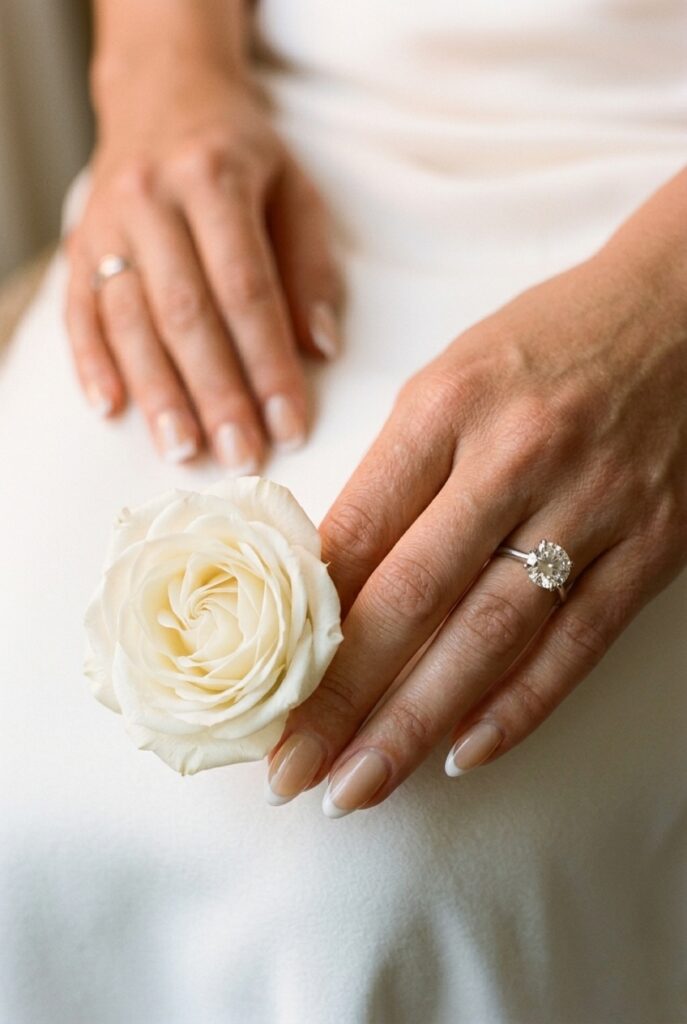
Almond nails photograph longer and more elongated than they are — which is an asset if your fingers are shorter or wider.
Square nails photograph exactly as they are, which works beautifully on naturally long nail beds but can look stubby on shorter fingers.
Neither is universally correct, and every competitor article that recommends one shape as “classic” is ignoring the reality that nail shape is a function of your hand geometry, not a trend.
The wrong version: blunt square tips on short nail beds.
They visually shorten every finger and read as practical rather than bridal.
Switch to a soft square (squoval) or a rounded almond for the same clean look without the truncating effect.
The flattering range of tip widths is also different on each shape — a 2mm tip on almond reads modern, the same 2mm tip on square reads like a mistake.
Available in press-on format for trial purposes from KISS Salon Acrylic ($10–$14, Amazon) so you can physically see both shapes on your own hand before committing.
Your salon can then match the shape you choose.
3. The Champagne Base — Why Most “Nude” Bases Are Wrong for Wedding Photos
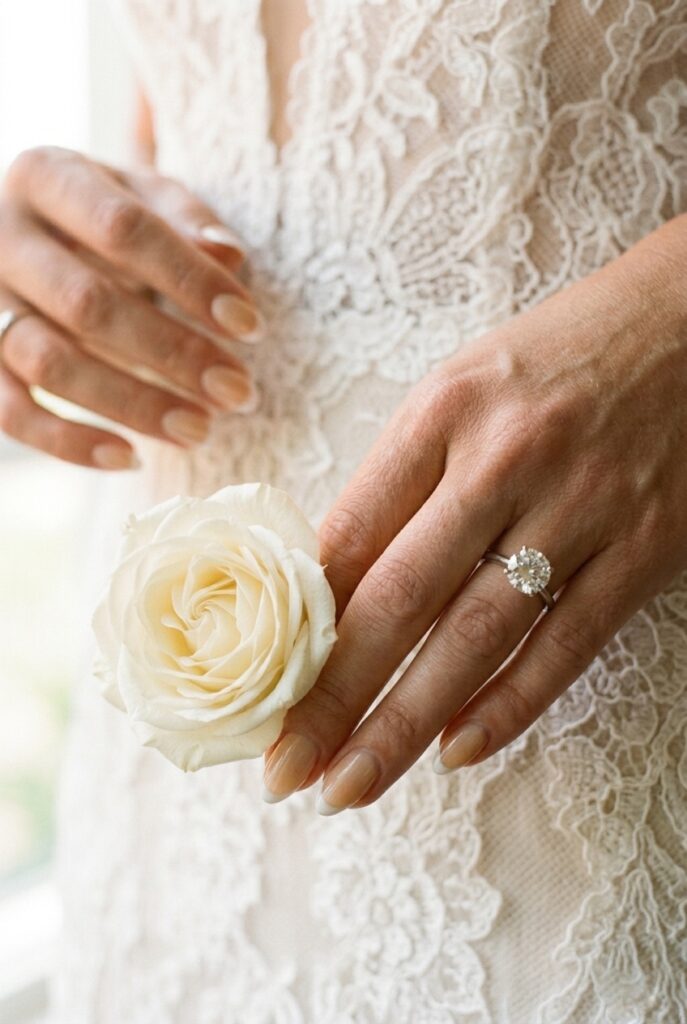
The “nude” base that most salons default to for French nails is a cool-toned, translucent pink that photographs flat and slightly gray under reception lighting.
A champagne base — sheer, slightly warm-golden — reads as skin and adds a soft glow that neither a stark nude nor a pink base achieves.
This is the base used in almost every editorial bridal nail shot you’ve saved, and it’s almost never labeled as such.
Skip this if your wedding gown is a pure bright white.
Champagne against stark white fabric can look slightly yellow in certain lighting.
In that case, a sheer pink-white (like OPI Bubble Bath or Essie Ballet Slippers) is the technically safer choice.
For ivory, off-white, and cream gowns, champagne base is almost always the upgrade.
OPI Bubble Bath retails around $12 at Ulta; Essie Ballet Slippers around $10.
For a gel version, ask your tech for a sheer pink-white gel base — most nail supply brands carry this in their builder gel line.
Budget Hack after Idea 3: If you’re doing gel nails, bring your own Essie Ballet Slippers ($10, Target or Ulta) or OPI Bubble Bath to the appointment and ask your tech to use it as the base color under the gel top coat. Many salons mark up polish significantly, and bringing your own preferred shade costs you nothing extra while guaranteeing the exact color on your actual nails — not a salon approximation.
4. Pearl-Tip French — The Elegant Upgrade That Photographs Like Fine Jewelry
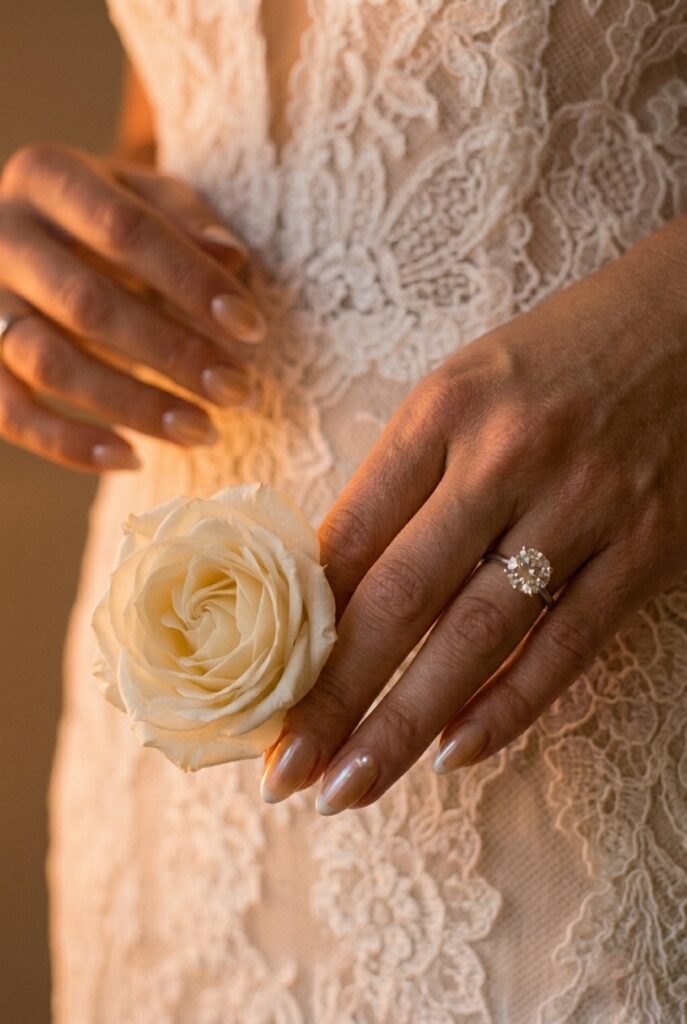
A pearl-finish tip is not the same as a rhinestone-covered nail.
A sheer iridescent white tip — think the inside of a shell rather than a sequin — adds a dimensional quality to the French tip that a matte or plain white simply cannot replicate, especially in flash photography where flat white tips can look painted-on.
The pearl effect refracts light gently and reads as expensive even in candid shots.
The cheap version of this is a chunky rhinestone border along the tip or a glitter line applied over the white. Both look dated within seconds of seeing them in a photo.
The pearl effect instead comes from using a chrome powder (applied over the cured gel tip before sealing) or a specifically formulated iridescent white gel polish like the Kiara Sky Chrome Nail Powder, available on Amazon for about $10–$12.
The result is subtle enough to look like skin at twenty feet and deliberate in a close-up.
Salon cost: $65–$100 for a full gel set with pearl tip effect. Ask specifically for “iridescent white chrome on the tip” — don’t just say “pearl nails” or you risk getting rhinestones.
5. The Ombré French — Skin That Glows Rather Than Tips That Pop
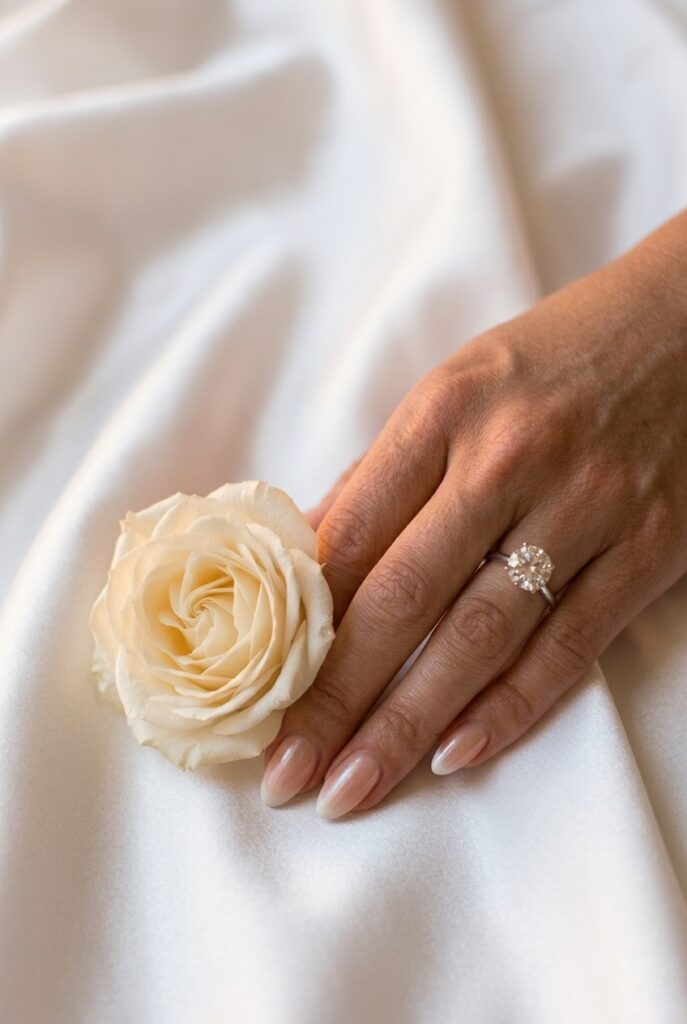
The ombré French — a gradient from sheer pink at the base to white at the tip with no hard line — is the most forgiving French variation for imperfect nail shapes because the absence of a defined tip line means there is nothing to measure or second-guess.
It also holds up better across twelve-plus hours of photography because there is no hard tip edge to chip visibly. When a regular
French chips at the tip, it’s immediately obvious. When an ombré French chips slightly, it blends back into itself.
This is more skill-intensive than a standard French, so it genuinely matters whether your technician has done it before.
Use The Knot’s salon finder to search specifically for salons with bridal nail experience in your area — then call and ask if the tech on staff has done ombré bridal sets. Don’t assume.
Salon cost: $70–$110 for gel ombré French. Takes 15–25 minutes longer than a regular French due to the sponge or brush blending technique.
6. Short Natural Nails with French — Stop Apologizing for Nail Length
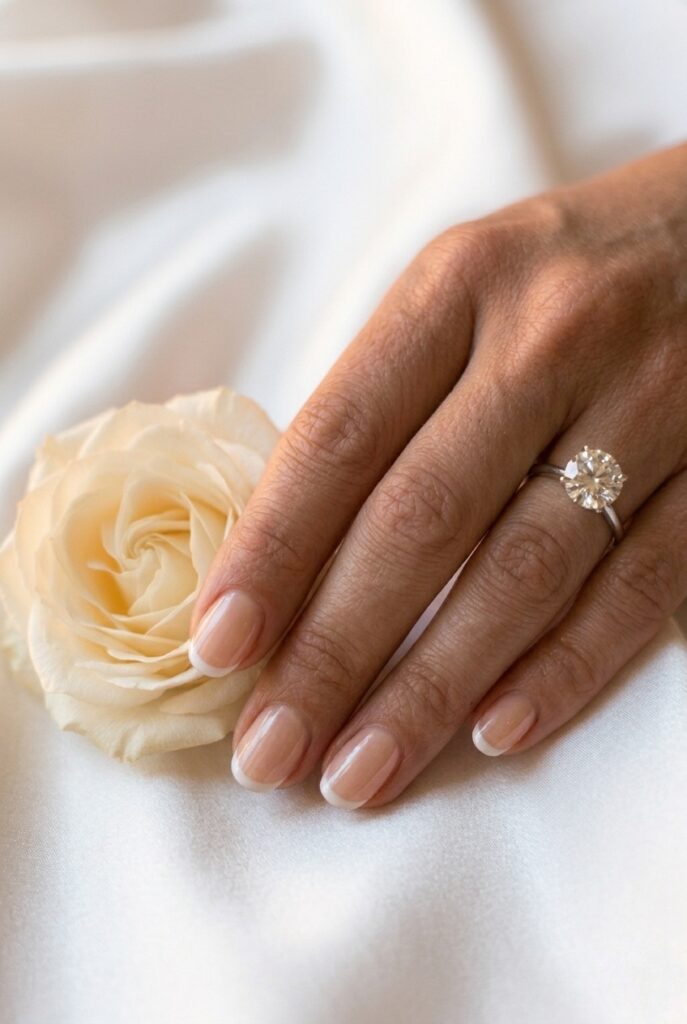
Short nails with a precise micro French are, in experienced photographers’ opinions, often the most photogenic option. The ring fills the frame without competition.
There’s nothing to distract from the stone or the band.
The mistake most short-nail brides make is adding extensions to create length they’re not used to wearing, then spending the wedding day hyperaware of nails that don’t feel like theirs. Every photographer has seen a bride pick at a lifted extension corner during dinner.
Only do this if you want length you genuinely enjoy in daily life. If you’ve never worn extensions before, your wedding day is not the experiment.
A pristine, short micro French on natural nails — properly shaped, buffed, and sealed — is more elegant than anxious three-week extensions.
For natural nail strengthening in the weeks before the wedding, Ella + Mila nail strengthener ($12, Amazon) used every other day for three weeks adds noticeable thickness to soft natural nails without artificial product.
Budget Hack after Idea 6: Book your bridal nail appointment on a Tuesday or Wednesday morning rather than the weekend. Many salons offer walk-in or same-week rates Monday through Wednesday that run $15–$25 less than peak Friday or Saturday slots. More importantly, your tech will have had a slower morning and will take more time on your set — speed is the enemy of a clean French tip line. Weekend appointments at busy salons are often rushed, and that is precisely when lines go uneven.
7. Colored French Tips — The Decision Requires More Thought Than Most Guides Admit
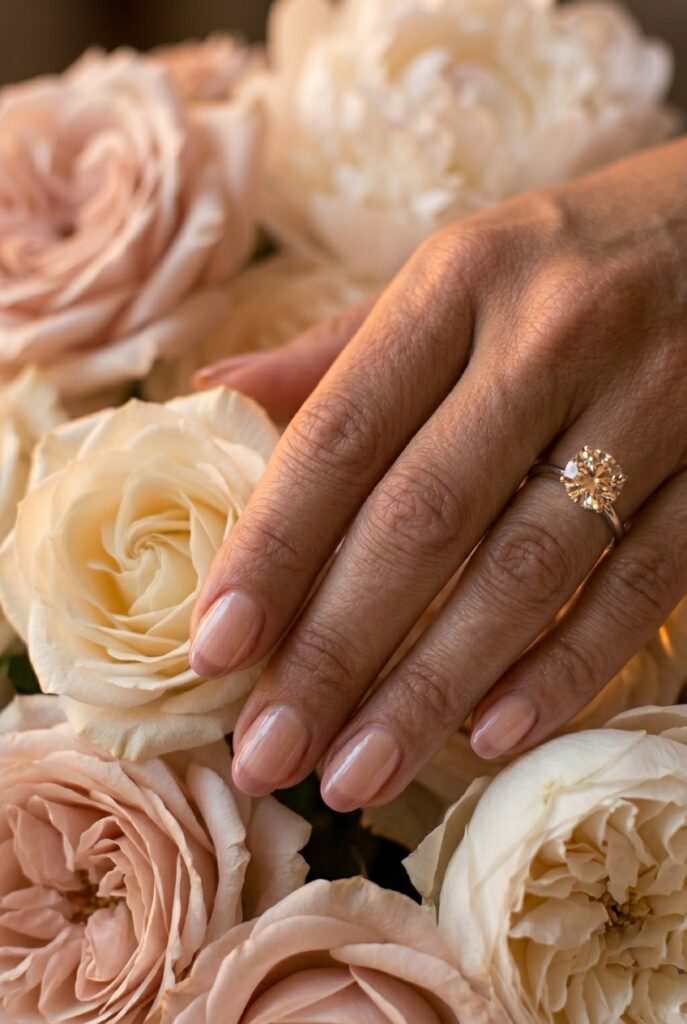
Colored French tips — dusty rose, champagne, sage, even muted terracotta — work exceptionally well when the tip color is within two shades of your base.
When the contrast is too high, you get drama instead of elegance, and drama photographs differently than it looks in the salon. A blush tip on a sheer nude base: refined.
A hot pink tip on a white base: a statement that competes with your dress.
Here is what no French nail article tells you: the same white tip color reads differently on every skin tone.
A stark blue-white tip on fair skin reads bridal.
The same stark blue-white on deeper skin tones photographs gray and can create a stark line that looks more like a graphic nail than a French manicure.
On deeper skin tones, an ivory-white or warm cream tip almost always reads better under both natural and artificial light.
Ask your technician to test a patch of the white on one nail before committing — hold it under the actual lighting you expect at your venue, not just salon fluorescents.
Available as gel: Morgan Taylor’s “Fairy Tailor” and OPI’s “Funny Bunny” are two of the most-used bridal tip whites at US salons, around $10–$12 per bottle at Sally Beauty.
8. The Velvet Matte French — For the Bride Who Finds Shine Exhausting
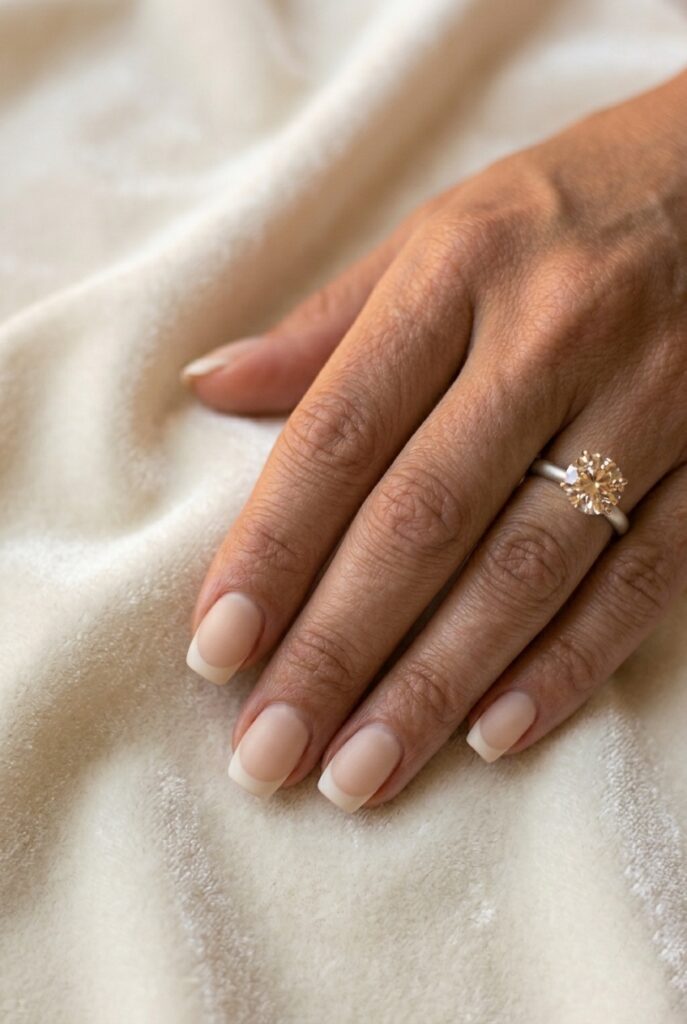
Matte top coats applied over a traditional French create a velvety, tactile finish that looks entirely different from a standard glossy French — more editorial, more intentional, slightly unexpected.
The finish reads beautifully in natural light photos and tends to flatter all skin tones because it reduces reflective hot-spots.
The trade-off is durability.
Matte top coats — even gel matte finishes — show surface scratches and wear at the tip edges faster than a high-gloss seal.
Only do this if your wedding is under ten hours and you’re not doing heavy work with your hands during setup or breakdown.
If your wedding is an outdoor all-day event with setup involved, stick to glossy.
Gelish Matte Top Coat is available on Amazon around $14 and can be applied over almost any gel polish for the matte effect.
Ask your salon if they carry a matte top coat before booking.
9. The Trial Appointment — The Step Most Bridal Nail Guides Skip Entirely
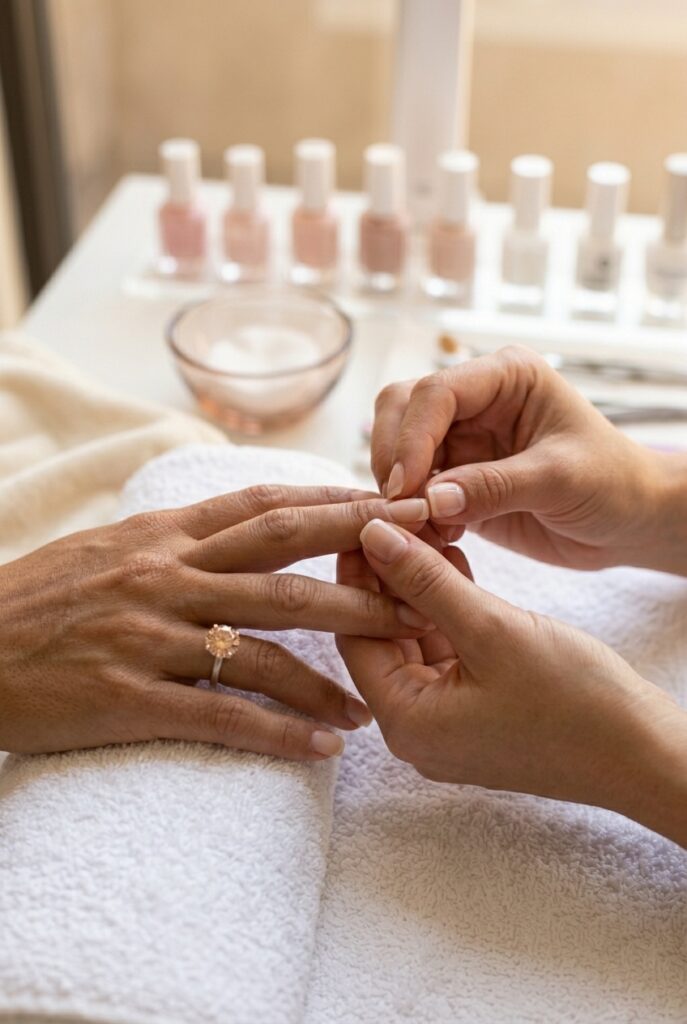
Every bridal beauty article tells you to book your nail appointment early.
None of them tell you to book a trial appointment three to four weeks before the wedding — at the same salon, with the same technician, in the same product — specifically to test wear-time on your actual lifestyle.
Here’s why this matters: gel nails applied over natural nails typically last 14–21 days before you see lifting at the sidewalls or tips.
But “typically” is based on an average, and your hands are not average. Some brides wash their hands 30 times a day; some work in water; some have naturally oily nail beds that lift gel faster than average.
If you discover this on your wedding morning, it is too late.
A trial appointment 3–4 weeks out shows you exactly how your nails behave in your real life, gives you and your tech a chance to adjust the preparation process (dehydration, primer, seal), and tells you whether you need soak-off gel, hard gel, or dip powder for your chemistry.
WeddingWire’s bridal beauty planning checklist is a useful starting point for building your full timeline.
The nail trial appointment belongs on it, not as an afterthought.
Cost of a trial: the same as a regular appointment ($50–$90). Consider it insurance on a $200–$500 wedding day beauty investment.
Budget Hack after Idea 9: Dip powder French nails run $35–$55 at most US salons — significantly less than hard gel or acrylic extensions — and typically outlast regular gel by 1–2 additional weeks. For brides with natural nails who want a French set that genuinely survives the honeymoon, ask specifically for dip powder in a sheer pink base with white dip tip. Nailboo’s Dip Starter Kit ($55, Nailboo.com) is also one of the best at-home options if you want to practice the look or do a touch-up between appointments.
10. The Accent Nail — One Rule That Changes Everything
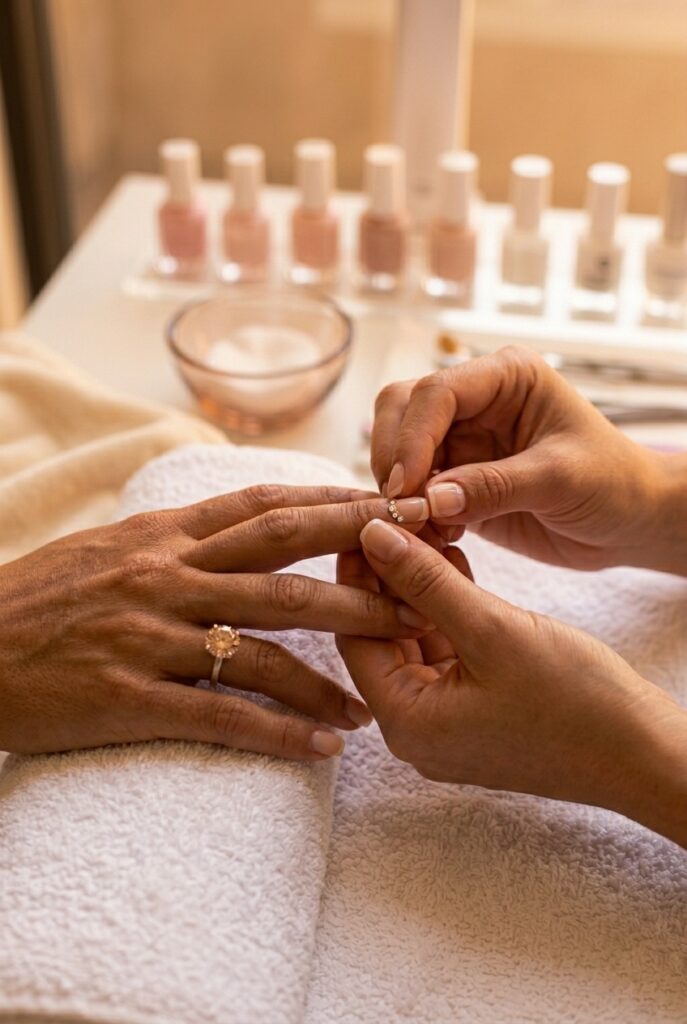
One accent nail — almost always the ring finger — done in a slightly more detailed version of your French can add interest without overwhelming the set.
The key is that the accent should be the quietest possible upgrade: a single tiny Swarovski crystal at the cuticle, a fine gold line along the tip, one small pearl bead.
The moment you add three or more embellishments to the accent nail, it becomes the focal point of your entire hand instead of a supporting detail.
The cheap version of this is a full rhinestone-covered accent nail surrounded by plain nails.
The contrast reads as an add-on rather than a design choice — like a chandelier earring worn with a t-shirt.
Instead, use the accent nail to extend the French theme slightly: if your base is micro French, the accent could be the same micro tip with a single pearl at the base. The continuity is what makes it look designed rather than assembled.
Swarovski flat-back crystals for nail art (size SS5 to SS7) are available on Amazon in packs of 100 for $6–$10.
Your nail tech can apply them during the appointment — just bring them as a backup or to ensure size accuracy.
Decision Filter
If your wedding ceremony runs under three hours and your reception is in a controlled indoor venue, any product — regular gel, hard gel, or dip — will survive the day.
If you are doing an all-day outdoor wedding in heat and humidity, skip regular gel and ask for hard gel or dip powder, which handles temperature and moisture significantly better.
For natural nail length under 3mm past the fingertip, micro French or ombré French are your two safest choices — both forgive minor length irregularities.
If your guest count is under 60 and the event is intimate, a single embellished accent nail reads beautifully; at a large reception where you’re constantly shaking hands and embracing people, keep all ten nails identical to reduce snag risk on embellishments.
The Real Reason
The real reason French nails remain the dominant wedding nail choice is not because they’re safe — it’s because they solve a very specific problem that colored nails cannot: they never fight with the dress.
In a decade of watching brides dress, the ones who regret their nail choice almost universally picked something they loved in isolation — a beautiful color, an interesting design — without considering it in motion, in candlelight, next to ivory fabric, while holding white garden roses.
French nails, done right, disappear into the overall picture and let everything else breathe.
The contrarian reality: the “classic” wide-tip French that dominated the 1990s and early 2000s is not actually timeless — it is dated, and it photographs dated.
What brides are actually reaching for when they say they want a French manicure is the micro French, the ombré, or the pearl-tip version.
The wide stark-white tip with a bubblegum pink base is a specific cultural moment, not an eternal truth.
The insider observation that almost no couple hears before booking: photographers and videographers can always tell which nails were done the night before.
Not because the polish looks fresh — because the hands look tense.
Brides who went to their appointment in a rush, who sat in an uncomfortable position, who didn’t properly hydrate their cuticles in the week before — their hands hold a certain stiffness that shows in every ring shot.
The best thing you can do for your nail photos is drink enough water in the four days before your appointment, moisturize your hands every night with something that absorbs fully (not a heavy barrier cream), and arrive at the salon relaxed with 90 minutes minimum on your schedule.
Mistakes to Avoid
Mistake 1 — Doing the opposite of what every nail article says: matching your tips to your wedding color palette.Every blog recommends coordinating your nails to your wedding colors.
This is the wrong way to think about it. Your flowers, your ribbons, your linens — all of those exist at arm’s length.
Your nails are in frame with your ring, your dress, and your face. They belong to your body, not your décor.
A sage green French tip might look stunning next to your eucalyptus centerpieces, but against ivory fabric and bare skin in a close-up ring shot, it reads as costume.
Keep your nails in the skin-adjacent register — sheer, neutral, luminous — and let your décor be the color moment.
Mistake 2 — Booking the wedding-day appointment without the trial. Brides who skip the trial appointment and discover lifting on their actual wedding morning typically pay $150–$250 for an emergency repair or replacement set done under time pressure by a technician who didn’t do the original work.
The trial appointment costs $50–$90 and eliminates that scenario entirely. This is the single most preventable nail expense in the wedding budget.
Mistake 3 — Choosing nail length based on inspiration photos, not your own hand history. You will not realize until after the wedding that you spent the entire reception holding your bouquet awkwardly, struggling to button things, or pulling at your veil because your nails were a length you’ve never worn before.
Brides consistently underestimate how much even 4–5mm of added length changes the physical experience of doing everything from pinning a veil to holding a champagne flute.
Whatever length you’ve worn comfortably in daily life for the past year is your wedding day length.
Mistake 4 — Assuming your regular nail salon can do a precision French manicure. This is uncomfortable to say, but a French manicure is one of the most technically demanding nail looks to execute cleanly — far harder than painting a solid color.
A slightly uneven tip line, one nail with a thicker band than the others, a base that bubbled under the lamp — these things are invisible in the salon chair under bright overhead light and completely visible the moment a camera focuses on your hands.
Book specifically with a technician who has bridal portfolio images.
Your regular tech may be wonderful for your monthly manicure and simply not have the precision training for a wedding-day French.
FAQ
Is French manicure good for wedding nails?
French nails are an excellent choice for weddings because they complement every dress color and skin tone without competing with the ring.
They’re especially effective in micro or ombré format, which photographs better than the traditional wide-tip version.
The finish reads as polished and deliberate in both close-up and wide-angle photography.
How long before the wedding should I get my nails done?
Get your nails done one to two days before the wedding — not the morning of.
For gel or dip powder sets, two to three days gives the product time to fully cure and settle, and your cuticles time to calm down from the appointment.
The morning-of appointment leaves no buffer for corrections if something lifts or chips overnight.
What nail shape is best for a wedding?
Almond and oval shapes photograph most flatteringly across the widest range of hand proportions.
Square works well on naturally long nail beds.
Coffin and stiletto shapes are high-risk for breakage during a physically active day.
If you’re unsure, test shapes with press-ons before committing at the salon.
Can I do bridal French nails at home?
You can do a clean at-home French using a dip powder kit and French tip guides, but precision is difficult without professional training.
A better approach: book the salon for the full set, then use the Nailboo Dip Kit or OPI Infinite Shine French Manicure pens ($12–$18, Amazon) for minor at-home touch-ups in the days following. Don’t attempt a full first-time French manicure the night before your wedding.
Budget Table
| Option | Product Type | Approx. Cost | Where to Book/Buy | Durability |
|---|---|---|---|---|
| Classic micro French | Gel | $55–$85 | Local gel salon | 2–3 weeks |
| Ombré French | Gel | $70–$110 | Bridal-specialist salon | 2–3 weeks |
| Pearl tip French | Gel + chrome powder | $65–$100 | Nail artist with bridal portfolio | 2–3 weeks |
| Dip powder French | Dip | $35–$55 | Most nail salons | 3–5 weeks |
| At-home French kit | Dip or press-on | $10–$55 | Amazon, Nailboo.com | 1–2 weeks |
| Trial appointment | Any product | $50–$90 | Same salon as wedding day | N/A — diagnostic |
| Accent nail crystals | Swarovski flat-backs | $6–$10 (pack) | Amazon | Same as gel set |
Every decision in this article comes back to one thing: your nails will be in more photos than almost any other single element of your bridal look, and the French manicure only delivers on its promise of elegance when the width, the base, the product, and the technician are all chosen deliberately rather than by default.
Book your trial appointment now — not the week before — and bring this article to the consultation so your technician knows you’ve done the thinking.
When you’re ready to think about the rest of your bridal day details, start with your elegant wedding décor or simple, beautiful ceremony setup — the same principle of intentional restraint applies to both.