Most brides pick their bouquet flowers first and their florist second — and that’s exactly backwards.
The bouquet that looks incredible on camera isn’t about which blooms you love; it’s about how those blooms interact with your dress, your venue light, and the specific weeks your wedding falls in spring.
This article gives you the exact framework to make every one of those decisions right.
1. The Loose Garden Bouquet: The Style That Photographs Best Right Now
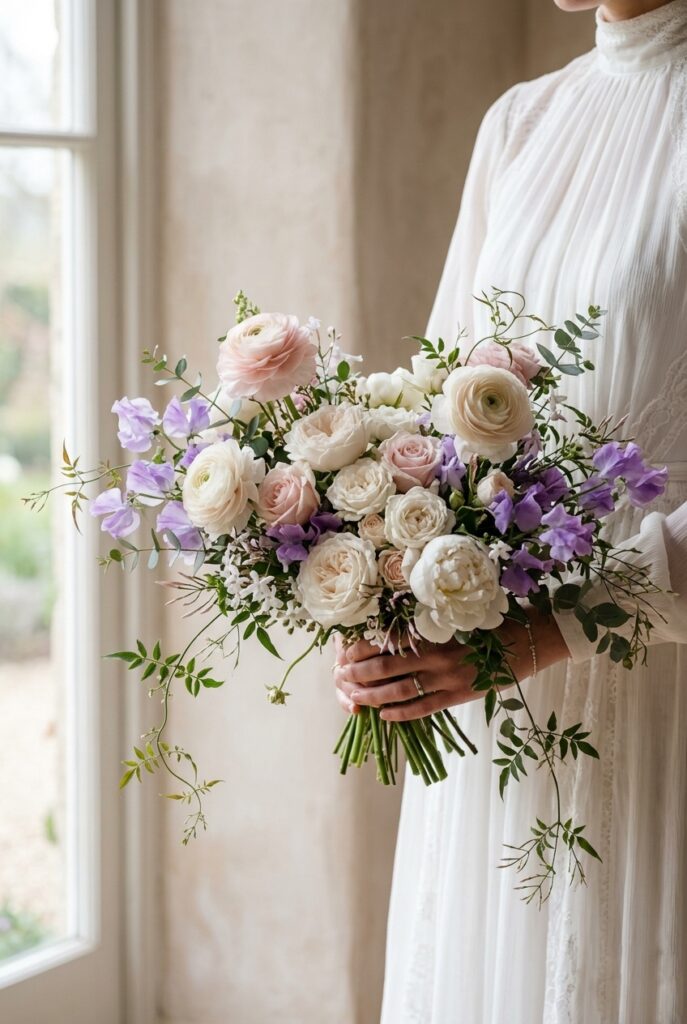
The tightly round, perfectly spherical bouquet — the kind that looks like a ball of pink — was everywhere a decade ago and has not aged well.
Photographers will tell you privately that round bouquets read as a solid blob of color in images; they lose all the individual flower detail the moment you step back more than six feet.
The loose garden bouquet, by contrast, has stems at varying heights, some flowers pushed deeper into the arrangement, others extending outward, with intentional negative space between blooms.
That negative space is what makes each flower readable in photos.
What to buy / where: Source ranunculus ($18–$28/bunch, 10 stems) and spray roses ($12–$20/bunch) from a local wholesale market or FiftyFlowers.com.
Ask your florist to leave stem length intentional and visible.
Skip this if you’re wearing a ballgown with a heavily embellished bodice — the loose, organic silhouette competes visually with beading and lace. Go cascade instead.
2. The Peony-Led Statement Bouquet: Beautiful but Only in the Right Window
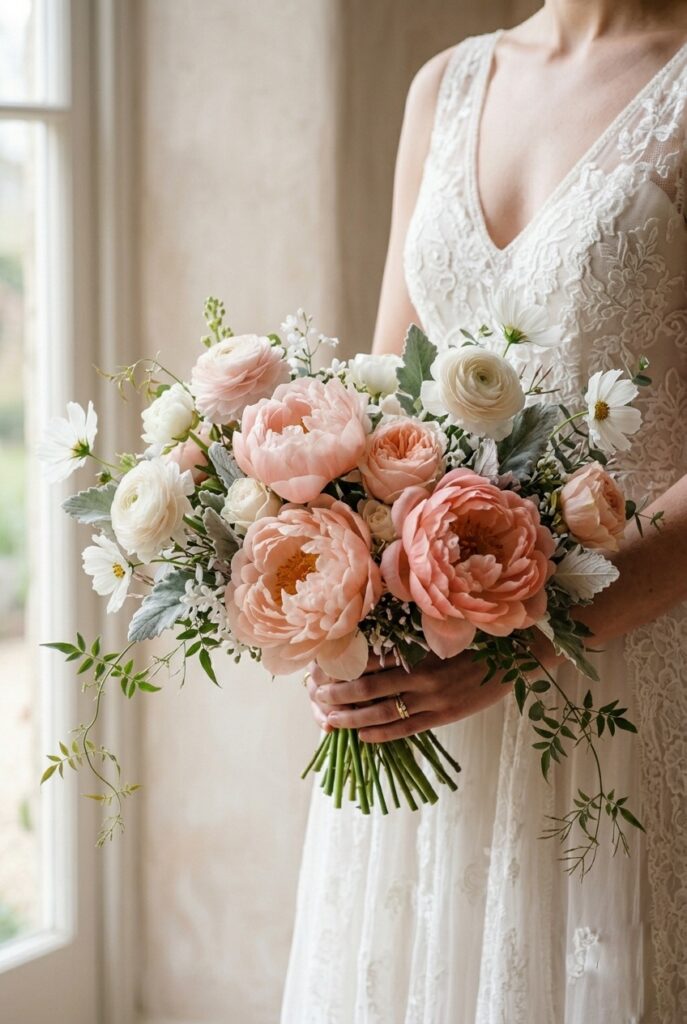
Peonies are the spring bridal bouquet flower. They’re enormous, they’re fragrant, they have an irreplaceable softness that no other bloom matches.
The problem competitors never mention: peonies in the US have a hard availability window from roughly late April through mid-June.
If your wedding is in March or very late June, your florist will source them internationally, and the price per stem can double or triple — sometimes jumping from $4 a stem to $12 or more.
Before you build your entire bouquet concept around peonies, ask your florist specifically whether they’re available from domestic growers during your wedding week.
[GAP IDEA 2 — Competitor Gap] This is the peak bloom window problem that nobody in the top results addresses.
The solution: give your florist a color palette and a mood, not a specific flower list.
A good florist sources what’s best that week, and you get a cheaper, fresher bouquet.
Ranunculus, garden roses, and anemones can all fill the same visual role as peonies when they’re at local-market peak.
What to buy / where: For a peony-forward bouquet, budget $350–$600 with a local florist depending on stem count. For wholesale DIY, check FiftyFlowers.com or a local USDA-certified wholesale market; bunches of 5 stems run $15–$22.
3. The Tulip Bouquet: The Underdog That Beats Everything for Under $200
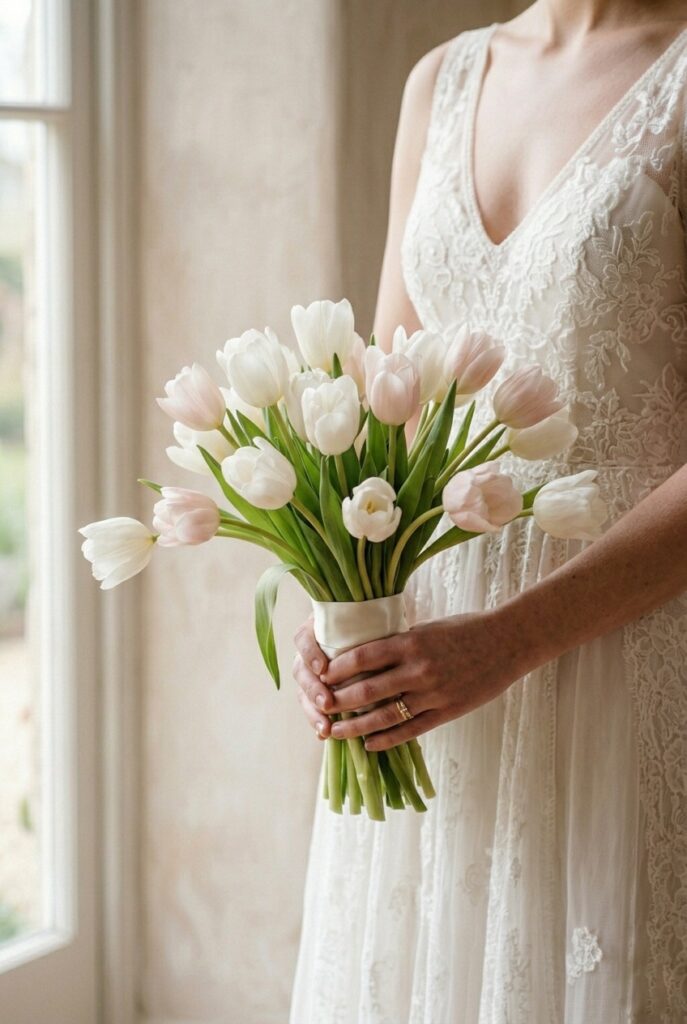
A mono-floral tulip bouquet is the most underrated thing in spring bridal flowers.
Tulips are peak-season from February through May, genuinely affordable (often $1–$3 per stem retail), and when left to relax and open slightly rather than forced tight, they take on a sculptural quality that reads as intentional and high-design, not cheap.
The trick: buy them one to two days before your wedding and let them open at room temperature rather than refrigerating them.
A relaxed tulip looks completely different from a tight bud.
What to buy / where: A bouquet of 30–40 tulips costs $40–$90 in stems from Trader Joe’s floral section, a local farmer’s market, or a Dutch wholesale supplier.
Add a wide grosgrain or satin ribbon wrap from Etsy ($6–$15) and the total outlay stays well under $200.
💸 Budget Hack #1: Trader Joe’s stocks premium Dutch tulips for $4.99–$6.99 per bunch of 10 during peak spring. Buy three to five bunches, strip the leaves, let them stand in water for 24 hours before the wedding, and you have a 40–50 stem bridal bouquet for under $35 in flowers. No other retailer comes close to that price-to-quality ratio for a single spring bloom. Go Thursday morning — new stock typically arrives Wednesday night.
4. The Cascading Bouquet: Still Stunning, Still Totally Worth It
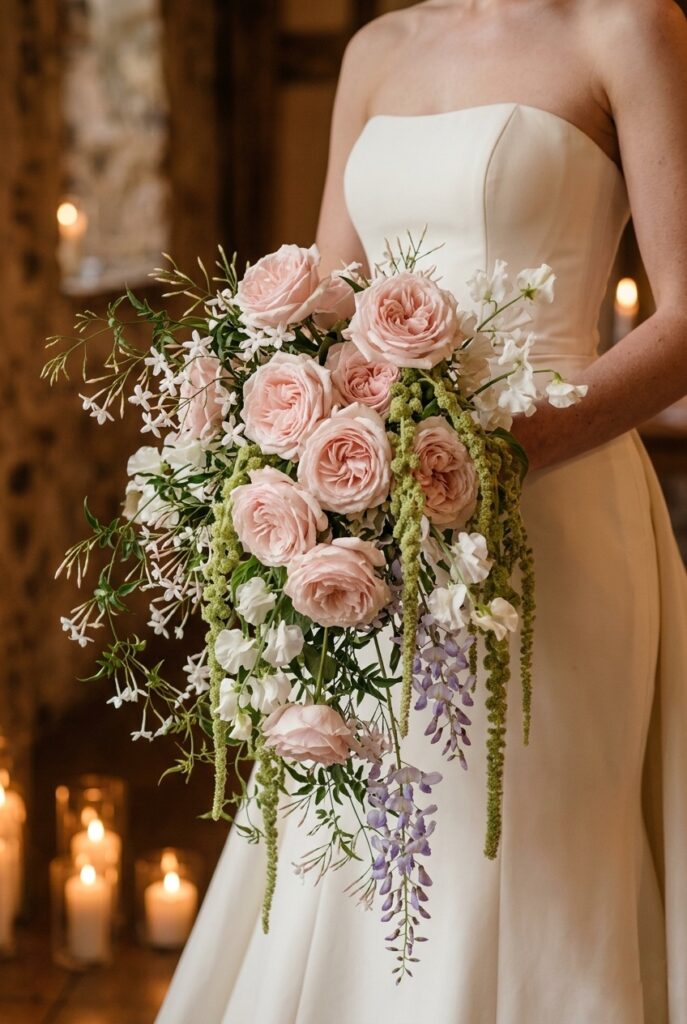
The cascade had its moment with Princess Diana and then got associated with the heavy, stiff waterfall shapes that went out of fashion.
What’s replaced it is something far more wearable: a loose-structured cascade with delicate trailing jasmine, wisteria, or hanging amaranthus that extends naturally below the base of the bouquet rather than being forced into a rigid V-shape.
This works beautifully with ballgowns and A-lines, and it photographs dramatically well because it adds vertical line to images where most bouquets add only width.
If your venue has high ceilings or your ceremony is outdoors, a trailing cascade reads as proportional and intentional. In a small chapel, it can overpower.
Scale it to the space.
Budget $400–$700 with a florist who specializes in structural bouquets; ask to see specific examples of their cascade work before booking.
Only do this if your dress has a train or a full skirt — the cascade is proportional to drama in the dress, and it will look costume-like against a mini or a sleek column gown.
5. Sweet Peas as the Star (Not the Filler): A Move Almost Nobody Makes
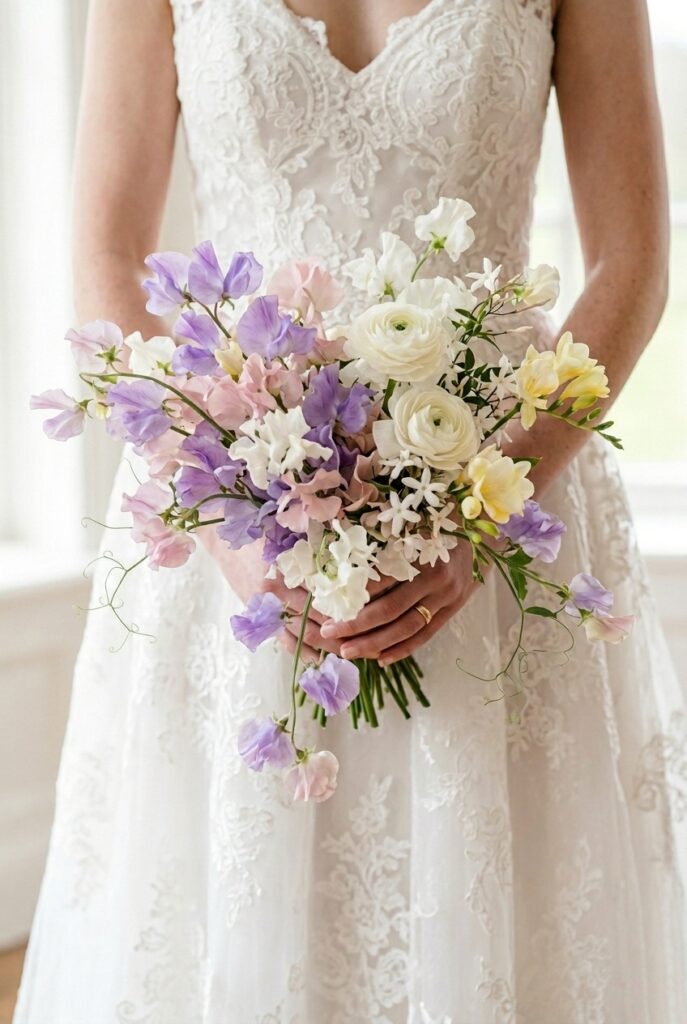
Sweet peas are almost always treated as accent filler — a few stems tucked in around the main flowers for softness and scent.
Building a bouquet where sweet peas are the lead flower is a completely different effect: ruffled, ethereal, extraordinarily fragrant, and unlike anything in the top 10 search results or on any standard florist’s sample board.
The natural tendrils left on sweet pea stems add movement in photos that staged bouquets simply can’t replicate.
The honest caveat: sweet peas are delicate and wilt faster than most spring flowers.
Your florist needs to condition them properly (24 hours in water in a cool room before the event) and you should keep them out of direct sun on the day.
Confirm availability — sweet peas peak in April through May in most of the US, and availability drops sharply in late June.
What to buy / where: Sweet peas are available through specialty flower farmers on Floret Farm’s directory, at local farmers’ markets during peak spring, or from Etsy sellers offering cut flower bundles ($28–$45 for a large bunch). Retail at florists: $4–$7 per stem.
6. The Anemone-Forward Bouquet: The Spring Flower That Stops Photographers in Their Tracks
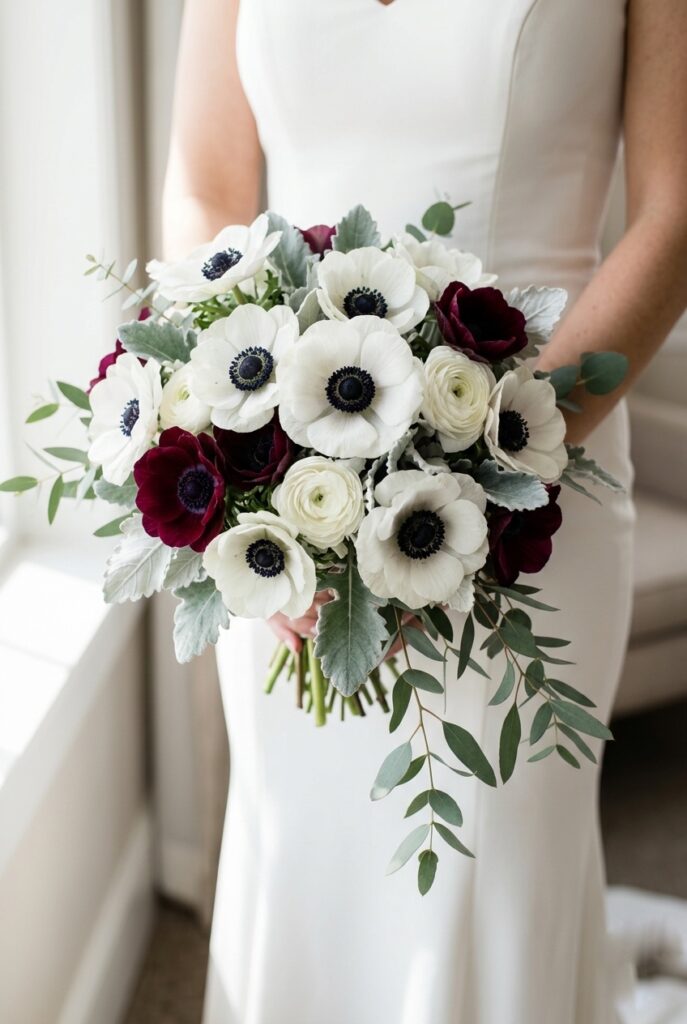
Photographers actively get excited when they see anemones in a bridal bouquet.
The reason is purely visual: the black center of a white or blush anemone creates a natural focal point that draws the eye in images, which means your bouquet photographs distinctively even in a reception full of soft pink arrangements.
Anemones peak in late winter through mid-spring (February through April primarily), which makes them a better choice for March and April weddings than for late May or June brides.
[GAP IDEA 1 — Competitor Gap: Matching bouquet to dress silhouette] Anemones carry graphic weight because of that dark center. Pair them with an airy, simple gown — a slip dress, a minimalist crepe sheath, a Regency-style bodice — and the contrast is sophisticated. Put them against a heavily beaded gown and the visual competition is exhausting.
What to buy / where: Anemones wholesale for $18–$28 per bunch of 10 stems.
Order from FiftyFlowers.com or GrowersBox.com for direct-to-bride wholesale pricing. With a florist, expect $280–$450 for an anemone-forward mid-size bouquet.
💸 Budget Hack #2: GrowersBox.com sells wholesale anemone bunches direct to consumers with no minimum order. A 10-stem bunch runs about $18–$22 during peak season. Compare that to a retail florist charging $4–$6 per stem individually. On a 40-stem bouquet, that’s a saving of $90–$120 in flowers alone. Pair with simple Italian ruscus greens (also available on GrowersBox at $15/bunch) and you have a complete base for a DIY arrangement without needing anything else. Order 10–12 days before your wedding to allow buffer shipping time.
7. Dried and Fresh Mixed Bouquets: Stop Being Afraid of This
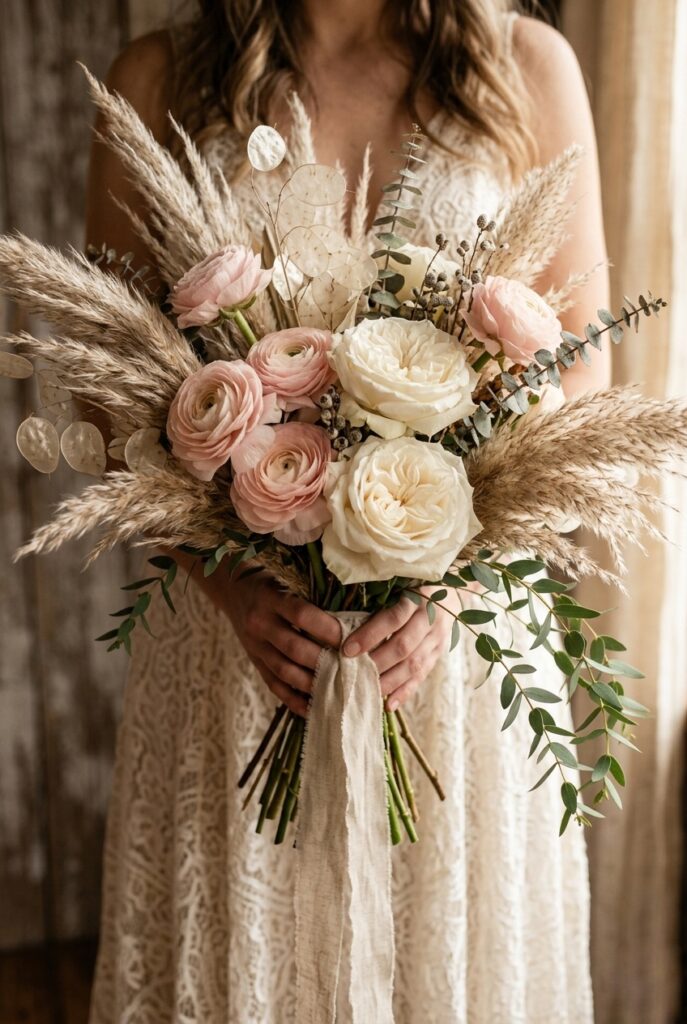
The mixed dried-and-fresh bouquet looks either brilliantly editorial or like a craft project gone wrong, and the difference comes entirely down to restraint.
The version that fails: too many dried elements, overcrowded, with fluffy pampas grass taking up two-thirds of the volume. It reads as filler disguised as a concept.
The version that works: one to two dried statement elements (a few stems of dried lunaria, a single pampas plume, some preserved cotton) combined with three to four fresh seasonal blooms as the clear focal point.
The fresh flowers lead; the dried elements add texture and extend the visual interest.
This style is particularly forgiving for outdoor spring weddings where humidity and heat can wilt delicate blooms — the dried elements hold their shape all day regardless of conditions.
What to buy / where: Dried pampas grass bundles on Etsy from small specialty farms run $18–$35 for a generous bunch. Fresh ranunculus from a local wholesale market handles the bloom weight. Total bouquet cost DIY: $65–$120; through a florist familiar with the style: $250–$380.
8. The Herb-and-Bloom Bouquet: What Nobody’s Telling You About Scent Strategy
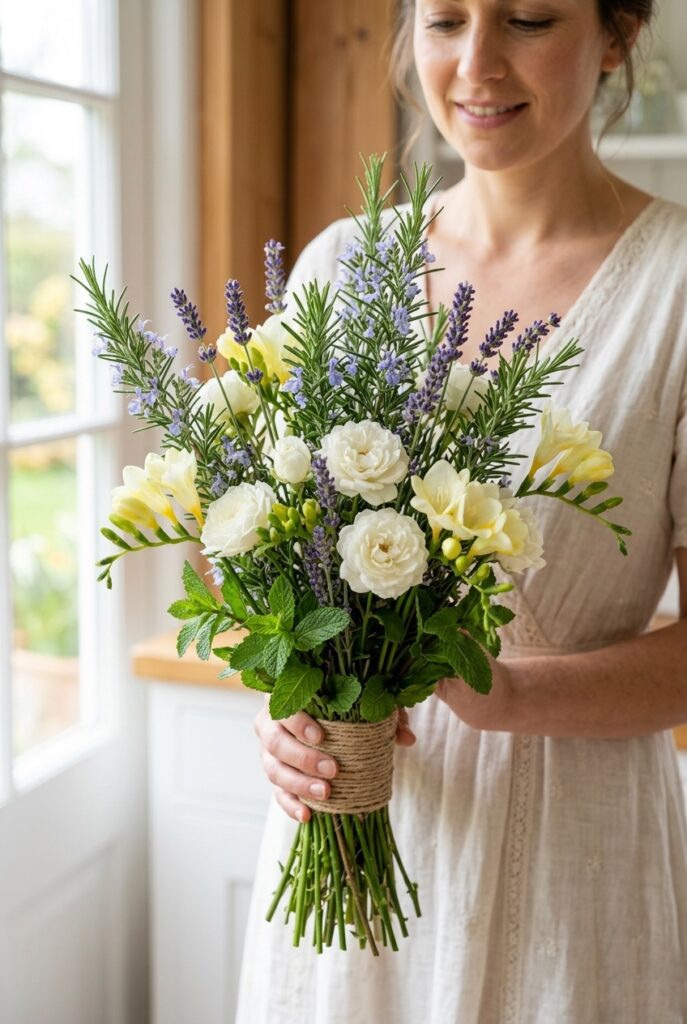
Here’s something your florist probably won’t bring up unprompted: heavily floral bouquets in an enclosed ceremony space — a small church, a chapel, a tented venue — can be overpowering for guests in the front rows.
Particularly with lilies, gardenias, and hyacinth, which all have forceful fragrance. If your ceremony is indoors, consider blending culinary herbs — rosemary, lavender, mint — with your blooms.
They’re visually beautiful, they carry a lighter, more pleasant scent, and they’re genuinely less expensive than premium floral stems.
This is a style deeply connected to cottage-garden and outdoor aesthetics referenced throughout our spring wedding decor ideas guide.
Rosemary also carries traditional symbolic meaning (remembrance) that many couples find meaningful.
Lavender is a natural spring flower that peaks perfectly in May and June.
A 60/40 ratio of blooms to herbs keeps the bouquet clearly floral while the herbs do structural and sensory work.
What to buy / where: Fresh culinary herbs are available at Whole Foods or a local farmers’ market for $2–$4 per bunch.
Combined with garden roses ($20–$30/bunch wholesale), the material cost for a herb-forward bouquet comes in at $30–$60, significantly below an all-floral arrangement of similar size.
Pair with simple rustic decor styles covered in our DIY wedding decor ideas resource.
9. The All-White Bouquet: The Most Underrated Power Move in Spring
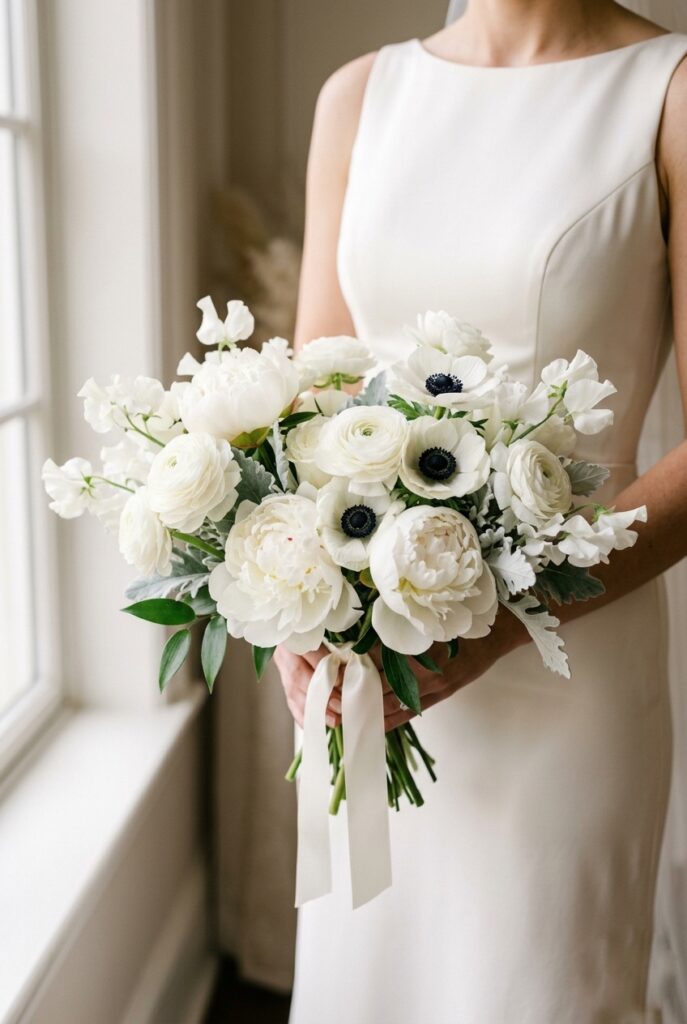
Everyone gravitates toward blush and pink for spring. Which is exactly why an all-white bouquet reads as intentional and sophisticated in a season full of pastel arrangements.
White is not the absence of color in a bouquet — it’s a design choice that makes the individual flower forms legible, that allows texture to lead over hue, and that photographs with extraordinary clarity across every lighting condition from outdoor noon ceremony to candlelit reception.
The mistake is building an all-white bouquet from all the same flowers, which flattens into one uniform surface.
Build it with texture contrast: large-petaled peonies next to ruffled ranunculus next to the graphic disk of an anemone next to the delicate racemes of sweet pea.
The white unifies; the forms differentiate.
What to buy / where: Ask your florist to build an “all-white mixed texture” bouquet rather than naming specific flowers — this gives them flexibility to use the best-available stems that week.
Budget $280–$500 through a florist; or DIY from a wholesale supplier for $60–$120 in stems.
For a clean, minimal wedding aesthetic, see our guide to simple wedding decor ideas for how to extend this palette throughout your reception.
💸 Budget Hack #3: Sam’s Club and Costco Business Center floral departments regularly stock bulk white ranunculus and white roses during spring for 30–50% below retail florist prices — typically $18–$25 for a 10–15 stem bunch. Call your local warehouse club on a Wednesday morning to ask what their current spring stems are; you can often buy the same quality a bridal florist uses, without the bridal markup. Combine with $12 worth of greenery from Trader Joe’s and you have the base of a stunning all-white bouquet for under $50 in materials.
10. The Single-Stem Bridal “Bouquet”: The High-Fashion Bride’s Secret Weapon
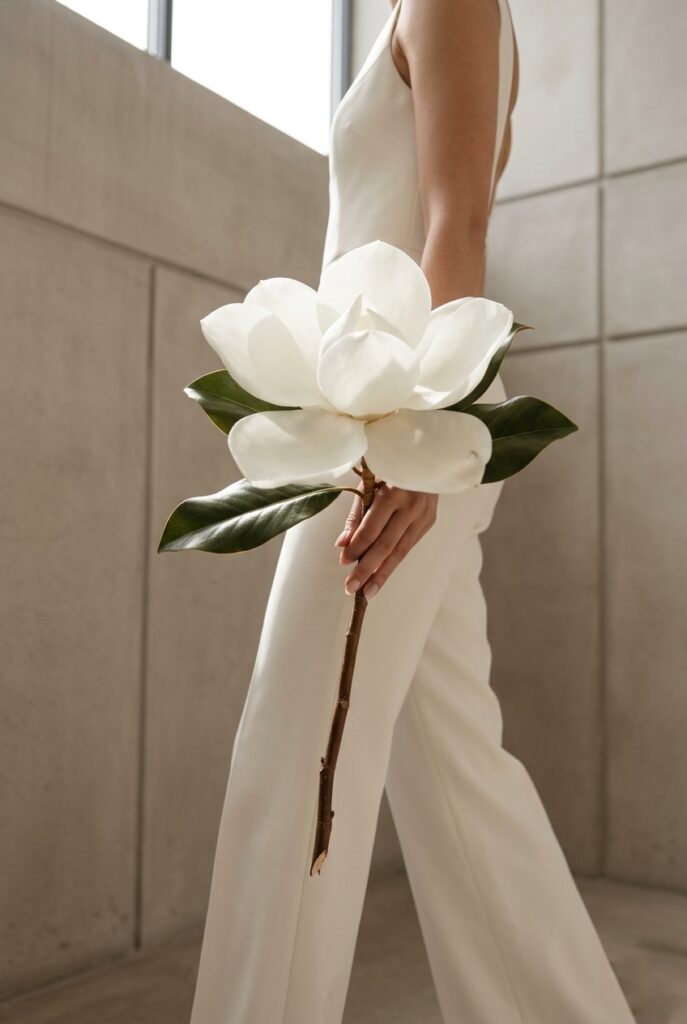
This is the bold move that polarizes people, which is exactly why it works.
A single oversized stem — one magnolia bloom, one king protea, one oversized garden rose, one large-headed sunflower — held naturally against the hip is not a mistake or a budget shortcut.
It is a fashion statement that reads more as editorial styling than as a traditional wedding bouquet, and for the right bride it is more distinctive than any elaborate arrangement in this article.
It has an obvious home with minimalist gowns, with brides who don’t enjoy elaborate florals, and with couples leaning toward unique wedding decor ideas who want the individual visual elements to be deliberately spare.
The single stem photographs beautifully because there is no competition — just the bloom, the hand, and the dress.
Only do this if your personality genuinely skews editorial or minimal. If you wanted a lush bouquet but are considering this to save money, you will regret it. Save money elsewhere.
What to buy / where: A king protea runs $8–$15 per stem at specialty florists or online from FlowerMoxie.com.
A large magnolia or garden rose is $4–$8 per stem. Total cost: under $20.
Decision Filter
If your wedding is in March or April and you’re choosing between styles, lean toward anemones, sweet peas, and ranunculus — these are at local US peak during that window and will be fresher and less expensive than peonies.
If your wedding is in May or June, peonies are fully available and worth building around. For outdoor weddings over 100 guests, the bouquet competes visually with a wider space — go larger and looser, not tighter.
For an intimate ceremony under 50, a single-stem or a small 25-stem arrangement reads perfectly proportional and intentional.
If your dress is heavily embellished, keep the bouquet textured-but-not-chaotic; the garden loose style works, but the herb-and-bloom or all-white mix will prevent the visual from fighting your bodice.
The Real Reason
The best bouquet decision you can make is telling your florist your favorite photograph of a wedding bouquet — not a list of flowers, not a color palette swatch, just one image.
Here’s the contrarian truth most couples don’t hear: florists design backward from what brides ask for rather than forward from what the florist knows is available and beautiful that week.
When you hand a florist a specific flower list, they’re locked into sourcing those exact stems regardless of freshness or price. When you hand them an image, they can source the most gorgeous equivalent stems at peak quality without being constrained by a name. The image communicates shape, scale, texture, and color simultaneously.
The strong opinion: most spring bridal bouquets are too small.
Not too expensive — too small. A bouquet that ends at mid-torso looks proportional in an Instagram square but disappears in a full-length portrait against a garden backdrop or a venue with 20-foot ceilings.
Size up by 20% from whatever you’re initially planning.
The insider observation: Your bouquet should be photographed in natural window light at the venue before the ceremony, not just during the processional.
Every photographer knows this, almost no coordinator schedules it. A 10-minute dedicated flat-lay or detail shoot of the bouquet against a wooden pew, a stone wall, or the bridal suite windowsill produces the keepsake images most brides say they wish they had more of.
Ask your photographer to schedule it into the pre-ceremony timeline. It costs nothing and it changes your album.
You can also coordinate this moment with your overall decor approach — see how top photographers approach the detail-rich environments in our elegant wedding decor ideasarticle.
Mistakes to Avoid
Mistake 1: Locking in a specific flower list before confirming availability with your florist Every spring bouquet article tells you to “choose your favorite spring flowers” — and then doesn’t mention that lily of the valley costs $8–$15 per stem and is only available for roughly five weeks, or that peonies in March require overseas sourcing that can triple their cost.
Confirm availability for your specific wedding date, not the season in general, before designing around any specific bloom.
Mistake 2: Spending $600 on a bouquet while under-budgeting ceremony flowers The number of couples who spend $500–$700 on a bridal bouquet and then put $150 toward ceremony arch flowers is staggering — and the result is a beautiful bouquet photographed against a sparse, forgettable backdrop.
Your photographer will capture that arch behind you for every ceremony portrait.
A $350 bouquet with $350 redirected toward the ceremony arch produces better wedding photos than a $700 bouquet in front of nothing.
Budget for the context, not just the object. For smart allocation ideas, our budget wedding decor ideas guide breaks this down by venue type.
Mistake 3: Choosing a bouquet style you’ve never held before Nobody tells you this until after the wedding: cascading bouquets are heavy.
A full cascade with trailing amaranthus and structural stems can weigh two to three pounds and gets heavier as your arm fatigues during a 20-minute ceremony and hour-long cocktail photo session.
Some brides develop a noticeable arm tremor in their ceremony photos because they’re fighting the weight.
If you want a cascade, do a physical trial with your florist before the wedding — hold it for 20 minutes, walk with it, see how your wrist angle shifts.
This is not optional for a structural bouquet.
Mistake 4: Matching your bridesmaid bouquets too closely to the bridal bouquet Your bouquet should read as distinctly yours from across the room.
When bridesmaids carry the same flowers in the same palette — just smaller — the effect in photographs is a visual wash where everyone looks like part of a coordinated set and the bride doesn’t stand out.
Give your attendants a complementary palette with a different flower as the lead: if you carry peonies, they carry ranunculus.
If you carry white anemones, they carry blush spray roses.
The contrast draws every eye in the room to you specifically.
This also extends to how your floral palette ties into the broader tablescape — which our wedding table decor ideas article covers in detail.
FAQ
What flowers are in season for a spring bridal bouquet?
The peak spring season (March–June in the US) brings peonies, ranunculus, sweet peas, tulips, anemones, lilac, hyacinth, and garden roses to their best availability and lowest price.
Availability varies significantly by month — anemones and sweet peas peak earlier (March–April), while peonies and garden roses are strongest in May–June.
Always confirm your specific wedding date with a local florist rather than assuming all spring blooms are available simultaneously.
Check The Knot’s spring flower availability guide for a US regional breakdown.
How much does a spring bridal bouquet cost?
A spring bridal bouquet typically runs $150–$600 through a florist, depending on flower choice, stem count, and design complexity.
Single-flower or simple tulip bouquets can come in under $200; lush peony-and-ranunculus arrangements from a premium florist run $350–$600.
DIY from wholesale suppliers can cut costs to $40–$120 in materials.
The biggest variable is which specific flowers you choose — lily of the valley and gardenia cost significantly more per stem than tulips, sweet peas, or ranunculus at the same time of year.
What is the most popular bridal bouquet style for spring weddings?
The loose, organic garden bouquet is the most requested spring bridal style right now — a departure from the tightly round arrangements that dominated in previous decades.
These bouquets feature varied stem heights, intentional negative space, and a “gathered from the garden” quality.
For spring specifically, brides are combining ranunculus, garden roses, and sweet peas in soft palettes of blush, ivory, and sage, often with trailing foliage or vines.
Explore Zola’s wedding flower planning tool to build a full floral vision board before meeting your florist.
Can I DIY my spring bridal bouquet?
Yes — spring is the most achievable season for DIY bridal bouquets because peak-season stems are fresher, more forgiving, and available at accessible sources like Trader Joe’s, Costco, and local farmers’ markets.
A 30–40 stem hand-tied bouquet in tulips or ranunculus is manageable for anyone who can follow a YouTube tutorial.
The realistic caveat: structural bouquets (cascades, armature designs) require real technique and should be left to a professional or practiced extensively before the wedding day.
For a full walkthrough of DIY floral projects, our DIY wedding decor ideas article covers technique and sourcing.
Budget Table
| Bouquet Style | DIY Cost | Florist Cost | Best Spring Flowers | Where to Source |
|---|---|---|---|---|
| Tulip mono-floral | $35–$65 | $120–$200 | All spring (Feb–May) | Trader Joe’s, farmers’ market |
| Loose garden bouquet | $60–$120 | $250–$450 | Ranunculus, spray roses | FiftyFlowers.com, local wholesale |
| Peony-led statement | $80–$150 | $350–$600 | Late April–mid June | Florist/local wholesale |
| Sweet pea-forward | $45–$90 | $200–$380 | April–May | Floret Farm directory, Etsy |
| Anemone bouquet | $55–$100 | $280–$450 | February–April | GrowersBox.com |
| Herb-and-bloom | $30–$60 | $180–$320 | April–June | Whole Foods, farmers’ market |
| All-white mixed | $50–$120 | $280–$500 | All spring | Costco/Sam’s Club + local market |
| Cascading bouquet | $100–$200 | $400–$700 | May–June (peak trails) | Specialty florist required |
| Single statement stem | $8–$20 | $30–$80 | Variety-dependent | Specialty florist, FlowerMoxie.com |
The bouquet you carry will appear in more photographs than any other single object at your wedding — more than the cake, more than the dress details, more than the centerpieces.
That’s not a reason to overspend. It’s a reason to spend intentionally, choose with your dress and venue in mind, and have one honest conversation with your florist about what is actually beautiful and available on your specific wedding date rather than building a wishlist from images shot in a different season.
Pick one idea from this article that genuinely excites you, text your florist today with a single reference image, and ask what they’d build around it right now with what’s at local market.
That conversation costs nothing and will get you 80% of the way to your bouquet.