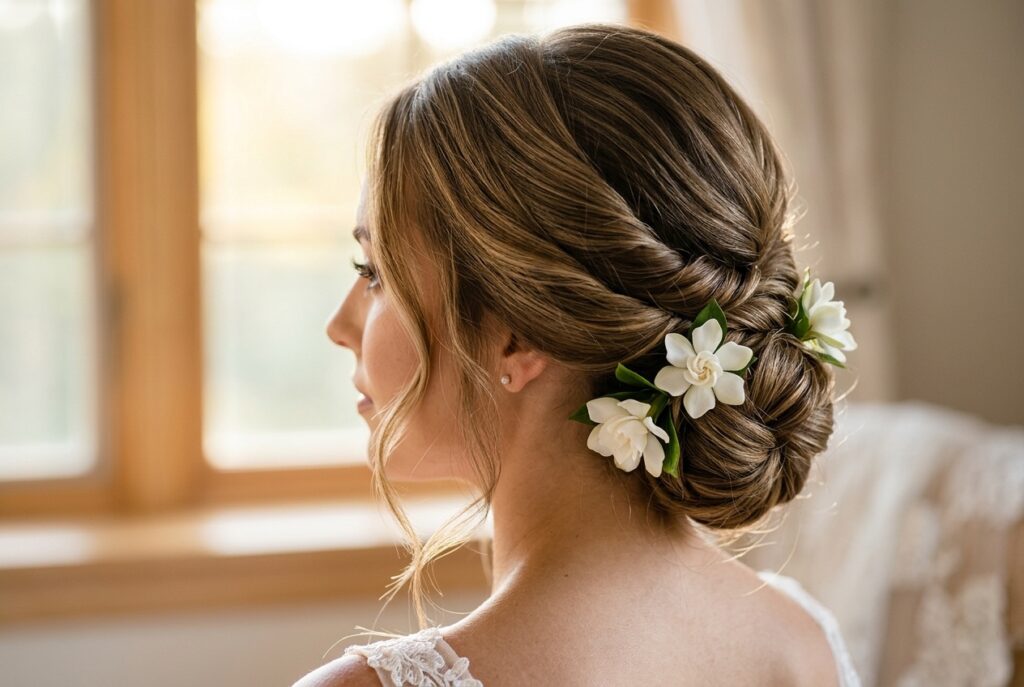
10 Bridal Bouquet Styles: Will Match Your Aesthetics For Sure!


Bridal bouquet of garden roses, ranunculus, eucalyptus against ivory satin gown
3:2 landscape

You’ve been looking at flower photos for weeks, and you still can’t explain what’s wrong with most of them — they look fine, but not quite you

The problem isn’t the flowers. 

It’s that bouquet advice almost always starts with blooms when it should start with your dress. 

This guide works the other way: dress first, then shape, then flowers — and by the end, you’ll know exactly what to ask your florist


1. The Round Posy: The Dress-Agnostic Workhorse
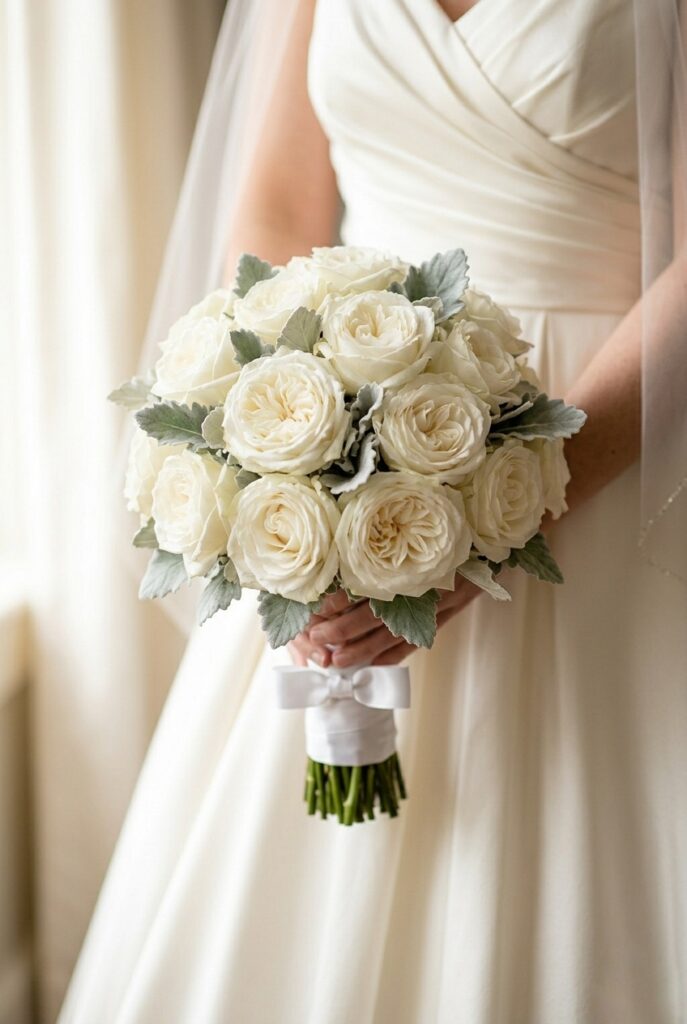
Tight round posy, white garden roses and dusty miller

A round posy is the most reliably flattering bouquet shape because it has a defined edge that creates a clean focal point against any dress silhouette. 

Ball gown, A-line, column — the posy works with all three. Where it falls down: lace-heavy gowns, where the circular geometry competes with the organic texture of the lace, making neither look intentional. 

If your dress is heavily textured or patterned, move to the garden-style or loose-gathering shapes below. 

Price range for a posy with quality blooms (garden roses, ranunculus, dusty miller): $175–$350 depending on your region and florist, sourced through a local florist found via The Knot’s florist directory

Only do this if you want clean, graphic photos — the posy photographs the most consistently of any bouquet shape.


2. The Garden-Style Gathering: For Dresses That Need to Breathe
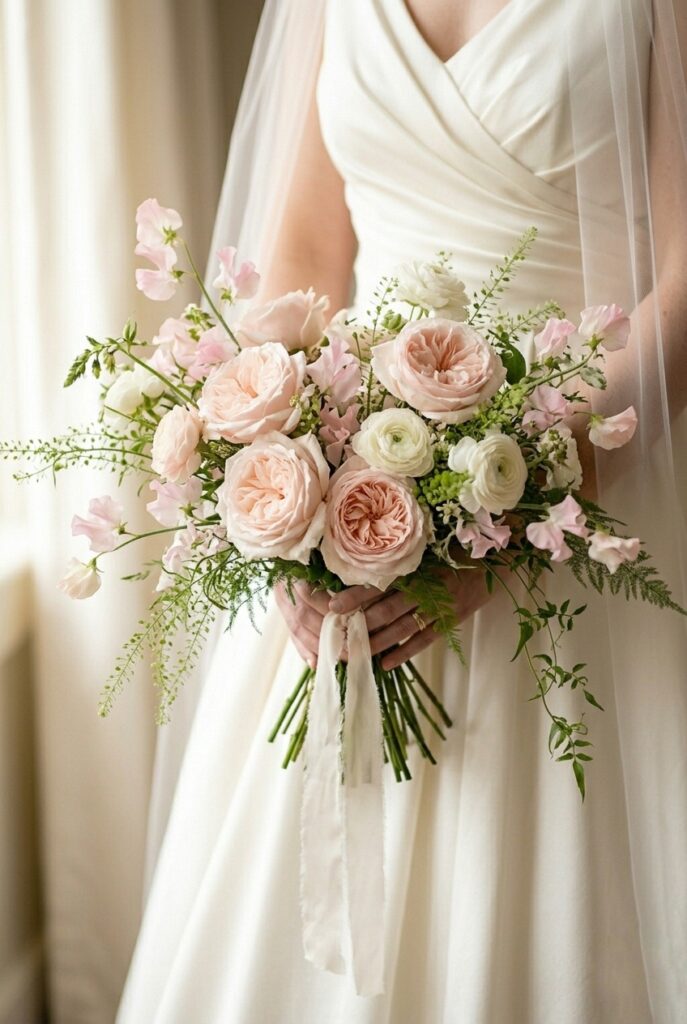
Loose garden-gathered bouquet, blush roses and sweet peas

The garden-style bouquet — sometimes called a gathered or “just-picked” arrangement — is loose-handed, with stems of varying heights and flowers that haven’t been forced into a dome. 

This is the right call for lace gowns, bohemian dresses, soft tulle, and any silhouette with organic texture, because the bouquet’s own looseness mirrors the dress and lets both breathe. 

The version that fails: a “loose” bouquet that’s actually just a messy posy with stems pointing in all directions and greenery that looks like it came from someone’s backyard.

Ask your florist specifically for “conscious looseness” — meaning the arrangement should look studied, not haphazard. 

Price range: $200–$420, with the cost driven primarily by flower variety count and stem count. 

If you’re planning a garden-themed wedding, this style flows naturally into the broader aesthetic explored in these garden wedding decor ideas.


3. The Cascading Bouquet: Powerful, Earned, and Misused
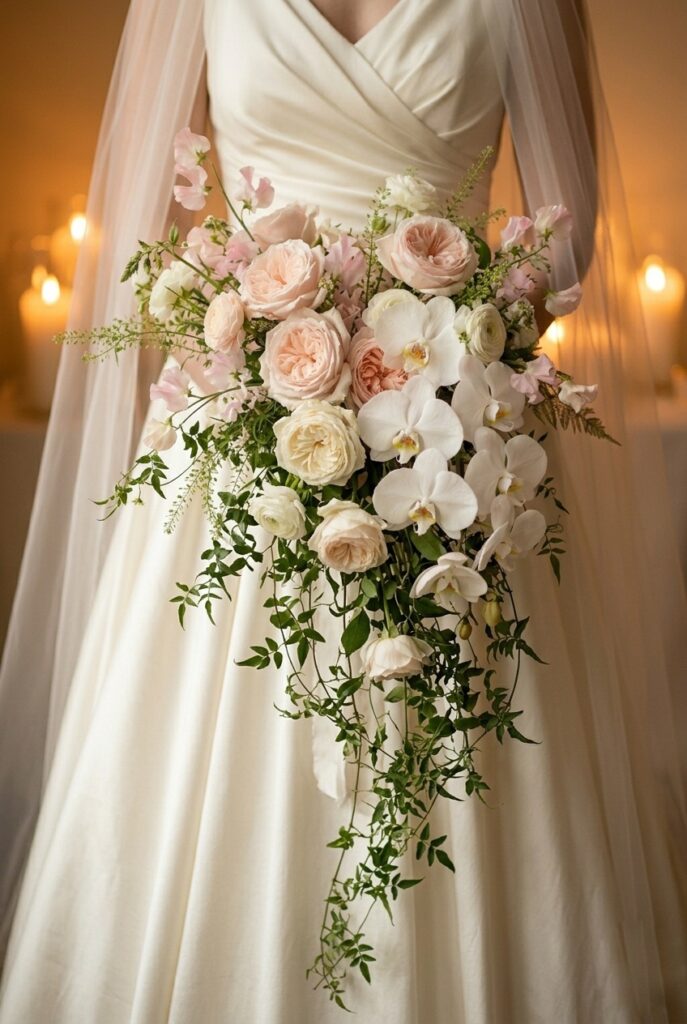
Cascading waterfall bouquet with orchids, roses, and ivy

Cascading bouquets have been overused as a shorthand for “grand wedding,” but when they’re right, nothing else comes close. 

A cascade is specifically correct for two situations: ball gowns with a full, sweeping skirt that needs the vertical line of the cascade to balance the horizontal volume at the hem, and cathedral-length trains where the drama of the dress calls for a bouquet with equal visual weight. 

Skip this if your dress is a column, sheath, or minimalist silhouette — the cascade overwhelms a dress that’s doing its work through restraint. 

Also skip it if your venue has low ceilings or tight aisle spacing; a 24-inch cascade in a small chapel reads as cramped. 

For details on how grand ceremony aesthetics work together as a system — florals, architecture, lighting — the breakdown in this guide to indoor elegant wedding decor is worth your time. 

Price range: $350–$700+, reflecting the significantly higher stem count and construction time.


💸 Budget Hack #1: Cascading bouquets cost more because of labor, not just flowers — the trailing elements require wire armature and significant construction time. You can cut 30–40% of the cost by asking your florist to do a “half-cascade” or “waterfall posy”: a full round top with 8–10 trailing ivy or smilax stems below, rather than a full structured trail. The photos read as a cascade; the price doesn’t. This saves roughly $120–$200 on average versus a full constructed cascade.


4. The Single-Stem Statement: A Bold Opinion
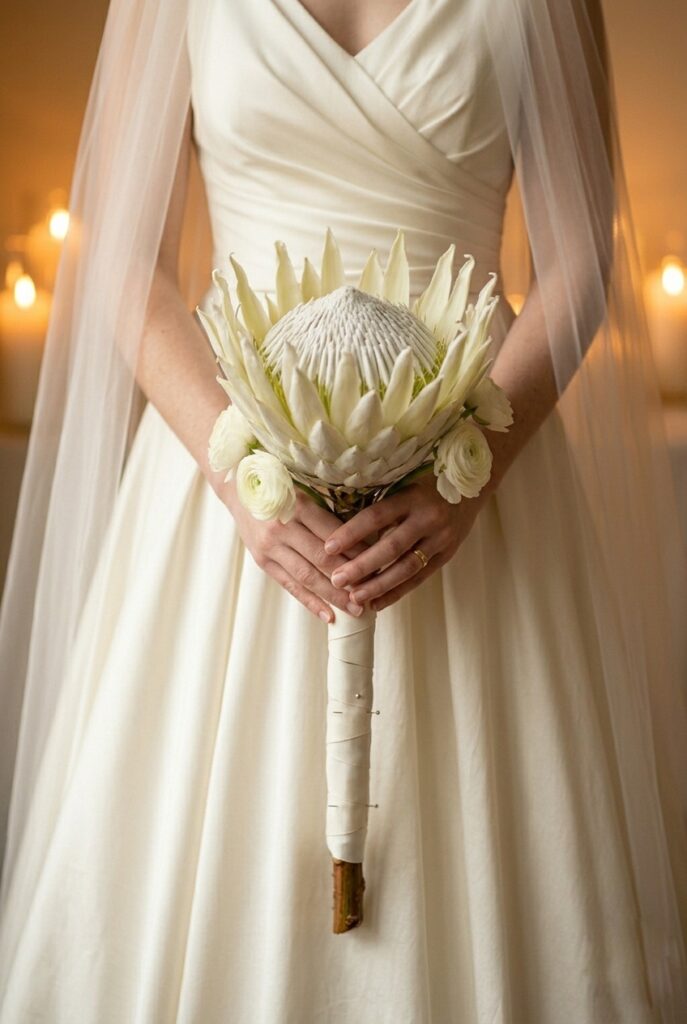
Single king protea stem with wide ribbon wrap

Nobody tells you this is an option. 

A single structural stem — a king protea, a giant garden peony at full open bloom, a single calla lily — carried with a wide ribbon wrap is one of the most distinctive choices a bride can make, and it works precisely because it’s unexpected. 

It’s also the most affordable bouquet on this list at $40–$90 total, which makes it the right call for brides who want their budget in the venue and the dress, not the florals. 

The single stem works for minimalist, modern, and architectural dress silhouettes — think crepe, structural satin, simple column. 

It fails immediately on romantic, lace-heavy, or maximally embellished gowns where the single bloom looks incomplete rather than intentional. 

Only do this if you’re committed: a half-hearted single stem reads as underbaked. A confident one reads as editorial.


5. Dried and Preserved Flowers: The Enduring Alternative
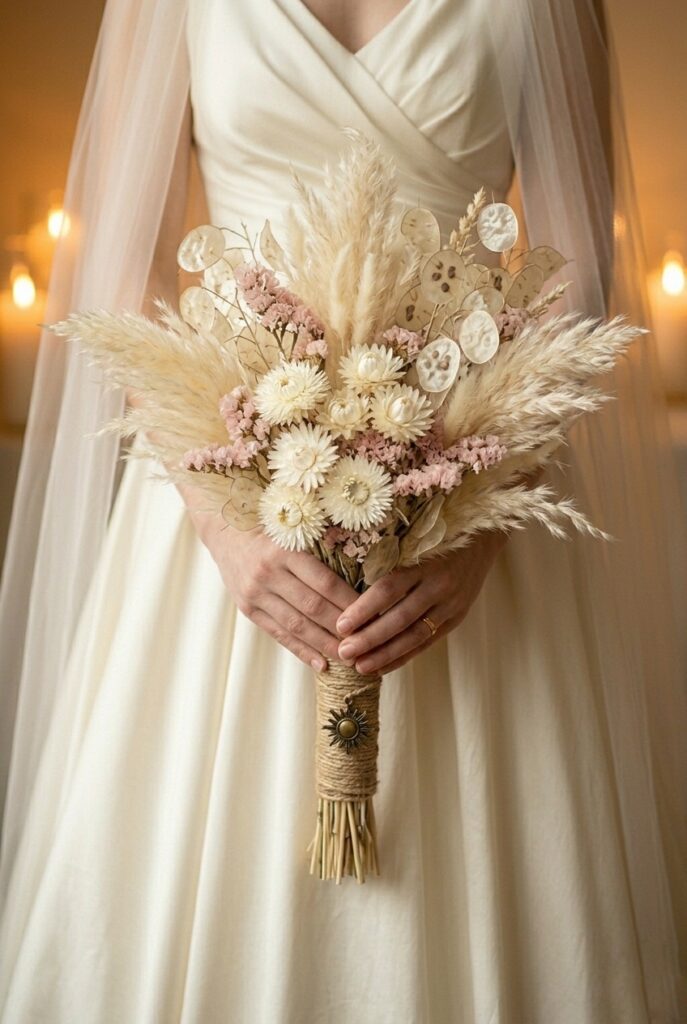
Dried and preserved bouquet — pampas, strawflowers, lunaria

Dried and preserved bouquets have crossed over from niche to genuinely mainstream, and for good reason: they can be ordered months ahead, they don’t wilt in heat, they survive an outdoor summer ceremony, and they can be kept permanently afterward without freeze-drying. 

For an outdoor, rustic, boho, or vintage wedding — particularly the kind of venue covered in these rustic wedding decor ideas — a dried bouquet can feel more native to the setting than fresh flowers. 

The version to avoid: dried bouquets that use brown-tipped, poorly stored stems that read as dead rather than preserved. 

Source from a specialist — Etsy shops like WildernessBloomsCo or Fleurette Florale use properly dried, color-fast stems. 

Price range: $120–$300, with the significant advantage that you order 4–6 weeks out and the bouquet ships directly to you.


6. The Monochromatic Bouquet: Color Theory You Can Carry
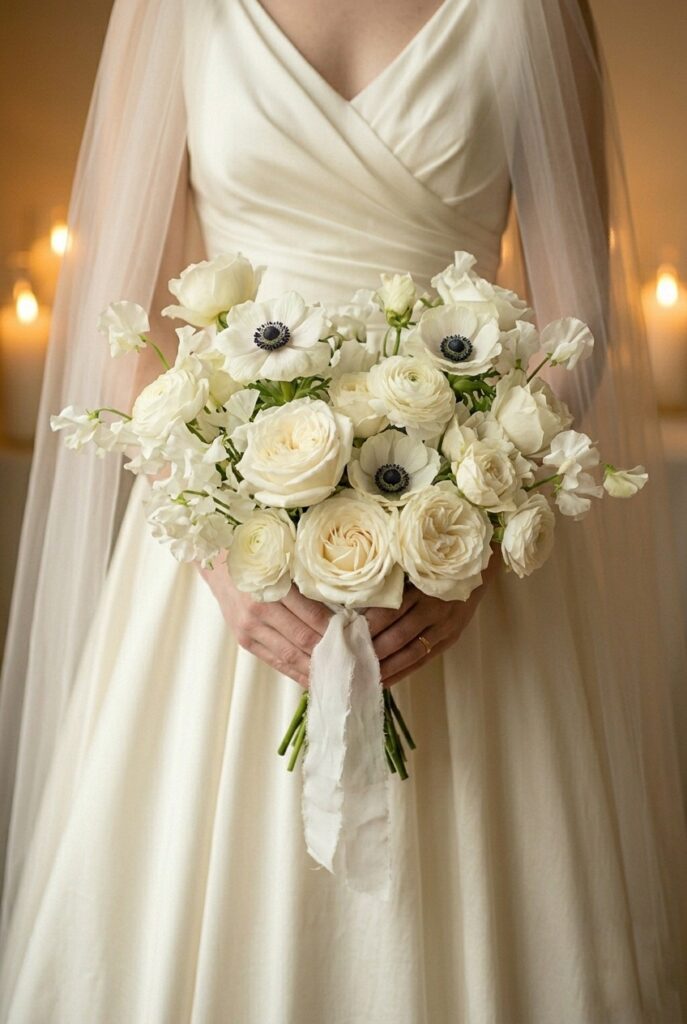
All-white monochromatic bouquet with texture variation

[GAP IDEA 1 — competitor gap] Almost every competitor article treats monochromatic bouquets as “classic white,” as if they’re a default or a backup plan. 

The actual design principle here is the one they miss: monochromatic doesn’t mean boring — it means the interest must come entirely from texture and form variation within a single color family, which is the hardest thing to execute well and the most photogenic when done right. 

An all-white bouquet with five varieties of flower at five different stages of bloom — a fully open garden rose next to a tight ranunculus bud next to a soft sweet pea next to a spiky anemone — reads as intentional and sophisticated. 

The same all-white bouquet built from uniform spray roses and baby’s breath reads as a grocery store flower arrangement from 1994. 

When building your monochromatic bouquet, ask your florist to use at minimum four distinct bloom types with different petal shapes. 

The more structural variation, the stronger the result. 

Price range: $180–$380, sourced through your florist or via FiftyFlowers.com’s wholesale bridal bouquet builder for DIY assembly.


💸 Budget Hack #2: An all-white monochromatic bouquet is significantly cheaper to build yourself than any colorful arrangement because white blooms are the most widely available, year-round flower category. White spray roses from Sam’s Club or Costco run $15–$20 for 40 stems. Add white anemones from FiftyFlowers.com ($28 for 25 stems) and white lisianthus from your local wholesale flower market. Total material cost for a full-sized bouquet: $55–$80. The visual result, with proper stem-gathering technique (spiral method, rubber band tightened, then ribbon-wrapped), is indistinguishable from a $300 florist build.


7. Greenery-Forward: When the Foliage Is the Feature
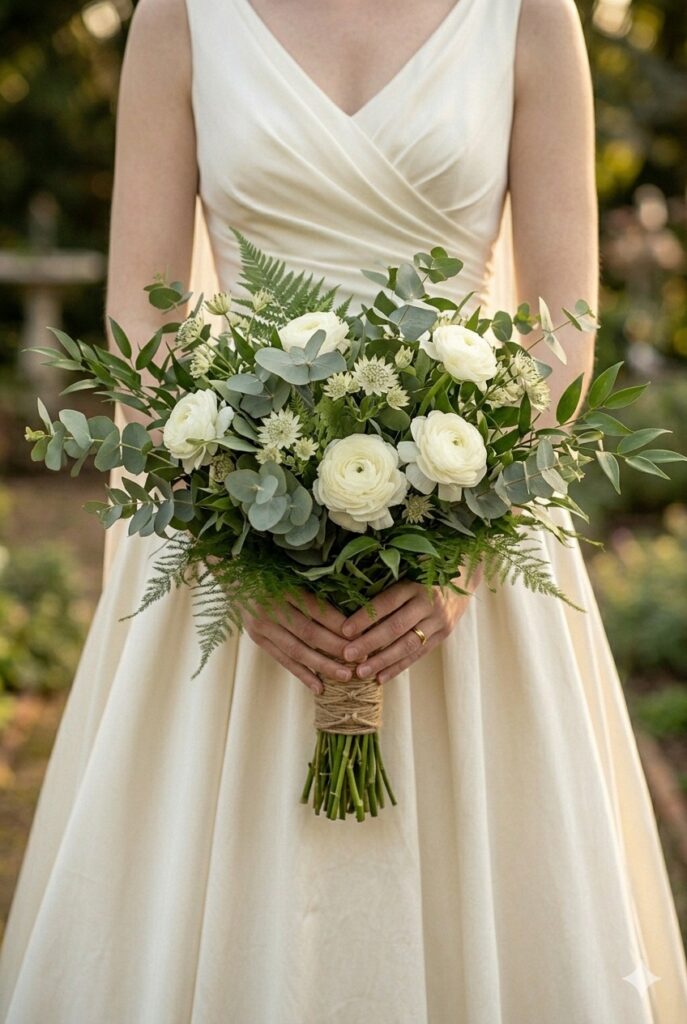
Greenery-forward bouquet with eucalyptus, ferns, white ranunculus

A greenery-forward bouquet — where foliage is the majority and flowers play supporting roles — is the most underused style in this category and the one with the best cost-to-impact ratio. 

Eucalyptus, fern, Italian ruscus, maidenhair fern, and olive branches cost roughly 40–60% less than premium blooms, and a generous volume of quality greenery with a handful of white accent flowers photographs with more depth and texture than a flower-heavy bouquet of similar size. 

This works for outdoor venues, garden and vineyard settings, and minimalist aesthetics. 

It fails for ultra-formal venues — a greenery bouquet at a hotel ballroom reads as incomplete. 

Price range: $120–$240, with cost driven by foliage variety. 

This style is a natural partner to the kinds of simple wedding decor ideas that prioritize restraint and natural texture over volume and color.


8. The Architectural Bouquet: Geometry Over Romance
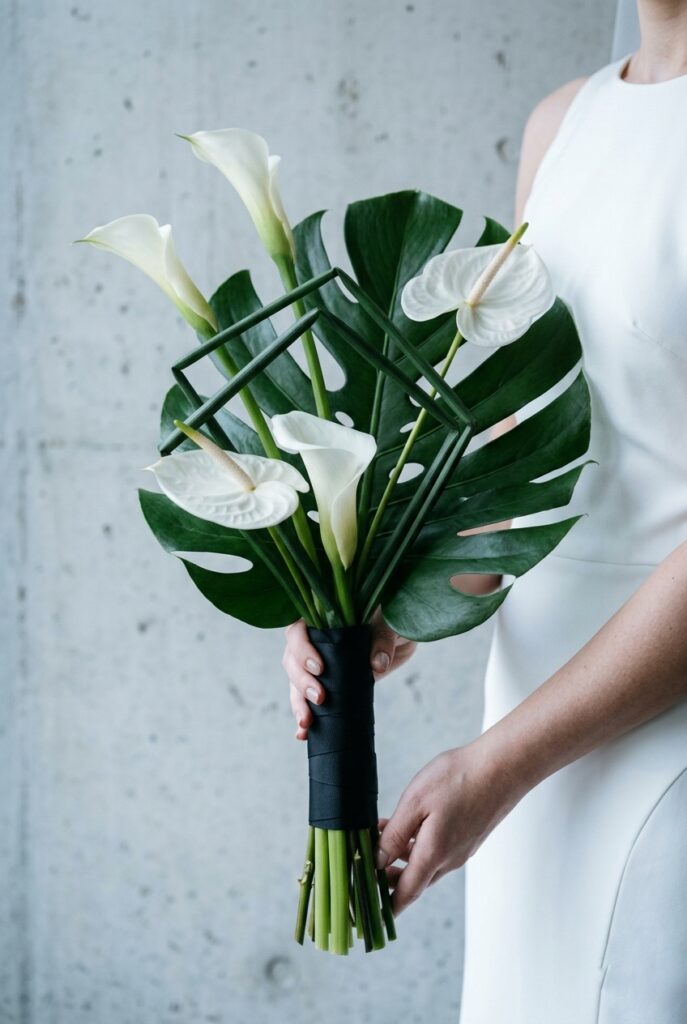
IMAGE 8 HERE Alt text: Architectural bridal bouquet with sculptural calla lilies, anthuriums, and monstera leaves in a modern geometric arrangement Image prompt: Photorealistic editorial-style photo of a modern architectural bridal bouquet featuring long-stemmed white calla lilies, white anthuriums, and a single large monstera leaf. The arrangement is deliberately angular and geometric rather than round — stems cross at clean angles, creating visual structure. Stems wrapped in wide black grosgrain ribbon. Cool, soft natural window light with slight blue cast. Photographed against a pale grey concrete wall background. No text overlays. Generate in vertical portrait orientation, 2:3 aspect ratio, optimized for mobile display.
1 image

[GAP IDEA 2 — competitor gap] Not one of the top-10 competitor articles mentions the architectural or sculptural bouquet as a distinct category. 

These are bouquets built on structural logic rather than romantic abundance: calla lilies arranged at deliberate angles, king proteas paired with monstera leaves, anthuriums stacked above maidenhair fern. 

This style is specifically correct for modern and minimalist weddings, industrial venues, and art-forward couples — the precise audience that finds romantic garden bouquets misaligned with their aesthetic but hasn’t been shown what the alternative looks like. 

The architectural bouquet reads as intentional art direction, not just flowers. It also photographs with striking clarity against a clean backdrop, which matters on a day when half your photos will be close-up bouquet shots. 

Price range: $200–$450, with the premium driven by structural blooms (calla lilies, anthuriums, protea) rather than construction complexity.


9. The Heirloom-Added Bouquet: Making It Personal Without Making It Cluttered
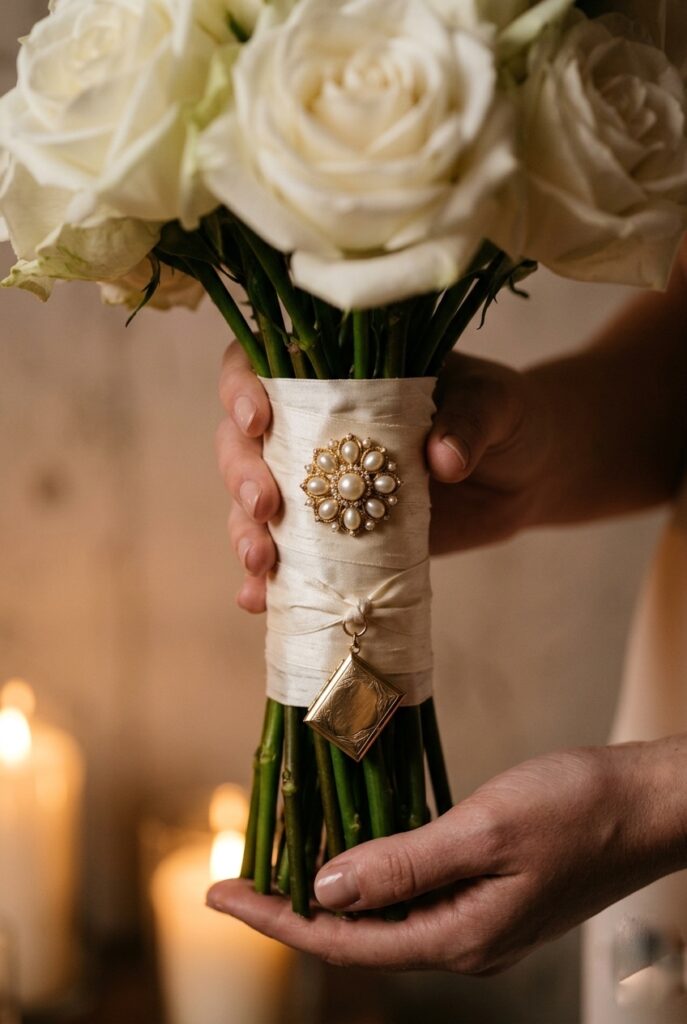
IMAGE 9 HERE Alt text: Bridal bouquet with vintage brooch and grandmother's pearl earring wrapped into the stem ribbon as a sentimental heirloom detail Image prompt: Photorealistic close-up detail shot of a bridal bouquet stem wrap, showing ivory dupioni silk ribbon wrapped tightly around white rose stems. A single vintage pearl and gold brooch is pinned into the center of the ribbon wrap, and a small folded locket charm hangs from the knot below. Warm candlelit atmosphere with soft golden light. The flowers above are slightly blurred, keeping focus on the ribbon and heirloom details. No text overlays. Generate in vertical portrait orientation, 2:3 aspect ratio, optimized for mobile display.

The brooch-and-ribbon stem wrap is the right way to personalize a bouquet — small, invisible in full-length shots, intimate in close-ups. 

What it isn’t: a brooch bouquet, where the entire arrangement is constructed from brooches and silk flowers instead of real blooms. 

That version became a trend, and it peaked. A heavy brooch bouquet weighs significantly more than a fresh flower arrangement, it photographs with a metallic glare rather than organic warmth, and most brides who made one in the last decade no longer have strong feelings about it. 

A single meaningful piece — a grandmother’s pearl brooch, a locket with a small photo, a charm from a childhood bracelet — wrapped into the ribbon stem of your actual flower bouquet is the version that lasts. 

It costs nothing beyond the flowers themselves and creates the photo detail people actually ask about. 

Skip this if your dress has extremely heavy embellishment at the waist — the stem detail won’t read at all and the extra weight becomes a fatigue issue.


💸 Budget Hack #3: The single biggest variable in bouquet price is not the flower variety — it’s the stem count. A lush-looking bouquet can be built from 18–22 stems at the right size and with the right supporting greenery, but most brides over-order at their florist consultation because they’re seeing loose stems in a bucket rather than a finished arrangement. Before finalizing your order, ask your florist to show you a mock assembly with 18 stems, then 25, then 35. You’ll almost always find that 22 stems looks full and finished. Cutting from 35 to 22 stems can save $60–$120 on a mid-range bouquet without any visible change to the finished product.


10. The Seasonal Committed Bouquet: The Professional Shortcut to a Better Bouquet
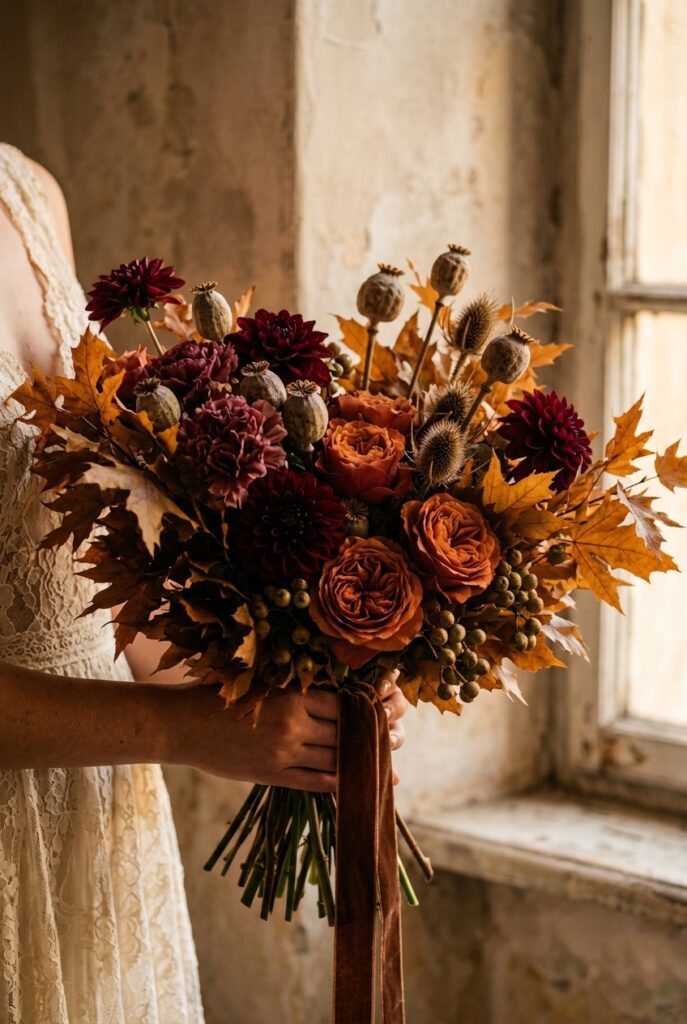
IMAGE 10 HERE Alt text: Lush autumn bridal bouquet with deep burgundy dahlias, rust garden roses, dried seed heads, and amber-toned foliage Image prompt: Photorealistic photo of a rich autumnal bridal bouquet featuring deep burgundy café au lait and dahlia-type blooms, rust-orange garden roses, dried seed heads, and amber-toned maple foliage with greenish-brown berries. The palette is warm, moody, and saturated. The arrangement is loose and gathered, not tightly structured. Stems wrapped in deep brown velvet ribbon. Soft warm natural window light with golden afternoon tones. No text overlays. Generate in vertical portrait orientation, 2:3 aspect ratio, optimized for mobile display.
1 image

Committing to seasonally appropriate flowers is the single professional shortcut most brides ignore, and it has two major benefits: the flowers are at peak condition because they’re not being forced or flown from across the globe, and the cost drops 20–35% because your florist isn’t sourcing specialty items. 

A winter wedding with a bouquet built on amaryllis, hellebores, dusty miller, and ranunculus will be more composed, better conditioned, and cheaper than the same bride asking for peonies in February. 

For autumn weddings, dahlias, chocolate cosmos, rust garden roses, and dried grasses are all in-season, peak-quality, and priced as staples rather than imports. 

Ask your florist what’s at the absolute top of quality that week — whatever the answer is, build around it. 

The results of working with a florist’s best available material on any given week, rather than against it, are consistently better. 

You can see how seasonal commitment plays into the broader design sensibility of a wedding in these spring wedding decor ideas and summer wedding decor ideas.


Decision Filter

If your dress is a ball gown or princess silhouette, choose the cascading style or a generous round posy — both balance the visual weight of a full skirt. 

If your dress is a column, sheath, or minimalist crepe, the architectural bouquet or single-stem statement will serve the silhouette far better than a romantic garden gathering, which will look proportionally mismatched. 

For outdoor garden venues, go greenery-forward or garden-style; for formal indoor venues, the round posy or monochromatic bouquet keeps pace with the architecture. 

Budget under $200? Greenery-forward, dried-and-preserved, or a single-stem statement are your sharpest options — all can be done under that threshold with the sourcing notes above. 

If the wedding is a destination or has heat and humidity concerns, the dried-and-fresh mix or fully dried bouquet are the only styles that reliably survive a full ceremony and reception without visible decline. 

For the full picture on how wedding decor on a tight budget can still look fully considered, that’s where to go next if you’re optimizing spend.


The Real Reason

The real reason bridal bouquet advice is so generic is that most of it is written from a sales position — florists and wedding vendors have a financial interest in larger, more complex bouquets. 

Nobody has a financial interest in telling you that a single king protea stem wrapped in wide ribbon is the most photographically distinctive choice on this list and costs $60.

The incentive structure of the wedding industry runs toward more, not better.

The contrarian truth: your bouquet shouldn’t match your wedding colors. It should complement them, which is a completely different thing. 

Matching means your bouquet is the same blush pink as your bridesmaids’ dresses and your table linens and your stationery. 

Complementing means your bouquet introduces a temperature or tone variation that makes every element around it read more clearly. 

A warm ivory bouquet against a cool white dress. 

A deep burgundy stem as an accent against an otherwise all-white arrangement. 

Contrast is what makes each element visible; matching collapses everything into a single flat plane.

Here is what photographers know and almost never tell couples: the standard way brides hold their bouquet — stomach height, arms slightly bent — cuts the most photogenic part of the arrangement in half. 

A bouquet held too high hides the waistline; held too low, the stems face the camera instead of the blooms. 

The correct position is hands at hip-bone level, arms nearly fully extended, bouquet tilted very slightly toward the camera. 

Every experienced photographer asks for this adjustment on the wedding day, but most brides have never been told to practice it. 

Spend ten minutes with your bouquet in front of a mirror the morning of your wedding and find the angle that works. 

It will change every photo taken from the waist up for the rest of the day.


Mistakes to Avoid

Mistake 1: Choosing your bouquet to match your bridesmaid flowers. Every competitor article encourages “cohesion” between the bridal and bridesmaid bouquets. What this advice produces in practice is a bridal bouquet that doesn’t stand out from the party — the bride carries a larger version of what six other women are holding. 

The bridal bouquet should contrast with the bridesmaid bouquets in shape, density, or color temperature so that every photograph automatically draws the eye to the bride. 

If your bridesmaids carry a loose blush garden posy, you carry a structured white architectural arrangement. 

The cohesion is in the venue and the overall palette — not in the flowers being identical variations of each other.

Mistake 2: Over-ordering at the florist consultation and spending $200 you didn’t need to. The average bride overspends on stem count by 30–40% because florist consultations happen with flowers in buckets, not in a finished arrangement. 

When you see 40 loose stems spread across a table, your instinct is to want all of them — the assembled result looks abundant. 

When those same 40 stems become a finished bouquet, it’s often visually indistinguishable from 25 stems and significantly heavier to carry. 

Ask for a mock assembly at consultation, not just a mood board. 

The weight difference between a 25-stem and a 45-stem bouquet is the difference between carrying it naturally for six hours and feeling it in your wrists by the first dance.

Mistake 3: Picking flowers you’ve never smelled before your wedding day. Stargazer lilies are one of the most commonly requested wedding flowers. 

They’re also intensely, head-clenchingly fragrant in an enclosed space — some people find the scent overwhelming; some trigger migraines. 

Tuberose has a similar profile: gorgeous in photos, potentially suffocating at close range for hours. 

You are carrying this bouquet for your ceremony, your portraits, your cocktail hour, and part of your reception. 

Smell every flower your florist proposes before you commit, in a room that approximates the size of your ceremony space. 

This sounds obvious. Almost nobody does it.

Mistake 4: Skipping the “throw bouquet” and tossing your real one. This is the practical cruelty nobody mentions. The bouquet toss is the moment where a bride holds a flower arrangement over her head, which means petals catch on the ceiling and the wire structure can come apart on impact. 

If you plan to keep your bouquet — for pressing, drying, or display — order a $30–$50 throw bouquet from your florist made from leftover cuttings. 

Tossing your real bouquet and having it land on a tile floor in a tight crowd is one of the most common post-wedding regrets I’ve heard from brides, always described in the same tone: “I didn’t think about it in the moment.”


FAQ

What is the most popular bridal bouquet style right now?

The loose, garden-gathered style is currently the most requested — organic, slightly undone, and built with a mix of garden roses, ranunculus, and seasonal foliage. 

The tight round posy and architectural minimalist styles are both strong alternatives for different dress silhouettes.

 Brides.com’s bouquet guide tracks current florist trends if you want to verify what’s moving most right now.

How much does a bridal bouquet typically cost?

Most bridal bouquets run between $150 and $400, with the primary cost drivers being stem count, flower species (local and seasonal vs. imported), and construction complexity. 

A cascade adds $100–$200 over a standard round bouquet in labor alone. A single-stem or greenery-forward bouquet can land under $100 when sourced directly. 

Budget 8–12% of your total floral spend on the bridal bouquet, allocating the rest toward ceremony florals and reception centerpieces where guests see the flowers for hours rather than minutes.

What flowers are best for a wedding bouquet?

Garden roses, ranunculus, peonies (seasonal), and lisianthus are the four workhorses of bridal bouquets — good condition, strong stem, and they hold for 8+ hours without significant wilting. 

Avoid heavily fragrant flowers like tuberose and stargazer lily unless you’ve verified you can tolerate the scent for six hours. 

For structure and longevity, ask your florist what’s at peak quality that specific week rather than committing to a species list months in advance.

How do I match my bouquet to my wedding dress?

Match the bouquet shape to the dress silhouette before you match the color. 

Ball gowns suit cascades and full round posies; column and sheath dresses suit architectural or single-stem styles; A-line works with almost any shape. 

For color, don’t match — complement. 

A white-on-white bouquet can read as invisible against an ivory gown; a slightly warm or slightly cool undertone shift in the bouquet creates the separation that makes both the dress and the bouquet visible in photos.


Budget Table

Bouquet StyleAvg. Cost RangeDIY Possible?Best Source
Round posy$175–$350YesLocal florist / FiftyFlowers.com
Garden-style gathered$200–$420With practiceLocal florist
Cascading / waterfall$350–$700+DifficultLocal florist only
Single-stem statement$40–$90Very easyLocal flower market
Dried & preserved$120–$300YesEtsy / afloral.com
Monochromatic$180–$380YesFiftyFlowers.com
Greenery-forward$120–$240YesLocal wholesale market
Architectural / sculptural$200–$450ModerateSpecialty florist
Heirloom-added (fresh base)$175–$380YesLocal florist + personal items
Seasonal committed$140–$320YesLocal florist (let them lead)
Dried-and-fresh mix$160–$350YesLocal florist + afloral.com

What Your Bouquet Is Actually Deciding

Your bouquet isn’t decoration. It’s a visual anchor — the one element in every photograph from your left hand to your face that either pulls the image into focus or fragments it. 

The couples who end up with bouquets they genuinely love on their wedding day are almost always the ones who gave their florist a dress silhouette and a venue photo and then said: “Tell me what works.” 

The ones who arrive with a screenshot of a specific arrangement and say “I want this exactly” are the ones who end up with a technically correct bouquet that subtly fights the rest of the aesthetic all day. 

Trust the structure first. 

If you want to go deeper on how the entire ceremony visual — florals, décor, venue dressing — works as a single coherent design, start with these unique wedding decor ideas and work outward to your flowers from there.

Leave a Comment

Your email address will not be published. Required fields are marked *

Scroll to Top