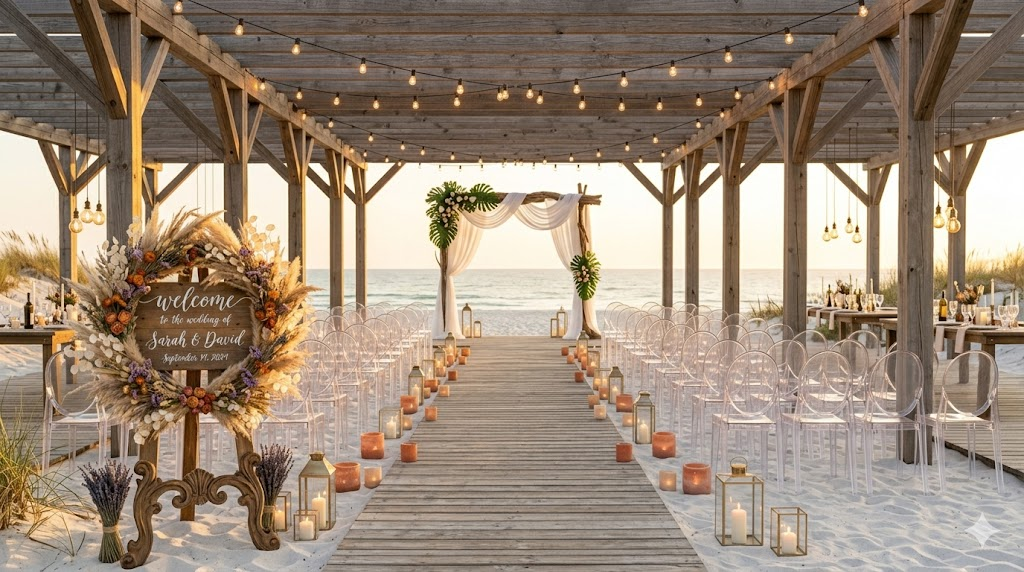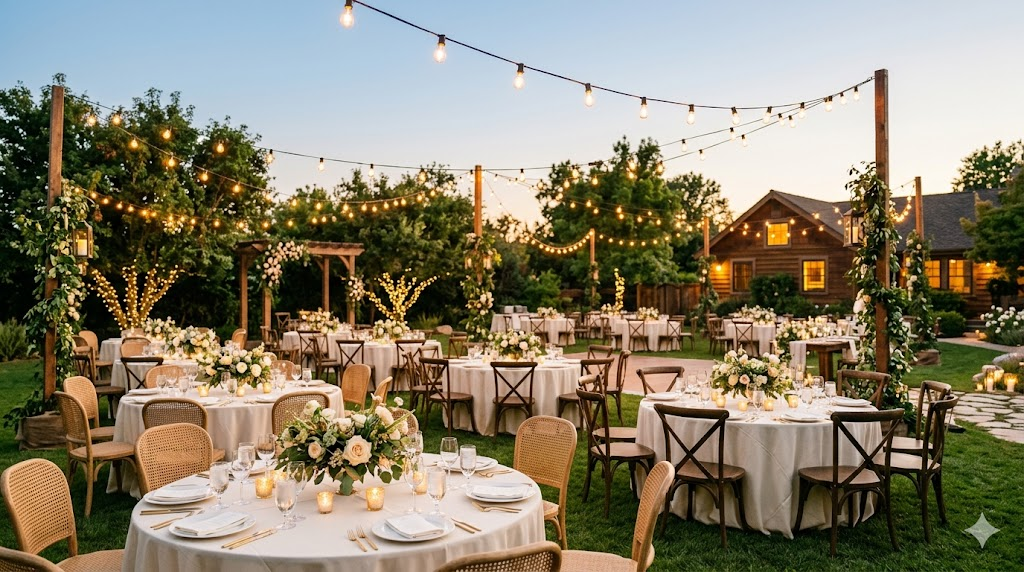
Your venue is a blank canvas, but you’re filling it with the wrong centerpiece ideas because you didn’t look at the room first.
The most common mistake isn’t that centerpieces are ugly—it’s that they don’t match where they’re sitting.
A gorgeous tall floral that stuns in a loft doesn’t work in a restaurant with 9-foot ceilings. An intimate cluster of candles looks sparse and sad in a 5,000-square-foot ballroom.
The right centerpiece for you depends on your venue, your table count, your ceiling height, and how you want guests to actually experience the room.
Before you settle on an idea, answer three questions: Will guests be able to see across the table? Does this style match the bones of the room?
Are you trying to fill space or create moments? Then choose.
Centerpieces are the unspoken design language of reception tables.
They whisper elegance or scream chaos depending on your choices. Pick the wrong scale and guests lean around flowers to talk. Pick the right one and they don’t even notice—they just feel the room.
The Short Answer
Choose centerpieces based on your venue’s architecture and ceiling height before you choose by style.
In a ballroom with high ceilings and empty space, tall arrangements (18-24 inches) and dense florals are intentional and fill air beautifully.
In a restaurant with 9-foot ceilings and crowded tables, keep pieces under 14 inches so guests can see across their table.
In a garden or outdoor venue, use minimal centerpieces (small arrangements or candles only) so the natural backdrop stays the star.
Match the centerpiece intensity (flowers-heavy vs. flowers-light) to room size: big empty rooms need drama; intimate spaces need subtlety.
This single decision—venue first, then style—eliminates 90% of centerpiece regret.
1. The Tall Floral Statement (High-Impact, High-Ceiling Rooms)
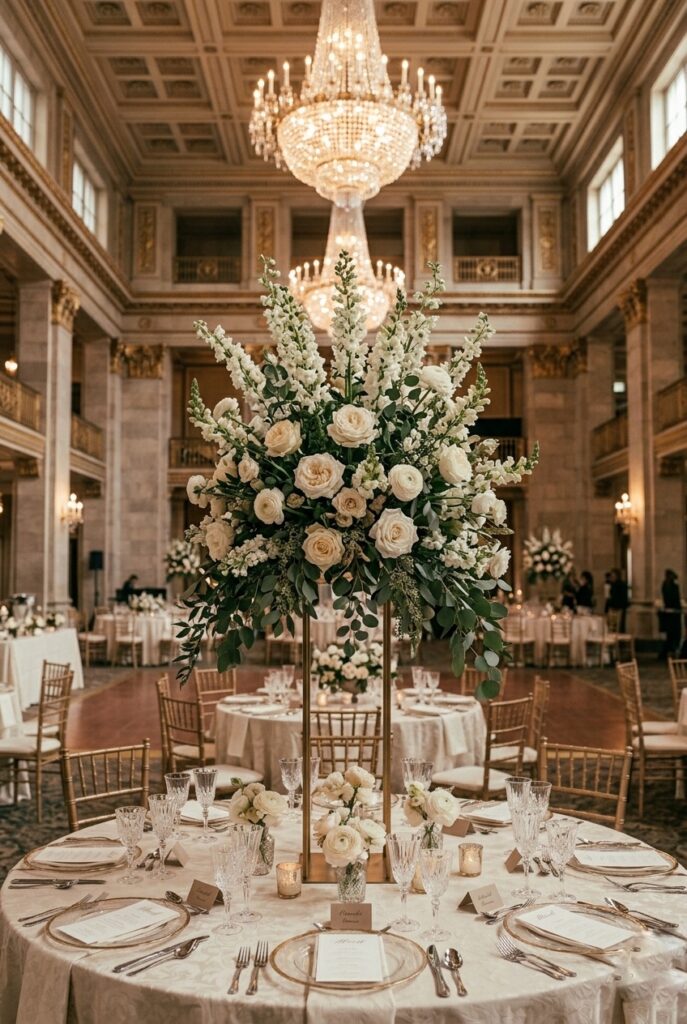
Use this in ballrooms, lofts, and large event spaces where ceiling height is 12+ feet and you want to fill vertical space.
These arrangements run 18-28 inches tall with layered florals, greenery, and branches creating an intentional silhouette.
Think white roses with eucalyptus and curly willow branches, dusty mauve ranunculus with dried pampas grass, or blush peonies with Italian ruscus.
The height isn’t a mistake—it’s architectural. These work at venues where you’re trying to make a grand room feel less empty.
They also work when your guest count is fewer than 100, so there’s breathing room between tables.
Where to buy: FiftyFlowers.com (wholesale florals + greenery for DIY, $20-35 per arrangement), Floral designers (pre-made, $75-150 per piece), or rent from event rental companies ($40-80 per piece).
Budget: $20-150 per centerpiece depending on DIY vs. professional.
Taste Layer: Short, droopy arrangements in tall rooms look like guest tables at a conference—cheap and small-scale.
Tall, structured arrangements in the same room read as intentional and expensive.
The difference is 4-6 inches of height and one branch choice. Scale matters more than flower count.
2. The Low Intimate Arrangement (Restaurant & Banquet Hall Tables)
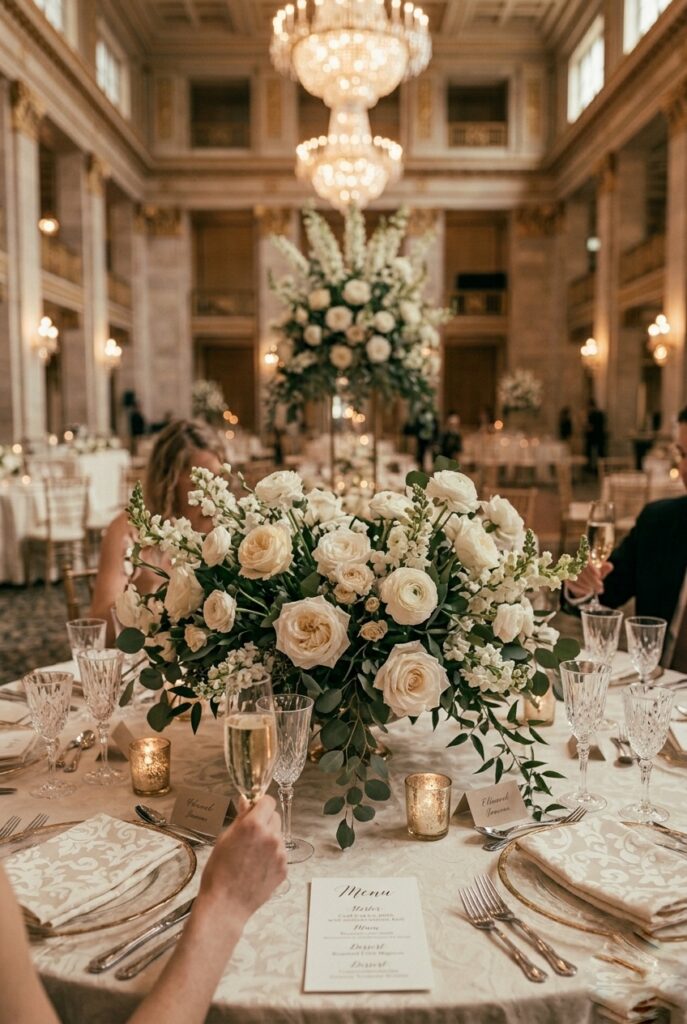
These sit 8-14 inches tall—the height where guests can lean forward to talk without moving a vase. This is the safest choice for traditional wedding venues with 9-10 foot ceilings and standard round tables.
Keep florals to one type (garden roses, hydrangeas, or dahlias) with greenery filling around them.
A low arrangement doesn’t mean boring—it means dense with color and texture at a conversational height.
Think cream roses with dark green salal, blush hydrangea with seeded eucalyptus, or coral garden roses with curly willow for height without reaching above eye level.
These feel sophisticated because they’re restrained.
Where to buy: Local florist (custom, $35-65 per piece), FiftyFlowers.com DIY (wholesale, $15-25 per piece), or pre-made rental vases (event rental, $25-50 per piece).
Budget: $15-65 per centerpiece.
3. The Candle-Focused Minimalist (Modern & Elegant, Any Room Size)
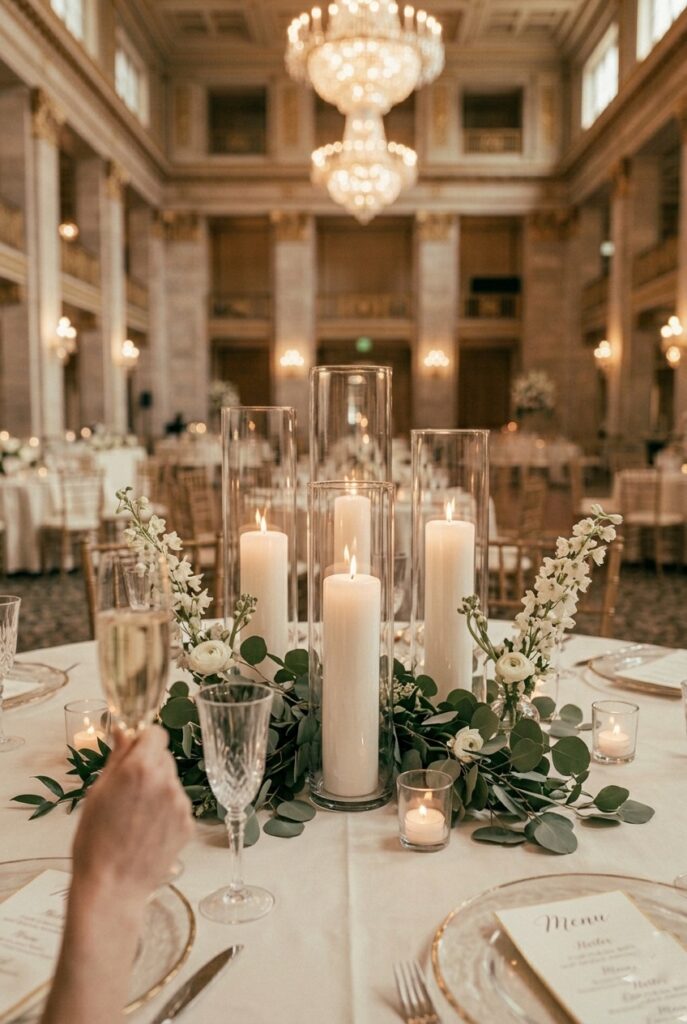
A trio or cluster of varying-height candles—some in hurricane vases, some standing alone—with minimal or no flowers.
This approach works in any venue because it’s about light and simplicity, not scale or density.
Mix white pillar candles (3″, 4″, 6″ heights) with thin taper candles in gold or silver candlesticks; add 2-3 stems of greenery (eucalyptus, ruscus, or Italian leather leaf).
The effect is romantic, modern, and doesn’t compete with the room.
This idea costs far less than florals and still looks intentional. It’s also the strongest choice for outdoor weddings because it doesn’t fight with nature.
Where to buy: Amazon (pillar candles + hurricane vases, bulk, $20-40 for a full table set), Costco (candles + holders, $1-3 per candle), or event rental (candlesticks, $3-10 per piece).
Budget: $8-25 per centerpiece if DIY; $30-60 if renting formal candlesticks.
Taste Layer: Cheap votive candles from a gas station in mismatched holders look cluttered.
Real pillar candles in clear or frosted glass hurricanes, or proper candlesticks in gold/silver finish, look intentional and expensive.
The candle quality and holder finish are what make this work.
4. The Garden Mixed Arrangement (Garden Venues & Outdoor Spaces)
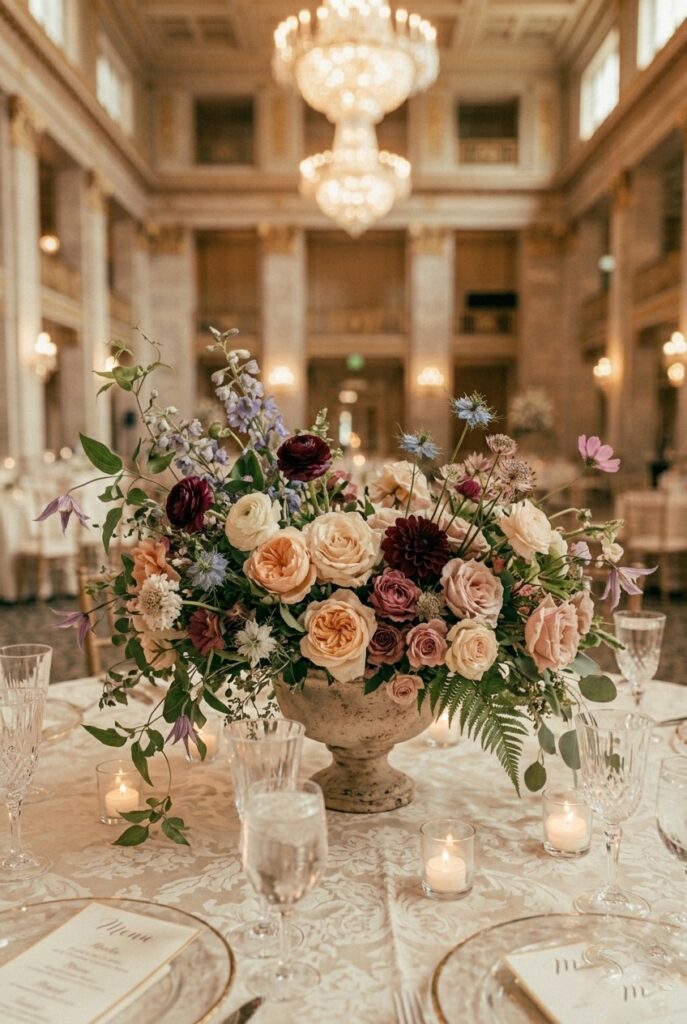
Loose, overflowing florals that look like you picked them from a garden—no rigid structure, varied heights, multiple flower types mixed in one vessel.
This works for outdoor venues, garden estates, and farm settings where structured florals feel out of place. Include a base of greenery (eucalyptus, ruscus, bay leaves), then layer in cottage flowers (David Austin roses, ranunculus, lavender, astilbe, seed pods, scabiosa, sweet peas).
Leave stems long and let them cross each other. The imperfection is the point. These feel abundant but should still fit in a 12-inch vessel so they’re not awkward on tables.
Where to buy: Local farmers market florist (loose bunches for DIY, $15-30 per arrangement), FiftyFlowers.com (mixed bunches, $20-35 per arrangement), or a garden-focused florist (pre-made, $40-75 per piece). Budget: $15-75 per centerpiece.
5. The Geometric Modern Arrangement (Contemporary & Minimalist Weddings)
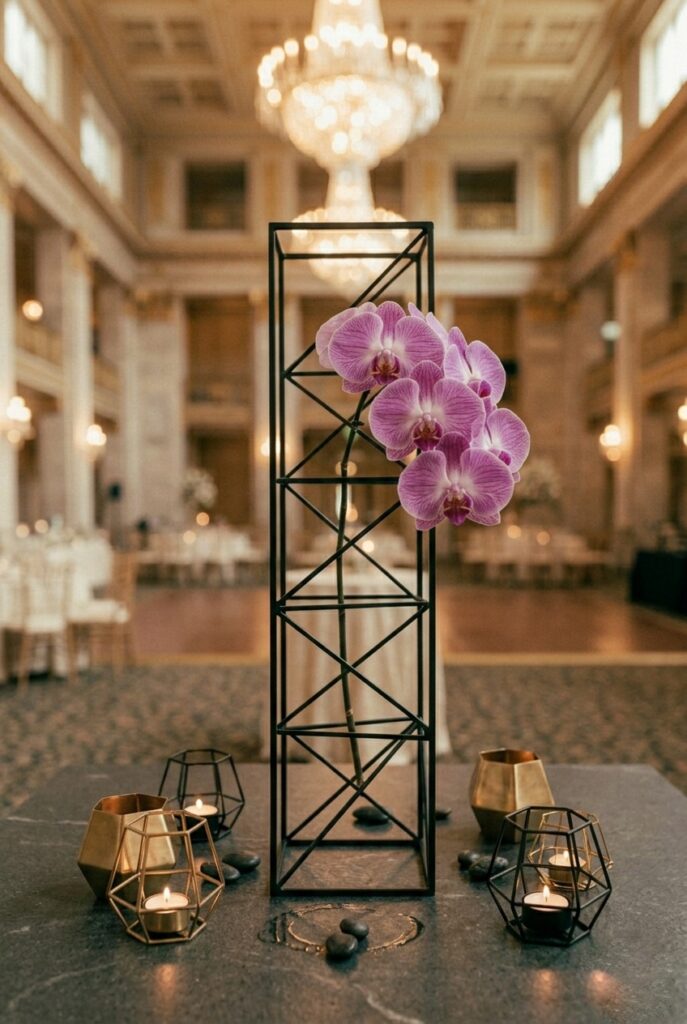
Single focal flower in a tall, thin vase (one statement orchid, one calla lily, one open rose), or a grid of individual small vases each with one or two stems.
This works in modern ballrooms, lofts, and minimalist venues.
The beauty is in restraint and repetition. Think: 15 identical glass tubes on a long table, each holding one white branch, or single tall vases on each round table, each with one oversized coral dahlia and one piece of greenery.
This approach is surprisingly affordable because you buy fewer flowers, and it looks editorial and expensive because of the intentionality.
Where to buy: Florist for pre-made single-stem arrangements ($10-20 per vase), or DIY with stems from FiftyFlowers + test tubes or bud vases from Amazon ($15-30 per table for DIY).
Budget: $10-30 per centerpiece.
Budget Hack After Idea 5: Orchids and calla lilies last 2-3 weeks in water, so buy them 10-14 days before the wedding and store in a cool room.
They won’t wilt by your reception date, and they cost half what peonies or roses do.
Orchids from grocery stores cost $8-15 versus $3-5 per stem wholesale. Specific action: Source orchids from Trader Joe’s or local orchid growers 10 days prior.
They’ll be fresher and cheaper than ordering ahead from a florist.
6. The Dried Flower Timeless Arrangement (Boho, Rustic & Romantic)
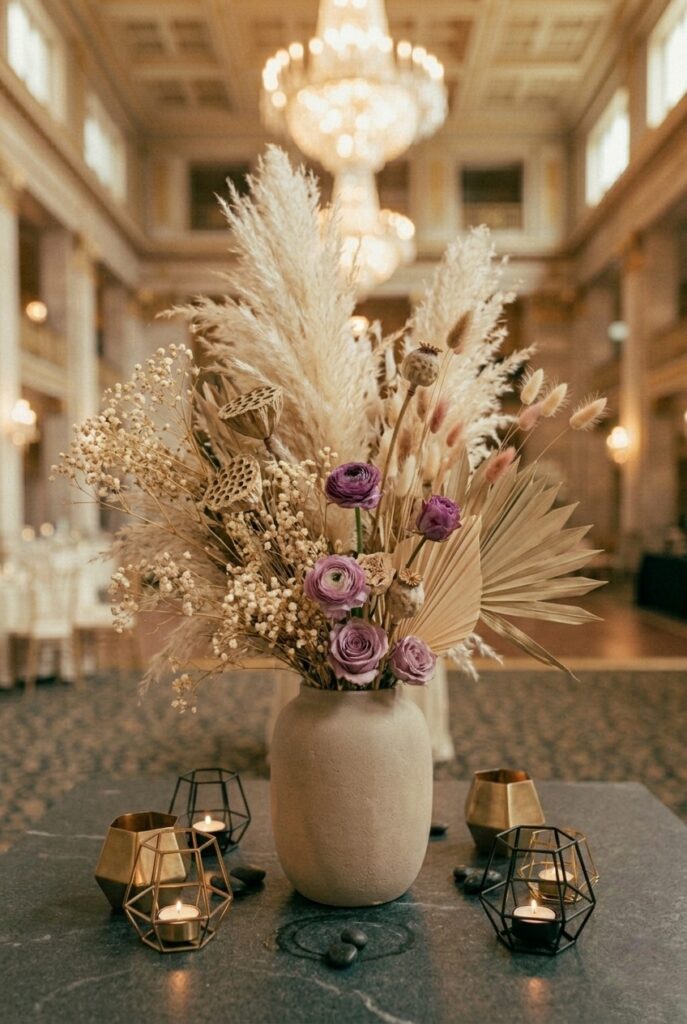
Dried roses, pampas grass, wheat, eucalyptus, and textural elements mixed into a loose, full arrangement in a neutral vessel (glass, ceramic, or burlap-wrapped).
This works everywhere because dried arrangements feel both modern and nostalgic.
They don’t wilt, so you can assemble them weeks ahead and store easily.
They photograph beautifully and look intentional even with minimal effort.
Mix dried elements with 2-3 fresh greenery stems for vibrancy.
These arrangements feel sophisticated in minimalist spaces and rustic in farmhouse settings.
Where to buy: Dried flower wholesalers like Dry Branch Box ($25-40 per subscription or à la carte), Afloral (dried arrangements and components, $20-50 per arrangement), or DIY with stems from craft stores like Joann (watch for 40-50% off coupons, $20-35 per arrangement total).
Budget: $15-50 per centerpiece.
7. The Fruit & Foliage Statement (Garden Weddings, Outdoor Celebrations)
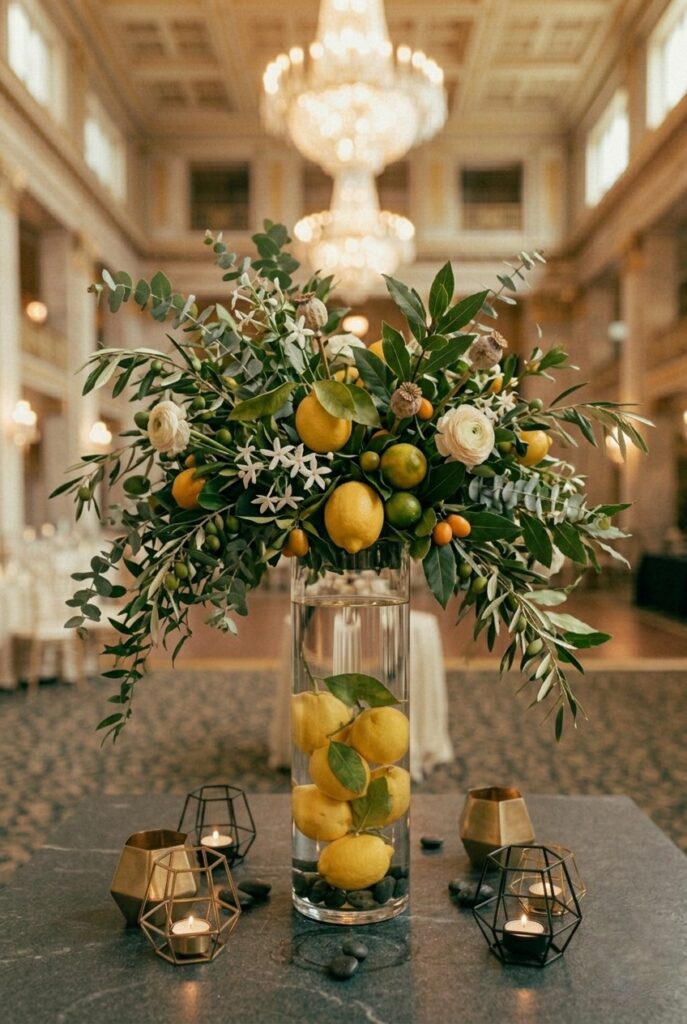
Lemons, limes, pomegranates, or branches of berries grouped with greenery in clear vases or wooden trays.
No flowers—just color and natural texture.
This looks refreshing, unexpected, and is less expensive than florals while still making a visual impact.
It works in garden venues especially well because it feels organic to the setting. The fruit doesn’t wilt and can be harvested just days before the wedding. Include branches of greenery to create height and fullness.
Where to buy: Farmers market or grocery store (lemons $0.50 each, pomegranates $1-2 each, berries $3-5 per bunch), or specialty produce suppliers for bulk orders.
Budget: $10-20 per centerpiece.
8. The Monochromatic Tonal Arrangement (Elegant & Cohesive)
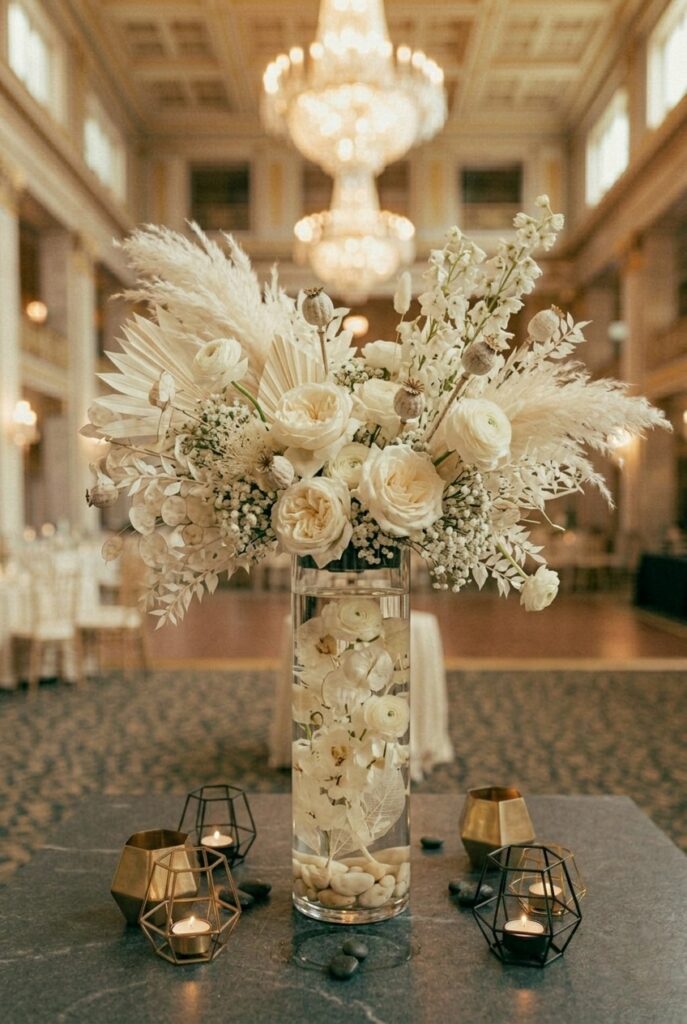
One color family at multiple depths—all whites with cream and ivory, all dusty roses with blush and mauve, or all greens with sage and forest tones.
This approach works in any venue because the cohesion reads as expensive and intentional.
Use varying textures (smooth roses, feathery astilbe, textural greenery) and heights, but stay within your color story.
This is easier than you think because you buy fewer SKUs and they all coordinate naturally.
Where to buy: Tell a florist or wholesale supplier your color and ask for pre-bunched arrangements, or DIY from FiftyFlowers by choosing 3-4 coordinated stem types ($20-35 per arrangement).
Budget: $20-65 per centerpiece.
Budget Hack After Idea 8: Buy your centerpiece flowers in bunches rather than stems. One bunch of garden roses (25 stems, $20) makes 5-7 centerpieces versus buying 35 individual stems ($3-5 each, $105-175 total).
The cost difference is massive.
Specific action: Order from Trader Joe’s or wholesale sites in bunches; calculate pieces per bunch and order accordingly.
One bunch per 2-3 centerpieces is standard for full-looking arrangements.
9. The Tall Branch & Minimal Florals (Architecturally Bold, High-Ceiling Rooms)
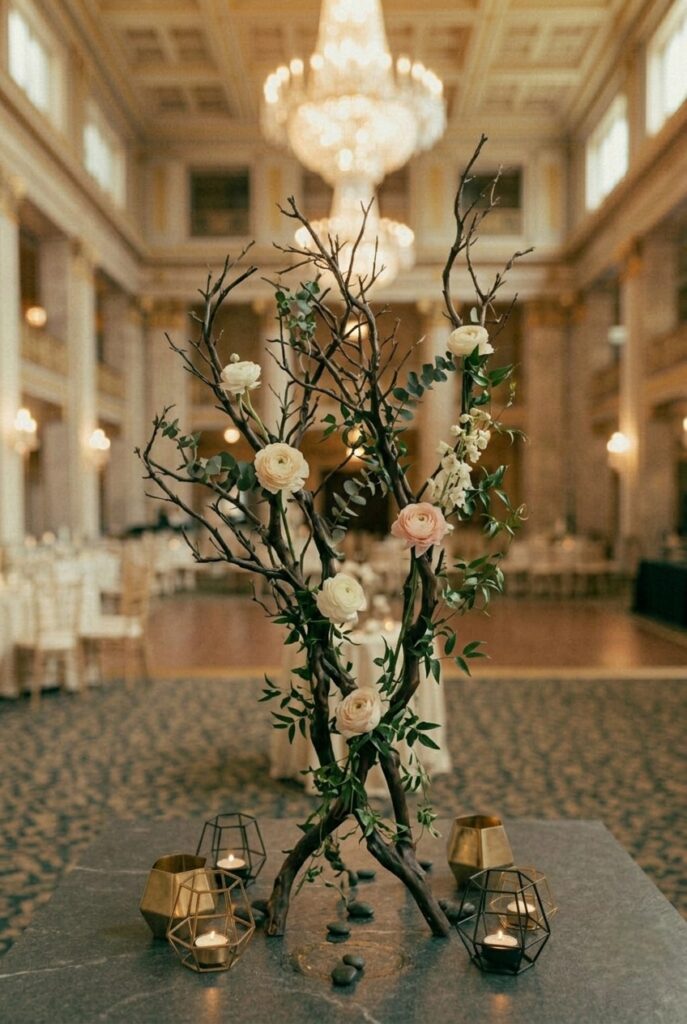
Tall, sculptural branches (curly willow, birch, tall grass stems) creating vertical structure, with just 3-5 focal flowers and minimal greenery filling around them.
The branches do the visual work; flowers are accents.
This works in very tall rooms and looks dramatically different from standard floral arrangements. The drama comes from structure, not density.
Where to buy: Branches from FiftyFlowers ($2-5 per stem for specialty branches), florist, or DIY gathered branches spray-painted white or gold ($0.50-2 per branch after spray paint). Focal flowers from any source.
Budget: $25-40 per centerpiece because branches are inexpensive and you use fewer flowers.
10. The Seasonal Botanical Mix (Any Venue, Fresh & Timely)
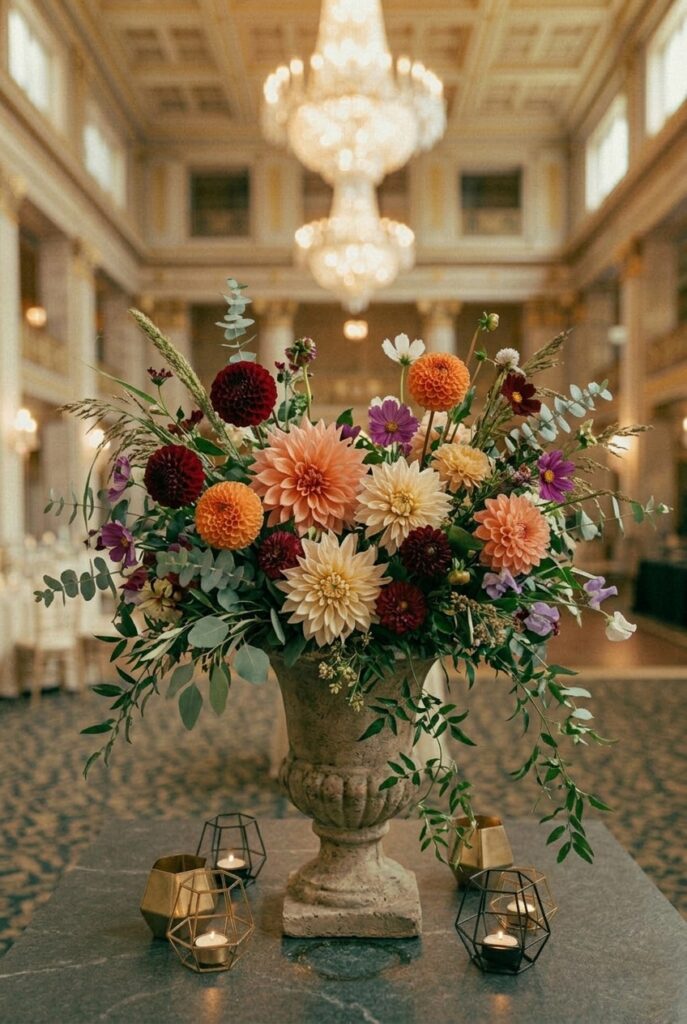
Build arrangements using whatever is in season and abundant (and therefore inexpensive) during your wedding month.
Spring: cherry blossoms, ranunculus, tulips, pussy willows. Summer: dahlias, zinnias, garden roses, hydrangeas, wildflowers. Fall: dried wheat, pumpkins, burgundy dahlias, hypericum berries, oak leaves.
Winter: evergreen branches, white roses, silver dollar eucalyptus, pinecones, winter berries. Seasonal flowers cost 40-60% less than out-of-season choices and look fresh and intentional for your time of year.
Where to buy: Tell your florist your wedding month and ask for seasonal options, or browse FiftyFlowers’ seasonal category.
Budget: $15-40 per centerpiece (seasonal flowers are always cheaper).
Decision Filter
If your venue has high ceilings (12+ feet) and you have fewer than 75 guests, choose tall arrangements (Ideas 1 or 9) to fill vertical space and make the room feel intentional.
If you’re in a traditional banquet hall or restaurant, choose low arrangements (Idea 2) so guests can see each other during dinner.
If your venue is already beautiful—garden, estate, outdoor space—choose minimal centerpieces (Ideas 3, 5, or 8) so the architecture and landscape stay the focal point, not your flowers.
If you’re on a tight budget, choose seasonal flowers (Idea 10) or dried arrangements (Idea 6)—both cost less and still photograph beautifully.
If you want maximum visual impact with minimum effort, choose candle-focused (Idea 3) or fruit-and-foliage (Idea 7) options—they require fewer materials and less assembly time.
The Real Reason
Here’s what venue designers know that couples don’t: centerpieces fail not because they’re ugly, but because they’re scaled wrong for the room.
The most expensive, elaborate floral arrangement looks wilted and overshadowed if you place it in a massive ballroom.
The most elegant candlelit centerpiece feels out of place if guests are shoulder-to-shoulder at cocktail tables.
The reason the best centerpieces feel effortless is because they match the room’s dimensions, ceiling height, and guest density.
A second insider truth: the height of your centerpiece directly determines whether your guests can have a conversation.
Every inch above 14 inches, guests have to crane their necks or stand up to see faces across the table.
This isn’t a small detail—it affects the entire emotional tone of dinner.
The third thing florists see repeatedly is couples spending 30-40% of their total wedding budget on flowers that could have been achieved for 50% less by choosing seasonal flowers instead of forced, expensive out-of-season blooms.
If your wedding is in August and you’re ordering imported peonies, you’re overpaying significantly.
If you’re in August and you choose dahlias (which are peak season, stunning, and cost half as much), you’ve just shifted $500-1000 back into your pocket.
Mistakes to Avoid
Mistake 1: Choosing tall centerpieces because they “photograph better” without considering actual guest experience. Photographers tell you tall arrangements look good in shots; they don’t mention that guests spent the whole dinner looking at flowers instead of each other.
Your goal is a beautiful room and guests who actually enjoy sitting at the tables. If your venue has a 9-foot ceiling, keep it under 14 inches, period.
The photo will still be beautiful because the whole table will be in frame, not just flowers.
Mistake 2: Spending $120 per centerpiece on out-of-season flowers when seasonal options would cost $30-40 and look fresher. A bride ordered imported garden roses for a December wedding at $4-5 per stem in a market where they’re out of season.
She paid $140 per arrangement. The same arrangement in May would have cost $35-40. The December roses looked tired by 6 PM; May roses would have lasted through the night.
Know your season before you order.
Mistake 3: Choosing a centerpiece style you love from a photo without visiting the actual venue first. That gorgeous tall arrangement worked at an estate with 14-foot ceilings and 40 guests spread across 8 tables.
Your ballroom has 10-foot ceilings and 150 guests at 20 tables. The style doesn’t translate—it needs to be shorter and denser to match your actual space.
Always walk your venue, measure ceilings, note natural light, and count tables before finalizing centerpiece design.
Mistake 4: Assuming that more flowers = more expensive look, so you cram florals to save money. Dense, overstuffed arrangements actually read as cheap because they look panicked and unshaped.
A restrained arrangement with 5-7 stems, thoughtful greenery, and intentional spacing looks more expensive than an arrangement with 25 stems shoved into a vase.
Budget-friendly doesn’t mean crowded; it means deliberate.
FAQ
What’s the ideal centerpiece height so guests can talk across the table?
Keep centerpieces under 14 inches tall if you want guests to see each other without leaning or standing.
Low-profile arrangements (8-12 inches) are ideal for round tables where people sit in a circle and need sightlines.
If you prefer tall centerpieces, use open-structure designs with branches and scattered florals so guests can see through gaps, not a dense wall of flowers.
How far in advance should I order or make centerpieces?
Order wholesale flowers 5-7 days before; make arrangements 2-3 days before. Dried flowers can be assembled 2-4 weeks early and stored.
Pre-made rental centerpieces should be ordered 2-3 months ahead. Fresh flowers are the variable—order too early and they’re wilted; order too late and your florist is booked.
Seasonal flowers are more forgiving; out-of-season flowers need more lead time.
Should all tables have identical centerpieces?
No. Mix 2-3 heights or styles across your tables for visual interest and better photo layering.
For example, alternate tall arrangements on every other table with low arrangements in between, or vary flowers slightly (same height and vessel, different color per table) to keep cohesion while adding visual rhythm.
Identical centerpieces can feel monotonous; strategic variation feels intentional.
What’s the cheapest way to fill table space without using many flowers?
Use candles, branches, fruits, or succulents. Pillar candles in hurricane vases cost $0.50-2 each.
Branches from nature or wholesale costs $2-5 per stem and create height without flowers.
Lemons or pomegranates cost pennies. Potted succulents guests can take home cost $3-5 each. Any of these approaches costs 50-70% less than traditional floral arrangements.
Budget Table
| Centerpiece Style | Cost Per Piece (DIY) | Cost Per Piece (Professional) | Cost Per Piece (Rental) | Best For | Where to Source |
|---|---|---|---|---|---|
| Tall Floral Statement | $20-35 | $100-150 | $50-80 | High ceilings, large rooms | FiftyFlowers, wholesale florist |
| Low Intimate Arrangement | $15-25 | $40-65 | $25-50 | Standard banquet halls | Local florist, FiftyFlowers |
| Candle-Focused Minimalist | $8-15 | $30-60 | $30-60 | Modern venues, outdoor | Amazon, Costco, event rentals |
| Garden Mixed Arrangement | $15-35 | $50-75 | N/A | Outdoor, garden venues | Farmers market, florist |
| Geometric Modern | $10-25 | $20-40 | $25-50 | Contemporary venues | FiftyFlowers, florist |
| Dried Flower Arrangement | $15-40 | $35-60 | N/A | Any style | Afloral, Dry Branch Box |
| Fruit & Foliage | $10-20 | $25-45 | N/A | Garden, outdoor | Farmers market, grocery |
| Monochromatic Tonal | $20-35 | $50-80 | $30-60 | Elegant venues | Florist, wholesale |
| Tall Branch & Minimal | $20-35 | $60-100 | $40-70 | High-ceiling spaces | FiftyFlowers, florist |
| Seasonal Botanical | $15-40 | $30-60 | $25-50 | Any venue | Seasonal florist |
| Total for 20 tables (DIY mid-range) | $300-500 | $800-1400 | $600-1000 | ||
| Per-table cost (DIY) | $15-25 | $40-70 | $30-50 |
Cost Savings Breakdown:
- Seasonal flowers: 40-60% cheaper than out-of-season
- DIY + wholesale: 60-75% cheaper than professional florist
- Candle-only + branches: 70-80% cheaper than floral-heavy arrangements
- Renting: 30-50% cheaper than buying if you need under 15 centerpieces; break-even at 15-20 pieces
Your centerpiece choice is a design decision first, a budget decision second. Choose the right style for your room and you’ve already won.
Everything else—budget, flowers, DIY vs. professional—is just logistics.
Start by walking your venue and measuring the ceiling height.
Then match the list to your room, not to your
Pinterest board. If you’re torn between two ideas, the smaller, simpler one almost always looks better in person than the big, elaborate one photographed in an entirely different space.
Make your choice based on where guests will actually sit, not where a photographer stood to shoot it.