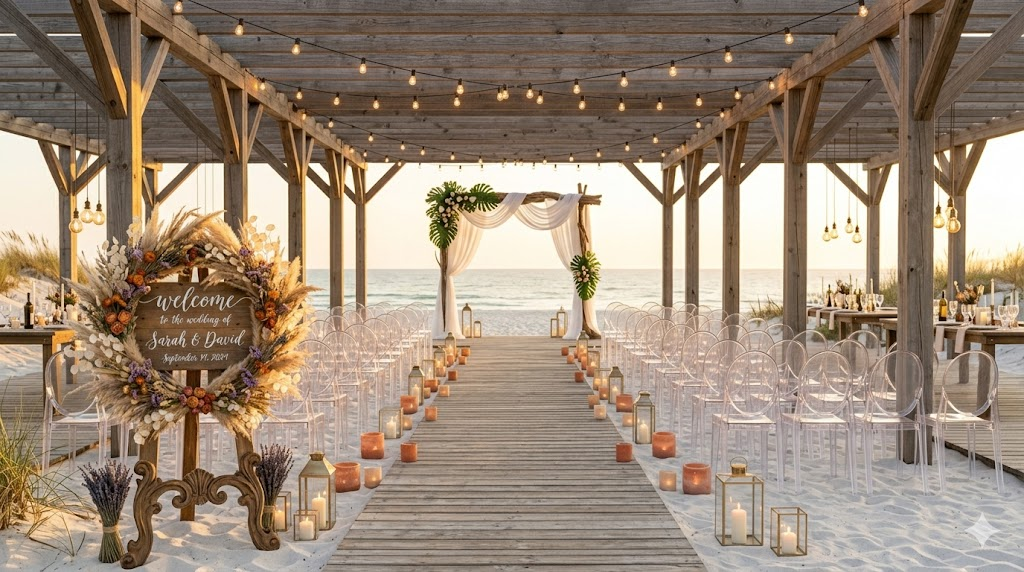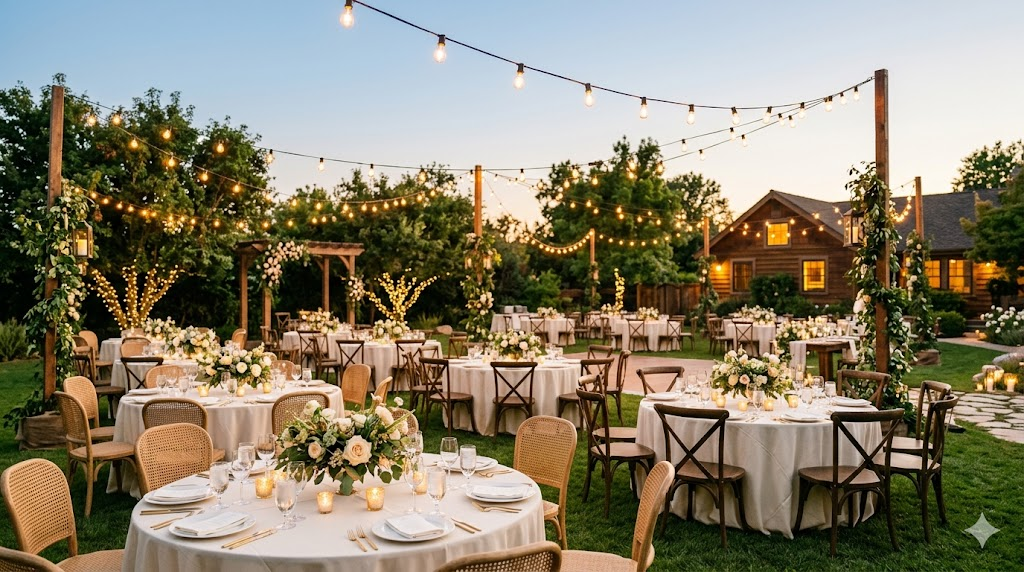
The thrift store doesn’t give you a wedding. It gives you raw material.
What separates the couple whose thrifted reception ends up on Pinterest from the couple whose thrifted reception looks like a flea market — is a single design decision made before they bought a single item: what is the visual anchor of this room?
Every beautiful thrifted wedding has one. A chandelier. A rug aisle. A chandelier draped in greenery. A gallery of wine bottles. The rest of the room supports that anchor. Without it, you’re just shopping.
It started with one thing. A chandelier, gold-sprayed and improbable, hanging where no chandelier had any right to be —from a branch, from a beam, from belief. Everything else arranged itself around it. That’s how the best rooms work. One brave choice. Then everything else.
The Short Answer
The most stunning thrifted weddings are built outward from one anchor piece — the statement item that justifies everything around it.
Find that piece first. Then source the rest to support it.
A thrifted wedding designed this way looks curated.
One designed by accumulation looks like it happened by accident, even when every individual piece is beautiful.
1. Layered Vintage Persian Rugs as a Ceremony Aisle — The Most Photographed Thrift Move
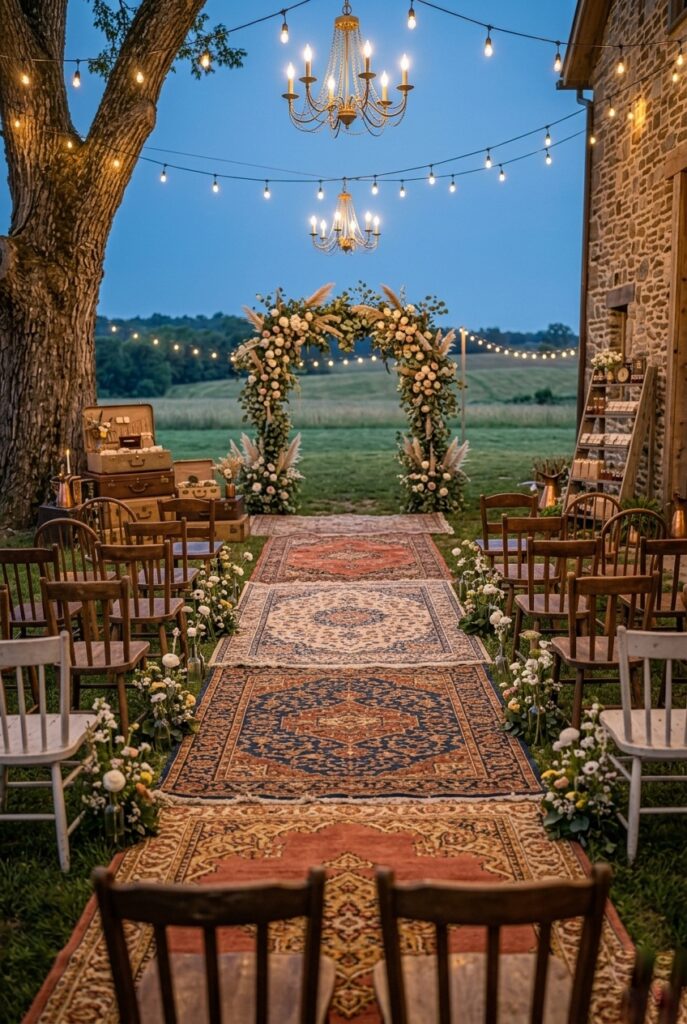
This is the single most Pinterest-saved thrifted wedding moment — and nearly every article that mentions it gives it one sentence and moves on.
Here’s the actual execution: source three to five vintage Persian or kilim rugs in a complementary color story (warm jewel tones, or all neutral and cream, or all earthy terracotta) from Goodwill, Facebook Marketplace, or local estate sales.
Lay them end to end, overlapping slightly at the seams to prevent tripping.
The overlaps also read as intentional layering, not a patchwork mistake.
Rug dimensions for a typical outdoor aisle: aim for rugs roughly 2×3 feet or 3×5 feet each.
Cost: $5–$30 per rug at Goodwill or estate sales; $15–$60 per rug on Facebook Marketplace.
Total aisle cost for five rugs: $25–$150.
After the wedding, rugs move to the lounge area or back under your sweetheart table for a second life in your photos. Then sell them back.
The aisle is also your most photographed moment — this one decision elevates every ceremony shot.
Only do this if your ceremony surface is flat and stable. Rugs over uneven grass or gravel can shift. Use rug tape or tent stakes along the edges if needed.
2. A Thrifted Chandelier, Spray-Painted and Hung — Your Statement Anchor Piece
This is the anchor idea.
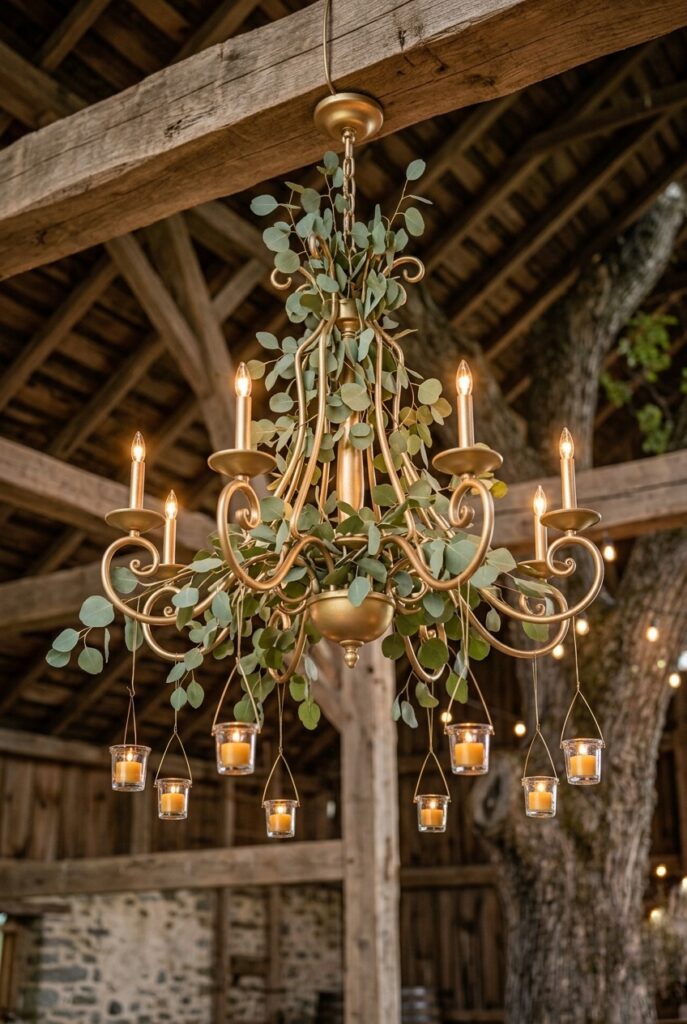
A chandelier — thrifted from Goodwill, Habitat for Humanity ReStore, or Facebook Marketplace — spray-painted in matte gold, matte black, or left in its original brass, and hung from a barn rafter, a tree branch, or a pergola beam becomes the single visual decision that makes guests stop and look up.
Wrap trailing eucalyptus or ivy through the arms.
Hang small glass votives from the chandelier arms with thin wire. It requires an extension cord and a venue that allows it, but the visual return is enormous.
Thrifted chandeliers: $10–$60 on Facebook Marketplace or at ReStores. Spray paint: $6–$8.
Trailing greenery: $10–$20 from a bulk florist or Trader Joe’s. Total cost: $26–$88.
A rental chandelier from an event company runs $200–$600.
This is the thrift that feels most like cheating — in the best possible way.
Confirm with your venue that you can hang items from the ceiling or beams, and always use a hardwired or battery-powered candle in the votives — open flame overhead is a fire risk.
3. The Wine Bottle Single-Stem Gallery — Sorted by Color, Not by Label
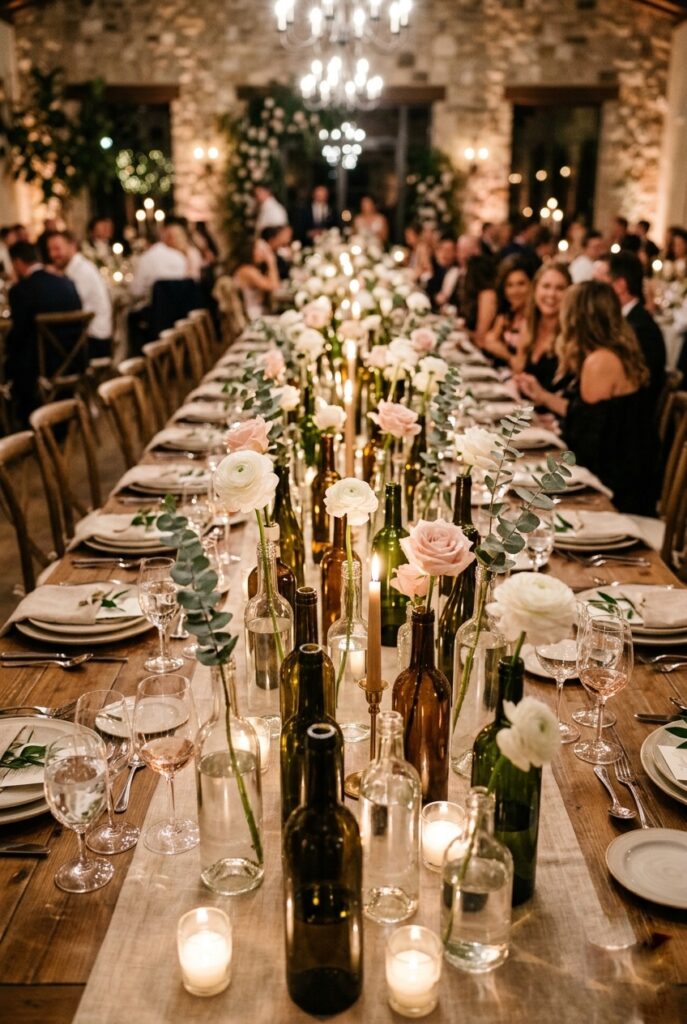
Wine bottles are everywhere — and every article about them says to spray-paint them and leave it there.
The version that photographs beautifully requires one more decision: sort by glass color.
Line green bottles together, clear bottles together, brown bottles together, and cluster them in color groups running the length of the table like a gallery.
Each bottle holds a single flower stem.
The simplicity is the point — one stem per bottle, no arrangement required, no floral skills needed.
The effect is a linear centerpiece with color rhythm and genuine visual interest.
Ask restaurants, friends, or neighbors for their empty bottles — free. Or source from Goodwill for $0.50–$1 each.
Flowers from Trader Joe’s or a grocery store: $0.50–$1.50 per stem.
Full long-table centerpiece: under $30.
This is the thrift idea with the highest elegance-to-effort ratio on this entire list.
💡 Budget Hack #1: Soak wine bottle labels off overnight in warm water with a splash of Goo Gone. Most peel cleanly in under five minutes the next morning. Clear bottles with labels removed look architectural and modern. Brown bottles with labels intact look rustic. Both work — decide your direction before you start collecting.
4. A Vintage Suitcase Stack as Welcome Display and Card Holder
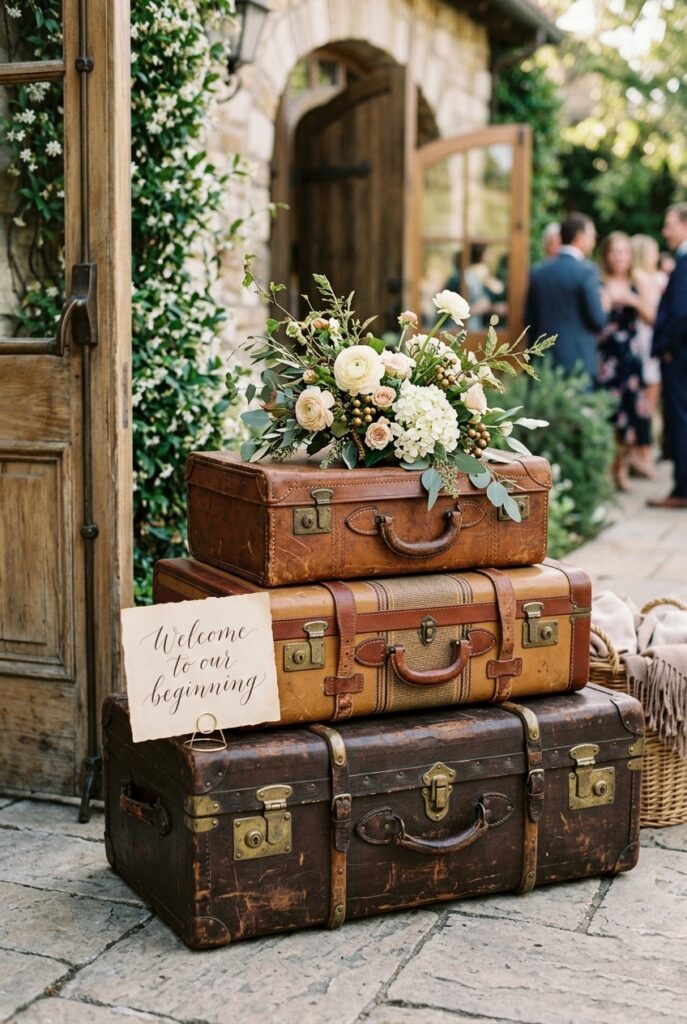
This is a thrift store classic that almost nobody executes with enough visual intention.
Three vintage suitcases in complementary tones — stacked largest on the bottom, smallest on top, tied loosely with a wide ribbon — create a sculptural welcome display that stops guests at the entrance.
Cut a clean slot in the lid of the middle suitcase for guest cards.
Top the smallest suitcase with a small bouquet or a potted plant.
Lean your welcome sign against the stack.
The whole thing takes five minutes to assemble and uses only items that came from one or two thrift trips.
Vintage suitcases at Goodwill and estate sales: $3–$15 each depending on size and condition.
The stack reads as intentional styling — the kind that appears in professional editorial shoots — and costs under $50 total.
After the wedding, sell the set on Marketplace as a “styled vintage suitcase display” for $30–$60.
5. Vintage Teacup Candles — The Place-Setting Detail That Doubles as a Favor
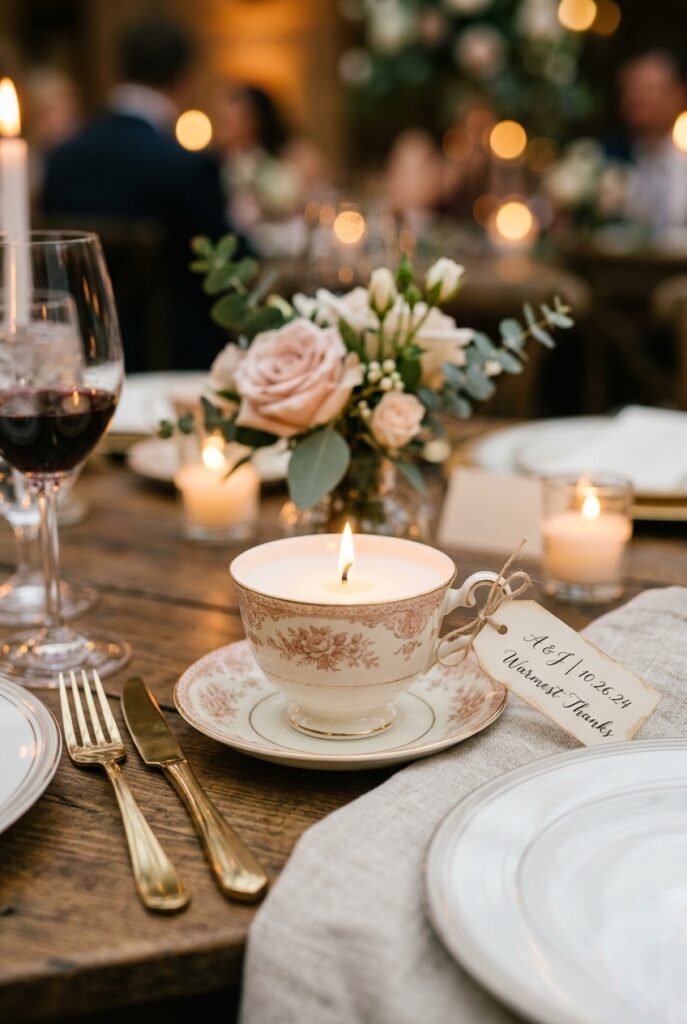
This idea sits at the intersection of centerpiece, place setting detail, and wedding favor — and almost nobody is giving it the full treatment it deserves.
Source mismatched vintage teacups from Goodwill ($0.50–$2 each), pour soy candle wax with a pre-tabbed wick into each cup ($15–$25 for a candle-making kit from Michael’s covers 20–30 cups), and let them set.
Tie a small hand-lettered tag to each handle.
Set one at every place setting. It’s a lit candle during dinner that goes home with your guest as a keepsake afterward.
The mismatched floral patterns of vintage teacups are exactly what makes this look curated rather than uniform — no two are the same, which is the point.
Total cost per guest: $1.50–$4.Comparable favor candles purchased retail: $8–$15 each.
The math is obvious. The visual on the table is gorgeous.
6. A Thrifted Wooden Ladder as a Multi-Level Display Tower
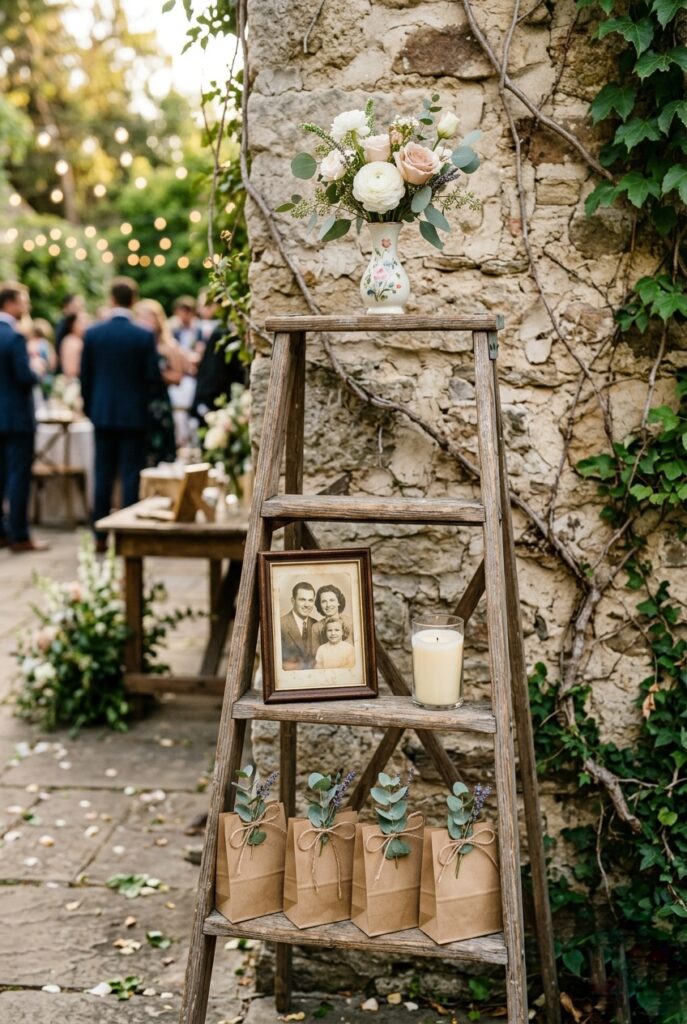
Wooden ladders appear at thrift stores and estate sales constantly — usually ignored because nobody knows what to do with them.
Here’s what to do: lean it against a wall or a tree, and use each rung as a display shelf.
Top rung: a small floral arrangement or a hanging greenery piece.
Middle rungs: framed photos, a candle cluster, a vintage sign. Bottom rung: favor bags, a small plant, extra programs.
You’ve turned a $10 thrift find into a multi-level display tower that works for your welcome table, dessert station, or ceremony backdrop.
Wooden ladders at Goodwill and estate sales: $5–$20.
Sand lightly and seal with a clear coat if the wood is rough.
Paint white for a clean look, leave natural for rustic.
This is one of the few thrift ideas that works at any wedding aesthetic — romantic, bohemian, country, garden, or minimalist.
Skip this if your venue has no wall or vertical surface to lean it against safely. An unsupported ladder is a liability.
💡 Budget Hack #2: A wooden ladder from a thrift store is a $10 find. A wooden ladder from a home improvement store — if you need a specific size and can’t find one thrifted — runs $25–$45 new. Either way, it dramatically outperforms a rented display tower ($80–$150) that looks like a generic retail fixture.
7. Thrifted Curtain Panels as Ceremony Backdrop Draping
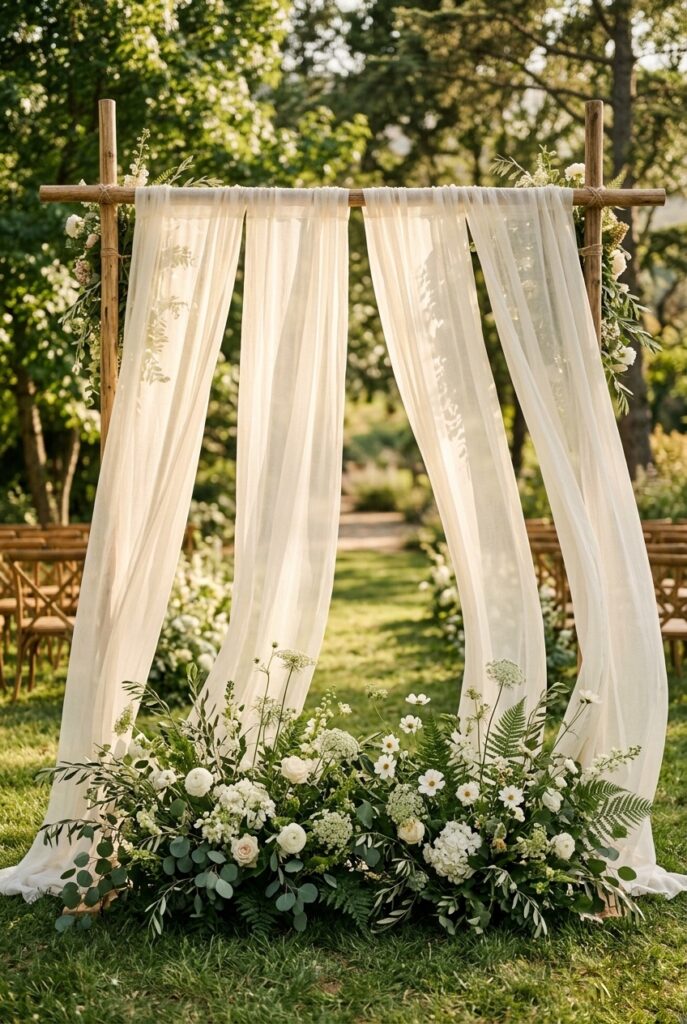
Fabric draping is one of the most transformative ceremony decor moves — and one of the most expensive when purchased new.
The thrift answer: sheer white or ivory curtain panels from Goodwill or Facebook Marketplace.
Source four to six panels in the same general tone (they don’t need to match exactly — slight variations in white, cream, and ivory layer beautifully), and drape them from a PVC pipe, wooden dowel, or simple arch frame.
The panels catch light, move in a breeze, and create an ethereal backdrop that photographs like a professional installation.
Curtain panels at Goodwill: $1–$5 each. Six panels for a full backdrop: $6–$30.
A comparable purchased fabric backdrop: $40–$150. A florist-draped fabric installation: $300–$800.
This is one of the biggest cost gaps between DIY thrift and professional purchase in all of wedding decor.
💡 Budget Hack #3: Run curtain panels through a steamer or hang them in a bathroom with a hot shower running for 15 minutes before the wedding to remove any fold creases. This takes them from “found at Goodwill” to “freshly pressed” in under 20 minutes. A travel steamer costs $20–$35 on Amazon and pays for itself immediately.
8. Silver Tray Bar Station — The Thrift Move Nobody Calls Out
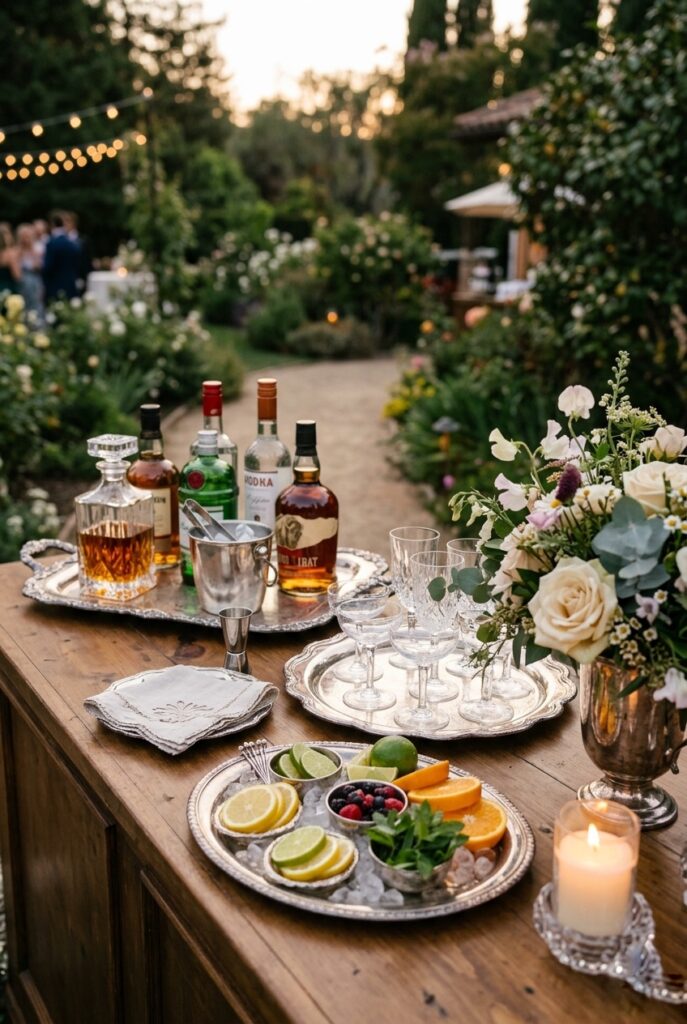
Silver trays are thrift store staples — donated constantly, bought rarely, because people don’t know what to do with them.
The answer for a wedding: use them to organize and elevate every surface at your bar station.
One large tray holds the bottles.
A medium tray corrals the glassware. A small tray organizes citrus garnishes or bar tools.
The repetition of silver across the bar surface creates a cohesive, styled look that signals intention without requiring any arrangement skill.
A bar styled this way photographs the way hotel bars look in travel magazines.
Thrifted silver trays at Goodwill: $1–$8 eachdepending on size. Buy six to eight in different sizes.
Polish with silver cream ($4–$6 at any hardware store) before the wedding.
Total bar styling cost with trays: under $40.
This same look from a rental company using silver serveware: $80–$150.
9. The Personal Memory Table — Built Entirely from Thrifted Frames
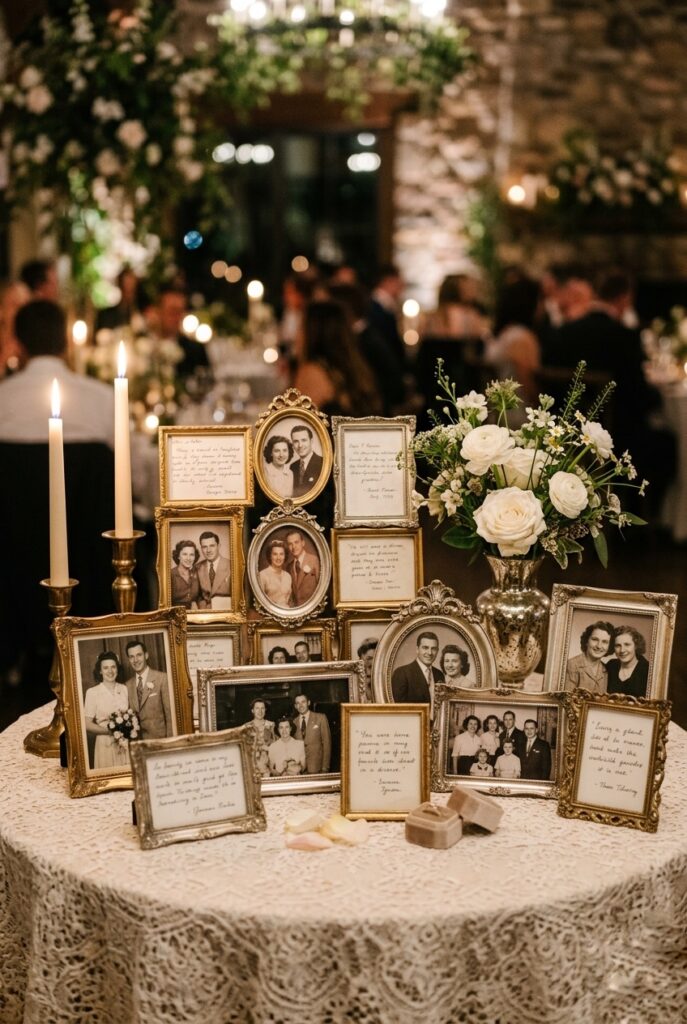
Most weddings have a memory table for loved ones who’ve passed — and most of them look like a sad afterthought.
A memory table built intentionally from thrifted frames becomes one of the most emotionally resonant and visually beautiful displays in the room.
Source 10–15 mismatched ornate frames (gold, silver, or mixed) from Goodwill in varying sizes.
Spray them all a uniform metallic tone or leave them deliberately mismatched within the same metal family.
Fill them with family photos, handwritten love notes, recipe cards from beloved relatives, or meaningful quotes.
Layer over a lace tablecloth, add a small vase of flowers and two candles, and the table becomes something guests return to all night. Frame cost at Goodwill: $0.50–$3 each.
Total table: $15–$45. No other table at the wedding will get more sustained attention.
10. The Vintage Brooch Bouquet — The Heirloom Alternative
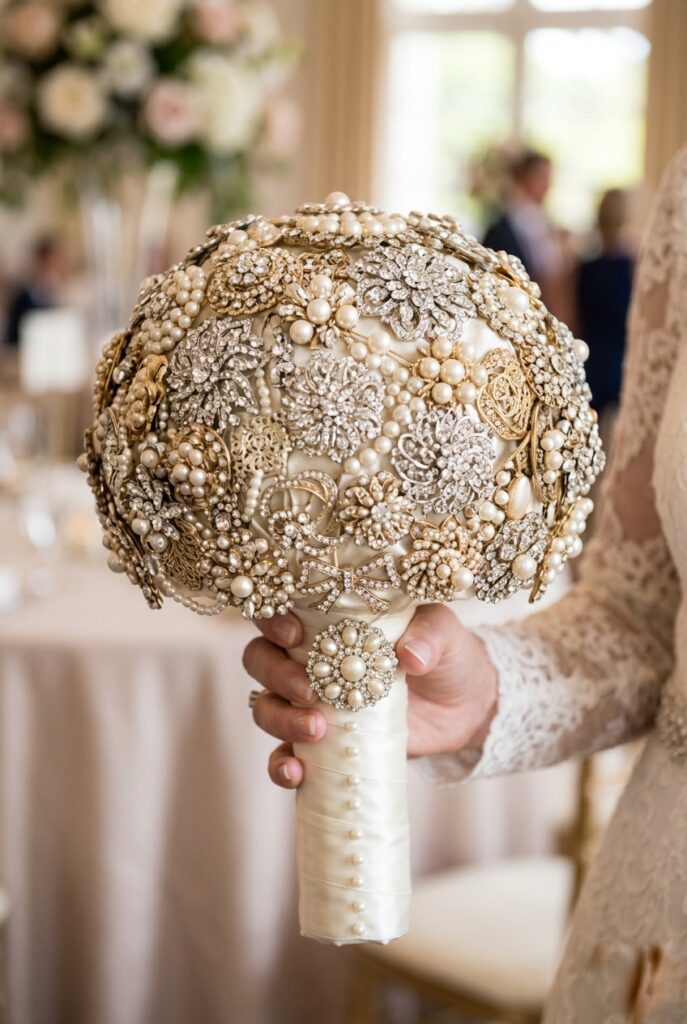
This is the one idea on this list that no competitor article gives its full weight — and it belongs here because it is entirely thrifted and it is the most personal decor item at any wedding.
A brooch bouquet is made by collecting vintage brooches, pearl strands, rhinestone pins, and costume jewelry pieces from Goodwill display cases ($0.50–$4 each) and attaching them with pearl-topped corsage pins to a wrapped stem base.
The result is a bouquet that never wilts, travels as a carry-on, and can be passed down.
More importantly: it tells a story in every piece. An aunt’s cameo.
A grandmother’s pearl brooch.
A market find that caught the light.
Fresh flowers are beautiful and gone by 10pm.
A brooch bouquet is a family heirloom from the moment you finish making it.
Total cost for a full bouquet: $30–$80 depending on how many pieces you collect.
A florist’s bridal bouquet: $150–$400.
Only do this if you have 4–6 weeks to collect enough pieces — you need 40–80 brooches for a full bouquet. Start early and enjoy the hunt.
How to Design a Thrifted Wedding Like a Stylist
- Choose your anchor piece first — chandelier, rug aisle, wine bottle gallery — and source everything else to support it
- Pick one metal tone and one textile direction before you buy a single additional item
- If you’re unsure whether a piece “goes” — ask yourself: does it share the metal tone, the color palette, or the material story of your anchor? If yes, it belongs. If no, leave it.
The Real Reason Thrifted Weddings Get Photographed
It’s not the individual pieces. It’s the vignettes.
A beautiful thrifted wedding is designed as a series of small styled scenes — the welcome table, the bar, the ceremony aisle, the sweetheart table, the memory display — each of which could stand alone as a photograph.
When you walk into a room like that, you feel it before you understand it.
Every surface has been considered.
Nothing is accidental, even though everything was secondhand.
That’s the designer’s approach to thrifting: stop thinking about items and start thinking about scenes. What does the entrance look like when guests walk in?
What does the bar look like from across the room? What does the ceremony aisle look like in the wide shot?
Design each of those moments as a complete visual, and the thrifted pieces inside them become irrelevant — nobody is thinking about where you got the silver trays or the suitcase.
They’re thinking about how beautiful the whole thing looks.
The contrarian truth: a thrifted wedding requires more design thinking than a catered wedding.
With a vendor, you delegate the thinking. With thrifted decor, you are the creative director.
The couples who understand that go in with a brief, a visual anchor, and three constraints. The couples who don’t go in with a shopping cart and hope.
Mistakes That Make a Thrifted Wedding Look Unfinished
No anchor piece. Every beautiful thrifted wedding has a hero — one statement item that organizes the whole room visually. Without it, the eye has nowhere to rest.
Find the anchor first and everything else follows.
Mixing too many DIY techniques in the same space. Spray-painted bottles next to macramé next to chalkboard signs next to raw wood next to doilies is five different projects that never became one wedding.
Choose two or three techniques and repeat them throughout the room.
Repetition creates the feeling of intention.
The brutally honest one: Skipping the steam and polish step because you ran out of time.
Wrinkled curtains, cloudy crystal, dusty frames, and tarnished silver are the details that make every guest’s brain register “thrift store” instead of “gorgeous wedding.”
The cleaning and finishing step isn’t optional — it’s the final pass that turns raw material into design.
Budget two hours the day before your wedding for nothing but cleaning, steaming, and polishing. It will change how the room reads entirely.
People Also Ask: What’s the Hardest Part of Thrifting for a Wedding?
Scale. Finding one beautiful vintage brooch is easy. Finding 70 that work together for a bouquet takes six weeks. Finding one perfect silver tray takes one trip. Finding twelve for a full bar station takes five. The couples who thrift successfully start at least four months out, shop weekly, and keep a running list on their phone of exactly what they still need and in what quantities. The hunt is part of the experience — and it’s genuinely enjoyable when you’re not racing a deadline. Start absurdly early, and the scale problem mostly solves itself.
Thrifted Wedding Decor Budget Breakdown
| Element | Thrifted Cost | Comparable New/Rental | Time Investment |
|---|---|---|---|
| Vintage rug ceremony aisle (5 rugs) | $25–$150 | $200–$500 rental | 2–3 thrift trips |
| Thrifted chandelier styled | $26–$88 total | $200–$600 rental | 1 trip + spray day |
| Wine bottle gallery (per table) | $15–$30 | $80–$150 florist | Bottle collection: 3–4 weeks |
| Vintage suitcase welcome display | $10–$45 | $150–$300 styled | 1–2 estate sale trips |
| Teacup candle favors (per guest) | $1.50–$4 | $8–$15 retail | Candle-making session |
| Wooden ladder display | $5–$20 | $80–$150 rental | 1 thrift trip |
| Curtain panel ceremony backdrop | $6–$30 | $300–$800 installed | 1–2 thrift trips |
| Silver tray bar station (6–8 trays) | $8–$50 | $80–$150 rental | 1–2 thrift trips |
| Memory table frames (10–15) | $15–$45 | $80–$200 new | 2–3 thrift trips |
| Brooch bouquet | $30–$80 | $150–$400 florist | 4–6 weeks collecting |
The thrift store is patient.
It will have what you need.
The only thing it can’t give you is the design vision — and that has to come first, before you ever pick up a single secondhand piece.