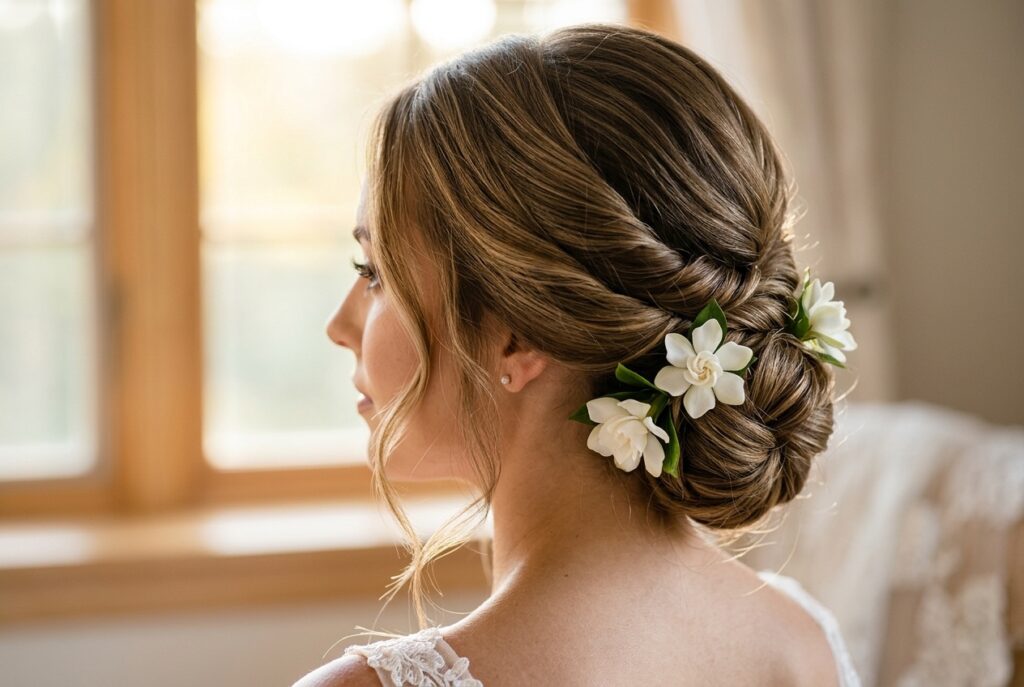
Your ceremony dress is for the vows — your reception look is for the party, and the whole point is contrast so clear your guests can see it from across the room the moment you walk back in.
Plan the outfit first, then reverse-engineer the beauty refresh to match it, because a dress change without a coordinated hair or makeup shift looks incomplete on camera and misses the entire opportunity. less and you’ve just done laundry in the middle of your wedding.
1. The Satin Mini With a Cowl or Slip Neckline

The bias-cut satin slip photographs consistently well across venues, body types, and lighting conditions because it catches candlelight with a warmth and softness that no other fabric produces, and it reads as elevated without any effort.
The critical detail is fabric: polyester satin has a bright, slightly blue-toned shine that photographs plasticky under artificial light, while silk charmeuse or acetate satin has a warmer drape and genuine weight — and if you are building from your full bridal look framework outward, the fabric and silhouette you choose here should feel like the logical, liberated conclusion of everything you wore for the ceremony.
2. The Sequin or Embellished Mini (The Dance Floor Statement)

If the ceremony dress was white, romantic, and soft, this is the opposite — and that is exactly the point, because the transformation is immediate and total, and even guests who were beginning to drift will turn around.
Don’t be afraid of silver or gold for a reception look because the reception is specifically the moment where this registers as right rather than excessive, and the sequin option works best in venues with uplighting or event lighting that gives each facet something to catch — so ask your coordinator what the actual reception lighting setup is before you commit to a heavily embellished fabric.
3. The Feather-Trim Cocktail Dress

Feather-trim cocktail dresses catch light and movement simultaneously, which means every dancing photograph becomes a natural action shot rather than a stiff posed moment — but the right version has a structured base dress in crepe or twill with clean feather trim only at the hem or cuffs, not fluffy marabou applied across the whole skirt, which reads as costume.
Look specifically for Regal or ostrich feather applied at a single edge with visible negative space in the construction, and know that the difference between a fashion moment and a school play in this category is entirely about restraint in the application.
💰 Budget Hack #1: Rent your reception dress instead of buying. Sites like Rent the Runway and Nuuly have entire bridal and formal sections with styles identical to what you’d purchase for $400+, available to rent for $85–$140 for a four-day window that covers your wedding weekend. Since a reception dress is worn for approximately three to four hours and never again, renting is the objectively smarter move for most budgets.
4. The Bridal Jumpsuit (Gap Idea #2 — Beauty Refresh Architecture)

Your reception look needs a beauty refresh plan to match it — not just a dress swap — because when a bride changes into a bold second look without adjusting her hair or makeup, the dress is communicating one thing and the face is saying another, and that disconnect shows in photographs.
For a jumpsuit specifically, the refresh is a coordinated move toward a style that exposes the clean jawline-to-shoulder line the neckline creates — a slicked-back bun with a single gold barrette, a pearl comb swapped for a minimal gold bar clip — and if you want the full range of hairstyle options that work for this transition, the bridal hairstyle guide covers exactly how each updo construction responds to a quick in-between-events refresh.
5. The Structured Mini in Crepe or Twill (Gap Idea #1 — Timing Architecture)
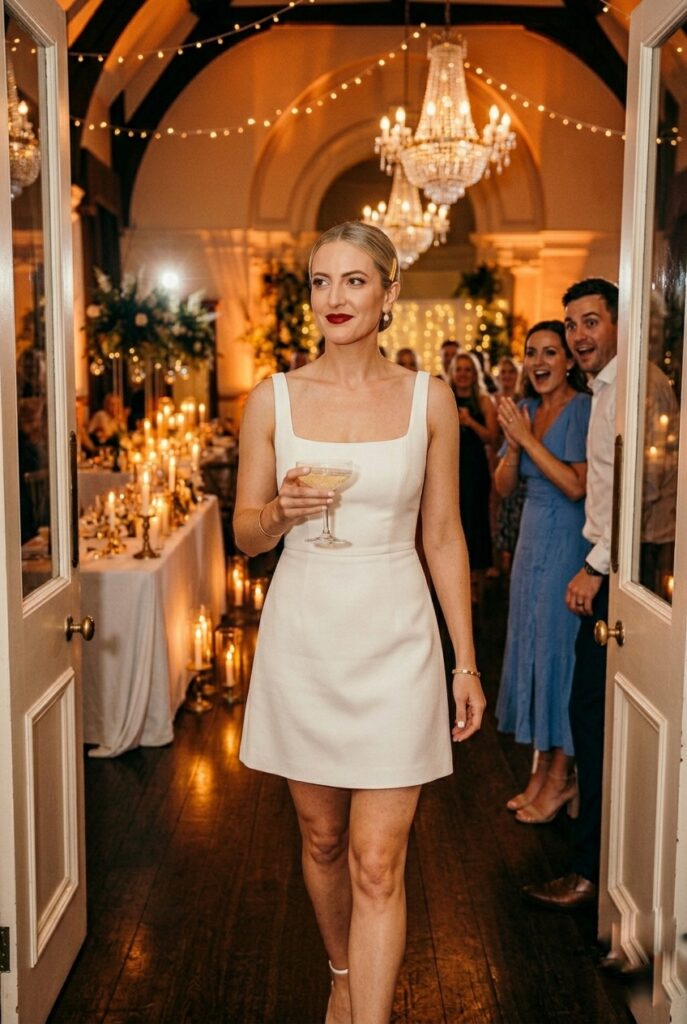
When you change matters as much as what you change into — brides who disappear for thirty minutes during cocktail hour come back to a room that has already settled into its own rhythm, and the return does not register as an entrance because everyone is mid-conversation.
The correct moment is the transition from dinner to dancing, immediately before the first open dance floor song when guests are standing and energised and looking for a signal that the party is beginning, which is also why the structured crepe mini is the right dress for this timing — it signals movement and celebration with its silhouette the moment it appears through the doors, and it reads cohesively alongside simple, refined wedding decor without competing with the room.
6. The Two-Piece Bridal Set
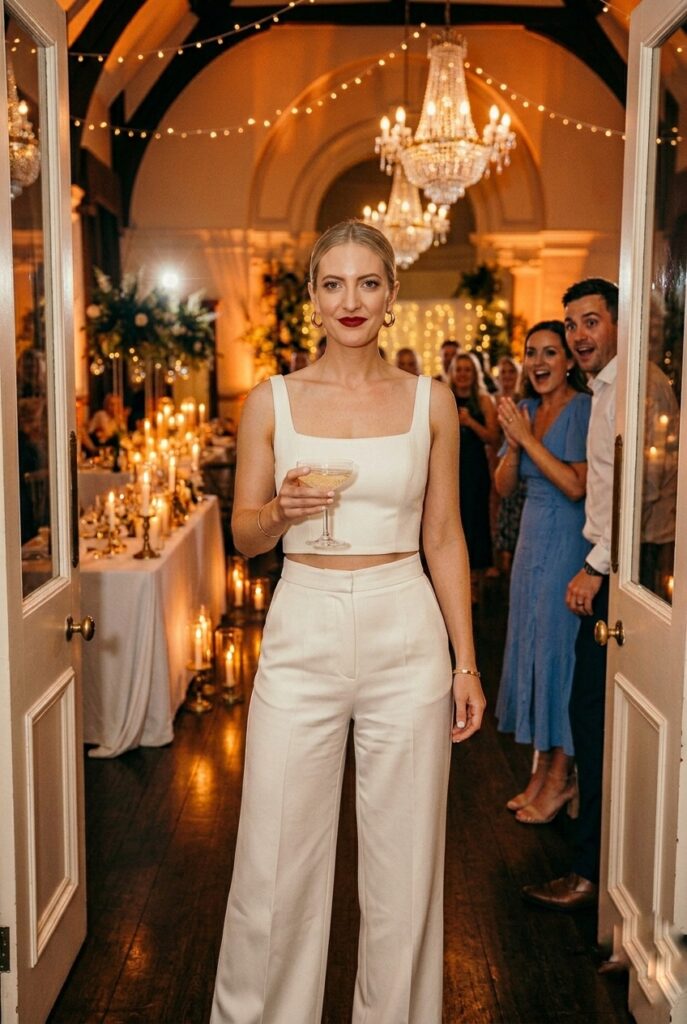
A tailored crop top with high-waisted trousers reads as bridal when the fabric is ivory, white, or champagne and the execution is clean — and its specific advantage over a dress is that the top and bottom are fitted independently, which produces a more precisely fitted garment than any off-the-rack hemline-and-waist alteration.
The longer crop top that grazes the waistband is gallery-ready and cohesive; full midriff exposure is a different visual register, so the fit decision is worth trying both versions in your actual venue lighting rather than a changing room, and for indoor reception settings with clean architectural design, a sharp ivory trouser set is the only second look that completes rather than competes with the surrounding space.
💰 Budget Hack #2: Buy the reception dress before the ceremony dress, not after. Most brides do this backward — they spend their full dress budget on the ceremony gown, then scramble for a reception dress with whatever is left. When you buy the reception dress first, you have twice the time to shop, you can buy off-season or sample sale, and you avoid the $300+ markup that bridal retailers add when they know you’re a bride in the final weeks before the wedding. Specifically, BHLDN and Reformation run end-of-season sales in January and July where reception-appropriate styles drop by 40–60%.
7. The Color Moment

White is not mandatory for a reception look — a dusty rose, champagne, soft sage, or pale blush slip photographs with a warmth under evening amber lighting that white cannot match, and the soft desaturated range reads as a specific bridal decision rather than a guest’s dress.
Stay within that muted palette — pale blush, dusty rose, warm champagne, sage, butter yellow — and avoid saturated bright hues unless your overall wedding aesthetic is genuinely maximalist, and for outdoor and garden reception settings a soft dusty rose or sage second look echoes the botanical surroundings in a way that pure white simply cannot.
💰 Budget Hack #3: Skip the formal bridal alteration appointment for a reception dress and use a local tailor instead. A dry cleaner with on-site tailoring charges $18–$40 for a hem and $25–$55 for a side-seam take-in versus $80–$180 at a bridal boutique for identical work. The boutique markup on alterations for non-ceremony garments has no basis in skill — it’s billing for the label. Use a recommended local tailor and pocket the $80+.
8. The Removable Overskirt (When You Can’t Commit to Two)

Not every bride wants the logistics or expense of a full second outfit — and the removable overskirt is the honest answer, because many ceremony gowns are designed with a detachable full skirt over a complete slip or fitted underdress that requires zero additional budget, zero extra fitting appointments, and zero time away from the party.
Only commit to this option if you have tried the underdress alone at your fitting and confirmed it reads as finished rather than like something is missing — and if your overall wedding approach is one of refinement and restraint, the simple bridal nail ideas are the natural companion to this look, giving your hands a polished finish that photographs cleanly throughout both the ceremony and the reception transition without requiring two different nail looks.
Your reception look lands when it is planned with the same attention as the ceremony dress — pick the style that creates the greatest visual distance from what you wore to the ceremony, build in the beauty refresh to match, and coordinate the timing with your photographer before the day arrives.
For everything you need on hand to keep both looks intact across a full wedding day, the bride’s wedding day checklist covers your touch-up kit, your maid of honour’s bag, and your reception comfort essentials, and the bridal nail art guide closes the final detail of a look that photographs from your hairline to your fingertips.