Most groom checklists are just a list of clothes with a reminder to bring the rings — as if forgetting your own wedding band is the likeliest thing to go wrong. It isn’t.
The things that actually derail grooms on wedding days are subtler, more specific, and never on those lists.
Here’s the version written by someone who has watched grooms panic, scramble, and miss shots they can’t get back.
The suit bag hanging on the back of the door, collar pressed flat, cufflinks already threaded through. A folded notecard in the breast pocket — vows written in your own handwriting, ink slightly smudged. Something about holding it in your hands makes the whole day feel less like a performance.
The Short Answer
Grooms who have a genuinely good wedding day are almost always the ones who prepped everything the night before and had nothing left to figure out in the morning.
Every groom who panicked in the getting-ready suite did so because something critical was packed wrong, missing, or assumed to be handled by someone else.
This checklist doesn’t assume anyone else is handling anything.
It puts it directly on you — and flags the specific items that show up in photographs in ways you won’t notice until six months after the wedding when you’re looking at the album.
1. Your Suit or Tuxedo — Steamed, Not Just Picked Up (Gap Idea #1)
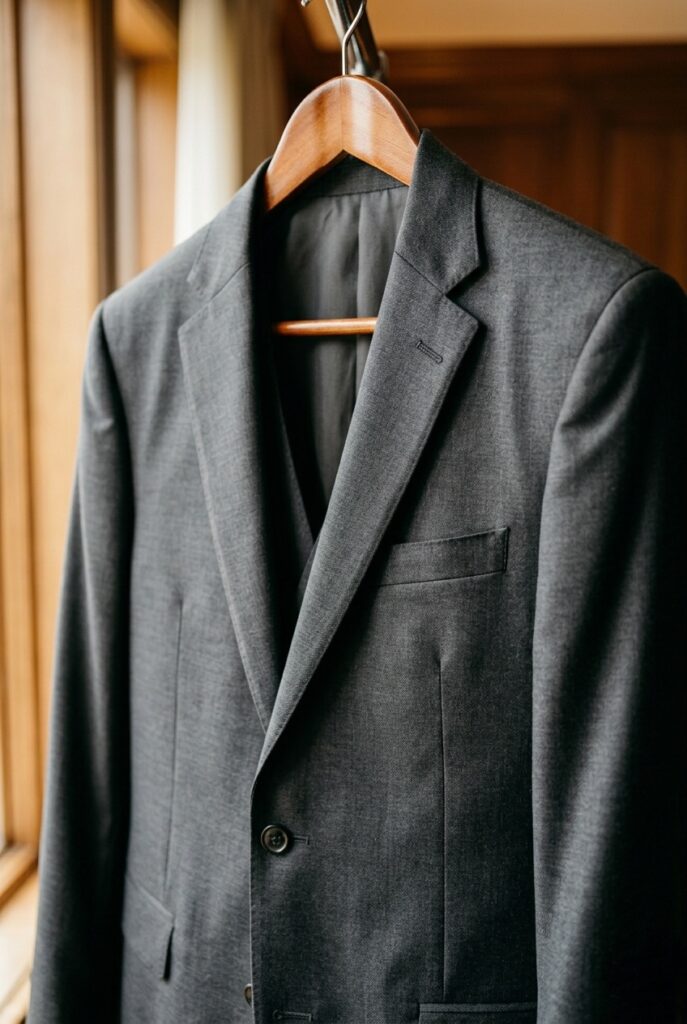
Pick up your rental or tailored suit at minimum two days before the wedding, never the morning of.
Open the bag the moment you get home.
Check every piece: jacket, trousers, waistcoat if applicable, dress shirt, tie — all of it.
Confirm colors match, sizes are correct, and nothing is missing.
Rental shops send wrong tie colors and mismatched trouser sizes more often than any groom expects, and you need days, not minutes, to correct it.
Here is the thing no standard checklist tells you: have the suit steamed before the wedding day, not pressed.
Steaming lifts wrinkles by relaxing the fibers without flattening them, preserving the natural texture of the fabric. Pressing — with an iron directly on wool or a fine weave — flattens the surface and can leave hard crease lines that catch flash photography in unflattering ways.
A wedding photographer shooting a well-steamed suit versus a pressed one will see the difference in every close-up frame.
Men’s Wearhouse locations offer complimentary steaming with rentals if you ask — most grooms don’t know to ask.
Price range: $0–$25 for professional steaming. A handheld garment steamer for at-home use runs $30–$80 on Amazon.
2. The Complete Accessories Inventory
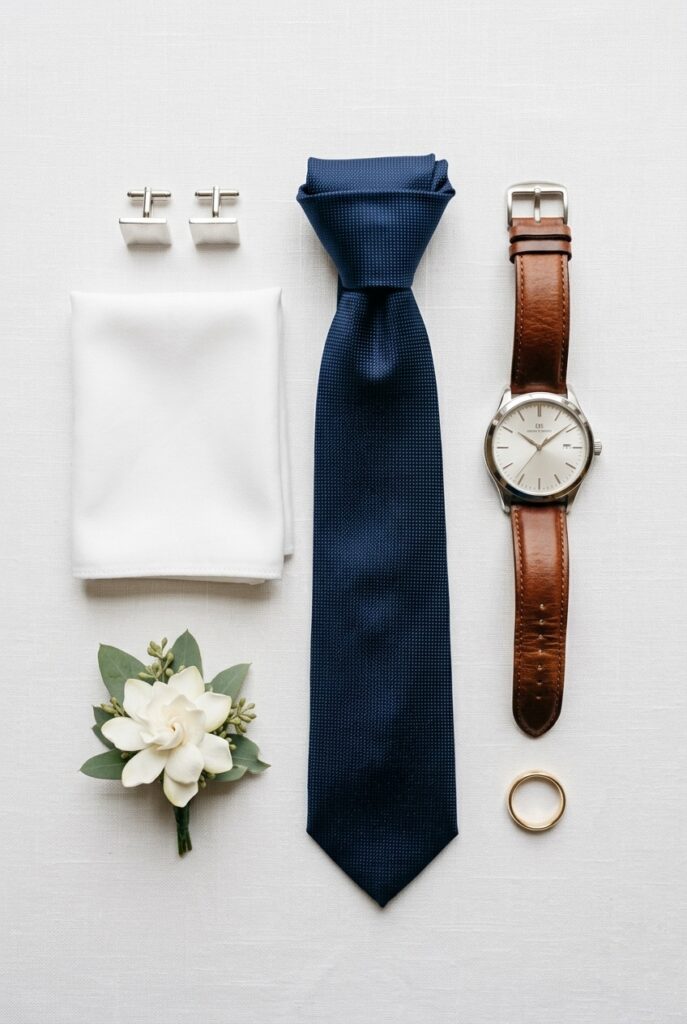
The number of grooms who arrive at a venue with their suit and forget a cufflink is extraordinary.
Accessories should be packed as a unit — not spread across different bags, nightstands, and bathroom counters.
The night before the wedding, put every single accessory into one small pouch or box: cufflinks, tie or bowtie, pocket square, dress watch, boutonniere pin if you’re attaching it yourself, collar stays, and the belt or suspenders.
Zip it. Put it on top of the suit bag. Done.
Skip this if you’re getting ready at the venue and having someone bring items separately — instead, email them this list and have them confirm every item two days in advance. Never assume.
Check your collar stays specifically. Most dress shirts for weddings have collar points that curl without stays, and curled collar points photograph terribly in close-up portraits.
A $12 set of magnetic collar stays from Amazon is the cheapest grooming upgrade with the highest photographic return.
Price range: Collar stays $8–$20 on Amazon. Cufflinks $20–$200 depending on metal.
3. The Wedding Rings — Both of Them, Confirmed Location
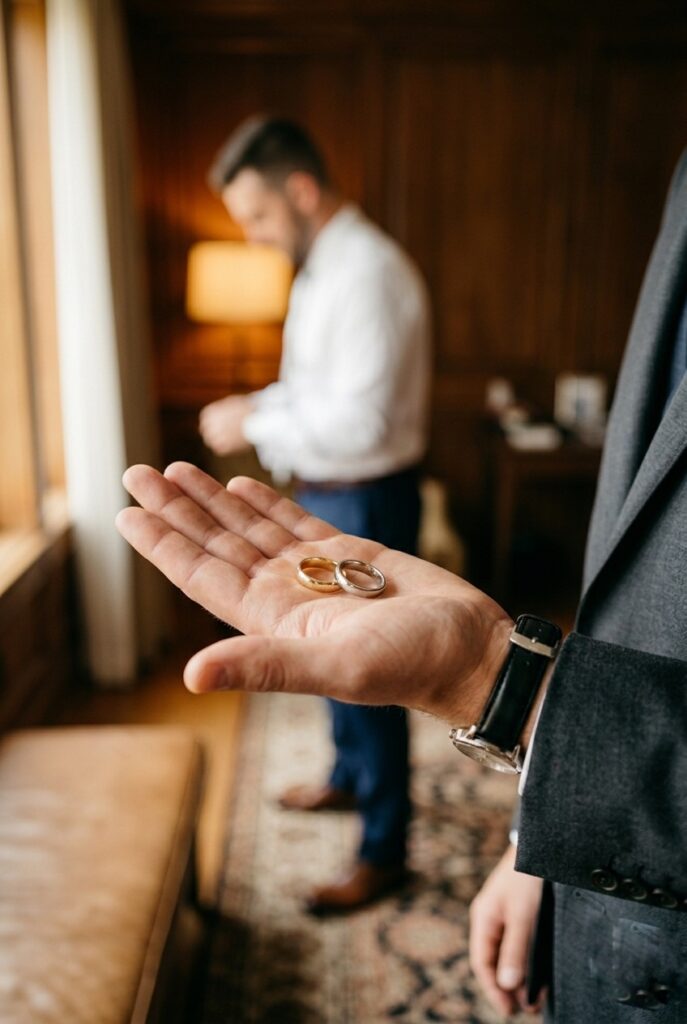
The rings go with the best man.
Not in your jacket pocket, not in the car, not in the hotel room safe unless someone has already confirmed they will retrieve it with two hours of buffer time before the ceremony.
The best man holds the rings. That is his most concrete logistical job of the entire day.
Confirm ring location the night before, verbally, with your best man. Then text him the morning of.
Confirm he physically has them before you leave for the ceremony venue.
This sounds excessive until you’ve seen a groom sprint to a hotel room 40 minutes before a ceremony because nobody confirmed whose pocket the rings were actually in.
Only do this if you have a best man you trust implicitly with a non-negotiable task.
If your best man is the type to lose his own car keys regularly, carry one ring in your own inside jacket pocket as a backup.
💰 Budget Hack #1: If you’re purchasing a second dress shirt as a backup (strongly recommended — spills happen before the ceremony more often than during), buy it from Target’s Goodfellow & Co. line rather than a formalwear retailer. The shirts run $20–$28 and are cut similarly to dress shirts costing $80+. For photographs, the collar, placket, and buttons are identical in visual weight. Spend the $60 difference on vendor tips instead.
4. Your Vow Card — Handwritten, Not Screenshotted
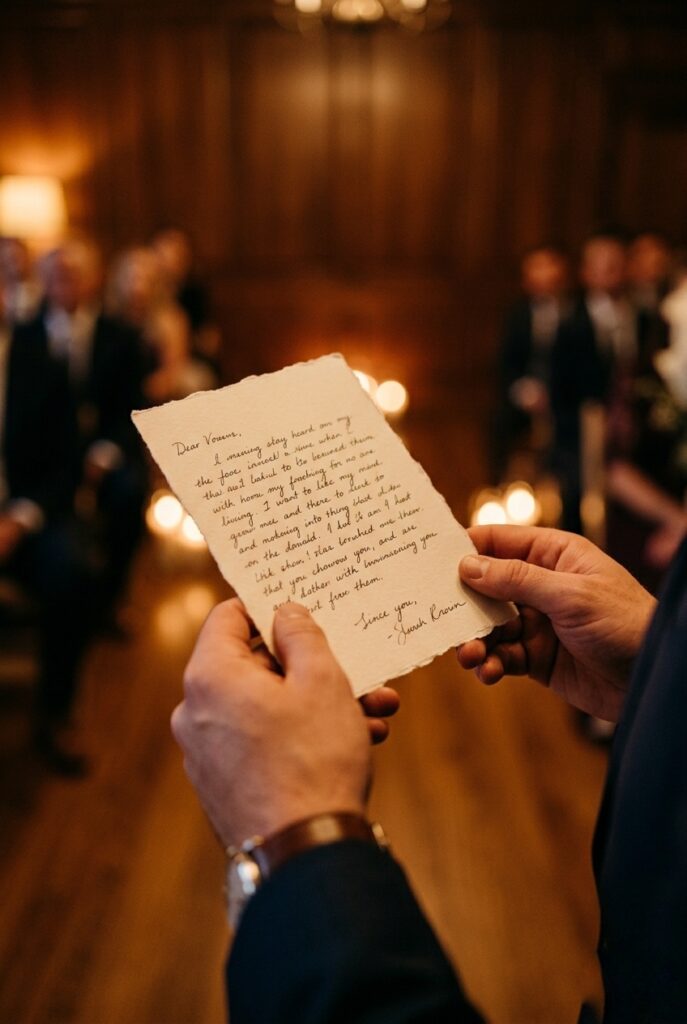
Write your vows on a card. Not your phone. A card.
There are two reasons for this and they are not sentimental — they are practical.
First, phones go to lock screen mid-ceremony and forcing yourself to unlock your phone while holding your partner’s hands is a genuinely awkward photographic moment that you cannot undo.
Second, a handwritten card on thick cream stock photographs as an intentional detail; a phone photographs as a phone.
Keep the card in your inside breast pocket. Practice reading from it at least twice the day before so your eyes can find the lines without squinting.
A card from a paper goods shop like Rifle Paper Co. or Minted runs $3–$8 for a single heavy-stock card — it is the cheapest and most underrated detail in groom prep.
5. The Hands Audit (Gap Idea #2)

Ring exchange photographs are standard at every wedding.
Your photographer will shoot your hands during the ring placement, during the first look if you do one, during the vow reading if you’re holding a card, and repeatedly throughout portraits.
Your hands are in more photographs than almost any other part of your body except your face.
Trim your nails clean three days before the wedding — not the morning of, because freshly cut nails can look raw and have sharp edges that catch light unnaturally.
File the edges. Apply hand lotion every morning for the week leading up to the wedding if your skin runs dry.
Address any hangnails.
This takes four minutes total and is something every wedding photographer privately notices and rarely mentions until after the photos are delivered.
The bold opinion: a man who gets a basic manicure — trim, file, cuticle push, and buff, nothing colored — before his wedding is not doing something unusual.
He is doing something smart that will show up in a minimum of thirty photographs.
Price range: Basic men’s manicure at a nail salon, $15–$30. Costs four minutes of mild awkwardness and zero regret.
6. Your Grooming Kit — Specific, Not Optimistic

Groom grooming kits in most articles read: “toothbrush, deodorant, cologne.”
That is not a kit — that is what you pack for a one-night business trip.
A real wedding day grooming kit contains: a lint roller (compact, not the full handle), matte setting powder or blotting papers (for oil control in photos — every groom who has seen a photograph of himself shining under reception lighting wishes he knew this), clear lip balm, cologne, nail file, stain removal pen (Tide To Go), and backup collar stays.
Shave the day before, not the morning of. Razor burn reads on camera even when it isn’t visible to the naked eye, and skin needs 12–16 hours to settle after a close shave.
If you prefer a barber shave, book it for the afternoon or evening before the wedding.
The morning-of shave is one of the most consistent groom mistakes — mentioned by photographers, rarely corrected before the day arrives.
Products: Translucent matte powder: Laura Mercier or RCMA No Color Powder ($35–$45, Sephora or Amazon) — yes, it works on all skin tones, and no, it does not read as “makeup” in photos.
Tide To Go pens ($4, every drugstore). Compact lint roller ($6–$10, Amazon or Target).
💰 Budget Hack #2: Vendor gratuity envelopes are one of the most expensive last-minute scrambles on a wedding day. Prepare them the Wednesday before the wedding: write each vendor name on an envelope, fill with the cash amount, seal, and give the full set to your best man or wedding coordinator to distribute at appropriate moments during the day. The average couple tips $400–$800 total across all vendors. Withdrawing cash on Thursday avoids ATM fees, avoids the Sunday-before-wedding panic, and takes the task entirely off your plate on the day itself. WeddingWire has a comprehensive vendor tipping guide that breaks down the standard range by vendor type.
7. The Emergency Kit That Isn’t Generic

Every groom checklist says “emergency kit” and then lists bandages, ibuprofen, and a safety pin. That is the beginning of an emergency kit, not the end of it.
A complete groom emergency kit also includes: clear nail polish (seals a run in dress socks, keeps a fraying thread from unraveling, holds a loose button in place for hours), double-sided fashion tape (keeps shirt plackets flat, keeps a pocket square from collapsing), a spare collar button (the most commonly lost piece of a dress shirt), black shoe polish in a compact tin, and athletic insoles cut to fit dress shoes.
That last item — insoles — is one that almost no guide mentions and that every groom who stands for seven hours in new leather-soled shoes wishes someone had told him.
Dress shoes have zero cushioning.
A $12–$18 pair of slim gel insoles from Dr. Scholl’s or Superfeet, trimmed to fit, is the difference between enjoying your reception and spending the last hour of your own wedding sitting down because your feet are wrecked.
Price range: Full emergency kit self-assembled from Target and Amazon, $35–$55. Far cheaper than the bridal emergency kits sold pre-packaged for $75+.
8. Food and Water — Scheduled, Not Assumed

Grooms routinely skip breakfast on their wedding day because the morning is chaotic.
Then they have one or two drinks at the cocktail reception on an empty stomach, and by the time they’re in their first dance photos, the alcohol has hit.
Every wedding photographer has seen this pattern.
The fix is so simple it barely warrants explaining: order food the night before.
Have it delivered or arranged for the getting-ready suite. Protein, carbs, water. Eat before you put on the suit.
Designate one groomsman specifically to track your water intake during the day.
This sounds silly until hour six when you’re taking portrait photos in a dark ceremony room and wondering why you have a headache.
Dehydration under event lighting, after hours of talking, gripping handshakes, and standing in formal attire, is genuinely common and genuinely affects how you look in photographs — skin color, eye clarity, everything.
Only do this if your venue doesn’t have an assigned coordinator managing groom suite logistics.
If a coordinator is on site, confirm with them directly that food is arranged — don’t assume it’s being handled.
Price range: Getting-ready breakfast, $30–$80 depending on what you order. Zero budget if the venue includes it.
9. The Timeline — Read It Fully, Own It

Read your wedding day timeline in full the night before.
Not skim it — read every entry, every time, every location.
Know exactly when you need to be dressed, when portraits start, where you need to stand for the first look if you’re doing one, when the ceremony begins.
Your photographer cannot reshoot a first look that happened ten minutes early because you walked out of the getting-ready suite without checking where your partner was.
Your coordinator cannot add time back to the schedule because the groomsmen took longer to dress than expected.
The specific item that most grooms misread: portrait time. Most timelines block 45–60 minutes for couple portraits between the ceremony and reception.
Grooms frequently underestimate how long this takes and spend the first fifteen minutes of it saying “how many more?” Portraits take the time they take.
The couples who get the best images are the ones who arrived already knowing what they were walking into and surrendered to the schedule rather than fighting it.
If you want insight into how venue aesthetics affect your portrait backdrop options, the wedding decor ideas on BlessedVows show you what different venue setups look like from a visual standpoint — useful context before you finalize your getting-ready location.
💰 Budget Hack #3: Book your groom haircut exactly eight days before the wedding, not the day before. A fresh haircut on the morning of the wedding looks stark and has no settling time — the edges are too sharp, the shape sits differently on camera than it will in two days. Eight days out gives the cut enough time to relax into a natural shape while still being clearly recent in photos. Most barbershops charge the same $25–$50 regardless of timing. Zero extra cost for significantly better photographs.
10. Your Gift for Your Partner — Ready and With You

This is not a logistics item — it is a photograph.
The moment a partner reads a card or opens a gift before the ceremony is one of the most reliably emotional shots of the entire day, and it only happens if the gift actually exists and is actually present.
Put the gift and card in the getting-ready bag the night before.
Tell your best man it needs to be delivered to your partner before the ceremony, with enough time for the photographer to be in position.
The gift itself does not need to be expensive.
A personal letter, a piece of jewelry that references something specific and private between the two of you, a book with handwritten notes in the margins — anything that reflects actual thought photographs better than anything expensive that doesn’t.
A $400 bracelet with no story is a bracelet.
A $30 piece of antique jewelry from an estate sale with three lines explaining why you chose it is a moment.
Price range: Whatever reflects your relationship. $30–$300 is a reasonable range. What matters far more than price is that it exists and arrives on time.
Decision Filter
If you’re renting your suit, pick it up at least two days out and inspect every piece immediately — this is non-negotiable, not a suggestion.
If you’re buying, have your final fitting no later than two weeks before the wedding and confirm alterations are complete five days ahead of the date.
If you’re getting married outdoors in summer, add sweat-proof undershirt and body powder to your emergency kit — heat and formal attire in direct sun is a combination most indoor-focused checklists completely ignore.
For a summer outdoor wedding, fabric choice is also worth factoring into your suit selection earlier in the process than most grooms realize.
The Real Reason
Grooms tend to underperform on wedding day preparation not because they don’t care, but because they treat the day as something that will just happen — a series of events they’ll navigate as they arrive.
The bride typically has a plan, a schedule, and a stylist.
The groom often has a group chat and a general sense of when to show up.
The contrarian truth: the details that read as “extra” — the manicure, the steamed suit, the handwritten vow card, the matte powder — are not vanity.
They are the things that separate photographs that look polished from photographs that look like someone’s friend happened to take a picture.
The camera does not forgive the small things the eye overlooks.
The strong opinion: sharing wedding planning equally doesn’t mean doing equal amounts of the same tasks.
It means each person owns their lane completely.
The groom’s lane is smaller in scope than the bride’s on most wedding days — which means there is no excuse for it not to be airtight.
Mistakes to Avoid
Mistake 1: Picking Up the Suit the Morning of the Wedding
Every formal wear guide and competitor article says “pick up the suit in advance.”
What they don’t say is that picking it up the morning of leaves you with zero buffer time when the wrong tie arrives or the trousers are two inches too long in the inseam.
Same-day corrections are functionally impossible.
Rental shops are often not open or cannot fix alterations in under six hours.
Pick it up two days before, open the bag immediately, try everything on, and confirm it all fits and matches before you leave the shop’s parking lot.
Mistake 2: Spending $150 on a Pre-Made Groom Emergency Kit
Pre-packaged wedding day emergency kits marketed to grooms cost $75–$150 and contain generic items chosen for perceived value rather than actual utility.
The identical items — lint roller, stain pen, pain reliever, safety pins, matte powder — assembled from Target or Amazon cost $35–$55 total and include full-size versions rather than trial-size quantities that run out by cocktail hour.
The markup exists because the packaging says “groom emergency kit.” It doesn’t earn it.
Mistake 3: Not Telling Your Photographer What Shots Matter to You
Grooms consistently assume the photographer will capture everything they want without being told.
Photographers are professionals, but they are not mind readers.
The specific shot of you and your father before the ceremony, the image of the groomsmen from a specific angle, the candid of you reading your partner’s card — none of these happen automatically unless you’ve told your photographer they matter.
Email your photographer a list of five to eight specific shots that are personal and non-negotiable two weeks before the wedding.
Every professional photographer will execute those requests better than any candid instruction delivered on the day itself.
Mistake 4: Drinking Without Eating First and Calling It Nerves
Grooms who drink through the morning getting-ready session and the cocktail hour without eating are not calming their nerves — they are changing how they look in every photograph taken after noon.
The puffiness, the color flush, the slight glassiness in the eyes — these read on camera.
Your photographer can correct a lot in post-processing.
They cannot correct the fundamental effect of alcohol on skin and eyes.
Eat before you drink.
Drink water between every alcoholic beverage. Finish the night with the photographs you want to look at for the rest of your life.
FAQ
What should a groom have in his emergency kit for the wedding day?
A complete groom wedding emergency kit includes a lint roller, Tide To Go stain pen, extra collar stays, double-sided fashion tape, clear nail polish (for loose threads and sock runs), matte blotting papers or translucent powder, a small sewing kit, safety pins, ibuprofen, and gel dress shoe insoles.
Build it yourself from Target and Amazon for $35–$55 rather than buying a pre-packaged kit at a significant markup.
How far in advance should a groom pick up his wedding suit?
Pick up a rented suit at least two days before the wedding, never the morning of.
Open the bag and try on every piece immediately upon pickup to check sizing, color matching, and completeness.
Alterations and replacements take time — same-day corrections are rarely possible.
Purchased suits should have final fittings completed at least five days before the wedding date.
What do grooms most often forget on their wedding day?
The most commonly forgotten items are collar stays, a backup dress shirt, cufflinks left on a bathroom counter, the vow card, and vendor gratuity envelopes.
Accessories are consistently more forgotten than clothing because they’re small, stored separately, and assumed to be handled until they aren’t.
Pack everything into a single bag or pouch the night before the wedding.
Should the groom write his own vows?
Writing personal vows is increasingly common and produces significantly more emotional ceremony moments than traditional vow repetition for most couples.
If you write your own, print or handwrite them on a physical card — not your phone.
A card can be held naturally during the ceremony, photographs as a meaningful detail, and won’t lock or require unlocking at the wrong moment.
Budget Table
| Item | Essential | Where to Buy | Budget Range |
|---|---|---|---|
| Suit steaming | Yes | Men’s Wearhouse, local cleaner | $0–$25 |
| Collar stays | Yes | Amazon, Target | $8–$20 |
| Matte blotting powder | Yes | Amazon, Sephora | $15–$45 |
| Stain pen (Tide To Go) | Yes | Any drugstore | $4 |
| Compact lint roller | Yes | Amazon, Target | $6–$10 |
| Backup dress shirt | Strongly recommended | Target Goodfellow & Co. | $20–$28 |
| Gel dress shoe insoles | Yes | Target, Amazon | $12–$18 |
| Double-sided fashion tape | Yes | Amazon | $6–$12 |
| Basic manicure | Strongly recommended | Local nail salon | $15–$30 |
| Vow card (heavy stock) | Yes | Minted, Rifle Paper Co. | $3–$8 |
| Vendor gratuity envelopes | Yes | ATM + standard envelopes | $400–$800 total tips |
| Gift for partner | Yes | Personal choice | $30–$300 |
| Emergency kit (full, self-assembled) | Yes | Target + Amazon | $35–$55 |
The groom who shows up fully prepared on his wedding day — steamed suit, clean hands, vow card in pocket, rings confirmed, food eaten, timeline read — has essentially removed himself from the list of things that can go wrong.
Everything else becomes someone else’s job. That is the point.
Go build your kit from this list right now, then bookmark The Knot’s full 12-month groom planning checklist for the longer planning runway — it covers the decisions that happen months before the day and is the most comprehensive free resource available for where to start.