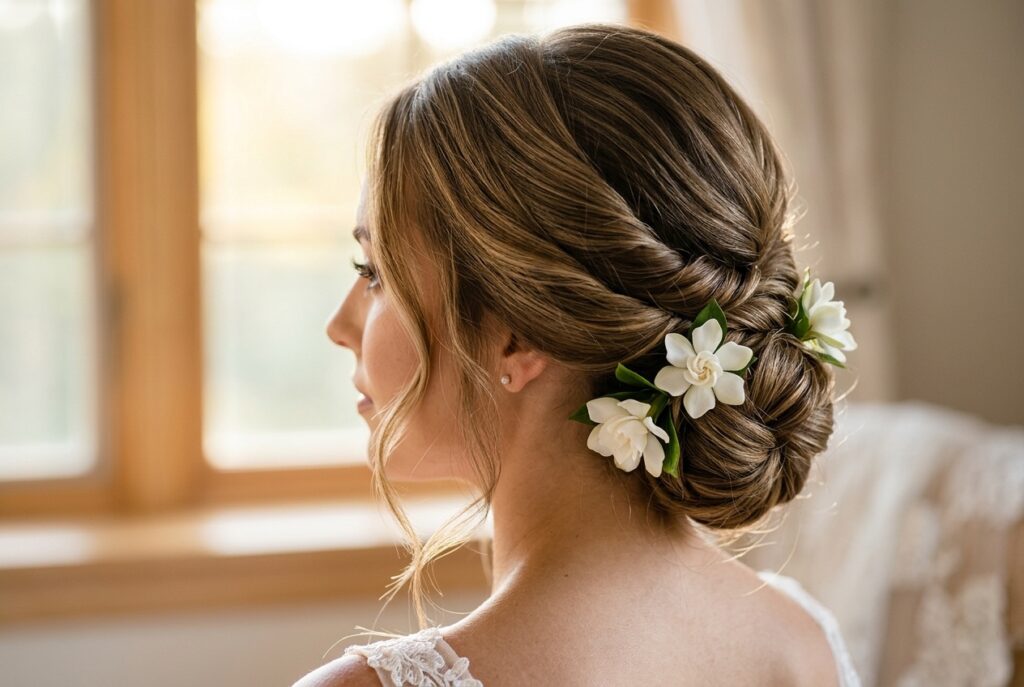
10 Bridal Nail Art Designs Which Looks Very Aesthetic!


Close-up of a bride's hands displaying hand-painted white botanical nail art with tiny roses and gold leaf detail on almond nails, held against a white silk wedding gown Image prompt: Photorealistic close-up of a bride's two hands together showing hand-painted white botanical nail art on almond-shaped medium-length nails — delicate white rose miniatures with fine gold leaf accents on three nails and a sheer blush base on the remaining nails — hands resting lightly on draped white silk wedding dress fabric, soft warm natural window light from the left, shallow depth of field, editorial wedding photography aesthetic, no text overlays. Generate in horizontal landscape orientation, 3:2 aspect ratio, optimized for desktop display.

Nail art galleries will show you ten fingers of full floral sculptures and call it bridal inspiration. 

What they won’t tell you is that the bride wearing that set snagged her veil pulling off the car door handle, lost a sculpted petal during the ceremony handshake, and couldn’t cut the cake without the caterer noticing the damage. 

The art looked spectacular for the engagement photos. The wedding was a different story.

Real bridal nail art has two jobs: look deliberate in photographs and survive until midnight.

This is how you get both.


The nail artist held the dried rose pressed flat between her fingers, a pale Juliet from October, the petals still the color of old cream. She mixed three gel tints to match it exactly — warm, slightly tan, not pink. On the nail, the size of a thumbnail, she painted something the bouquet could answer. The photographer said he had never noticed nails before.


The Short Answer

Most bridal nail art fails because it’s chosen from a gallery instead of designed from the wedding. 

The nail art that photographs consistently well — that earns the compliments, that holds all day, that looks intentional in ring shots and vow shots and candid reception frames — is art that contains one clear visual reference to something that already exists in the wedding: the rose in the bouquet, the lacework of the gown, the metal of the ring setting. 

Generic “bridal” motifs (swirls, butterflies, random florals) look unconnected. Specific, referenced art looks like it was designed alongside everything else.


1. Hand-Painted Micro Florals: The Art That Photographers Ask About
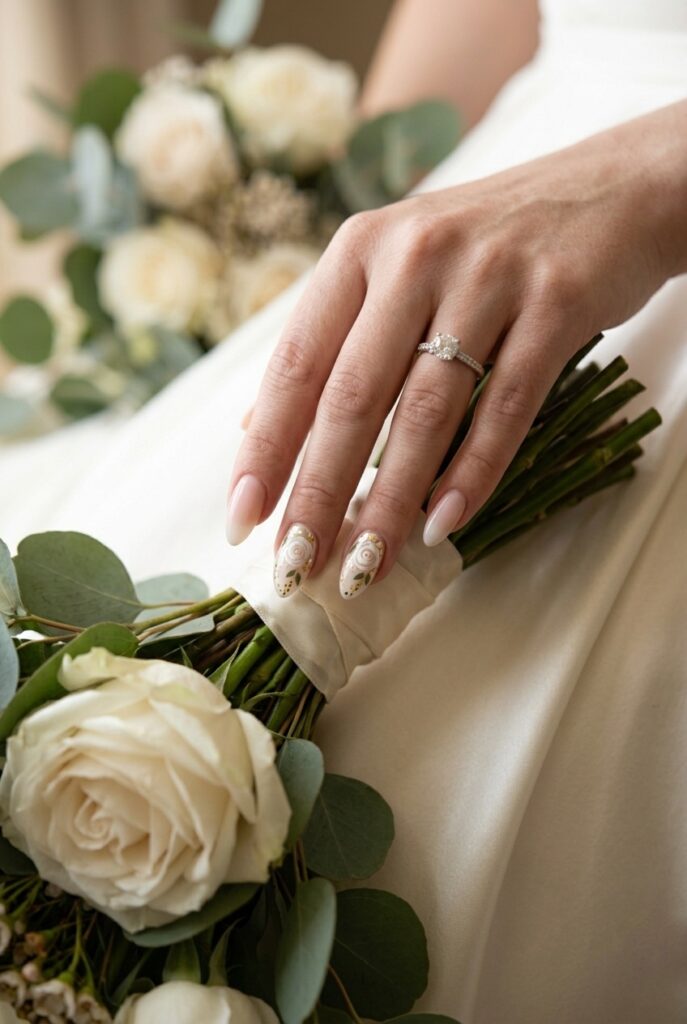
IMAGE 1 HERE Alt text: Bride's almond nails with hand-painted micro white garden rose nail art on sheer pink base, matching white bouquet roses visible Image prompt: Photorealistic close-up of a bride's hand with hand-painted miniature white garden rose nail art on almond nails — tiny white roses with yellow-green centers and small dark green leaves on three nails, sheer blush base on the remaining nails — fingers curled loosely around a white garden rose and eucalyptus bridal bouquet with matching flowers visible, soft natural window light, editorial close-up wedding photography, no text overlays. Generate in vertical portrait orientation, 2:3 aspect ratio, optimized for mobile display.

Hand-painted micro florals are the single most photographed nail art at every wedding I’ve been to where a bride wore them. 

Not because they’re showy — because they’re specific. 

A nail tech painting white garden roses to match the flowers in your bouquet creates a visual thread that runs through every photograph involving your hand: the ring shot, the bouquet hold, the vow exchange. 

Photographers actively compose around it. 

The difference between good micro florals and poor ones is the brushwork — it requires a nail artist with a dedicated botanical nail art portfolio, not a general gel tech who sometimes does flowers. 

A stamped floral decal looks flat under macro photography; hand-painted florals have depth and shadow variation that reads as genuinely painted even in extreme close-up. 

Expect $100–$180 for a full set with art on three nails. 

Budget from specialty bridal nail artists; search The Knot’s beauty vendor marketplace specifically for nail artists who photograph their work.

Only do this if your bouquet contains distinct flowers with visible petal structure (roses, peonies, ranunculus, anemones). 

Abstract or wildflower bouquets don’t translate well to miniature — the art will look generic without a clear reference.

Price range: $100–$180. Requires specialist bridal nail artist with botanical portfolio.


2. Gold Linework and Foil Art: Minimal Input, Maximum Return
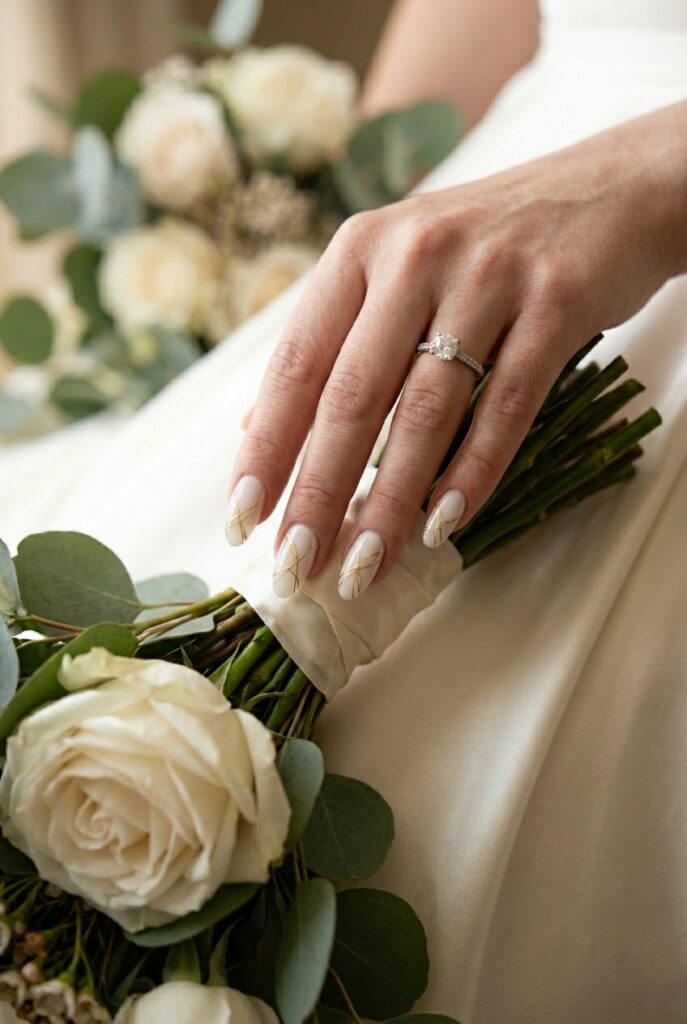
IMAGE 2 HERE Alt text: Bride's short oval nails with delicate hand-drawn gold line art — thin abstract brushstroke lines — over a soft white gel base, engagement ring visible Image prompt: Photorealistic close-up of a bride's hand with a soft white gel base manicure on short oval nails featuring delicate hand-drawn gold metallic thin line art — abstract single-stroke brushwork — across each nail, a gold band solitaire engagement ring visible on the ring finger, soft warm natural window light, the gold lines catching the light, editorial bridal photography, no text overlays. Generate in vertical portrait orientation, 2:3 aspect ratio, optimized for mobile display.

The nail art hierarchy is the most practically important concept in bridal nail design and virtually no guide covers it. 

Art on all ten nails creates visual chaos in photographs — the hand reads as a surface of competing detail rather than a composition that directs the eye.

The standard used by editorial nail artists: art on two to three nails, the remaining nails in a clean tonal base. 

Gold linework is where this approach reaches its most refined expression. 

A single painted gold line — one confident brushstroke per nail, abstract and non-representational — over a white or sheer blush base reads as deliberate and architectural in ring photographs. 

It catches light without competing with the ring, it complements both gold and platinum settings, and it is achievable at most salons by any tech with a fine liner brush and gold gel paint ($8–$15 at Sally Beauty). 

Applied to three nails only (thumb, index, ring finger on the photographed hand), it creates a compositional rhythm without the clutter of a full art set. 

For a bride whose elegant reception decor already incorporates gold elements — candelabras, gold-rimmed charger plates, metallic centerpieces — gold nail linework creates a cohesive thread from fingertip to reception table.

Price range: $45–$70 for gel base plus linework add-on at most salons.


3. Pearl Embellishment Nail Art: The Decision That Determines Whether It Works or Destroys Itself

IMAGE 3 HERE Alt text: Bride's oval nails with a sheer blush gel base and tiny flat nano-pearl accents placed in a delicate trail pattern along each nail, warm candlelight setting Image prompt: Photorealistic close-up of a bride's hand with a sheer blush pink gel manicure on oval nails, tiny flat nano-pearls arranged in a delicate curved trailing line pattern across each nail surface, photographed against cream silk fabric, warm amber candlelit atmosphere with the pearl accents catching the light softly, editorial bridal photography, no text overlays. Generate in vertical portrait orientation, 2:3 aspect ratio, optimized for mobile display.

Pearl nail art divides sharply into two categories by execution, and the wrong category destroys itself before you reach the altar. 

Dome pearls — round, raised, large — are the wrong category. 

They catch on lace, on veil fabric, on bouquet ribbon, on every textured surface a bride touches in a wedding day, which is many. 

Within three hours a dome pearl set is missing stones and the remaining ones are shifting in their gel cradles. 

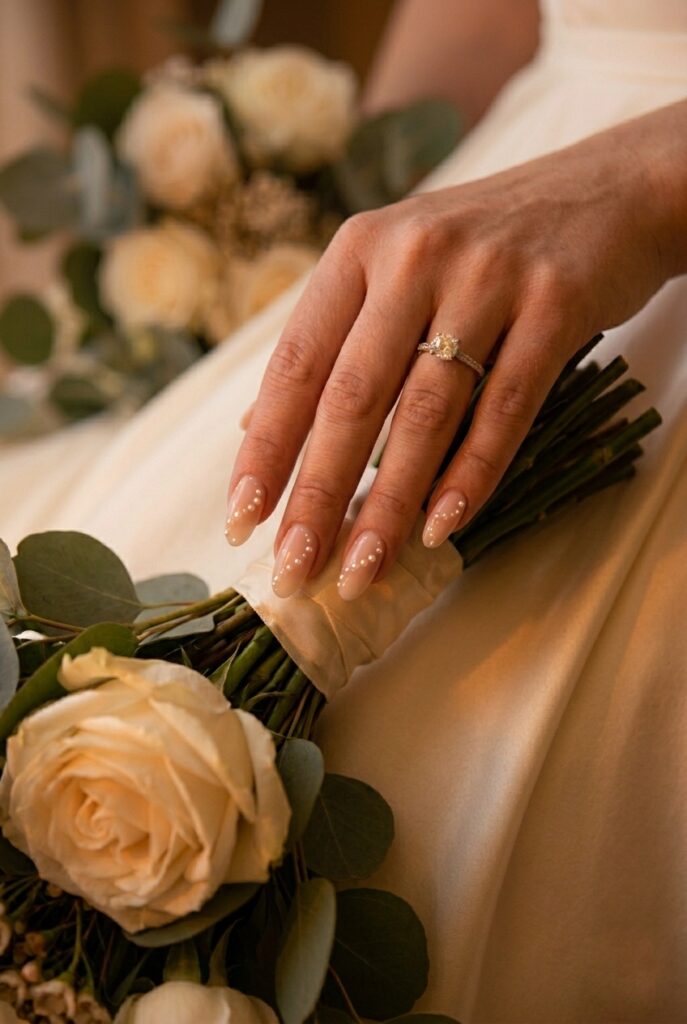
The right category is flat nano-pearls applied flush with the nail surface, sealed under a top coat layer so there is nothing raised to catch. 

These survive the full day without loss. Applied in a deliberate pattern — a trailing arc, a scattered cluster on the top third of the nail only, or three pearls at the cuticle in a geometric arrangement — they create genuine nail art rather than scattered decoration. 

Nail Charm flat nano-pearls ($8–$12 on Amazon for 200 pieces) are the specific product that works. 

In a salon, the pearl placement is an add-on service running $20–$35 on top of the base gel. Total spent: $55–$80.

Skip this if your gown has a heavily textured or beaded bodice — you’ll be pressing that surface against your stomach throughout the evening and pearls will feel every contact.

Price range: $55–$80 salon gel plus pearl add-on; or $8–$20 DIY over existing gel.


 Budget Hack after Idea 3: The most expensive part of bridal nail art is the nail artist’s hourly rate for the time spent placing individual elements. If your design uses scattered small accents — pearls, tiny crystals, micro-dots — purchase the raw elements yourself from Amazon or Michael’s and bring them to your regular gel appointment. Flat nano-pearls at Amazon cost $8–$12 per 200 pieces; a salon sourcing those same pearls marks them up 300–400%. You supply the product, the tech applies it at their standard hourly rate. This saves $25–$50 on a standard bridal pearl set without any difference in outcome.


4. Lace-Inspired Nail Art: Earn It With Your Dress or Skip It Entirely
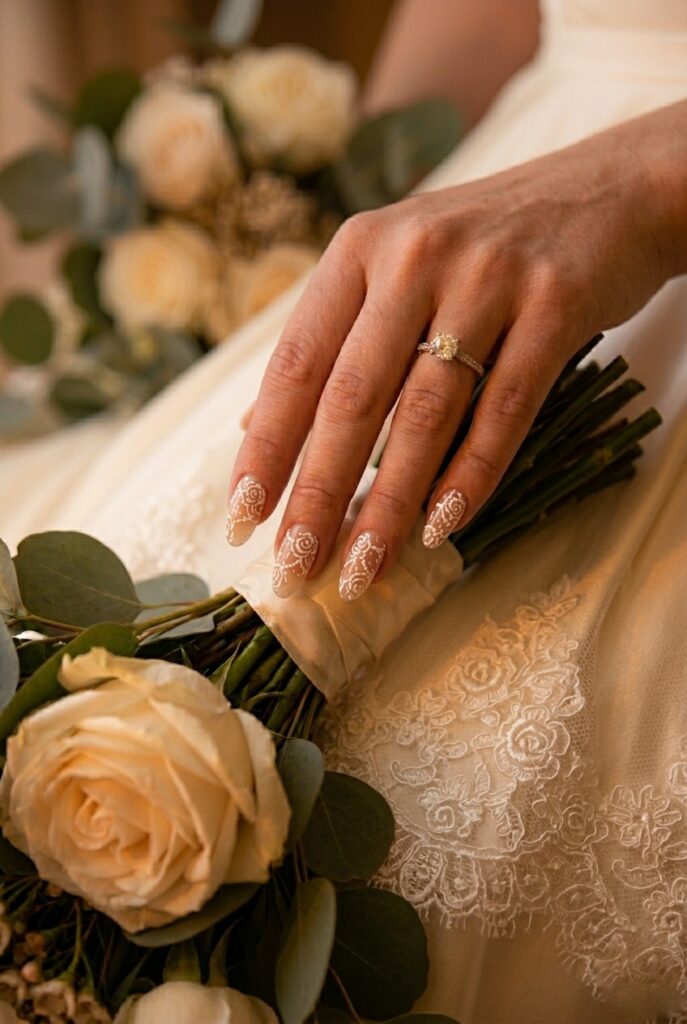
IMAGE 4 HERE Alt text: Bride's long oval nails with intricate hand-painted ivory lace pattern nail art over a sheer nude base, held against the lace hem of a wedding gown Image prompt: Photorealistic close-up of a bride's hand with hand-painted ivory lace-pattern nail art on long oval nails — fine dotwork floral lace design in white over a sheer nude gel base — fingers resting against the lace hem of an ivory wedding dress, the nail lace pattern echoing the dress lace texture, soft natural window light, editorial bridal photography, no text overlays. Generate in vertical portrait orientation, 2:3 aspect ratio, optimized for mobile display.

Lace nail art is the single most context-dependent design in bridal nail work. 

When the nails repeat a lace motif from a lace gown, the result is cohesive and intentional — a visual echo that photographers notice immediately and frame deliberately. 

When lace nails appear on a bride wearing a clean crepe or satin column gown, the motif has no reference, no anchor, and reads as a design that wandered in from a different wedding. 

The application requires a specialist — this is not a stamped decal design. 

Stamped lace nail art has a mechanical regularity that reads as printed rather than painted under macro photography, and the top coat fills the indentations of a stamp plate, softening the definition even further. 

Hand-painted lace, executed with a fine 00-size detailing brush, has genuine variation in line weight and opacity that looks dimensional even in close-up. 

Expect $120–$170 for a set with lace art on four to five nails at a qualified bridal nail artist. 

This is non-negotiable on the specialist requirement — the design looks worse when executed by the wrong hands than no art at all.

Only do this if your dress has actual lace. Not lace trim. Lace as a significant gown fabric or overlay.

Price range: $120–$170. Specialist bridal nail artist required; verify hand-painted lace portfolio specifically.


5. Sculpted 3D Rose Accent: One Nail, Done Right, All Day Long

IMAGE 5 HERE Alt text: Bride's almond nails with a single hand-sculpted 3D white rose gel accent on the ring finger nail, remaining nails in sheer milky white, warm candlelight Image prompt: Photorealistic close-up of a bride's hand with four sheer milky white gel nails and one ring-finger nail featuring a single hand-sculpted 3D white rose gel accent with visible petal layers, photographed in warm amber candlelit atmosphere, the sculptural rose casting a small shadow on the nail surface below, editorial bridal photography, no text overlays. Generate in vertical portrait orientation, 2:3 aspect ratio, optimized for mobile display.

Every competitor article that mentions 3D sculpted nail art shows photos of ten fingers of raised elements and says nothing about durability.

Here is what actually happens at weddings with full 3D sets: a sculpted flower that sits 3–4mm off the nail surface will catch on every piece of fabric it contacts — veil, gown, tablelinens, the bow on the flower girl’s sash — and by the reception, the sculpture is compromised, often asymmetrically, which reads in photos as damaged rather than styled. 

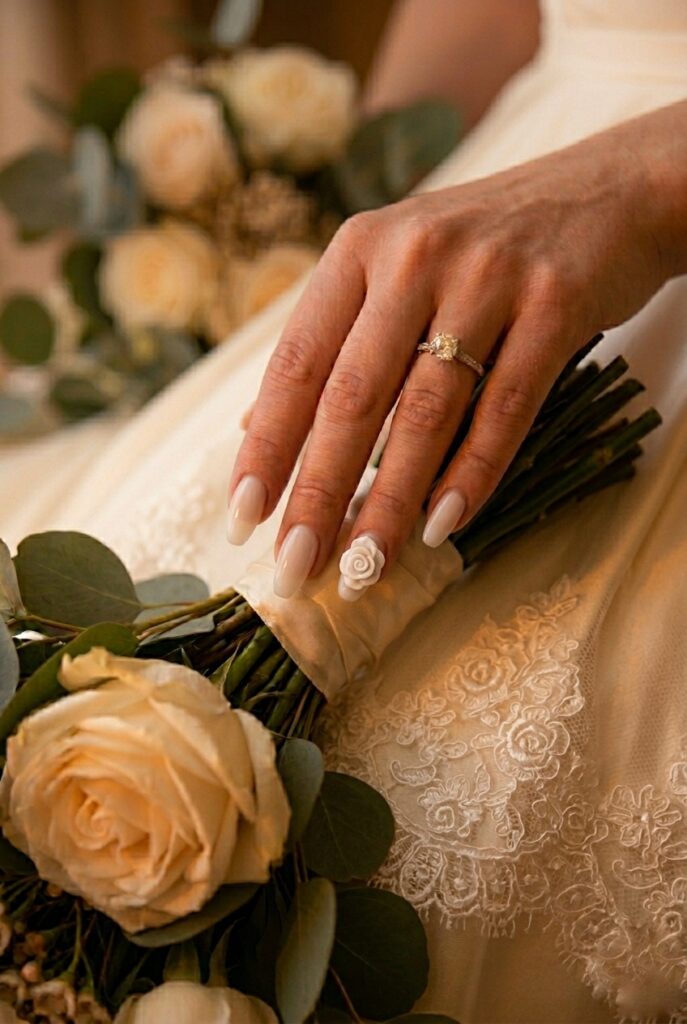
The correct bridal approach to 3D nail art is one sculpted element on one nail: the ring finger. 

A single hand-sculpted 3D rose — built from gel over a sheer base in two to three petal layers, sitting no more than 2mm off the surface — on one finger only. 

The remaining nine nails stay in a flat milky or sheer base. This placement is not a budget compromise; it’s a composition choice. 

A single raised element on the ring finger, photographed beside the ring, creates an image that looks like it was art-directed. 

Ten raised elements look like a display nail. Salon price for a 3D accent on one nail: $25–$50 as an add-on. Do not let any tech talk you into the full set.

Price range: $65–$95 for gel set plus single 3D accent. Add-on only: $25–$50 on top of existing gel.


6. Bow Nail Art: The Coquette Detail Done With Restraint
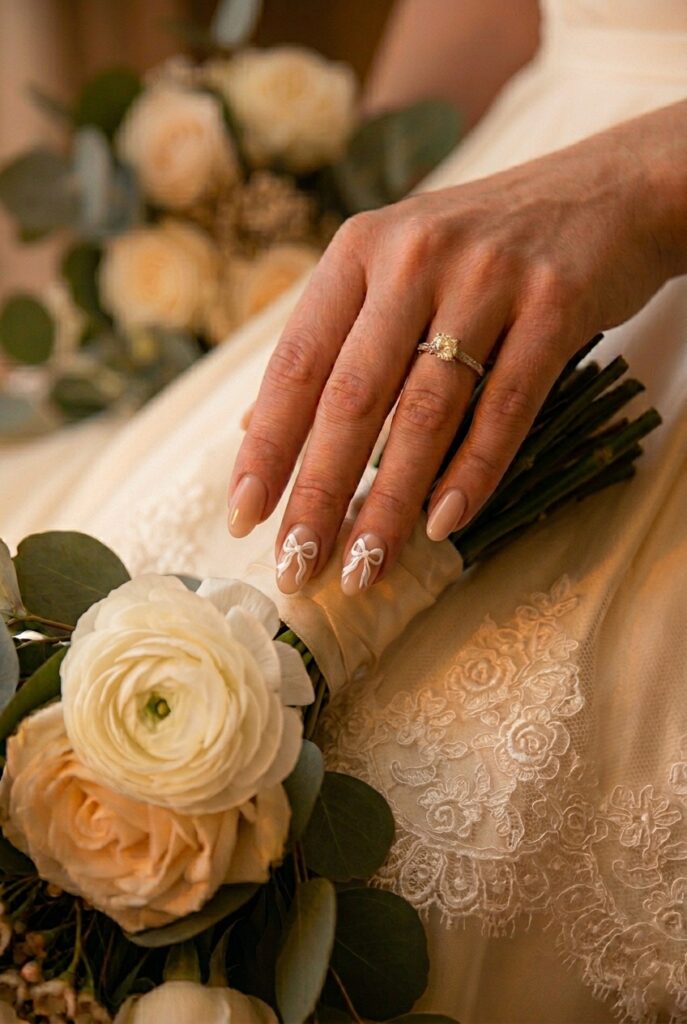
IMAGE 6 HERE Alt text: Bride's short oval nails with hand-painted white satin ribbon bow nail art on a nude gel base, held beside white ranunculus bouquet Image prompt: Photorealistic close-up of a bride's hand with hand-painted white satin-look ribbon bow nail art on short oval nails — delicate painted bow on three nails with a subtle glossy sheen suggesting fabric — over a warm nude gel base, hand resting near a white ranunculus bridal bouquet, soft natural window light, editorial bridal photography, no text overlays. Generate in vertical portrait orientation, 2:3 aspect ratio, optimized for mobile display.

Bow nail art has arrived hard in bridal spaces — the coquette aesthetic that’s been building for two years has now crossed fully into wedding manicure territory. 

The execution range is wide and the gap between the version that works and the version that doesn’t is simply scale. 

A painted bow covering the full nail surface in 3D with a sculpted ribbon loop is a costume-level choice that will compete with your ring, your dress, and everything else in a ring shot. 

A hand-painted bow in matte white or soft ivory, rendered at the upper third of the nail only with 2D brushwork — suggesting a bow rather than declaring one — reads as a refined detail in photographs. 

The matte version specifically is what stops this from tipping into precious territory: a matte painted bow looks deliberate; a high-gloss painted bow looks like nail polish art for a birthday party. 

Apply matte top coat selectively over the bow only, leaving the surrounding nail in a standard gloss finish, to create a texture contrast that reads even in photos. 

Essie’s Matte About You top coat ($9 at Target) handles this perfectly.

Skip this if your overall wedding aesthetic is traditional or formal. Bow nails are right for romantic, garden, vintage, or cottagecore-adjacent weddings. 

On a bride in a structured ballgown at a ballroom venue, bow nails look like a mismatch.

Price range: $55–$85 for gel base plus bow nail art at most salons with nail art experience.


 Budget Hack after Idea 6: Press-on nail sets with pre-painted bridal nail art have reached a quality level that makes them genuinely viable for brides on a tight nail budget. Brands like KISS imPRESS, Clutch Nails, and Aprés Gel-X all produce sets with hand-designed bridal art — bows, pearls, micro florals — for $10–$25 on Amazon or at Target. The key is application: use nail glue over the included adhesive tabs, press for 30 full seconds per nail, and avoid soaking for 48 hours after. Applied correctly, a high-quality press-on set lasts 10–14 days, gets through the wedding and honeymoon, and costs $75–$130 less than a salon nail art set. The limitation is fit — order two sizes and do a test application 2 weeks before.


7. Watercolor Wash Nail Art: The Design That Looks Custom Without Looking Complicated

IMAGE 7 HERE Alt text: Bride's oval nails with a delicate watercolor-effect wash of blush and white on a translucent base, photographed in soft morning window light Image prompt: Photorealistic close-up of a bride's hand with a soft watercolor wash nail art effect — diluted blush pink and white gel colors blended wet-on-wet in an abstract cloud-like pattern across the nail surface — on oval medium-length nails, photographed against ivory linen in soft morning natural window light, painterly and diffused aesthetic, editorial bridal photography, no text overlays. Generate in vertical portrait orientation, 2:3 aspect ratio, optimized for mobile display.

Watercolor nail art is the design that looks like it required an extraordinary skill level but is actually achievable at most salons that work with gel — because the technique is wet-on-wet blending, not fine-line painting. 

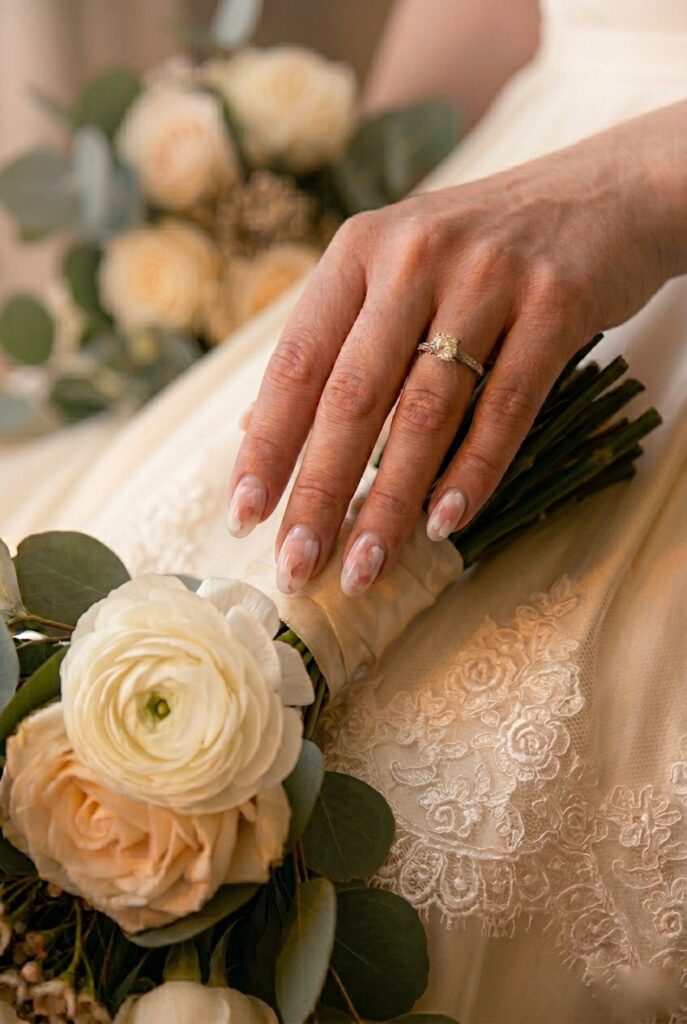
Two to three diluted gel colors (sheer blush, translucent ivory, and soft white work for bridal) are applied over an uncured base and blended with a clean brush before curing. 

The result is an abstract, atmospheric wash of color that reads as intentionally artistic without being decorative in the traditional sense. 

It photographs with exceptional softness and works equally well in natural morning light and warm evening candlelight because it has no hard lines to overexpose. 

Only do this if your overall wedding has a soft, romantic, or artistic quality to it — watercolor nail art reads as whimsical. 

At a structured, formal black-tie wedding, it will feel tonally off. For a garden wedding setting or a spring celebration with loose floral arrangements, it’s compositionally perfect.

Price range: $55–$80. Most gel-experienced salons can execute this; show a clear reference photo.


8. Crystal and Rhinestone Nail Art: The Technical Brief for Getting It Right

IMAGE 8 HERE Alt text: Bride's almond nails with a precisely composed rhinestone pattern — a constellation scatter of clear AB crystals on a sheer blush gel base — photographed beside a diamond ring Image prompt: Photorealistic close-up of a bride's hand with a sheer blush gel manicure on almond nails with a deliberate constellation pattern of clear AB Swarovski flat-back rhinestones — approximately five to seven stones per nail in an intentional scatter arrangement, not random — beside an oval-cut diamond engagement ring, warm natural window light catching both the crystals and the diamond stone, editorial bridal photography, no text overlays. Generate in vertical portrait orientation, 2:3 aspect ratio, optimized for mobile display.

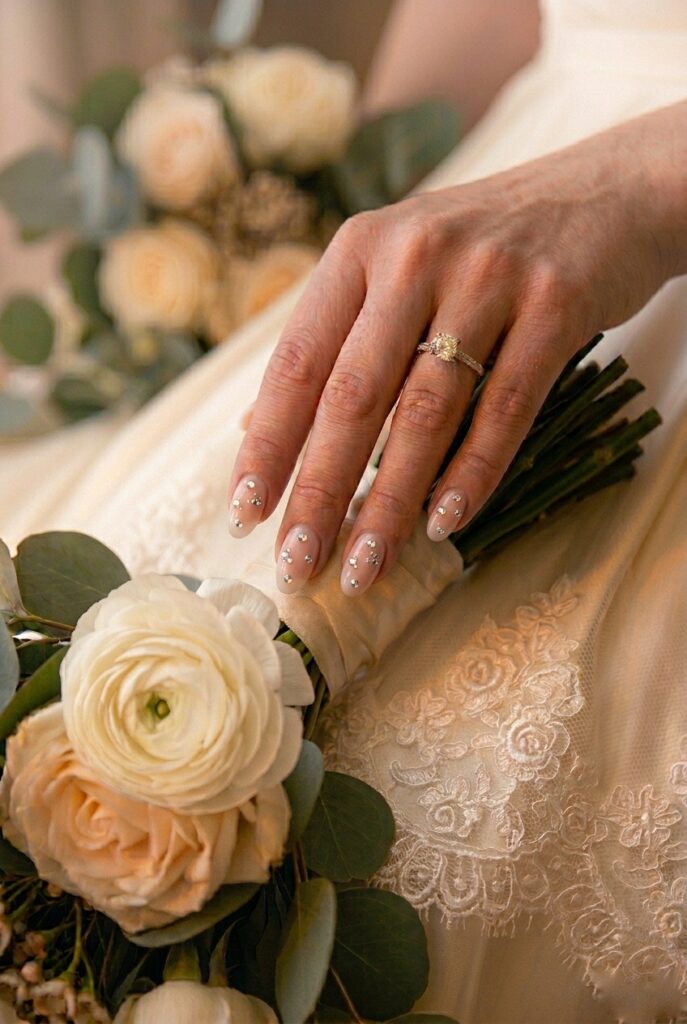
The rhinestone brief that actually works in bridal nail art is this: five to seven 2–3mm clear AB flat-back crystals per nail, arranged in a non-random deliberate scatter (think constellation, not confetti), sealed under a layer of gel so nothing sits proud of the nail surface. 

This is categorically different from the rhinestone briefs that don’t work: dome-raised crystals that protrude above the nail plane (snagging liability), full-coverage crystal coverage (reads as Mardi Gras in ring shots), and clusters on one accent nail only with bare nails on the rest (unbalanced in group hand photos). 

A constellation scatter across all ten nails — the same arrangement repeated — creates uniformity that reads as designed. 

Swarovski flat-back AB crystals in 2mm size from their Swarovski Elements professional line are the quality standard; Amazon knockoffs have inconsistent sizing that creates an uneven surface even when flush-applied. 

Salon application: $70–$95 for gel base plus rhinestone placement sealed under top coat.

Price range: $70–$95. Swarovski elements from swarovski.com or professional craft suppliers.


9. Negative Space Nail Art: The Modern Bridal Look Nobody’s Doing Yet
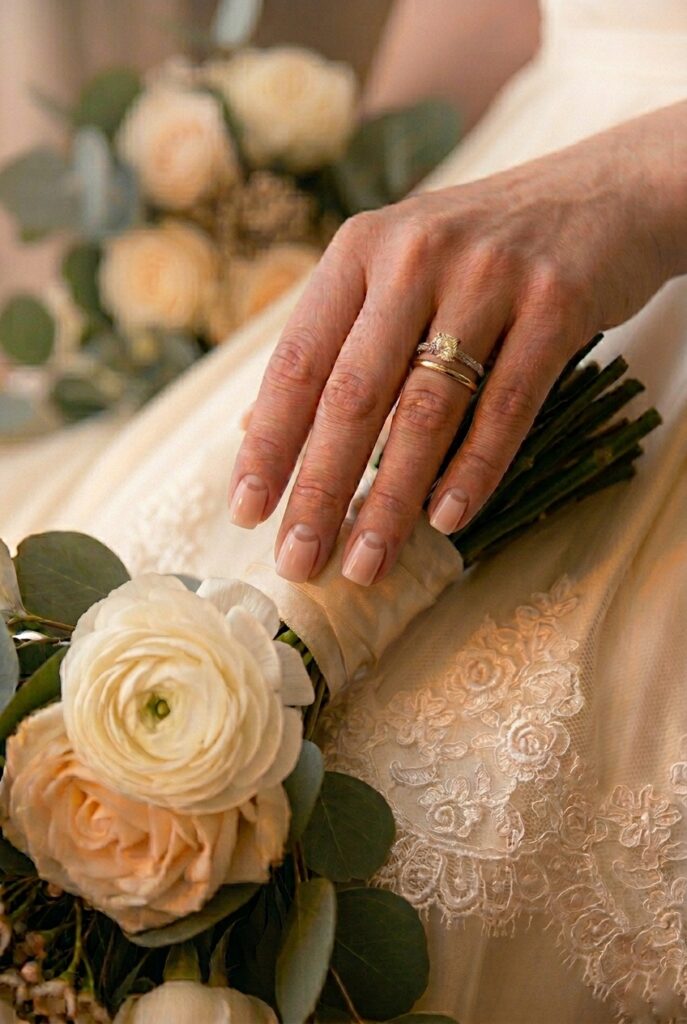
IMAGE 9 HERE Alt text: Bride's short square nails with geometric negative space nail art — clean unpainted crescent moon shapes at the base of sheer blush nails — beside a minimalist wedding band Image prompt: Photorealistic close-up of a bride's hand with negative space nail art on short square nails — a precise unpainted crescent at the base of each nail left bare, contrasting with a soft warm blush gel color on the upper nail — beside a thin gold wedding band, soft natural window light, clean and modern editorial bridal photography aesthetic, no text overlays. Generate in vertical portrait orientation, 2:3 aspect ratio, optimized for mobile display.

Negative space nail art — where portions of the bare nail plate are intentionally left unpainted within a geometric design — is the one bridal nail art approach that genuinely separates a design-aware bride from the crowd, and it’s almost completely absent from competitor bridal nail guides.

A bare crescent at the base of a blush nail. 

A clean unpainted triangle at the tip that inverts the French tip structure. 

A single horizontal stripe of bare nail across the center of an otherwise opaque color. 

These techniques use absence as the design element, which photographs with precision and edge that conventional art cannot achieve. 

The look is wrong for a romantic or vintage aesthetic — it reads as architectural, which suits modern venues, civil ceremonies, and minimalist wedding aesthetics. 

For a bride who wants nail art that feels genuinely distinctive in a sea of pearl and floral sets, this is the move. 

Any gel-experienced tech can execute negative space with tape or precise brush work; no specialist is required. 

Cost is a standard gel application — $45–$65.

Price range: $45–$65. Standard gel salon appointment; no specialist required.


 Budget Hack after Idea 9: The Etsy marketplace for custom bridal press-on nail art has significantly matured. Searching “bridal nail art press-ons” on Etsy surfaces hundreds of small-batch nail artists selling hand-painted or custom-designed press-on sets for $18–$55 — with personalization options including matching your specific bouquet flowers, your dress lace pattern, or your wedding colors. These are not the drug-store press-ons from a decade ago. A custom hand-painted Etsy set typically arrives in 5–7 days, lasts 7–14 days with proper application, and costs $80–$140 less than a specialist salon session for the same quality of art. For brides who want genuinely custom nail art without a $150 salon appointment, this is the most underused option in bridal nail planning.


10. Gold Foil Fragment Art: Organic, Unpredictable, Photographically Alive
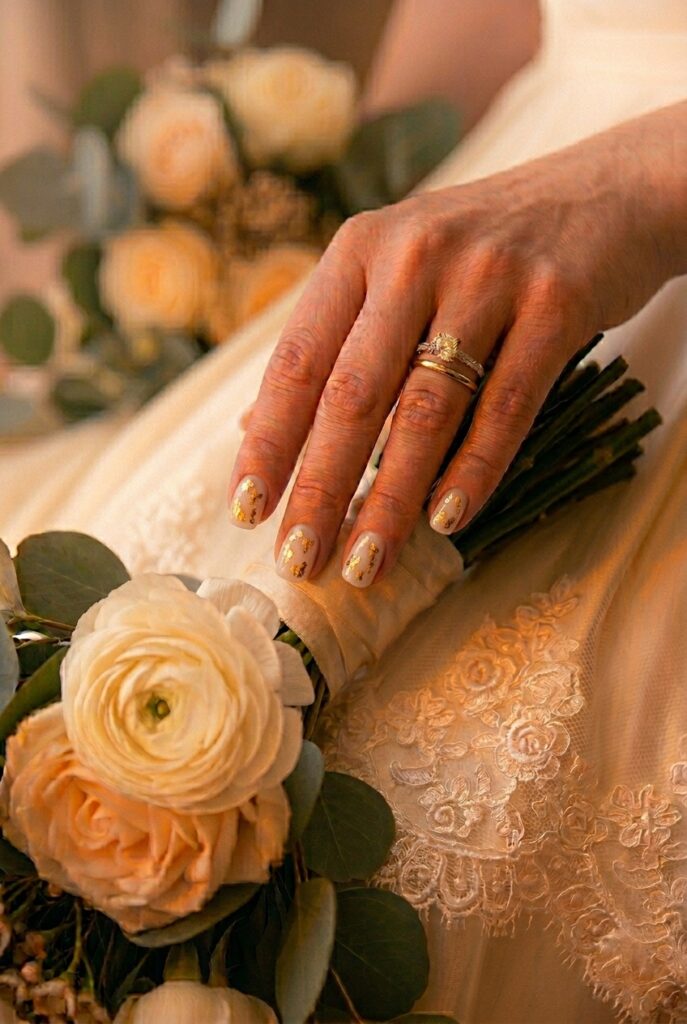
IMAGE 10 HERE Alt text: Bride's oval nails with scattered gold foil fragments over a milky white gel base, warm candlelit reception lighting making the foil gleam irregularly Image prompt: Photorealistic close-up of a bride's hand with scattered irregular gold foil fragment nail art over a milky white gel base on oval nails — organic, non-uniform gold flake shapes distributed across the nail surface without a pattern — photographed in warm amber candlelit reception atmosphere, the gold foil catching the candlelight in multiple irregular reflections, editorial bridal photography, no text overlays. Generate in vertical portrait orientation, 2:3 aspect ratio, optimized for mobile display.

Gold foil nail art is the design that looks deliberately imperfect, which is exactly what makes it compelling in wedding photography. 

Applied over a milky or sheer base, gold foil fragments — pressed onto tacky gel before curing — create an organic, irregular pattern that is impossible to replicate exactly, making each nail visually distinct within a cohesive set. 

Under natural daylight it reads as a soft metallic accent. Under candlelight or warm reception lighting, the irregular foil surfaces catch light at dozens of different angles simultaneously, creating a living, shifting quality in photographs. 

The technique is achievable at virtually any salon with gel experience — gold foil transfer sheets cost $6–$10 on Amazon and require no specialized skill to apply.

The design pairs particularly well with indoor elegant reception environments where amber lighting amplifies every gold surface in the room, including yours.

Skip this if your wedding palette runs cool-toned — silver metallic, cool white, ice blue. Gold foil reads as warm and needs a warm context to feel intentional rather than accidental.

Price range: $50–$70 for gel base plus foil application. Gold foil sheets: $6–$10 on Amazon.


Decision Filter

If you want nail art that requires a specialist and should be booked two to three months out, choose hand-painted micro florals, lace art, or 3D sculpted accents — these depend on specific skill, not just salon availability. 

If you want nail art any good gel salon can execute, choose gold linework, watercolor wash, negative space, or foil — all require reference photos but no niche training. 

If your venue is candlelit and warm-toned, foil, gold linework, and pearl art will actively improve as the evening progresses; the warmer the light, the more these surfaces activate. 

If your ring has genuine visual presence in photographs and you want nails that compete with it rather than support it — reconsider the full art approach and choose one of the simpler finishes from our bridal nail ideas guide instead.


The Real Reason Your Bridal Nail Art Looks Different in Photos Than It Did on the Table

Nail art seen on a salon light table is viewed from above, at close range, under controlled lighting. 

Wedding photography uses a combination of natural light, reception ambient light, and flash — three environments your art has never been tested in. 

The insider observation that nail artists who work specifically with wedding photographers know: flash photography reads nail art at 20–30% more detail than the naked eye. 

Every imperfection in line quality, every uneven petal edge, every slightly misaligned rhinestone reads in a ring shot. 

This is why the professionals who create editorial bridal nail art — the ones whose work ends up in magazines — always specify “photographer-ready” work, meaning every edge is crisp, every detail is sealed, and the design works at macro-lens distances.

Strong opinion: buying nail art based on gallery photos without checking the nail tech’s macro-photography portfolio is the single most common mistake brides make, and it results in more day-of disappointment than any other nail decision. 

Ask specifically: do you have close-up ring-shot photos of your bridal nail art work? 

If the answer is no, or if the portfolio only shows Instagram-standard photos (distant and filtered), find someone else.

The thing couples almost never hear before the wedding: gel top coat shrinks slightly when it cures under a UV lamp, and on nail art with raised edges — like hand-painted petals or thick linework — this shrinkage can pull the art’s edge inward and create a visible gap between the design and the nail edge. 

The fix is a second sealed top coat pass over the entire nail after the art cures, which wraps the edge and eliminates the gap. Not every tech does this automatically. 

Ask for a wrap coat on your art before leaving the salon.


Mistakes to Avoid

Mistake 1: Choosing nail art to match your wedding theme instead of your bouquet and ring. Every guide says coordinate with your wedding. 

The better instruction is to coordinate with the objects in your hands — because those are what appear in every close-up photograph. 

A dusty blue and sage theme may translate beautifully to table decor, but dusty blue nail art beside a diamond ring and a white peony bouquet reads as a disconnect in ring shots. 

Your florals and your ring setting are the correct reference objects for nail art selection.

Mistake 2: Spending $150 on specialist nail art at a booking that doesn’t include a trial. The average specialist bridal nail art appointment costs $120–$180 and lasts three to four hours. 

A bride who books this appointment without a trial run four to six weeks prior is trusting three hours of work to an untested relationship. 

A $60–$80 trial lets you see the exact art on your hands, photograph it in your home lighting, and determine if anything needs adjusting. 

Skipping the trial and then discovering the colors look wrong or the scale is off on the wedding morning is an expensive, un-fixable regret.

Mistake 3: Not telling your nail artist the specific finish of your gown fabric. Matte crepe, satin, lace, tulle, and beaded fabric all create different visual textures in photographs. Your nail art should be calibrated against your dress’s finish, not against a generic “bridal” aesthetic. 

A satin gown reflects light; paired with chrome or foil art, the two reflective surfaces compete. 

A matte crepe gown absorbs light; paired with a matte nail finish, the hand disappears into the gown in every shot. 

This specific information changes the nail artist’s recommendations significantly, and brides almost never offer it unprompted.

Mistake 4: Getting nail art that looks identical to what’s in your inspo folder without showing the artist the rest of your wedding details first. Inspo photos show nails in isolation. The right bridal nail art only works in context. 

The bride in the inspo photo had different hands, a different ring, a different gown, and a different photographer with a different aesthetic. 

Handing a tech an inspo photo and asking for that exact look, without the qualifying context of your specific situation, produces a result that matches the photo and misses the wedding.


FAQ

What is the difference between nail art stamping and hand-painted nail art for a wedding?

Stamped nail art uses a metal plate and roller to transfer a pre-etched pattern — it’s faster but creates identical, mechanical-looking designs that reveal themselves under macro photography. 

Hand-painted nail art is brushwork created freehand, which gives each nail organic line variation and depth. 

For bridal ring shots and close-up detail photography, hand-painted work photographs significantly better.

How far in advance should I book a bridal nail artist for nail art?

Book two to three months before your wedding for any specialist nail art — lace, hand-painted florals, 3D accents. 

Popular bridal nail artists fill their calendar quickly in wedding season. 

Schedule a trial appointment six weeks before, then the wedding appointment three to five days before the ceremony.

Can I do my own bridal nail art at home?

You can DIY foil art, watercolor washes, and simple negative space designs at home with gel lamp and basic gel products — these techniques require careful practice runs but not specialized skills. 

Hand-painted florals and lace art require professional execution if you want results that hold up under close-up photography. 

Press-on nail art from Etsy or Amazon is the strongest DIY-adjacent option for complex designs: custom sets with real hand-painted art, properly fitted and applied with nail glue, achieve salon-level results for $18–$55.

Does nail art last a full wedding day without damage?

It depends entirely on what type and how it’s secured. 

Flat nail art — linework, foil, watercolor, rhinestones sealed under top coat — lasts a full wedding day and honeymoon without issue. 

Raised 3D elements — dome pearls, sculpted flowers, raised charms — are vulnerable to catching on fabric and are best limited to one accent nail and kept to 2mm maximum height.

A wrap coat over all nail art is the standard finishing step that protects edges and significantly extends durability.


Budget Breakdown

Nail Art TypeSalon CostDIY CostDurability Risk Level
Hand-painted micro florals$100–$180Not recommendedLow (flat)
Gold linework$45–$70$15–$20 (gel paint + brush)Low (flat)
Flat pearl arrangement$55–$80$20–$30 (pearls + UV lamp)Low if flat nano
Lace nail art$120–$170Not recommendedLow (flat)
3D sculpted rose (1 nail)$65–$95Not recommendedMedium (raised)
Bow nail art$55–$85$20–$35Low (flat painted)
Watercolor wash$55–$80$25–$40 (gel kit)Low (flat)
Rhinestone scatter (sealed)$70–$95$20–$35 (crystals + UV)Low if sealed flush
Negative space$45–$65$20–$30Low (flat)
Gold foil fragments$50–$70$20–$30 (foil + UV lamp)Low (flat)
Custom Etsy press-on art$18–$55N/AMedium (depends on application)

Here’s what I’ve watched happen at dozens of weddings: a bride with extraordinary nail art that nobody noticed because it wasn’t connected to anything in the visual story around it, and another bride with three small painted roses matching her bouquet exactly, where every single guest who held her hands for the ring exchange comment on her nails.

The second set cost less. The second bride remembered what people said about them ten years later.

The connection is the art. Start with your bouquet, your ring metal, or your dress texture — one of those three — and build the nail design from that reference outward. 

Then find our complete bridal nail ideas guide to confirm the right finish and formula for your specific application, and our skin tone nail color guide to lock in the base before the art goes on top.

Leave a Comment

Your email address will not be published. Required fields are marked *

Scroll to Top