10 Wedding Table Decor Ideas for Round Tables: What Actually Makes Them Look Expensive!


HERO IMAGE / FEATURED IMAGE Alt text: Elegant round wedding reception table with layered linen, low garden centerpiece of garden roses and eucalyptus, warm candlelight, and gold charger plates at an indoor venue Image prompt: Photorealistic overhead and slight angle view of a beautifully styled 60-inch round wedding reception table. Layered ivory and blush linen with a 24-inch formal drop. A low lush centerpiece of garden roses, eucalyptus, and dusty miller sits at a slight off-center position. Gold charger plates, white taper candles in varying heights, crystal votives, calligraphy place cards, and folded ivory linen napkins with a sprig of dried lavender. Warm romantic candlelit atmosphere glowing amber on crystal and gold. Rich, photorealistic editorial quality. Generate in horizontal landscape orientation, 3:2 aspect ratio, optimized for desktop display.

Most couples spend a week agonizing over their centerpiece and ten minutes deciding on their tablecloth — which is exactly backwards.

The tablecloth is the foundation everything sits on, and when it’s wrong, no amount of expensive florals will save it.

This article covers every layer of a round wedding table, in the right order, with the exact details that separate a table that looks like it cost $3,000 from one that actually did.

The linen pressed flat like a sail in dry air, edges dropping to the floor or stopping short at the knee — it is the first decision anyone sees before the roses, before the glass. A candle flame finds itself twice in the charger’s gold rim. The fork lies cool and parallel. Nobody notices when it’s right.

The Short Answer

Round tables are the most forgiving shape in a reception room, and couples waste that advantage by decorating the center and forgetting the rest.

A well-dressed round table is designed in layers — linen drop, rim detail, mid-height fill, centerpiece anchor, and tabletop place setting — and each layer has to make a decision before the next one is added.

Skip any layer and the table reads as unfinished, regardless of how much you spent on flowers.


1. Get the Linen Drop Length Right First
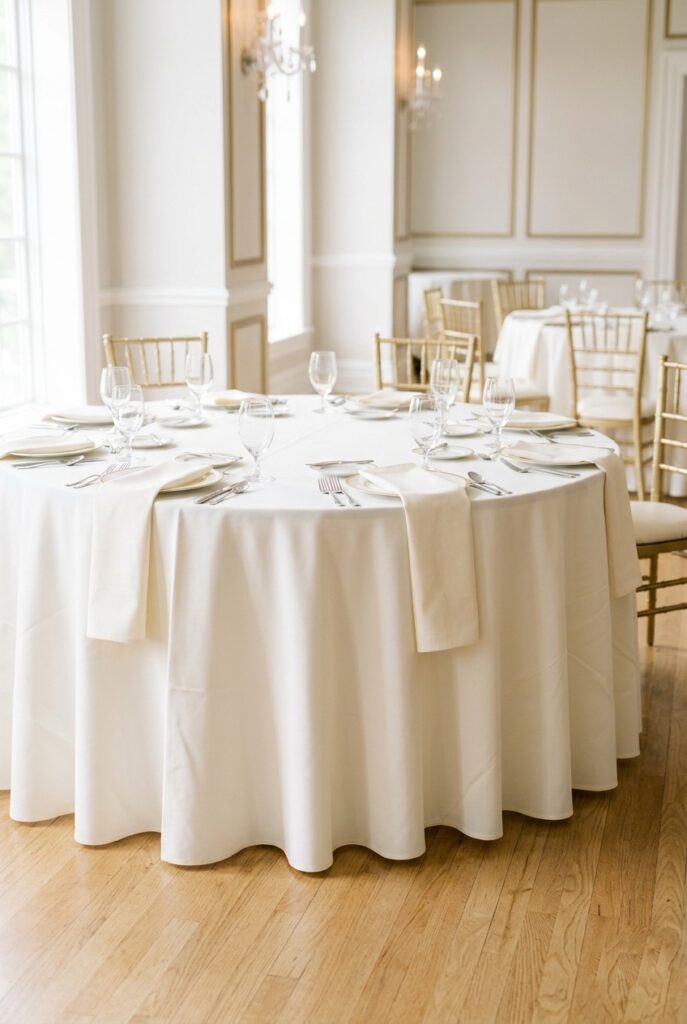
IMAGE 1 HERE Alt text: Round wedding table with 108-inch ivory tablecloth showing a clean 24-inch formal drop to the floor, elegant and tailored look Image prompt: Photorealistic side-angle view of a 60-inch round wedding reception table with a crisp ivory 108-inch round tablecloth showing a clean 24-inch formal drop to just above the floor. No centerpiece yet — the focus is on the pristine, tailored linen. Soft natural window light from the left side. Venue is a bright, airy ballroom with light wood floors. Editorial wedding photography quality. Generate in vertical portrait orientation, 2:3 aspect ratio, optimized for mobile display.

This is the single most overlooked decision in round table decor, and getting it wrong undermines everything else.

A standard 60-inch round table needs a 108-inch round tablecloth for a formal 24-inch drop — the length that reads polished in photos and in person.

A 90-inch cloth gives you a casual knee-length drop that works for garden parties.

A 120-inch cloth puddles on the floor and only works for sweetheart or cake tables you want to look theatrical.

Most rental venues provide 90-inch cloths as default.

If you want that clean floor-length look without paying for floor-length specialty linens, order 108-inch polyester rounds from CV Linens ($8–$15 each) and swap what the venue provides. It takes thirty seconds per table and immediately elevates the room.

Price: $8–$15 per cloth from CV Linens or Tableclothsfactory.com | Also available via Amazon for smaller quantities


2. Layer Two Linens for Depth

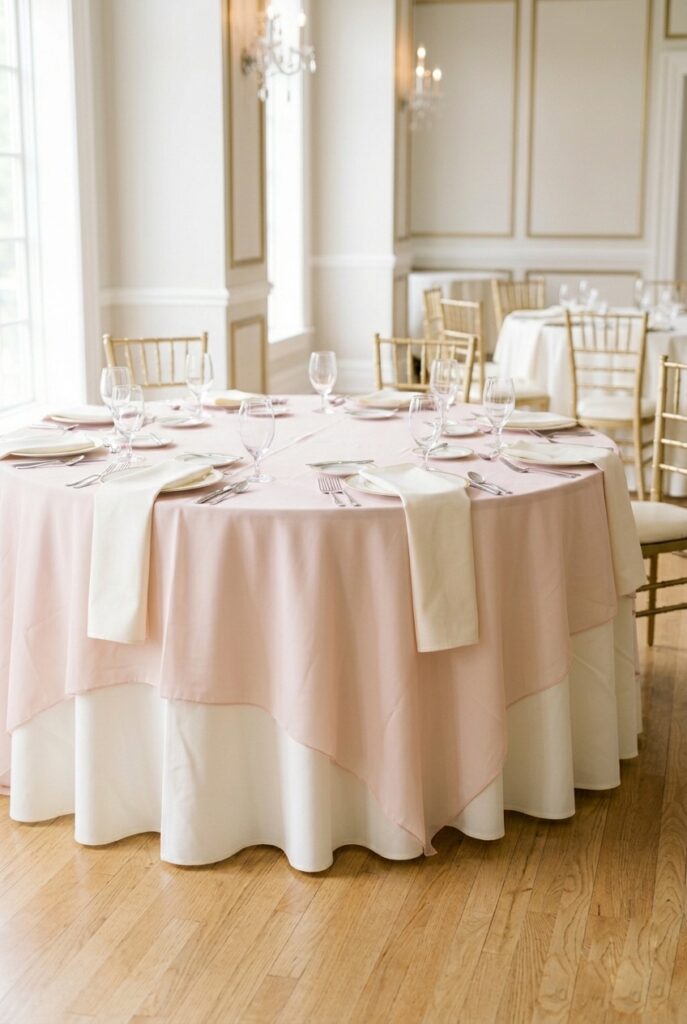
IMAGE 2 HERE Alt text: Round wedding table with layered linens — ivory base cloth and blush chiffon overlay creating a two-tone elegant effect Image prompt: Photorealistic close-up and mid-distance view of a 60-inch round wedding table styled with a white floor-length base linen and a blush chiffon overlay dropping 18 inches from center. The chiffon catches soft natural window light and creates subtle folds. No centerpiece in frame — the focus is entirely on the linen layering effect and how the fabrics interact. Warm, bright airy setting. Editorial quality. Generate in vertical portrait orientation, 2:3 aspect ratio, optimized for mobile display.

One tablecloth is a flat surface. Two linens create dimension. The formula: a floor-length base linen in ivory or white, topped with a shorter overlay in a texture that picks up your palette — dusty rose chiffon, sage charmeuse, or champagne satin.

The overlay sits centered and falls about 18 inches, creating a floating layer effect that photographers love because it catches light differently at every angle.

The cheap version of this: a single synthetic overlay in a color that doesn’t match anything else on the table. It looks like a tablecloth that slipped sideways.

The fix is to keep the overlay in a neutral or tone-on-tone shade and let the florals carry the color.

Available on Etsy from shops like LinenTablecloth or SimplyElegantLinens; overlay sets run $12–$30 each.

Price: $12–$30 per overlay | Etsy or CV Linens


3. Use a Runner Across the Diameter, Not Just Down the Middle
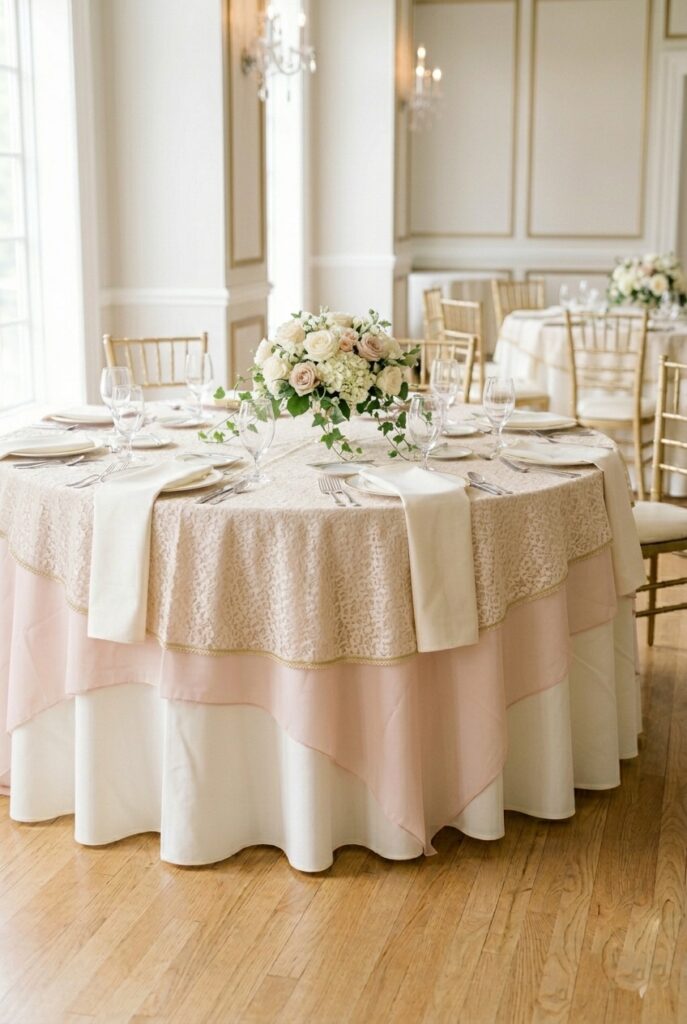
Every competitor article about round tables either ignores runners entirely or says you can use one without explaining how.

The answer: run a single narrow linen runner straight across the table’s full diameter — edge to edge, not just through the center — and let it drape down both sides.

This creates a natural visual axis that helps anchor the centerpiece and breaks up the circular monotony without fighting the shape of the table.

Linen runners from Tabletop Linen or Solino Home on Amazon run $18–$40 and come in washed linen, which is the texture that works on round tables.

Skip this if your table is under 54 inches — the proportions don’t work at smaller scales.

Price: $18–$40 | Solino Home or Tabletop Linen on Amazon. For DIY options, see the DIY wedding decor ideas guide for cutting and hemming your own runners from fabric yardage.


💡 Budget Hack #1: Order washed linen fabric by the yard from Fabric.com rather than buying pre-made runners. A single yard of 60-inch wide natural linen ($8–$12/yard) cuts into two full-width round-table runners with no sewing required — just a straight cut and a quick iron. That is $5–$6 per runner versus $25–$40 for a branded version. Search “natural linen fabric 60 wide” on Fabric.com and order six yards for ten tables.


4. Solve the Dead Center Problem with Off-Center Centering
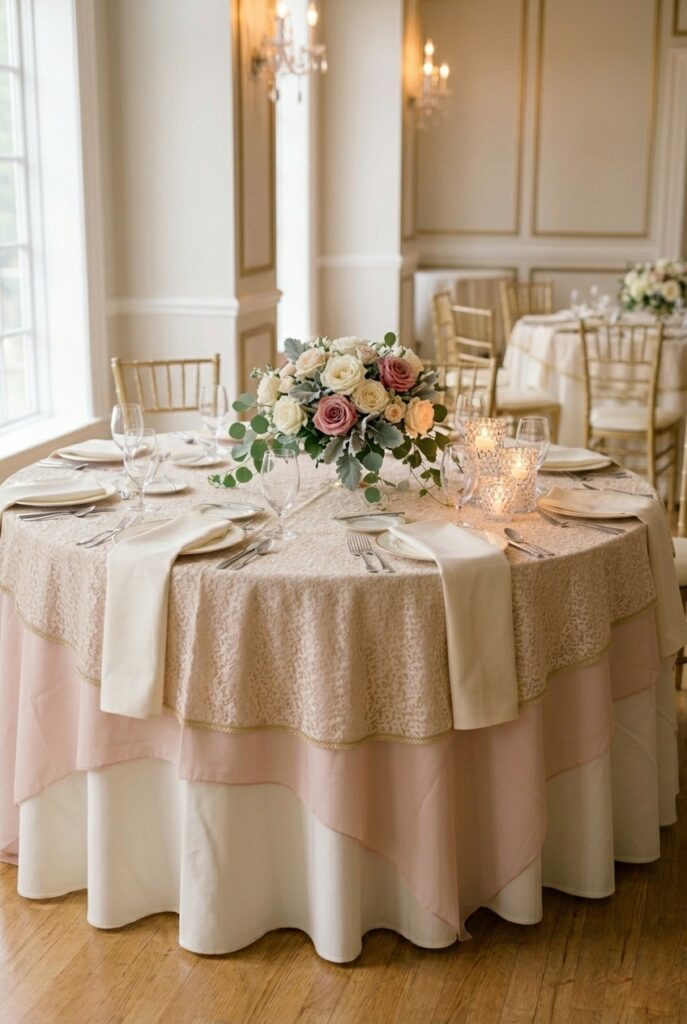
IMAGE 4 HERE Alt text: Off-center wedding centerpiece on round table with asymmetric floral arrangement balanced by clustered votive candles on opposite side Image prompt: Photorealistic editorial photograph of a 60-inch round wedding table viewed from a slight overhead angle. A lush low floral centerpiece of garden roses, dusty miller, and trailing eucalyptus sits slightly off-center toward one guest position. On the opposite side of the table at the rim, three grouped crystal votive candles create a balancing cluster. White linen base, gold charger plates, crystal glassware, folded white napkins. Warm romantic candlelit atmosphere. Generate in vertical portrait orientation, 2:3 aspect ratio, optimized for mobile display.

Every round table article tells you to place your centerpiece in the center.

Here is what they don’t say: a dead-center placement with a wide arrangement blocks sightlines across the table and forces every conversation to happen around the edges of a floral arrangement.

At a 60-inch round seating eight guests, a centerpiece wider than 14 inches starts to visually split the table in half.

The fix is weighted asymmetry: place your main floral element slightly off-true center, between the center point and one guest position, then balance it with a cluster of three votives on the opposite side at the rim.

The result is a table that feels designed rather than installed, and photographers will shoot it on an angle because the arrangement has movement.

This is the single most common note I give couples after seeing their mock-up setup — the centerpiece looks exactly like a centerpiece, and nothing else.

Price: No additional cost — this is a placement decision, not a purchase


5. Choose Centerpiece Height Deliberately Based on Your Venue Ceiling
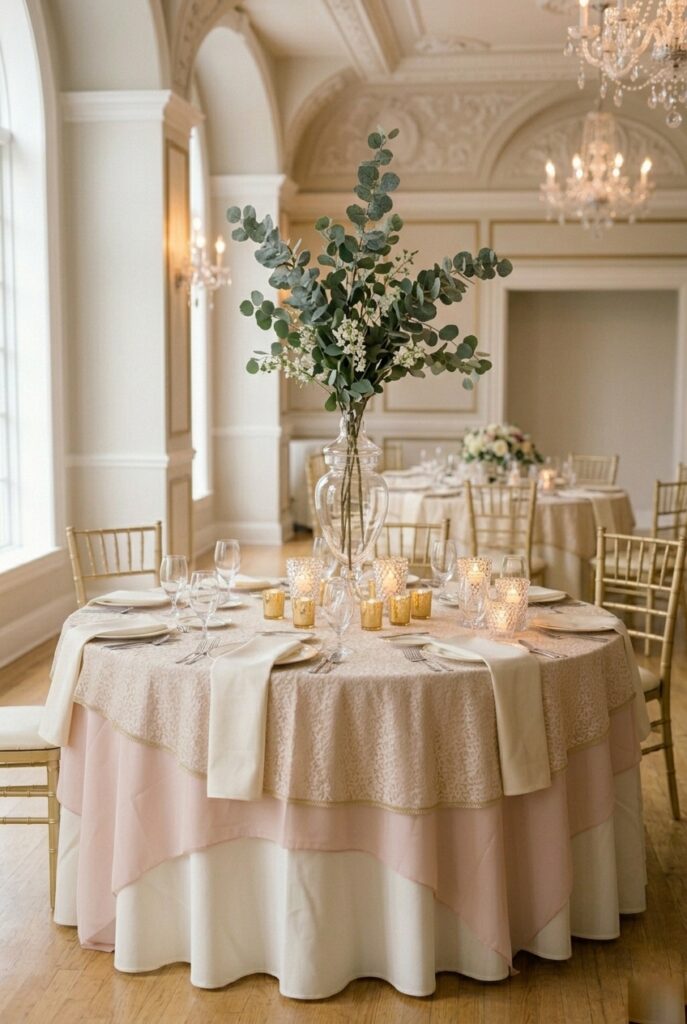
IMAGE 5 HERE Alt text: Tall wedding centerpiece on round table using eucalyptus branch in clear apothecary jar with votive candles at base in a ballroom venue Image prompt: Photorealistic photograph of a round 60-inch wedding table in a grand ballroom with high ceilings. Center of the table features a tall clear apothecary glass jar holding a single dramatic eucalyptus and white flowering branch reaching 30 inches. At the base, seven clustered gold votive candles glow in warm candlelight. White floor-length linen, gold charger plates, crystal glassware, ivory napkins. The high ballroom ceiling is visible in soft background bokeh. Generate in vertical portrait orientation, 2:3 aspect ratio, optimized for mobile display.

Short centerpieces in a ballroom with 20-foot ceilings disappear.

Tall centerpieces in a tent with 10-foot ceilings look like they’re trying to escape through the roof.

The height decision isn’t aesthetic — it’s architectural. As a rule: ceilings under 12 feet need centerpieces under 18 inches tall.

Ceilings over 16 feet can carry topiary-style arrangements on pedestals up to 36 inches.

Everything in between works with mid-range arrangements at 18–24 inches, which is the zone most florists default to anyway.

The cheap version of tall: a single sunflower bouquet rubber-banded to a rented rod.

It reads as a centerpiece that ran out of budget halfway up.

If you want height without the floral cost, use a single branch of eucalyptus or white birch in a tall apothecary jar ($12–$18 on Amazon from NUPTIO) and cluster votives at the base.

It reads as intentional and modern.

Price: $12–$45 for apothecary jars from NUPTIO on Amazon | Florist-designed tall arrangements: $85–$250 per table


6. Build the Place Setting Outward from the Charger Plate
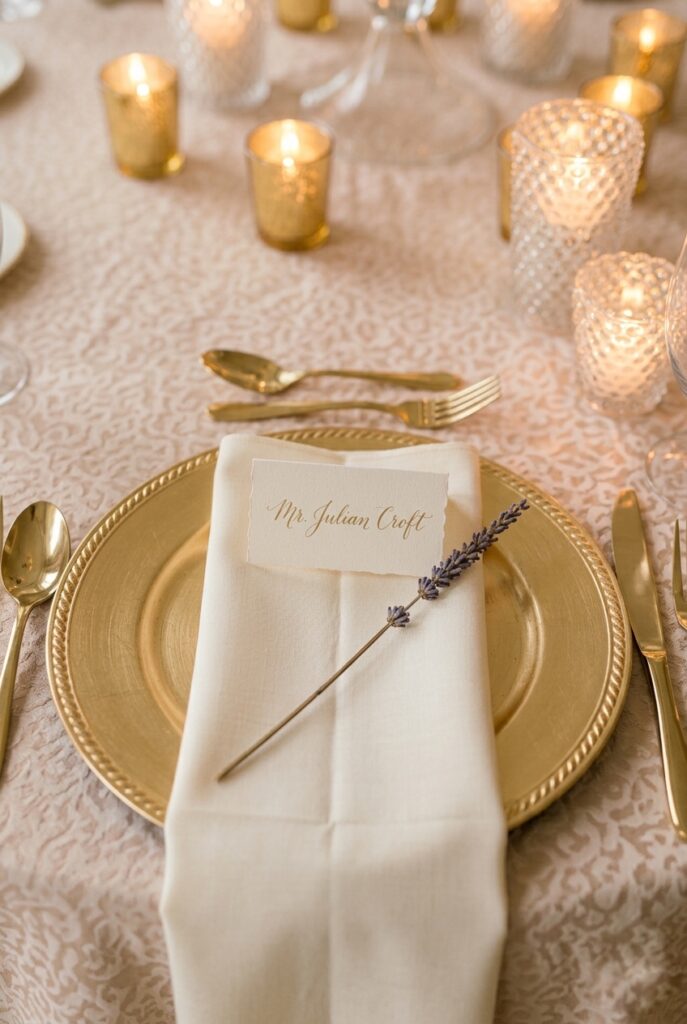
IMAGE 6 HERE Alt text: Elegant wedding place setting on round table with gold charger plate, folded ivory napkin, calligraphy place card, and dried lavender sprig Image prompt: Photorealistic extreme close-up of a single elegant wedding place setting on a white linen tablecloth. A gold metallic charger plate centered at the bottom. An ivory linen napkin folded into thirds sits on the charger. A calligraphy place card leans at a slight angle against the napkin fold. A single sprig of dried lavender lies diagonally across the napkin, tucked under the card. Gold flatware on either side. Soft romantic candlelit atmosphere warming the gold tones. Generate in vertical portrait orientation, 2:3 aspect ratio, optimized for mobile display.

Most couples build their place setting the way they learned from a Pinterest screenshot: napkin, fork, knife, plate.

What that misses is that the charger plate is the visual anchor of each seat, and everything should read as orbiting it rather than stacked on top of it.

Lay the charger first. Set the napkin folded into thirds on the charger, not beside it — this frees up the table surface for the runner and votives.

Lean a menu card or place card against the napkin fold at a slight angle.

Add a single sprig of dried lavender or rosemary across the napkin, tucked under the place card.

That one dried stem costs pennies but changes how the place setting photographs — there’s now a tactile, aromatic element that guests touch and smell before the food arrives.

Bulk dried lavender bundles on Amazon (ZYSD brand) run $12–$18 for 100 stems, enough for 100 place settings.

Price: $12–$18 for 100 stems of dried lavender from ZYSD on Amazon | Charger plates: $0.75–$2.50 each at CV Linens or via Amazon bulk sets


💡 Budget Hack #2: Rent gold charger plates from a local event rental company rather than buying them. Most couples quote $1.50–$2.50 per plate at retail. Local event rental companies charge $0.35–$0.65 per plate with a minimum order — search your city + “charger plate rental” on WeddingWire. For 100 guests, that’s $35–$65 in rentals versus $150–$250 buying the same plates on Amazon. You also skip storage and resale hassle after the wedding.


7. Use Colored Glassware as Your Free Accent Color
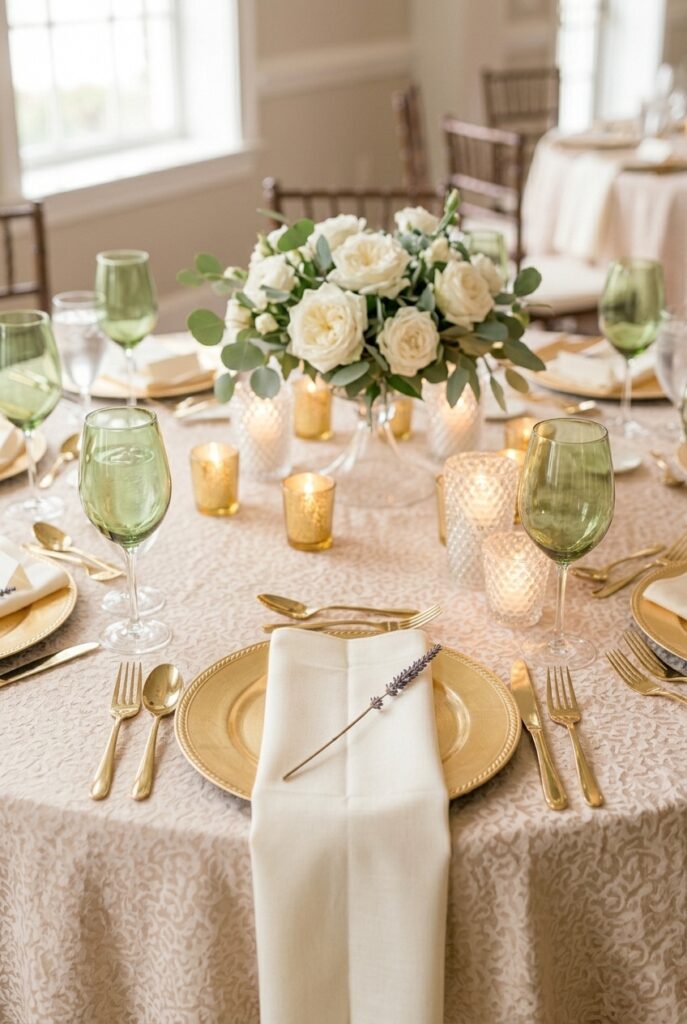
IMAGE 7 HERE Alt text: Round wedding table place setting with sage green tinted wine glasses against ivory linen and white flowers for a curated color effect Image prompt: Photorealistic editorial photograph of a round wedding table detail shot showing four place settings. Sage green tinted wine glasses stand tall beside clear water glasses. Ivory linen tablecloth, gold charger plates, white garden rose and eucalyptus centerpiece in background. Soft natural window light creating a bright, airy daytime quality. Green glass color is the single saturated element against the neutral palette. Generate in vertical portrait orientation, 2:3 aspect ratio, optimized for mobile display.

This is the one move that separates a styled table from a catered table, and it costs almost nothing extra if you negotiate it in.

Most rental companies carry amber, smoke, sage green, and cobalt blue glassware for $0.25–$0.75 per stem more than standard clear.

For a table of eight, that’s $2–$6 in added cost — but the visual return is enormous.

Colored glassware reads as intentional palette choice rather than rental default, and it photographs as rich and curated even in basic venue lighting.

Only do this if your palette is cohesive — one accent glass color that echoes either your florals or your linen overlay.

Do not mix two tinted glass colors at the same table.

That’s where it tips from editorial to chaotic.

Check availability for your region through The Knot’s vendor directory to find local rental companies with specialty glassware.

Price: $0.25–$0.75 per stem premium over standard rental glass | Also available via Amazon in sets of 6 ($18–$35)


8. Cluster Candles in Odd Numbers at the Rim
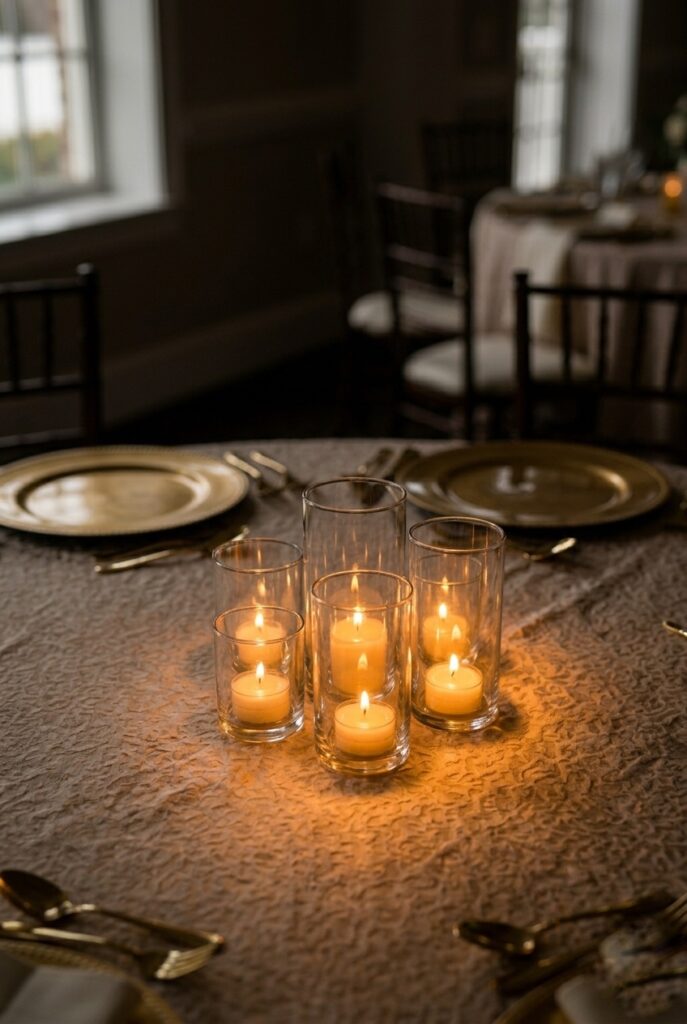
IMAGE 8 HERE Alt text: Clustered votive candles in odd numbers at the rim of a round wedding table creating a warm glowing pool of light between place settings Image prompt: Photorealistic close-up of a round wedding table rim between two place settings. Five clear cylindrical glass votives in three varying heights — 2, 3, and 4 inches — clustered tightly together. Tea light candles inside each votive cast warm amber candlelit glow on the ivory linen. Gold charger plates visible in soft foreground bokeh. Dark, moody romantic evening atmosphere with warm golden light pooling on the table surface. Generate in vertical portrait orientation, 2:3 aspect ratio, optimized for mobile display.

The rim of a round table is the most underused real estate in wedding decor. Competitors tell you to scatter votives around the centerpiece — which is fine but predictable.

The move that actually reads as designed: cluster three, five, or seven candles in a tight group at the table’s rim, between two place settings, at a single point on the circle.

It creates a pooled glow that photographs as intentional rather than scattered, and it leaves conversational sightlines across the rest of the table completely clear.

Use cylindrical glass votives in varying heights — 2″, 3″, and 4″ — from the same manufacturer so the glass weight matches.

Mismatched votive holders from different sources have different glass thicknesses that catch light differently and look assembled rather than curated.

Sziqiqi clear glass votives on Amazon ($18–$24 for 24 holders) are consistent in quality and wall thickness.

Price: $18–$24 for 24 holders from Sziqiqi on Amazon. For more approaches to this kind of budget-conscious layering, the budget wedding decor ideas guide covers candle sourcing in detail.


9. Choose Table Numbers That Earn Their Spot
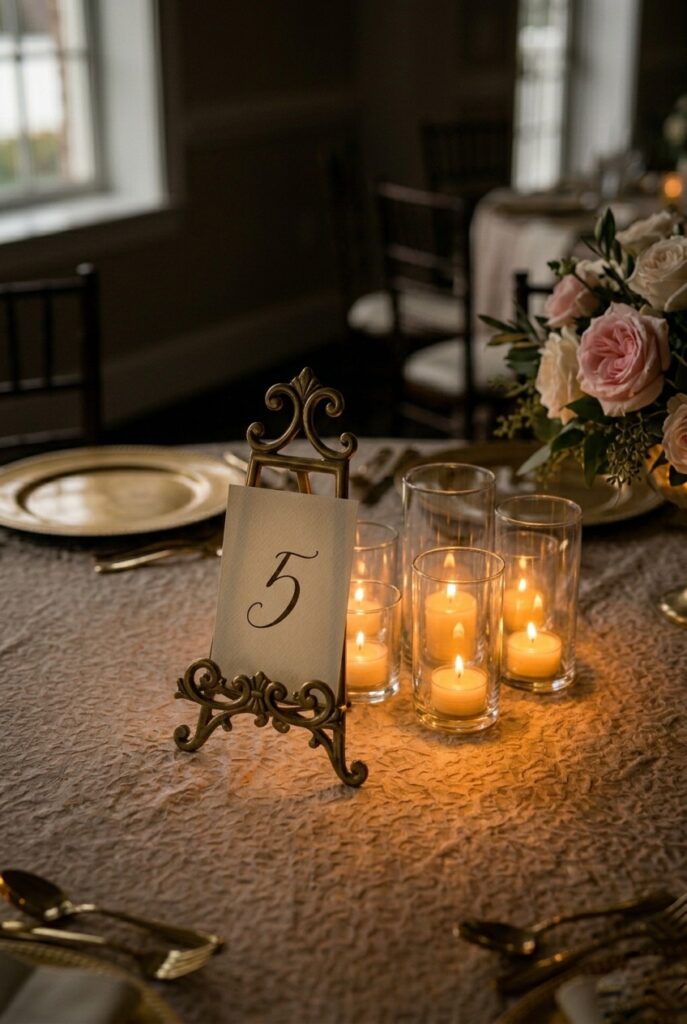
IMAGE 9 HERE Alt text: Brass metal table number stand with number 5 on an elegant round wedding table with linen and candles Image prompt: Photorealistic close-up of a small brass metal easel-style table number stand displaying number 5, sitting on a white linen tablecloth with a linen washed runner beneath it. Behind the stand, a small cluster of crystal votives and the edge of a garden rose centerpiece visible in soft bokeh. Warm romantic candlelit atmosphere. Rich gold tones of the brass against ivory linen. Generate in vertical portrait orientation, 2:3 aspect ratio, optimized for mobile display.

A table number is the most overlooked piece of vertical real estate on the table.

A cardstock tent card in Times New Roman from an office printer communicates one thing: nobody thought about this.

A table number should function as a design element that picks up a material from elsewhere on the table — brass metal stands ($2–$4 each from Amazon, NUPTIO brand), acrylic with a laser-cut number ($3–$6 each from Etsy shops like LuminousLabCo), or a small terracotta pot with the number hand-painted in gold paint ($1–$2 each DIY from Michaels supplies).

Skip this if: your tables are doing table names instead of numbers — in that case, calligraphy cards on paper weight 120gsm or heavier, in a typeface that matches your invitation suite, are all you need.

Only do this if: the table number stand is sitting directly on a runner or charger — floating it at the rim of a plain linen cloth makes it look abandoned.

Price: $2–$6 per table number | Amazon (NUPTIO), Etsy (LuminousLabCo), or Michaels for DIY terracotta option


💡 Budget Hack #3: Buy table number stands from a wedding resale marketplace rather than new. Facebook Marketplace, Marry Me Already, and Nearly Newlywed regularly list full sets of 15–20 brass or acrylic stands for $15–$40 total — the equivalent of $1–$2 per stand versus $3–$6 new. Search “table number stands wedding” in your zip code on Facebook Marketplace, filter to the last 30 days, and message sellers immediately — these go fast in wedding season. You can also find sets on Etsy under “used wedding decor” from couples who have already celebrated.


10. Add a Scent Layer That Nobody Else Thinks About
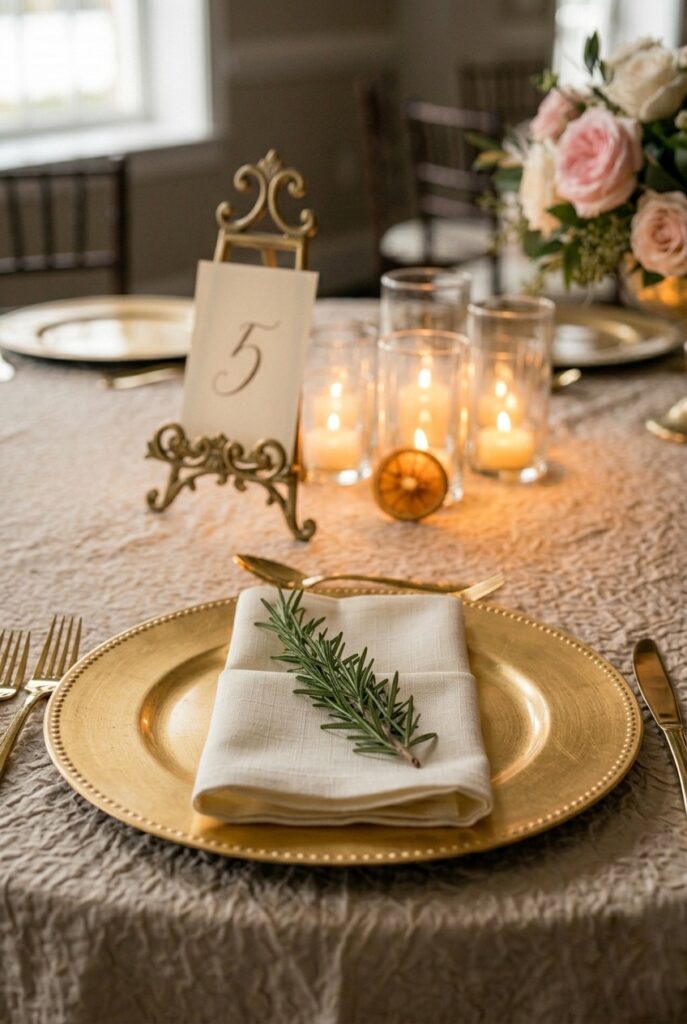
IMAGE 10 HERE Alt text: Wedding place setting detail with fresh rosemary sprig tucked under ivory linen napkin on gold charger plate for a sensory decor touch Image prompt: Photorealistic macro close-up of a single round wedding table place setting. An ivory linen napkin is folded in thirds on a gold charger plate. A fresh sprig of rosemary with dark green leaves is tucked under the napkin fold, its needle-like texture visible in crisp detail. A place card leans at an angle above it. A small dried orange slice sits near the votive cluster in the soft background. Soft natural daylight from above and to the left creating a bright fresh atmosphere. Generate in vertical portrait orientation, 2:3 aspect ratio, optimized for mobile display.

Every competitor article focuses entirely on what a table looks like.

None of them mention what it smells like — which is something your guests will notice within 30 seconds of sitting down and remember for years.

A single rosemary sprig under each napkin, or a small dish of dried citrus rounds near the centerpiece, activates memory in a way that visual decor never does.

This is particularly effective for garden, rustic, and Italian-inspired weddings.

Avoid strong floral scents near food service — fresh eucalyptus works beautifully because it’s herbaceous rather than sweet.

Fresh rosemary bundles at a farmers market run $4–$6 per large bunch, enough for 20–25 place settings.

Dried orange slice centerpiece accents are available on Etsy ($8–$12 per 50 slices) and add a warm, spiced quality to the table in fall and winter settings.

Price: $4–$6 per large rosemary bunch (farmers market) | $8–$12 for 50 dried orange slices on Etsy. This pairs naturally with simple wedding decor ideas that rely on sensory layering over volume spending.


Decision Filter

If your guest count is under 80, allocate more per-table budget and style every table identically — variation only works at scale when you have enough tables to create a rhythm.

If you’re in a blank ballroom, put 60% of your table decor budget into the linen and charger plate layer before touching florals — these are the elements that fill the room visually when guests first walk in.

If your venue has low lighting or string lights overhead, skip tall centerpieces entirely and go low and candle-heavy; your photographer will thank you, and so will your guests’ conversations.

For couples keeping costs tight, the wedding decor ideas on a budget breakdown walks through exactly where to cut without compromising the final look.


The Real Reason Round Tables Are Hard to Style

The contrarian truth about round tables: they’re not actually easier to decorate than rectangular tables — they’re just more forgiving of mistakes.

A mediocre rectangular tablescape looks sparse and intentional in a bad way.

A mediocre round tablescape just looks average.

That’s why so many round table receptions end up looking exactly the same as every other wedding at that venue.

The strong opinion: if you are working with a venue that provides basic white linens and a house centerpiece package, the single best use of your additional decor budget is not upgrading the florals — it’s replacing the tablecloth with a textured linen and adding two different candle heights.

The florals are the last 20% of the visual. The foundation is the first 80%.

The insider observation your florist probably won’t say out loud: the standard 60-inch round table seats 8–10 guests comfortably with a centerpiece under 16 inches in diameter.

When florists design centerpieces for their portfolio shots, they shoot tables with 6 guests and extra space for the arrangement to spread.

In reality, at full guest capacity, a 22-inch-diameter low centerpiece leaves 19 inches of undecorated table per side, and guests end up moving it to reach each other.

This is why you should specify centerpiece diameter, not just height, when discussing designs with your florist — and aim for 12–16 inches across for tables that will actually be at capacity.


Mistakes to Avoid

Mistake 1: Spending on florals before deciding on linens. Almost every competitor article leads with centerpiece ideas. That’s the wrong sequence.

Florals sit on top of linens — which means if your linen is a rented default ivory polyester with a 14-inch drop that shows the table leg, no floral arrangement reads the way it’s supposed to.

Decide your linen first. It’s the wall your centerpiece hangs on.

Mistake 2: Renting a centerpiece package without checking the actual diameter. Venue centerpiece packages typically cost $45–$85 per table. What most couples don’t know until setup day: the arrangement is often designed to fit a demonstration table in a showroom, not a 60-inch round at full capacity.

At 100 guests seated, that arrangement gets moved, knocked sideways, or shoved toward one guest all evening.

The $75 you spent on that rental delivered about 90 minutes of its intended visual effect.

The fix is to ask your venue coordinator for the exact diameter and arrangement footprint in writing before signing the package.

Mistake 3: Choosing table linens in a color that looks right on a screen but wrong under the venue’s lighting. Dusty rose looks like salmon under warm tungsten. Sage green reads gray under cool fluorescent.

Champagne turns flat white under stage lighting.

Every linen color shifts under venue-specific lighting conditions, and this is something almost nobody realizes until they see the tables fully set at their rehearsal — which is too late to change anything.

The fix: request a physical swatch from your linen vendor and hold it under the venue’s actual light sources before ordering.

This is free and takes fifteen minutes, and The Knot’s real wedding pricing tool can help you identify local linen vendors who stock samples.

Mistake 4: Treating all ten tables identically when your budget doesn’t actually support it. This is uncomfortable to say: styling ten tables at the same level as your hero table photos requires ten times the budget.

Most couples spend heavily on two or three tables for the mock-up and then stretch the remaining budget across the others — which means half the room looks different on the wedding day than in the planning photos.

If your total table decor budget is under $1,500, choose one elevated element and replicate it perfectly across all tables rather than attempting a full layered design on every surface.


FAQ

How many centerpieces do I need for round tables?

One centerpiece per guest table is standard, plus one for the sweetheart or head table if applicable.

For rooms with a mix of table sizes, you may need different centerpiece scales — a 48-inch round needs a smaller footprint than a 72-inch.

Account for cake tables, escort card tables, and gift tables when ordering from your florist, as these are often quoted separately.

What size tablecloth fits a 60-inch round table?

A 108-inch round tablecloth gives a formal 24-inch drop, which is the most versatile for wedding receptions.

A 90-inch cloth gives a relaxed 15-inch drop that works for casual or garden-style events.

A 120-inch cloth creates a full floor-length puddle appropriate for sweetheart or cake tables.

Most rental venues default to 90-inch — upgrade to 108-inch for photographs that read polished. 

Brides.com has a tablecloth sizing chart with every standard round table size mapped to its ideal cloth dimensions.

Can you use a table runner on a round table?

Yes, and the best approach is running it straight across the full diameter — edge to edge — so it drapes on both sides rather than sitting centered like a place mat.

Use a narrow runner, 12–14 inches wide, in a texture that contrasts slightly with your base linen.

Avoid runners wider than 16 inches on a 60-inch round; they overpower the place settings on either side.

How do I decorate a round wedding table on a budget?

Prioritize in this order: linen quality first, candles second, a single statement element (one cluster of florals or a striking centerpiece vessel) third.

Anything you see in cheap wedding decor ideas works best on round tables when you treat the candle layer as your primary visual rather than a supporting element.

Three taper candles in varying heights cost $6–$10 per table and read more intentional than a $45 filler-flower arrangement from a warehouse florist.


Budget Table

ElementSkip / DIY OptionMid-RangePremium
Round tablecloth (108″)$8–$15 each (CV Linens)$18–$30 linen rental$35–$65 specialty linen rental
Linen overlaySkip; use runner instead$12–$22 chiffon overlay$30–$55 silk charmeuse overlay
Table runner$5–$6 DIY from fabric yardage$18–$40 pre-made linen$45–$85 specialty runner
Centerpiece$25–$45 candle cluster$65–$120 florist compact$150–$300 designer arrangement
Charger plates$0.35–$0.65 rental$1–$1.75 buy bulk$2.50–$4 specialty metal
Candle votives (set of 8)$12–$18 Amazon (Sziqiqi)$24–$40 vintage-style holders$50+ crystal holders
Table numbers$1–$2 DIY terracotta$2–$4 brass stands (Amazon)$5–$8 acrylic laser-cut (Etsy)
Place setting accent (lavender/rosemary)$4–$6 farmers market$12–$18 bulk dried on Amazon$18–$28 styled bundles on Etsy
Per-table total$60–$115$155–$290$335–$600+

Round tables give you the most democratic seating arrangement in a reception room — every seat has equal sightlines, equal conversation access, and equal visual relationship to the centerpiece.

The couples who make the most of that geometry are the ones who stop designing one spectacular center element and start designing the entire surface as a layered composition. Start with your linen, confirm your drop length, then work outward.

If you’re still deciding between table shapes or want to see how these principles apply in a full room context, read through the wedding table decor ideas guide next — it covers rectangular, sweetheart, and escort card tables alongside round configurations with the same layered approach.

Leave a Comment

Your email address will not be published. Required fields are marked *

Scroll to Top