
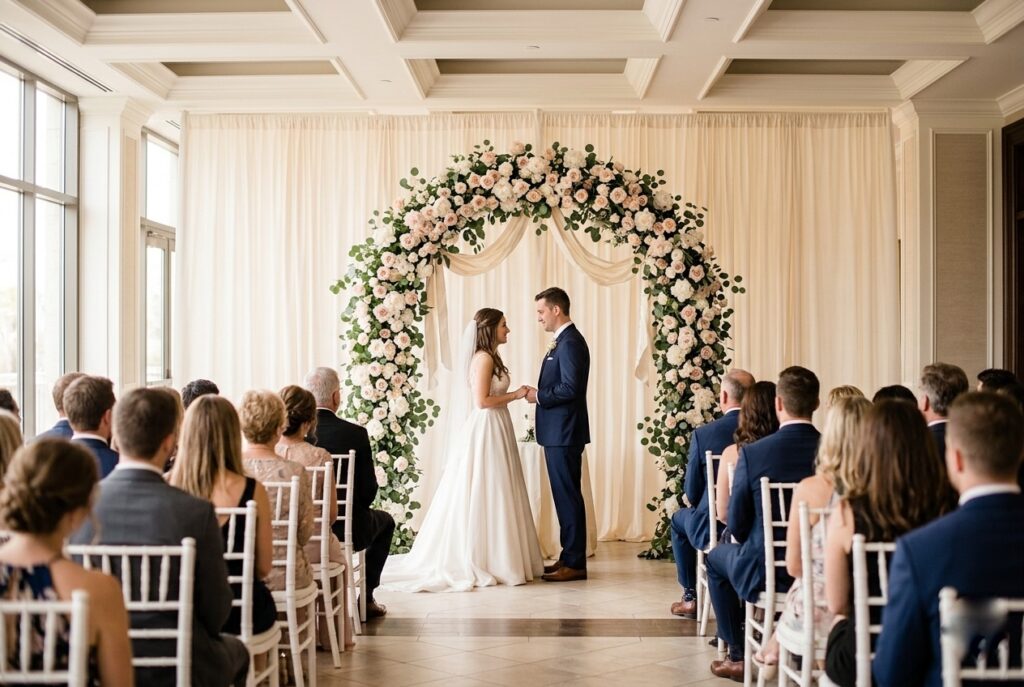
Most couples design their ceremony backdrop using Instagram photos and Pinterest boards.
They see a gorgeous floral arch, save it, and assume it will work exactly the same way in their space.
Your ceremony backdrop has two audiences—your photographer (who has one hour to capture moments) and your guests (who have 30–60 minutes to sit and experience the visual weight of your design).
A backdrop that photographs beautifully might feel cold or disconnected to guests sitting 30 feet away.
A backdrop that creates intimacy for guests might not have enough dimension for dramatic photography.
The best ceremony backdrops do both, and that requires understanding the spatial dynamics, not just aesthetic preferences.
Here’s what actually matters: backdrop shape, flower longevity under ceremony conditions, proportion to your space, and how your design choices affect what your guests emotionally experience during the most meaningful moment of your celebration.
Curves hold the eye, geometry sharpens it.
A guest in the third row feels the difference without knowing what they’re looking at— only that the space breathes or contracts depending on what stands behind you.
The Short Answer
Your ceremony backdrop should be designed around three decisions that most couples never consciously make: the shape (curved softens and romanticizes; geometric sharpens and modernizes; linear elongates), the flower selection based on how long blooms actually stay fresh under ceremony lights rather than how pretty they look in photos, and the proportional scale relative to your venue’s dimensions and guest count.
Skip the backdrop that looks perfect on Instagram if the flowers wilt under your venue’s lighting or if the scale dominates rather than frames your couple.
Test your backdrop’s visual impact by standing where your guests will sit, not just where your photographer will stand.
That perspective change—from guest view to photo view—is where the disconnect happens.
1. Backdrop Shape Psychology: Curves vs. Geometry vs. Linear
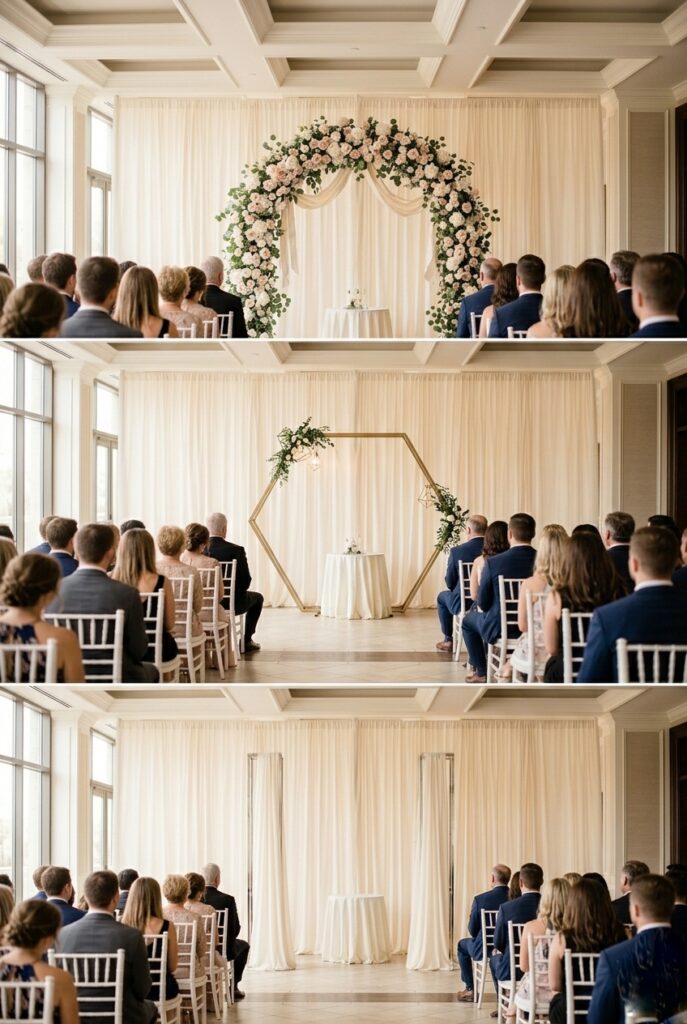
The shape of your backdrop affects how your guests psychologically perceive the couple and the space, whether they consciously notice it or not.
This is design principle, not decoration.
Curved arches (rounded, circular, asymmetrical crescents): Soft, romantic, historically feminine. A curved arch psychologically “holds” the couple—your eye follows the curve and returns to the center.
The couple feels contained and intimate.
Good for guests—curves feel welcoming rather than stark.
Curved arches make spaces feel smaller and more inviting, which works well if your venue is large or if you want an intimate feel.
Flower wilting is visible because curves expose more of the arch structure as you look at it from different angles—missing flowers become obvious faster.
Geometric arches (hexagons, triangles, rectangles, circles framed as shapes rather than curves): Sharp, modern, intentional.
Geometry psychologically frames rather than softens.
Your eye is drawn to the defined shape, not the negative space.
The couple appears more formal, the space more architectural.
Geometry works for minimalist, modern, or contemporary weddings.
Geometry also hides flower wilting better because the overall shape remains intact even if some flowers fade or drop—the design is about the structure, not fullness.
Linear backdrops (tall straight posts, minimal framing): Clean, elongating, sometimes austere.
Linear designs make spaces feel taller and less intimate.
Your eye travels vertically rather than circling. Linear works for outdoor ceremonies with natural backdrops or for very simple, high-fashion minimal aesthetics.
Flowers on linear structures are more visible individually—you’re not seeing a unified shape, but individual elements along a line.
The visual weight difference: A large curved arch in a small ballroom feels dominant and overwhelming.
A geometric arch with negative space in the same room feels intentional and proportional.
The same flowers on both structures feel completely different emotionally to guests because the shape controls how the design reads, not just the flowers.
Price range: Shapes don’t differ in cost—curved arches, geometric shapes, and linear posts cost roughly the same to build ($400–$2,000 depending on materials and flowers).
The cost difference is in material choice and flower load, not the shape itself.
2. Flower Selection for Ceremony Longevity (Not Just Beauty)
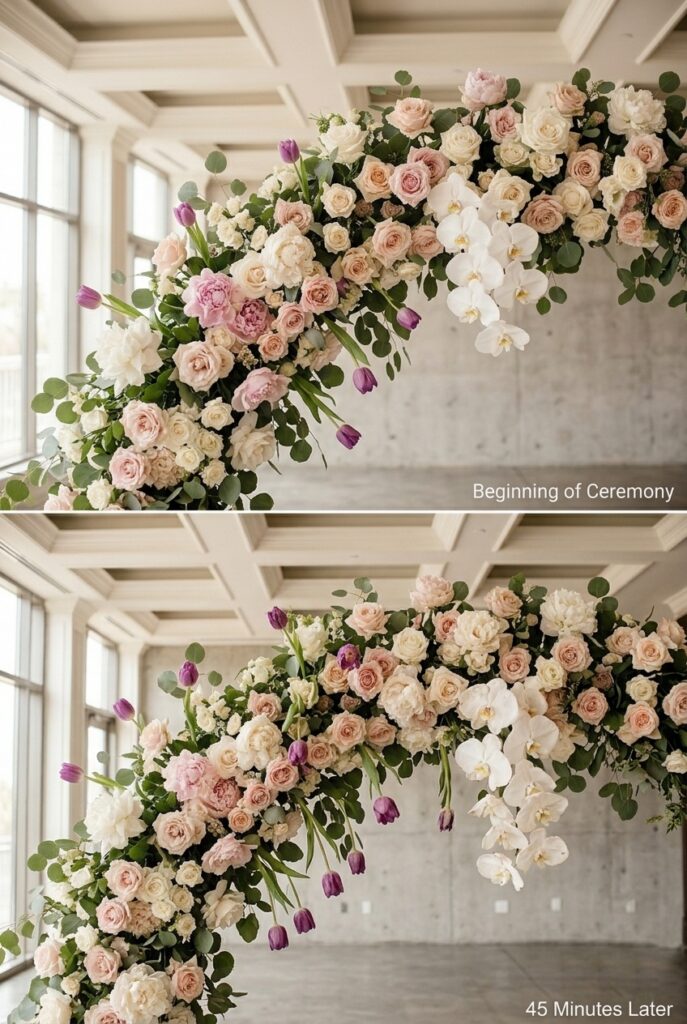
This is where most couples fail without realizing it.
You choose flowers because they’re gorgeous in a photograph, then they wilt under ceremony lights, and your 2-hour timeline falls apart.
You’re exchanging vows in front of visibly wilting flowers, and your photos reflect that.
Flowers have different heat and light tolerance.
A rose under ceremony lights (often 500+ watts of warm, direct light) for 45 minutes behaves completely differently than the same rose at an outdoor garden wedding with diffuse natural light.
Flowers that hold fresh for 60+ minutes under ceremony lights:
- Roses (especially full garden roses; tight hybrid teas hold better than loose ones)
- Peonies (incredibly hardy, last the longest)
- Ranunculus (dense, durable, wilt-resistant)
- Dahlias (thick petals, hold up beautifully)
- Eucalyptus and greenery (nearly indestructible)
- Hydrangeas (thicker than expected, hold water well)
Flowers that wilt visibly within 30–45 minutes under direct heat:
- Tulips (delicate, droop noticeably as they warm)
- Orchids (depend on humidity, crisp in cool conditions, droopy when warm)
- Delphinium (tall, look sparse quickly as individual florets drop)
- Gardenia (opens in heat, can look overblown within an hour)
- Lisianthus (gorgeous but extremely sensitive to temperature and humidity)
The professional move: Choose your flowers based on your ceremony duration + venue lighting.
If you have direct venue lights, overhead spotlights, or an outdoor ceremony in direct sun, select flowers from the “hardy” category.
If you have diffuse light (shaded outdoor, northern window light, dimmed ballroom), you have flexibility with more delicate options.
Ask your florist: “What’s the heat output of the venue lighting? How long will these specific flowers stay fresh under those conditions?”
Not every florist thinks this way. The ones who do will design accordingly.
The ones who don’t will create a gorgeous arch that wilts during your vows.
Price range: Flower costs don’t vary dramatically by hardiness—peonies and roses cost the same as orchids and lisianthus ($50–$150 per stem at typical pricing).
The premium is in design complexity and flower count, not the flower variety itself.
The difference is in whether your flowers look fresh in your actual ceremony or beautiful-in-photos-only.
Budget Hack #1: Skip mixed-delicate bouquets and choose a single flower type or two complementary hardy varieties instead. A lush arch of 200 garden roses with eucalyptus ($1,800–$2,500) lasts pristinely through a 60-minute ceremony. A mixed arch with orchids, lisianthus, tulips, and roses ($2,000–$2,800) shows visible wilting by photo time. You save $200–$400, your flowers look better, and the design actually reads more sophisticated because it’s restrained rather than maximalist. Source: Tell your florist you want “ceremony-hardy flowers in a cohesive color palette.” Ask them to suggest the most durable options in your color scheme. This simple conversation shifts the entire design from “pretty but fragile” to “beautiful and practical.”
3. Proportion to Your Space: The Invisible Math Couples Skip
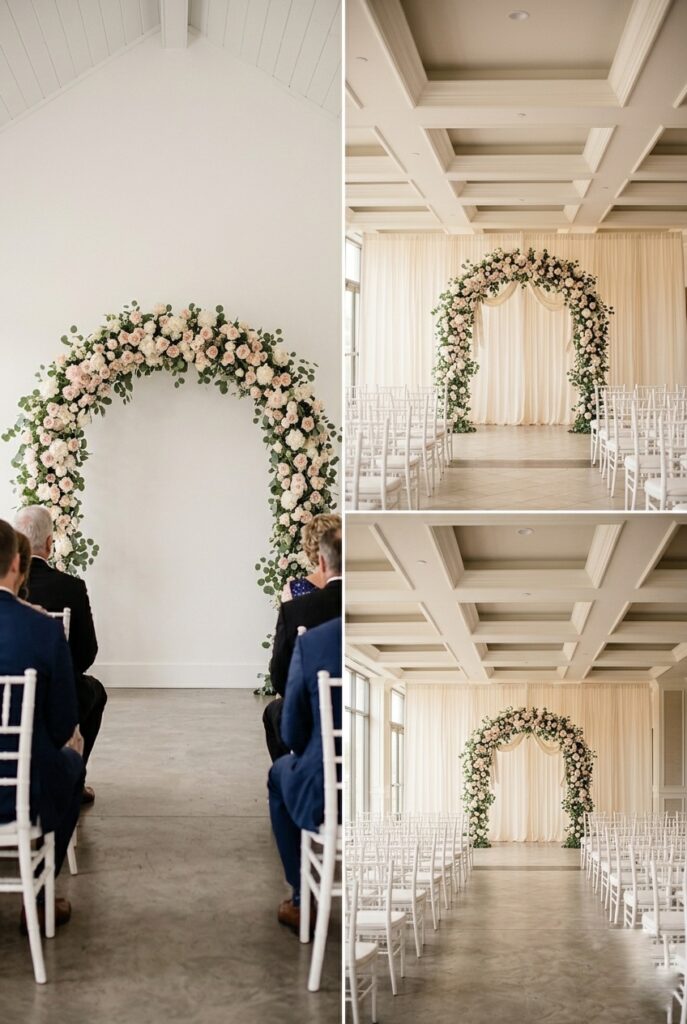
Your ceremony backdrop’s visual weight is determined by the ratio of backdrop size to room size, not by the absolute size of the structure.
An 8-foot-wide floral arch in a small chapel (20 feet wide) looks enormous and overwhelming.
The same 8-foot arch in a grand ballroom (40 feet wide) looks balanced and intentional. Same structure, different visual weight entirely.
Calculate backdrop proportion:
- Small ceremony space (under 40 feet wide): backdrop should be 25–35% of room width
- Medium ceremony space (40–60 feet wide): backdrop should be 30–40% of room width
- Large ceremony space (60+ feet wide): backdrop should be 35–50% of room width
For a 40-foot-wide chapel: design a 10–14-foot-wide backdrop.
For a 60-foot ballroom: design a 18–24-foot-wide backdrop.
These proportions ensure the backdrop frames the couple without dominating the space or feeling insignificant.
Measure your ceremony space before designing.
Ask your venue for the distance from the back wall (where your backdrop will be) to the front row of guest seating, and the width of the ceremonial area.
Use these numbers to calculate proportional backdrop width. Show your florist or designer the dimensions.
This prevents the “we designed it to look pretty in photos but it dominates the actual space” problem that happens constantly.
Price range: Proportional design doesn’t change material cost—a 10-foot arch costs roughly the same as an 8-foot arch (same construction, slightly more flowers).
The difference is in how intentional and balanced your final result feels to guests sitting in the room.
4. Guest Sightline Positioning: The Perspective Nobody Considers

Most couples position their backdrop by asking “where will the photographer shoot from?”
Then they’re surprised when guests in the side section can’t see the couple’s faces clearly because the backdrop or floral arrangement is blocking the view.
Professional ceremony setups position the backdrop with guest sightlines as the priority.
Your photographer works around the best guest view, not the other way around.
Guest sightline rules:
- Guests should see the couple’s faces and upper bodies clearly from any seat in the ceremony space
- The backdrop should frame without obstructing—this means leaving sight lines open on the sides of the arch or structure
- Floral density should be higher at the top and sides of the arch and more open at the couple’s face height (so guests can see through/past the flowers to see the couple’s expressions)
- A 6-foot tall arch with flowers all the way down blocks short guests’ views of the couple’s faces. An 8-foot arch with flowers concentrated at the top and more open at face height (5–7 feet) solves this.
Walk your ceremony space from every guest section before finalizing your backdrop design. Sit in a chair where the front-row guests will sit, then the side sections, then the back. Can you see the couple’s faces clearly?
Can you see their hands when they hold hands or exchange rings? If not, your backdrop positioning needs adjustment.
Price range: Sightline-friendly design doesn’t change cost—it changes the technical design (how flowers are distributed on the structure).
Have this conversation with your florist or designer explicitly.
5. Fabric Draping: The Multiplier Effect on Visual Impact
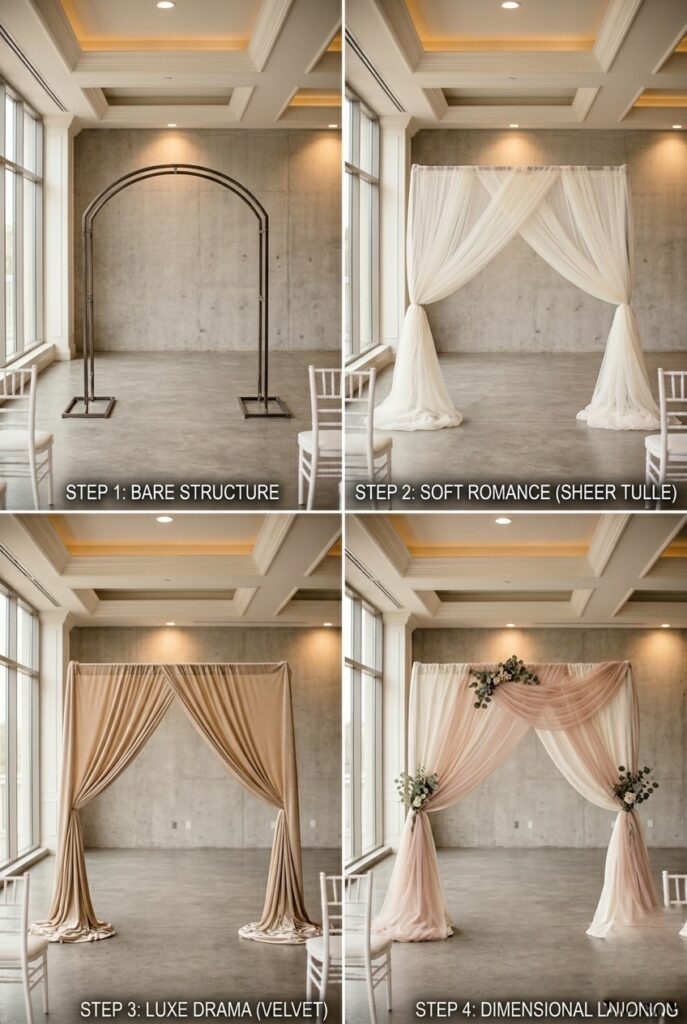
A plain floral arch is a structure. Draping transforms it into an installation.
Fabric changes how the backdrop reads visually and photographically by adding layers, softness, and visual weight.
Sheer fabric (tulle, chiffon): Adds romance and softness without visual heaviness.
Photographs beautifully with light passing through it, creating luminous dreamy effects.
Doesn’t hide the structure behind it—the arch is still the focal point, the fabric is enhancement.
Cost: $100–$300 for enough fabric to drape around an 8–10-foot arch.
Structured fabric (velvet, silk dupioni, heavyweight linen): Adds elegance and visual drama.
Reads as intentional and expensive. Hides the structure entirely—the fabric is the focal point.
Works for formal, modern, or luxe aesthetics. Photographs with rich texture and dimension.
Cost: $300–$800 depending on fabric quality and yardage needed.
Layered fabric (two or three different fabrics, different textures or colors): Adds complexity and depth. Photographs with dimensional visual interest.
Takes more skill to execute well—poor layering looks busy. Cost: $400–$1,200.
No fabric (structure only): Works for modern, minimal, or geometric designs.
Floral arches without fabric feel lighter and more natural.
Works well when flowers are lush and statement-making on their own.
Cost: $0, but requires visually substantial florals.
The visual multiplier: adding fabric to a basic arch design increases its visual impact by 30–50% photographically but makes it feel slightly smaller in person to guests because fabric creates visual boundaries.
This is why your photographer might love a heavily draped design while guests find it feels claustrophobic.
Discuss this balance with your designer explicitly.
Price range: Draping costs $100–$1,200 depending on fabric choice and complexity.
It’s often the difference between a “nice” backdrop and a “wow” backdrop photographically.
6. Lighting Strategy for Ceremony Freshness (Not Just Night Visibility)
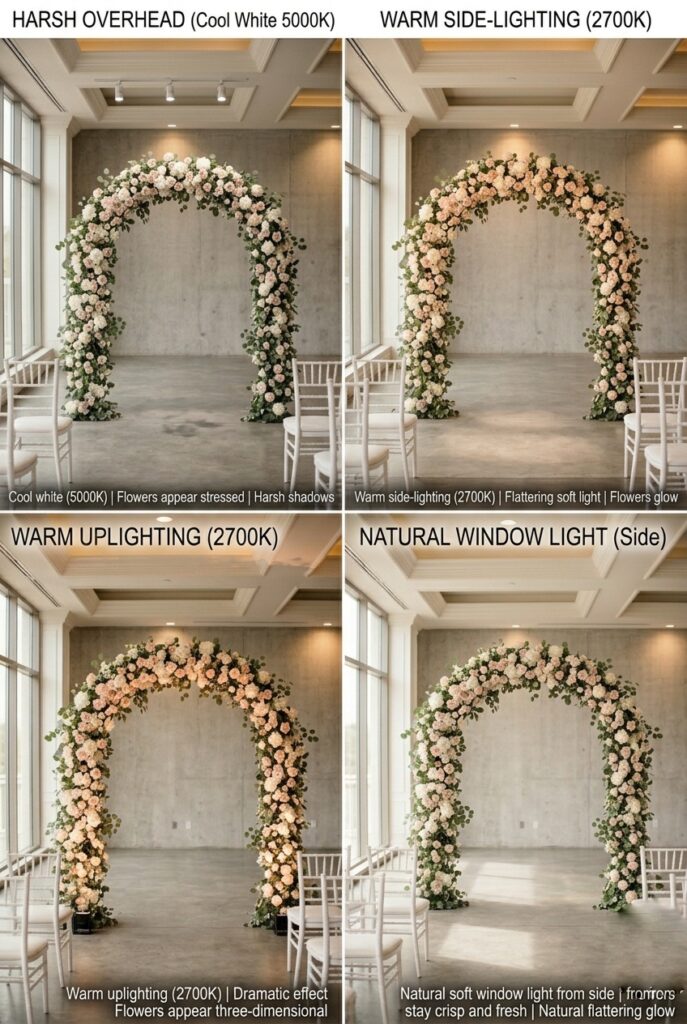
Ceremony lighting affects flower freshness, how colors photograph, and how your design reads in person.
Most couples think about lighting only for evening ceremonies. Daytime ceremonies have lighting too—you’re just not aware you’re designing it.
Overhead venue lights (typical ballroom/indoor ceremony): Warm white (2700K) is flattering. Cool white (5000K+) is harsh and makes whites look clinical.
Direct overhead spots create shadows under eyes and chins—unflattering for guests and couple.
Solution: ask your venue if side lights or uplighting can be added instead of harsh overhead.
Natural window light (daytime indoor ceremony): Diffuse, flattering, keeps flowers fresh longer because there’s no concentrated heat.
If window light is the primary light, your flowers will stay fresher than under artificial lights.
Positioning matters—side windows are more flattering than front windows (no harsh backlighting making the couple squint).
Direct outdoor sunlight: Flowers wilt faster. Heat from direct sun causes heat stress. Solution: choose hardy flowers (peonies, roses, ranunculus) and provide some shade or misting if possible.
Uplighting around the backdrop (evening or lit ballroom): Adds drama and visual dimension. Warms the space.
Doesn’t create shadows on faces like overhead lights do. Best practice for photography and visual impact.
Tell your venue or lighting designer: “What’s the primary light source during our ceremony? Can we adjust it to be side-lit or uplighting rather than harsh overhead? We want our flowers to stay fresh and our couple to look flattering.” This single conversation prevents both wilting flowers and unflattering photos.
Price range: Lighting adjustments cost $0–$300 depending on your venue’s existing equipment and your requests. It’s almost always worth the conversation.
7. The Backdrop Location Decision: Ceremony vs. Reception Repositioning
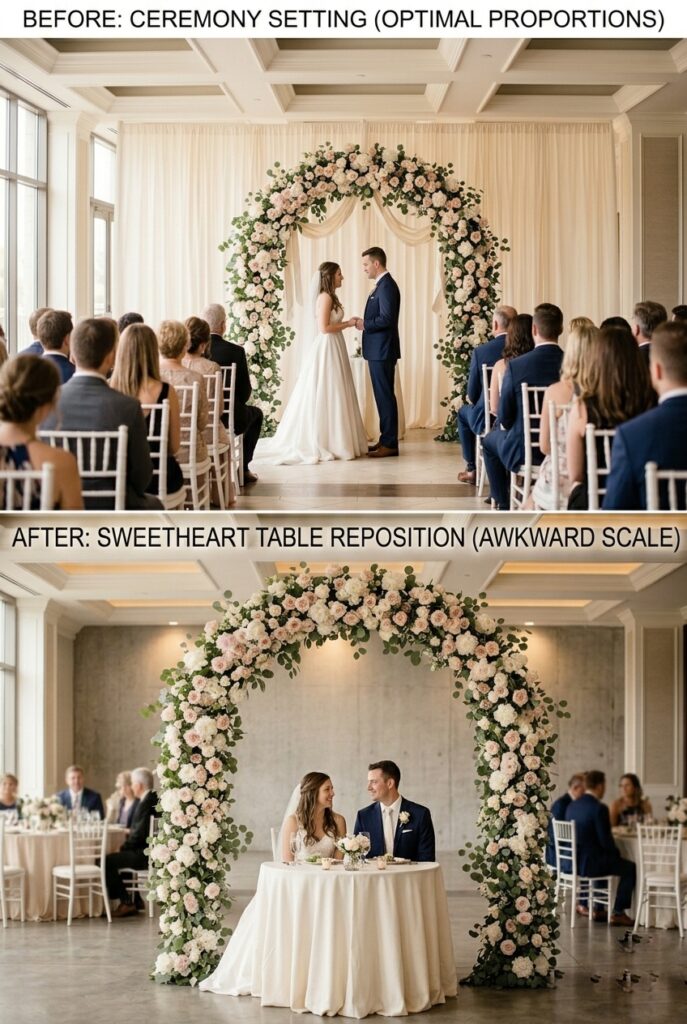
Some couples design their ceremony backdrop intending to move it to the reception for the sweetheart table background.
This saves money but often compromises both uses because what frames a couple beautifully during ceremony doesn’t necessarily work for a seated tablescape.
If you’re repositioning: Design for the ceremony first (sightlines, proportion, guest experience).
Accept that it will look different during reception (probably better in photos because the couple is seated closer to it, but visually different).
Budget $200–$500 in additional flowers or fabric to refresh it for reception use.
If you’re using it ceremony-only: Design freely without thinking about reception.
You can create something perfectly optimized for the ceremony experience without compromise.
Most elegant approach: build/rent a smaller statement backdrop for reception (behind sweetheart table, 6–8 feet) rather than trying to reposition the ceremony arch.
Costs $200–$400 more but creates two spaces that are both intentionally designed rather than one compromise.
Price range: Repositioning costs $0 but compromises design.
Separate ceremony and reception backdrops costs $400–$800 additional but ensures both spaces are optimally designed.
8. Statement Single-Element Backdrops (When Less Is More)
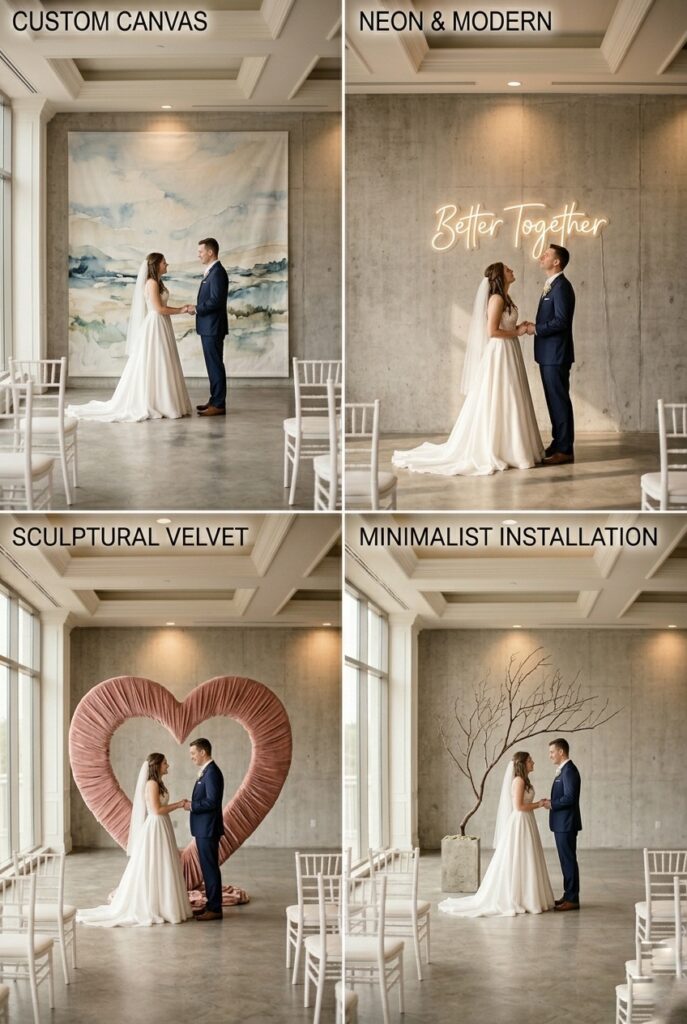
Not every ceremony needs a full arch. Sometimes a single statement element—a painted backdrop, a neon sign, a velvet heart, a large fabric installation—creates more impact than a traditional floral structure.
Painted custom backdrop: Investment upfront ($300–$1,500 for custom art), but it’s reusable, doesn’t require fresh flowers (no wilting concerns), and you own it forever.
Works beautifully photographically.
Cost: $300–$1,500. Where: commission local artists on Etsy or through your coordinator.
Neon sign: Trendy, modern, statement-making. Photographs beautifully in evening ceremonies.
Works for contemporary, fun, or casual weddings. Cost: $500–$2,000 for custom neon.
Where: Etsy, local sign makers, or specialized neon companies.
Large velvet shapes (heart, circle, geometric form): Luxe, sculptural, statement-making.
Photographs dramatically. Works for bold, fashion-forward aesthetics.
Cost: $800–$3,000 depending on size and material.
Where: custom fabricators or high-end rental companies.
Minimalist single-element installation: One large tree, one sculpture, one fabric installation in a single hue.
Japanese/Scandinavian-inspired restraint.
Photographs with clean sophistication. Cost: $200–$800 depending on element.
Where: rentals, natural elements, or DIY.
The advantage: these single-element backdrops usually photograph more dramatically than traditional arches because they’re unexpected and bold.
Guests also experience them differently—as art rather than decoration.
Price range: $300–$3,000 depending on what you choose.
Usually equivalent to a traditional floral arch but with entirely different visual impact.
Budget Hack #2: Commission a local artist to paint a custom backdrop on canvas (8×10 feet) for $400–$800 instead of renting a floral arch for $1,200–$2,000. You own it permanently, it doesn’t wilt, it’s completely unique, and you can repurpose it as home decor or rent it to other couples to recoup costs. Source: Search “canvas painter” or “wedding artist” on Etsy, or ask your coordinator for local recommendations. Request a proof before final painting and give clear direction on style, colors, and dimensions.
9. The Seasonal Flower Reality (Hardy vs. Seasonal)
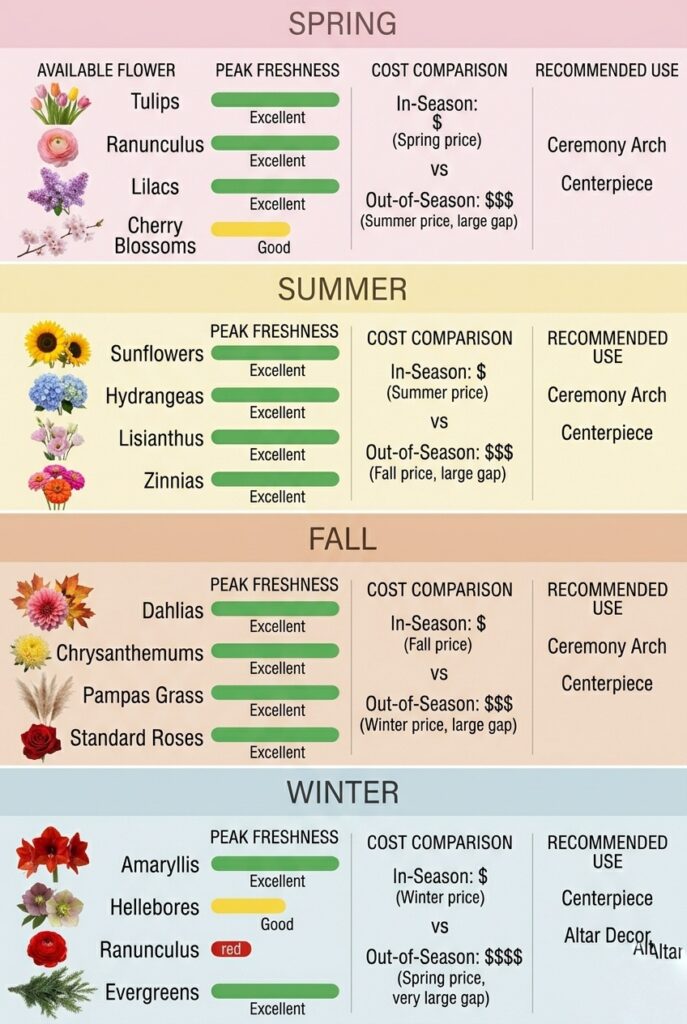
Seasonal availability affects both cost and longevity. Peonies are ridiculously inexpensive in June but impossible to source in November.
Roses are available year-round but seasonal varieties are fresher and cheaper. Choose based on your date.
Spring (March–May): Peonies, ranunculus, tulips (use hardy varieties for ceremony), garden roses, bleeding heart, lily of the valley.
Abundance, reasonable cost, excellent freshness.
Summer (June–August): Roses, dahlias, hydrangeas, delphiniums, zinnias, lisianthus (avoid lisianthus for hot ceremony lights—it wilts).
Peak availability, peak pricing on premium varieties, excellent freshness.
Fall (September–November): Dahlias, roses, hypericum berries, seeded eucalyptus, burgundy/deep color flowers.
Moderate pricing, excellent color options, good freshness.
Winter (December–February): Roses (premium pricing), ranunculus (imported, expensive), amaryllis, hypericum, greenery, dried elements.
Limited freshness, highest cost, fewer options.
Planning your wedding in peak season for specific flowers? Work with your florist to emphasize those flowers—they’ll be fresher, cheaper, and more stunning.
Fighting the season? Budget 20–30% more for imported or out-of-season blooms.
Price range: Seasonal flowers cost 30–50% less than out-of-season blooms. Timing saves money and improves freshness.
10. Ceremony Music + Backdrop Timing: The Overlooked Coordination
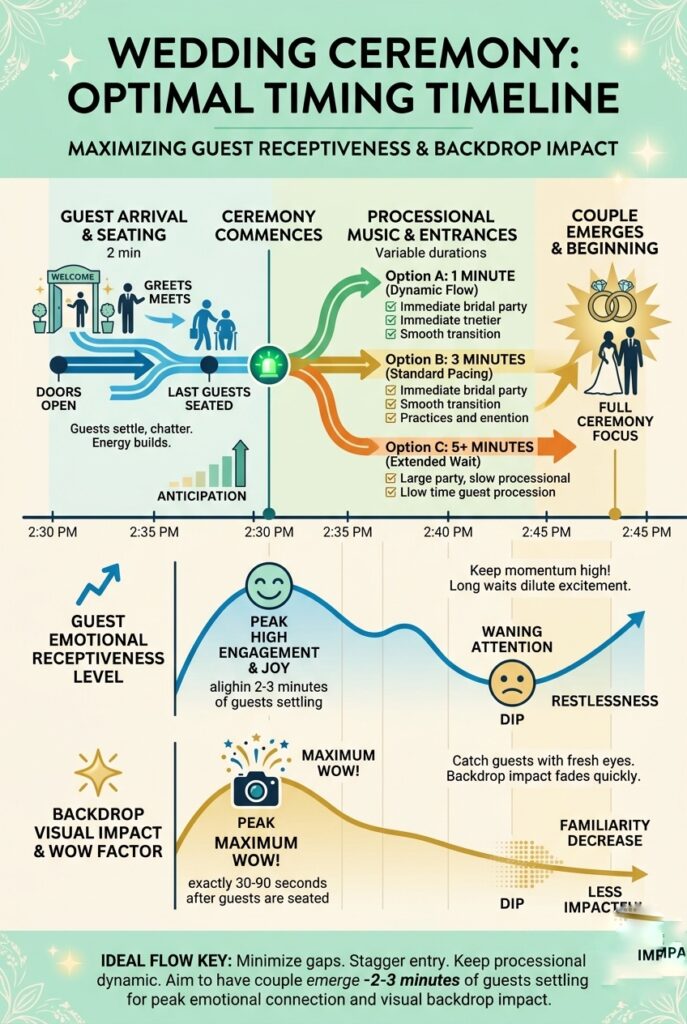
Your ceremony backdrop’s visual impact is heightened or diminished by timing.
If guests stare at your backdrop for 10 full minutes during processional music before anything happens, the impact flattens.
If your couple emerges within 30 seconds of guests being seated, the backdrop feels like a proper frame.
Coordinate with your officiant and musician: Can the ceremonial music be timed so guests are seated and settled just as the couple emerges?
A 2–3 minute gap between “guests seated” and “couple appears” is ideal—long enough for guests to absorb the backdrop, short enough that they’re still in a receptive emotional state.
Any longer and the moment loses momentum.
Any shorter and guests are still settling.
Also: your backdrop will look best in photos when there’s clear light (ceremony light, not sunset glare or shadow).
If you’re having an evening ceremony with uplighting, your backdrop needs that lighting to be set up and tested before the ceremony starts.
Nothing worse than dim, unflattering lighting because the lighting design wasn’t coordinated with ceremony timing.
Price range: This is coordination strategy, not cost. Talk to your planner and musician about timing.
Decision Filter
If you’re having a small, intimate ceremony (under 50 guests) in a cozy space, invest in backdrop shape and proportion over flower abundance.
Your guests will be close enough to see expressions and details—a curved 6-foot arch with garden roses and eucalyptus creates more impact than a 10-foot arch with sparse flowers trying to fill space you don’t have.
If you’re having a large ceremony (100+ guests) in a spacious venue, invest in scale and visual impact.
A 14–16-foot geometric or curved arch with substantial florals reads beautifully to guests 30+ feet away.
A small delicate arch gets lost in a ballroom.
If your venue has strong natural light (windows, outdoor setting), choose hardy flowers and embrace the freshness.
If your venue is artificially lit (ballroom, chapel with overhead lights), add uplighting around your backdrop and choose heat-tolerant flowers.
Coordinate lighting strategy with your design.
If you’re on a tight budget, choose a single-element statement backdrop (painted canvas, neon sign, large greenery installation, minimalist design) over an expensive floral arch.
One bold element photographs better and costs less than a mediocre arch with sparse flowers.
The Real Reason
Here’s what wedding designers, photographers, and venue coordinators know but couples rarely hear: your ceremony backdrop’s real job is to create a visual container for the most meaningful moment of your day—not to impress Instagram, not to check a Pinterest board item, but to make your guests feel the intimacy or grandeur or romance of the moment based on the spatial choices you make.
A curved arch signals softness.
A geometric shape signals intention. A single painted element signals personal story.
A heavily draped design signals luxury.
Linear posts signal simplicity. Your guests absorb these psychological messages without consciously knowing they’re doing it.
They feel the space differently depending on what shape holds the space.
That feeling is worth more than a perfect photograph because it’s the emotional memory that lasts forever.
The photo fades; the feeling stays.
The couples whose ceremony backdrops feel truly meaningful are the ones who designed for the people in the chairs, not the photographer’s angle.
They chose flowers that stayed fresh.
They positioned the structure so every guest could see clearly.
They understood that a backup-heavy arch in a small chapel feels claustrophobic and that a barely-there arch in a ballroom feels fragile.
They knew that curved feels romantic and geometry feels confident.
They made invisible decisions that gave guests permission to feel what they were supposed to feel.
Your backdrop isn’t a decoration. It’s the frame around the moment. Design it accordingly.
Mistakes to Avoid
Mistake 1: Choosing flowers because they photograph beautifully in Pinterest boards without testing how they hold up under your venue’s specific lighting and heat conditions. You’ll have gorgeous design photos but your couple exchanging vows in front of visibly wilting flowers that look sad in real-time ceremony footage.
Lisianthus and orchids are gorgeous but fragile under ceremony lights.
Talk to your florist specifically about your venue’s lighting conditions and ceremony duration.
This directly contradicts competitor articles that prioritize aesthetic choice over practical flower selection.
Mistake 2: Positioning your backdrop to maximize the photographer’s frame angles while sacrificing guest sightlines, then being disappointed during the ceremony when guests in the side sections can’t see the couple’s faces clearly because the arch is in the way. You got great photos but guests had a poor ceremony experience because they couldn’t see clearly.
Walk your venue from guest perspective before finalizing backdrop positioning.
Photographer angles come second to guest experience in a ceremony.
Mistake 3: Designing a ceremony backdrop that photographs beautifully in still photos but feels oppressive or cold to guests sitting 30 feet away because you didn’t account for how spatial weight feels in person versus in a 2D image. A heavily draped design might photograph with luxe texture, but guests experience it as visually heavy and claustrophobic if it dominates a small space.
Test your design mentally from the guest perspective, not just the photographer perspective.
Mistake 4: Waiting until the week of your wedding to finalize flower sourcing, then discovering your chosen flowers aren’t available in your region or the florist can’t guarantee freshness under your specific ceremony conditions. You end up with substitutions that don’t match your design vision or you compromise on flower quality.
Finalize flower selections at least 6 weeks before your wedding (longer for out-of-season blooms).
Get your florist’s written guarantee on freshness conditions.
FAQ
How do I know if my backdrop design will feel right in person if I can’t visit the venue yet?
Work with your florist or designer to create a scaled-down mockup in a similar-sized room (a friend’s living room or a rental studio space). See it from guest-sitting distance and from standing-at-altar distance. Photographs of it won’t help—you need to experience it spatially. Or request that your designer or florist have done this same testing with other clients and can speak to how your chosen design feels in person.
Should I choose a ceremony backdrop based on my color palette or my wedding theme?
Color palette first, theme second.
A theme might suggest “garden,” but if you’re getting married in an industrial ballroom, a cottagecore garden backdrop might feel stylistically wrong in the space.
Choose a backdrop that balances your theme with your venue’s inherent aesthetic.
A modern geometric arch with garden roses honors both modern design and garden-inspired flowers without feeling thematic-costume.
Is it worth upgrading to premium floral varieties for ceremony freshness, or will standard varieties work fine?
If your ceremony is under 30 minutes with optimal lighting and moderate temperature, standard varieties work.
If your ceremony is 45+ minutes, you have direct lighting or heat, or your venue temperature is uncontrolled, premium hardy varieties (garden roses over hybrid teas, peonies, ranunculus) are worth the upgrade.
It’s $200–$500 more in floral cost but prevents visible wilting during your vows. Worth it.
Can I use artificial flowers for my ceremony backdrop to avoid wilting concerns?
High-quality silk flowers from luxury retailers (Afloral, The Knot) look realistic and won’t wilt.
Budget silk flowers from craft stores read as artificial and cheap. If you choose silk, invest in premium quality and accept that they photograph slightly different than real flowers (less texture, less depth, sometimes shiny).
Cost: same as real flowers ($1,500–$3,000 for a complete arch). Benefit: zero wilting concern.
Decision: depends on photography priority (premium real flowers photograph better) versus stress-free execution (silk is foolproof).
Budget Options for Ceremony Backdrops
| Option | Cost | Longevity Concern | Best For |
|---|---|---|---|
| Simple Floral Arch | $800–$1,500 | High if flowers wilt easily | Traditional, romantic aesthetics |
| Geometric Metal Arch with Minimal Florals | $600–$1,200 | Low (flowers are accents, not structure) | Modern, minimalist, design-forward |
| Heavily Draped Fabric Arch | $1,200–$2,500 | None (no flowers to wilt) | Luxe, formal, traditional weddings |
| Single Statement Element (painted, neon, sculptural) | $400–$2,000 | None (non-perishable) | Bold, unique, personal style |
| Minimal Natural Feature (tree, water feature, architecture) | $100–$500 | None | Outdoor, garden, naturally scenic venues |
| Premium Ceremony Arch with Premium Florist | $2,500–$5,000+ | Variable depending on coordination | High-design, editorial, luxury weddings |
Your ceremony backdrop is one of three elements that define your wedding’s visual identity (the other two are your dress and your flowers).
Design it as intentionally as you design your gown.
That means understanding shape psychology, flower longevity, spatial proportion, and guest experience—not just choosing something that looks good in Pinterest photos.
The couples whose ceremonies feel meaningful are the ones who made these invisible decisions visible through thoughtful design.
Read our complete guide to indoor wedding decor ideas to see how your ceremony backdrop integrates with your full reception design.
For couples wanting elegant ceremony-specific guidance, elegant wedding decor ideas provides broader aesthetic direction.
If you’re planning an outdoor ceremony, outdoor wedding decor ideas offers ceremony-specific advice for natural venues.
Looking for simpler ceremony designs that avoid overstated decor, simple wedding decor ideas offers restraint-focused approaches.
For couples building their complete ceremony and reception aesthetic, wedding decor ideas for elegant receptions covers how ceremony and reception backdrops work together as a cohesive design story.