Most bridal shower invitations end up in a drawer or recycling bin within 48 hours.
Here’s why: they’re designed to be pretty, not to be remembered.
You see a template, add a photo of the bride, pick a color, hit send—and it looks like 50 other invitations her other friends are sending.
The shower itself might be beautiful. The invitation? Forgotten before guests even leave for the event.
I’ve been to enough showers to know what actually stops people cold: invitations that feel intentional, that say something about the bride instead of just announcing a date, and that last longer than the weekend.
This guide is about how to do invitations differently—not fussier, just smarter.
The truth no one says out loud: your invitation is the first gift to your guests, and the first impression they get about the shower itself. Treat it like one.
The cream cardstock invitation with the rushed generic text reads like a task someone delegated. The same invitation with specific, personal wording about why you love the bride reads like someone cared enough to think. That difference isn’t about price. It’s about intention.
An invitation arrives on Tuesday,
cream cardstock with weight to it, the kind
that doesn’t bend in the mailbox.
Before anyone reads the words, they already know:
this shower is not a checkbox.
The Short Answer
Most invitations fail because they try to do too much visually while saying nothing personally.
A remarkable bridal shower invitation starts with honest, specific words about the bride—something that only you could write—paired with one strong design choice: a material upgrade, a custom illustration, or hand-lettered text.
Wording matters infinitely more than template polish, and guests keep invitations because they reveal something real, not because they’re decorated with gold foil.
1. Lead with the Bride’s Story, Not Generic Humor
Stop with the puns. “Don’t let her get cold feet” or “last fling before the ring” work on every invitation ever made. What works is specific.
What makes someone keep an invitation is reading something and thinking, “oh, that’s exactly her.”
Instead of cute copy, write one sentence that only you could write.
Why does this bride matter to you? What’s something only her closest people know?
I’ve seen invitations that opened with “Sarah collects vintage teacups and strong opinions in equal measure” or “Emma once drove 8 hours for a friend’s emergency—now we’re throwing her a party.”
Those invitations stay on kitchen counters.
The body of the invitation (time, date, place) doesn’t need creativity. But the opening line? Make it true. Make it specific to her.
Price range: Free if you use Canva or design it yourself; $0–$15 per invite if you hire a designer to customize text-forward designs. Sources: Canva (free and paid templates), Fiverr (custom copywriting help), or your design-savvy friend who owes you a favor.
Budget Hack: Use free Canva templates but rewrite the copy completely.
Change the default text to something authentic about the bride.
The template handles the visual heavy lifting; your words make it memorable.
This takes 20 minutes and costs nothing. You’ll spend $30–$50 on printing 30 cards instead of $80–$150 on a designer template.
2. Upgrade the Cardstock Weight (Not the Design)

Here’s what separates invitations that feel cheap from invitations that feel intentional: the cardstock weight.
A 110 lb cardstock invitation feels expensive even if the design is simple. A thin 80 lb card with elaborate foil printing feels thin.
Most people max out the design complexity (more colors, more graphics) while cutting corners on the actual material. Do the opposite.
Start with heavyweight, quality cardstock—cream, natural white, or soft gray—and keep the design restrained. One or two colors. Minimal graphics. Let the paper do the work.
When someone picks up a 110 lb cream cardstock invitation with simple black text, before they read a word, they already feel the event is going to be thoughtful.
That first physical impression lasts longer than any design choice.
Price range: Heavy cardstock (110 lb+) runs $20–$40 per 50 cards from Minted, Artifact Uprising, or Magcloud.
Most mass-market options (Shutterfly, Vistaprint) use 80 lb stock as default and upcharge for better paper.
Where to buy: Minted (excellent paper quality, good designs), Artifact Uprising (customizable, premium cardstock), Costco (surprisingly good cardstock quality at lower prices for bulk printing), or local print shops (often cheaper than online for custom weights).
Budget Hack: Design something simple (one color, minimal graphics) on heavyweight cardstock from a local print shop. A simple two-color design on 110 lb cardstock costs $25–$30 per 50 cards.
Elaborate designs on thin paper often cost $40–$60. Better paper, less design, lower price, better impression.
3. Write the Date and Time in a Way That Feels Personal
This sounds small. It isn’t. How you format the date and time sets a tone.
“Saturday, June 14 at 2:00 p.m.” reads formal.
“Saturday, June 14 from 2 to 5 p.m.” reads like an actual afternoon.
“Come early (we need help setting up)” reads like she invited friends, not guests.
The invitations that feel human include small, honest touches in the details.
Instead of “Regrets only by June 3,” try “Let me know by June 3 if you can’t make it—no pressure if life is chaotic.”
Instead of a blank RSVP line, include the host’s phone number and email and write “Text, call, or email—whatever’s easiest for you.”
These feel like things a real person would write, not default template language. Guests notice.
Price range: This costs nothing; it’s a rewrite of existing text.
Budget Hack: Use Canva’s free templates but customize every single word of the body copy. Remove robotic language like “regrets only” and replace it with something genuine. You’re spending the same $30 on printing; spend 15 minutes making the language sound like you.
4. Include One Specific Line About What to Expect

The best invitations tell guests what the shower will actually be like.
“Afternoon tea with pastries and champagne” is better than “bridal shower.”
“Help Sarah pack up her apartment and throw her a party” is better than “brunch.”
“We’re doing a lingerie shower—wear something fun, bring something fun, no pressure on the gift” is clearer than a line everyone has to interpret.
Guests decide what to wear, what to bring, and what to expect based on your words.
If you’re vague, they panic. If you’re specific, they feel invited to something real.
This doesn’t mean essays.
One sentence. “Casual afternoon in the garden with snacks and champagne” tells them everything: weather expectations (casual/outdoor), dress code (casual), vibe (low-key), what you’re serving (specific).
Price range: Free; this is copy editing, not design work.
5. Use Hand-Lettered Text or Calligraphy for the Bride’s Name Only
Don’t calligraph everything. That reads as trying too hard and becomes illegible.
But the bride’s name hand-lettered or in a custom script? That creates a focal point and signals that this invitation was made for her specifically.
You can buy calligraphy fonts on Creative Fabrica ($12/month) or fiverr a freelancer for $30–$50 to hand-letter just the bride’s name on your final design.
Pair it with simple, clean copy everywhere else. The contrast makes the calligraphy feel intentional, not decorative.
Thin polyester calligraphy from supply stores reads as cheap theater.
Real calligraphy or a quality calligraphy font paired with readable text reads as a craft. The difference is material and restraint.
Price range: Free (Canva has calligraphy fonts), $12/month for Creative Fabrica, or $30–$50 to hire someone on Fiverr for hand-lettering the bride’s name on your design file.
Where to buy: Creative Fabrica (subscription service, unlimited font downloads), Etsy (search “custom calligraphy for wedding invitations”), Fiverr (search “hand lettering invitation”).
Budget Hack: Use a free calligraphy font from Google Fonts for the bride’s name, print the rest of the invitation on nice cardstock, and hand-letter her name yourself with a quality pen from a local art supply store ($8–$15). You’ll invest 30 minutes and $40 total and have something unique.
6. Choose One Color Palette and Stop

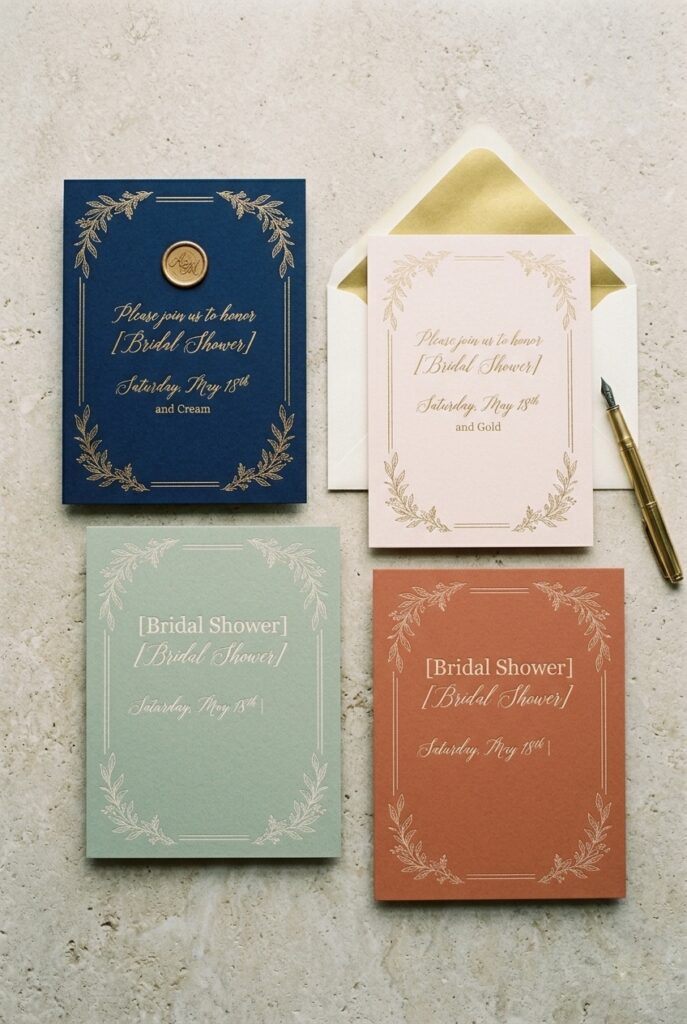
The invitations that feel expensive use one primary color (blush, sage, navy, cream, gold) and white or cream as a secondary.
They don’t mix five colors, add rainbow gradients, or use every element available in Canva.
One color says “intentional.” Five colors say “I wasn’t sure what I was doing.”
This applies to digital invitations and printed ones equally.
If the bride loves blush and gold, your invitation is blush and gold, cream, and black text.
Not blush, gold, sage, coral, and confetti. Restraint is the most expensive-looking design choice you can make.
Price range: Free; this is a design decision, not a cost.
Budget Hack: Limit your Canva palette to three colors maximum. This forces you to be intentional and also reduces printing costs if you’re using custom colors (fewer ink colors = lower unit cost).
7. Skip the Photo; Use Custom Illustration Instead
Here’s the unpopular opinion: most people don’t need a photo of the bride on the invitation.
Engagement ring photos, couple photos, childhood memories—they feel standard now. What actually stands out is a custom illustration or a simple line drawing that captures something about her.
A custom illustration of the bride’s favorite flower, her dog, or something from her story ($50–$150 from Fiverr or Etsy) feels more personal than a generic photo.
It’s also more unique—every other invitation will have photos; yours will have a drawing that took thought.
If you do use a photo, make it unexpected: a candid, non-professional shot of her laughing, not a posed engagement photo. Photos where she actually looks like herself feel more honest.
Price range: $50–$150 for a custom illustration from Fiverr, Etsy, or a local artist. Free if you commission a design-savvy friend.
Where to buy: Fiverr (search “custom illustration for wedding invitation”), Etsy (search “custom bridal shower illustration”), or ask a local artist for a commission.
Budget Hack: Instead of a paid custom illustration, use a simple line-art graphic (available free from Canva or Noun Project) that somehow represents the bride. A line drawing of her favorite plant, her dog, or a hobby. This costs nothing and feels thoughtful without being expensive.
8. Hand-Address the Envelopes (Or Find Someone to Do It)

This is the one detail that separates invitations people keep from ones they don’t.
Hand-addressed envelopes make guests feel seen before they even open them.
If your handwriting is decent, address them yourself.
If not, spend $30–$60 to have them professionally addressed. This seems extravagant. It isn’t.
Guests arrive expecting a beautifully designed invite; they don’t expect their name in real handwriting.
That single detail shifts how they feel about the event before they read a word.
Mass-printed addresses on envelopes feel like a bulk mailing. Handwritten addresses feel personal.
The cost difference is small; the feeling difference is enormous.
Price range: Free (your own handwriting), $30–$60 for professional address calligraphy from Etsy or a local calligrapher.
Where to buy: Etsy (search “envelope addressing calligraphy”), local calligraphers (often listed through your stationery printer or local wedding planning groups).
Budget Hack: Address envelopes yourself with a quality black or gold pen ($5–$10). Spend 2–3 hours addressing 30–50 envelopes. Your time is the investment; the impression is priceless.
9. Send Digital Invitations Only If the Entire Shower is Virtual or Ultra-Casual

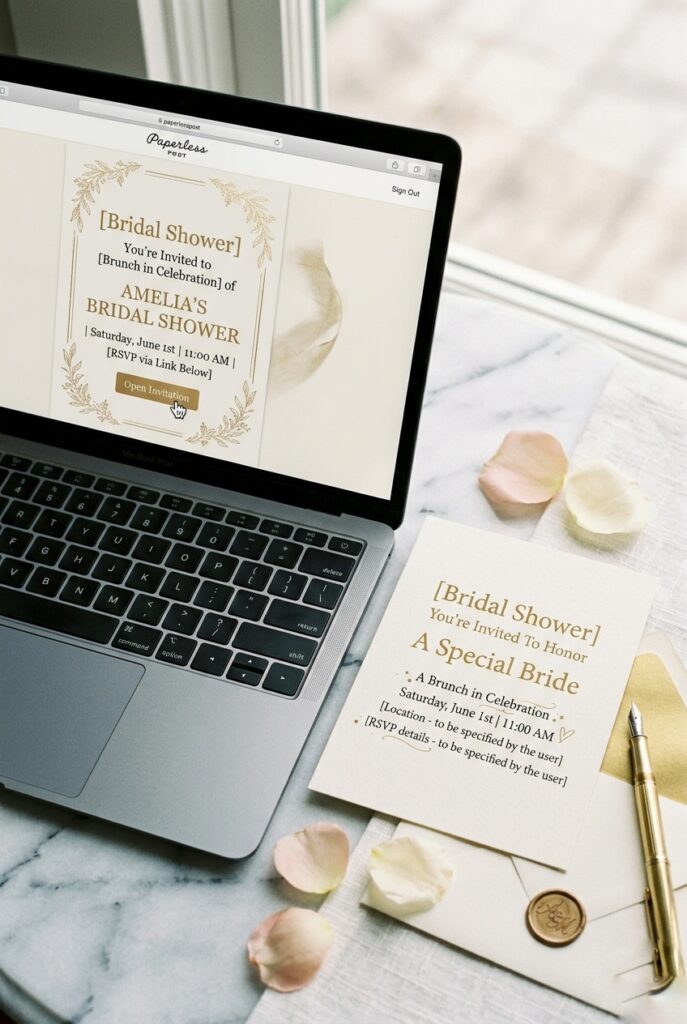
Digital invitations (Evite, Paperless Post, email) are convenient.
They’re not memorable.
If your shower is formal or in-person, printed invitations matter.
If it’s a casual backyard gathering or explicitly virtual, digital is fine.
But here’s the real talk: printed invitations set expectations. They say “we thought about this, we sent this to you specifically, it matters.”
Digital invitations say “I did this quickly on my phone.” One creates anticipation; one creates an obligation.
If you go digital, at least make it beautiful.
Paperless Post invitations have quality designs and a designed feel that Evite lacks.
They’re the only digital option that still feels intentional.
The worst choice is printing a digital invitation design from Evite on cheap paper.
You get none of the convenience benefits and all the cheap-looking results.
Price range: Free to $5 per recipient (Paperless Post interactive digital invitations); $30–$50 for printed digital designs (printing Evite or Canva designs on cardstock).
Where to buy: Evite (free), Paperless Post ($1–$5 per interactive invite), or print any digital design on your own cardstock.
Budget Hack: If you’re printing digital designs, skip the printing and just send digital. If you’re sending printed, invest in real stationery. Don’t hybrid it.
10. Include a Line That Makes Guests Feel Like Insiders
Add one sentence that gives context about the bride and makes guests feel like they’re part of something intentional.
“This is a surprise—don’t tell her!” or “Emma is finally doing this, and we’re all so happy” or “We’re celebrating six months of wedding planning, so bring your best stories.”
This sentence does the work of creating a feeling.
It tells guests they’re not just filling a room; they’re part of something that matters to someone they care about.
Price range: Free; it’s one sentence of copy.
11. Forget Photo Insert Cards; Use a Custom Wax Seal Instead

If you’re doing something special with the envelope, use a personalized wax seal instead of a printed photo insert card.
A simple wax seal with the bride’s initials, a monogram, or a symbol that matters to her ($20–$40 online for a custom seal, sealing wax $10–$15 for a set) changes the whole unboxing experience.
When someone opens the envelope and sees a sealed, wax-sealed invitation, they pause. It feels intentional.
It feels handmade. It feels like something that took effort.
Printed photo inserts are expected now and get tossed. A wax seal is unexpected and remembered.
Price range: $20–$50 for custom wax seal creation, $15–$25 for quality sealing wax and supplies.
Where to buy: Etsy (search “custom wax seal monogram”), Amazon (wax and seal sets, $15–$30), or use a laser engraver at a local maker space to DIY a seal from wood or acrylic.
Budget Hack: Use a simple geometric wax seal design instead of a custom monogram.
A circle, diamond, or herringbone pattern ($10–$15 online) paired with quality sealing wax ($5–$10) costs half the price of a full monogram seal and still creates impact.
12. Budget Hack: DIY Envelope Liners for Surprise Impact
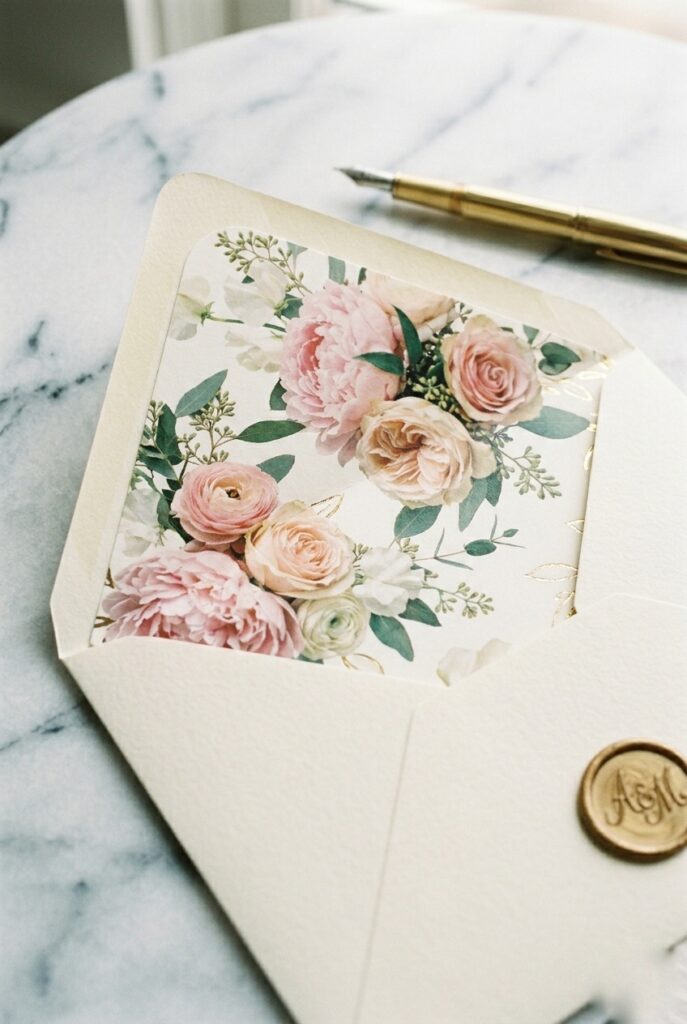
Print custom paper or watercolor designs on cardstock, cut them to fit your envelopes, and glue them inside.
This costs $5–$15 for 30 envelopes and creates a detail that guests see when they open the invitation. It’s unexpected, it’s personal, and it’s a detail almost no one else is doing.
The bride’s favorite colors, a pattern that matches the shower theme, or even a custom print with a meaningful quote inside the envelope—this is where guests feel the intention.
Price range: $5–$15 for printing custom liners, $2–$5 for envelope-friendly glue stick.
Where to buy: Print custom designs at home or through Minted/Artifact Uprising ($10–$20 per 50 envelopes), or find printable envelope liner templates free on Etsy and print at home.
Budget Hack: Use Canva to design simple envelope liners (a pattern, a color wash, or a quote), print them on cardstock at home ($10–$15 for a ream), cut them yourself with a ruler and paper cutter, and glue them in.
Total cost: under $20 for 30 envelopes. Time investment: an afternoon. Impact: guests will talk about it.
Budget Hack: Skip expensive foil printing on the envelope front.
Instead, invest in nice cardstock, simple typography, hand-addressed names, and a custom envelope liner.
You’ll spend $30–$40 per 50 invitations instead of $60–$80, and guests will think your version is more expensive because it feels intentional, not because it’s decorated.
Decision Filter
If you have under 30 guests, invest in quality cardstock and hand-addressed envelopes.
You’ll spend $80–$120 total and create something memorable.
If you have 75+ guests, focus on the wording (make it honest and specific), choose one color palette, upgrade the cardstock weight, and hand-address as many envelopes as you can or hire someone for half.
If budget is under $50 total, use Canva’s free templates but spend 20 minutes rewriting every word to be specific to the bride—your time is the upgrade, not the design.
If the shower is virtual or casual, a beautiful digital invitation from Paperless Post works; don’t print it on cheap paper trying to make it fancy.
The Real Reason
Here’s what nobody talks about: invitations fail because most people treat them as a design problem when they’re actually a personal communication problem.
You’re not trying to make something pretty; you’re trying to make something that makes the bride feel seen and makes guests feel like they’re part of something that matters.
The insider secret nobody mentions: professional wedding planners don’t spend their money on elaborate invitation designs.
They spend it on paper quality and wording.
A $100 invitation budget on custom illustration or foil printing looks like it cost $100. A $100 budget on 110 lb cardstock, real calligraphy, envelope liners, and wax seals looks like it cost $300. Paper and thought always outspend decoration.
One more thing vendors don’t tell you: guests keep invitations that feel handmade or intentional, not ones that feel professionally designed.
A printed invitation with hand-lettered names, a custom wax seal, and honest wording beats a design-heavy template every single time.
Handmade doesn’t mean amateur; it means someone cared enough to invest time, not just money.
Mistakes to Avoid
Mistake 1: Treating the invitation like a design brief instead of a personal message. Competitors tell you to focus on templates and visual polish. Stop. The invitation is your chance to tell guests who the bride actually is.
A beautiful template with generic wording is forgettable. Honest wording with simple design is memorable.
Mistake 2: Printing on cheap cardstock to save $30, then spending $60 on elaborate foil work. You’re literally backwards.
You paid $90 total for something that feels thin and desperate.
Spend $50 on heavyweight cardstock and simple text and it feels expensive.
Mistake 3: Assuming guests understand what you mean if you’re vague. “Please bring a gift” doesn’t tell anyone what you want.
“Please bring something from her registry or something fun for her new apartment” does.
“Casual dress” doesn’t confirm whether shorts are okay; “garden party, come comfortable” does.
Vague creates anxiety. Specific creates clarity and anticipation.
Mistake 4: Mixing digital and printed like they’re equivalent. If you print a digital Evite design on cardstock, you get the worst of both worlds—it looks like you printed something you could have just sent email.
A printed invitation is a physical object; a digital one is convenient. Pick one and commit.
Digital should be easy and fast. Printed should be intentional and substantial.
FAQ
What’s the difference between a good invitation and one that gets thrown away?
A good invitation feels personal (specific wording about the bride, not generic puns).
One that gets thrown away feels like a task someone completed (template text, no customization).
Weight to the paper, handwritten elements, and one honest sentence about who the bride is separate keepers from recycling.
Can I use a template if I customize the wording?
Yes. A Canva template with completely rewritten copy and upgraded cardstock printing is better than a generic template.
The wording carries more weight than the design. Spend your energy on making the copy sound like you, not on making the design elaborate.
How far in advance should I send invitations?
Mail printed invitations 4–6 weeks before the shower. If you’re hand-addressing envelopes, start 6 weeks out.
Digital invitations can go out 3 weeks ahead.
Early invitations give guests time to plan, buy a gift, and anticipate the event. Last-minute feels like an afterthought.
Should I match the invitation design to the shower theme?
Match the tone and color palette, not the literal theme. If the shower is a garden party, your invitation doesn’t need flowers everywhere.
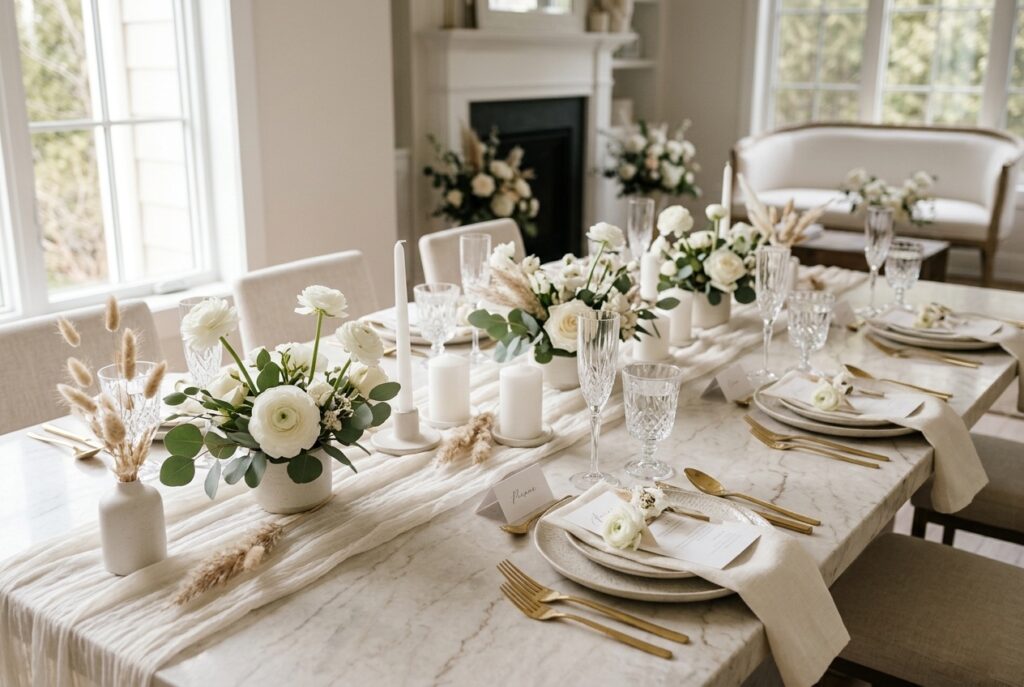
Sage green and cream with a simple layout communicates “garden party” without being heavy-handed. Let the wording tell the story; let the design support it quietly.
Budget Table
| Approach | Cost Per 50 Invitations | Time Investment | Impression |
|---|---|---|---|
| Canva free templates, home printing, no upgrades | $15–$25 | 2–3 hours | Forgettable; looks DIY |
| Canva template, upgraded cardstock, home printing | $40–$50 | 3–4 hours | Better; feels intentional |
| Canva template, upgraded cardstock, hand-addressed envelopes | $60–$80 | 6–8 hours | Strong; feels personal |
| Custom design, 110 lb cardstock, hand-lettered names, wax seals | $90–$120 | 8–10 hours | Exceptional; feels premium |
| Professional stationery (Minted, Artifact Uprising), standard service | $100–$150 | 1 week turnaround | Beautiful; professional |
| Professional stationery with calligraphy addressing | $150–$200 | 2 week turnaround | Luxury; feels expensive |
Closing Paragraph
Your invitation isn’t the prelude to the shower.
It is the shower’s beginning.
When guests open an envelope and feel thick cardstock, see handwriting with their name, and read something true about the bride, they’ve already decided the day matters.
You’re not trying to impress people with design—you’re trying to make them feel like they matter.
The invitations that stay on kitchen counters aren’t the fanciest ones; they’re the ones that made someone feel seen.
Before you worry about fonts or colors, ask yourself: what’s one true thing about this bride that only people who love her would know? Start there. The design follows.
Next step: Choose one upgrade—cardstock weight, hand-addressed envelopes, or honest rewritten wording—and commit to it. Everything else amplifies that single choice. You don’t need all of these ideas; you need one executed well.