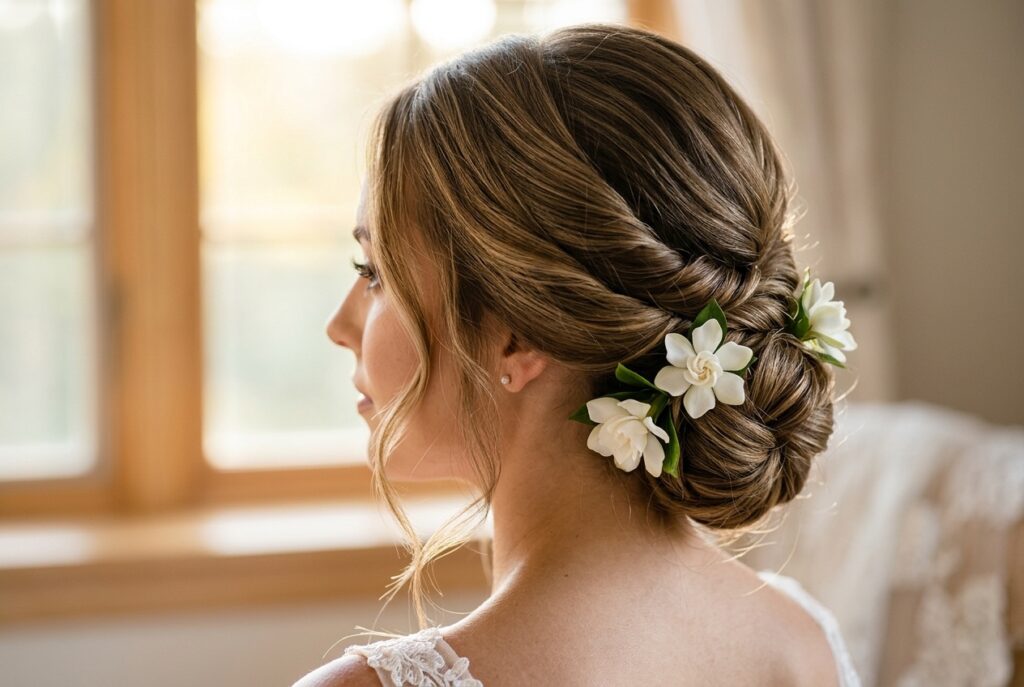
Most brides pick satin heels because satin looks like the obvious bridal choice — and then spend their wedding day in a shoe that photographs flat, scuffs on the ceremony carpet, and leaves them limping through the first dance.
Satin is not one material. It is a construction, a weave structure, and a quality spectrum that ranges from dull polyester to liquid-light silk — and the difference shows at 50 feet and in every single photo.
This guide tells you exactly which satin heels are worth buying, what to avoid, and how to match your heel to your dress so the whole look holds together.
1. Understand the Satin Quality Tiers Before You Buy Anything
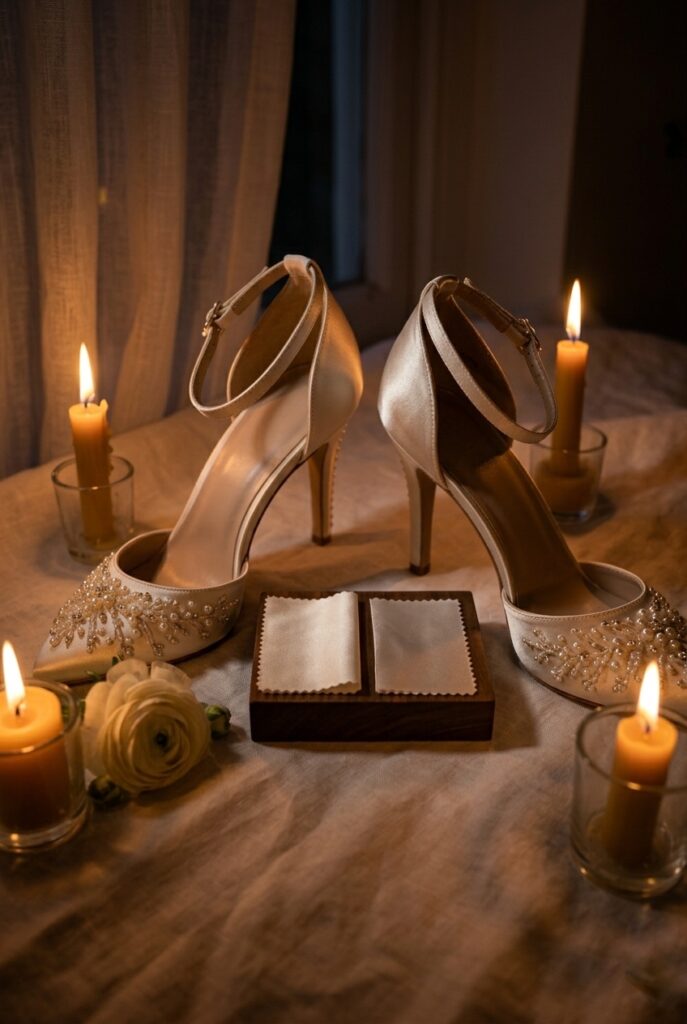
Satin is a weave, not a fiber — which means you can weave polyester into satin and call it bridal.
The three levels you will actually encounter: polyester satin (shiny, stiff, wrinkles at the toe and heel counter after two hours), satin-faced microfiber (the mid-tier — smooth, forgiving, holds shape longer), and silk duchess satin (dense, heavy, has a cool drape and a matte-luminous finish that reads as luxury on camera).
If the brand does not specify the fiber content, it is polyester. Bella Belle, Freya Rose, and Emmy London all use silk-faced or silk satin uppers.
Price range: polyester $45–$90, microfiber $95–$180, silk satin $220–$550+. Buy at Nordstrom, Bella Belle, or directly from bridal boutiques.
Taste layer: Mass-market satin heels sold at discount wedding retailers are almost universally polyester-backed. They look fine on a shelf but photograph as a flat, dead white — no depth, no light play.
Under reception uplighting or a camera flash, they turn greenish-gray.
Switch to a satin-faced microfiber minimum and the exact same silhouette photographs as intentional and considered.
2. Match the Satin Finish to Your Dress Fabric — Not Just the Color
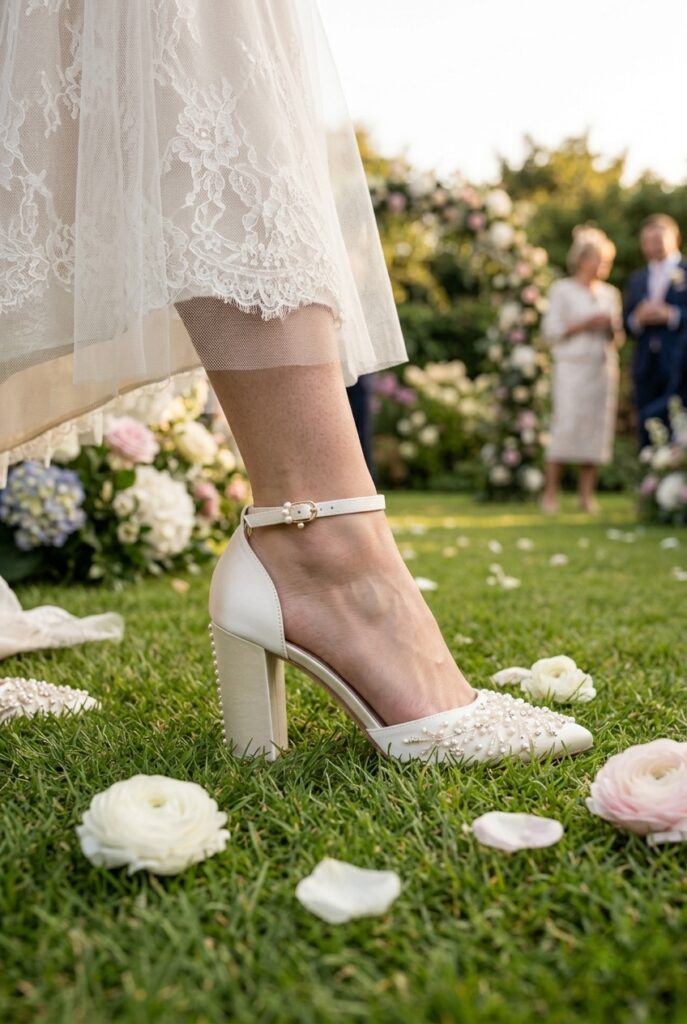
Here is the rule no competitor tells you: the sheen level of your shoe must match the sheen level of your dress.
A matte crepe gown with a high-gloss satin pump creates a visual disconnect that every photographer will notice even if you never do.
Duchess satin dress → duchess satin heel, same finish family. Matte mikado or crepe gown → a matte-finished satin or a brushed satin with low reflectivity.
High-shine charmeuse dress → a glossy satin or metallic satin heel pulls the look together. When the finishes mismatch, your shoes look like an afterthought even if they cost $400.
Sheen-matching satin heels: $120–$400. Shop Bella Belle, Nordstrom, or BHLDN.
Only do this if your dress hem will be visible for any portion of the day. Floor-length ball gowns rarely show the shoe — spend your shoe budget elsewhere if yours won’t.
3. Choose Your Heel Architecture for the Surface You’re Walking On
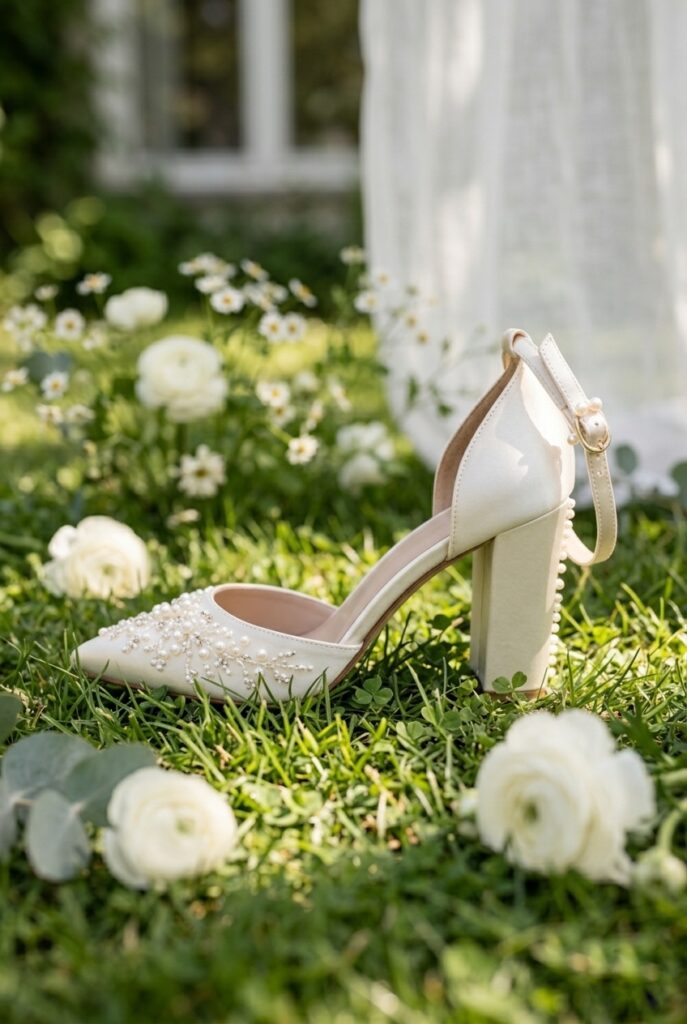
Stiletto heels on soft grass or uneven pavers are not a style choice — they’re a liability.
A 3.5-inch stiletto sinks 1.5 inches into soft ground after six seconds.
Block heels distribute your weight across a wider surface and are the correct choice for outdoor ceremonies, vineyard venues, barn floors, and cobblestone.
For church marble or ballroom hardwood, a slim heel is perfectly stable. Skip this if your venue is entirely indoor and hard-floored — you have full freedom.
Satin block heels: $65–$220. Satin stilettos: $75–$350. Shop Nordstrom, Amazon (Badgley Mischka line), or Bella Belle.
Budget Hack #1: After idea 3 — search “ivory satin block heel wedding” on Amazon filtered to $65–$110. Badgley Mischka sells a line of genuine satin-upper heels through Amazon at $89–$115 that retail for $150–$200 in bridal boutiques. Same manufacturer, same quality tier, no markup. Filter for “sold by Badgley Mischka” specifically to avoid third-party polyester knockoffs using the same search terms.
4. The Dyeing Strategy Most Brides Completely Ignore
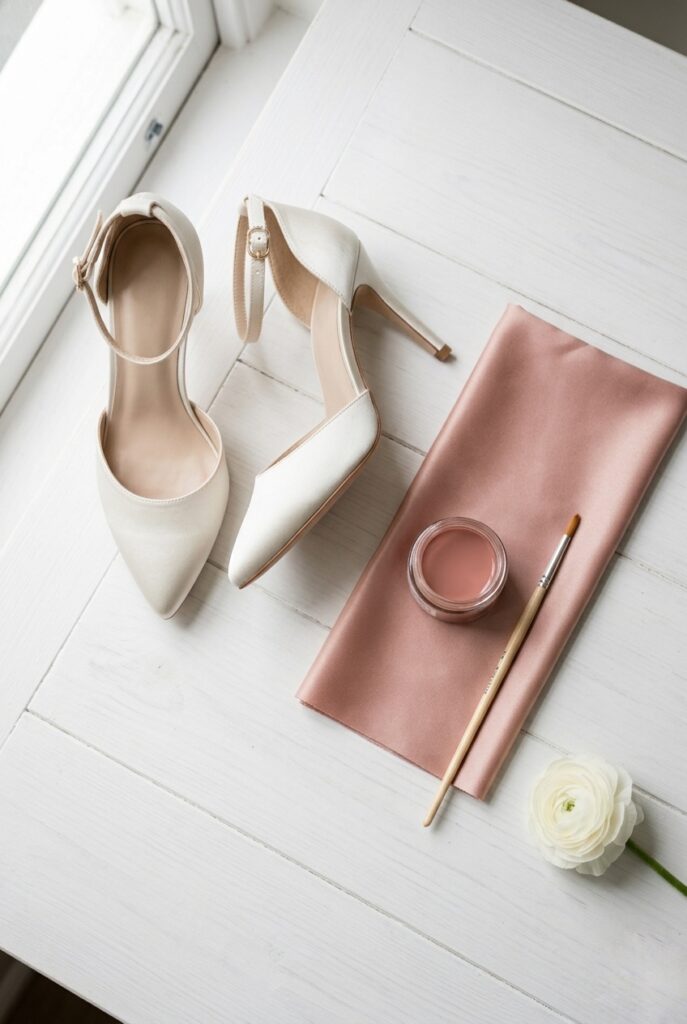
[COMPETITOR GAP IDEA #1] This is the strategy almost no bridal content covers: buying an ivory satin heel and dyeing it to a custom color opens up a $400 market for about $80 total.
Ivory and white satin shoes accept fabric dye exceptionally well because the base is pale and the weave is open.
A shoe dyer — most dry cleaners offer this, or search “shoe dyer near me” on Yelp — can match the shoe precisely to your blush, dusty blue, champagne, or sage bridesmaid palette.
The result is a custom-colored satin heel that exactly matches your scheme for a fraction of what specialty-dyed designer heels cost.
You can also check The Knot’s bridal shoe guide for color-matching inspiration before you commit.
Base ivory satin heel for dyeing: $45–$90 on Amazon or Nordstrom Rack. Professional dyeing service: $30–$50.
Only do this with natural-fiber or microfiber satin uppers — polyester does not absorb dye evenly and will mottle.
5. Heel Height Relative to Your Dress Hem Is Non-Negotiable
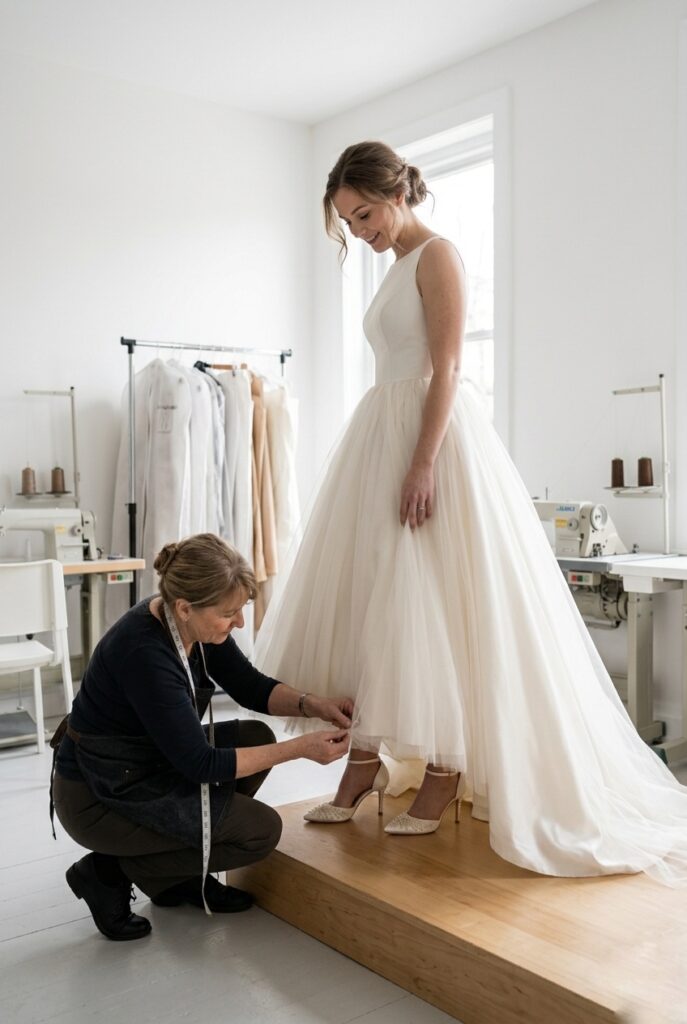
Your dress hem is altered to your heel height. This is not reversible without another alteration.
Bring your exact wedding shoes — not approximations, not the same height in a different shoe — to every single fitting starting from the first.
If you buy shoes after your final fitting, the hem will hit wrong.
A half-inch difference shows in every full-length photo. Brides who change heels the week before the wedding always regret it.
This point comes up in every fitting room conversation I’ve ever witnessed. It seems obvious until it’s too late.
6. Pointed Toe vs. Round Toe and What Your Dress Silhouette Actually Calls For
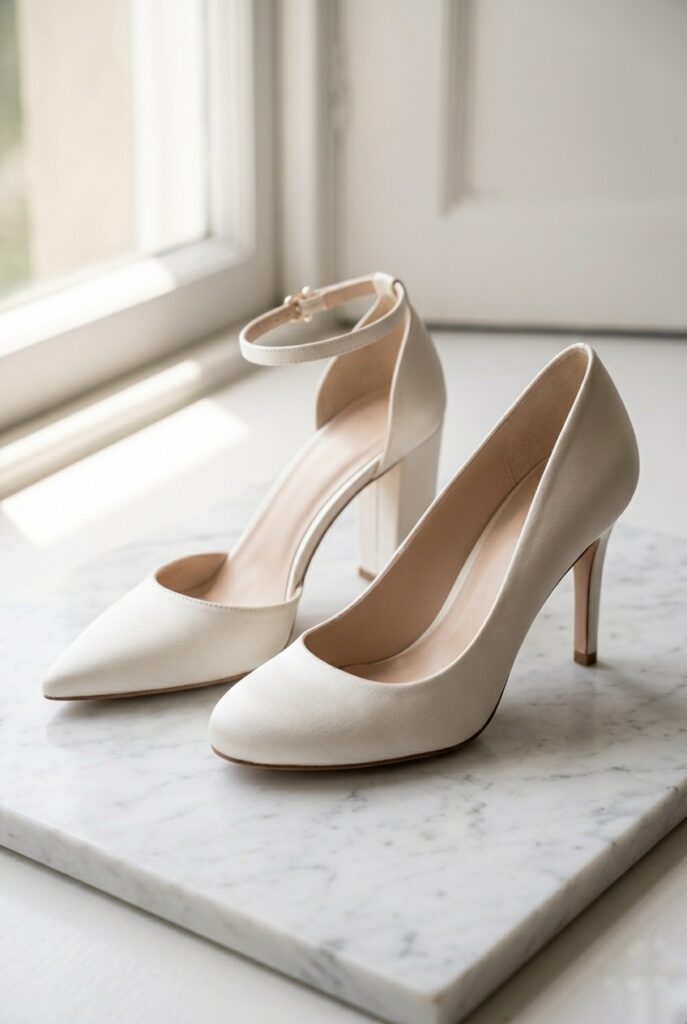
Pointed toes elongate the leg, photograph well under a high hemline, and match modern minimalist or structured gown silhouettes — think tailored column dresses and sleek fit-and-flare cuts.
Round toes read softer and suit vintage, romantic, and A-line styles.
Almond toes split the difference and flatter nearly everything.
The mistake brides make is choosing based on what looks good in the box, not on the foot, under the hem.
The silhouette of the toe extends the visual line of the leg in photos.
Make your choice while wearing your dress.
Pointed satin heels: $75–$280 at Nordstrom, Nine West, or Badgley Mischka. Round toe: $60–$200 at David’s Bridal or Amazon.
Budget Hack #2: Nordstrom Rack carries first-quality, full satin-upper bridal heels at 40–60% below retail during their Clear the Rack sale events (check NordstromRack.com monthly). Many are from the same Vince Camuto and Nina lines that appear in bridal boutiques at full price. Search “white satin heel” and filter to your size — you can routinely find a $170 retail heel for $65–$75. Act fast on your size because inventory is genuinely limited.
7. Break-In Protocol That Actually Prevents Blisters
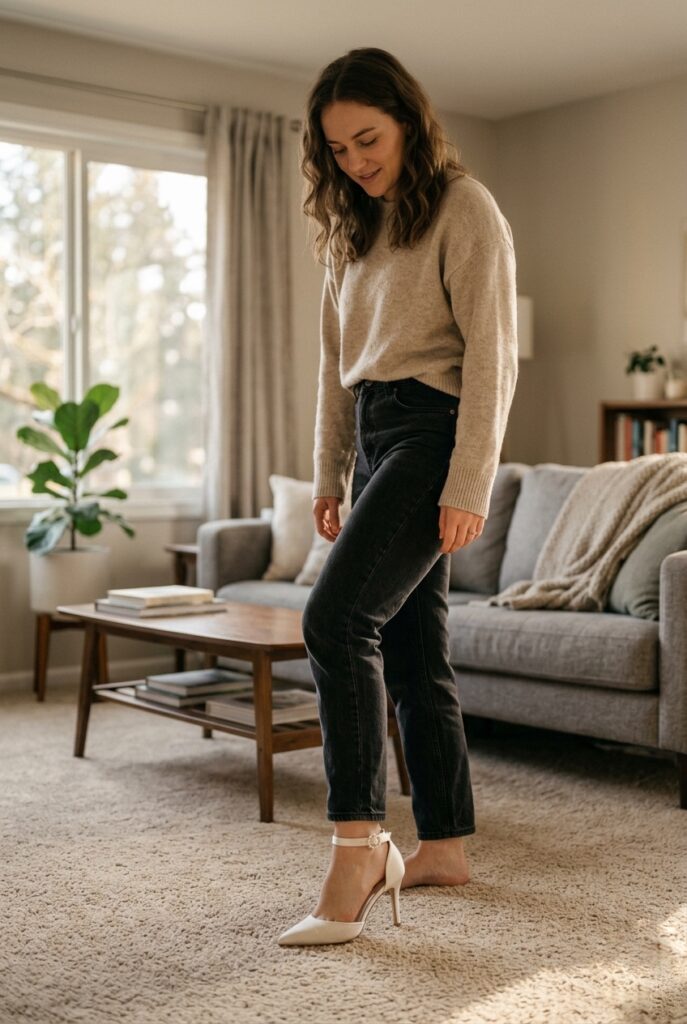
Satin heels need four to six wear sessions before your wedding to soften the toe box and heel counter.
Each session: twenty minutes minimum, on the surface that most closely mimics your venue floor (hardwood at home beats carpet for ballroom prep).
Add moleskin patches to the heel cup and the inside toe seam before session one — not after blisters start.
The moleskin compresses slightly during break-in and becomes invisible by wedding day.
Gel ball-of-foot inserts from Dr. Scholl’s ($9 on Amazon) drop into any satin heel without altering fit.
Moleskin: $7 at CVS. Ball-of-foot gel inserts: $9 on Amazon.
These are the two things that separate brides who make it to midnight from brides who change into flip-flops at 8pm.
8. The Embellishment Question — What to Add and What to Skip
Less embellishment reads as more intentional on a satin shoe. A single crystal buckle at the ankle strap is refined.
A fully encrusted satin pump competes with a beaded dress and creates visual noise.
The rule: only one shoe detail should draw the eye — either the heel shape, the toe detail, or the strap hardware. Never all three simultaneously.
Taste layer: Heavily rhinestoned satin pumps from wedding supply chain stores are the worst version of this idea.
The stones are glued, not set, and they begin to fall off by hour three from friction and sweat.
Within your first two dances, you will have gaps in the crystal pattern that photograph as damage.
Switch to a shoe where embellishment is stitched or cast into the hardware — Badgley Mischka and Bella Belle both use set crystals.
Embellished satin heels with quality hardware: $95–$320. Shop Nordstrom, Bella Belle, or Zappos for certified authentic listings.
9. The Second Shoe Strategy for the Reception
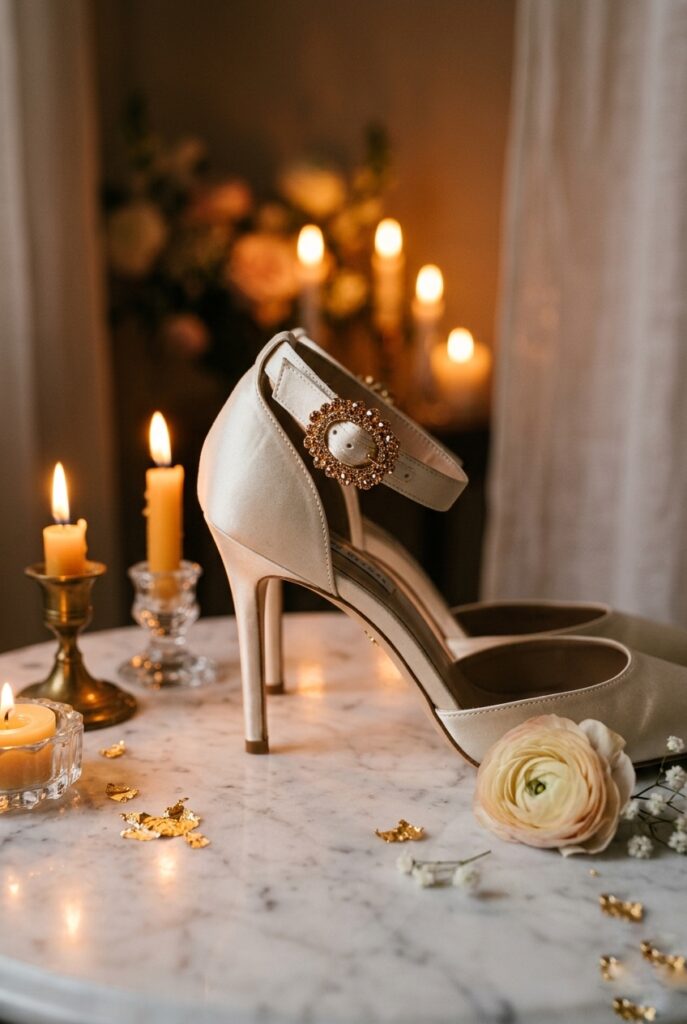
Plan two shoes from the beginning: a ceremony heel for the aisle and formal photos, and a lower satin kitten heel or satin mule for the reception.
This is not a compromise — it is a logistical decision. A 3.5-inch satin heel worn for five hours of dancing destroys both the shoe and your feet.
A matched satin kitten heel in the same ivory keeps the look coherent in photos without the physical cost.
Bag the ceremony heel in a fabric pouch and hand it to your MOH before the reception entrance.
Satin kitten heels for reception: $35–$85 on Amazon or DSW. Melissa Sweet at David’s Bridal makes excellent matched-pair options for under $120 for both.
Budget Hack #3: For your reception shoe specifically, search Etsy for “ivory satin kitten heel” from UK and Australian sellers — international sellers on Etsy routinely list quality satin-upper kitten heels at $28–$55 with free or low-cost shipping to the US that bridal retailers mark up to $90–$120. Look for seller ratings above 4.8 stars and listings that specify “satin upper” not “satin-look fabric” in the material description. This one distinction separates a shoe that photographs as expensive from one that does not.
10. Custom Monogram and Sole Personalization — The Detail Only You and Your Photographer See
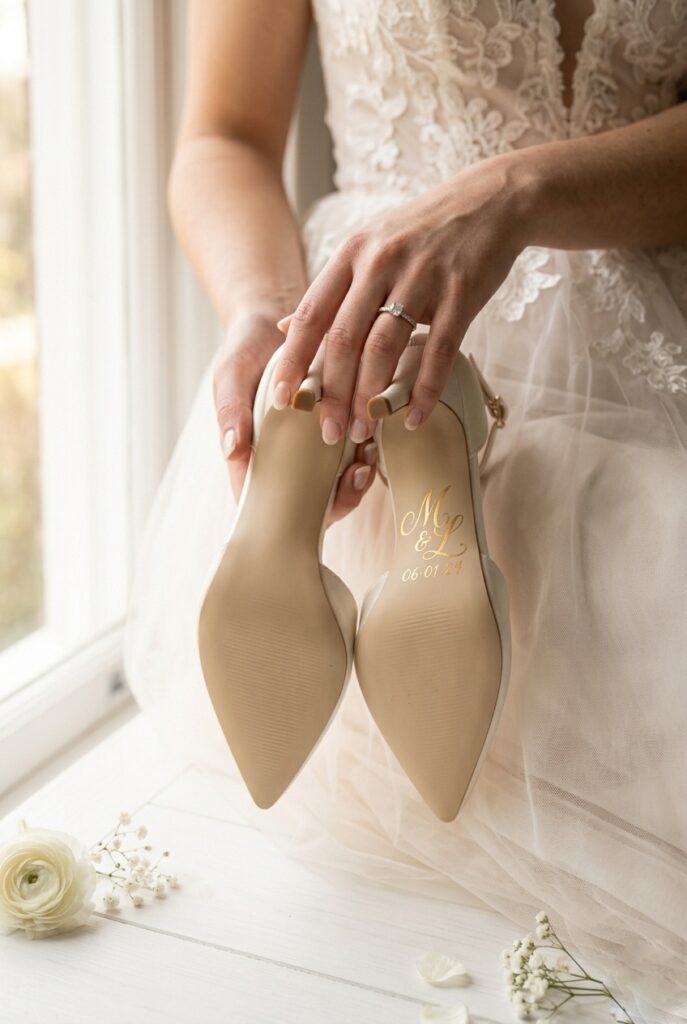
[COMPETITOR GAP IDEA #2] No competitor content mentions this: having your wedding date or initials painted onto the sole of your satin heels is a detail that costs $15–$25 from an Etsy calligraphy artist and generates a guaranteed detail shot your photographer will ask for.
Most photographers actively look for intimate detail moments — your shoes held sole-up is a shot that appears in nearly every editorial portfolio.
A blank white sole misses that moment.
Metallic gold paint markers from Posca or Sharpie work on smooth satin-sole heels and do not affect wearability since the sole paint does not contact skin.
This is a 10-minute addition that earns a photograph you will have forever.
Posca metallic gold paint marker: $7 on Amazon. Etsy sole personalization services: $15–$30.
Decision Filter
If your ceremony is outdoors on grass, gravel, or uneven pavers: block heel only, no exceptions regardless of how the stiletto looks in the box.
If your dress hem will be visible for more than half the day, spend at least $120 on a silk-faced or satin microfiber upper — the fabric reads differently in photos at every price tier below that.
If your budget is under $100 total, skip heavy embellishment entirely, buy a clean pointed-toe satin pump in that range, and put the saved $150 toward moleskin, gel inserts, and a second reception shoe.
The Real Reason
The real reason most brides are unhappy with their wedding shoes in photos is not heel height, not brand, not color — it is fabric quality under artificial light. Satin reflects whatever light hits it.
A polyester satin amplifies the cool-white cast of LED reception lighting and photographs with a slight blue-gray tinge.
A silk or microfiber satin absorbs and softens that same light and photographs warm.
Here is the opinion no one wants to give: the bridal shoe industry prices heavily on embellishment — crystals, bows, pearl details — and almost nothing on upper quality.
A $280 heavily rhinestoned polyester pump is a worse shoe than a $140 clean silk satin pump.
You are paying for glue-on stones, not for fabric.
Here is what your wedding photographer knows but will never say to you before your wedding: the detail shot of your shoes is almost always the shot that reveals cheap construction first.
In close macro photography, polyester satin shows a visible woven texture and surface fuzz.
Silk satin shows liquid smoothness and depth. Photographers can tell within thirty seconds of looking at a gallery which shoes were quality.
This information comes too late for most brides. It does not have to come too late for you.
Mistakes to Avoid
Mistake 1: Buying satin heels after your final dress fitting. Every competitor article tells you to “wear your wedding shoes to fittings.”
None tells you the consequence of not doing it: your hem is permanently cut to the wrong length and the alteration to fix it costs $75–$200.
Buy your exact shoes before your first fitting appointment.
Mistake 2: Spending $150 on embellishment on a $60 shoe. This is the most common $60 wasted in bridal footwear.
Rhinestone glue fails under heat and friction — the conditions of every wedding reception. You will find loose or missing stones in your detail photos.
A $120 clean pump with no embellishment photographs better at every hour of the night.
Mistake 3: Not testing the shoe on the actual venue surface before the wedding day. Most brides break in satin heels on carpet at home and discover on the day that their venue has polished marble or outdoor pavers they did not account for.
Satin-soled shoes on marble are slippery. Request a rubber sole tap or Topy from a cobbler ($15) applied to the ball of the foot before the wedding.
No one knows until they fall.
Mistake 4: Buying matching satin heels for your bridesmaids in the same polyester as your own. If your shoes are visible in group ceremony photos, twelve mismatched shades of polyester satin under different bodies of light will destroy the visual cohesion of the shot.
Either commit to a quality matching fabric for everyone or choose a non-fabric shoe for the group.
FAQ
What is the best heel height for a wedding?
Two to two-and-a-half inches suits most brides for all-day wearability across ceremony, photos, and dancing.
Heights above three inches are appropriate for shorter ceremonies with limited standing time or for brides who wear heels regularly.
Your dress hem alteration must reflect whatever height you choose before your first fitting.
Can I wear white satin heels with an ivory dress?
White and ivory are different tones and they clash in photographs when placed close together.
Pure white heels with an ivory gown read as mismatched in every detail photo.
Choose ivory, champagne, or blush to match your gown’s warm undertone rather than reaching for stark white.
How do I keep satin heels clean on my wedding day?
Apply a fabric protector spray — Scotchgard Fabric Protector or Kiwi Satin Protector — to clean satin heels 48 hours before the wedding and allow full drying.
This creates a light repellent barrier against grass, carpet fiber, and foot sweat staining.
Carry a white eraser in your emergency kit for scuffs that appear during the day.
Are satin heels comfortable for all-day wear?
Satin upper material does not determine comfort — construction does.
Look for shoes with a padded insole, a stable heel counter, and a reinforced shank. Add gel ball-of-foot inserts regardless of brand.
Plan a lower heel or flat for the reception if you are wearing anything above 2.5 inches for the ceremony.
Budget Table
| Shoe Type | Price Range | Where to Buy | Best For |
|---|---|---|---|
| Polyester satin pump (ceremony only) | $45–$90 | Amazon, David’s Bridal | Floor-length gowns where shoe won’t be seen |
| Satin microfiber pump | $95–$180 | Nordstrom, Zappos | Most brides, all venues |
| Silk duchess satin heel | $220–$550 | Bella Belle, Freya Rose, boutiques | Visible hemlines, detail photography |
| Satin block heel | $65–$220 | Nordstrom, Badgley Mischka via Amazon | Outdoor venues, grass, cobblestone |
| Satin kitten heel (reception) | $35–$85 | Amazon, DSW, Etsy | Second shoe for dancing |
| Embellished satin stiletto | $95–$320 | Nordstrom, Bella Belle | Indoor ballroom, low-movement ceremony |
| Custom-dyed satin heel | $75–$140 total | Amazon base + local dyer | Custom color matching |
Your Satin Heel Choice Comes Down to One Thing
Fabric quality is the decision. Everything else — heel height, toe shape, embellishment level — is secondary and adjustable.
Choose the highest-quality satin upper your budget allows, bring those shoes to your first fitting, add moleskin before you ever leave the house, and plan a lower second shoe for the reception.
If you are still building your full bridal look, the elegant wedding decor ideas guide will help you make sure your footwear choices land within a cohesive visual story from ceremony arch to exit.
Now go find your shoe — the one that photographs like it cost twice what it did.