
Blue is the most requested wedding color I hear from couples — and the one that most consistently disappoints them when the photos arrive.
Not because they chose the wrong color, but because nobody warned them that blue behaves completely differently under warm venue lighting than it does on a mood board.
This guide tells you what actually happens to blue in a real reception room, which specific shades survive it, and exactly how to build tables that look like the reference photos you saved — not a washed-out version of them.
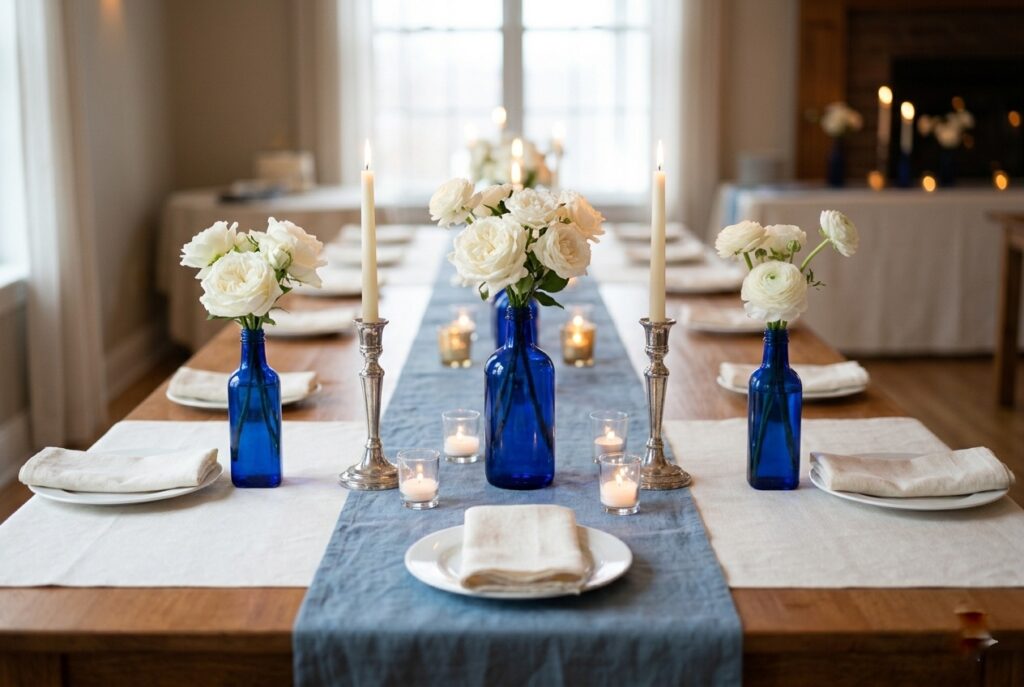
Three cobalt bottles on a white cloth, each holding a single garden rose gone slack in the heat of the room. The blue is the color of old medicine, of a window at four in the afternoon. It holds the light the way glass holds it — from the inside.
The Short Answer
Blue wedding tables fail when the palette is chosen from a screen and never tested under warm amber reception lighting.
Every shade of blue — navy, dusty blue, cornflower, periwinkle, cobalt — shifts significantly under the tungsten and warm LED lighting that most reception venues use as their standard setting.
Cool blues go grey.
Pale blues disappear. The shade that reads as sophisticated slate-blue on a laptop screen can read as washed denim under a chandelier.
The designers who get this right know one thing that the articles don’t say plainly: warm venue lighting needs a blue with enough depth or enough saturation to hold its identity through the color shift.
If you are planning a blue wedding table without having placed your chosen linen under your actual venue’s lights, you are designing blind.
The fix is not complicated. It is just specific — and this article makes it specific.
1. Choose Your Blue for the Venue’s Lighting, Not the Mood Board
This is the decision that determines everything else, and it is the one that competitor guides completely skip.
They show you “dusty blue” and “navy” and “cornflower” as if those are interchangeable style choices. They are not.
They are different color temperatures, and each one responds differently to the amber-to-warm-white light range that 85% of US reception venues operate in.
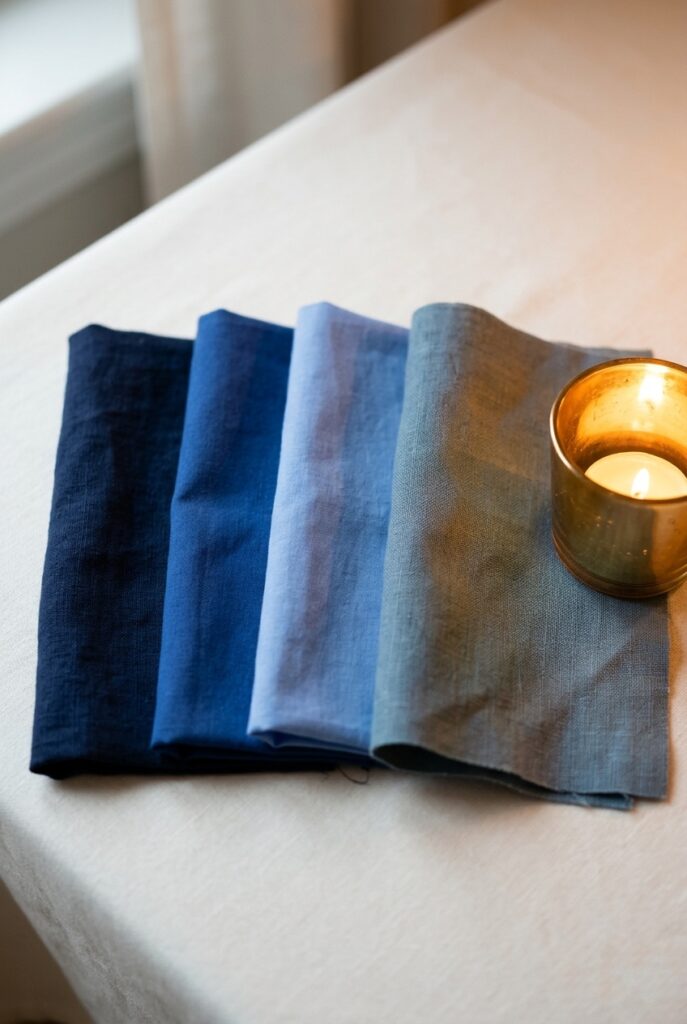
Dusty blue (muted, greyed-out blue-grey) is the most popular shade at the moment — and the most commonly misused.
Under natural daylight or photographer’s strobe, it reads as elegant and muted.
Under warm amber venue lighting, it pulls heavily toward grey and can lose its blue identity entirely.
If your venue uses warm Edison bulbs or amber-tinted uplighting, dusty blue linens will photograph as grey-blue at best and just grey at worst.
Navy (deep, saturated, dark blue) is the most lighting-stable shade in the blue family.
It has enough depth and saturation to maintain its identity under warm amber light.
What you choose is what you get. Navy never goes grey under a chandelier.
Cornflower and periwinkle (medium, slightly purple-toned blue) perform well in venues with cooler or daylight-balanced lighting — garden venues, outdoor tented receptions, venues with abundant windows.
They struggle in dark ballrooms with warm overhead lighting, where they shift toward lavender.
Cobalt (vivid, saturated mid-blue) holds its saturation under most lighting conditions because the intensity is high enough to survive the warm shift without tipping into another color.
Best for evening receptions where you want the blue to be unmistakable.
Before ordering a single piece of blue linen, take a swatch to your venue during setup hours and hold it under the actual lighting.
This is the step that saves you from the grey-table photo surprise.
Request a swatch from your Etsy or linen rental supplier — most charge $2–$5 and ship within a week. $2–$5 for swatches.
Etsy linen sellers, or your venue’s rental linen partner.
2. Cobalt Glass Bottles as the Entire Centerpiece
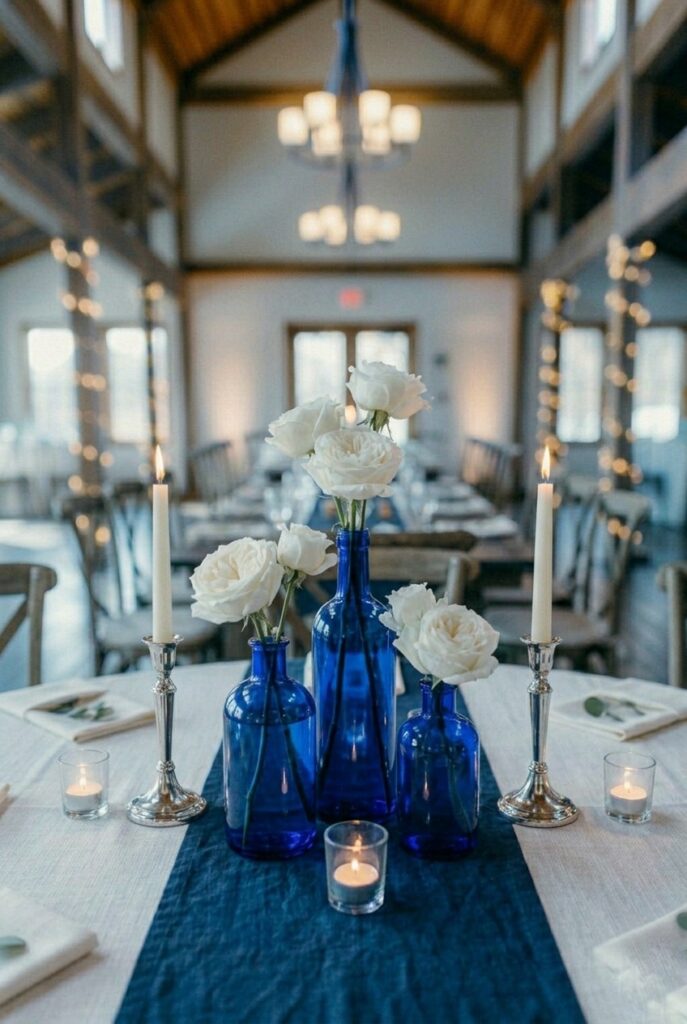
Here is the idea that none of the top results mention, despite it being one of the most photogenic and cost-effective blue table moves available: old cobalt blue glass bottles — medicine bottles, bitters bottles, vintage apothecary jars — sourced from thrift stores and estate sales, used as centerpiece vessels with simple white flowers inside.
The blue is in the glass, not the flowers.
You do not need blue blooms, blue dye, or a florist who specializes in blue arrangements.
You need three bottles and a bunch of white garden roses.
The version that fails: clear glass vases with blue food-dye-tinted water. It looks like a science fair project and the dye stains stems visibly. Instead, let the glass carry the color.
Group three to five cobalt bottles in graduated heights — one tall, one medium, two short — and place two to three stems of white ranunculus, white sweet peas, or white garden roses in each.
The white flowers against cobalt glass creates a high-contrast, deeply photogenic combination that holds its visual identity under every lighting condition because the cobalt glass is backlit by any nearby candle and literally glows.
Thrift stores, Goodwill, and estate sales consistently stock cobalt bottles at $0.50–$3 each. Search “cobalt blue glass bottles” on Facebook Marketplace and eBay for bulk lots at $15–$30 for 12 bottles.
Or buy new from Amazon’s vintage-style bottle section at $18–$28 for a set of six.
$8–$28 per table. Goodwill, Facebook Marketplace, eBay, or Amazon.
3. Navy and White as the Structural Foundation
Every successful blue wedding table has a clear decision about which blue is the base and which elements carry the contrast.
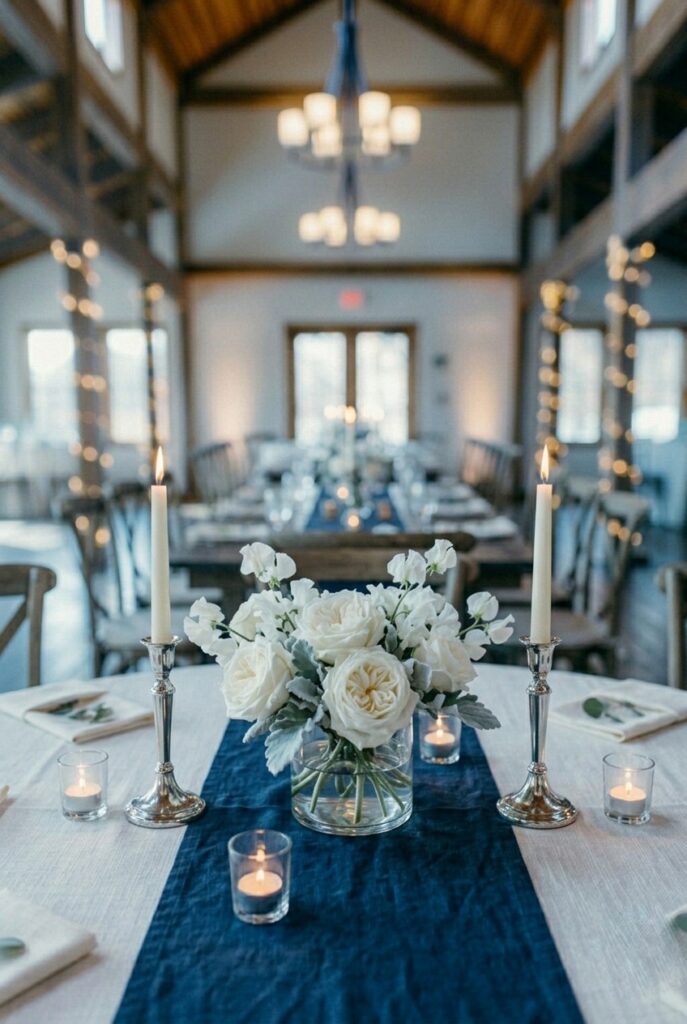
The most photogenic version of a blue wedding table — regardless of the shade of blue you choose — uses blue as the textile foundation and white as the contrast carrier.
Blue runner over ivory tablecloth.
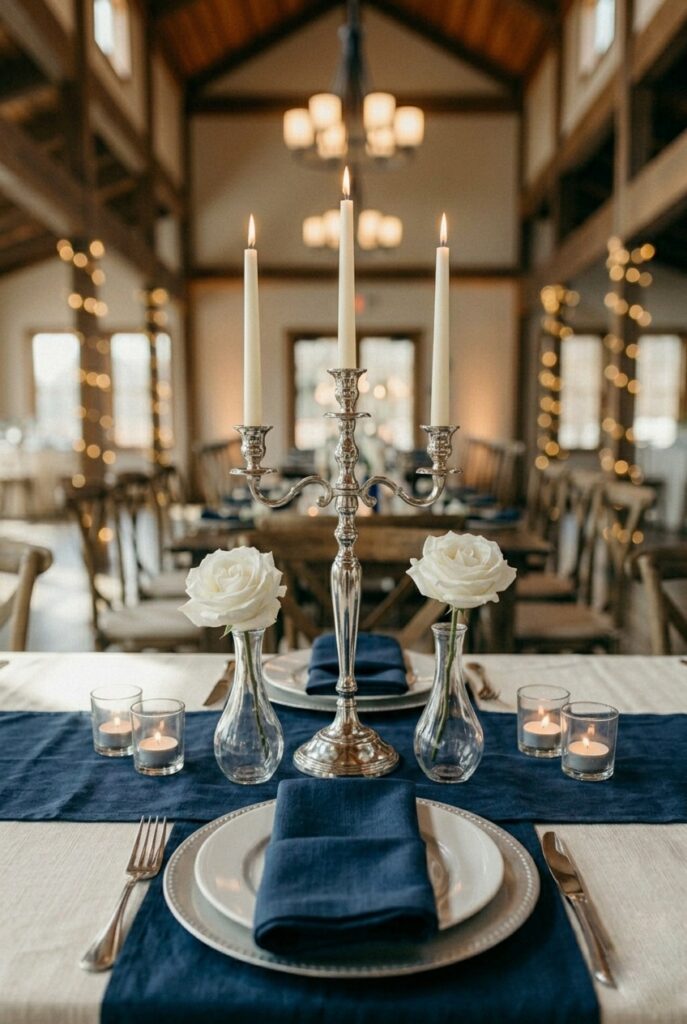
White flowers in blue or clear vessels. White dinner plates on blue or navy chargers. White taper candles in silver holders against a blue ground.
The version that fails: blue on blue on blue — navy runner, blue napkins, blue candles, blue glassware.
It reads as monotone, particularly under warm venue lighting, and the entire table loses dimensionality in photographs because there is nothing for the eye to contrast against.
Every professional tablescape designer works with a dominant color and a clear counterpoint.
For blue, that counterpoint is white or ivory, full stop.
Invest in a navy or dusty blue washed-linen runner from an Etsy seller ($10–$20 per runner) and pair it with the venue’s standard ivory tablecloth underneath.
That one textile decision establishes your entire table’s color structure. Everything else — flowers, candles, napkins — slots into place against it.
For how this contrast principle applies across different reception styles, the elegant wedding table decor ideas guide breaks down the dominant-and-counterpoint rule in detail.
$10–$20 per table for the runner. Etsy washed-linen sellers in navy, dusty blue, or cobalt.
💡 Budget Hack after Idea 3: Navy tablecloths and runners are sold in two parallel markets: the wedding linen market (where they cost $18–$35 each) and the restaurant and catering supply market (where the identical heavyweight cotton fabric costs $6–$12). Companies like WebstaurantStore and restaurant supply stores stock navy banquet tablecloths in standard 60×102-inch and 90-inch round sizes at wholesale pricing, no business account required for small orders. For a 12-table wedding, buying navy runners through a restaurant supply source instead of a wedding linen site saves $84–$276 on a single line item. Search “navy tablecloth 60×102” on WebstaurantStore.com and compare directly against your wedding linen quote before placing any order.
4. Delphiniums — the Right Blue Flower, Sourced the Right Way
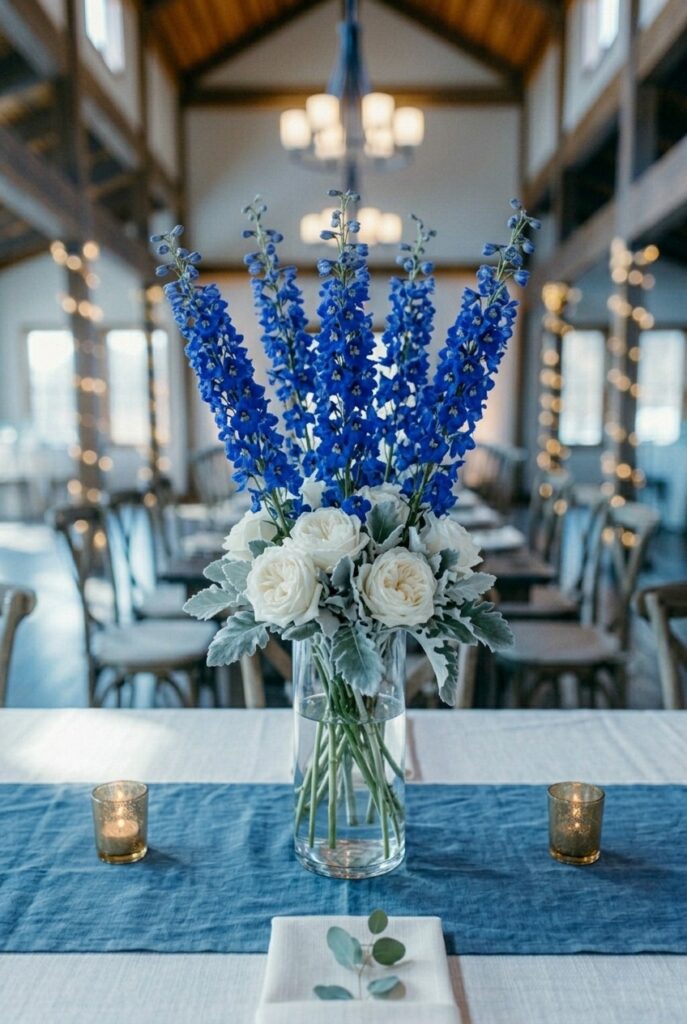
Blue is the rarest color in the natural flower world. Most flowers described as “blue” in wedding industry marketing are actually purple, violet, or lavender when you hold them next to a true blue reference.
The flowers that are genuinely, unambiguously blue are a short list: delphiniums, hydrangeas (in limited varieties), nigella, eryngium (sea holly), and tweedia.
Of these, delphiniums are the most structurally useful for table centerpieces — they have tall vertical spikes that create height without mass, and the saturated true-blue of a delphinium spike is one of the few floral elements that holds its color identity under warm venue lighting rather than shifting toward purple.
Order delphiniums in bulk from FiftyFlowers, which ships seasonal blooms direct from farms.
A 50-stem bunch of blue delphiniums costs $55–$75 and covers 8–10 table arrangements when used as the vertical element alongside shorter white companion flowers.
Alternatively, search “wholesale delphiniums blue” on Afloral for preserved or dried options that are available year-round with no delivery timing pressure.
Only do this if you are comfortable with DIY floral arrangement — delphiniums require conditioning in water for 6–8 hours before arrangement and should not be placed in venue heat more than 2 hours before guests arrive.
$55–$75 per 50-stem bunch.
FiftyFlowers.com or Afloral.com for preserved options.
For a full DIY arrangement approach, the DIY wedding decor ideas guide covers conditioning, timing, and assembly.
5. Blue Hydrangeas as Low Centerpiece Volume
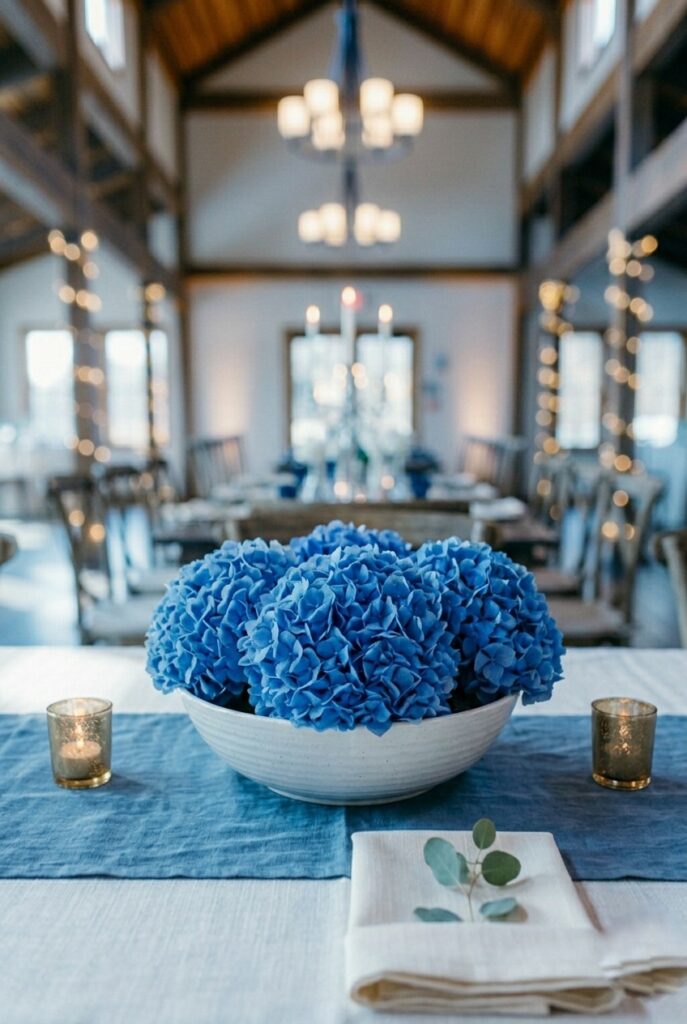
Where delphiniums provide height, blue hydrangeas provide volume.
A single hydrangea head — genuine blue, not purple-tipped — is roughly 6–8 inches in diameter and fills a wide-mouth vase completely on its own.
Three hydrangea heads in a low wide vessel create a lush, full centerpiece for round tables where height is a sightline concern, and they require no arrangement skill beyond placing them in water.
This is the most DIY-accessible blue floral option on this list.
The taste layer issue: grocery store and big-box hydrangeas labeled “blue” are almost always selling purple-toned blue or lavender-blue, not true blue.
True blue hydrangea varieties include Nikko Blue, Endless Summer, and BloomStruck — ask your florist or farm supplier specifically for these.
If the variety name is not on the label, the color is not guaranteed. Buy from a wholesale flower market or order direct from a farm supplier to get genuine blue.
$4–$8 per hydrangea headat a wholesale flower market; $12–$18 per stem at a retail florist.
For guest counts over 80, budget for 3–4 heads per table plus extras for breakage.
The round table wedding decor ideas guide addresses low-centerpiece strategy for rounds specifically.
6. Silver Over Gold — The Metal Pairing Blue Actually Needs
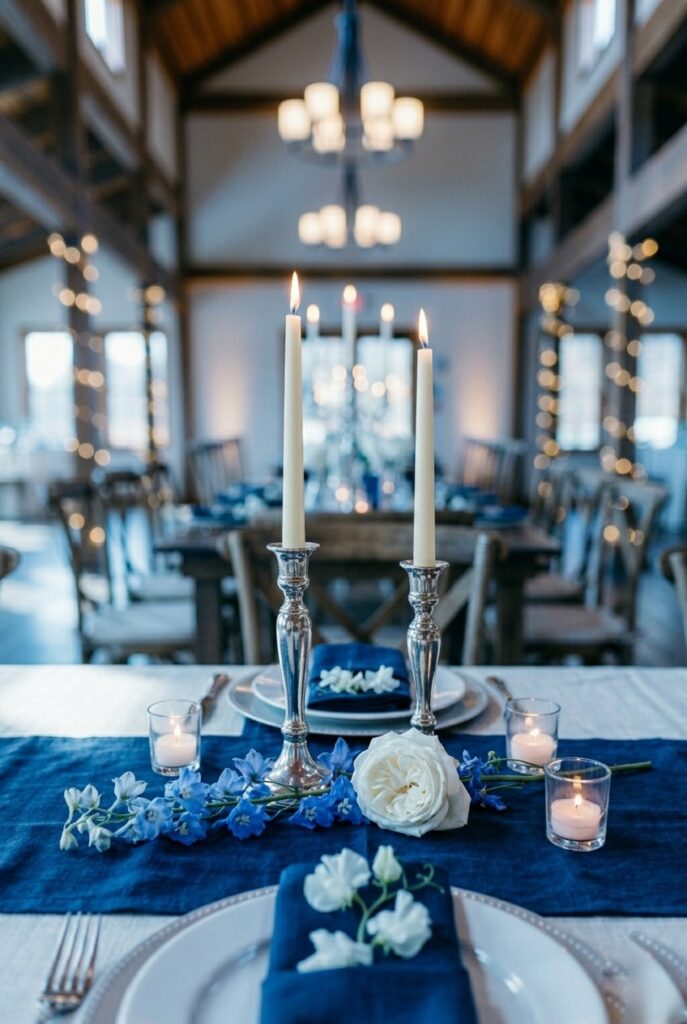
The default recommendation in every blue wedding guide is blue plus gold.
And gold does work with navy — it is a classic nautical palette.
But gold also warms the table’s overall color temperature, and on a blue table that is already fighting warm venue lighting, adding gold metallic accents tips the entire composition toward a tonal conflict where the yellow warmth of gold and the cool tone of blue are visually arguing with each other throughout the evening.
Silver is the metal finish that completes a blue table rather than competing with it.
Silver shares blue’s cool undertone. Under venue lighting, silver candlesticks and silver charger plates reflect the ambient light with a cool sheen that reinforces the palette rather than pulling against it.
The classic test: hold a gold candle holder and a silver candle holder next to your blue runner under your venue’s actual lights.
The silver one will look like it belongs. The gold one will look like an accent from a different table.
This is the decision that makes or breaks a blue table’s coherence in photographs.
Shop silver candlesticks at HomeGoods and TJ Maxx ($6–$14 each) or from Etsy vintage silver sellers at $8–$16 per piece. $12–$30 per table for a silver candle pair.
HomeGoods, TJ Maxx, or Etsy silver candlestick sellers. See how this silver-blue pairing is handled at the reception room scale in the indoor wedding decor ideas guide.
💡 Budget Hack after Idea 6: Silver charger plates are the single most cost-effective way to add metallic cohesion to a blue table at the place setting level. Amazon sells a set of four matte silver charger plates for $14–$18 — under $4.50 per place setting. Event rental companies charge $1.25–$2.50 per charger per event, which means for a 100-guest wedding, renting silver chargers costs $125–$250 versus buying them outright for $350–$450. But here is the math most couples miss: after your wedding, a set of 100 silver charger plates sells for $80–$120 on Facebook Marketplace or wedding resale groups, dropping your net cost to $230–$330 for the bought-and-resold option versus $250 for rentals. For weddings over 80 guests, buying and reselling silver chargers often costs less than renting them.
7. Blue Napkins as the Place-Setting Anchor
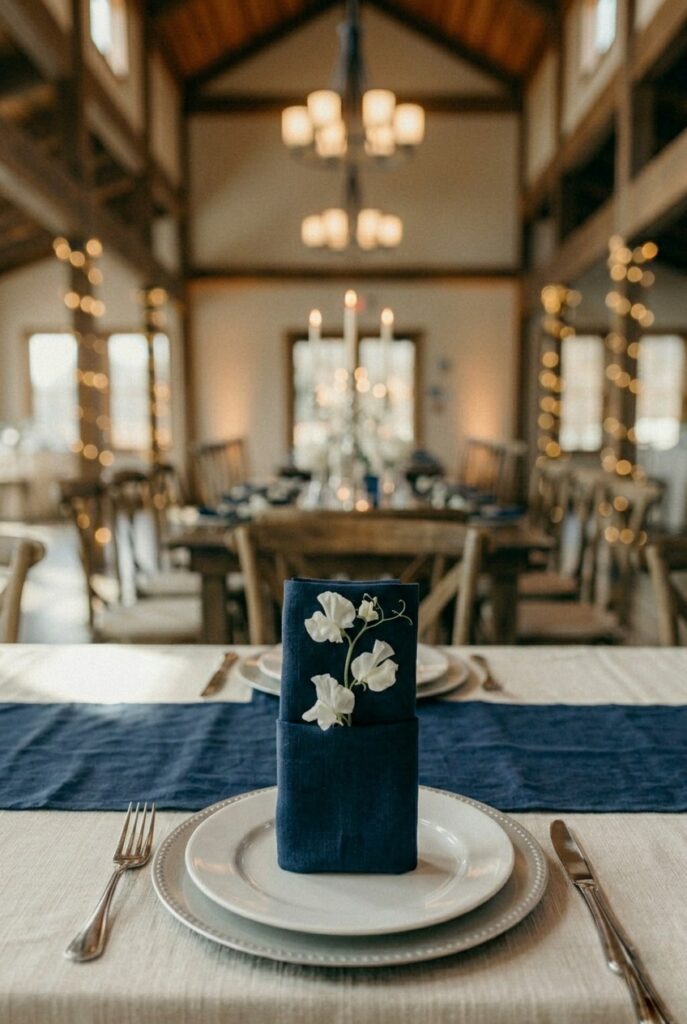
If committing to a fully blue table runner feels like too much, a navy or dusty blue napkin at each place setting is the minimum effective dose of blue at the table surface level.
This approach — white or ivory tablecloth, white or neutral runner, blue napkin folded on the white plate — introduces the palette at the point where guests are most likely to handle and notice it while keeping the overall table light and airy.
The fold matters more than most couples realize. A flat napkin laid under a fork disappears.
A column fold standing upright on the plate, or a fan fold tucked into a wine glass, creates a vertical blue element at the place setting level that reads clearly from across the table.
For round tables where sightlines matter, the standing column fold gives each place setting a visible blue flag that reinforces the palette without requiring a blue centerpiece.
Skip this if you are already using a blue runner — two blue textile elements at the same table surface level (runner plus napkin) reads as busy. Choose one.
$18–$30 for a set of 10 napkins. Etsy washed-linen sellers in navy or dusty blue.
For how napkin placement interacts with the broader place setting, the wedding table decor ideas roundup covers this directly.
8. Something Blue — Done as a Full Commitment
Every guide about blue wedding tables eventually mentions “something blue” as the tradition that inspired the palette.
This framing actually limits how boldly couples use the color. When you think of blue as “the something blue tradition,” you treat it as an accent — a nod, a gesture.
When you treat it as your actual palette, you commit it fully and the tables look designed rather than thematic.
The most memorable blue wedding tables I have seen were not navy-accented.
They were navy-committed: navy runner, white flowers, silver metal, ivory linen, and nothing else.
No gold, no mixed-pattern elements, no additional accent colors competing for attention.
The restraint is what made them stop guests in the doorway. If blue is your color, own it at the table completely rather than hedging it with four other accent colors.
Use The Knot’s wedding color palette tool to explore real wedding photography in your chosen shade of blue — looking at actual reception photos rather than styled shoot imagery will show you how each shade behaves in real venue conditions.
No cost.
Commitment is the investment. For more on using blue as a full wedding palette across all decor decisions, the blue wedding decor ideas guide goes beyond the table to the full room.
9. Eryngium and Sea Holly for a Textural Accent
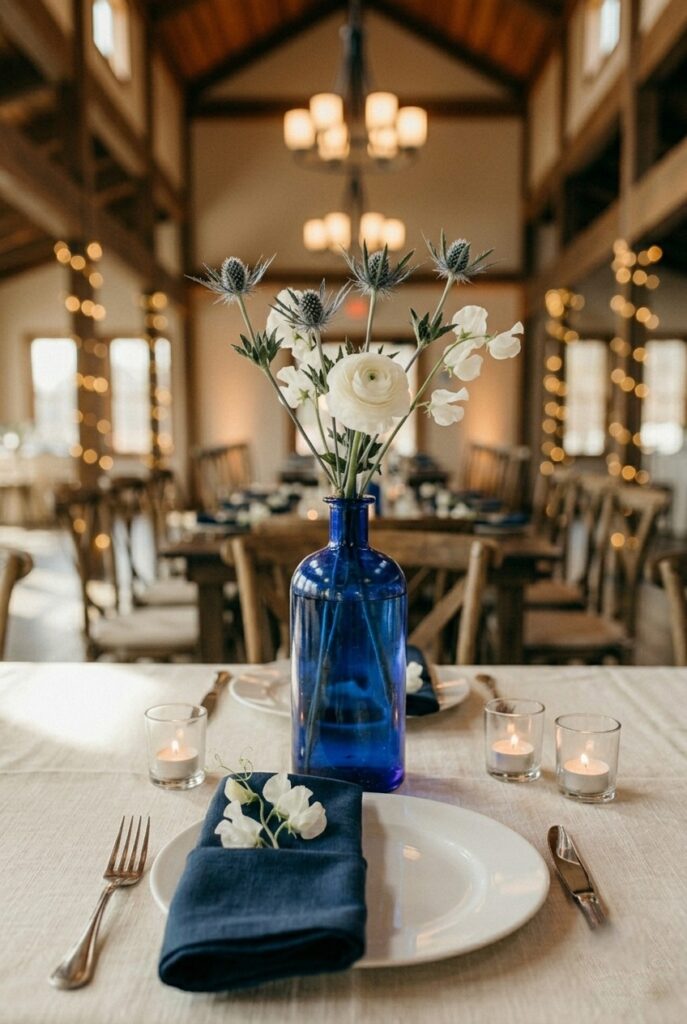
Eryngium — commonly called sea holly — is one of the most underused blue florals in wedding table design and one of the few that is genuinely, metallically blue rather than purple-adjacent.
Its spiky, architectural texture is completely distinct from the round softness of hydrangeas or the spike-column shape of delphiniums, which means it adds a textural layer to a blue arrangement that no other blue flower provides.
Tucked into a mixed white arrangement, eryngium reads as blue from across a room and adds dimensionality that prevents the centerpiece from looking like a single-note floral statement.
It is also among the most hardy cut flowers available — eryngium holds its structure and color for 10–14 days in water, which means you can arrange with it 2–3 days before your wedding without risk of wilting on the day.
For DIY centerpiece builds, this is a significant practical advantage.
A bunch of 10 stems from a wholesale flower market costs $8–$14.
Mixed with white companion flowers and placed in cobalt glass bottles (see idea 2), eryngium creates one of the most photographically distinctive blue table combinations at the lowest possible floral cost.
$8–$14 per bunch at wholesale flower markets or specialty Etsy farm sellers.
For preserved options, Afloral carries dried eryngium at $12–$18 per bunch.
💡 Budget Hack after Idea 9: For couples working with a tight floral budget, the cobalt bottle plus eryngium combination in idea 9 is the highest-return per dollar in the blue table category. Here is the exact math for a 10-table wedding: 10 cobalt bottles sourced from Goodwill at $1.50 average = $15 total. One bunch of eryngium from a wholesale market = $12. One bunch of white sweet peas from Trader Joe’s = $8. Total centerpiece cost for 10 tables: $35, or $3.50 per table. That is not a typo. The cobalt glass does the visual heavy lifting, the eryngium provides the blue texture, and the white sweet peas provide the contrast. Arrange the day before your wedding, keep in a cool room overnight, and place on tables during setup. This combination photographs as a $60-per-table florist arrangement.
10. Watercolor-Style Blue Menu Cards as Place Setting Architecture
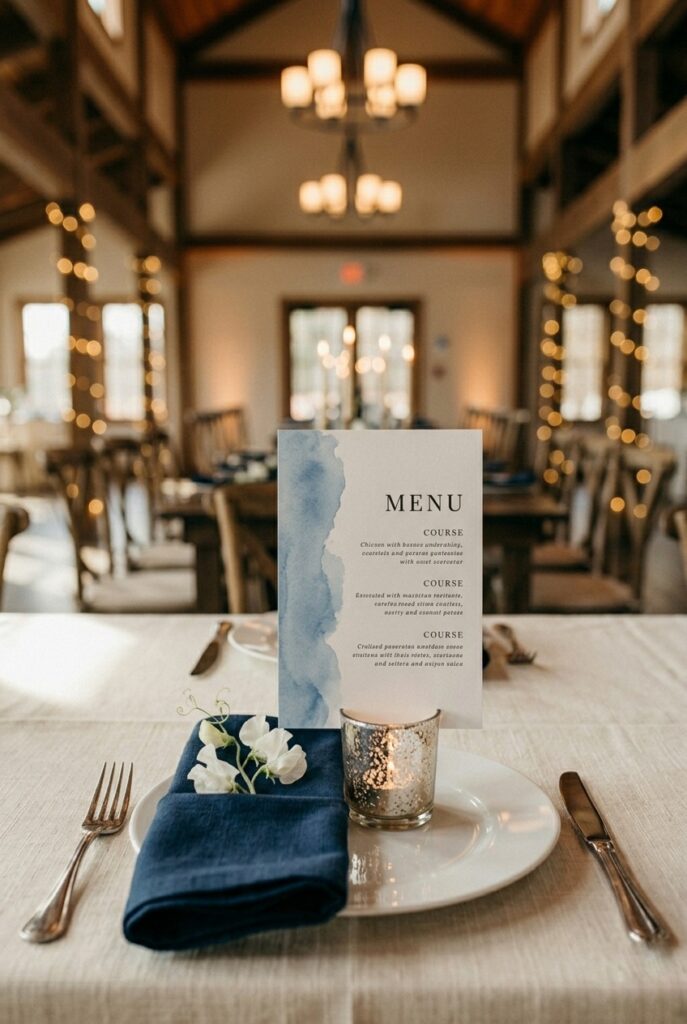
Blue stationery at the place setting is the detail that ties the table’s color story down to the individual guest’s eye level — the same principle as the blue napkin in idea 7, but in a different medium and at a different angle.
A menu card printed on blue cardstock with a watercolor wash border, or a menu in ivory with a blue ink treatment and a blue wax seal, props upright against a bud vase or silver votive and becomes a designed object rather than a functional slip of paper.
The version that fails: a blue-bordered menu printed on thin standard-weight paper and laid flat. It reads as office printing.
The version that works: a 5×7 card printed on 130-pound matte cardstock through Canva Pro and Vistaprint, with a simple watercolor blue wash on one margin, scored and folded at the base so it stands.
At $1.50–$2.20 per card in quantities over 50, for a 100-guest wedding the total stationery cost is $150–$220 — and those cards pull the palette together at every single place setting simultaneously.
For stationery and printing resources, Zola’s vendor partners include a stationery marketplace that applies savings on wedding stationery orders for couples with Zola registries. $1.50–$2.20 per card.Vistaprint or Canva + Printful.
Wax seal kits in navy or cobalt on Etsy run $15–$22 for a complete set including wax sticks and a custom stamp.
Decision Filter
If your venue has abundant natural light — a garden venue, an outdoor tent, a coastal or beachside space — any shade of blue from dusty to cobalt will read correctly in photographs because natural daylight is color-balanced.
This is where periwinkle, dusty blue, and cornflower all shine. Commit fully and use the cobalt bottle idea freely.
If your venue is an indoor ballroom or hotel with warm amber lighting, go navy or cobalt only — those are the two shades with enough depth and saturation to survive the color shift.
Dusty blue in a warm-lit ballroom will photograph grey.
If your guest count is under 60 and your tables are rounds, the hydrangea bowl in idea 5 paired with navy napkins in idea 7 is the most efficient two-element combination: it establishes the palette at both the center and the place setting, and it requires no florist.
If you are working with a strict floral budget, the cobalt bottle plus eryngium combination from the Budget Hack after idea 9 at $3.50 per table is the correct starting point before spending anything else.
For beach weddings specifically, the beach wedding decor ideas guide covers how blue and coastal natural elements work together as an extended palette.
The Real Reason
The reason blue tables disappoint more often than almost any other palette comes down to a single professional truth that coordinators know and almost never say out loud to couples before the wedding: blue is a cool-temperature color being asked to perform in a warm-temperature environment. Reception venues are designed to feel warm and intimate — amber uplighting, candlelight, chandeliers, warm LED fixtures. All of those light sources are adversaries to cool-toned blue. The blue you see on a well-lit screen is not the blue that appears at 7 PM under a warm chandelier.
The contrarian truth: dusty blue is the safest-feeling choice in the blue family, and that safety is precisely what makes it risky.
It has so little saturation that it depends entirely on optimal lighting conditions to read as the color it is supposed to be.
If you love the dusty blue aesthetic, use it for the napkins — which are close to guests and handled under direct table light — and choose navy for the runner, which is the element photographed from six feet away.
That combination gives you the dusty blue feeling and the navy stability.
Mistakes to Avoid
Mistake 1: Buying blue flowers online without a color reference sample. Every blue wedding article recommends “blue hydrangeas, delphiniums, and nigella” as if all three are the same shade of blue. They are not.
Hydrangeas range from true blue to purple-blue to lavender depending on soil pH during growth.
Delphiniums in “blue” come in five to seven different shades from pale sky to deep indigo. Nigella is closer to violet than blue in most growing conditions.
Ordering “blue” flowers from an online farm supplier without a variety-specific color reference is how couples end up with a purple table in photos.
Always request a sample stem or a farm-specific color photo of the exact variety you are ordering, not a stock image of the flower family.
Mistake 2: Spending $40–$65 per table on a florist-arranged blue centerpiece when the floral cost includes a 200% markup on blue-flower sourcing. Blue flowers are specialty items in the wholesale flower market.
Florists source them at $2–$4 per stem wholesale and invoice them at $6–$10 per stem in arrangements.
A centerpiece described as “blue floral” at $65 often contains $12–$18 worth of actual blue blooms.
The cobalt glass bottle approach in idea 2 achieves a more visually interesting table for $8–$28 total, using white flowers — which are inexpensive at every sourcing point — and lets the glass carry the color.
The florist markup on blue florals is significantly higher than on white, blush, or greenery-forward arrangements.
Mistake 3: Choosing your blue linen at home under natural light, then never seeing it under your venue’s lighting until setup day. This is the mistake that generates the most post-wedding disappointment in the blue category.
A dusty blue runner that looks sophisticated at your kitchen table under a north-facing window reads as muted grey in a ballroom with warm amber recessed lighting on the day of.
By the time you discover this, your linen rental is non-refundable and setup is two hours away.
The swatch test at the venue under the actual lighting is not optional on a blue palette.
Every other color can be approximated from home lighting. Blue cannot.
Mistake 4: Using blue candles as the primary blue element on your tables. Blue pillar candles and blue taper candles appear in almost every “blue wedding decor” shopping guide.
Here is what those guides do not tell you: colored candle wax contains dye that pools as liquid when the candle burns.
On a blue taper candle, that melted dye pools at the base of the holder as blue-tinted wax and drips in blue rivulets down white tablecloths.
By 9 PM, your pristine blue table has blue wax drips on the ivory linen, blue puddles around the candlestick bases, and a cleanup bill from your venue.
Use ivory or white candles always. The blue should come from glass, fabric, and flowers — never from tinted wax.
FAQ
What flowers come in true blue for a wedding?
Delphiniums, eryngium (sea holly), and nigella are the most reliably true-blue options.
Blue hydrangeas vary significantly by variety — specify Nikko Blue or Endless Summer when ordering.
Most “blue” flowers in florist arrangements are actually blue-violet or lavender-blue.
Always request a farm-specific color photo of the exact variety, not a generic stock image, before committing to a bulk order.
What colors go well with blue for wedding table decor?
White and silver are the most reliable pairings for any shade of blue.
White provides high contrast without competing, and silver shares blue’s cool undertone rather than fighting it. Ivory works as a softer alternative to white.
Navy plus sage green reads as coastal and fresh for outdoor venues.
For a more dramatic combination, navy plus deep emerald green creates a rich jewel-tone palette that photographs strongly in low-light receptions.
How do I decorate a wedding table with a dusty blue color scheme?
Use dusty blue at the place setting level — napkins, menu cards — rather than as the runner or primary textile, since it loses its blue identity under warm venue lighting more than any other blue shade.
Pair with an ivory tablecloth, white garden roses in clear glass vessels, and silver candle holders.
For the tablescape to read as dusty blue rather than grey in photographs, supplement your venue’s warm lighting with one cool-white LED puck light per table placed under the centerpiece vessel.
Is navy blue or dusty blue better for a wedding?
Navy is more lighting-stable, more universally flattering across venue types, and more distinctly itself in photographs.
Dusty blue is softer and more romantic in optimal lighting but susceptible to reading as grey in warm-lit indoor venues.
The practical answer: use navy for any element photographed from a distance (runners, chair sashes, table draping), and reserve dusty blue for elements handled up close — napkins, stationery, ribbon accents — where guests see them under direct table light rather than ambient venue light.
Budget Table
| Element | Self-Sourced | Florist / Rental / Vendor |
|---|---|---|
| Navy washed-linen runner | $10–$20 (Etsy) | $20–$40 (event rental) |
| Cobalt glass bottle set (5 bottles) | $5–$15 (Goodwill/Facebook Marketplace) | $25–$45 (event rental) |
| Delphinium bunch (50 stems) | $55–$75 (FiftyFlowers farm-direct) | $140–$200 (florist arranged) |
| Blue hydrangea heads (3 per table) | $12–$24 (wholesale flower market) | $45–$75 (florist arranged) |
| Silver taper holders + candles (pair) | $12–$20 (HomeGoods/TJ Maxx) | $28–$50 (event rental) |
| Navy linen napkins (set of 10) | $18–$30 (Etsy washed linen) | $12–$25 (venue rental) |
| Eryngium sea holly (10 stems) | $8–$14 (wholesale market) | $25–$40 (florist add-on) |
| Watercolor menu cards (100 cards) | $150–$220 (Canva + Vistaprint) | $280–$450 (wedding stationer) |
| Silver charger plates (set of 4) | $14–$18 (Amazon) | $20–$40 (event rental, 4 pieces) |
| Full table (self-sourced, cobalt bottle approach) | $3.50–$22 per table | $100–$180+ per table |
Blue Earns Its Place When You Stop Treating It as a Gesture
The couples who walk into their reception and feel their blue tables actually land — not just register, but stop them — are the ones who made a shade decision first, tested it under their venue’s actual lights, and then committed to it without hedging. They did not scatter blue across twelve different elements at three different saturation levels.
They chose one carrier — a runner, a set of cobalt bottles, a field of navy napkins — and let everything around it be white, silver, and light.
Read the blue wedding decor ideas guide next for how these table decisions extend across the full room — arch, aisle, signage, and reception backdrop — and the garden wedding decor ideas guide if your venue has natural light that will let every shade of blue be exactly what it is.