Every fall wedding I’ve worked has had the same nervous conversation around table decor: the couple wants it to feel seasonal without looking like a harvest festival display at a grocery store.
That is not an unreasonable fear — and nobody’s article actually tells you where the line is.
This guide tells you exactly where that line is, which specific elements earn their place on a fall table, and what to skip even though every other list keeps recommending it.
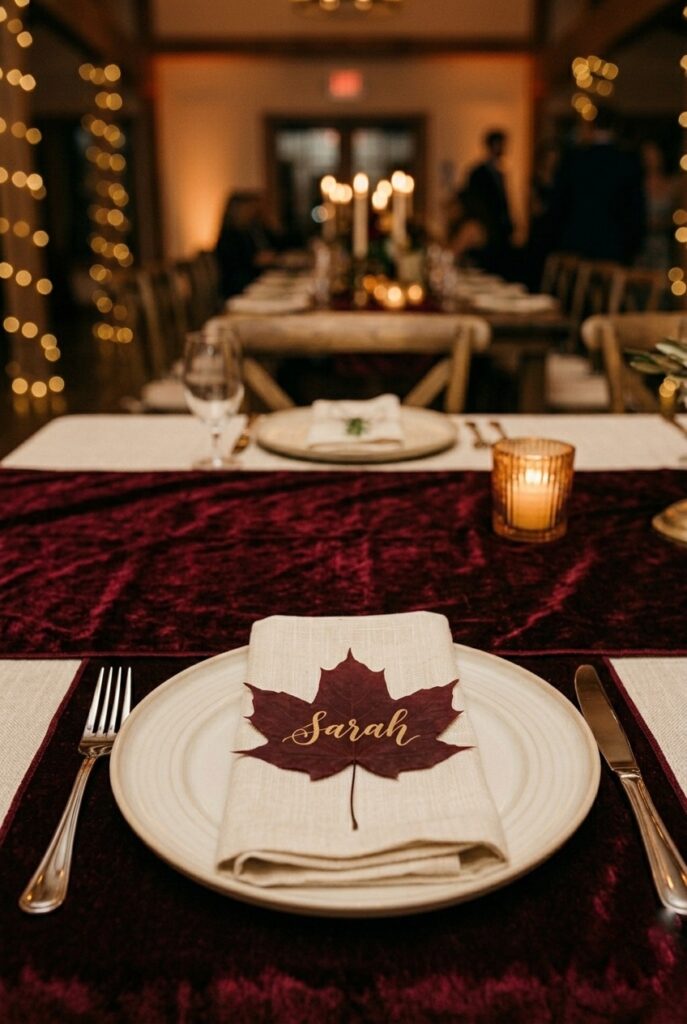
A single oak leaf pressed flat inside the menu card, already turned, already dry at the edges, the color of a brick left in the rain. You notice it only because you were looking for a pen.
The Short Answer
Fall decor fails on wedding tables when it prioritizes the season over the occasion.
Pumpkins, corn husks, and rustic burlap signal autumn — they do not signal a wedding.
The elements that actually work are the ones that happen to peak in autumn: dahlias, dried wheat, deep jewel-toned linens, and the particular low amber quality of candlelight against a warm palette.
Those elements feel like fall without announcing it.
Your guests should feel cozy and transported the moment they walk into the room.
They should not feel like they need to pick up a hay bale and find a corn maze.
The secret that makes fall the most photogenic wedding season is not the pumpkins.
It is the light — warm, golden, already leaning toward dusk even at 5 PM. Build your tables to receive that light. Everything else follows from that decision.
1. Dahlia and Dried Wheat Centerpieces
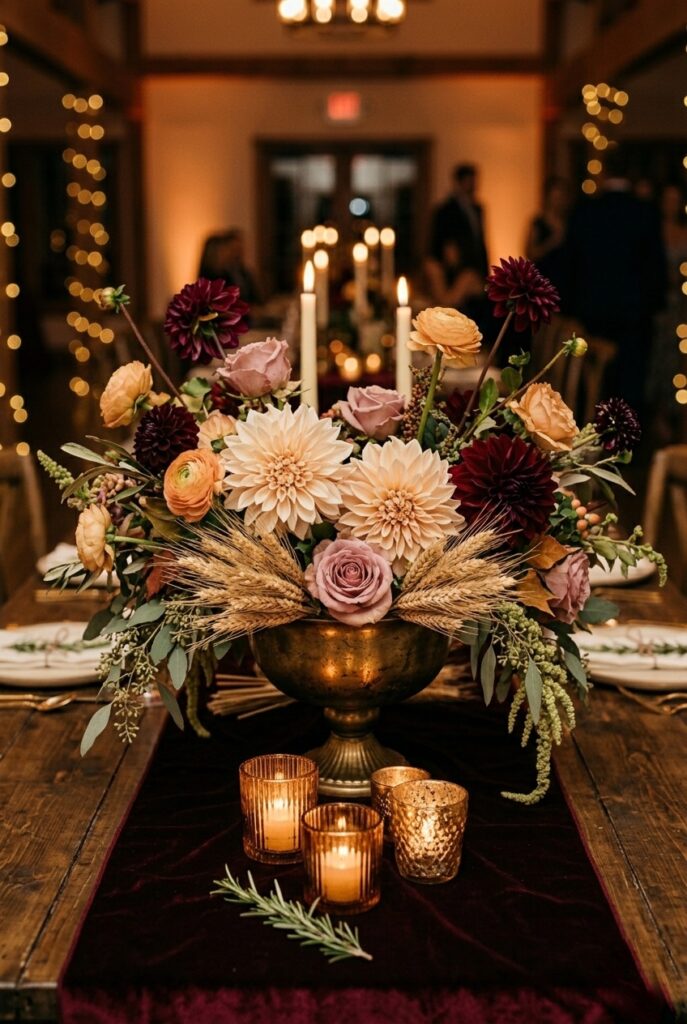
Dahlias are the definitive fall wedding flower: they peak from August through October, they hold structure in a vase longer than most seasonal blooms, and their layered petals in café au lait, burgundy, burnt orange, and deep plum read as absolutely of-this-season without being obvious about it.
Pair them with dried wheat bundles as structural filler and you eliminate half your floral cost while adding texture that photographs exceptionally well.
One critical warning the other articles miss entirely: dahlias and ranunculus are heat-sensitive.
In a venue with aggressive indoor heating — which most fall weddings use — a centerpiece built around dahlias will start flagging by 8 PM if the flowers aren’t in water with floral preservative and the venue temperature is above 72°F.
Tell your florist this specifically, ask for conditioned stems, and if you are DIYing, keep arrangements in a cool room until 90 minutes before guests arrive.
Buy dahlias in bulk from FiftyFlowers, which ships seasonal blooms direct from farms at $45–$80 per 40-stem bunch.
$35–$65 per table for a mixed dahlia and dried wheat centerpiece.
2. Deep Jewel-Tone Velvet Runners Over Neutral Linens
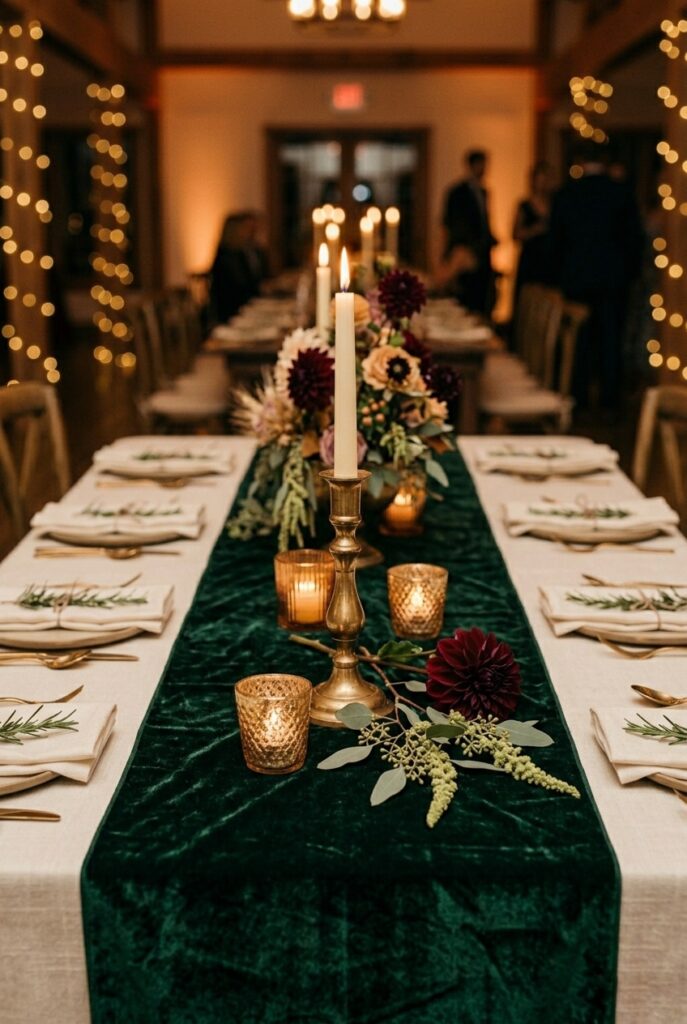
The linen choice is where most fall tables either commit to the season or quietly betray it.
A standard white or ivory tablecloth under a table full of fall elements creates a visual contradiction — the flowers and candles feel warm, the linen reads as generic summer.
A deep velvet runner in forest green, plum, or burgundy laid over an ivory or grey base linen ties the whole table into its season without a single additional element.
The version that fails: a thin, shiny satin runner in “burgundy” from a wedding supply discount site.
Satin reads as cheap in the amber light that defines fall evenings, and the sheen competes with your candles rather than complementing them.
Switch to crushed velvet or washed cotton velvet, which absorbs candlelight and photographs with genuine warmth and depth.
Available on Amazon in 2-meter lengths for $12–$18, or from Etsy velvet fabric sellers for $8–$14 per runner. $10–$22 per table.
3. Dried Wheat and Grain Bundles from a Feed Store, Not a Florist
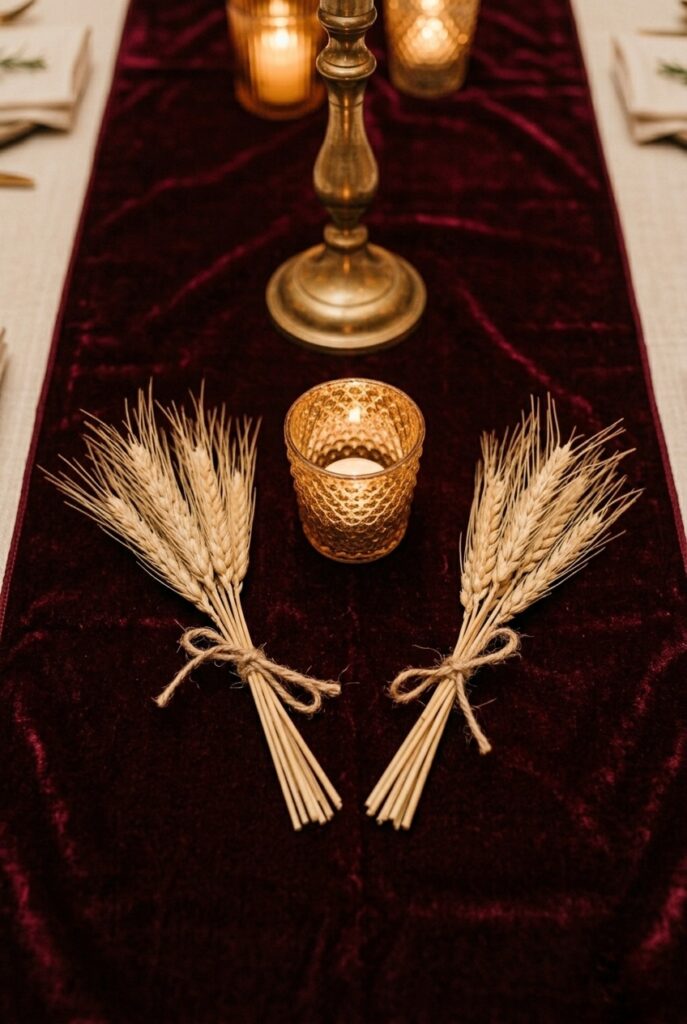
Here is the sourcing shortcut that no competitor article gives you: dried wheat bundles, dried lavender stalks, and dried oat grass are agricultural products.
They are sold at farm supply stores — Tractor Supply Co., Rural King, and local feed stores — in quantities that would cost four to five times as much at a floral shop or wedding supply site.
A bundle of 50 dried wheat stalks from Tractor Supply runs $4–$7. The same “artisan dried wheat bundle” on a wedding decor site costs $18–$28.
Tie three to five stalks together with a 6-inch length of natural jute twine (available in bulk on Amazon for $6 per 100-yard spool) and lay two bundles flat on your runner at each table, angled slightly outward from the centerpiece.
The effect is harvest-season and romantic simultaneously — particularly effective against velvet runners and brass metal finishes.
Only do this if your wedding has a warm or earthy palette. Against white and silver, wheat reads as farmhouse, not autumn elegant. $4–$8 per table total.
Tractor Supply Co. or Rural King, in-store only for the best pricing.
💡 Budget Hack after Idea 3: For dried pampas grass, smoke bush stems, and ornamental grasses for fall tables, check the floral department at your nearest Trader Joe’s or Whole Foods in September and October specifically — both stores receive seasonal dried stem stock during harvest months that sells for $6–$12 per bunch. That is 50–65% cheaper than ordering through a wedding floral supplier. Visit the week before your wedding, buy what’s in stock, and supplement with two or three specific varieties from Afloral if you need consistent quantity. Total dried stem spend for a 10-table wedding using this hybrid approach: $60–$90 versus $180–$260 through a florist.
4. Taper Candles in Brass and Aged Copper Holders
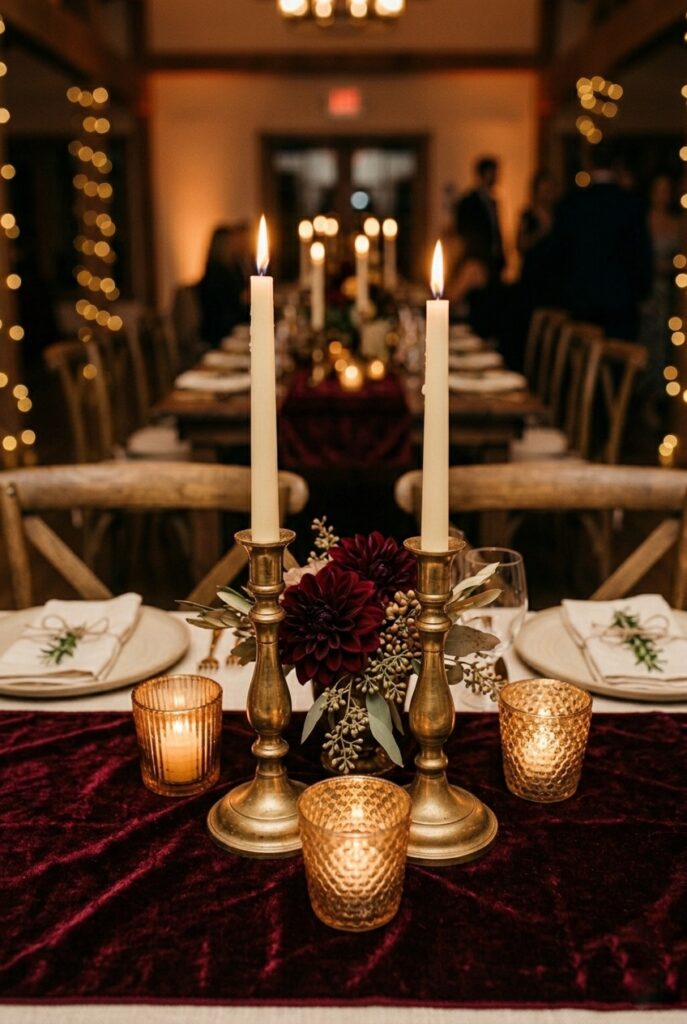
Taper candles are having a full reinvention in modern wedding design, and fall is their native environment.
The narrow vertical line of a taper in a brass holder creates elegance that pillar candles cannot match, and the slender silhouette means you can use two or three per table without blocking sightlines across the table.
The combination of brass metal with ivory taper candles and a dark velvet runner is one of the most photographically effective fall table combinations I have seen — it works in barns, in ballrooms, and in outdoor tented spaces equally.
The version that fails: plastic taper holders in fake brass — the kind with the visible seam line and the orange undertone that shows under warm light.
Real brass or solid cast iron holders photograph completely differently. Check HomeGoods, TJ Maxx, and Tuesday Morning for genuine brass taper holders at $4–$8 each.
Alternatively, Etsy has small shops selling antique brass taper holders in bulk sets of 6 for $28–$45.
Pair with unscented ivory tapers — never scented at dinner tables.
$8–$20 per table for a pair of holders plus candles.
For more approaches to creating an elevated feel at your tables without the florist invoice, the elegant wedding table decor ideas guide is worth bookmarking.
5. Pressed Leaf Place Cards

This is the fall table detail that costs almost nothing and reads as genuinely considered — the kind of thing that makes guests pick up their place card and look at it twice.
Take a deep burgundy maple leaf, a golden ginkgo leaf, or a rust-orange oak leaf, press it flat for 48 hours between the pages of a heavy book, then write or print the guest name directly on the leaf with a gold paint pen.
Lay it flat on the folded napkin at each place setting.
In person it looks deliberate and seasonal.
In photos, it adds an organic layer to the place setting that a printed cardstock name card cannot replicate.
Total cost for 100 guests: the price of a gold Sharpie paint pen ($4.99 at Michael’s) and the time it takes to collect leaves from your yard or a park two weeks before the wedding.
Skip this if your wedding is very formal or black-tie — pressed leaves belong to a certain register of elegance, and that register does not include tuxedos and crystal glassware.
$5–$15 total for the whole wedding. Gold paint pens at Michael’s or Hobby Lobby.
Leaves from any park, yard, or roadside in September and October.
6. Smoke Bush and Eucalyptus Garlands as the Runner
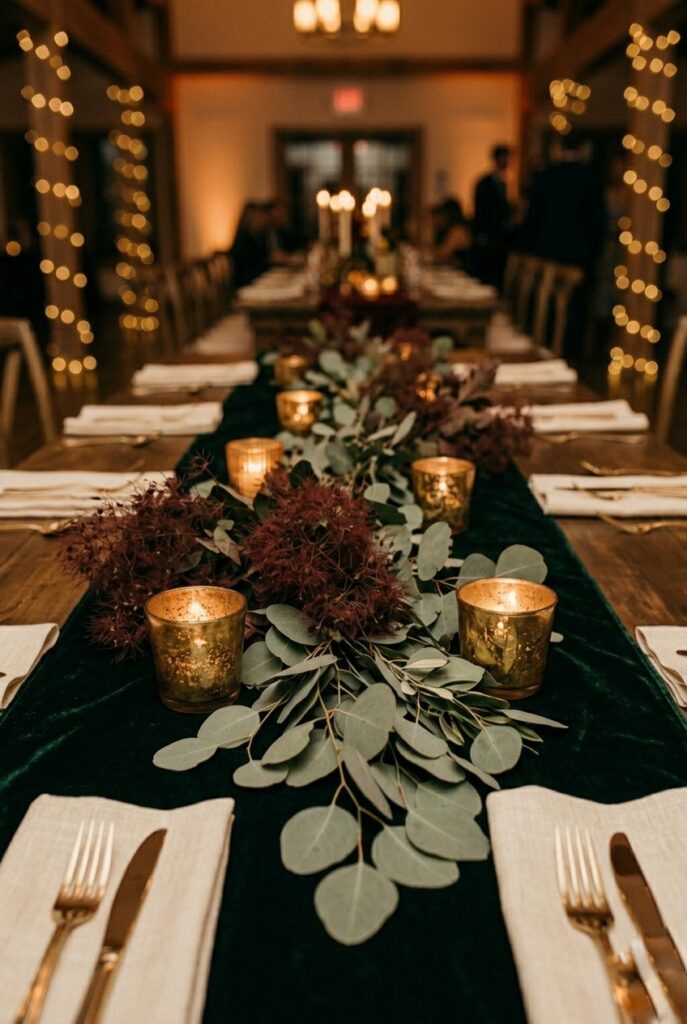
Smoke bush — that dramatic shrub with burgundy-to-rust foliage and feathery seed plumes that peaks in October — is one of the most underused table elements in fall wedding design.
It does not appear in most competitor guides because it is not widely available from standard florists.
Find it at local wholesale flower markets, from specialty farm flower suppliers on Etsy, or by asking a florist directly about sourcing it.
One 12-stem bunch covers roughly two table lengths as a loose garland when combined with seeded eucalyptus.
The smoky, feathery texture of the seed plumes reads as unmistakably autumnal and photographically distinct — no one else’s tables will look like yours.
Layer smoke bush with silver dollar eucalyptus and a few stems of burgundy ranunculus into a loose draping garland for long tables.
For round tables, create a compact cluster arrangement rather than a garland.
Smoke bush from a wholesale flower market or specialty Etsy seller runs $18–$30 per bunch.
Combined with eucalyptus at $12–$16 per bunch, a full long-table garland costs $25–$40.
These elements also hold their structure in warm indoor conditions far better than dahlias — a critical advantage for heated venues.
$25–$45 per long table; $15–$25 per round table. Check local wholesale flower markets or search “smoke bush wedding” on Etsy for farm-direct sellers.
7. Mini Gourd Clusters — The Right Way
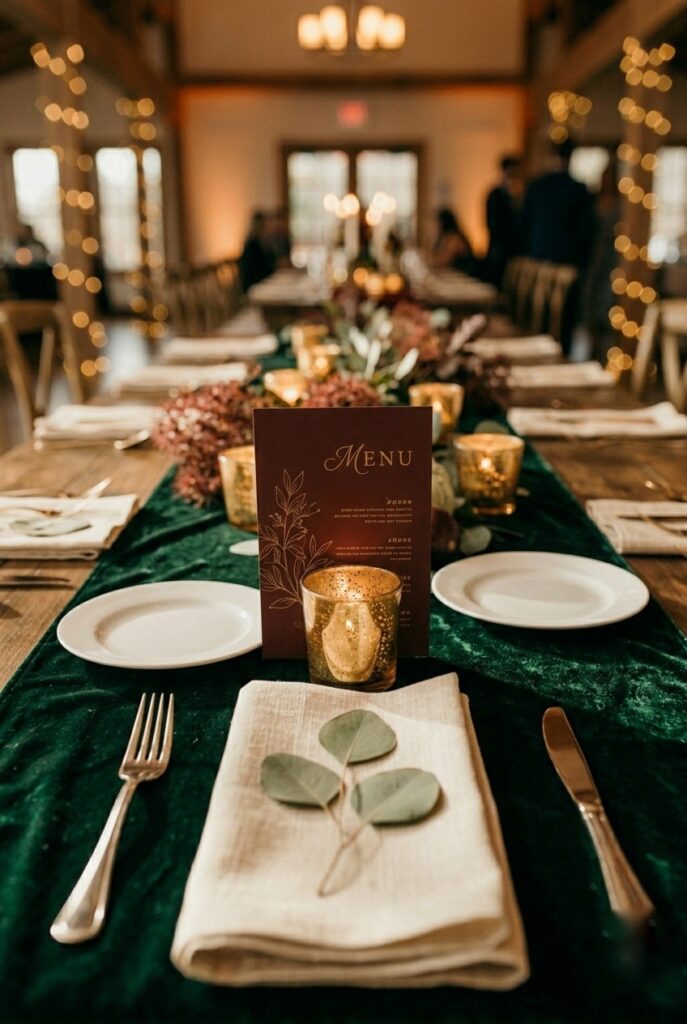
Every fall wedding guide tells you to use mini pumpkins and gourds.
Very few tell you the rule that separates a wedding table from a Thanksgiving table.
Here it is: gourds work on a fall wedding table when they are used as supporting texture, not as the centerpiece itself.
Two or three miniature white ghost pumpkins or small ornamental gourds placed at the base of a candle cluster, partially tucked under a garland, or nestled between votives read as intentional and seasonal.
A hollowed-out pumpkin used as a vase, or a group of gourds centered on the table with nothing else, reads as a buffet display at a church potluck.
Additionally: skip orange gourds entirely unless your venue is a barn.
Orange is the dominant color of Halloween, and inside a carpeted ballroom under warm overhead lighting, orange pumpkins look like holiday decor that was not put away.
White ghost pumpkins, pale green gourds, and dark burgundy ornamental varieties photograph as editorial and sophisticated.
They come in those colors. You just have to buy them deliberately.
$2–$6 per table for 3–4 mini gourds. Available at Whole Foods, Trader Joe’s, farmers markets, and Michaels in September and October.
8. Deep-Toned Paper Menus as Place Setting Architecture
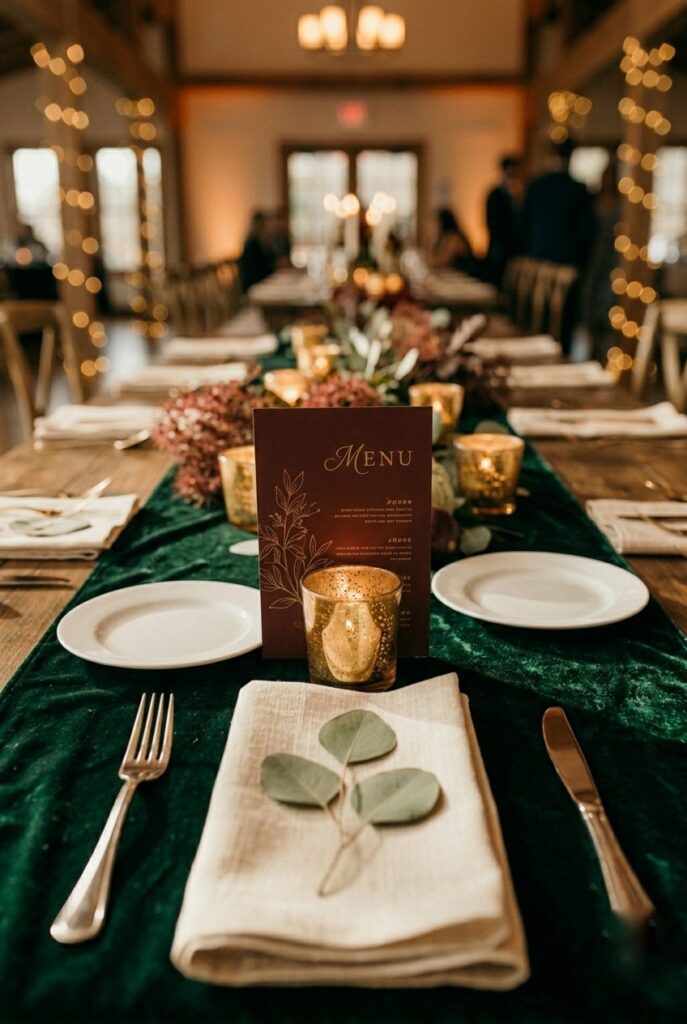
At a fall reception, your place setting is the first thing guests touch and the thing they look at for the first three minutes before the event begins.
A menu printed on deep-toned cardstock — forest green, burgundy, or warm terracotta — propped against a bud vase or taper candlestick adds height and color to the place setting without requiring a single additional purchase.
It does the job of a place card and a decorative element simultaneously.
Use Canva to design a menu with a subtle botanical illustration in a fall palette, print on matte cardstock through Vistaprint ($55–$80 for 100 cards), and score the bottom half-inch so it stands upright with a slight lean.
The version that fails here is a flat menu printed on glossy white paper — it lies flat, gets moved in the first thirty seconds, and adds nothing visual.
Matte card with a standing score adds architecture at eye level, and architecture at the place setting level is what distinguishes a designed table from an assembled one.
$55–$80 total for 100 guests. Vistaprint or Canva + Printful for print-ready files.
For more ways to maximize your stationery investment, check The Knot’s wedding planning tools for vendor comparison and budget planning.
9. Foraging for Decor — What Is Actually Free in October
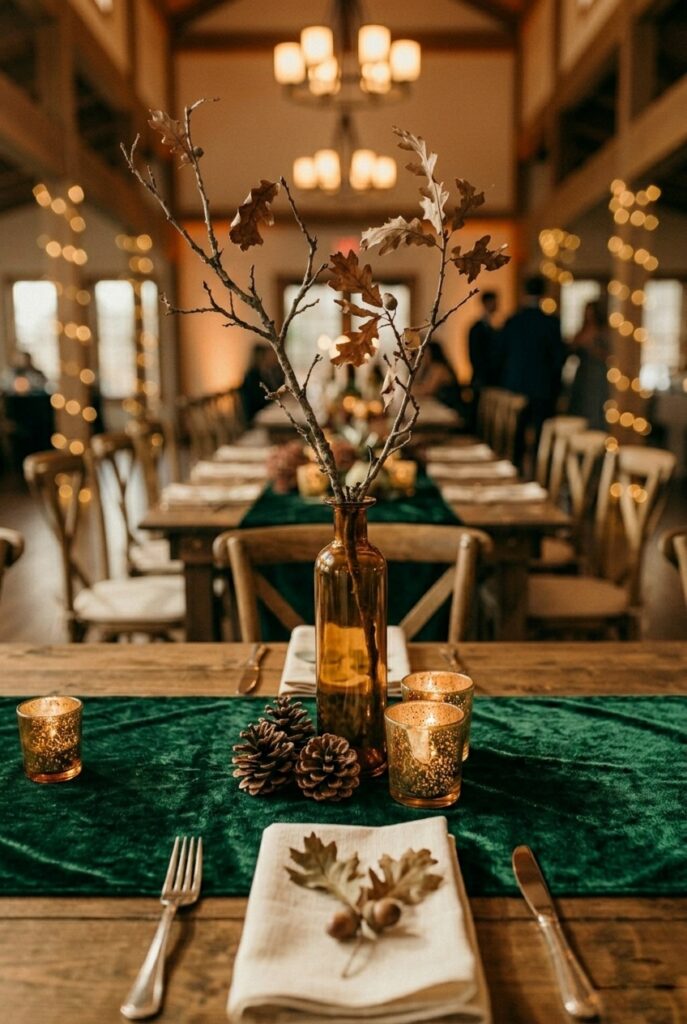
If you have access to any outdoor space in the six weeks before your October or November wedding, you have access to free table decor.
Dried oak leaves gathered and pressed flat work as place cards (see idea 5).
Bare branches with their natural gnarled texture, cut to 18–24 inches and placed upright in a tall narrow vase, become sculptural centerpieces at zero cost.
Pinecones scattered in a cluster with votives at the base cost nothing. Wild dried grasses pulled from roadsides, bound in a loose bunch, and placed in a ceramic vase read as expensive when the vase does its job.
The rule for foraged decor: it needs a container that elevates it. A beautiful ceramic or amber glass vase containing one foraged branch reads as designed.
That same branch in a Dollar Tree plastic vase reads as a craft project. Invest $8–$15 per table in the container and spend nothing on the contents.
This combination — quality vessel, foraged contents — achieves the layered organic look that competitors describe as “expensive” without ever explaining how to access it cheaply.
For more on this principle applied across the whole reception, the DIY wedding decor ideas guide walks through the same concept in detail.
$0–$15 per table depending on vessel sourcing. Vessels from HomeGoods, thrift stores, or Amazon.
💡 Budget Hack after Idea 9: After your wedding, fall centerpiece elements — dried pampas, wheat bundles, gourds, foraged branches, and pressed leaves — have resale value. Post your full table decor set on Facebook Marketplace or the r/weddingplanning subreddit’s “selling” section within the week. Fall brides shopping in advance for the following year buy these items aggressively, and a full 10-table lot of fall table decor regularly resells for $80–$150 — recovering a significant portion of your original spend. Several couples I’ve worked with have recovered $100–$200 this way. List immediately after your wedding while the items are still in good condition.
10. The Moody Table — Done in Real Light, Not Just in Styled Shoots
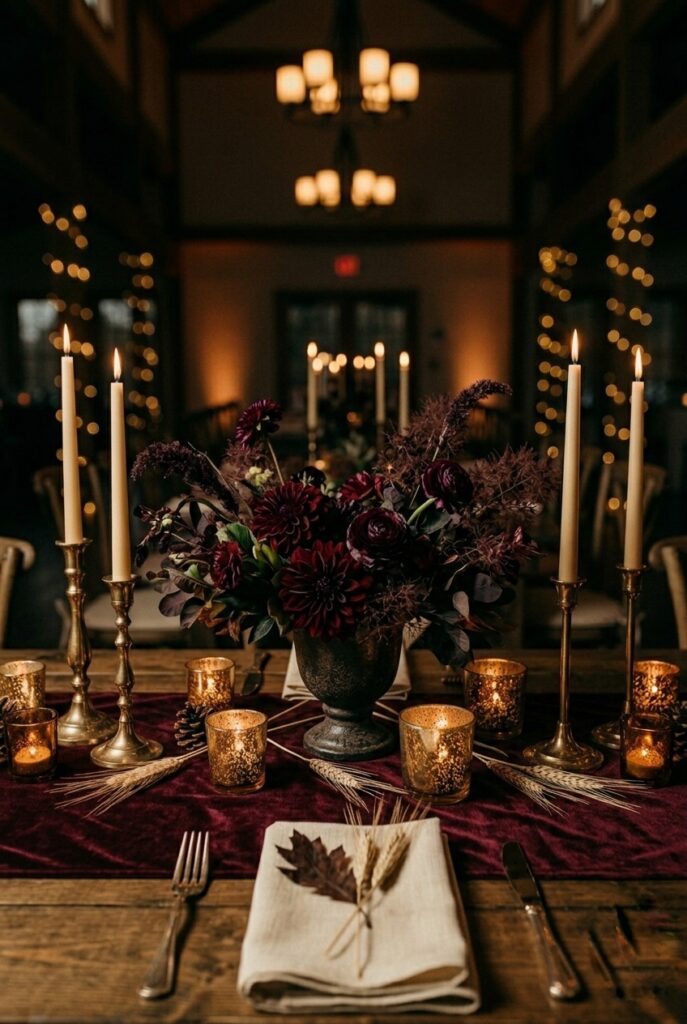
Dark, moody fall tables look extraordinary in editorial styled shoots published on wedding blogs and in vendor portfolios.
They are shot with professional off-camera lighting that adds drama and depth to deep-toned palettes.
That same table in a real venue with standard venue lighting looks flat, heavy, and dim — and your guests spend five hours sitting in front of it.
Here is what actually makes a moody fall table work in a real reception: you need at least eight individual light sources per table.
That means six to eight candles of varied heights plus two supplemental light sources — either battery-operated fairy lights tucked under the greenery, or a string of warm-tone LED votives filling in the gaps.
The deep jewel-tone palette absorbs light rather than reflecting it, which is visually beautiful in photography but means you need to put more light in to compensate.
Plan your candle count first, then build the rest of the table around it.
If you are shooting for a dramatic dark aesthetic across 12 tables at a ballroom wedding, discuss venue pin-spot lighting with your venue coordinator — $150–$300 added to your venue contract for pin-spot uplighting will do more for the moody fall aesthetic than any additional centerpiece spend.
For a full breakdown of how lighting interacts with indoor table decor, the indoor wedding decor ideas guide is the most practical next read.
Pin-spot lighting addition: $150–$300 venue add-on. DIY candle-only solution: $22–$35 per table in mixed candle holders.
Decision Filter
If your venue is a barn, vineyard, or outdoor tent, lean into ideas 3, 6, and 9 — dried wheat from a farm supply store, smoke bush garlands, and foraged branches are native to that environment and will look completely uncontrived. If your venue is an indoor ballroom or hotel banquet space, prioritize ideas 4, 10, and 2 in that order: taper candles first, then lighting strategy, then the velvet runner to anchor the palette. The moody fall table only works at scale when you have at least 8 candles per table — commit fully or it reads as gloomy rather than dramatic. If your guest count is over 100 and you want consistent impact without blowing your entire floral budget, the combination of dried wheat bundles (idea 3), velvet runners (idea 2), and taper candle pairs (idea 4) creates a complete, cohesive fall table for under $35 per table — no florist required.
The Real Reason
Most fall wedding tables look exactly like each other because couples are shopping from the same mood boards and the same three wholesale suppliers. The result is a visual vocabulary that has become self-referential: burnt orange, burlap accent, lantern, small pumpkin, eucalyptus. Guests have seen that table twenty times. It does not make them stop.
The contrarian truth about fall decor is that orange — the color most associated with the season — is the single hardest fall color to use well at a wedding. It photographs warm in natural light and garish under indoor lighting. The couples whose fall tables actually stop guests in their tracks have almost universally shifted to burgundy, forest green, plum, and warm ivory as their primary palette, with orange and rust appearing as small accents only. If you are currently planning a burnt-orange-forward fall table scheme, show your florist reference photos taken indoors under venue lighting. Not outdoor styled shoot photos. Indoors. What you see will likely prompt a conversation.
The insider observation that coordinators know and couples almost never hear before the wedding: the strongest fall table photos in your gallery will come from the tables nearest to a window during golden hour — typically the 45-minute window before the room transitions fully to candlelight. Your photographer will be shooting during cocktail hour, but if your tables are dressed and lit early, that window of warm autumn light coming through venue windows creates photographs that look like a luxury styled shoot. Position your most detailed tables near north- or west-facing windows, and ask your photographer to do five minutes of table detail shots before guests are seated. It costs nothing and produces images that look like $400-a-table design on a $35 table.
Mistakes to Avoid
Mistake 1: Trusting fall floral inspiration photos without checking where they were taken. Every competitor guide says “use dahlias, smoke bush, and deep burgundy blooms for a moody fall table.” What they do not tell you is that 90% of the reference photos they’re pulling from were shot outdoors in natural autumn light or in studios with professional lighting rigs. Your hotel ballroom does not have that light. Before committing to a dark, jewel-tone, floral-heavy fall table concept, take your florist to your actual venue during its normal evening lighting conditions and look at a test arrangement. What photographs as moody and rich in an outdoor vineyard shoot photographs as muddy and dim in a beige-carpeted banquet hall.
Mistake 2: Spending $65–$95 per table on a florist-arranged fall centerpiece when the season provides better raw materials for free. October is the one month of the year when foraged materials — bare branches, dried grasses, oak leaves, pinecones — outperform florist-sourced arrangements in actual venues because they are structurally stable, heat-resistant, and visually textured. Couples who spend $700 on florist-arranged fall centerpieces at a 10-table wedding are largely paying for labor on materials that cost the florist $8–$15 per table to source. The materials are accessible to anyone. The vessels are a HomeGoods run. The labor is an afternoon.
Mistake 3: Not accounting for fall centerpiece timing when dahlias are involved. Dahlias are the most photographically stunning fall bloom — and the most logistically demanding. They must stay refrigerated until roughly 90 minutes before use, they wilt noticeably in heated venues above 72°F, and they cannot be arranged more than 24 hours before the event. Couples who DIY dahlia centerpieces and arrange them the evening before their morning-setup wedding day arrive to wilted flowers. If dahlias are central to your table vision, either hire a florist who will deliver day-of, or pivot to dahlia-look alternatives: burgundy lisianthus holds longer, costs 30% less, and photographs almost identically at a distance.
Mistake 4: Mixing fall decor with non-fall-appropriate linens because you already paid a deposit on them. This happens constantly. A couple books white polyester banquet linens through their venue six months out, then develops a fall decor vision that is completely at odds with the cold, bright-white base they are locked into. Fall palettes — burgundy, forest green, plum, terracotta — need a warm neutral base or a dark velvet runner to cohere. On pure white, every fall element looks like a centerpiece placed on the wrong table. If you are locked into white venue linens, buy a velvet runner to lay over them as the primary surface your decor sits on. The runner costs $12–$22 and completely changes the tonal foundation of the table.
FAQ
What are the best flowers for a fall wedding table?
Dahlias, lisianthus, ranunculus, and chrysanthemums are the strongest fall choices. Dahlias peak September through October and are unmatched for fall color range. Lisianthus is the practical alternative — similar visual effect, better heat tolerance, lower cost. Avoid sunflowers for formal tables; they read as casual and do not photograph well in low reception light.
What colors work best for fall wedding table decor?
Burgundy, forest green, deep plum, and warm ivory are the most reliable fall wedding table palette. Burnt orange is overused and difficult to photograph in indoor venues — use it as a small accent only, not a dominant color. Dark jewel tones on a warm neutral base create the most versatile fall table regardless of venue type.
How do I make a fall wedding table look elegant without it looking like Halloween?
Replace orange with burgundy, swap plastic pumpkins for white ghost gourds used as texture accents rather than centerpieces, and build around candles and brass metal finishes rather than corn husks and hay. Elegance in fall table design comes from restraint: one strong seasonal element done with full commitment, not seven symbols of autumn competing for attention. The simple wedding decor ideas guide addresses this restraint principle directly.
How far in advance can I set up fall wedding table decor?
Dried and foraged elements — wheat bundles, pampas, branches, gourds, pressed leaves — can be assembled up to one week in advance and stored in a cool, dry space. Fresh floral centerpieces should not be arranged more than 18–24 hours ahead, and arrangements containing dahlias should stay refrigerated until 90 minutes before doors open. Candles, linens, and non-floral table elements can be fully set the morning of the wedding.
Budget Table
| Element | Self-Sourced | Florist / Wedding Vendor |
|---|---|---|
| Dahlia centerpiece (10 stems) | $18–$28 (FiftyFlowers bulk) | $65–$120 (florist arranged) |
| Velvet table runner | $10–$18 (Amazon/Etsy) | $25–$45 (event rental) |
| Dried wheat bundle accent | $4–$7 (Tractor Supply) | $18–$28 (wedding floral shop) |
| Taper candles + holders (pair) | $8–$16 (HomeGoods/TJ Maxx) | $30–$55 (event rental set) |
| Mini gourds cluster (3 pieces) | $2–$6 (Trader Joe’s/farmers market) | $12–$20 (event florist) |
| Pressed leaf place cards | $5 total (gold paint pen) | $1.50–$3 per card (stationer) |
| Foraged branch centerpiece | $0–$12 (vessel from HomeGoods) | $45–$75 (florist arranged) |
| Smoke bush + eucalyptus garland | $25–$40 (wholesale flower market) | $80–$140 (florist) |
| Full table (self-sourced) | $28–$55 per table | $140–$280+ per table |
The One Thing Nobody Will Tell You Before Your Fall Wedding
The couples who walk into their fall reception and feel genuinely transported are the ones who stopped trying to represent autumn and started trying to embody an autumn evening. That is not a metaphor — it is a practical distinction. An autumn evening is warm candlelight against dark fabric. It is the smell of something dried and organic. It is a table where the light itself feels like the season. You build that with five candles, a velvet runner, and two dried wheat bundles. You do not build it with twelve different items from a fall wedding Pinterest board.
Pick three elements from this list that share a tonal family — warm brass, dark fabric, one botanical texture — and commit to them at every table. Then read through the rustic wedding decor ideas guide and the wedding table decor ideasroundup to see how those three elements can be varied across your different table types — head table, sweetheart, and guest tables — without losing the cohesion that makes a reception room feel designed rather than decorated.