Blue is one of the most misused colors in weddings — not because couples choose the wrong shade, but because they choose too many of them.
Dusty blue napkins. Navy tablecloth.
Sky blue bridesmaid dresses. Cobalt glassware.
Baby blue candles. Royal blue ribbon.
Every surface with a different blue screaming for attention, and the effect is noise dressed up as a palette.
The weddings that stop people mid-step are the ones that picked a single shade and committed. Fully. Fearlessly.
Everything else white, cream, or greenery. Blue as the protagonist, not the chorus.
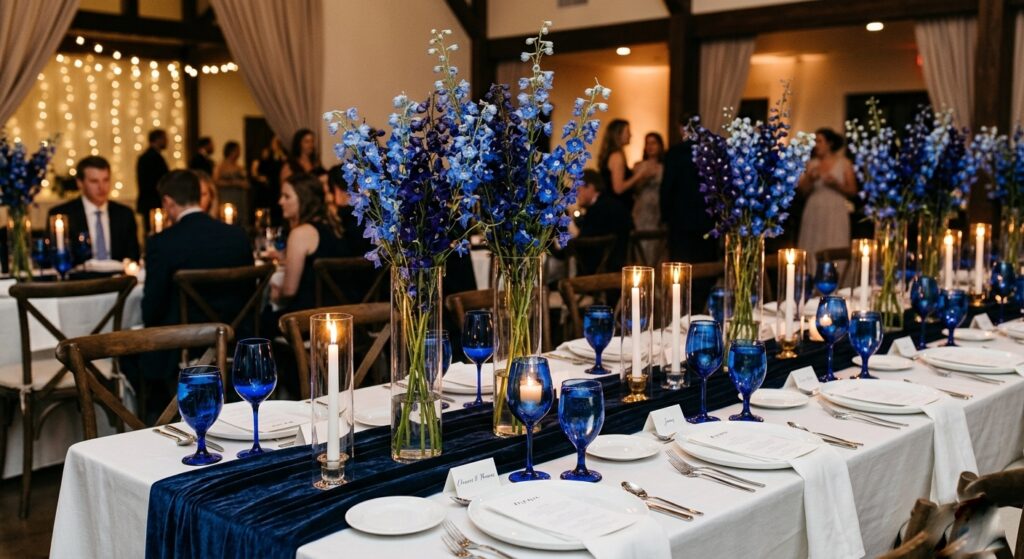
One shade. Not six trying to agree. The table was white, the glass was blue, and the light moved through it like water through a window. Nobody needed anything else. That’s the discipline nobody warns you about: knowing exactly when the room is done.
The Short Answer
Pick one shade of blue before you touch a single item.
Not “mostly navy with some dusty blue accents.”
One shade. Then use it in two or three places only — glassware, candles, a textile. Let the rest of the table be neutral.
That restraint is what makes blue look intentional instead of themed.
The most beautiful blue weddings aren’t the ones with the most blue in them.
1. Cobalt Glassware as the Only Blue on an All-White Table
This is the idea that makes the most impact for the least effort — and almost every blue wedding article buries it in a paragraph about mixing shades.
Here’s the execution in full: white tablecloth, white plates, ivory or cream napkins, simple gold or brass candleholders with cream tapers. Nothing else.
Then: cobalt blue wine glasses and water goblets at every place setting. That’s your entire color moment.
The cobalt catches the candlelight in a way that no other blue element can replicate, and against the all-white table it reads as intentional, dramatic, and deeply elegant.
It costs less than a full floral arrangement and photographs better. Cobalt glassware sets from Amazon or World Market: $4–$8 per glass.
A set of two goblets per guest for a 100-person wedding: $800–$1,600 total — or rent cobalt glassware from most event rental companies for $1.50–$3 per piece.
The entire color story of your reception, delivered in glass.
Skip this if your venue’s existing lighting is very warm amber — cobalt reads deepest and most beautiful in cooler or neutral light. In very warm venues, opt for dusty blue glassware instead.
2. Blue Wax Taper Candles — No Flowers, Just Blue and Flame
Here’s the blue wedding idea that almost nobody executes because it feels too simple: replace flowers entirely with clusters of blue taper candles.
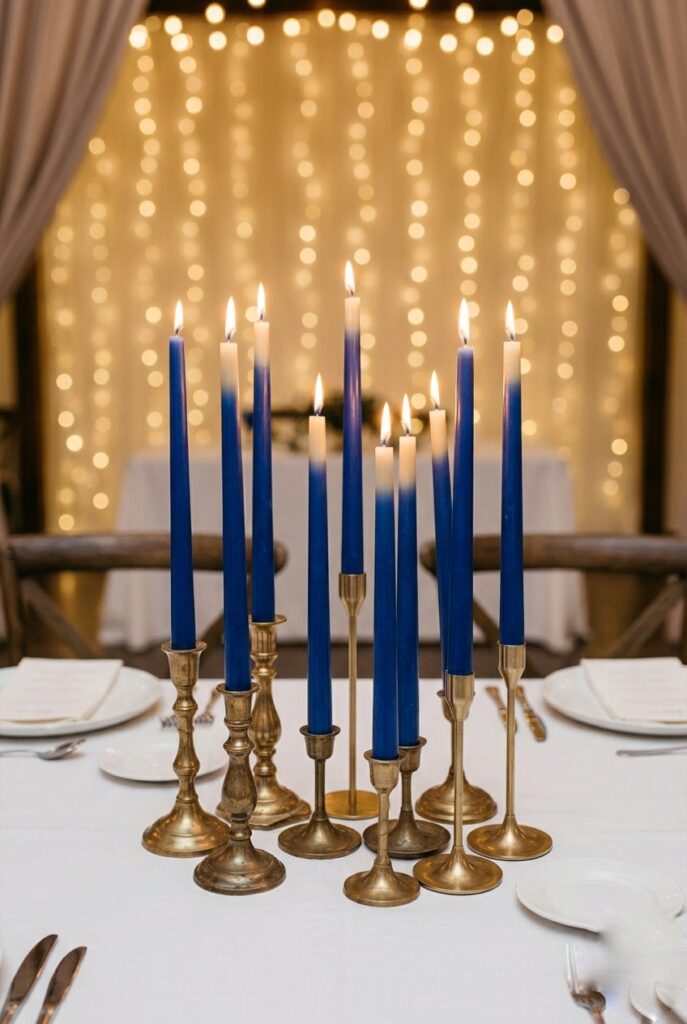
Navy, dusty blue, or cobalt wax tapers in mismatched brass and gold holders at varying heights — five to seven per table, nothing else.
No greenery, no arrangements, no fillers. Just candlelight and blue wax in a warm metallic cluster.
The effect in photographs is extraordinary: the blue wax softens toward cream at the flame, the gold candleholders reflect the light, and the table looks like an editorial shoot from a Paris restaurant.
Coloured taper candles from Etsy shops or Candles by Danielle: $12–$20 per dozen.
For a 10-table reception: $120–$200 total for centerpieces — the lowest-cost blue centerpiece strategy that still looks intentional.
This is the idea for couples who want blue without flowers and without a craft project.
3. Indigo Velvet Table Runner — One Textile, Full Commitment
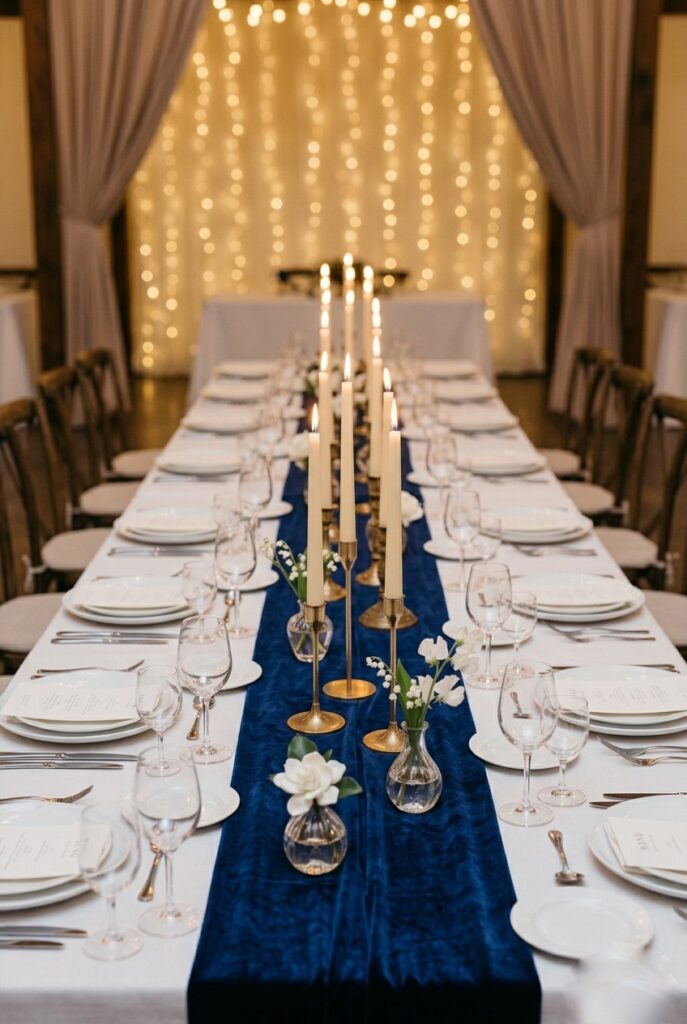
Velvet is the right material for deep blue.
Dusty blue velvet reads soft and romantic.
Navy velvet reads formal and rich. Indigo velvet reads like neither — it’s the shade between them, and it photographs with a depth that neither extreme achieves.
One indigo velvet runner down the center of an otherwise white or cream table is a complete tablescape decision.
You don’t need coordinating napkins in the same color.
You don’t need blue florals to echo it.
The runner does all the work — everything else stays neutral and lets it breathe.
Velvet table runners on Amazon or Tableclothsfactory.com: $12–$22 each. For a 12-table wedding: $144–$264 total.
This is the highest-elegance, lowest-complexity blue option in this entire list.
The one thing you must get right: buy the same dye lot if ordering multiple runners.
Slight shade variation between velvet pieces is visible at scale and breaks the effect entirely.
💡 Budget Hack #1: Velvet runners photograph dramatically darker than they appear in person. Before ordering 12 in the same color, order a single sample, lay it on your actual table linen under your actual venue’s light, and photograph it. What looks midnight blue in a daylit room reads as nearly black in evening candlelight — which may be exactly what you want, or may not be.
4. Blue Ribbon Chair Ties — Ceremony Color in a Single Gesture
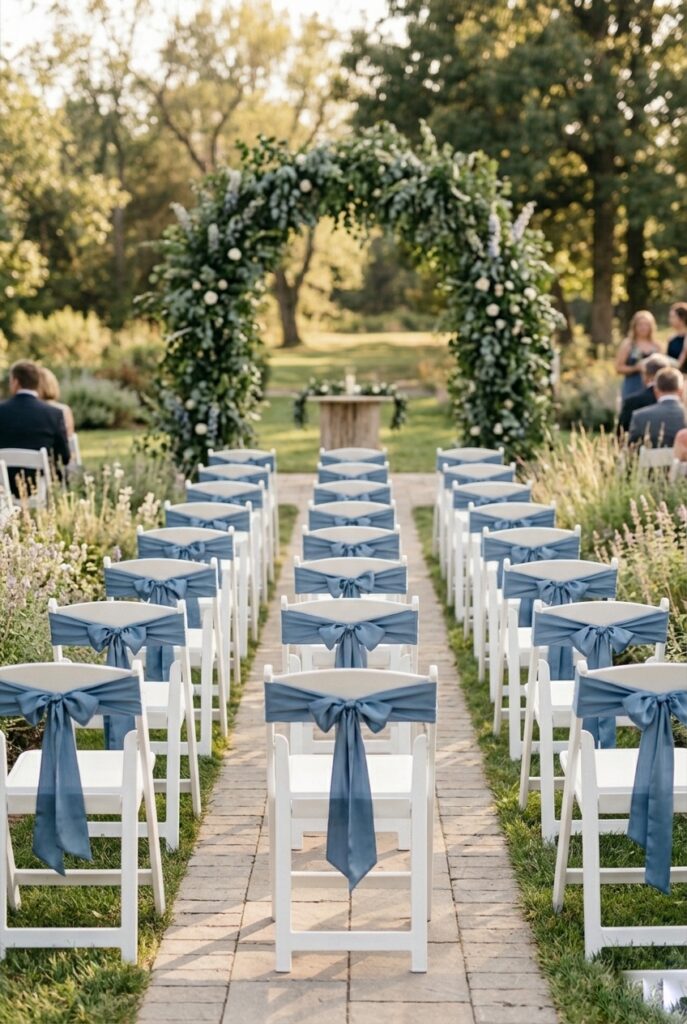
The most minimal ceremony color decision: one wide silk ribbon in your blue shade tied to the back of every ceremony chair, and nothing else.
No floral chair decor, no pew cones, no hanging arrangements. Just the ribbon, tied in a loose knot or a simple bow, in the same shade throughout.
The visual effect down a ceremony aisle — that consistent repetition of one color against white chairs — is one of the most underrated ceremony moments you can create, and it costs almost nothing.
Wide silk or satin ribbon (3 inches or wider reads best from a distance) from Etsy or a fabric supplier: $8–$15 per 10-yard spool.
For 100 chairs using roughly half a yard per chair: 3–4 spools total, $25–$60. After the ceremony, untie and repurpose the ribbon around napkins, bouquets, or favors at the reception. One material, used twice, for under $60 total.
Only do this if your chairs are uniform in height and style — ribbon ties look best when the repetition is precise. Mixed chair styles create a less cohesive line.
5. Agate Slice Escort Cards — Blue Mineral as the Color Story
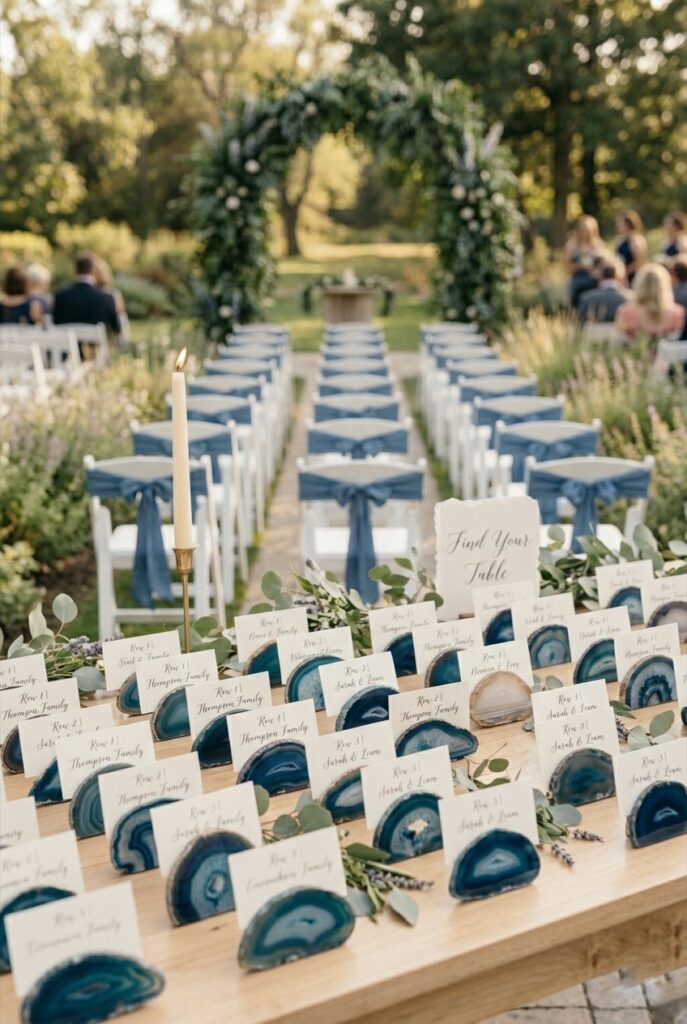
Natural agate slices in blue tones — the translucent banded mineral with veins of white and every shade of blue from pale sky to deep indigo — are one of the most photographed wedding details on Pinterest and one of the most genuinely beautiful ways to introduce blue as a natural, organic element rather than a dyed or painted one.
Use them as individual escort card holders: one slice per guest, a small card tucked into a cut slot, arranged across your welcome table.
Guests take them home. Blue agate slices on Amazon or Etsy: $1.50–$4 each depending on size.
For 100 guests: $150–$400 total for escort cards and favors combined.
The mineral pattern means every piece is unique, which is the design point — no two are identical, but all of them are unmistakably the same color story.
💡 Budget Hack #2: Agate slices are significantly cheaper when bought as an uncut slab lot from a mineral wholesaler or Etsy mineralogy supplier and hand-cut with a tile saw, rather than purchased pre-sliced. If you have access to a tile saw (many local maker spaces offer tool access for $10–$20/hour), you can cut 80–100 escort card-sized slices from a single slab for under $60 total. The slices are also thicker and more substantial, which reads as more premium.
6. Blue Candlelight Uplighting — The Entire Atmosphere, One Decision
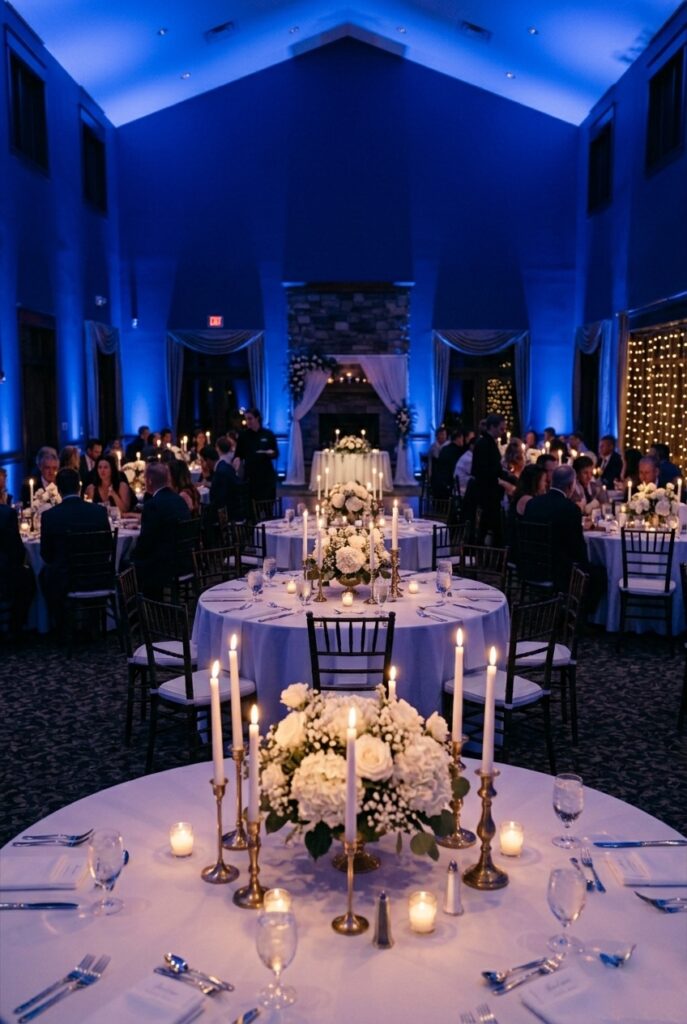
Here’s the blue wedding move that transforms the entire room without touching a single table: blue uplighting on the venue walls.
Sapphire or cobalt uplights rented from your venue’s AV supplier or a local lighting company wash every surface in blue — the effect is immersive in a way no tablecloth or centerpiece can match.
The contrast works best when the table level is kept deliberately warm (cream linens, gold candleholders, white florals) while the walls and ceiling carry the blue.
That contrast — warm intimate tables against a blue-washed room — is the combination that photographers love and guests remember.
Uplighting rental: $25–$50 per light. Eight to twelve lights for a full room transformation: $200–$600 total. This is the single largest visual return per dollar in blue wedding decor.
And because the blue is in the air rather than on the table, it doesn’t compete with anything — it becomes the room’s entire mood.
7. Delphinium-Only Centerpieces — One Flower, Dramatic Height, No Filler
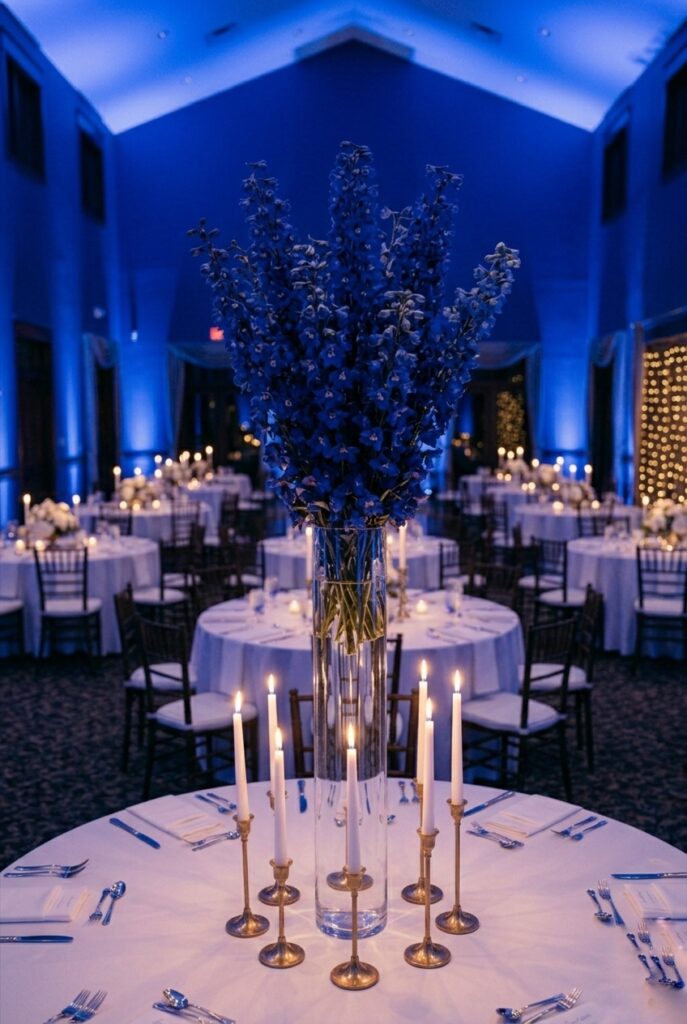
The minimalist florist move: one flower variety, one color, nothing else.
Delphiniums are the most naturally blue flower available, they grow tall, and they photograph beautifully without any arrangement skill because their vertical form does the work for you.
A cylinder vase of delphiniums — stems cut to the same length, tightly grouped, no filler, no greenery — creates a centerpiece of pure blue height that draws the eye upward and reads as architectural rather than decorative.
Delphiniums from a wholesale supplier or your florist: $8–$15 per stem.
Ten stems per centerpiece, per table: $80–$150 per centerpiece.
This is not the cheapest option on this list — it’s the most visually decisive.
The commitment to a single flower and a single color is exactly what makes it look more expensive than a mixed arrangement of the same price.
Only do this if your tables are round or if you’re using long banquet tables with enough length that tall centerpieces don’t obstruct conversation. Low ceilings and tall delphiniums fight each other.
💡 Budget Hack #3: Source delphiniums through a wholesale floral market (most major cities have one open to the public on weekend mornings) rather than through a florist. Wholesale pricing is typically 40–60% less than retail. A full bunch of 10 delphinium stems at wholesale: $12–$20. At a florist: $35–$60 for the same bunch.
8. Chinoiserie Blue-and-White China — The Table’s Entire Narrative
Chinoiserie — the ornate blue-and-white porcelain pattern with its garden scenes, birds, and florals — is the one tableware choice that contains an entire world in each piece.
Used as the primary color delivery at the table, it makes flowers largely unnecessary: the plates themselves carry the visual interest, the narrative, and the blue.
Everything else at the table stays deliberately quiet — white linen, crystal glassware, simple gold flatware, one small white flower arrangement.
The china does the rest. Chinoiserie rental plates through specialty vintage rental companies: $4–$10 per place setting.
Purchased from antique markets, estate sales, or eBay: $3–$8 per piece in sets of varying patterns.
This works particularly well for intimate wedding dinners and garden party receptions — any setting where the table itself is meant to be the experience.
9. Blue Fruit Tucked Into Neutral Arrangements — The Detail Nobody Sees Coming
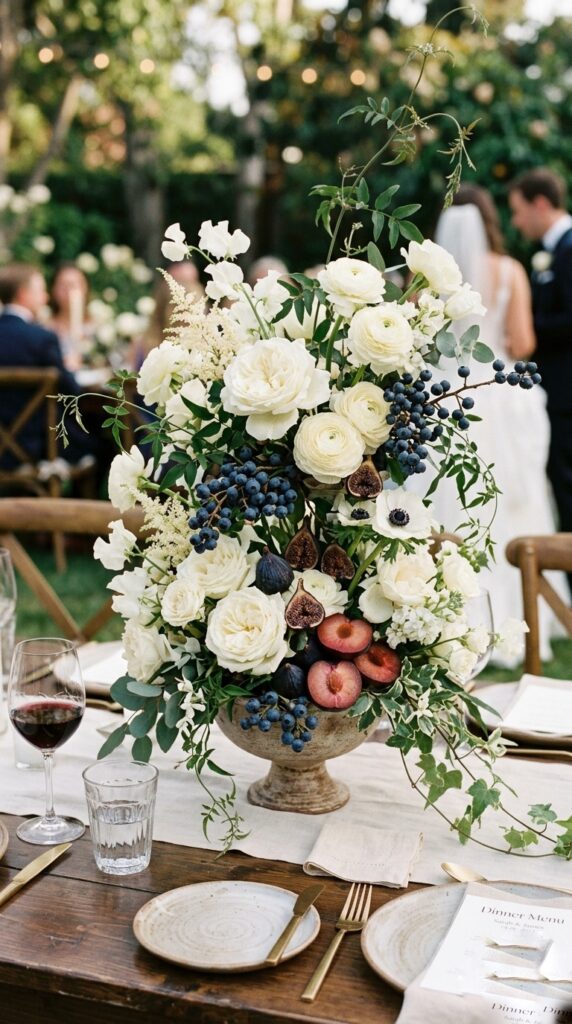
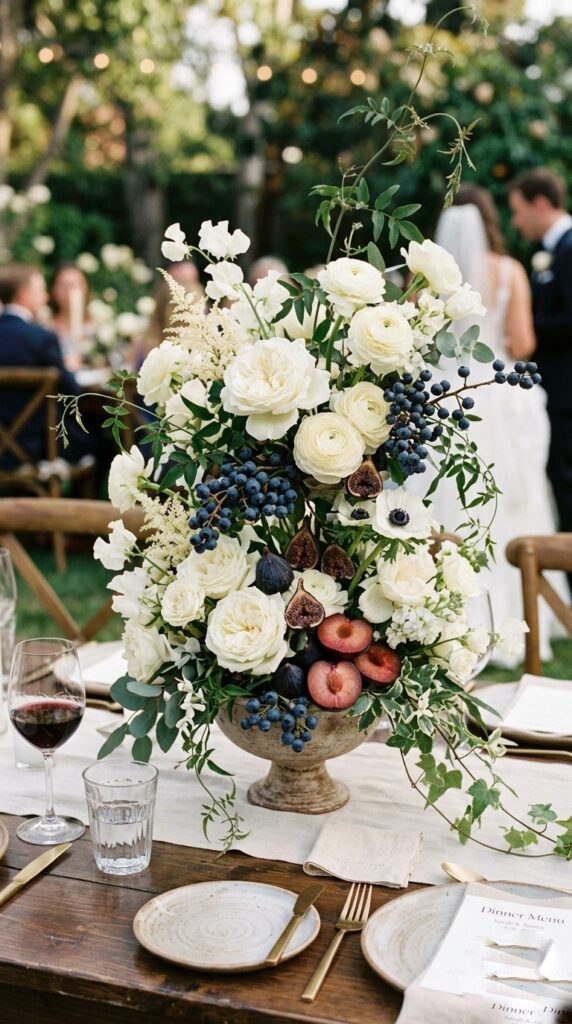
This is the gap idea that none of the competitor research touches: using naturally blue and blue-adjacent fruit as the color element within an otherwise neutral floral arrangement.
Fresh blueberries tucked between white garden roses. Halved dried figs with their deep indigo interiors.
Sliced plums with their purple-blue flesh.
These aren’t accessories to the flowers — they are the blue in the arrangement, and because they’re organic and natural, they read as considered rather than themed.
The effect is a centerpiece that has blue in it without looking like a blue wedding centerpiece, if that distinction makes sense.
Blueberries by the pint from Costco or a farmers market: $3–$6. Dried figs from a specialty grocer: $4–$8.
Add them to your florist’s brief as inclusions or tuck them in yourself the morning of the wedding.
This is the smallest cost addition with the most unexpected visual payoff on this entire list.
10. Blue Wax Seal Stationery Extended to Place Cards and Menus
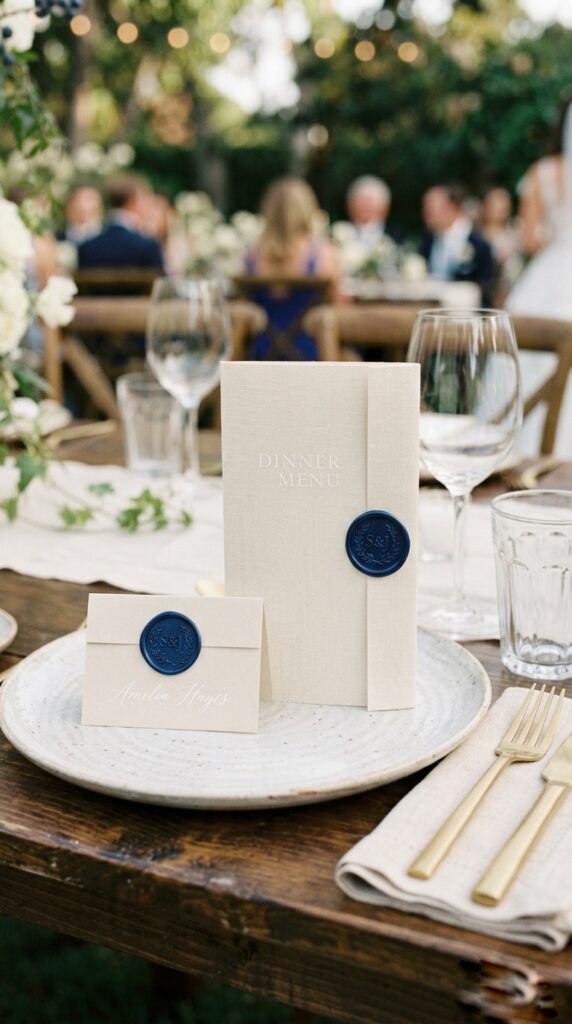
The most restrained blue detail on this list — and the most elegant.
A blue wax seal on every menu card and place card is a single circular gesture that introduces your shade without overwhelming anything.
Navy blue wax with a botanical or initial stamp pressed into it, applied to heavy cream card stock, placed on a white plate: the combination is quietly luxurious and requires nothing else.
Wax seal kits from Amazon with a stamp and colored wax beads: $15–$30 for a complete kit.
Blue wax beads specifically: $6–$10 per bag, enough for 80–100 seals.
Per-guest cost: under $0.30.
This is a detail that requires exactly one quiet evening to produce and elevates every place setting in a way that guests notice without knowing why.
It extends your blue story into the stationery without a redesign — just a wax stamp in the right color at the right moment.
Make the Decision Before You Touch the Mood Board
- If your venue has dramatic lighting or strong architecture → use blue uplighting and keep every surface neutral
- If your budget for decor is under $1,000 → cobalt glassware rental + blue taper candles + indigo velvet runners covers every table beautifully
- If you want blue but don’t want it to dominate → blue fruit in neutral arrangements and wax seal stationery deliver the shade without the commitment
The Real Reason Blue Weddings Look Dated Before the Day Is Over
Because couples treat it like a theme instead of a decision.
A blue theme is: blue tablecloths, blue napkins, blue candles, blue flowers, blue ribbon, blue signage, blue cake.
Every surface has blue on it and the whole room feels like a nursery.
A blue decision is: this shade, these two or three surfaces, nowhere else.
That constraint is what separates a color palette from a color flood.
The couples who do it right choose one shade so specifically they could name its hex code — not “dusty blue” but “this particular dusty blue, the one that looks grey in shade and true blue in sunlight.”
Then they use it in the most impactful places and stop. The rest of the room stays white, cream, and greenery.
The blue items look chosen, not collected. That’s the difference.
Contrarian truth: the most photographed blue weddings have less blue in them than you’d expect.
The blue earns its place precisely because it isn’t competing with a dozen other iterations of itself. Edit until it hurts.
Then edit one more time.
Mistakes That Make Blue Look Like a Decoration Instead of a Decision
Using three different shades of blue in the same room. Dusty blue napkins, navy runners, and sky blue florals is not depth — it’s indecision.
Depth in a blue palette comes from texture and material variation within a single shade: a dusty blue velvet runner next to a dusty blue taper candle next to dusty blue glassware.
Same shade, different surfaces. That’s how you create richness without chaos.
Matching the bridesmaids’ dress color exactly to the table linens. When the table linen is the same shade as the bridesmaids, every photograph has the bridesmaids visually merging into the background of the reception.
Offset by at least one tone — navy bridesmaids with dusty blue tables, or sky blue bridesmaids with indigo linens.
The contrast keeps everyone visible and distinct in every photo.
The one that quietly ruins the whole aesthetic: Choosing blue florals without asking what that shade looks like in your venue’s specific light.
Blue hydrangeas in natural afternoon light read as true blue.
The same hydrangeas under warm incandescent or amber Edison bulb lighting look grey, almost colorless, because warm light strips cool tones.
If your reception is evening and warm-lit, blue florals will disappoint you.
Glassware, velvet, and candles hold their color in warm light far better than flowers do.
Know your light before you commit your color to florals.
People Also Ask: What Colors Go With Blue for a Wedding?
The safest answer is white and gold — it works for every shade of blue from the softest dusty to the deepest navy.
But the more interesting answer depends on the shade.
Cobalt pairs powerfully with warm white and black, or with terracotta and cream for something unexpected.
Dusty blue pairs most beautifully with sage green, ivory, and antique brass — the palette that photographs best in natural light.
Navy pairs with blush and champagne for something romantic, or with deep forest green for something moody and rich.
Indigo — the shade between blue and violet — pairs with warm cream and dried botanicals for an editorial, autumn-appropriate look that feels entirely its own.
The one pairing to skip across all shades: blue and silver.
It reads as prom, regardless of the quality of the individual pieces.
Blue Wedding Decor Budget Breakdown
| Element | Budget Option | Mid-Range | Premium |
|---|---|---|---|
| Cobalt glassware (rental per piece) | $1.50–$2 | $2.50–$4 | $5–$8 own |
| Blue taper candles (per dozen) | $12–$16 | $18–$24 | $28–$40 beeswax |
| Indigo velvet runner (each) | $12–$16 | $18–$22 | $25–$40 |
| Blue ribbon chair ties (per spool) | $8–$12 | $14–$20 silk | $22–$35 wide satin |
| Agate slice escort cards (each) | $1.50–$2.50 | $3–$4 | $5–$8 large |
| Blue uplighting (per light rental) | $25–$35 | $35–$50 | $55–$80 |
| Delphinium centerpiece (per table) | $80–$110 | $120–$160 | $180–$250 |
| Chinoiserie china (rental per setting) | $4–$6 | $7–$10 | $12–$18 |
| Blue fruit add-on (per table) | $3–$8 | $10–$16 | $20–$30 |
| Wax seal kit + blue wax | $15–$22 kit | $25–$35 | $40–$60 premium wax |
Blue is already a complete decision. You don’t need to decorate on top of it — you need to let it work.