
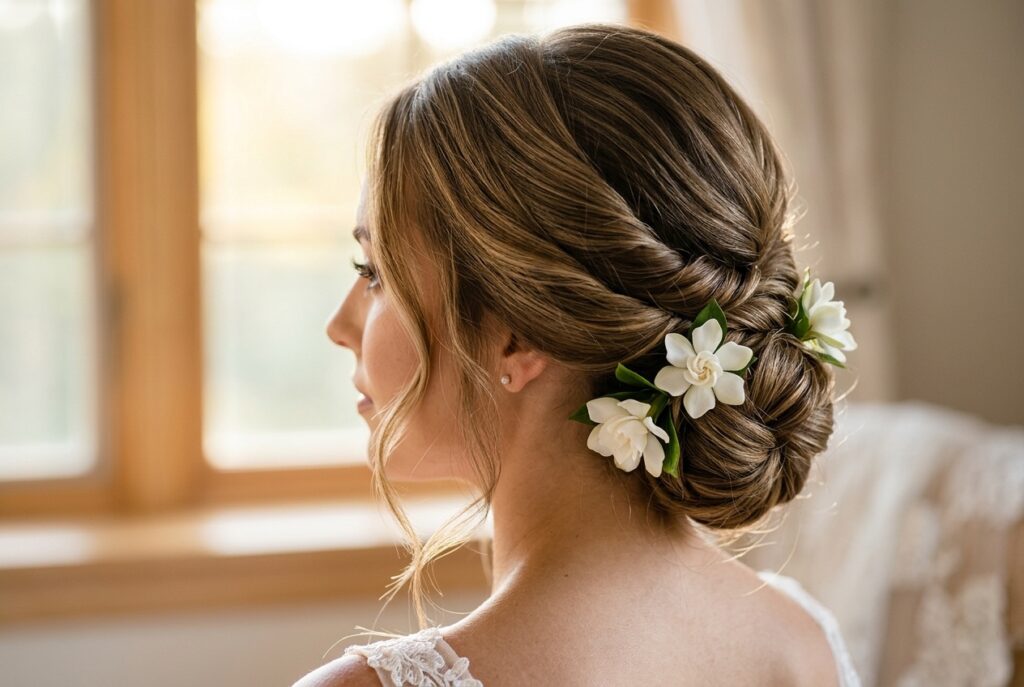
Most brides spend three months choosing their dress and forty-five minutes choosing their hairstyle — then wonder why their hair falls apart before the first dance.
The problem isn’t the stylist. It’s that nobody tells you which styles are actually built for a full wedding day, and which ones only work for a styled shoot.
This guide gives you the insider read on what holds, what photographs, and what you’ll regret by hour seven.
Bobby pins along the nape of the neck, the smell of hairspray and gardenias mixed together, satin ribbon threaded through a low chignon. Your hands still cold from the florist’s refrigerator. Somewhere between the mirror and the door, a small decision that will outlast most of the flowers.
The Short Answer
Your hairstyle isn’t just about looks — it’s a structural engineering problem that needs to last from 10am ceremony photos to midnight on the dance floor, through humidity, a veil removal, two outfit changes for some brides, and whatever weather decides to do.
The styles that photograph best are almost never the ones that hold best, and finding the middle ground between those two facts is where good bridal hair actually lives.
Forget what looks good on someone else’s wedding gallery.
What matters is what your specific hair texture holds, what your venue’s humidity does to curl, and what appears in the back of every single ceremony shot your photographer takes.
1. The Low Twisted Chignon
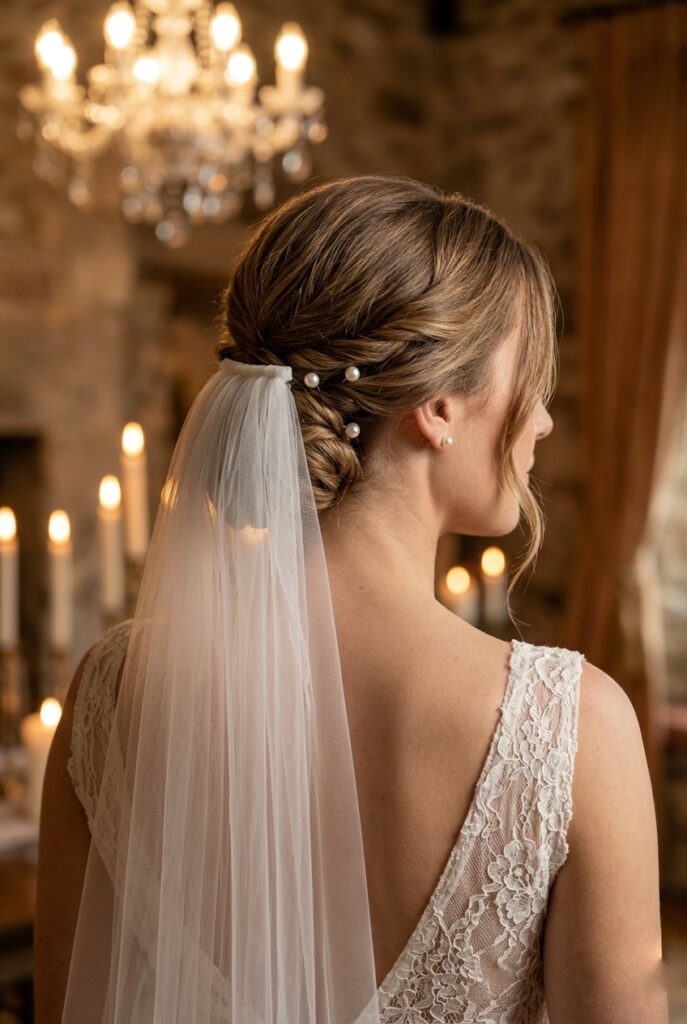
This is the workhorse of bridal hair and for good reason — a well-constructed chignon stays put through dancing, hugging, wind, and crying.
The key word is “well-constructed.”
A chignon built on dirty (day-old) hair with a strong pomade base, secured with at least 15–20 pins in a crosshatch pattern, will survive a hurricane.
A chignon built on freshly washed hair with three pins will fall apart by cocktail hour.
Taste layer: The cheap version is the foam donut bun from a drugstore — stiff, perfectly round, and reads as a flight attendant from 2003.
What you want is a hand-twisted chignon where the sections are irregular and the surface has soft texture, not a sealed lacquered finish.
Ask your stylist specifically for “lived-in tension” rather than “smooth.”
Price range: $150–$400 with a professional bridal stylist. Search WeddingWire’s bridal hair stylist directory filtered by your zip code to find someone who specializes in updos specifically.
2. Soft Hollywood Waves
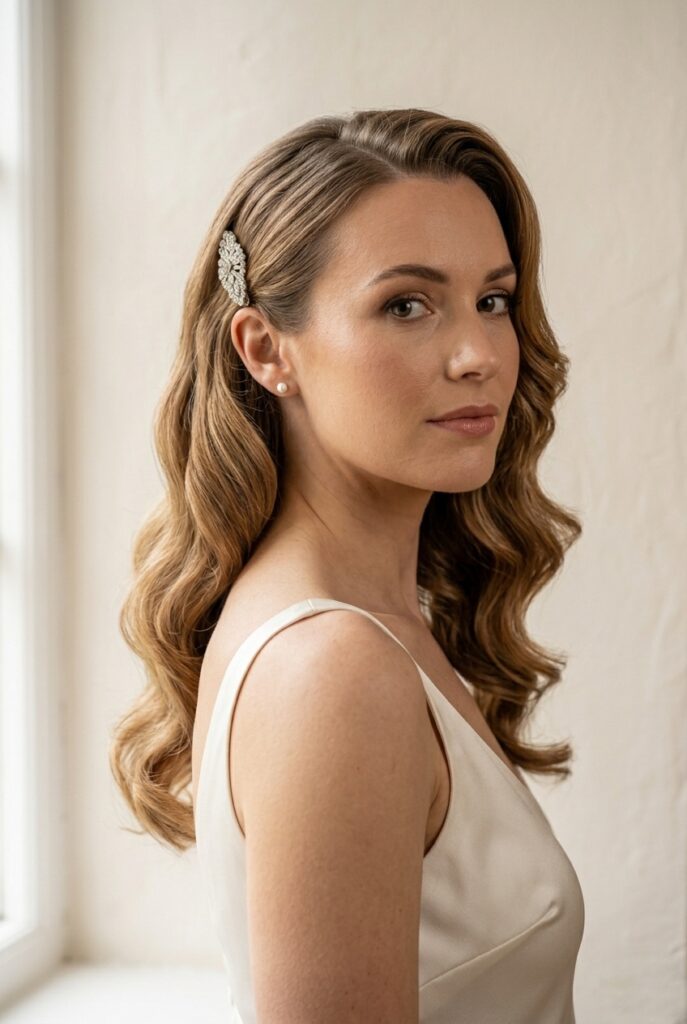
Hollywood waves look extraordinary in photos — they catch light the way no other style does, and the structured S-curve photographs on camera like a painting.
The problem is that genuine Hollywood waves require fine, smooth hair to hold their shape, and they can lose definition in humidity within two to three hours without the right setting spray.
Only do this if your hair is naturally fine to medium, or you’ve confirmed with your stylist that your texture can hold a set curl.
If your hair is thick, coarse, or has any natural wave, your stylist can achieve a looser “modern wave” version that actually holds better and still reads just as glamorous in photos.
Source: Pravana Nevo Styling Spray ($22, Amazon) is the product most editorial hair stylists use for setting waves that last through a full event day without going crunchy.
3. The Braided Crown (Gap Idea #2 — Hair Durability by Hour)
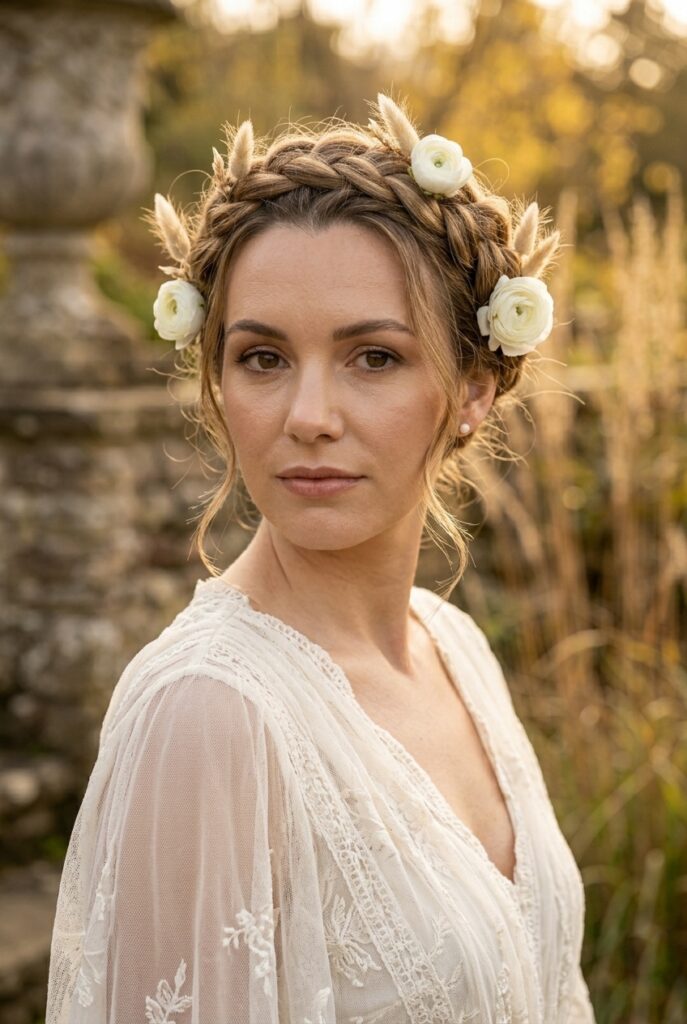
The braided crown is the single most durable bridal hairstyle that exists, and almost no bridal hair article gives it credit for that. A braided crown, once pinned, does not move.
It will look identical in your getting-ready photos at 10am and your last dance photos at midnight.
No touching up, no hairspray reapplications. For outdoor weddings, beach ceremonies, or summer weddings in humid climates — this is the objectively correct choice.
It also photographs differently depending on whether the braid is tight and sleek (more editorial) or loosely woven with texture (more romantic).
You get a genuinely different look by simply asking your stylist to change their braid tension.
Check out how braided elements can also complement your garden wedding decor for a cohesive aesthetic from hair to flowers to table arrangements.
Price range: $120–$320 with a professional stylist. Etsy sellers like TheWildFlowerPress sell dried floral hair adornment kits ($18–$45) designed specifically to be woven into braids.
💰 Budget Hack #1: Book your hair trial on a Tuesday or Wednesday rather than a weekend. Most bridal stylists charge $75–$100 for a weekday trial versus $150+ on Saturday, because Saturday slots are premium. You get the exact same stylist and the exact same work for 40% less. Call and ask specifically — it’s not advertised.
4. Loose Romantic Curls (Down Style)
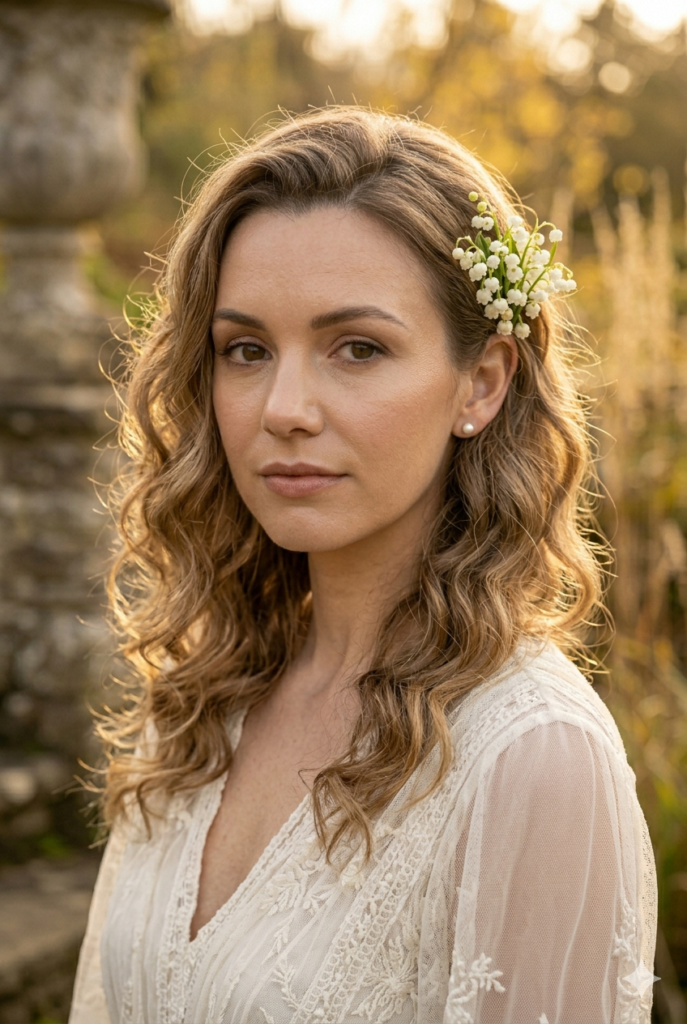
Down styles are the one area where stylists and brides consistently disagree, and the stylist is usually right.
A full down style with curls photographs with tremendous softness and romance, but it requires your hair to cooperate with humidity, and it means your hair will be touching your face, your neck, and your dress all day.
Many brides who choose a down style end up pulling their hair into a ponytail by the reception.
Skip this if your wedding is outdoors in summer, if you tend to run warm, or if your venue is known for humidity.
That’s not an aesthetic judgment — it’s physics.
If you love the look of soft curls, ask your stylist about a half-up version that keeps curls off your neck while still giving you the romantic down-hair visual.
The Knot has an excellent wedding hairstyle gallery with filterable options by hair length and style to help you narrow down what to bring to your trial.
Price range: $120–$350. Kenra Platinum Silkening Mist ($20, Amazon or Ulta) is the product most salon stylists recommend for controlling curl frizz without weighing down the bounce.
5. The Textured Low Bun With Face-Framing Pieces
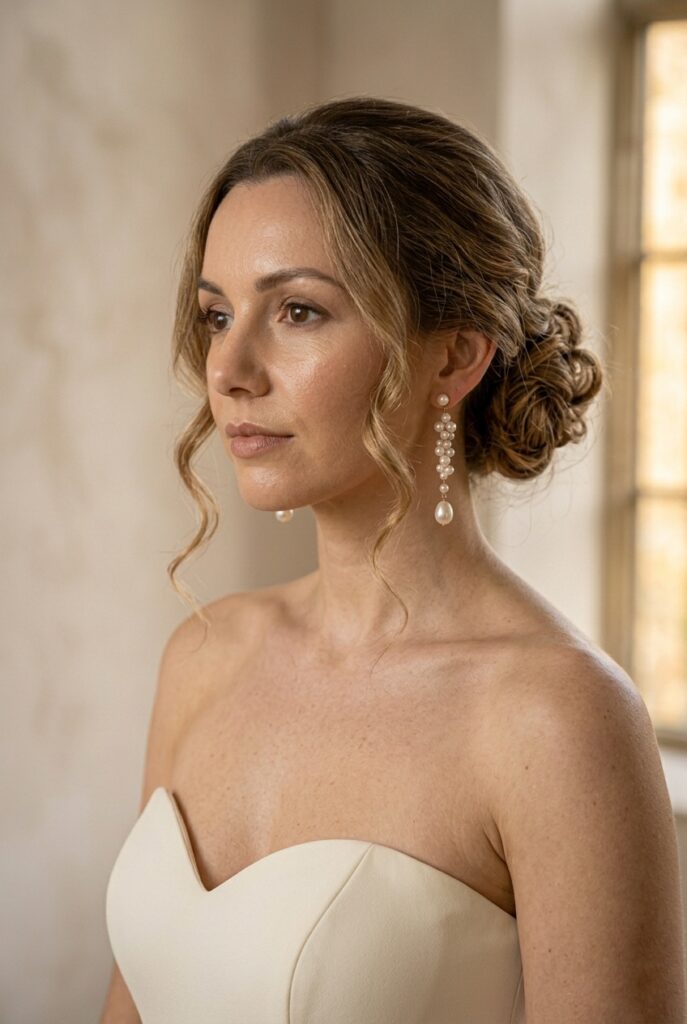
This is the style most working bridal stylists recommend as their personal first choice for clients who aren’t sure what they want.
It photographs beautifully from every angle, it’s forgiving across face shapes, it holds a veil cleanly, and the face-framing tendrils soften what would otherwise look overly severe.
It’s also easy to refresh — if a tendril drops or loses curl, you can re-curl it in 30 seconds with a wand.
The mistake brides make with this style is asking for it to be “perfect.”
The textured bun needs some imperfection to read as intentional rather than messy.
A bun that is too smooth is just a bun. A bun with a few pulled sections and visible texture reads as a deliberate choice.
Tell your stylist “I want it to look like it took effort but not effort” — every good bridal stylist knows exactly what that means.
Price range: $130–$380 with a professional stylist.
6. The Sleek Low Ponytail (Gap Idea #1 — Photography Frame Consideration)
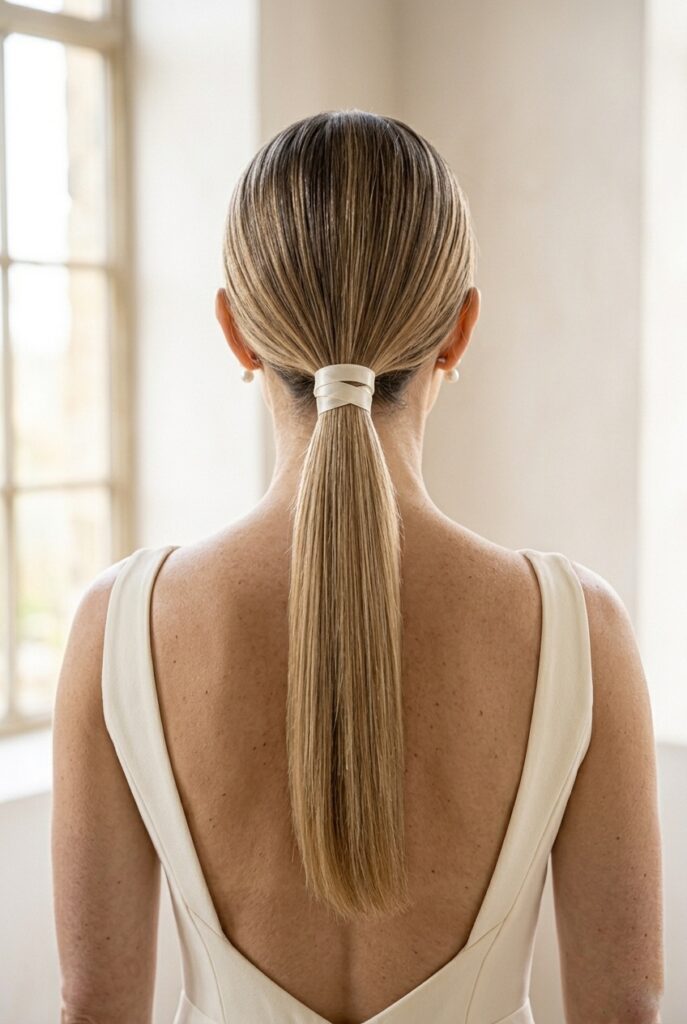
Here is what no bridal hair article tells you, and what every wedding photographer knows: the back of your head is in a significant majority of your ceremony photos.
The moment you walk down the aisle, exchange rings, and face the officiant, your photographer is shooting your back.
A sleek low ponytail with a satin ribbon wrap is one of the few hairstyles that is genuinely designed to be seen from behind — the clean geometric line, the ribbon detail, and the exposed nape create an intentional, editorial frame that looks as good from the back as it does from the front.
This is not commonly discussed in bridal hair advice, but it should be the first question you ask: what does this look like from behind?
For elegant wedding decor ideas with clean architectural lines and minimal florals, the sleek ponytail is the only hair style that genuinely matches the aesthetic energy of the room.
Price range: $100–$280 with a professional stylist. Add a silk ribbon wrap from Etsy ($8–$15) for a detail that elevates the entire look.
💰 Budget Hack #2: If you want extensions for volume or length on your wedding day, rent clip-in wefts rather than buying. Luxy Hair and Zala both offer high-quality human hair clip-ins starting at $120 for a full set — worn once, resellable on Facebook Marketplace afterward for 60–70% of the purchase price, effectively making your extensions cost $36–$48 net. Don’t buy from a wedding supplier charging $300+ for synthetic that photographs with a shine that reads as fake on camera.
7. The Veil-Compatible Updo With a Removable System
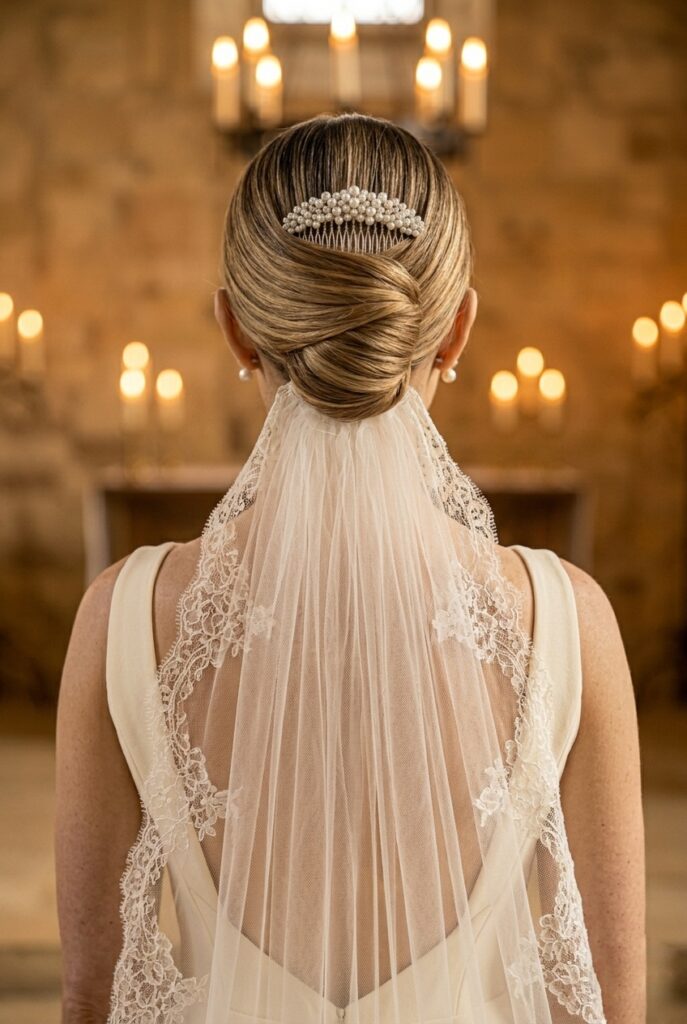
The veil is the single most overlooked detail in hair planning. Most brides choose their hairstyle and then figure out the veil afterward — which is exactly backward.
The veil placement determines everything: whether it sits at the crown, the mid-head, or the nape, and whether it’s attached with a comb, clips, or pins.
If you plan to remove the veil for the reception (most brides do), your stylist needs to build in a removable attachment system that leaves your hair looking complete and finished when the veil comes out, not like something is missing.
Ask your stylist at your trial: “What does my hair look like the moment the veil is removed?”
If they haven’t thought about it, find a different stylist.
The French twist, the textured low bun, and the low chignon all work beautifully with a mid- or crown-attached veil with planned removal.
This pairs naturally with vintage wedding decor ideas — the French twist especially reads as intentionally old-world when surrounded by antique candlesticks and sepia tones.
Price range: $150–$420 total for updo plus veil attachment strategy.
8. The Half-Up With a Statement Accessory
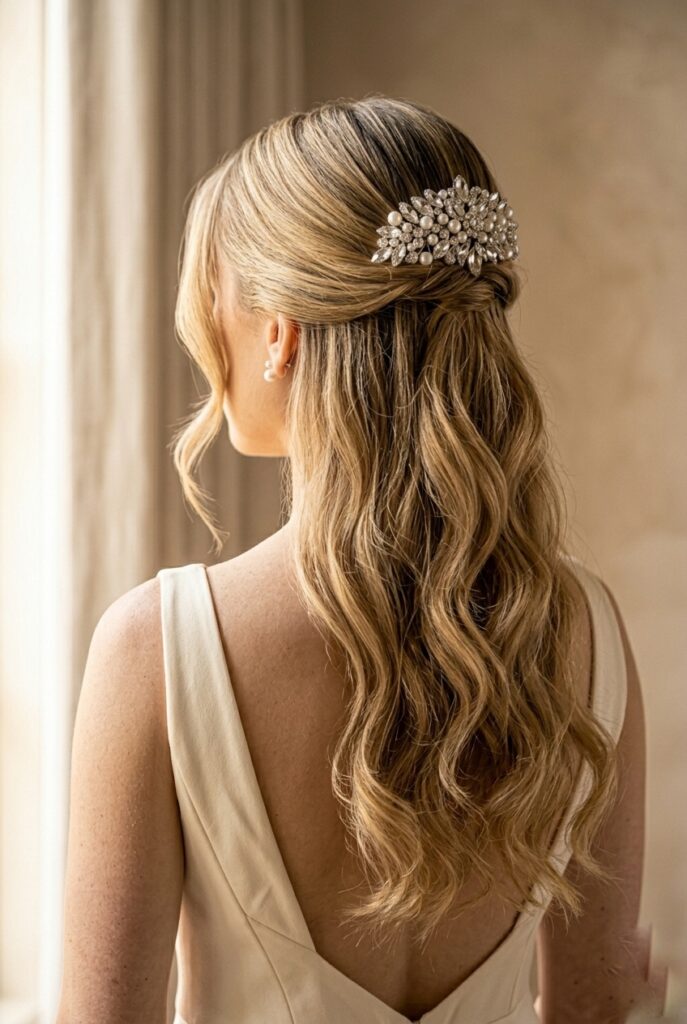
The half-up is the most forgiving style for brides who genuinely cannot decide — you get the romanticism of down hair and the formality of an updo, and you have options at every price point and hair length.
The style rises or falls entirely on the accessory. A drugstore butterfly clip looks exactly like what it is.
A well-chosen bridal comb from a jeweler or artisan maker is the thing people compliment at the reception.
Taste layer: Skip the rhinestone-studded combs mass-produced for the bridal market — they have too many stones, too much uniformity, and too much shine.
What works instead is a comb with asymmetrical placement of stones or pearls, slight oxidization on the metal, and enough negative space that it reads as chosen rather than purchased.
Etsy sellers like AnnaMarguerite and VioletteDesigns make pearl and crystal combs in the $45–$95 range that look significantly more expensive than their price point.
For a half-up style with maximum versatility, Zola’s comprehensive half-up half-down wedding hair guide covers how to adapt the look across hair lengths and textures.
Price range: $110–$300 for the style; $45–$120 for a quality bridal comb.
💰 Budget Hack #3: Trial sessions are often charged at full styling price, but if you schedule your trial at the same time as a bridesmaid preview session, most independent stylists will offer 20–25% off both sessions because they’re consolidating their time. Text or email your stylist directly — not through a booking platform — and ask whether they offer a combined trial discount. This saves the average bride $60–$90 off trial pricing alone.
9. The Romantic Upswept Style With Dried Florals
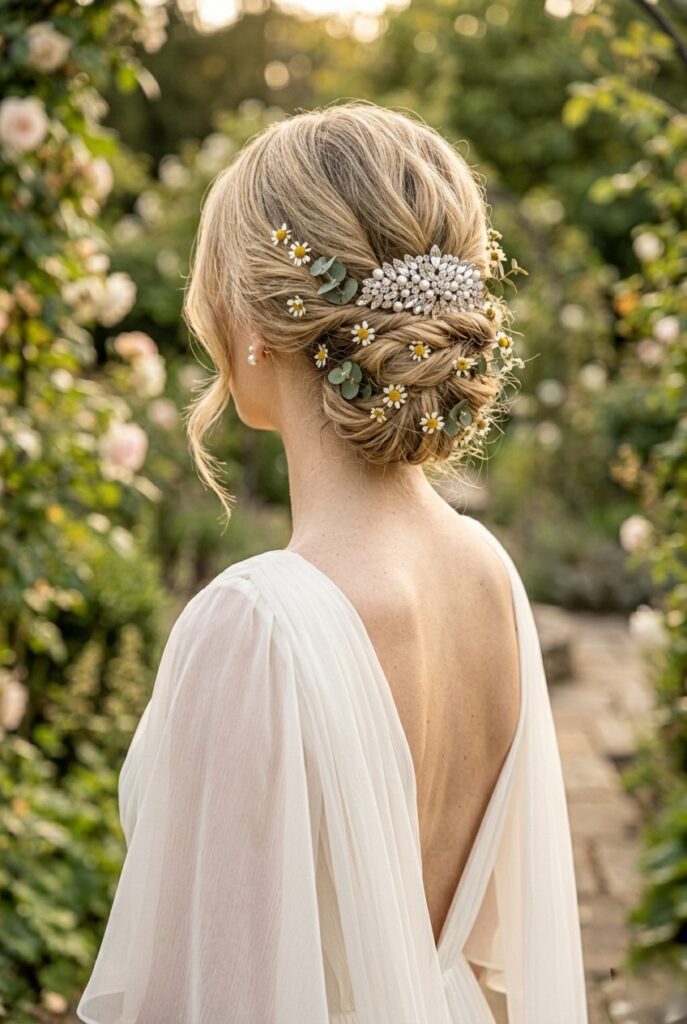
Fresh flowers in bridal hair have a window of about two to four hours before they begin wilting visibly, depending on the flower type and venue temperature.
Dried florals — chamomile, dried baby’s breath, pampas micro-sprigs, dried lavender — last indefinitely and photograph with the exact same soft, romantic texture as fresh flowers.
If your venue is warm or your timeline is long, dried florals are the intelligent version of fresh flowers in hair, not a compromise.
This approach suits rustic wedding decor and outdoor ceremony settings especially well — the dried botanical palette echoes the natural textures already in the space.
Dried floral hair kits are available on Etsy from $12–$35.
Price range: $130–$360 for the upswept style; add $12–$35 for dried florals.
10. The Sleek High Bun
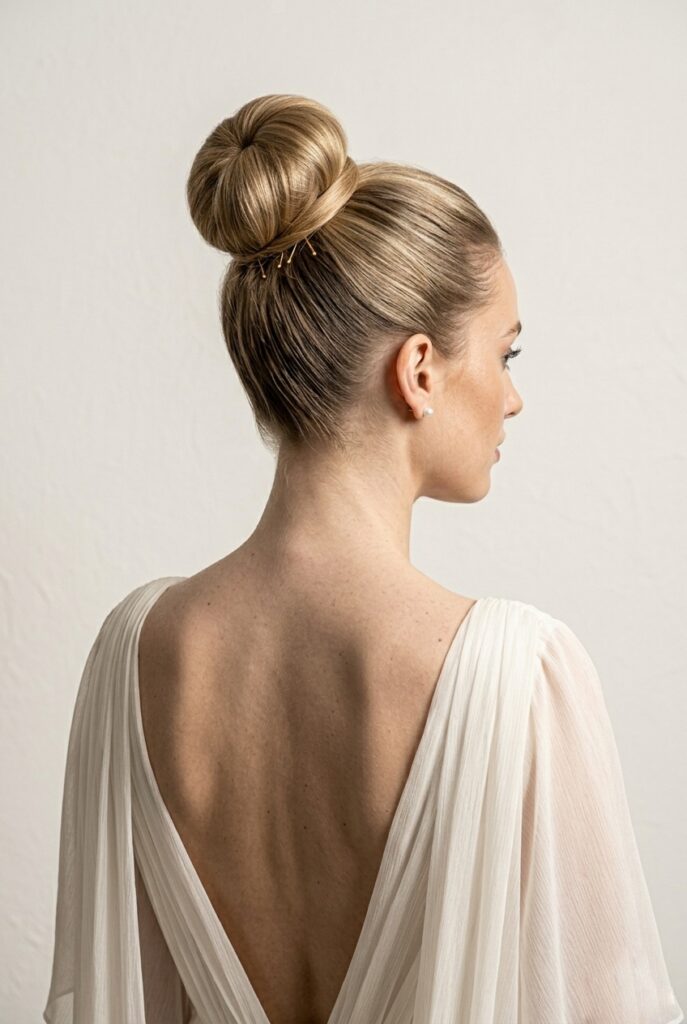
This is not for everyone, and that’s exactly its power.
The sleek high bun is architectural — it exposes the jawline, collarbone, and neck completely, and it creates a silhouette that reads as intentional and bold.
It is the correct choice for brides wearing statement earrings, dramatic necklines, or elegant, modern wedding decor with clean lines and sculptural florals.
It is the wrong choice for brides with rounder face shapes who prefer softer framing, or for outdoor summer weddings where the completely exposed neck becomes uncomfortable by noon.
Only do this if you’ve actually worn your hair up for a full day before and enjoyed it.
Some people find a tight high bun uncomfortable after four hours — test it at home for a day before committing to it for your wedding.
Price range: $100–$280 with a professional stylist.
Decision Filter
If your wedding is outdoors, at a beach venue, or in summer heat — cross every full down style off your list first, then choose from what remains.
If your ceremony runs longer than 90 minutes, your hairstyle needs pins, not spray, as its primary hold structure.
A style held primarily by product will begin shifting by the time you reach your vows.
For brides spending under $200 on hair, the braided crown and the textured low bun offer the strongest return — both are straightforward to execute, hold beautifully with minimal product, and photograph well across lighting conditions from ceremony to reception.
The Real Reason
The real reason most brides end up with a hairstyle they feel lukewarm about in their photos is that they chose their hair based on a photo from someone else’s wedding — different hair texture, different face shape, different venue lighting — and never interrogated whether it actually suited their specific situation.
The contrarian truth: the most important bridal hairstyle decision isn’t which style you choose. It’s whether the stylist you book has seen your hair texture in person before the wedding day.
A single-trial session is not enough time to problem-solve a difficult texture.
The best bridal stylists schedule two touchpoints before the wedding — a consultation with your hair dry, and a trial with it prepped — because the way your hair behaves when product-free is completely different from how it behaves after a blowout.
One appointment tells half the story.
The strong opinion: “Do what makes you feel like yourself” is the laziest advice in bridal beauty.
What makes most brides feel like themselves on a normal day is not appropriate for a 10-hour event under professional photography in 400 watts of flash and ambient light.
Your bridal hairstyle should make you feel elevated past your everyday self, not identical to it.
Here’s the insider observation that almost no bride hears before the wedding, but that every photographer knows: the light temperature inside your venue at ceremony time is almost always dramatically different from the light at the reception, and hairstyles respond to those two light environments differently.
Soft romantic styles with loose pieces photograph warmer and more dimensional in dim ceremony candlelight.
Sleek architectural styles hold their definition better under the brighter, cooler reception lighting.
If your venue transitions dramatically in light between ceremony and reception, the ideal is a hairstyle that works in both — which is why the textured low bun and the half-up are the two styles photographers consistently say they love working with most.
Mistakes to Avoid
Mistake 1: Washing Your Hair the Morning of the Wedding
Every bridal hair competitor article says “don’t wash the day of” but buries it in a list.
This deserves its own spotlight, because it’s the single most common mistake that derails styling and costs brides time. Freshly washed hair has a slick, product-resistant coating from the cuticle lying flat after water exposure.
It will not hold pins, hold curl, or hold product the way 24-hour-old hair does.
Wash your hair the evening before, sleep on it, and arrive to your appointment with day-old hair.
Your stylist will work faster, the style will hold longer, and you’ll be out of the chair with 30–45 minutes to spare.
Mistake 2: Overspending on a Hairpiece You’ll Wear for Four Hours
The average bridal comb or headpiece in a bridal boutique runs $85–$300.
Brides routinely spend $200+ on a hair accessory they wear during the ceremony and remove by the reception.
Etsy artisan makers produce crystal and pearl combs in the $45–$90 range that are genuinely indistinguishable in photographs from pieces costing three times more.
A bridal boutique markup on hairpieces averages 200–300%. Buy the accessory on Etsy, spend the savings on a better stylist.
Mistake 3: Not Planning Your Second-Half Hair
Most brides don’t realize until the morning after that their hair was already loosening, falling, or losing shape by hour five or six — which is right when the reception photos and candid moments happen.
Nobody plans for the second half of the wedding day. Before your trial, ask your stylist: “What does this style look like at hour six, and what can I do to revive it quickly?”
The answer should involve a specific touchup kit — a few extra pins, a small bottle of setting spray, and one additional product.
If your stylist doesn’t give you a specific answer, they haven’t thought about the whole day.
Mistake 4: Choosing Your Hairstyle to Impress Your Guests Instead of Your Future Spouse
This is uncomfortable but true. The hairstyle that generates the most compliments in the room is often the most elaborate, most maximalist option — the dramatic updo with rhinestones, the full bouncy curls with volume — because it reads as “effort” to a general audience.
Your photographer’s camera and your partner at the end of the aisle respond to something completely different: a style that enhances your specific face, moves naturally when you laugh, and doesn’t compete with your features.
The hairstyle that makes your partner’s face change when they see you is usually the one that makes you look like a heightened version of yourself — not a costume.
FAQ
What is the most popular bridal hairstyle right now?
The textured low bun with face-framing pieces is currently the most requested style in bridal salons across the US.
It works across face shapes, holds a veil cleanly, and photographs well under both natural and indoor event lighting.
It also transitions from ceremony to reception without any touchups needed.
How do I choose a bridal hairstyle for my face shape?
Match your hairstyle to the visual weight of your features rather than following a strict face-shape formula.
Soft pieces around the face add warmth to angular jawlines, while higher styles create length for rounder face shapes.
Your stylist can assess this in person at a consultation far more accurately than any online guide — the variables include your neck length, your ear placement, and how your natural hairline frames your face.
Should I do a hair trial before my wedding?
Yes — and schedule it at least eight weeks before the wedding.
A trial session lets you see the style under real lighting, test whether it holds for four-plus hours, and identify any adjustments needed.
Bring your actual veil if you have one, because the weight and length of the veil changes how the style sits on your head.
Can I wear my hair down for a wedding?
Wearing your hair completely down works best for indoor venues with climate control, shorter ceremonies, and brides with hair that holds curl naturally.
If your venue is warm, outdoor, or runs longer than 90 minutes, a half-up style gives you the visual softness of a down style with significantly better longevity.
Budget Table
| Style | DIY Difficulty | Professional Cost | Accessory Budget |
|---|---|---|---|
| Low Twisted Chignon | Moderate | $150–$400 | $20–$80 |
| Hollywood Waves | Hard | $150–$350 | $15–$40 |
| Braided Crown | Moderate | $120–$320 | $18–$45 |
| Loose Romantic Curls | Moderate | $120–$350 | $10–$30 |
| Textured Low Bun | Easy | $130–$380 | $25–$70 |
| Sleek Low Ponytail | Easy | $100–$280 | $8–$30 |
| Veil-Compatible French Twist | Hard | $150–$420 | $30–$90 |
| Half-Up With Comb | Easy–Moderate | $110–$300 | $45–$120 |
| Upswept With Dried Florals | Moderate | $130–$360 | $12–$35 |
| Sleek High Bun | Moderate | $100–$280 | $15–$50 |
Your hairstyle is not a decoration on top of everything else — it’s the frame around your face in every photograph taken that day, and your photographer is shooting the back of it for most of the ceremony.
Make that decision with the same rigor you gave your dress.
Now go to WeddingWire’s stylist directory, filter by your location and specialty, and book a consultation with someone who has seen your hair texture in person before you commit to anything.
That single step is worth more than any inspiration photo you’ve saved.