
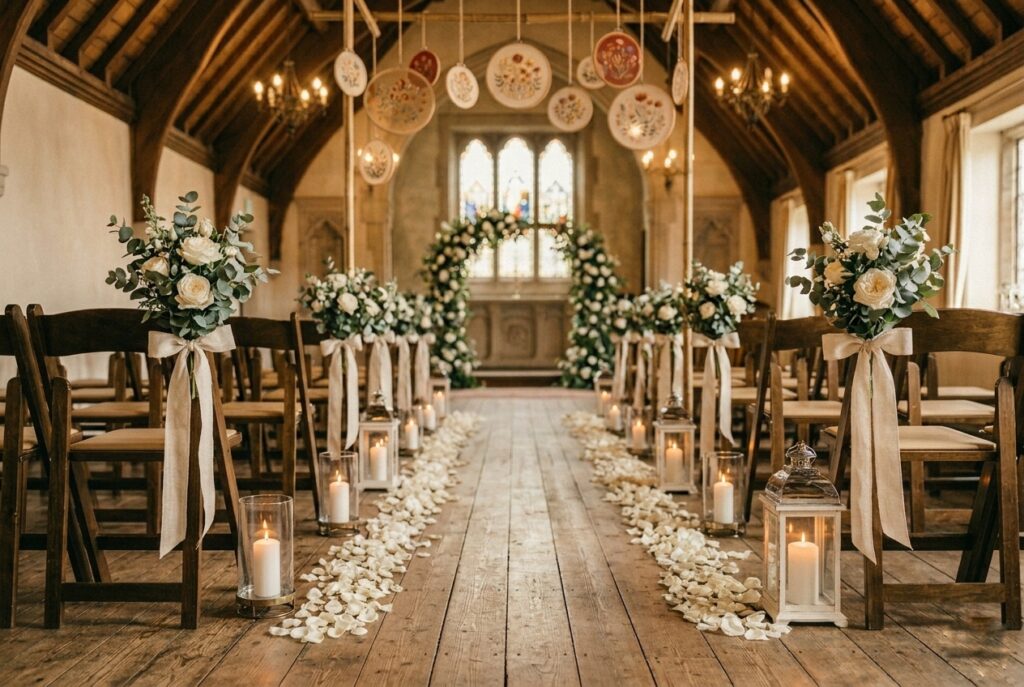
The aisle is the only part of your ceremony every single guest sees before you do — and it’s the setting for every processional photo your photographer takes.
Most couples spend ninety percent of their ceremony decor budget on the arch and leave the aisle looking like an afterthought.
The aisle is where your guests form their first impression of the day, and the ideas here will help you get it right without doubling your floral bill.
Petals on stone hold their color longer than anyone expects. The ribbon on the end chair loosens by the time the vows begin. Eucalyptus pressed flat against the back of a wooden chair. Its smell comes through before the music does. The aisle smells like a garden before it looks like one.
The Short Answer
Aisle decorations fail when they compete with the processional rather than frame it.
The job of every element along your aisle — every lantern, every floral cluster, every ribbon — is to draw eyes forward, toward the altar and toward you.
Anything that stops a guest’s gaze mid-aisle, or creates visual clutter at eye level, is working against you.
Less decoration placed with more intention almost always outperforms more decoration placed without a plan.
1. Alternating Lanterns and Floral Clusters on Shepherd’s Hooks
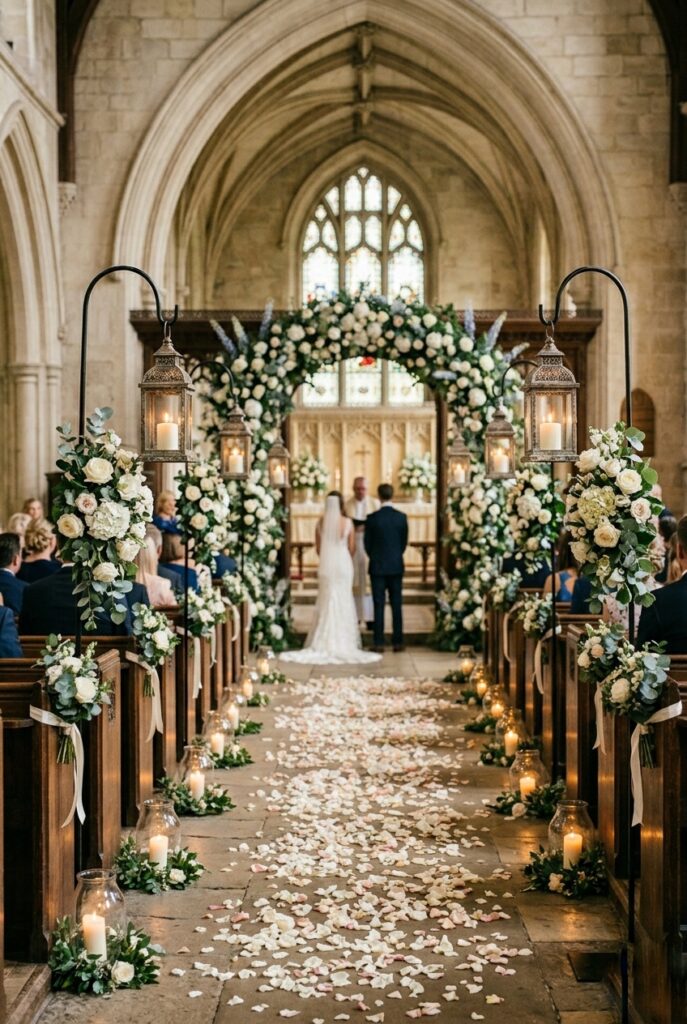
Shepherd’s hooks are the single most versatile aisle decoration tool because they elevate floral arrangements to standing height — which photographs cleanly at mid-frame in processional shots — without blocking sightlines or requiring chair attachment.
The key is alternating: one hook with a lantern, next hook with a small floral cluster, repeat.
The variation creates rhythm without making the aisle feel uniform and catalogued.
Metal shepherd’s hooks in matte black or antique brass run $2–$4 each on Amazon, and you’ll need two per aisle row if you want decorations on both sides.
Small floral clusters for each hook use three to five stems each — roses, lisianthus, or eucalyptus — and can be sourced wholesale and assembled the morning of the wedding.
Total per-hook cost: $6–$14 depending on flower choice.
For more ways to build out the ceremony space around the aisle, the full guide to outdoor wedding decor ideas covers ceremony framing from entry to altar.
2. Pew Markers — The Spacing Rule Nobody Tells You
[GAP IDEA 1 — No Competitor Gives This Specific Rule]
Every aisle decoration article tells you to use pew markers.
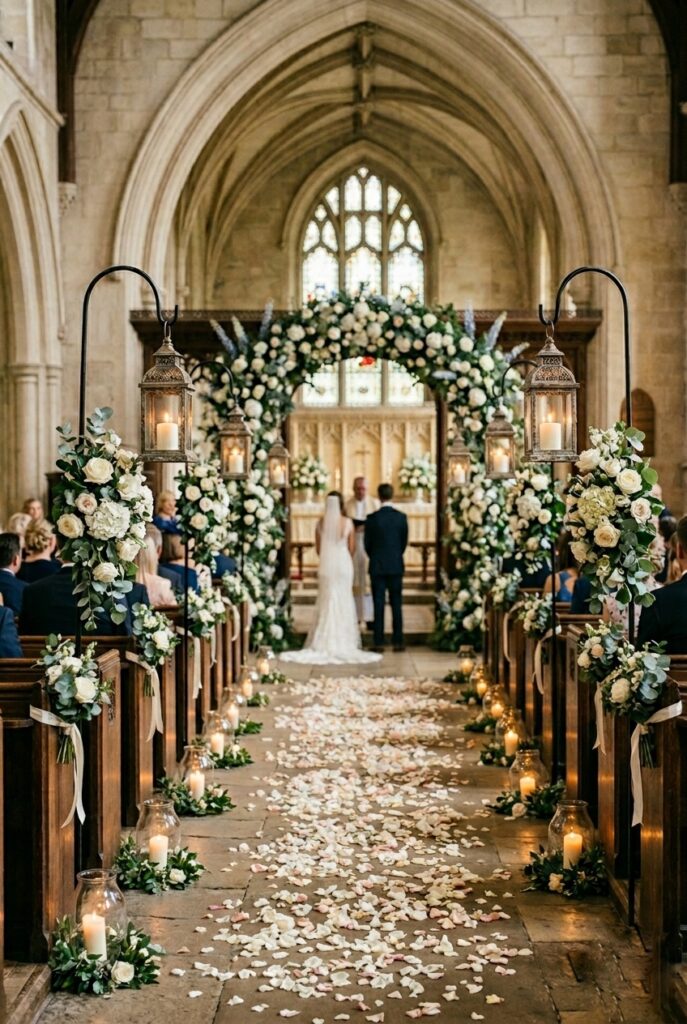
None of them tell you that decorating every other row rather than every single chair is the choice that actually photographs better, costs half as much, and makes the aisle feel longer and more expansive.
When you pack a marker on every chair, the aisle reads as a line of flower clusters rather than a grand walkway.
When you alternate — decorated row, bare row, decorated row — the eye travels forward more naturally, the individual arrangements have breathing room to read as distinct moments, and your photographer gets clean lines rather than a wall of florals on both sides of the processional frame.
Pew markers themselves are straightforward: a four to six stem cluster of your chosen flower in a small bud vase or foam holder, tied with ribbon to the chair end.
On Etsy, pre-made silk options run $8–$18 per marker; fresh versions made yourself cost $4–$9 per marker in materials from Trader Joe’s or a grocery store.
For a full ceremony done this way with 20 rows and alternating placement: ten markers per side, twenty total.
That is a meaningful budget difference against thirty-six or forty markers at every row.
3. Glass Hurricane Lanterns Along the Floor — Done Right
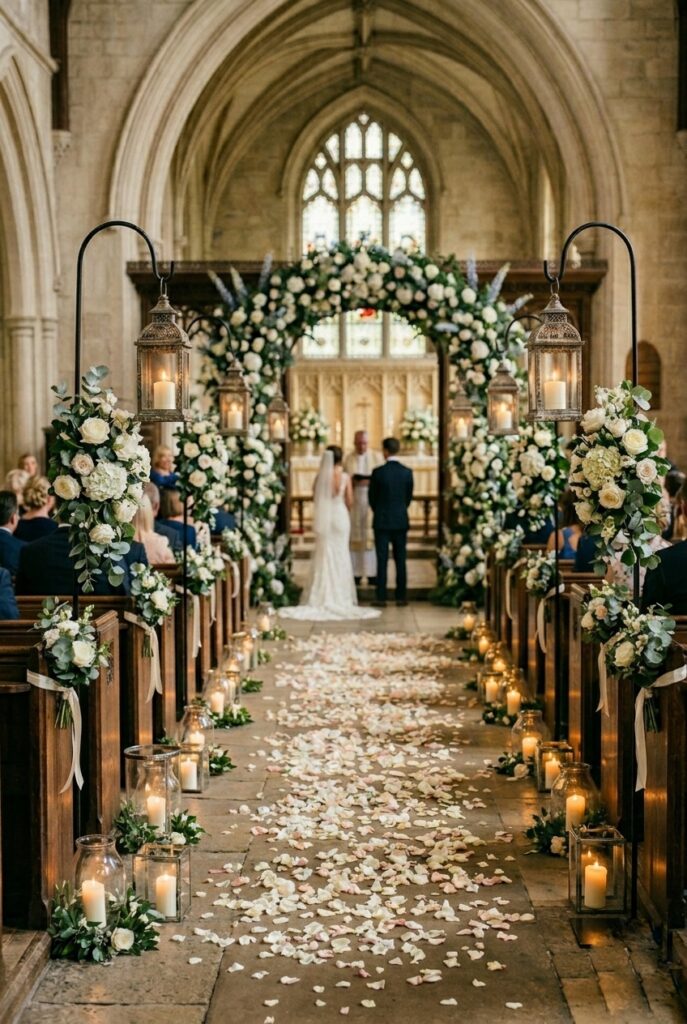
Floor lanterns feel genuinely romantic in photos in a way that chair-mounted arrangements do not — because they create a low, warm light source that glows at the level of the guests’ legs and the flower petals, and that glow is visible in every shot your photographer takes from the rear of the aisle.
The mistake that ruins this look is using matching lanterns of identical height in a perfectly straight line — it reads as hotel lobby, not wedding ceremony.
Buy three lantern heights (8″, 12″, and 16″) and alternate them in irregular groupings of two or three rather than one per position.
Clear glass hurricanes run $8–$22 each on Amazon; a set of twelve in three heights covers a full aisle for $120–$180.
If your venue prohibits open flame — ask specifically before setup — Luminara flameless pillar candles flicker convincingly and pass venue fire inspections ($18–$32 each).
Do not use cheap battery-operated candles here: the plastic flame tip is visible in close-up photographs and undermines the entire effect.
Skip this if your ceremony is fully outdoors with any wind — lanterns require calm air, and even a mild breeze turns an outdoor lantern ceremony into a constant fire-management situation for your coordinator.
The guide to budget wedding decor ideas has additional approaches for keeping ceremony costs lean without sacrificing the lantern look.
BUDGET HACK #1: Clear glass hurricane lanterns at wedding rental companies typically run $6–$12 per lantern per day, which adds up fast. Instead, check Facebook Marketplace and local wedding resale groups — couples sell lanterns after their weddings for $1–$3 each because they have nowhere to store them. Search “wedding lanterns” in your area with a location filter and buy four to six weeks before your date. For a 20-lantern aisle, you can frequently source the entire set for $30–$60 versus $120–$240 retail or rental.
4. An Aisle Runner That Actually Works
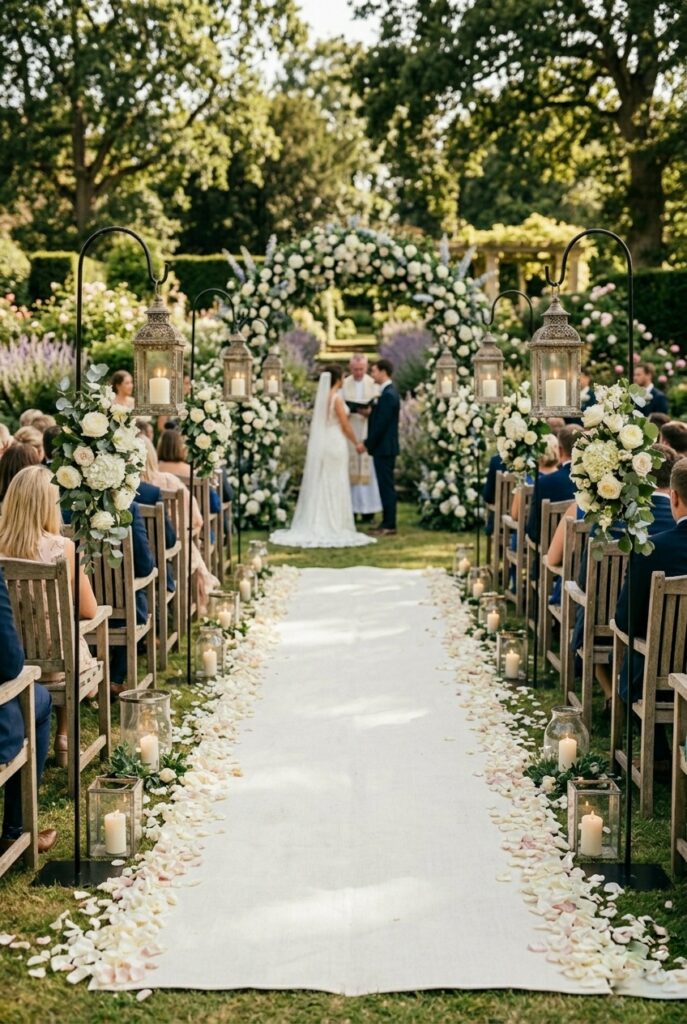
The cheap version of an aisle runner is a white polyester runner from a wedding supply site — it wrinkles in transit, bunches under foot traffic, catches on heels, and reads as plasticky in photographs. It is the single easiest aisle element to get wrong.
What actually works is a natural linen or cotton runner, or for a significant ceremony, a custom-printed option from The Original Runner Company, where monogrammed, printed, or painted runners start at $35 and go up to $150+ depending on length and design.
For DIY, unbleached muslin fabric from Fabric.com at $2–$4 per yard is cut to your aisle width and laid flat — it creases naturally and reads as intentional rather than polyester-smooth.
Any runner on an indoor hard floor must be taped down at the edges with white gaffer tape to prevent bunching; venues that prohibit adhesives require a runner with enough weight to stay flat on its own.
Test this at your venue before the wedding day.
5. Floral Petal Carpet — The One Competitors Always Underprice
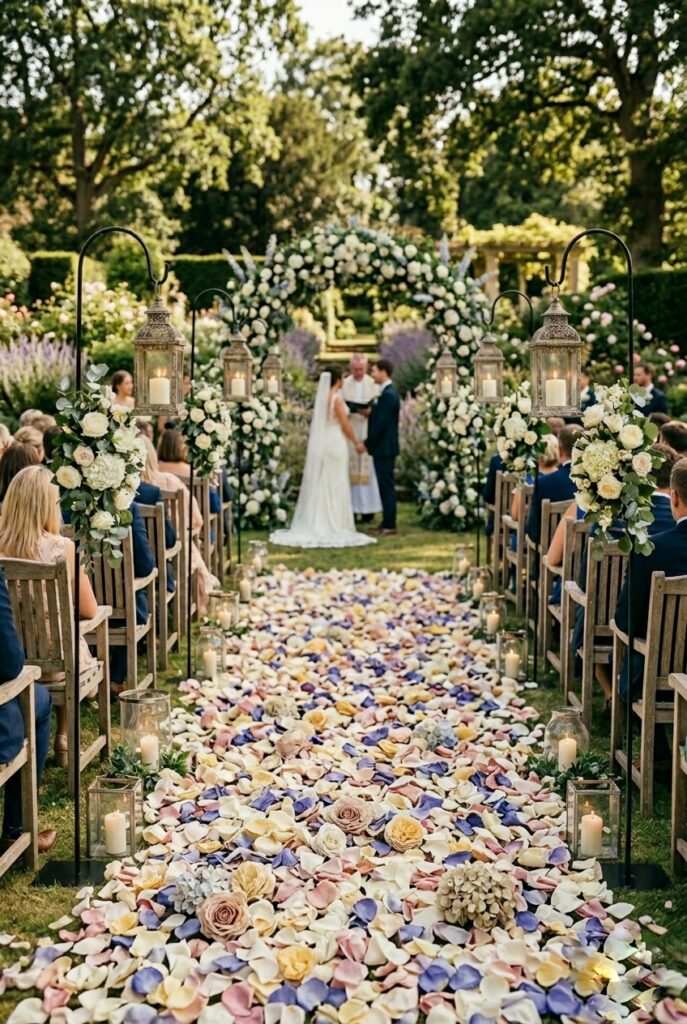
A true petal carpet — not a light scatter, but a dense, continuous layer of petals covering the full aisle floor — is the most photographed aisle decoration I have seen at two hundred weddings, and the most consistently underestimated in cost.
Competitors always present this as a budget-friendly option because petals are “just flowers.”
Here is the reality: a 50-foot aisle fully covered in fresh petals to the density you see in editorial photos requires 15–25 pounds of fresh petals.
Fresh rose petals from a florist run $20–$40 per pound, which puts a properly dense petal carpet at $300–$1,000 in fresh petals alone.
The budget alternative that nobody mentions: freeze-dried petals from PetalGarden or RoseHead on Amazon hold their color, don’t wilt, photograph identically to fresh, and cost $40–$80 for a quantity that covers a full aisle.
They are also significantly lighter and easier to scatter evenly than fresh petals, which clump.
Check your venue’s petal policy before ordering anything — many indoor venues prohibit fresh petals that can stain or damage floors, and most will accept freeze-dried.
6. Draped Fabric Along Chair Rows — Chiffon vs. Tulle Decision
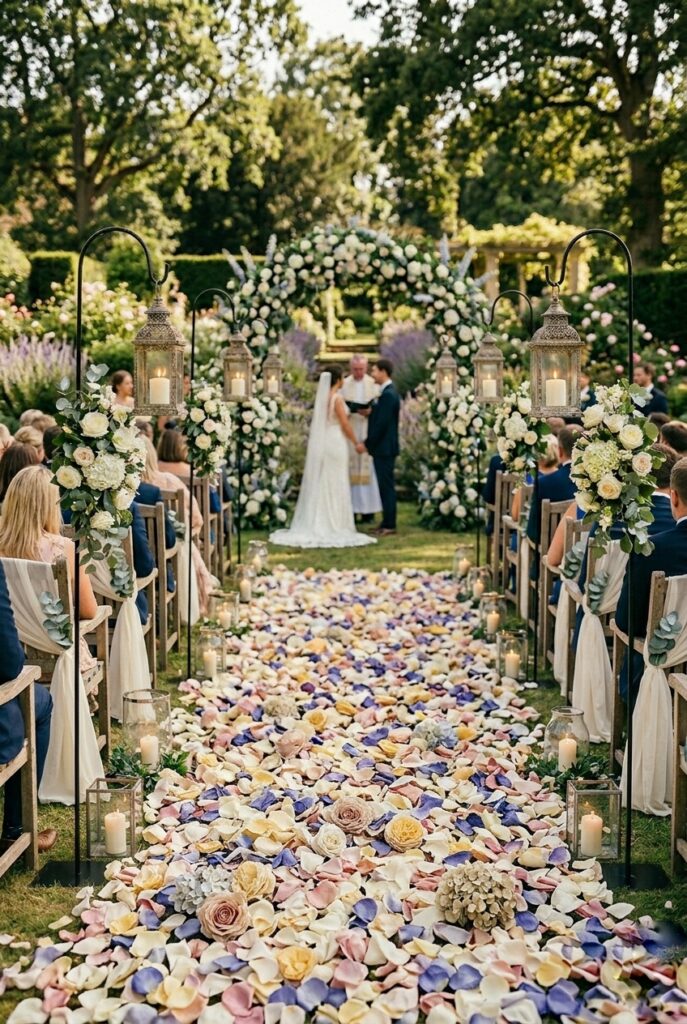
Fabric sashes on ceremony chairs are the easiest DIY aisle decoration — no floristry skill required — but the fabric choice determines everything.
Tulle is the cheap version: it reads as prom decoration, it snags on chair corners, and it wilts and bunches under its own weight within an hour of setup. Chiffon is what you want.
It drapes with natural weight, photographs softly in both natural and artificial light, and a 10-yard length of chiffon fabric from Fabric.com costs $8–$14, enough for two to three full chair wraps.
Ivory, dusty rose, sage green, and champagne are the colors that hold in photographs; pure white can blow out in direct outdoor light. Tie each sash in a loose, low knot rather than a bow — a bow reads as gift-wrapping, a loose knot reads as designed.
Add a single eucalyptus sprig or two dried rosebuds tucked into each knot and the result looks florist-assembled at a fraction of the cost.
Check the simple wedding decor ideas guide for additional no-skill ceremony approaches.
BUDGET HACK #2: Chiffon fabric for chair sashes is dramatically cheaper bought by the bolt than in pre-cut “wedding sash” packs. A pre-packaged set of 10 chiffon sashes on Amazon runs $18–$28 for ten chairs. Buying chiffon fabric from Fabric Wholesale Direct at $2.50–$4 per yard and cutting your own sashes at 10-yard lengths costs $25–$40 for the same ten chairs — and you control exact color, width, and drape weight. For a 100-guest ceremony needing 50 sashes: pre-cut packs cost $90–$140; bolt fabric cut yourself costs $38–$60.
7. Overhead Aisle Decor — The Highest-Impact Upgrade for Indoor Ceremonies
[GAP IDEA 2 — Fresh Angle Not in Top 10 Competitors]
For narrow indoor ceremony spaces — church naves, ballroom aisles, barn interiors — overhead aisle decoration is the single highest-return upgrade you can make.
A garland draped in a loose catenary curve from hooks on both sides of the ceiling above the aisle creates a botanical tunnel effect that appears in every processional photograph and video.
It requires no floor footprint, creates zero tripping hazard, and is completely invisible to guests until the music starts and they look up — at which point it becomes the detail everyone remembers.
Eucalyptus and greenery garland is the most cost-effective version: 6-foot artificial eucalyptus garlands from Amazon run $8–$14 each, and four to six strung end-to-end cover most aisle lengths.
For a fresh version, wholesale eucalyptus from a flower wholesaler or Trader Joe’s runs $3–$6 per bunch, and one bunch equals approximately three feet of loose garland when draped.
The practical requirement: confirm with your venue that hooks or temporary ceiling attachments are permitted.
Command strips rated for 5+ pounds work on most painted surfaces and remove cleanly.
If ceiling hooks are prohibited, rent a draping rig from a local event rental company for $80–$150.
For indoor venues where overhead decor is the focal point, the ideas in indoor wedding decor ideas complement this approach across the full ceremony space.
8. Potted Ferns and Living Plants as Aisle Borders
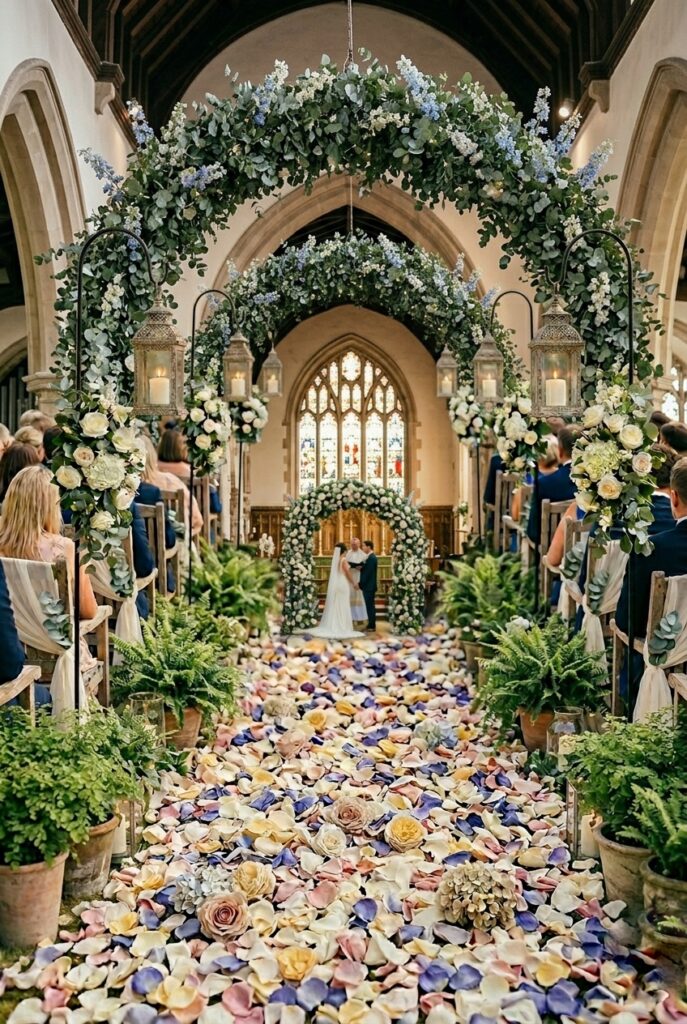
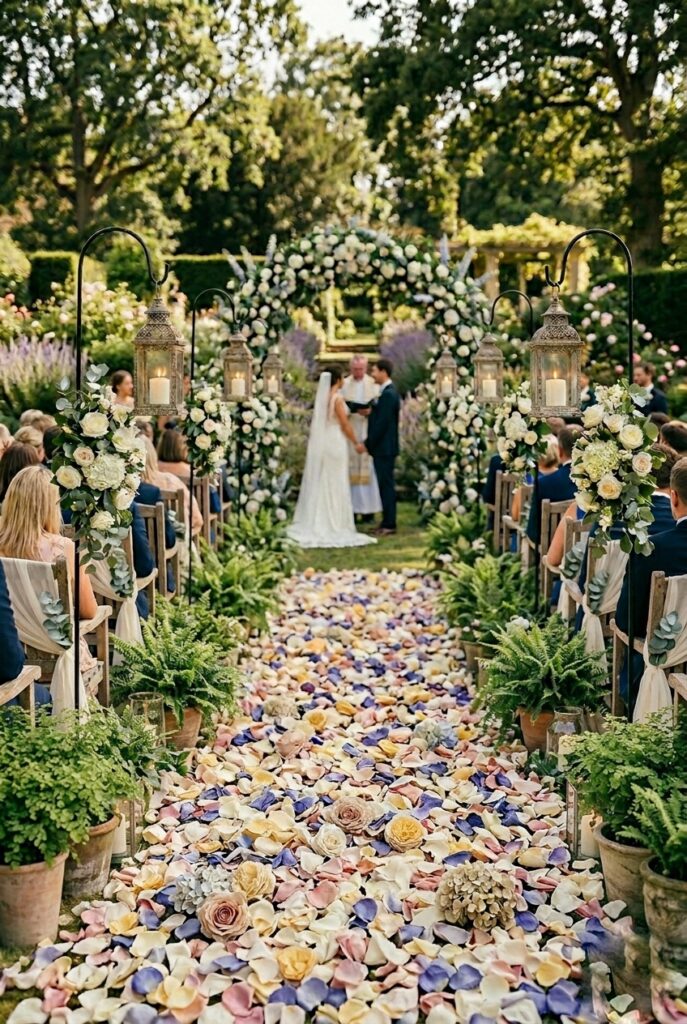
Living plants as aisle borders cost less than fresh florals, require no water management during setup, hold through a four-hour ceremony without wilting, and can be repurposed — gifted to guests, returned to a nursery, or used at your home afterward.
Boston ferns in 10″ nursery pots run $8–$18 each at Home Depot or Lowe’s, and a row of six per side frames a full aisle with enough visual density to read clearly in photographs.
At outdoor venues, potted olive trees ($25–$60 each) at the aisle entrance create a dramatic entry moment that no chair marker achieves.
This is particularly strong for garden, backyard, and outdoor barn weddings — see the full approach in the guide to garden wedding decor ideas.
The plants also serve double duty: move two large ferns to flank the sweetheart table at the reception, and guests who helped carry them collect them as thank-you gifts at the end of the night.
Only do this if your ceremony is on a surface that can handle nursery pot bases — grass, dirt, stone, or wood. Potted plants on carpet require waterproof saucers underneath each pot.
9. Chair-Back Posies — The Cheapest Meaningful Upgrade
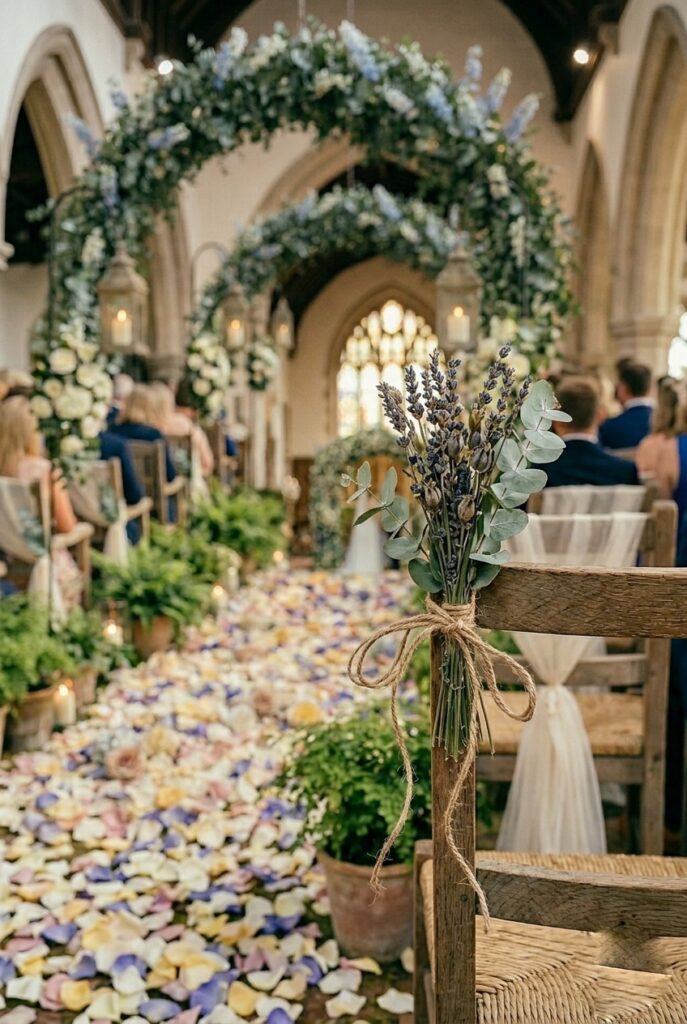
A chair-back posy — three to five stems of eucalyptus, dried lavender, or a single dried rosebud bound with twine — is the lowest-cost aisle marker you can make and one of the most photographed details at ceremonies where it appears, because it shows up in every shot where a guest is seated and looks back toward the aisle.
Cost: $1.50–$3 per chair in materials, all-in.
Eucalyptus from Trader Joe’s at $2.99 per bunch gives enough stems for approximately six to eight posies; dried lavender bundles from Amazon at $14–$22 for 100 stems make thirty to forty posies from one purchase.
The whole project assembles the evening before the wedding, requires no floristry skill, and is secured with a single loop of twine tied to the chair slat — no clips, no foam, no wire.
It is the aisle project that people with a $500 ceremony decor budget get more compliments on than the couple who spent $2,500 on rental lanterns.
For more ideas in this category, the DIY wedding decor ideas guide has a full assembly breakdown.
BUDGET HACK #3: Ceremony florals — including aisle markers and posies — cost 30–40% less when ordered directly from a wholesale flower market rather than through a florist. In most major US cities, wholesale flower markets are open to the public on Friday and Saturday mornings. For smaller cities without a local market, GrowersBox.com and BloomsyBox wholesale both ship directly to consumers with no minimum order requirement. A mixed box of 100 stems suitable for ceremony aisle markers runs $45–$75 shipped, compared to $120–$200 for the same volume from a retail florist. Order two to three days before the wedding and keep stems in water at room temperature to open fully before the ceremony.
10. The Aisle-to-Reception Transfer System — Built In from the Start
[GAP IDEA 2 — No Competitor Gives This as Actionable System]
Every aisle decoration article mentions that you can “repurpose” ceremony florals at the reception.
None of them tell you what to actually say to your coordinator, or which aisle elements transfer fastest, or how to build aisle decor from the beginning with transfer in mind.
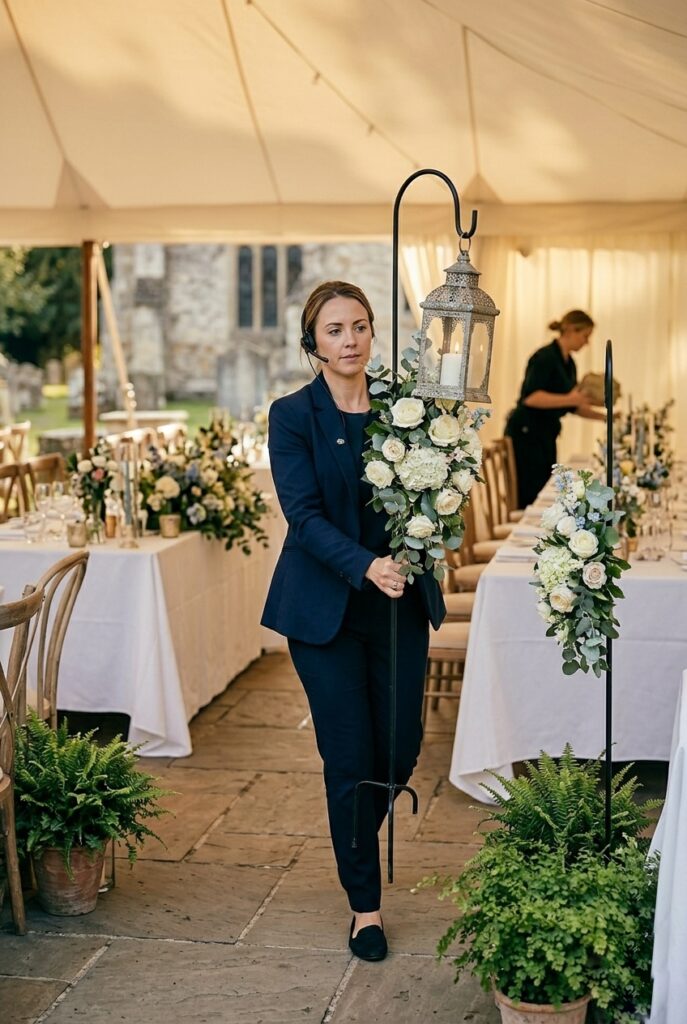
Here is the system. When briefing your florist or DIY assembling your aisle, identify the three or four highest-value elements — typically the shepherd’s hook arrangements or the entrance pedestal clusters — as “transfer pieces.”
These get built with detachable bases and self-contained water sources (floral water tubes rather than wet foam that drips).
Your day-of coordinator receives a written list: pedestal left transfers to cocktail bar entrance, pedestal right transfers to escort card table, shepherd’s hooks pull to frame the photo booth.
This handoff happens during cocktail hour while guests are at drinks.
Done correctly, it takes one coordinator and two venue staff approximately 12 minutes to complete.
What this represents financially: those four shepherd’s hook arrangements at $30–$60 each in materials now serve dual duty in two separate spaces rather than sitting in an empty ceremony room for three hours while guests are at dinner.
Source ceremony florals through WeddingWire’s florist marketplace to find vendors who specifically offer coordination of ceremony-to-reception transfers.
Decision Filter
If your ceremony is outdoors in a garden or backyard, ideas 1 and 8 — shepherd’s hooks with alternating floral clusters and potted plant borders — give the most natural, lush look without competing with the landscape.
If you are in a narrow indoor space like a church or ballroom, idea 7 — overhead garland tunnel — is your highest-impact single upgrade and leaves the floor completely clear.
On a strict budget under $200 for the full aisle, ideas 2, 6, and 9 together — alternating pew markers, chiffon chair sashes, and eucalyptus chair-back posies — deliver a complete, layered ceremony look for $120–$180 at fifty chairs.
Any aisle decoration plan should also identify which elements transfer to the reception at cocktail hour before finalizing what to rent or purchase.
The Real Reason Aisle Decorations Disappoint Couples in Photos
The contrarian truth: most aisle decor looks significantly better in the planning imagination than it does in photographs.
The reason is that ceremony photography is primarily shot from the back of the aisle looking forward — a perspective from which individual pew marker arrangements mostly disappear behind the chairs and the mass of seated guests.
What photographs beautifully from that angle are things at floor level (lanterns, petals, potted plants), things at overhead level (garland, draped fabric), and things at the entrance (large pedestals, arches, statement arrangements that frame the couple as they enter).
Mid-aisle chair decorations that look gorgeous up close are largely invisible in the wide processional shots that will actually end up in your album.
The strong opinion: if you are choosing between spending $400 on forty chair pew markers down the full aisle or spending $400 on two statement pedestal arrangements at the aisle entrance, spend it on the pedestals.
Every wide shot of your processional will show the entrance. Almost none of them show pew marker row fourteen.
The insider observation — something coordinators know and rarely say upfront: the order of setup matters more than the quantity of elements.
Ceremony decor that is placed by a team in the wrong order — lanterns first, then chairs moved in, then runners laid on top — takes two to three times longer to set up and frequently results in crushed flowers, disturbed runners, and lanterns shifted out of position.
The correct order is chairs first, runner second, floor lanterns third, then all elevated elements (shepherd’s hooks, chair markers, posies) last.
Tell whoever is setting up your aisle this sequence explicitly, in writing, the week before. It is the single logistics detail that determines whether your aisle looks as designed at ceremony start — or pieced-together and rushed.
Mistakes to Avoid
Mistake 1: Spending equally on every row of the aisle when competitors universally recommend it. The standard advice is to line the full aisle with markers on every row.
The reality is that the first three rows, the mid-aisle point, and the last two rows before the altar are the only positions that appear in photographs and that guests actually look at during the processional.
Decorating rows five through twelve identically to rows one through four wastes 40–60% of your aisle decoration budget on positions that photograph as a blurry mass rather than individual arrangements.
Mistake 2: Renting glass cylinder vases with water for the aisle floor. This is the most reliably broken item at wedding ceremonies.
Venue coordinators have seen this destroyed at almost every wedding where it appears — guests scoot chairs back, flower girls run, parents reach for tissues.
A glass cylinder filled with water and tipped over during the processional creates a soaked aisle runner, a disrupted ceremony, and a slip hazard for everyone walking in heels.
The alternative is a hurricane lantern with a pillar candle or heavy-base bud vase without water, secured with a rubber gripper ring.
If you must have water for fresh stems, use sealed floral water tubes inserted into an opaque vessel that would not shatter if knocked.
Mistake 3: Not confirming aisle width before finalizing decoration sizes. Standard ceremony aisle width is 48″–60″.
Every element placed along that aisle reduces walkable width.
Full shepherd’s hook arrangements that extend 12″ into the aisle leave 24″–36″ of center walking space — barely enough for a bride in a full skirt with a father on her arm.
I have watched brides turn sideways to avoid catching their dress on aisle arrangements they approved from a photo reference without checking the actual dimensions.
Measure your venue’s aisle width and subtract the footprint of every element before finalizing any ground-level decor.
Mistake 4: Trusting flower petal scatter to stay in position outdoors. Loose rose petals on an outdoor aisle — grass, stone, or gravel — migrate with any breeze.
They cluster at the edges within 20 minutes of placement, leaving the center of the aisle bare by the time the processional begins.
The fix is either freeze-dried petals (which are lighter and interlock slightly, holding position better than fresh), a petal path confined within a runner border so wind can’t move them laterally, or simply waiting until 10–15 minutes before the ceremony to scatter rather than placing them an hour ahead during setup.
FAQ
How much do wedding aisle decorations cost?
Wedding aisle decorations typically run $150–$800 for a DIY approach and $400–$2,500 for florist-designed installations, depending on aisle length, flower choice, and element count.
The biggest variable is fresh flowers — freeze-dried petals, potted plants, fabric sashes, and candle lanterns all deliver strong visual results at the lower end of the range.
For a full breakdown of where to cut ceremony costs, the guide to cheap wedding decor ideas covers ceremony-specific approaches.
What are the most popular wedding aisle decorations?
Pew markers or chair markers with ribbon are the most common, followed by floor lanterns, aisle runners, and floral petal scatter.
Currently, overhead garland tunnels and potted plant borders are gaining significant ground as alternatives that photograph distinctively and reduce on-floor tripping hazard.
Can you DIY wedding aisle decorations?
Absolutely — and several of the most effective aisle elements are specifically easier to DIY than to source from a florist.
Chair-back posies, chiffon sashes, lantern groupings, and potted fern borders all require zero floral skill and assemble in an afternoon.
The easy wedding decor ideas guide includes a full ceremony-to-reception DIY checklist.
What aisle decorations work for outdoor weddings?
Potted plants and ferns, shepherd’s hook floral arrangements, weighted hurricane lanterns in calm conditions, and fabric chair sashes all hold outdoors reliably.
Avoid loose petals in wind, tall unanchored arrangements on uneven ground, and any water-filled vessels on grass.
Use the outdoor wedding decor ideas guide for a complete outdoor ceremony framework.
Budget Table
| Aisle Decoration | DIY Cost | Florist/Vendor Cost | Best Source |
|---|---|---|---|
| Shepherd’s hooks + floral clusters | $6–$14 per hook | $20–$40 per hook | Amazon hooks + Trader Joe’s flowers |
| Pew markers (every other row) | $4–$9 per marker | $18–$35 per marker | Grocery store stems + Etsy ribbon |
| Glass hurricane lanterns | $8–$22 each | $6–$12/day rental | Amazon, Facebook Marketplace |
| Linen or cotton aisle runner | $2–$4/yard (DIY) | $35–$150 | Fabric.com, The Original Runner Company |
| Freeze-dried petal carpet | $40–$80 total | $300–$1,000 (fresh) | Amazon, PetalGarden |
| Chiffon chair sashes | $2.50–$4/yard | $3–$6 per sash | Fabric Wholesale Direct |
| Overhead eucalyptus garland | $32–$84 (artificial) | $150–$400 | Amazon, wholesale eucalyptus |
| Potted fern borders | $8–$18 per fern | $25–$50 per pot (rental) | Home Depot, Lowe’s |
| Chair-back eucalyptus posies | $1.50–$3 per chair | $8–$15 per chair | Trader Joe’s + Amazon lavender |
The Aisle Is Thirty Seconds of Walking and Thirty Years of Photographs
Every decision about your aisle decoration is really a photography decision — because that is the only record that lasts.
Stand at the back of your actual ceremony space before finalizing anything, look toward the altar, and ask yourself what you see from that angle.
If the answer is the backs of chairs with tiny flowers you can barely make out, move the budget to floor elements or the entrance. If the answer is a beautiful botanical frame around an empty walkway, you have built the right aisle.
Then confirm the setup sequence with your venue coordinator in writing, identify which elements transfer to cocktail hour, and let the processional do the rest.
When you are ready to think beyond the ceremony space, the wedding decor ideas guide covers the full arc from ceremony to reception in one place.