Most church aisle decoration guides show you what everything looks like after a professional florist spends four hours setting up — and say nothing about what your church will and won’t allow you to attach, tape, or stake to a 200-year-old pew.
Before you buy a single stem or spool of ribbon, get three answers from your church coordinator: what can be attached to the pews, whether open flames are permitted, and how much setup time you’ll have.
Those three answers determine everything else on this list.
1. The Attachment Method Conversation — Have It First, Not Last
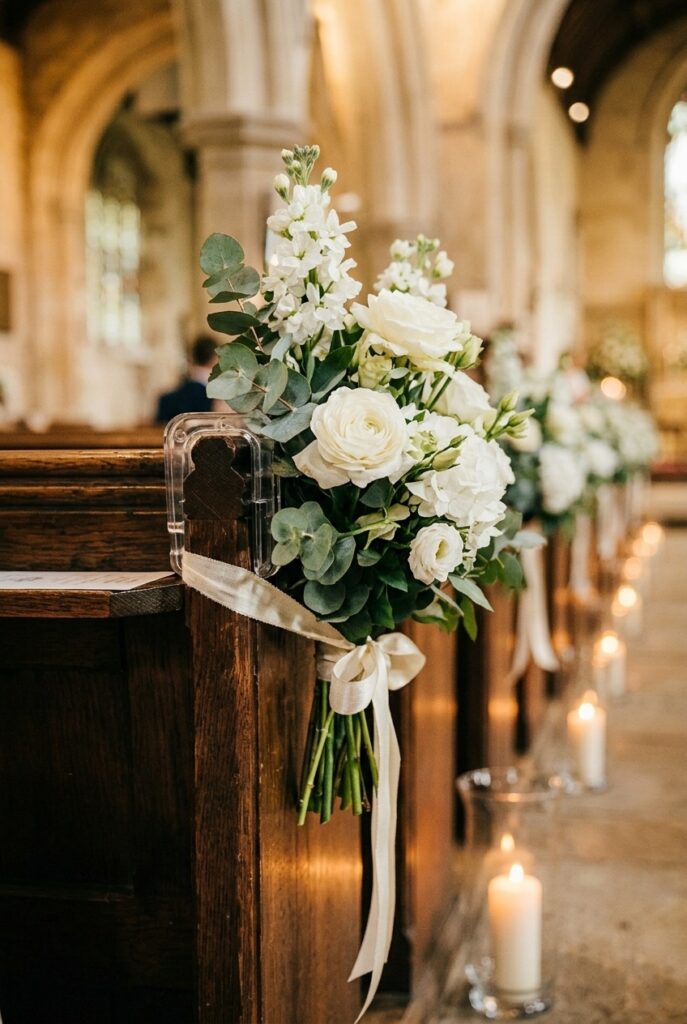
Every church has decoration rules and they vary more than most couples expect — Catholic churches routinely prohibit tape, staples, pins, and any adhesive on pews, while many historic Protestant churches restrict anything that contacts the wood at all, and most churches across denominations have flame policies that will determine whether your entire candle plan is viable before you order a single pillar.
The attachment methods that work in most churches, from most to least permissive, are: heavy-duty pew clips ($12–$18 for a set of 24 on Amazon), elastic loops made from quarter-inch elastic band, ribbon ties looped around a protruding pew end, and floor-standing elements that require zero attachment — and the pew decoration guide covers which attachment works for which pew profile across the most common church chair and bench types.
2. Pew-End Floral Swags With Compact Proportions
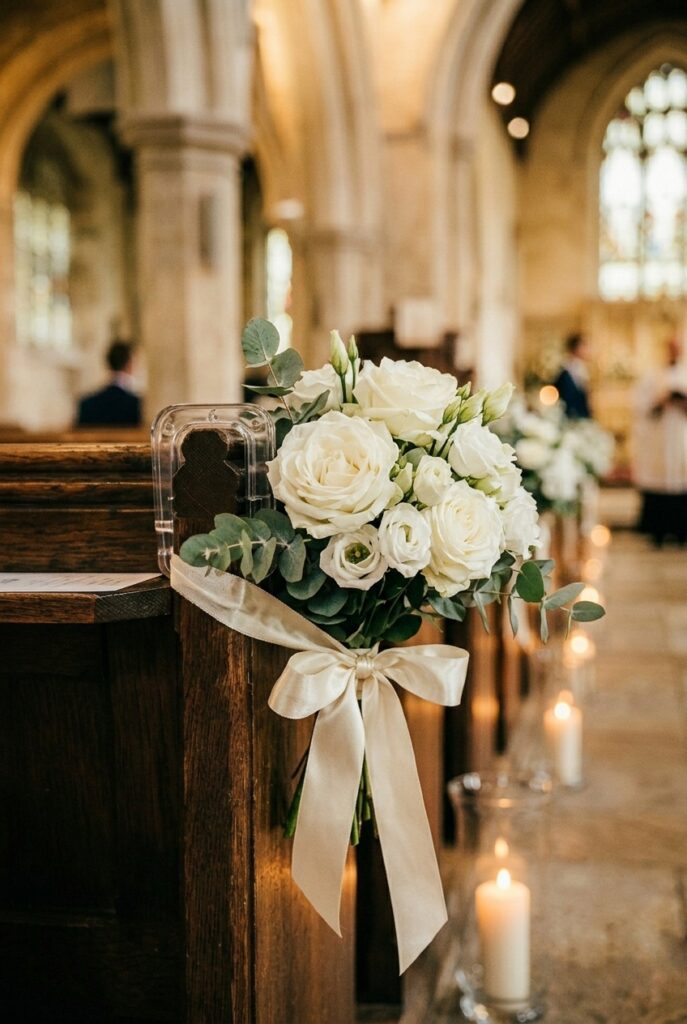
A standard florist pew swag is too wide for most church aisles — a typical church aisle runs 4.5 to 5.5 feet wide, and a swag projecting 10 or more inches from the pew cuts that to under four feet per pass, which means your dress brushes petals off every third arrangement on the walk.
The right proportion is five to seven inches in diameter, tight and contained, which reads full and lush from ten feet away without encroaching on the walkway — and if this kind of scaled, intentional approach to the aisle appeals to you, the simple aisle decoration guide builds out a complete framework from the same restraint principle.
3. Pillar Candles in Enclosed Hurricane Glass
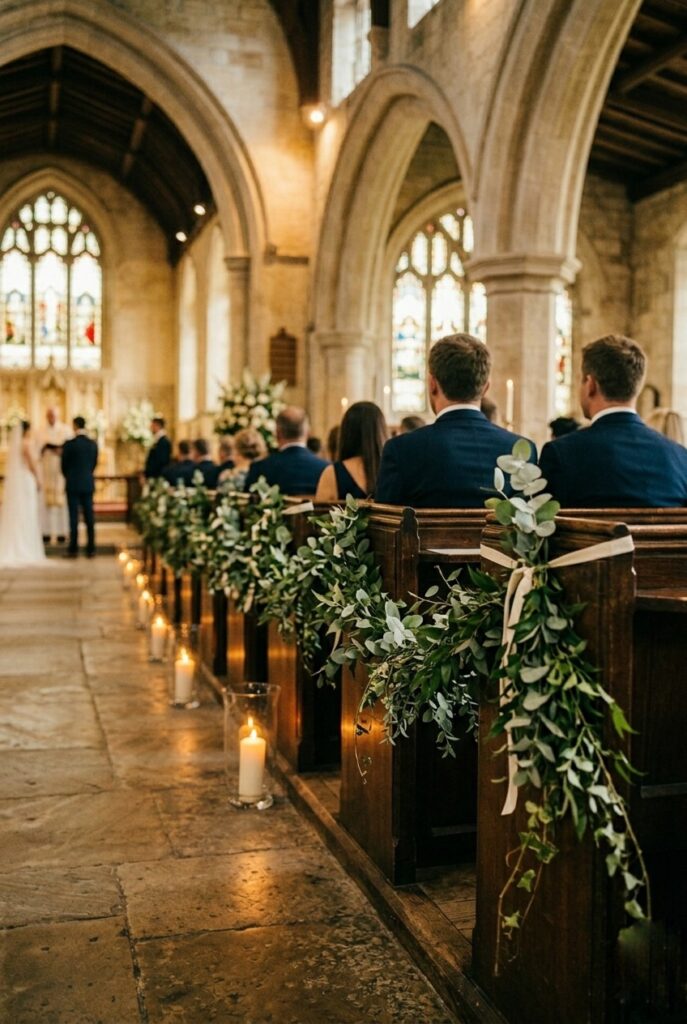
Floor-standing hurricane lanterns are the most universally permitted church aisle decoration because they need no pew attachment and can be moved in minutes — and the glow at knee height creates a warm corridor effect that reads far more intimate in person than anything placed at eye level.
Enclosed glass is non-negotiable here because an open flame in a drafty stone nave will blow out during the processional, and the wedding candle guide covers the full breakdown of which candle formats survive which venue conditions — including the Luminara LED pillar candle that photographs identically to real wax and is the only flameless option worth buying for a no-flame church.
💰 Budget Hack after Idea 3: IKEA’s BORRBY lantern at $9.99 is the same form factor as the ones event rental companies charge $7–$10 per day to loan — before the $75–$125 delivery fee. For 16 lanterns covering both sides of a standard church aisle, buying outright costs $160 versus renting at $112–$160 plus delivery. Buy, use, and list on Facebook Marketplace within two weeks of the wedding at $6 each. You’ll recoup $96 and your effective cost drops to $64 — roughly half of the rental total without the logistics dependency. Search “wedding lanterns [your city]” on Facebook Marketplace first, though — many couples sell sets for $40–$60 all-in.
4. Greenery Garland Along the Pew Rail
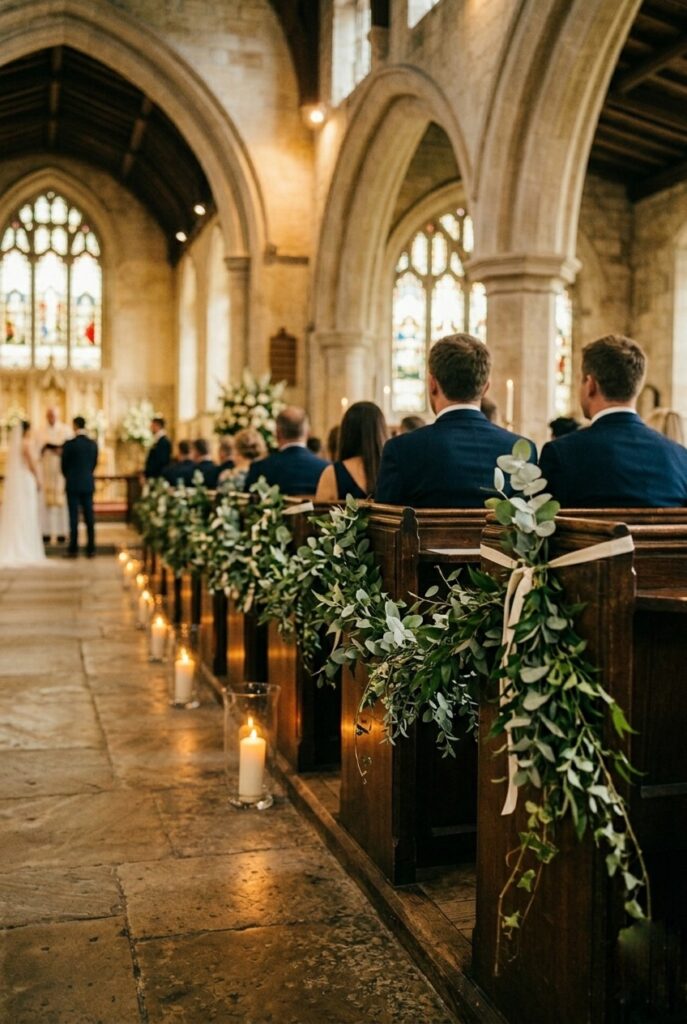
A continuous greenery garland draped loosely between pew ends — not pulled tight, but hanging with a soft arc between each rail — creates one of the most striking church aisle effects available without a florist, and the gentle drape is what makes it read as lush rather than flat, because a taut garland photographs as a stripe while a draped one photographs as volume.
Afloral.com sells pre-made six-foot faux eucalyptus garlands at $14–$22 each that are indistinguishable from fresh in most church lighting, for a 60-foot aisle you’ll need ten to twelve lengths for both sides, and the full principles behind greenery-forward ceremony design translate directly from the indoor wedding decor guide.
5. Floor-Standing Cylinder Vases for Restricted Churches
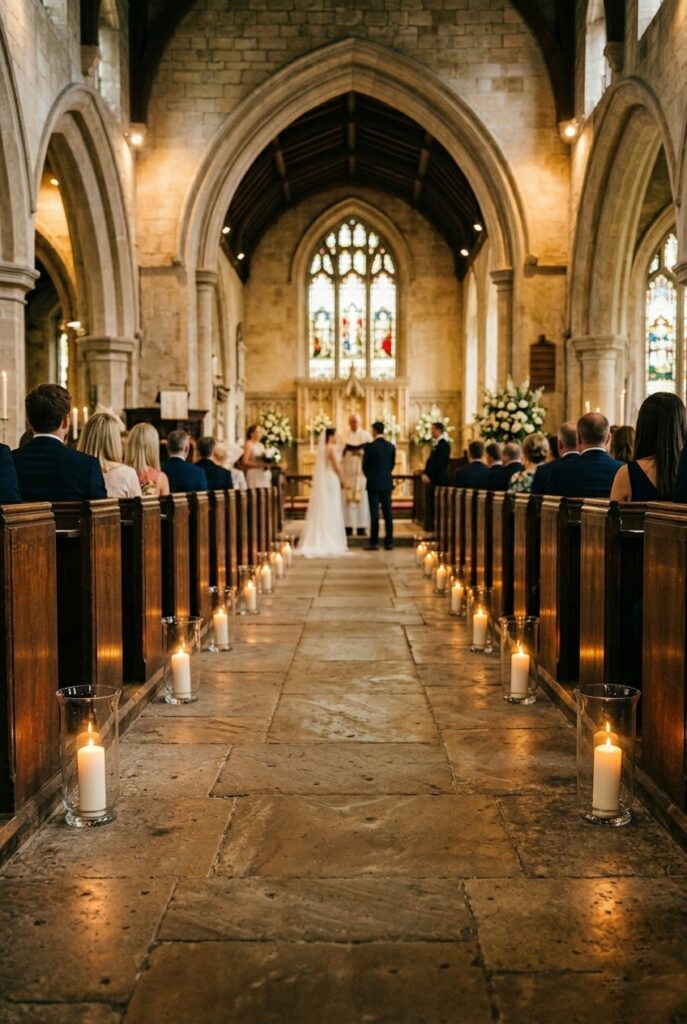
When your church prohibits any contact with the pews — no clips, no ties, no hooks — floor-standing cylinder vases placed directly on the floor at the aisle edge are your entire aisle strategy, and they work extraordinarily well because a 20–24-inch glass cylinder with a dense five-stem arrangement reads at the correct visual height from a seated guest’s perspective and photographs with excellent depth in processional shots.
Fill each base with four to six inches of water for stability, add a thin rubber jar gripper underneath on marble or polished stone to prevent sliding, and the restraint principle behind placing flowers only where they do the most work is at the core of everything in the simple wedding decor guide.
6. The Texture-and-Sound Consideration Nobody Talks About
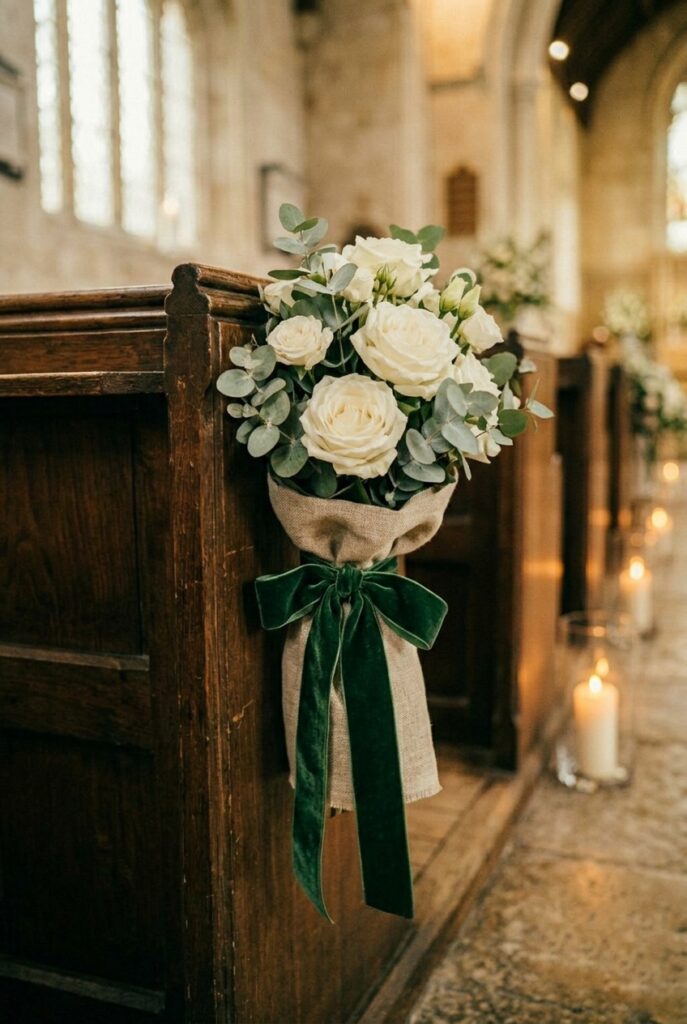
Soft-textured pew decorations — linen, velvet, woven ribbon, thick floral stems — measurably dampen the echo in a reverberant stone church, so wide velvet ribbon tied in a full bow contributes more acoustic warmth than thin satin ribbon and thick-stemmed blooms like peonies and roses contribute more than sparse greenery.
This means fabric choice matters beyond aesthetics in a stone or plaster nave: double-sided velvet ribbon in ivory or sage runs $18–$28 per 25-yard spool on Amazon and covers every-other-pew in a medium-sized church — and for the full range of how indoor aisle elements interact with different architectural environments, the indoor aisle decoration guide covers stone, plaster, brick, and contemporary interior settings.
7. Baby’s Breath Cones or Posies as Pew Accents
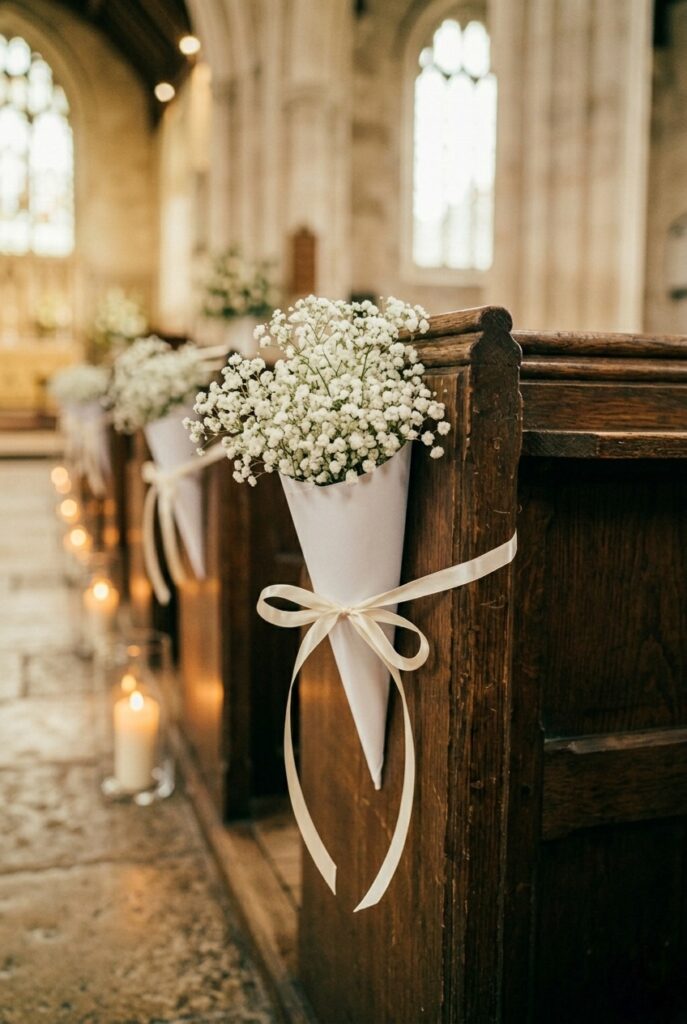
Baby’s breath cones are the most budget-consistent church pew decoration available because baby’s breath holds 48–72 hours after cutting without wilting, costs $3–$5 per bunch at Trader Joe’s, and one bunch fills two to three cones — for a 50-foot church aisle decorating every other pew you need roughly eight to ten bunches total, which puts the complete aisle material cost at $30–$50.
The version that reads as intentional is a fully packed cloud that fills the entire cone opening with no interior visible; the version that reads as rushed is three or four loose sprigs tied with ribbon and drooping — and more ways to build a full ceremony look at this price point are in the budget wedding decor guide.
💰 Budget Hack after Idea 6: Wholesale flower markets in most metro areas open Saturday mornings between 4am and 9am and are open to the public — not just florists. A bunch of baby’s breath at retail (Trader Joe’s, Whole Foods) costs $3–$5. The same bunch at a wholesale market costs $0.80–$1.50. For a church aisle requiring 10 bunches of baby’s breath, that difference is $15–$35 saved on flowers alone. Search “[your city] wholesale flower market” and verify Saturday public access. Get there before 7am for the best selection. Bring buckets of water and cash; most markets are cash-only.
8. Ribbon-Only Pew Markers for Architecturally Significant Churches
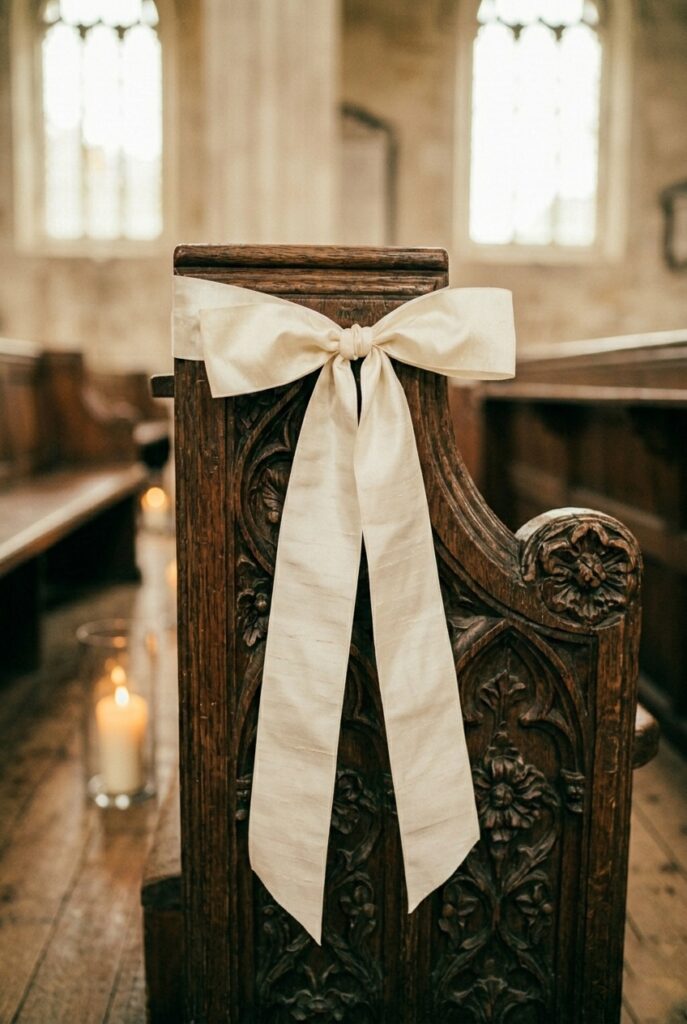
If your church is genuinely architecturally beautiful — carved wood, stained glass, stone columns, painted ceilings — a four-inch-wide dupioni or natural linen ribbon tied in a full bow with 20-inch tails is often the strongest aisle decoration you can choose, because it adds softness and marks the aisle without introducing a color or material that fights what the building is already doing.
A 25-yard spool of four-inch dupioni ribbon costs $22–$35 on Amazon or Etsy and covers a full church aisle with room to spare, no flowers or florist invoice required, and the full philosophy behind when a single well-chosen material outperforms a layered decoration scheme is in the elegant wedding decor guide.
9. Petal Scatter — The Only Conditions Where It Works in a Church
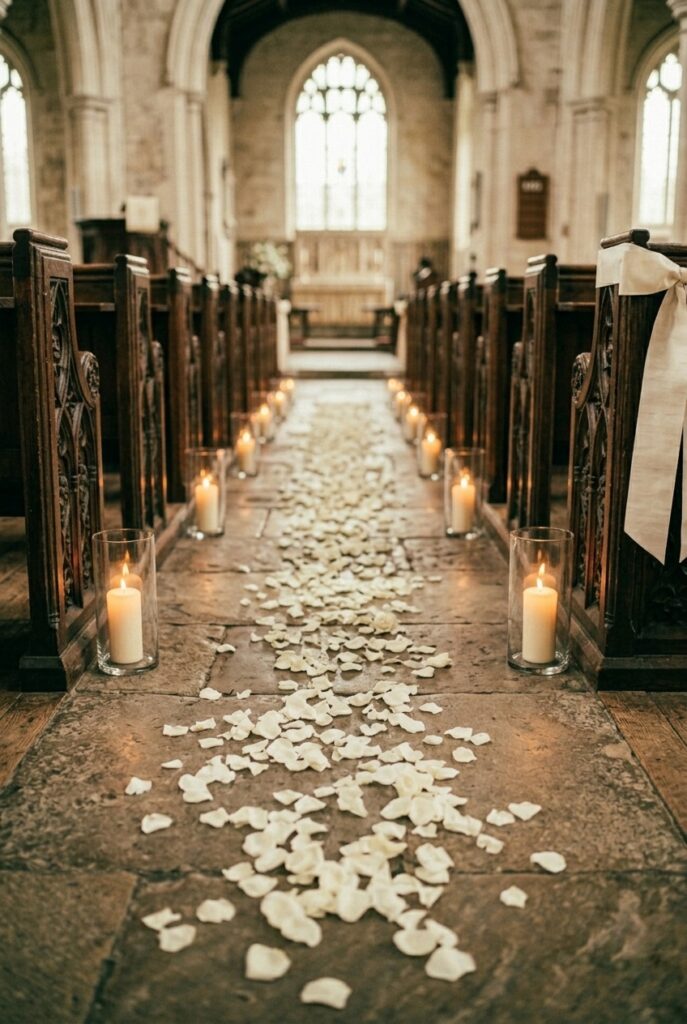
Petal scatter inside a church is one of the few situations where the outdoor version’s biggest problem disappears entirely — stone, tile, and sealed hardwood church floors are cool and climate-controlled, meaning fresh petals hold their color for several hours rather than minutes.
Always confirm petal scatter is permitted in writing before your flower order is placed, use fresh or dried petals only and never dyed silk (the polyester ignites near any open flame), and dried petals at $12–$20 per cup from Amazon or Etsy hold color for 24 hours, sweep up cleanly, and are the preferred choice for churches with strict cleanup timelines — the DIY wedding decor guide covers morning-of scatter timing that keeps petals in position until the processional begins.
10. The Aisle-Entry Pedestal Treatment
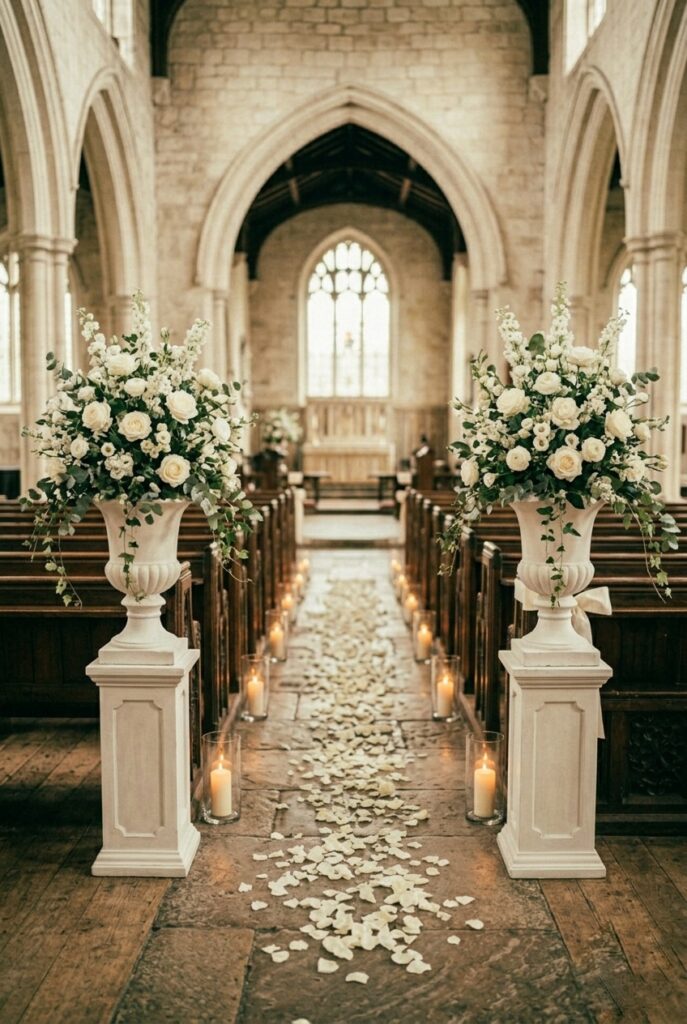
Most church aisle budgets are spread too thin across every pew when the better investment is two statement pedestal arrangements at the aisle entrance — the first thing every guest sees when they arrive and the visual framing for every processional photograph taken from the rear of the nave.
Pedestal stands rent for $15–$25 each from local event rental companies, floral arrangements using wholesale stems run $40–$80 per pedestal, and your aisle budget ratio should weight toward this end rather than pew-by-pew swags — because every wide processional shot shows the entrance while almost none show pew marker row twelve — and the DIY aisle decoration guide includes the step-by-step for building the pedestal arrangement yourself the morning before using wholesale stems and a pre-soaked foam base.
💰 Budget Hack after Idea 9: Most florists charge $120–$180 per pedestal arrangement for church ceremonies because they factor in design time, delivery, and installation. If you want the same visual at a quarter of the cost, rent the stands from an event rental company ($15–$25 each) and buy wholesale stems from a local market the morning before the wedding. A tight arrangement of 10 garden roses, a half-bunch of eucalyptus, and three stems of lisianthus costs $18–$28 in wholesale stems and takes 30 minutes to build with no floral experience — just pack stems tightly into pre-soaked floral foam in a bowl or cylinder set inside the urn. The result is visually identical at 10 feet away, where every guest and your photographer will be standing.
11. The Aisle Runner Question — When It Helps and When It Hurts
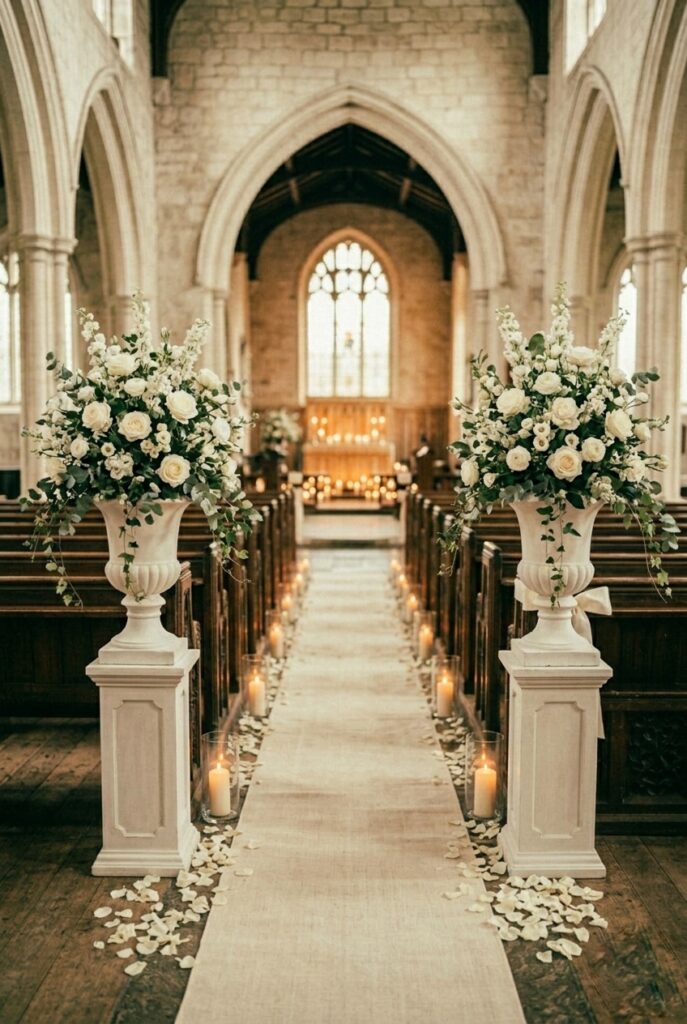
A church aisle runner is genuinely useful in two scenarios — protecting an uneven stone floor that’s uncomfortable under thin-soled shoes, and defining the walkway in a very wide nave where without a runner the aisle feels formless — and actively problematic in most others, because standard satin runners wrinkle within minutes, buckle when chair legs catch the edges, and create a heel-catching tripping hazard on a long formal walk.
Use natural linen or heavyweight cotton muslin at a minimum 36-inch width, the weight alone keeps it flat without tape, raw linen by the yard at JOANN runs $6–$9 per yard so a 60-foot runner costs $18–$28 in fabric, and the full aisle decoration guide covers runner alternatives for short aisles, carpeted floors, and cathedral-train dresses where any runner creates more problems than it solves.
Call your church facilities manager today — not the parish secretary, not the day-of coordinator — and get your three answers in writing: attachment method, flame policy, and setup window.
Then come back and choose two ideas from this list that fit those answers, and the unique wedding decor ideas guide will help you carry the same intentional choices through every other part of the day from reception entrance to sweetheart table.