
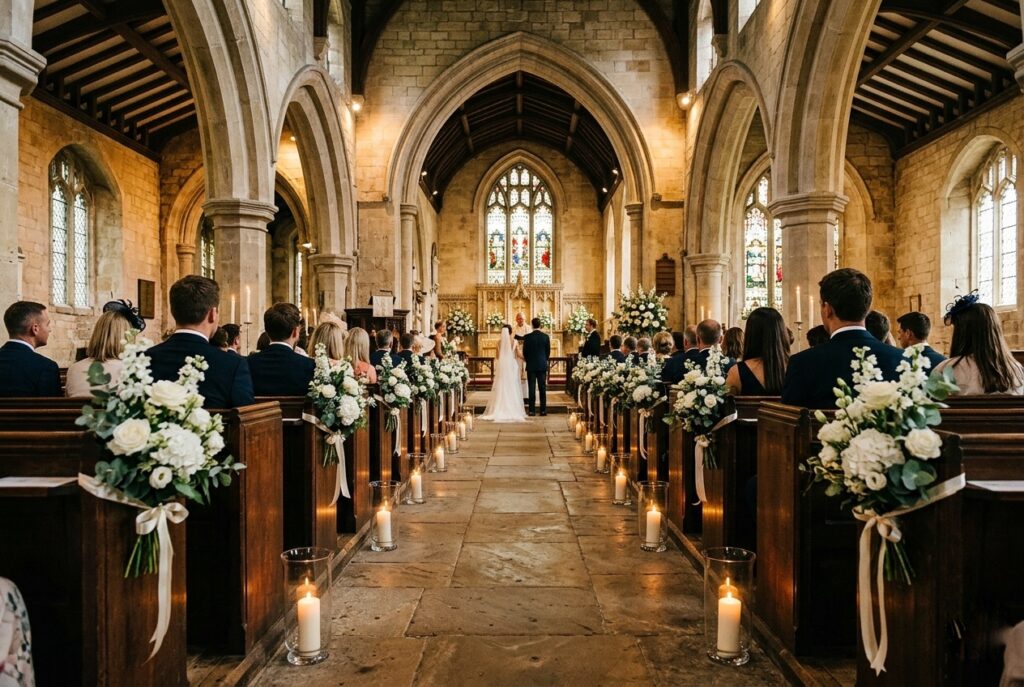
Most church aisle decoration guides show you what everything looks like after a professional florist spends four hours setting up — and say nothing about what your church will and won’t allow you to attach, tape, or stake to a 200-year-old pew.
That gap between inspiration and reality is where most church wedding decor budgets quietly unravel.
This is the version of the guide that starts where it should: with the rules, then the ideas.
The candles had been placed at every third pew, thick ivory pillars in clear glass that smelled faintly of beeswax. Someone had tied linen ribbon — rough-edged, the color of old paper — around bunches of white ranunculus, and the knots were not quite even. The stone floor held the cold of February. Nobody noticed anything except the walk.
The Short Answer
Church aisles are the most constrained decorating environment in all of wedding planning — and every guide that skips that truth is setting you up for a panicked call to your florist two days before the wedding.
Before you buy a single stem or spool of ribbon, you need three answers from your church coordinator: what can be attached to the pews, whether open flames are permitted, and how much setup time you’ll have.
Those three answers determine everything.
The prettiest idea on the internet means nothing if your church prohibits clips and bans candles.
If you’re still building out the full ceremony picture beyond the aisle, traditional wedding decor ideas covers the broader church ceremony aesthetic from entrance to altar.
And if budget is a real constraint, cheap wedding decor ideas that actually hold up will save you from overspending on elements nobody photographs.
1. The Attachment Method Conversation — Have It First, Not Last
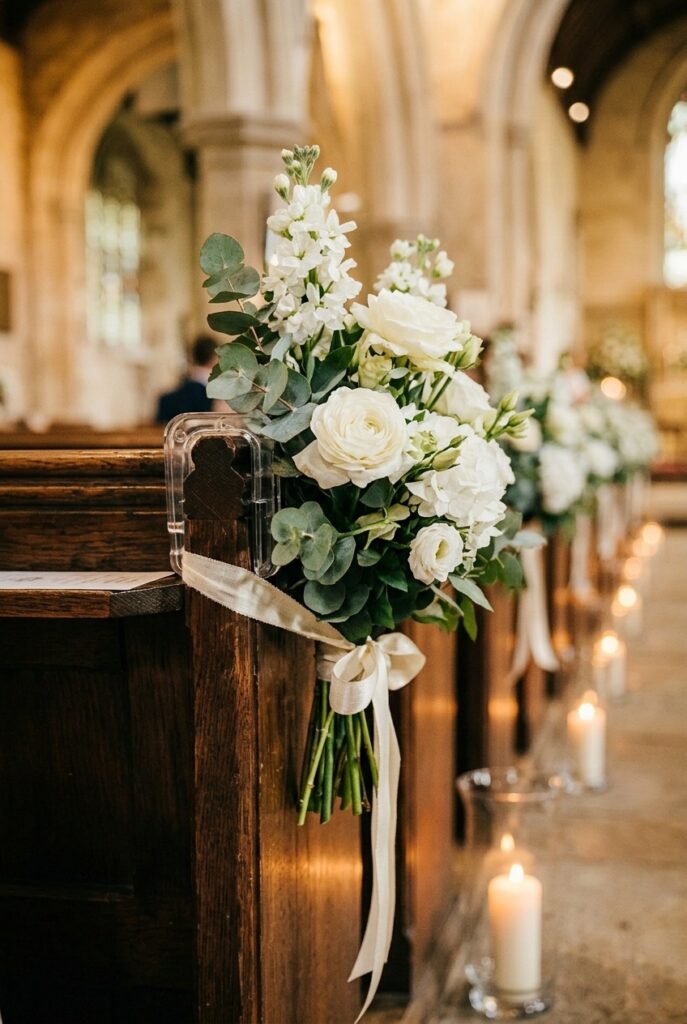
This is the gap idea no competitor addresses directly, and it is the single most practical thing in this entire article.
(Competitor gap idea #1.) Every church has decoration rules, and they vary more than most couples expect.
Catholic churches routinely prohibit tape, staples, pins, and adhesive of any kind on pews.
Some historic Protestant churches won’t allow anything that contacts the wood at all.
Many churches across denominations restrict open flames entirely — meaning every pillar candle idea you’ve saved requires a flameless substitute.
The attachment methods that work in most churches, from most permissive to most restrictive:
Pew clips (heavy-duty plastic hooks that grip the pew rail without puncturing it) are the most universal solution — a set of 24 runs $12–$18 on Amazon and fits pews from 1 to 2.5 inches thick.
Elastic loops made from 1/4-inch elastic band looped around the pew end work on most solid-wood rails without clips. Ribbon ties looped around a protruding pew end work when nothing else will.
Floor-standing elements (lanterns, cylinder vases, floral stands) require zero attachment and are universally permitted.
Before ordering anything that needs to be fastened to a pew, call your church office — not the day-of coordinator, but the facilities manager — and ask explicitly: what can touch the pews and how.
This call takes five minutes and potentially saves you $200 in unusable decorations.
Price: Pew clips $12–$18 for a set of 24. Amazon.
2. Pew-End Floral Swags With Compact Proportions
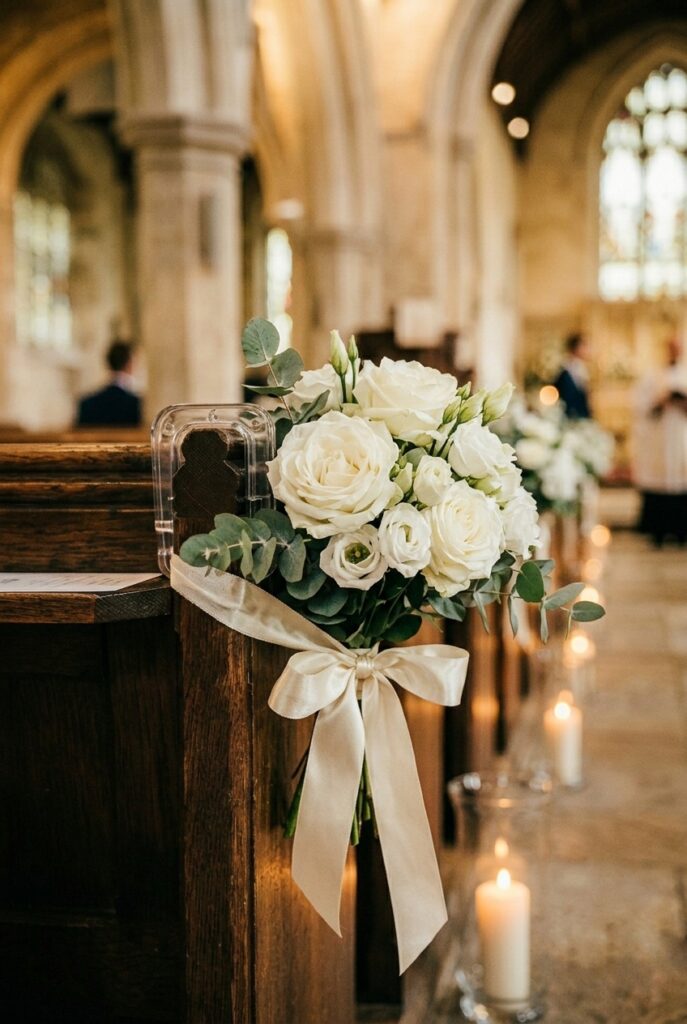
The standard florist pew swag is too wide for most church aisles — and nobody tells you that until the photos come back. A typical church aisle is 4.5 to 5.5 feet wide.
A swag that projects 10 or more inches from the pew end cuts that to under 4 feet on each pass, which means the bride’s dress brushes petals off every third arrangement.
The right proportion for a church pew swag is 5–7 inches in diameter — tight, round, and contained. It reads full and lush from 10 feet away, and it doesn’t encroach on the walkway.
The cheap version of this is pre-made silk flower clusters in a bag from a party supply store.
They photograph flat because synthetic petals don’t catch or refract light the way fresh or quality dried blooms do, and they all look identical down the aisle, which creates a manufactured rather than curated look.
Source fresh stems from a wholesale flower market — Trader Joe’s, a local farm market, or Mayesh Wholesale — and build compact swags the morning of.
Five stems of ranunculus plus two eucalyptus branches per pew, tied with ribbon: that’s your swag, and it costs $4–$6 per unit.
Only do this if: your church permits attachment to pews. If it doesn’t, see Idea 5 for the floor-based alternative that looks equally strong.
Price: $4–$8 per swag, DIY.
Trader Joe’s or local wholesale market for stems; Amazon for ribbon.
3. Pillar Candles in Enclosed Hurricane Glass
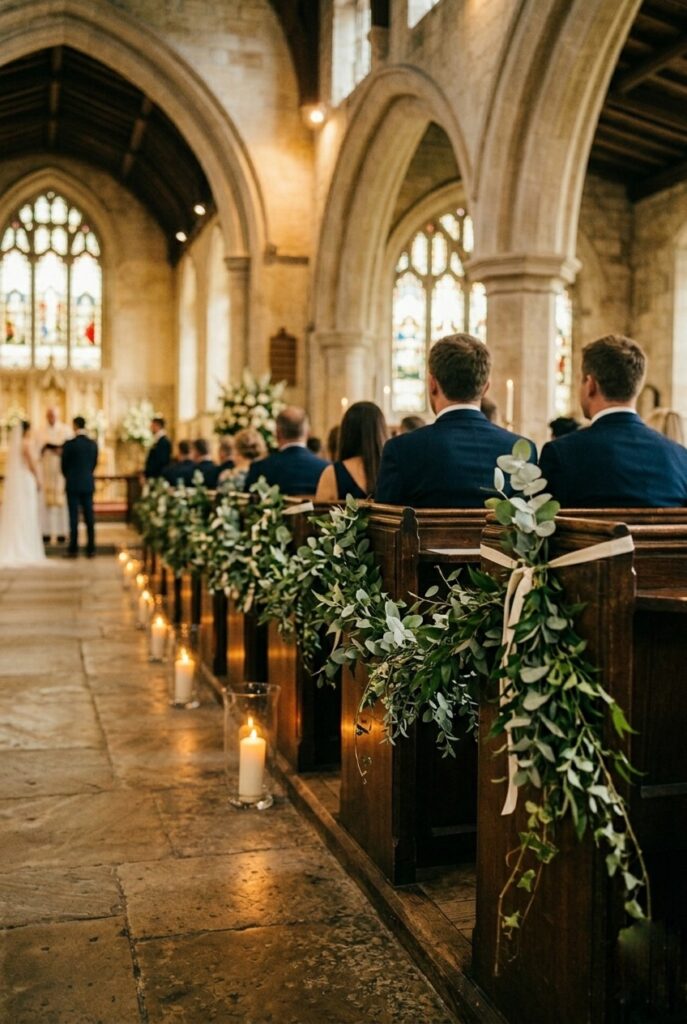
Floor-standing hurricane lanterns are the most universally permitted church aisle decoration because they require no attachment to pews and can be moved in minutes.
They sit on the floor at pew-end level, and the glow at knee height creates a warm corridor effect that reads far more intimate in person than anything at eye level can achieve.
The enclosed glass is essential — open-flame candles in a drafty stone nave will blow out during the processional every time, and an unenclosed flame near fabric is a venue liability issue that will get you banned from the space.
Confirm whether your church permits real flames. Many do, with enclosed glass; many don’t, period.
For no-flame venues, the Luminara brand flameless pillar candle ($28–$40 each at Target) has a realistic flicker that photographs identically to real wax in most church lighting conditions — it’s the one LED candle worth paying for.
Budget-tier LED candles look flat in photos and the battery compartment flicker is too fast to read as real.
Lanterns in clear glass run $8–$15 each at IKEA; plan one per aisle side every 4–5 feet, alternating with or in addition to pew-end swags.
Price: $8–$15 per lantern (IKEA); $28–$40 per LED pillar candle (Target/Luminara). Full aisle setup $120–$200.
💰 Budget Hack after Idea 3: IKEA’s BORRBY lantern at $9.99 is the same form factor as the ones event rental companies charge $7–$10 per day to loan — before the $75–$125 delivery fee. For 16 lanterns covering both sides of a standard church aisle, buying outright costs $160 versus renting at $112–$160 plus delivery. Buy, use, and list on Facebook Marketplace within two weeks of the wedding at $6 each. You’ll recoup $96 and your effective cost drops to $64 — roughly half of the rental total without the logistics dependency. Search “wedding lanterns [your city]” on Facebook Marketplace first, though — many couples sell sets for $40–$60 all-in.
4. Greenery Garland Along the Pew Rail
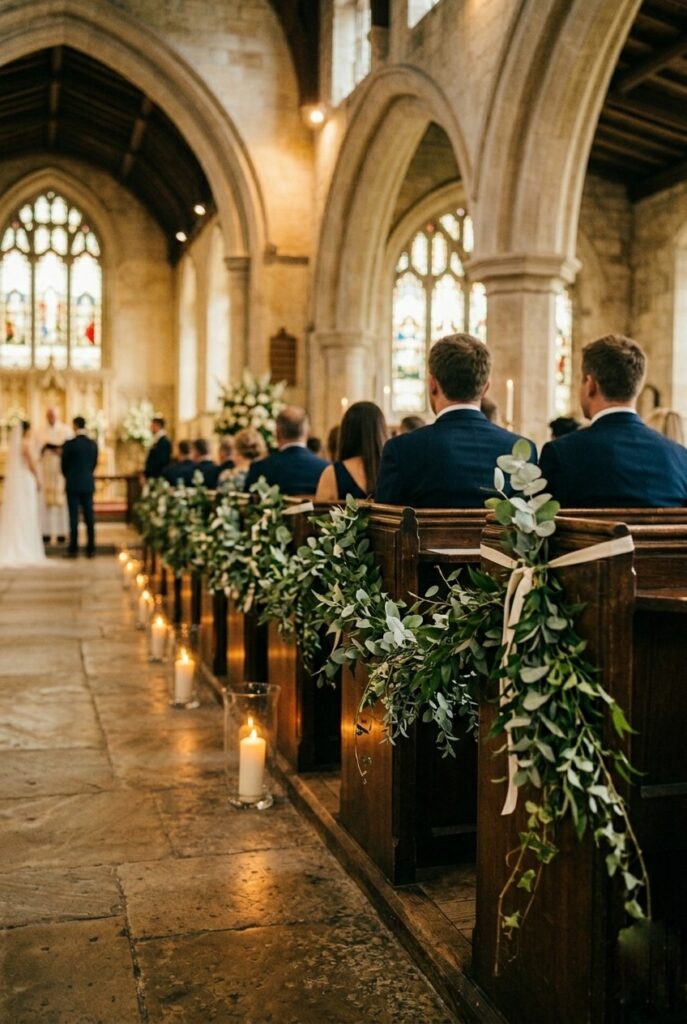
A continuous greenery garland draped along the pew ends — not hung from them, but looped loosely between each pew rail with ivory ribbon ties — creates one of the most striking church aisle effects available without a florist.
The key word is drape: the garland should hang with a soft curve between pew ends, not pulled tight.
That gentle arc is what makes it read as lush rather than flat.
Use eucalyptus, Italian ruscus, smilax vine, or a mix of all three.
Afloral.com sells pre-made 6-foot faux eucalyptus garlands at $14–$22 each, which are indistinguishable from fresh in most church lighting conditions.
For a 60-foot aisle you’ll need 10–12 lengths for both sides.
This approach pairs well with the minimal pew swag — garland along the rails, one compact floral cluster every 4–6 pews — rather than decorating every pew end with both elements simultaneously, which tips into visual overload.
The garland does the continuous work; the flowers do the punctuation.
For broader context on how greenery-forward ceremony design works across different settings, indoor wedding decor ideas covers the principles that translate directly here.
Price: $14–$22 per 6-foot length. Afloral.com (faux) or Costco Business Center (fresh eucalyptus).
5. Floor-Standing Cylinder Vases for Restricted Churches
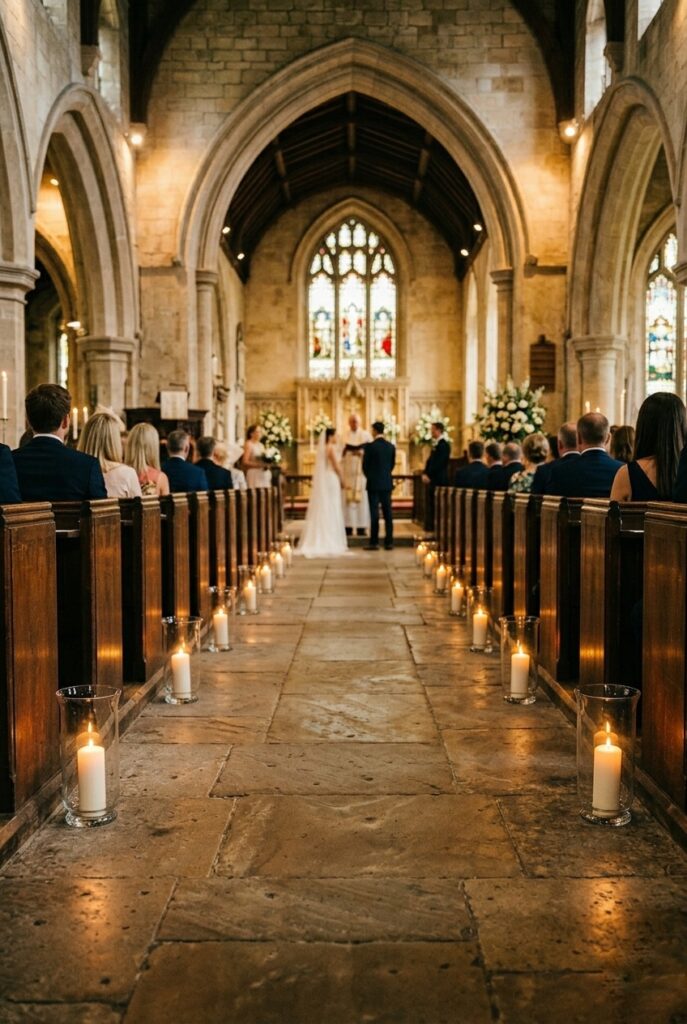
When a church prohibits any contact with the pews — no clips, no ties, no hooks — floor-standing vases are your entire aisle strategy, and they work beautifully.
Tall 20–24-inch glass cylinder vases placed directly on the floor at the aisle edge between pew ends create a standing floral column that reads at the right visual height from a seated guest’s perspective and photographs with excellent depth in processional shots.
Fill with a single dense arrangement per vase: five garden roses, a branch of eucalyptus, and a few stems of lisianthus, arranged tight to the rim so the flowers sit just above the vase top.
The base stability issue is real: cylinders on a stone or tile floor can tip if a guest brushes them while finding their seat.
Fill each vase with 4–6 inches of water — the weight alone provides significant stability.
For marble or polished stone floors, add a thin rubber mat underneath each vase (sold as “jar grippers” at kitchen supply stores, $4–$6 for a pack) to prevent any slide.
Rent or buy 20–24-inch cylinders on Amazon at $10–$18 each.
For a different take on keeping church ceremony design minimal and intentional, simple wedding decor ideas works through the same restraint logic.
Price: $10–$18 per cylinder. Amazon. Florals $5–$10 per vase from local wholesale market.
6. The Texture-and-Sound Consideration Nobody Talks About
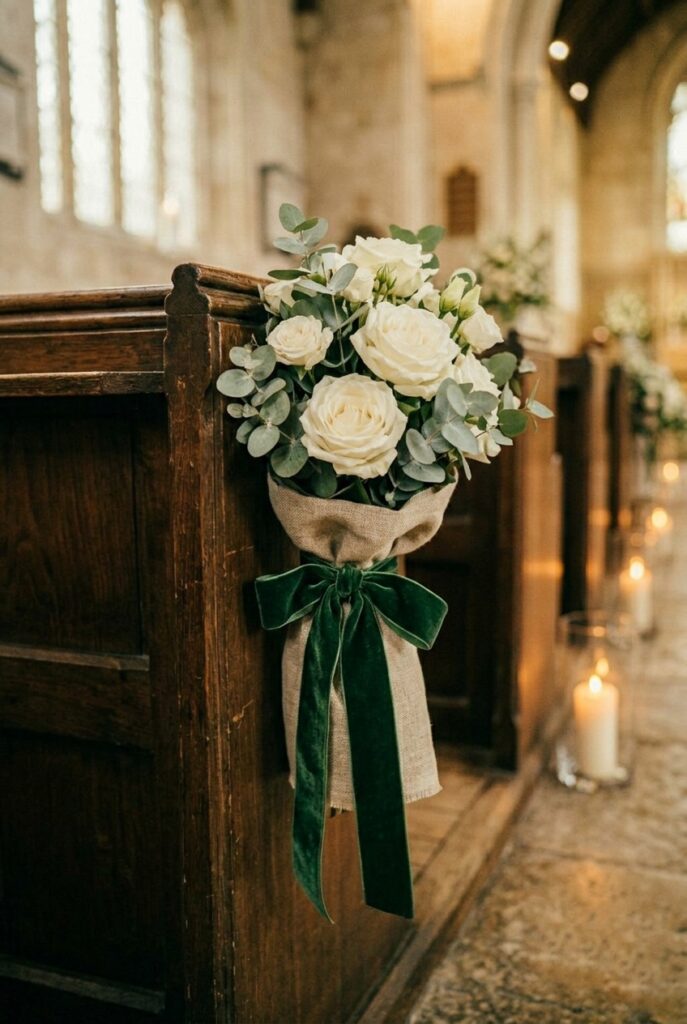
Here is the insider observation that wedding coordinators who work regularly in stone and masonry churches know, and almost no one tells couples before the wedding: soft-textured pew decorations — linen, velvet, woven ribbon, thick floral stems — measurably dampen the echo in a reverberant stone church.
(Competitor gap idea #2.) A church nave with bare wooden pews has a bright, clicky acoustic quality.
Add twenty pew-end arrangements with thick fabric bows and fresh stem clusters and the room settles slightly — not dramatically, but perceptibly.
The effect is more intimate warmth and less cavernous echo during the vows.
This means fabric choice matters beyond aesthetics. Wide velvet ribbon ($1.50–$3.00 per yard on Amazon or JOANN) tied in a wide, full bow contributes more acoustic softening than thin satin ribbon.
Thick stems — peonies, roses, hydrangeas — contribute more than sparse greenery.
This isn’t a reason to over-decorate, but it’s a real reason to choose fuller bows and denser arrangements over the thin, minimalist versions if your church is stone or plaster.
Double-sided velvet ribbon in ivory or sage on Amazon runs $18–$28 per 25-yard spool — enough to bow every other pew in a medium-sized church.
Price: $18–$28 per 25-yard spool. Amazon or JOANN Fabrics.
7. Baby’s Breath Cones or Posies as Pew Accents
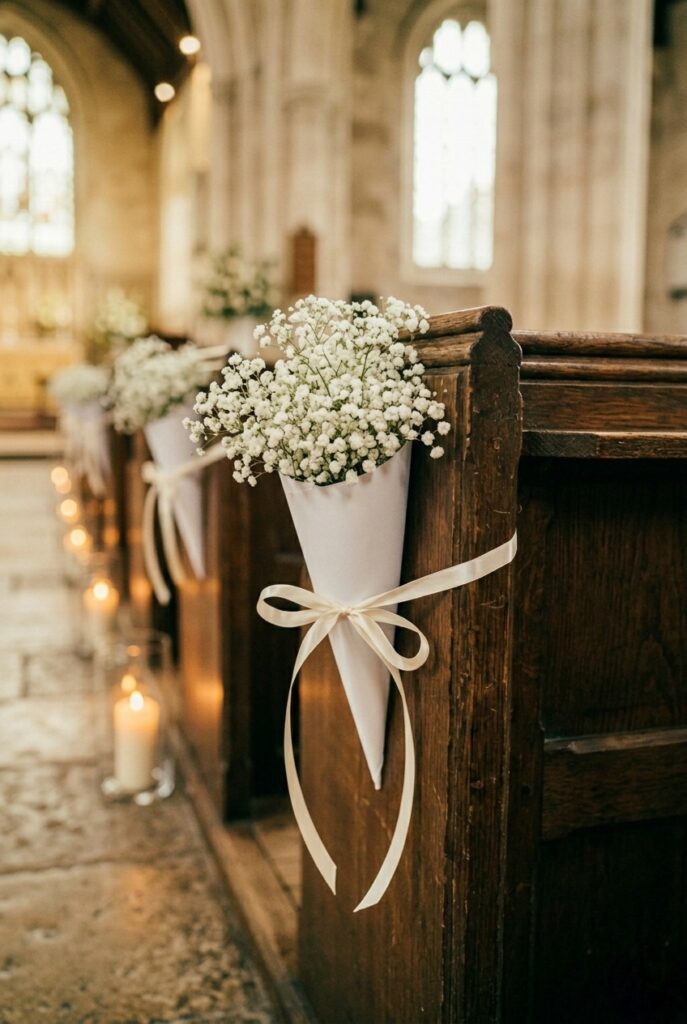
Baby’s breath cones are the most budget-consistent church pew decoration available — because baby’s breath is genuinely one of the most cost-effective flowers in existence, it holds for 48–72 hours after cutting without wilting, and it reads white and full from every viewing distance in church lighting.
A paper or linen cone (make them from heavy kraft paper or buy pre-made floral cones on Etsy for $1–$2 each) filled with a single dense bunch looks intentional rather than spare when the arrangement is truly packed — no visible cone interior, stems gathered tightly.
The skip-this here is the sparse version: three or four sprigs of baby’s breath loosely tied with ribbon to a pew, drooping.
That reads as rushed and underfunded.
The full version — a tightly packed cloud of baby’s breath that takes up the entire cone opening — reads as considered and deliberate.
One bunch of baby’s breath ($3–$5 at Trader Joe’s) fills two to three cones.
For a 50-foot church aisle decorating every other pew, you need roughly 10–12 cones per side, requiring 8–10 bunches total: approximately $30–$50 in flowers for the entire aisle.
Full breakdown of how to work at this price level without it showing is in budget wedding decor ideas.
Price: $30–$50 for a full aisle. Trader Joe’s (baby’s breath); Etsy or DIY (cones).
💰 Budget Hack after Idea 6: Wholesale flower markets in most metro areas open Saturday mornings between 4am and 9am and are open to the public — not just florists. A bunch of baby’s breath at retail (Trader Joe’s, Whole Foods) costs $3–$5. The same bunch at a wholesale market costs $0.80–$1.50. For a church aisle requiring 10 bunches of baby’s breath, that difference is $15–$35 saved on flowers alone. Search “[your city] wholesale flower market” and verify Saturday public access. Get there before 7am for the best selection. Bring buckets of water and cash; most markets are cash-only.
8. Ribbon-Only Pew Markers for Architecturally Significant Churches
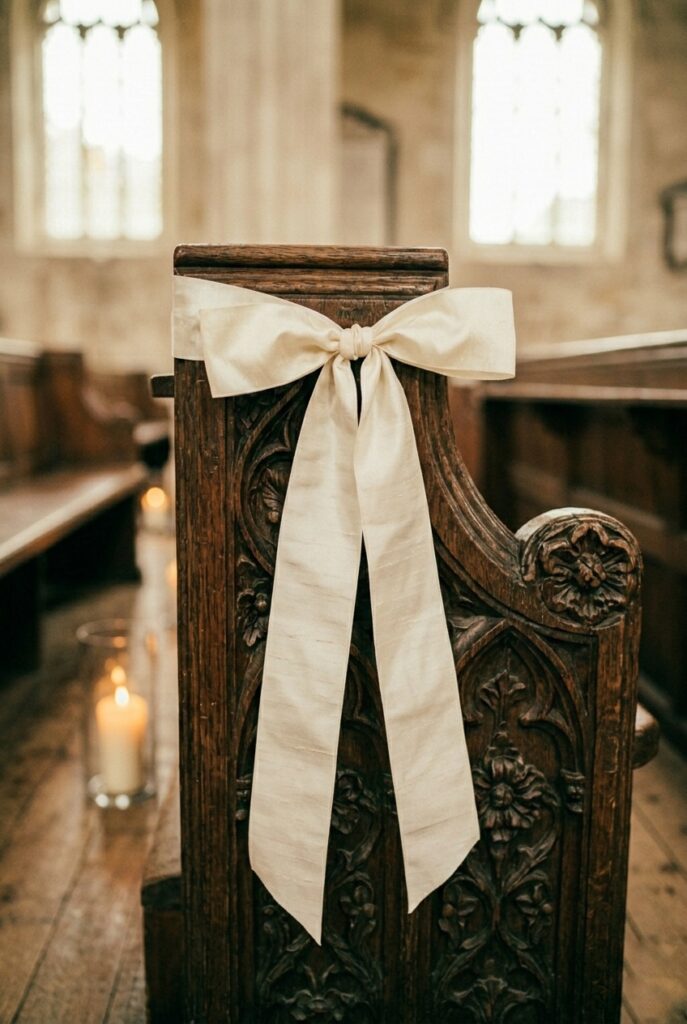
Here is the bold opinion: if your church is genuinely architecturally beautiful — carved wood, stained glass, stone columns, painted ceilings — ribbons alone are often the strongest aisle decoration you can choose.
A 4-inch-wide dupioni or natural-linen ribbon tied in a full, generous bow with 20-inch tails is the decoration that knows it belongs in that space rather than competing with it.
It adds softness and marks the aisle without introducing a color or material that fights the existing architecture.
And it’s the easiest church aisle decoration to attach cleanly to virtually any pew type, including those that prohibit clips.
The skip-this version is cheap polyester satin ribbon in a thin 1.5-inch width. It looks like it came off a gift box, catches overhead light in a synthetic sheen, and hangs limply.
Use 4-inch minimum width and a fabric that has body: dupioni, grosgrain, raw-edge linen, or wide velvet.
A 25-yard spool of 4-inch dupioni ribbon costs $22–$35 on Amazon or Etsy — enough for a full church aisle with room to spare.
No flowers needed.
No florist invoice. Just a clean, honest choice that respects the room.
For the full philosophy behind this kind of intentional editing, elegant wedding decor ideas works through when less is genuinely more expensive-looking.
Price: $22–$35 per 25-yard spool. Amazon or Etsy.
9. Petal Scatter — The Only Conditions Where It Works in a Church
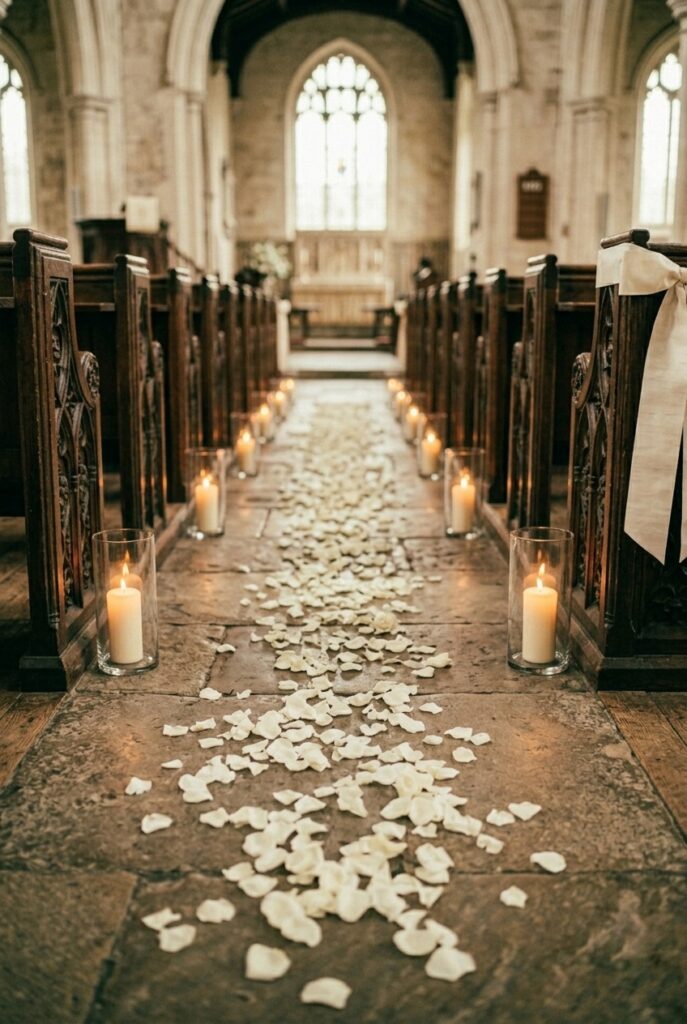
Fresh petal scatter inside a church is one of the few situations where the outdoor version’s biggest problem — wilting and browning — disappears entirely.
Stone, tile, and sealed hardwood church floors are cool and climate-controlled, meaning fresh petals hold their color for several hours rather than minutes.
Rose petals, ranunculus petals, and stock petals all work well.
The constraint to confirm first: many churches restrict petal scatter because of post-ceremony cleanup.
Ask specifically whether petals are permitted and who is responsible for removing them before the next service.
The version to skip is the dyed silk petal.
It looks synthetic against a church floor even from six rows back, and if any are loose near a candle flame, the polyester ignites.
Use fresh or real dried petals only. Dried petals ($12–$20 per cup from Amazon or Etsy’s FlowerPetalStore) hold color for 24+ hours, don’t wilt, and sweep up cleanly — making them the preferred choice for churches that allow petals but have strict cleanup timelines.
For a 60-foot aisle, plan 2–3 cups per side: $24–$60 total.
Only do this if: your church confirms petal scatter is permitted in writing, not just verbally. You want that confirmation before your flower order is placed.
Price: $24–$60 for a full aisle. Amazon or Etsy (dried petals).
10. The Aisle-Entry Pedestal Treatment
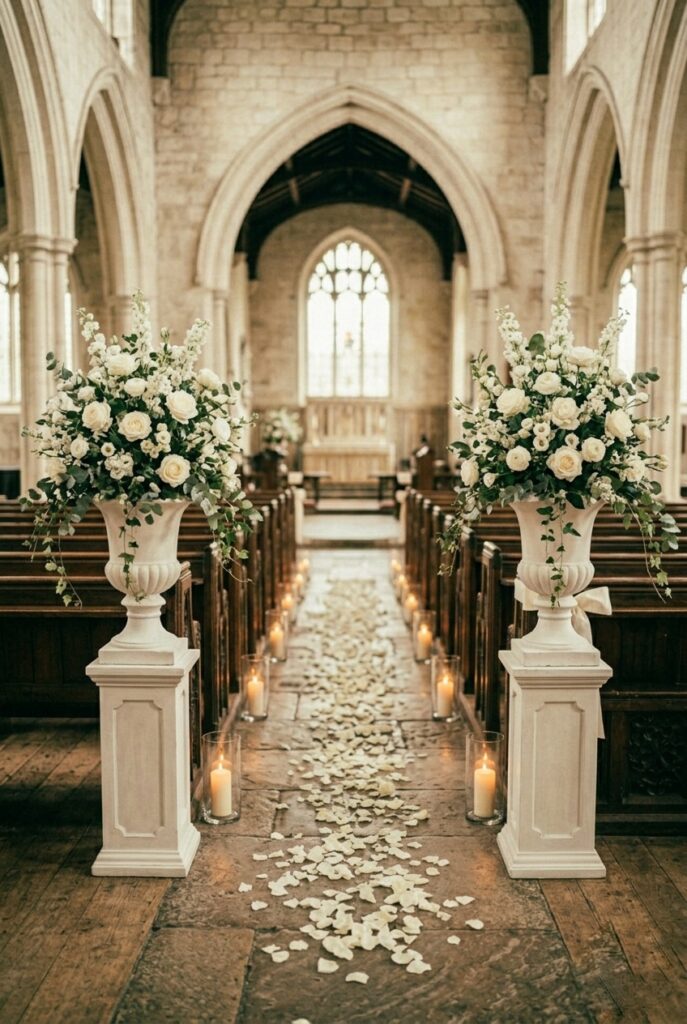
Most church aisle budgets are spread too thin across every pew.
The better investment — and the one photographers will photograph regardless — is two statement pedestal arrangements at the aisle entrance: the first thing every guest sees when they walk in and the visual framing for the entire processional.
Place two pedestal urns or column stands at the mouth of the aisle, flanking the first pew on each side, and keep pew decorations between them deliberately minimal.
The effect is that the aisle reads as defined and intentional from every position in the church, which a uniform run of small swags rarely achieves.
Pedestal stands rent for $15–$25 each from local event rental companies; or buy 36-inch column stands on Amazon for $25–$45 each and resell after.
Floral arrangements using wholesale stems run $40–$80 per pedestal. Full entrance treatment: $100–$200.
Use WeddingWire’s local vendor search to find a nearby rental company with column stands if purchasing feels excessive for a one-use piece.
Always confirm with your church that floor-standing structures are permitted at the aisle entrance — some restrict objects near the narthex for accessibility reasons.
Price: $100–$200 for two-pedestal entrance treatment. Rental company or Amazon.
💰 Budget Hack after Idea 9: Most florists charge $120–$180 per pedestal arrangement for church ceremonies because they factor in design time, delivery, and installation. If you want the same visual at a quarter of the cost, rent the stands from an event rental company ($15–$25 each) and buy wholesale stems from a local market the morning before the wedding. A tight arrangement of 10 garden roses, a half-bunch of eucalyptus, and three stems of lisianthus costs $18–$28 in wholesale stems and takes 30 minutes to build with no floral experience — just pack stems tightly into pre-soaked floral foam in a bowl or cylinder set inside the urn. The result is visually identical at 10 feet away, where every guest and your photographer will be standing.
11. The Aisle Runner Question — When It Helps and When It Hurts
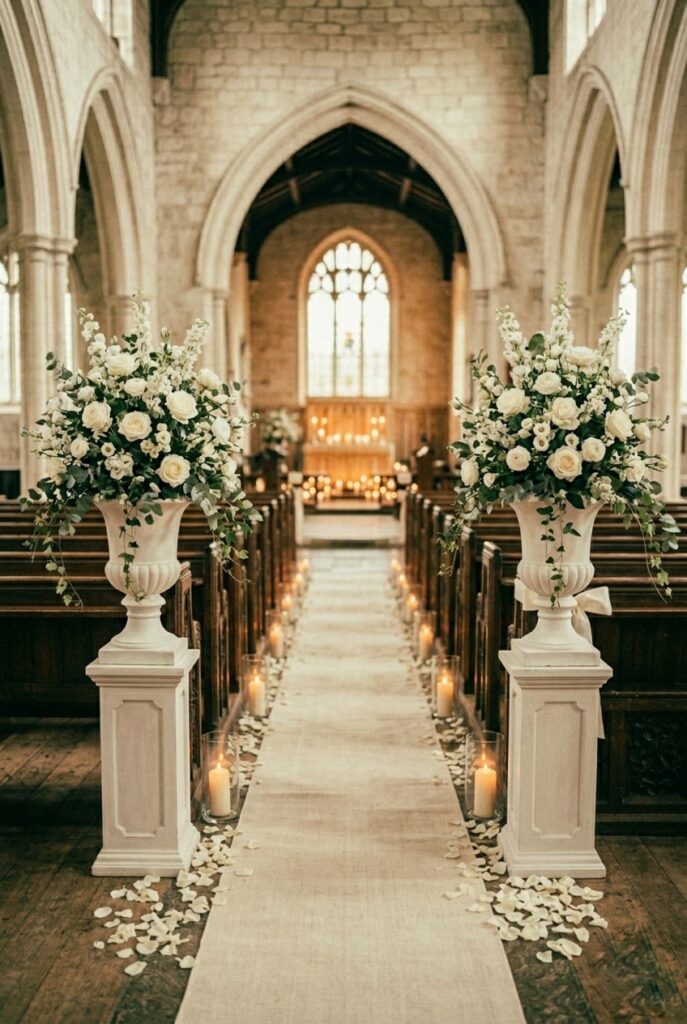
An aisle runner in a church is genuinely useful in two scenarios: protecting a stone floor that’s uneven or cold under thin-soled shoes, and defining the aisle visually in a very wide nave where without a runner the walkway feels formless.
In every other scenario, a runner is decoration for its own sake — and often actively problematic.
Standard white satin runners wrinkle within minutes of being walked on, buckle at the seams when chair legs catch edges, and the heel-catching edge is a real tripping hazard on a long walk in formal shoes.
If you want a runner, use natural linen or a heavyweight cotton muslin, not satin.
The weight holds the runner flat without tape.
Width should be 36 inches minimum — narrower than that photographs as a stripe rather than a defined path.
The Original Runner Company sells custom-sized natural linen runners ($45–$85) and will add monograms or botanical prints if you want personalization.
Standard raw linen by the yard at JOANN runs $6–$9 per yard for a 36-inch width — a 60-foot runner costs $18–$28 in fabric and 20 minutes of cutting.
Check easy wedding decor ideas for morning-of setup timelines that include runner laying without a coordinator present.
Skip this if: your church floor is carpeted (redundant), your aisle is under 40 feet (it’ll look short and abrupt), or your dress has a cathedral train longer than your aisle width (the train will push the runner up behind you).
Price: $18–$85 depending on source. JOANN (raw linen) or The Original Runner Company (custom).
Decision Filter
If your church is architecturally significant — carved stone, stained glass, ornate woodwork — invest in ribbon quality and one strong pedestal treatment at the entrance.
Let the building do the decorating. Adding too many competing elements to a beautiful church makes it look cluttered, not enhanced.
If your church is a plain contemporary building with standard wood chairs rather than pews, you have more freedom and actually need more decoration to give the space definition.
Floor cylinder vases, a linen runner, and a continuous garland along chair backs will do the visual work the architecture isn’t.
If your budget is under $100 for the full aisle, a combination of baby’s breath cones on every other pew ($35–$50) plus wide ribbon bows on the remaining pews ($22–$28) covers a complete 60-foot aisle with clean results.
Before making any final decisions, use The Knot’s church wedding planning checklist to confirm what your specific house of worship requires in terms of vendor access and cleanup.
The Real Reason Church Aisle Decorations Go Wrong on Setup Day
The contrarian insight: the single most important church aisle decoration decision has nothing to do with which flowers you choose — it’s confirming your attachment method six weeks out, not the week before.
Couples who find out their church prohibits clips on the morning of setup have three options: floor-based elements, ribbon-only ties, or nothing.
Two of those require having purchased the right supplies in advance.
Strong opinion: if you’re decorating your own church aisle without a florist, your setup window is shorter than you think.
Most churches give couples 60–90 minutes before the ceremony for decoration access, and a full 60-foot aisle on both sides takes longer to dress than anyone expects.
Plan for two people working together for the full window, not one person “taking care of it.”
The insider observation: wedding photographers who regularly shoot church ceremonies will tell you that the most-photographed aisle element is almost never the pew decorations — it’s the entrance and the altar.
Your florist and your own planning instincts both push you toward the pews because that’s where the budget line items are easy to count.
But every wide-angle shot of your processional is framed by what’s at the back of the church (the entrance arch or narthex door) and what’s at the front (the altar).
A couple who spends $400 on pew swags and $80 on two pedestal urns at the altar end will have an aisle that looks unfinished in photos.
The ratio should be inverted: $150–$200 on pew work, $200–$300 on the altar approach.
Almost nobody is told this before they write the check.
Mistakes to Avoid
Mistake 1: Decorating every single pew. Competitors universally recommend dressing every pew end.
The result is visual repetition that reads as mass-produced rather than curated, and the cost is double what an alternating-pew approach would be with virtually identical visual impact.
Decorate every other pew — the eye fills in the pattern, the aisle reads as consistently dressed, and you spend 50% less on materials.
The exception is a very short aisle of under 30 feet, where you have fewer than 8 pew ends per side and every-other would be too sparse.
Mistake 2: Spending $180 on a satin aisle runner that was destroyed before the ceremony started. Standard white satin runners from Amazon and party supply stores cost $25–$60 and look beautiful flat.
The moment a church coordinator pre-lays it and a guest sits in a pew chair whose leg catches the edge, the runner buckles and the fold cannot be straightened under ceremony conditions.
Satin aisle runners are the most frequently regretted church ceremony purchase I have seen across hundreds of weddings.
If you want a runner, buy linen, minimum 12 oz per yard weight, no exceptions.
Mistake 3: Not finding out about the candle policy until the florist arrives. This happens at roughly one in four church weddings in my experience.
The bride chose pillar candles in open glass for the entire aisle vision. The church prohibits open flames.
The florist arrives with 20 real-wax pillars and no LED substitutes. The aisle gets nothing.
Confirm the flame policy in writing — not a verbal yes from the church secretary, but an email from the facilities coordinator — before any candle purchase is made.
Frame it as a question about fire code compliance so you get a definitive answer rather than a guess.
Mistake 4: Choosing decorations that look perfect from the front and terrible from the back. Every single guest enters and walks past the pews from the back of the church.
The pew-end view they see when finding their seat is the back of your floral swag — which, if made with a round foam holder and ribbon, is a flat piece of plastic foam with a stick.
The front view is lush; the back view is the mechanics. Either use a swag design that has greenery on all sides (build around a stem cluster rather than a foam backing), or accept that the back of every arrangement will be visible to arriving guests and factor that into your design.
Almost no one thinks about this until they see the photos from the aisle entrance looking toward the altar — which show the backs of every single pew marker.
FAQ
How do you decorate church pews for a wedding without damaging them?
Use heavy-duty pew clips rated for the pew thickness — most antique wooden pews are 1 to 2 inches thick — or tie ribbon loops that grip without puncturing.
Never use tape, staples, glue, floral wire wrapped tightly, or adhesive hooks on historic wood.
A set of 24 plastic pew clips costs $12–$18 on Amazon and fits the widest range of pew rail profiles.
Confirm acceptable attachment methods directly with your church facilities manager before purchasing any supplies.
What are the best flowers for church wedding aisle decorations?
Garden roses, ranunculus, and lisianthus are the most reliable choices because they hold shape and color for 6–8 hours after cutting at room temperature.
White hydrangeas are popular and lush-looking but wilt faster in warm or dry church air — use them only if your church is climate-controlled.
Baby’s breath is the most cost-effective option and holds longest of any fresh bloom in a church setting.
Avoid tulips and sweet peas, which collapse within 2–3 hours of being out of water.
How much does it cost to decorate a church aisle for a wedding?
A complete church aisle can be decorated for $80–$150 using DIY baby’s breath cones, wide ribbon bows, and flameless lanterns from IKEA sourced without a florist.
A fully florist-installed aisle with fresh pew swags, pillar candle lanterns, and a linen runner typically runs $400–$800 depending on flower choice and aisle length.
The biggest single cost driver is labor, not materials — most of what a florist charges for a church aisle is installation time, which you can eliminate by building and installing yourself with two people and a 90-minute setup window.
Wedding decor ideas on a budget maps out exactly where DIY saves real money versus where it costs you in stress.
Can you use real candles for church wedding aisle decorations?
It depends entirely on your specific church.
Many permit real candles in fully enclosed hurricane glass; many prohibit open flames entirely for fire code reasons; some require a licensed pyrotechnic vendor for any candle use.
The only way to know is to ask your church facilities manager directly and get confirmation in writing before purchasing.
Where real flames are prohibited, Luminara LED pillar candles ($28–$40 at Target) are the only flameless option that photographs convincingly in low-light church conditions.
Budget Table
| Decoration Idea | Full Aisle Cost | Best For | Source |
|---|---|---|---|
| Baby’s Breath Cones | $30–$50 | Any church, all budgets | Trader Joe’s / wholesale market |
| Pew-End Floral Swags (DIY) | $60–$120 | Pew rail attachment allowed | Wholesale market + Amazon |
| Pillar Candle Hurricane Lanterns | $120–$200 | All churches (flameless if needed) | IKEA + Target (Luminara) |
| Greenery Garland (faux) | $140–$220 | No-flame churches | Afloral.com |
| Ribbon-Only Bows | $22–$35 | Historic/architecturally rich churches | Amazon / JOANN Fabrics |
| Floor Cylinder Vases | $120–$200 | No-pew-contact churches | Amazon + wholesale market |
| Petal Scatter (dried) | $24–$60 | Churches permitting petals | Amazon / Etsy |
| Linen Aisle Runner | $18–$85 | Wide naves, uneven floors | JOANN / The Original Runner Co. |
| Entrance Pedestal Urns (2) | $100–$200 | All church types | Rental company + wholesale market |
Every beautiful church aisle decoration in the inspiration photos you’ve saved was either installed by a florist who called ahead about attachment rules, or it was built by a couple who found out the hard way that none of their ideas were permitted.
The difference in your case is that you’ve read this first.
Call your church facilities manager today — not the parish secretary, not the day-of coordinator — and get your three answers: attachment method, flame policy, setup window.
Then come back to this list and choose two ideas that fit those answers.
If you want the full church ceremony picture from entrance arch to altar, indoor elegant wedding decor ideas covers exactly how to extend this same restraint and intentionality through every element of the space.