
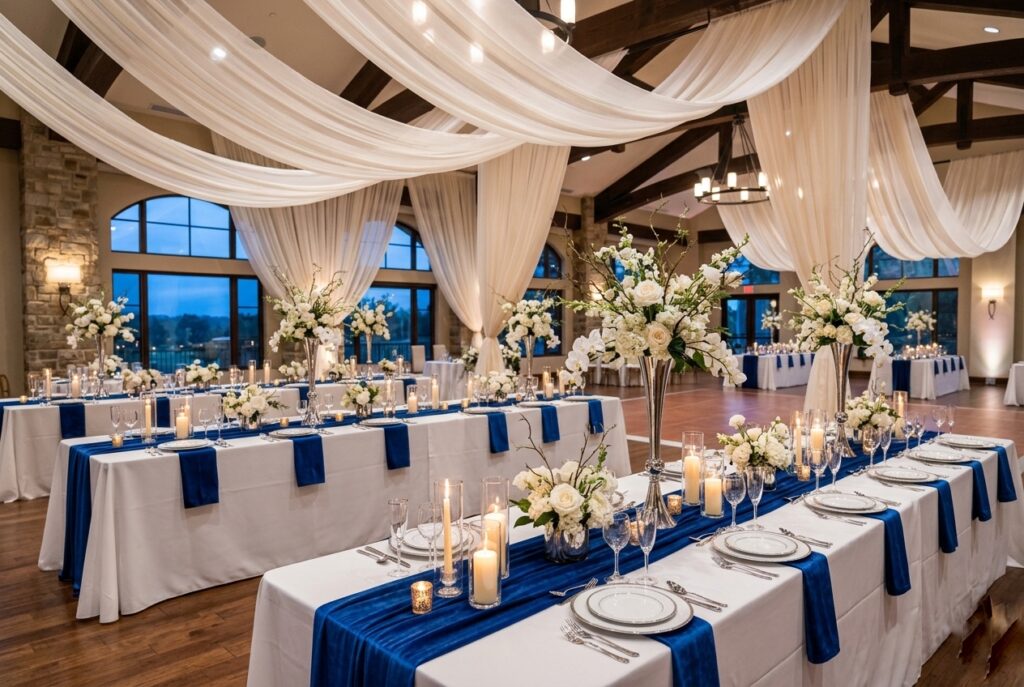
Every January, the trend articles arrive like clockwork — same five ideas dressed up in new photography. This year is genuinely different.
The shift happening this year wedding design isn’t a color palette change or a new centerpiece shape. It’s a philosophy shift. Couples are done decorating rooms.
They want to build environments.
And the gap between couples who understand that distinction and the ones who don’t shows up immediately the moment guests walk in the door.
Here is what’s actually worth your attention — and what to skip.
The room doesn’t look like a wedding. It looks like somewhere you’d want to stay. Fabric moves slightly near the window.Someone’s initials are stitched into the linen. This is the difference between decorated and designed.
The Short Answer
This year wedding decor is defined by three real shifts: texture over volume, one jaw-dropping installation instead of many medium ones, and personal craft details that make the day feel handmade rather than hired. Couples spending their budget chasing every trend on this list will end up with nothing memorable. Couples who pick two or three and execute them deeply will end up with photos that look nothing like anyone else’s wedding this year.
1. Silver Replaces Gold — Finally
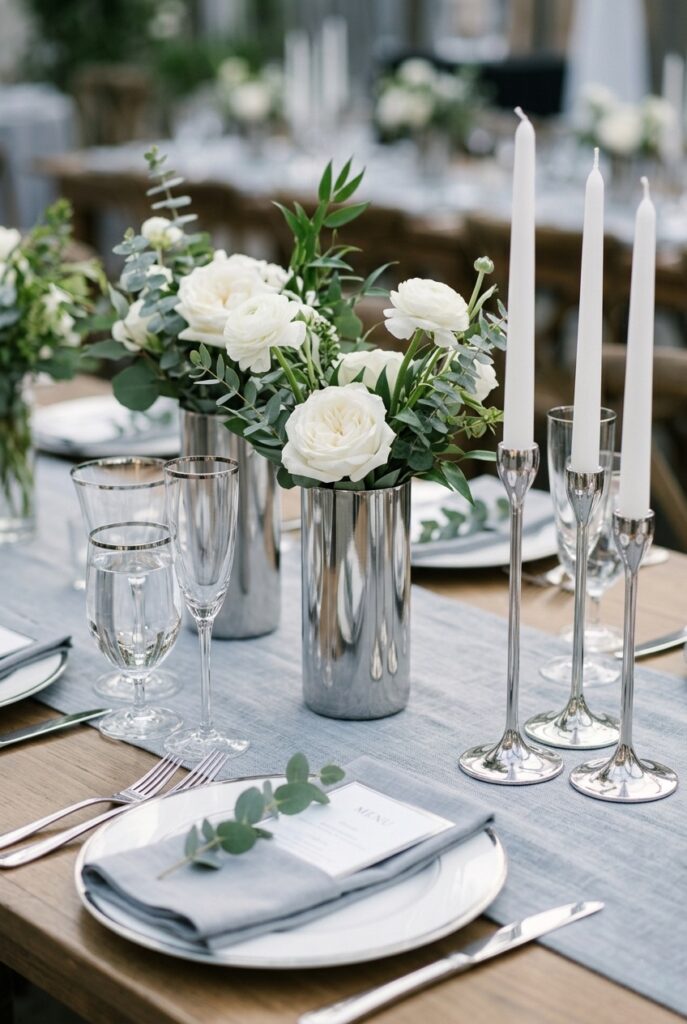
Gold has dominated wedding decor for nearly a decade, and it’s not that gold looks bad.
It’s that it no longer reads as a choice. Silver is the metallic moment of this year — cooler, more modern, and with a futuristic edge that photographs completely differently than warm brass. Think chrome-finish vessels, silver-rimmed glassware, stainless steel candleholders, and mirrored surfaces that catch candlelight in an almost discotheque way.
Skip this if your venue leans heavily warm — exposed brick, amber wood tones, warm Edison lighting. Silver fights those environments. In that context, stay with brass or skip metallics entirely.
Only do this if you’re working with a cool-toned venue — white walls, stone floors, natural light — where silver reads as sleek rather than cold.
💰 $15–$60 per table for chrome vessels and silver candleholders — Amazon chrome vase sets; HomeGoods for mixed silver candleholders; silver-rimmed glassware from Crate & Barrel or event rental companies
2. One Jaw-Dropping Floral Installation, Everything Else Quiet
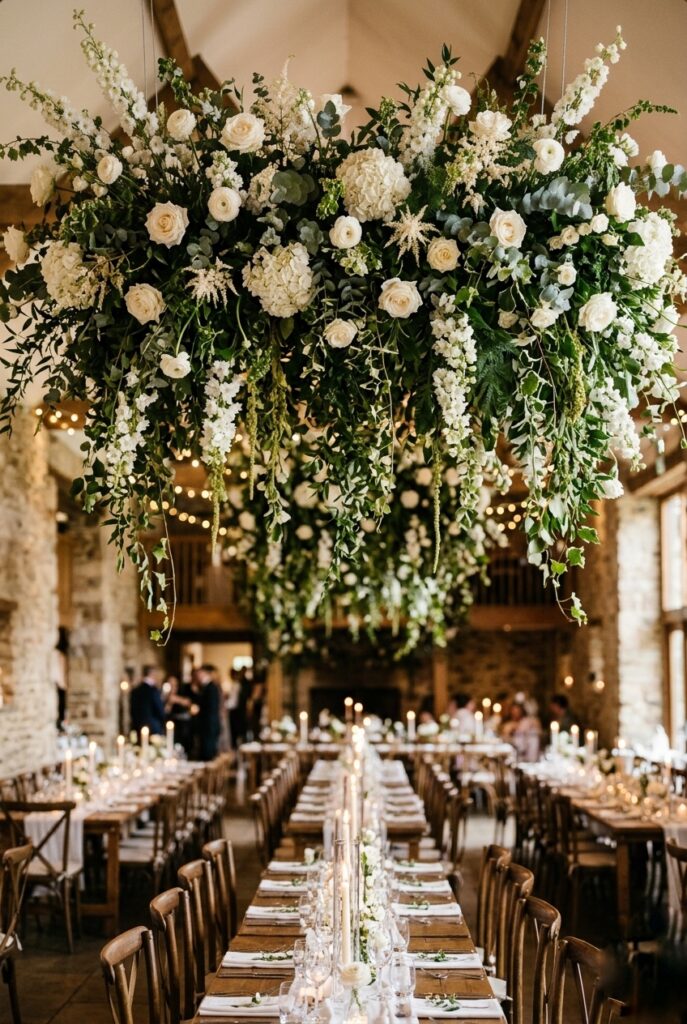
Here’s the shift that the smartest designers are making and nobody is explaining clearly: this year is not about more flowers.
It’s about one unmissable floral moment — a ceiling installation above the dance floor, a living floral wall behind the sweetheart table, a ground-level meadow-style arrangement that guests walk around at cocktail hour — and then deliberately scaled-back florals everywhere else.
The designer logic is simple: when you go big in one area, it doesn’t look like you cut corners in the other areas.
When you go “kind of medium everywhere,” spreading budget equally without creating any design focal points, the whole room feels like nothing. Stone House Creative
That one installation becomes the photograph every guest takes. The guest tables with their simple bud vases and candles look intentional beside it.
💰 $800–$3,500 for a statement installation — this is where to concentrate floral budget; guest table florals can drop to $15–$30 per table using bud vases and minimal stems
3. Fabric Draping as Architecture
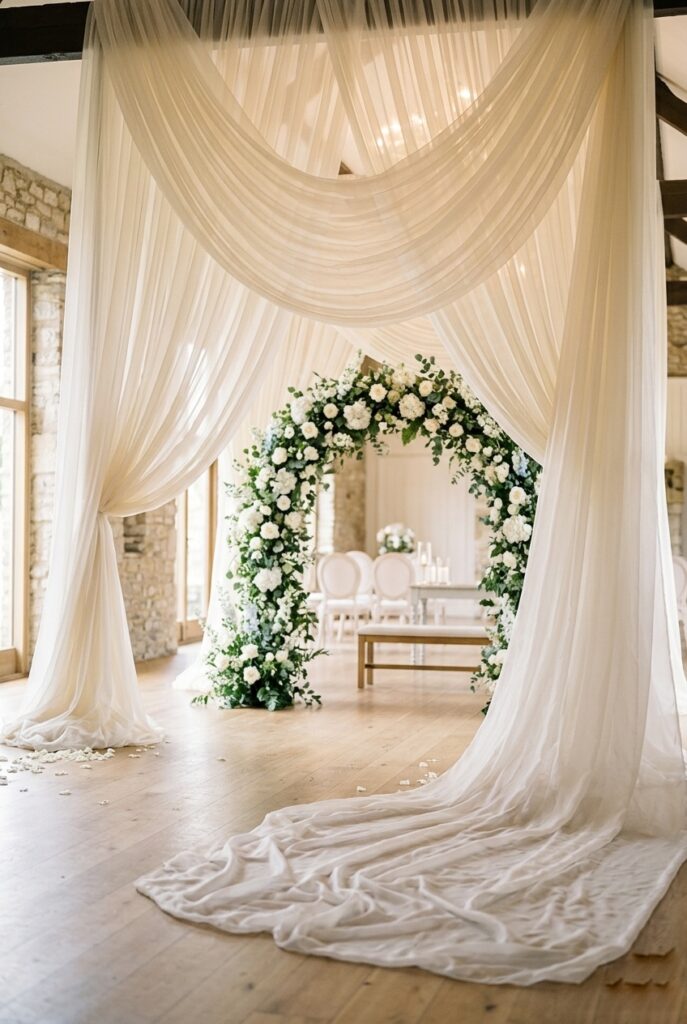
Draping has secured its place as a timeless favorite — and in this year it’s everywhere: twisting across table tops, billowing from ceilings, cascading over doorways and ceremony arches.
The difference between draping that looks expensive and draping that looks like a quinceañera is the fabric and the looseness.
Velvet and silk-weight fabrics pool and move with gravity in a way that polyester cannot replicate.
And the installation should look slightly imperfect — a drape that falls exactly evenly on both sides looks like it came from a party supply warehouse.
A drape that falls with slight asymmetry looks like a set designer touched it. Reverie Social
This is one of the highest-impact, lowest-material-cost decor moves available. Fabric is cheap. Labor to hang it properly is where the cost lives.
💰 $80–$400 depending on ceiling height and fabric quantity — sheer organza and velvet by the yard from Fabric.com or JOANN; professional installation through a decor rental company or theatrical rigging contact
💡 Budget Hack #1: Use sheer organza fabric instead of silk or velvet for ceiling draping. At $2–$5 per yard versus $15–$30 for luxury fabric, it stretches dramatically farther. Organza has the translucency that makes overhead draping beautiful because light passes through it — which velvet doesn’t do.
4. Cobalt Blue as Your Statement Color
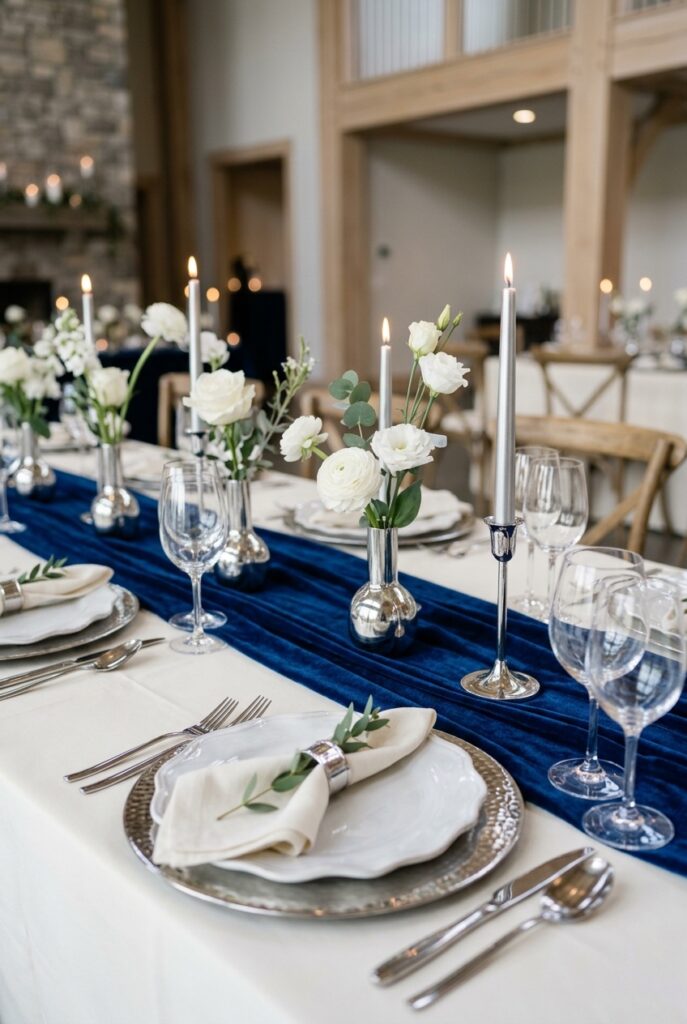
If there’s one color set to have a main-character moment in this year weddings, it’s cobalt blue.
Electric, modern, and impossible to ignore, this shade is forecasted to become one of the year’s most defining signatures.
The way to use it without overwhelming: commit to it in one dominant element — velvet table linens, a ceremony backdrop, bridesmaid dresses, or the bar setup — and let everything else go neutral.
Cobalt paired with ivory, silver, and white botanical greenery is the specific combination that photographs with real sophistication. THEWED
The version that doesn’t work: cobalt everywhere. Cobalt napkins AND cobalt tablecloths AND cobalt draping AND cobalt florals is a sensory assault, not a design statement.
💰 $15–$35 per linen for cobalt velvet or cotton table runners — LinenTablecloth.com; velvet runners on Etsy; also available through most party rental companies in major markets
5. Sculptural Florals That Play with Negative Space
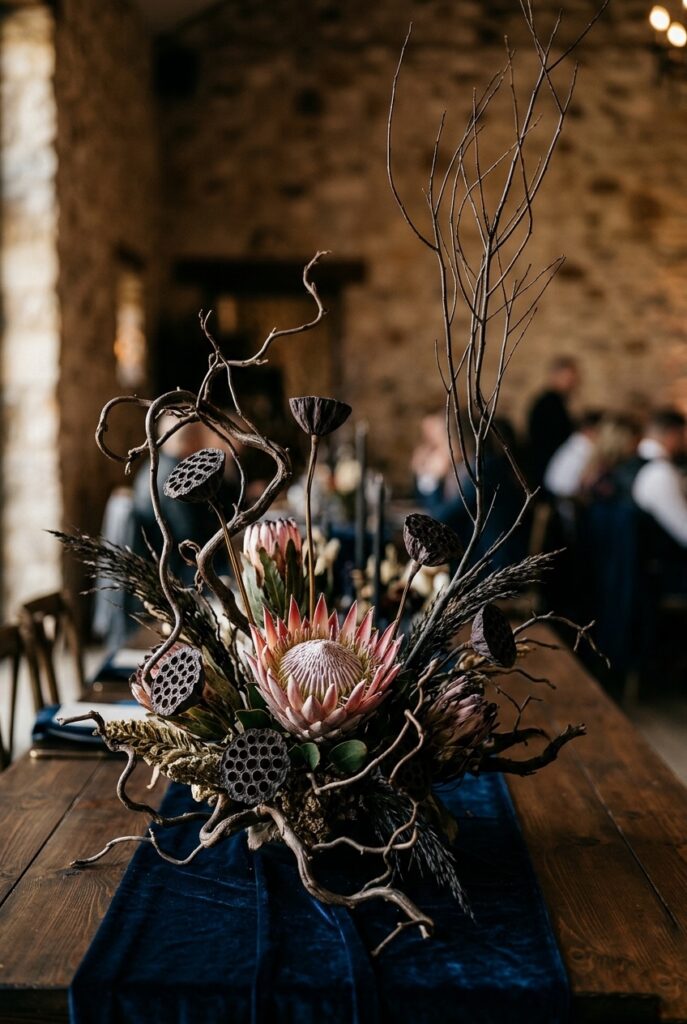
Florals are moving away from sheer abundance toward form.
We’re seeing flowers treated almost as sculptures — pieces that play with negative space, raw textures, and unexpected shapes.
They interact with the architecture and landscape, becoming part of the setting rather than just an addition.
Twisted stems, asymmetric arrangements that reach in one direction only, single architectural blooms like anthuriums or protea placed with deliberate space around them — these are the centerpiece choices that make guests say “I’ve never seen flowers like that” rather than “the flowers were beautiful.” THEWED
This is the trend that requires the most florist-level skill. It cannot be DIY’d the night before. If you want sculptural florals, book a florist with a proven editorial portfolio and brief them explicitly.
💰 $80–$250 per sculptural arrangement — budget-conscious version uses lotus pods, dried grasses, and protea which hold their structure naturally; source these through a wholesale market or Blooms2Door
6. Embroidered Textiles as Personal Decor
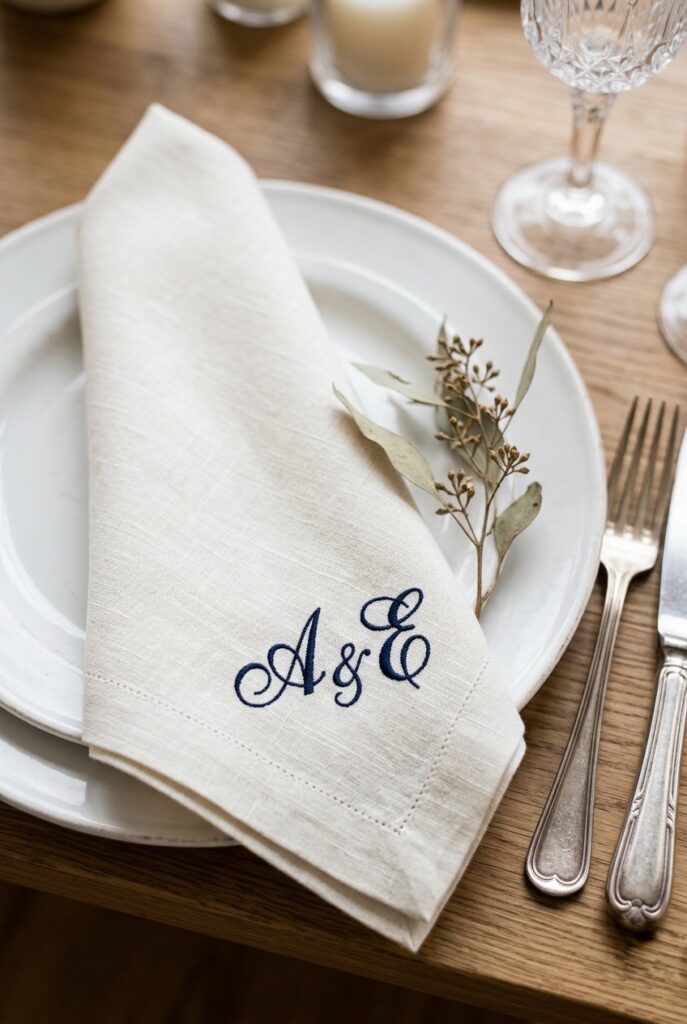
From napkins to tablecloths to ribbons to handkerchiefs, embroidery is one of the most darling wedding decor trends of this year.
It stems from modern couples’ proclivity for personalization and the swing toward handcrafted and homey elements.
The specific application that hits hardest: a hand-embroidered ceremony sign or welcome piece that becomes a piece of framed home art afterward
. Or embroidered linen napkins with the couple’s initials. Neither is cheap, but both are genuinely one-of-a-kind in a way no rental item can be. The Knot
The more accessible version: iron-on embroidered patches on fabric table runners, or custom embroidered ribbon used as place card ties. Both look handcrafted. Neither requires you to actually know embroidery.
💰 $15–$45 per napkin (embroidered custom) on Etsy; embroidered ceremony signs from $80–$300 depending on complexity; iron-on patches from $2–$5 each on Amazon
💡 Budget Hack #2: Order embroidered linen napkins in bulk from Etsy shops — many offer sets of 50 with custom monogramming for $150–$220 total. That’s $3–$4.40 per napkin for a fully personalized piece. Resell them on Facebook Marketplace or Poshmark after the wedding and recoup 50–70% of the cost.
7. The “Big Ceremony, Quiet Reception” Design Split
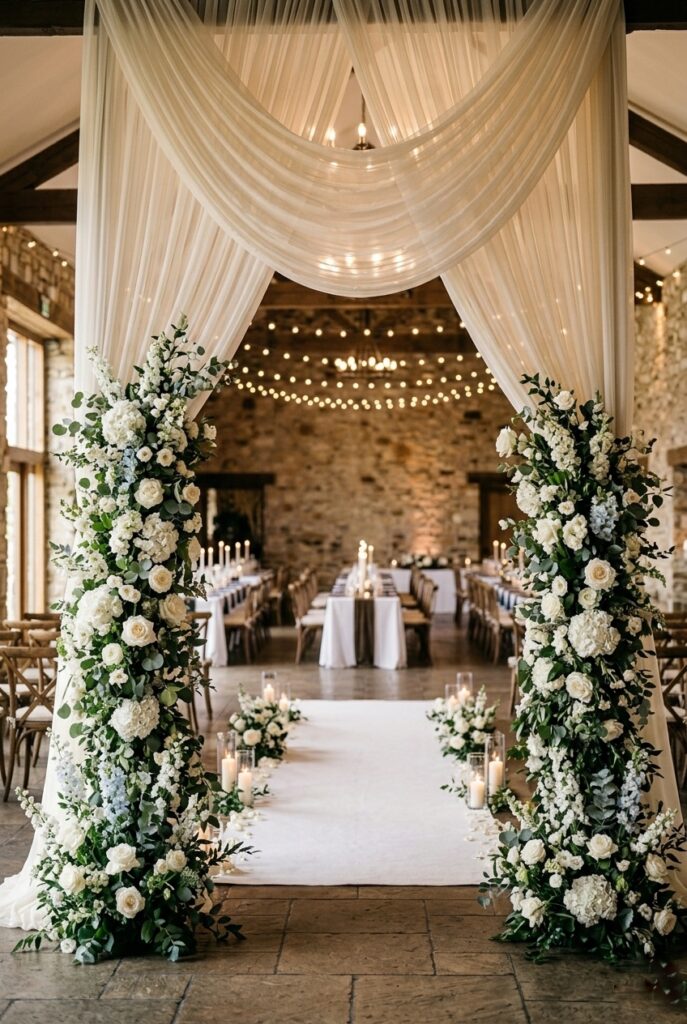
Nobody in the trend roundups is explicitly naming this, but it’s the smartest decor strategy working in this year and it’s worth spelling out.
Load your design impact into the ceremony space — a dramatic floral installation at the altar, heavy draping, a statement arch — and then let the reception breathe with simpler, quieter decor.
Minimal guest tables, candlelight, clean linens.
The ceremony lasts 20 minutes.
The reception lasts four hours.
Most couples spend their budget proportionally the wrong way — decorating the reception heavily and letting the ceremony backdrop be an afterthought. Flip it.
One stunning ceremony moment, photographed from every angle, does more for your wedding’s visual story than ten medium-quality reception details.
💰 Budget reallocation, not extra spend — shift 30–40% of your floral budget from reception centerpieces to one ceremony installation
8. Seashells and Organic Materials as Styling Accents
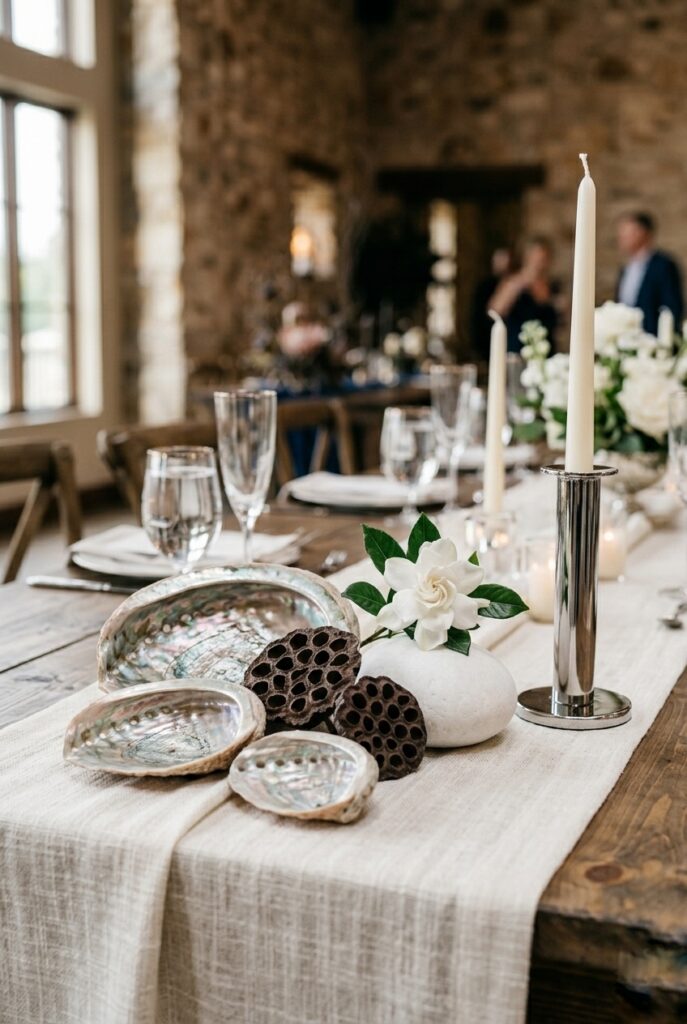
Seashells are back in weddings — and not reminiscent of the little scallop-shaped soaps in your grandma’s bathroom.
The iteration of shell decor is chic, elegant, and relies on the natural beauty, organic shapes, and pearlescent shimmer of the little treasures.
The elevated application: shells as escort card holders, as small vessel bases for a single stem, or incorporated into table number displays.
Lotus pods, driftwood, and polished stone round out this organic-materials moment. The Knot
This is the trend most accessible without a florist or a designer. You can buy shells, pods, and stones at a craft store or online and style them yourself in an afternoon.
💰 $20–$60 total for 10 tables — decorative shells on Amazon (bulk bags); lotus pods from Amazon or a wholesale floral market; smooth stones from any garden or craft store
💡 Budget Hack #3: The most costly part of 2026’s textural decor is the velvet and specialty linens. Rent them instead of buying. Most party rental companies in mid-to-large markets are adding velvet runners and specialty tablecloths to their inventories specifically because of this trend. Renting 10 velvet runners costs $60–$100. Buying them costs $200–$350. The rental gives you the same visual result.
9. Immersive Food as Decor — Not Just as Food
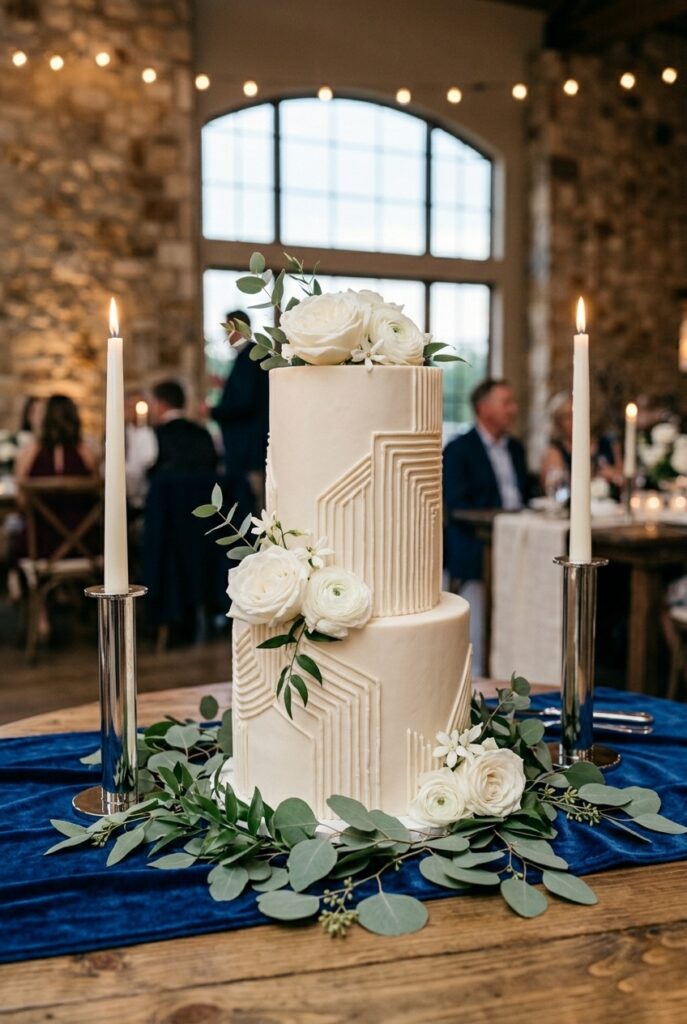
In 2026, cakes will be double-take worthy: is it art, or is it edible? This is the design trend that doesn’t require a florist at all.
A sculptural cake placed at the center of a reception table as the centerpiece. A grazing board so abundant and styled that it reads as decor.
A gelato cart in a corner that draws guests like a design installation. A bread-and-butter centerpiece where an artisan loaf becomes the table anchor. THEWED
These moves cost about the same as traditional decor — sometimes less — and they do something flowers can’t: they get guests up, moving, interacting, and photographing things that also end up in their mouths.
💰 $150–$500 for a styled cake-as-centerpiece — redirect floral centerpiece budget here; grazing board setups from a local caterer or DIY for $8–$15 per person
10. Monogrammed Everything — Done With Restraint
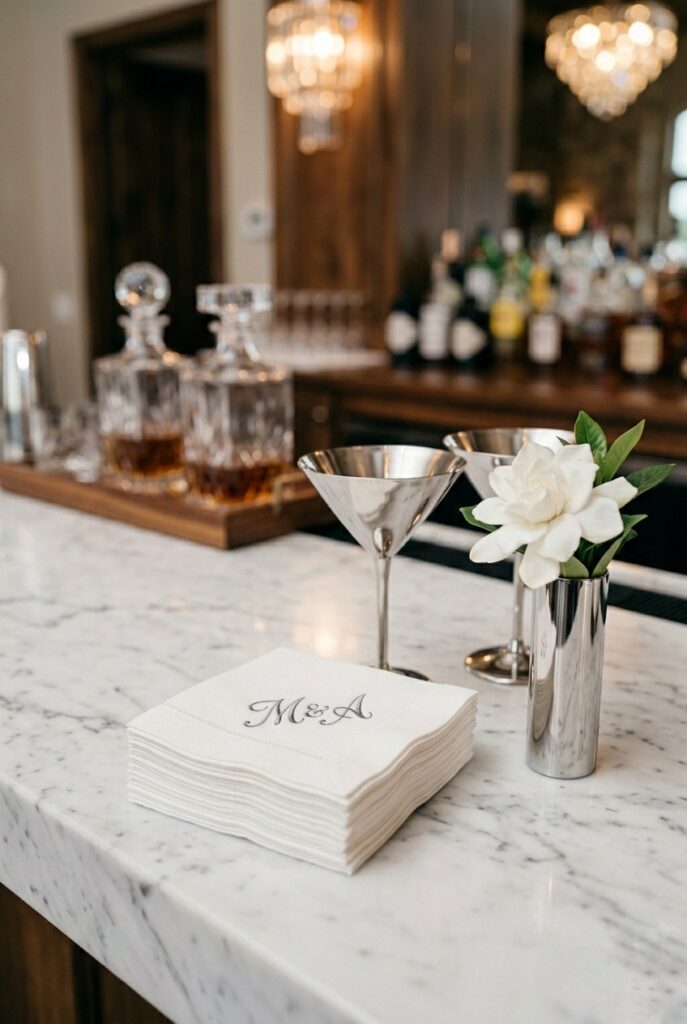
Couples will extend personalization beyond paper, placing their initials or custom monogram across textiles, décor, and even food.
The version that works: a monogram in one unexpected place — pressed into the wax of a candle, embossed on the cocktail napkins at the bar, stitched into the ceremony program cover.
The version that doesn’t work: the same monogram on the napkins, the chair backs, the welcome sign, the cake, and the dance floor projection.
When your initials are everywhere, they stop meaning anything. THEWED
Pick one surface for your monogram. Make it beautiful there. Let it go everywhere else.
💰 $12–$18 for a wax seal stamp kit on Amazon; custom cocktail napkins with monogram from Etsy ($35–$80 for 50); embossed wax seals on ceremony envelopes from $0.30–$0.50 each
11. Ice Sculptures — Seriously, They’re Back
![📷 [IMAGE 12 HERE] Alt text: Sleek modern ice sculpture at a 2026 wedding cocktail hour displaying fresh oysters on ice, with silver candleholders and white blooms surrounding it](https://blessedvows.com/wp-content/uploads/2026/05/IMG_1463-687x1024.jpeg)
Ice sculptures are back — and they’re chicer than ever.
Gone are the LED-lit iterations of the early 2000s; they’re being replaced by sculptures that evoke the opulent kitsch of the ’80s, and others that are sleek, sharp, and unequivocally of the modern moment.
Some even serve as slick ways to keep cold appetizers like oysters chilled in a way that’s much more eyecatching than a trough full of cubes. The Knot
The 2026 iteration isn’t a swan or a heart. It’s a monolith form, a single architectural slab, or a bowl-shaped piece that displays raw oysters at cocktail hour.
It’s functional, it’s genuinely surprising, and it’s the detail that photos of your wedding will be recognizable by. Nobody else will have it.
Skip this if your venue doesn’t have climate control or your wedding is outdoors in summer heat. Ice sculptures last two to four hours in controlled environments — considerably less in direct sun.
💰 $200–$600 depending on complexity — search “[your city] ice sculpture rental weddings”; functional oyster display versions on the lower end of the range
Your Decision Filter
If your budget is under $5,000 for total decor → skip the floral installation and the ice sculpture.
Put your money into one dramatic fabric draping moment and invest the rest in texture — velvet runners, embroidered napkins, chrome vessels.
Texture costs less than flowers and reads as equally elevated.
If your venue has strong existing architecture → work with it, not against it. A venue with dark wood and warm stone doesn’t need cobalt blue.
It needs silver to contrast and cool it down, or it needs deep jewel tones that lean into its existing richness.
If you can only pick one 2026 trend to act on → pick the sculptural floral installation.
One unmissable moment above the dance floor or behind the sweetheart table does more for the memory of your wedding than any combination of table details.
The Real Reason 2026 Weddings Look Different
The couples producing the most striking weddings this year are not following trends. They’re using trends as permission to be specific.
Cobalt blue isn’t a trend they’re chasing — it’s a color that means something to them, and 2026 is the year that choice is validated rather than questioned.
Sculptural florals aren’t a Pinterest category they’re replicating — they’re working with a florist they trust to make something that has never existed before.
The behind-the-scenes truth: the weddings that look most on-trend are usually the ones where the couple ignored the trend roundups entirely and made one or two extremely personal choices with complete confidence.
Trends give photographers and planners language. They give algorithm-hungry content a hook.
But the actual design work is always individual.
Here’s the insider observation worth remembering: if 2025 was about embracing personality and play, 2026 is about turning up the volume with texture, storytelling, and statement-making details that transform events into full sensory experiences.
Texture is the operative word. Not more flowers. Not bigger arrangements.
Texture — things that look different when you reach out and touch them. That’s the simplest brief you can give anyone helping you plan your decor this year. Reverie Social
Mistakes to Avoid
Chasing every 2026 trend at once. Silver metallics plus cobalt blue plus draping plus sculptural florals plus ice sculpture plus embroidered napkins is not a design vision — it’s a mood board that never resolved into an aesthetic.
Pick a direction. Every element that enters your planning conversation should pass this test: does it belong to the same world as the other choices? If not, it goes.
Treating the ceremony as the afterthought. This is the most expensive mistake in wedding decor, and it happens constantly.
Couples spend $3,000 on reception florals and $300 on a ceremony arch.
The ceremony is what every single guest photographs from their seat. It is the visual backdrop of the most important 20 minutes of the day.
It deserves disproportionate investment — especially in 2026, when one stunning ceremony installation can anchor the entire wedding’s design story.
Going cobalt without committing. Half-cobalt is worse than no cobalt. A single cobalt napkin amid ivory everything else looks like an accident.
If you want cobalt, make it the dominant linen color on every table, or use it as the clear color story of one defined zone — the bar, the ceremony backdrop, the sweetheart table. Commit or step away.
Hiring a florist without asking to see their sculptural work specifically. A florist who excels at traditional arrangements does not automatically have the design vocabulary for 2026’s sculptural trend.
These are genuinely different skills.
Ask to see examples of asymmetric, negative-space-conscious work before you book. If their portfolio is all lush, symmetrical round centerpieces, they will give you lush, symmetrical round centerpieces regardless of what you brief.
People Also Ask: What Are the Biggest Wedding Decor Trends for 2026?
The five defining decor moves of this year are silver metallics replacing gold, immersive fabric draping used architecturally, one statement floral installation that anchors the whole event, cobalt blue as a bold color commitment, and embroidered or handcrafted textile details that make the day feel personal and tactile. The overarching theme across all of them is sensation — decor you can see, touch, and feel, rather than decor you simply look at from across the room.
What 2026 Wedding Decor Actually Costs
| Trend | Entry Budget | Mid-Range | Full Investment |
|---|---|---|---|
| Silver metallics (per table) | $15–$30 (Amazon chrome vessels) | $40–$80 (mixed silver holders + rim glassware) | $100–$200 (full chrome tablescape rental) |
| Fabric draping (one space) | $80–$150 (organza DIY) | $200–$500 (pro install, premium fabric) | $600–$1,500 (full ceiling tent drape) |
| Cobalt velvet linen (per table) | $15–$25 (Amazon runner) | $30–$55 (linen rental) | $60–$120 (premium velvet own) |
| Sculptural floral installation | $400–$800 (simple ground install) | $1,000–$2,000 (ceiling hang, moderate) | $2,500–$5,000+ (full ceiling canopy) |
| Embroidered napkins (50 total) | $120–$180 (Etsy bulk) | $200–$300 (premium linen custom) | $400–$600 (luxury monogrammed set) |
| Ice sculpture (functional) | $200–$300 (simple oyster display) | $350–$500 (architectural form) | $600–$1,000+ (custom sculptural) |
| Monogramming (one element) | $12–$18 (wax seal stamp DIY) | $35–$80 (custom cocktail napkins) | $120–$250 (calligraphy + specialty item) |
| Sculptural florals (per table) | $40–$80 (lotus pods + dried grasses) | $80–$150 (florist-made low sculptural) | $200–$350 (editorial sculptural design) |
Planning a 2026 wedding and wondering where to start? Check out our guides on [the most stunning simple wedding decor ideas that won’t date], [wedding table decor ideas that photograph beautifully], and [how to build a cohesive wedding color palette from scratch].
The weddings that will define this year in editorial archives a decade from now won’t be the ones that chased every trend on this list.
They’ll be the ones where someone chose two or three ideas, believed in them completely, and didn’t flinch.
That’s always been the real move. This year just finally has the aesthetic vocabulary to reward it.