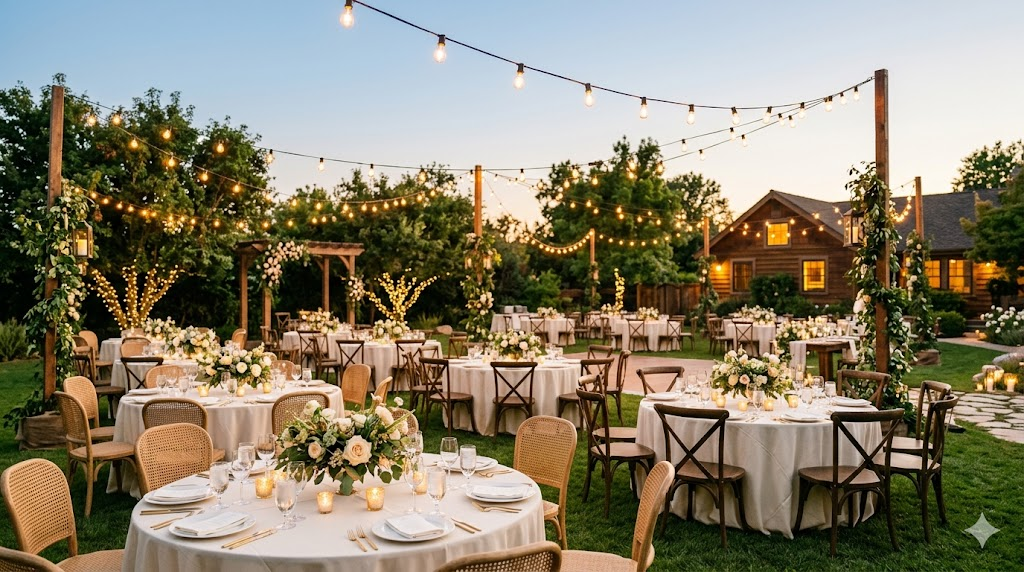
8 Rustic Wedding Aisle Decorations:That Looks Effortless!


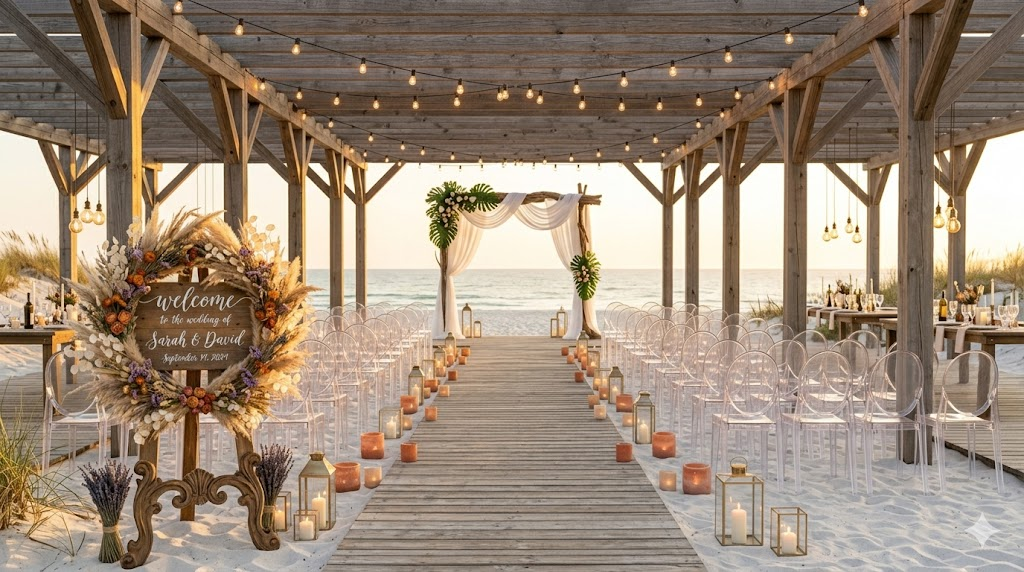
HERO IMAGE / FEATURED IMAGE Alt text: Rustic wedding ceremony aisle lined with alternating mason jar lanterns and galvanized metal buckets filled with wildflowers and herbs, creating a natural staggered pattern down a grass aisle with wooden chairs on either side Image prompt: Photorealistic image of a rustic wedding aisle in warm natural outdoor light. The aisle is lined with alternating elements down both sides: mason jar lanterns with battery candles, galvanized buckets overflowing with wildflowers and herbs (lavender, baby's breath, greenery), and simple wooden lanterns. The placement is intentionally staggered—not perfectly aligned—creating a natural, organic cadence. A simple burlap aisle runner or bare grass is visible. Wooden folding chairs flank both sides. The overall aesthetic is intentionally imperfect, grounded, and garden-like. Generate in horizontal landscape orientation, 3:2 aspect ratio, optimized for desktop display.

Rustic aisle decorations look effortless—that’s the whole point. But there’s actually a precise design logic behind that “thrown-together” feeling.

Most rustic aisle guides show you pretty pictures and list supplies.

They don’t teach you why a staggered placement of lanterns works while symmetrical ones feel formal, or why mixing three different mason jar sizes reads as collected over time but using all identical jars feels like you bought them on sale. The aesthetic is the design.


Twine wrapped around glass,
wildflower stems still dusty,
the way things are found—
not arranged, but arranged.


The Short Answer

Authentic rustic aisle design lives in the intentional imperfection: stagger your elements (don’t line them up), mix materials in layers (wood, metal, glass, rope), and anchor everything with one natural focal point—a wooden arch, wildflower mass, or barn door.

Skip uniformity.

Repetition in threes or odd numbers (not pairs) signals “gathered over time.” This approach costs less and photographs better than trying to make every detail match.


1. The Staggered Marker System: Why Imperfection Is the Design
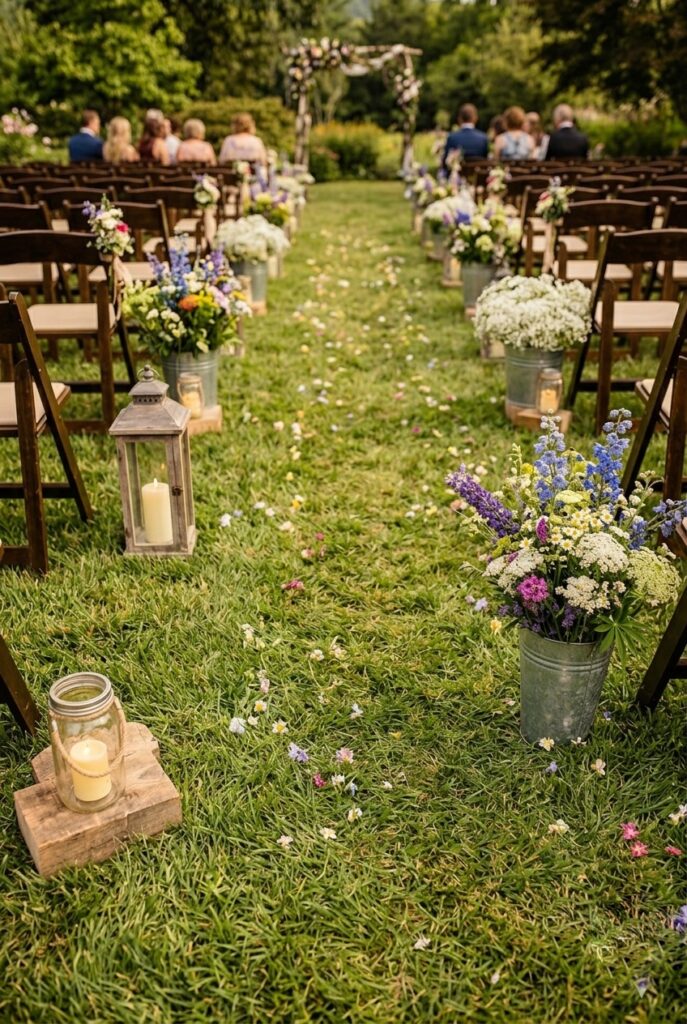
IMAGE 1 HERE Alt text: Overhead view of an aisle with staggered rustic markers on alternating sides—a mason jar lantern on the left, then a gap, then a galvanized bucket on the right, then another gap, showing the intentional uneven spacing that creates rhythm Image prompt: Photorealistic image taken from above of a rustic wedding aisle showing staggered marker placement. On the left side, a mason jar lantern with warm candlelight. Then moving down the aisle, empty grass space. On the right side, a galvanized metal bucket overflowing with wildflowers and greenery. Then more grass space. Another marker on the left (wooden lantern), then empty space, then a marker on the right. The pattern demonstrates intentional imperfection—not evenly spaced, not matched in pairs. Grass or light gravel visible between markers. Natural daylight illuminates the scene. The overhead perspective shows the full rhythmic pattern down the aisle. Generate in vertical portrait orientation, 2:3 aspect ratio, optimized for mobile display.

The biggest mistake couples make with rustic aisles is placing identical elements at perfect intervals—mason jars at exactly 4 feet apart, all facing the same direction, all the same height.

This reads formal, not rustic.

Authentic rustic uses intentional irregularity.

Instead: stagger your markers.

Place a mason jar lantern on the left side 3 feet down, skip 2 feet, then place a galvanized bucket on the right side, skip 3 feet, then place a wooden lantern on the left.

This creates visual rhythm without precision. It looks found, not ordered.

Vary the heights slightly so not every element is eye-level.

Some markers 12 inches tall, some 24 inches—this depth makes the aisle feel more organic.

The science of this: symmetry reads formal. Asymmetry reads lived-in. Budget: $50–$120 for supplies (mason jars, lanterns, buckets from thrift stores, Amazon).

Where to buy: thrift stores (galvanized buckets, old lanterns), Amazon (new lanterns if needed), Dollar Tree (candles).


2. Mason Jars vs. Galvanized vs. Vintage Lanterns: Which Material Reads What
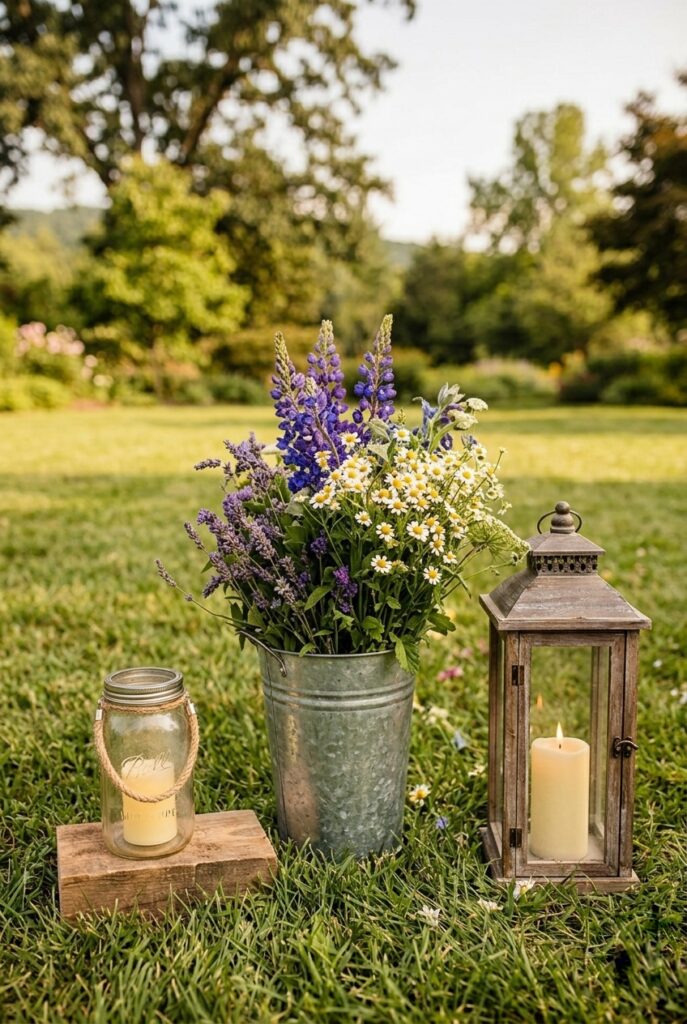
IMAGE 2 HERE Alt text: Close-up detail comparison of three different rustic aisle marker materials side-by-side: a mason jar with battery candle, a galvanized bucket filled with wildflowers, and a vintage metal-frame lantern, showing how each reads differently Image prompt: Photorealistic image showing three rustic aisle marker materials arranged side-by-side in warm natural light. On the left: a vintage mason jar (slightly cloudy glass, mismatched size) with a battery candle glowing inside. Center: a galvanized metal bucket with visible patina, overflowing with wildflowers, lavender, and greenery creating a full, lush look. On the right: an antique wooden-frame lantern with glass panels and a lit candle inside, showing warm candlelight. The three elements show different textures, scales, and visual weights. The image demonstrates why mixing materials creates a more sophisticated rustic aesthetic than using only one. Generate in vertical portrait orientation, 2:3 aspect ratio, optimized for mobile display.

This is where couples get trapped in false economy. All three materials are affordable, but they read completely differently depending on how you use them.

Mason jars alone = craft store, bridal shower vibes. They’re transparent, industrial-modern, not rustic.

The cheap-wrong version is buying matching mason jars from Walmart, all the same size, all pristine.

Solution: buy vintage mason jars from thrift stores (often $0.50–$2 each), mix sizes (pints, quarts, half-gallons), and fill them with battery candles or fresh wildflowers. Imperfection makes them rustic.

Galvanized buckets = authentic farm aesthetic. They read expensive even when they cost $8–$15. They get better with age (real patina, not fake).

Fill them with bunches of garden flowers (wildflowers, lavender, baby’s breath, herbs) so the flowers do the visual work. Don’t leave buckets empty—that reads unfinished.

Vintage lanterns (wood-framed, metal, with glass) = the luxury rustic choice.

One vintage lantern (thrifted for $10–$20) mixed with three mason jars and two buckets creates a curated, collected-over-years feeling.

Lanterns should have real candles (or convincing battery candles) visible inside—the glow is the point.

Budget: $80–$150 total for 10–12 mixed markers. Where to buy: Goodwill, Salvation Army, estate sales (lanterns, buckets), Amazon (new lanterns if thrift hunting fails), local flower wholesalers (bulk wildflowers).


3. The Wildflower Over Formal Flower Rule
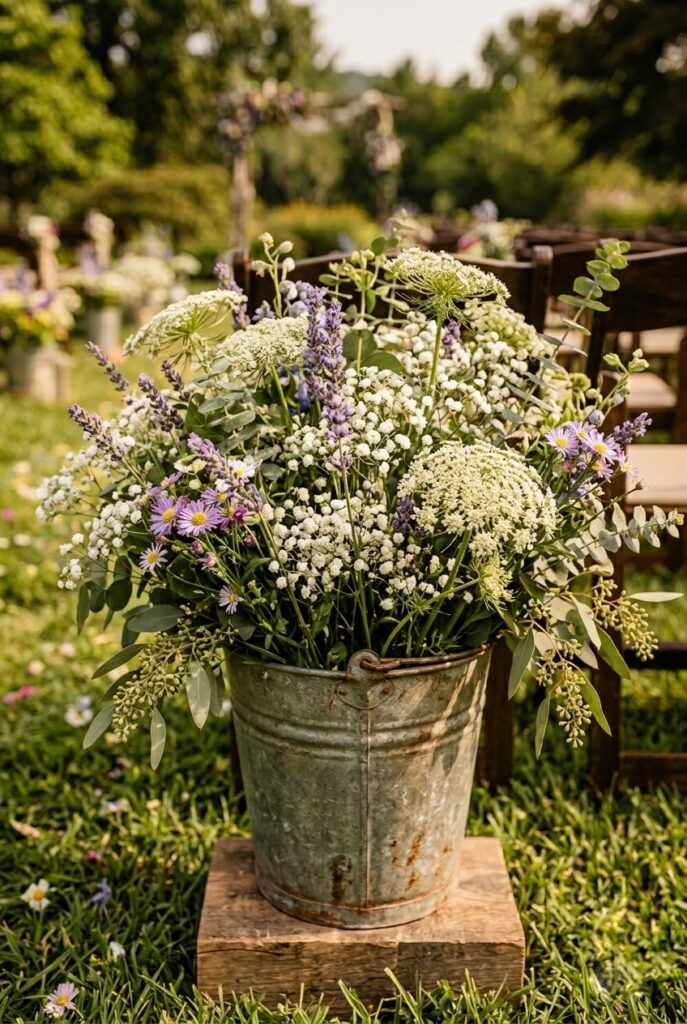
IMAGE 3 HERE Alt text: Lush close-up of wildflowers and herbs arranged in a galvanized bucket, showing a mix of lavender, baby's breath, Queen Anne's lace, eucalyptus, and garden greenery creating a full, organic bouquet Image prompt: Photorealistic image of a rustic wildflower arrangement in a galvanized metal bucket in warm natural sunlight. The arrangement is noticeably full and lush, featuring: lavender stems in soft purple, white baby's breath filling gaps, Queen Anne's lace with delicate white blooms, trailing eucalyptus and seeded eucalyptus in various shades of green, some greenery-only stems for texture, and what appears to be wildflower sprigs. The arrangement is slightly asymmetrical—fuller on one side, lighter on the other—creating movement. Stems are visible (not all hidden), adding to the just-picked, garden-style aesthetic. The bucket itself shows age and patina. The image captures the fullness and mixed-texture approach that makes rustic arrangements read expensive. Generate in vertical portrait orientation, 2:3 aspect ratio, optimized for mobile display.

Formal wedding aisle flowers (roses, peonies, hydrangeas in tight bunches) read expensive-modern, not rustic.

Rustic uses wildflowers, garden-style arrangements, and plants that look like they might grow nearby naturally.

Best rustic flowers: baby’s breath (romantic, affordable, fills space), wildflower mixes (Queen Anne’s lace, cosmos, zinnias), lavender (smells incredible, photographs beautifully, costs $3–$8 per bunch), greenery bundles (eucalyptus, seeded eucalyptus, ruscus, salal), and flowering herbs (rosemary, oregano in bloom).

Mix textures.

Don’t use all the same flower.

A bunch with 3 lavender stems, 2 wildflower sprigs, some baby’s breath, and trailing greenery looks intentional and garden-inspired. A bunch of 20 uniform roses looks like you ordered from a florist.

The cheap-wrong version is thin, sparse bunches that look accidental.

Solution: buy wholesale wildflower bunches ($3–$8 each) or bulk from Costco, then arrange them so buckets and jars are genuinely full and lush.

Fullness reads expensive. Sparse reads budget.

Budget: $40–$80 for flowers if bought wholesale. Where to buy: Costco (wildflower mixes, lavender bunches), local farmers market (in season), FiftyFlowers (bulk wholesale online), local florist wholesale (ask if they sell to public).


Budget Hack #1: Buy Lavender Bunches, Not Arranged Bouquets Wholesale lavender bunches (50 stems for $8–$12) cost 60% less than pre-arranged floral “rustic” packages. Split one bunch into 3–4 markers, mix with greenery you already have or buy cheap from a florist (eucalyptus, ruscus), and the aisle looks intentionally gathered. One $10 lavender bunch = 3–4 filled buckets.


4. Wooden Elements: Arch, Benches, Or Altar Backdrop
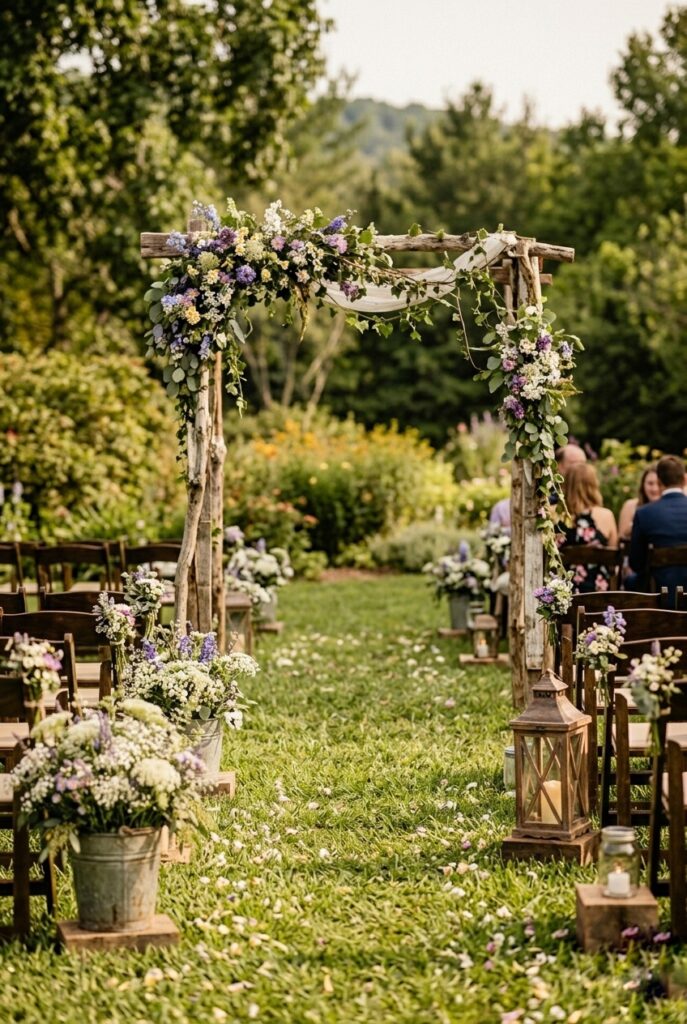
IMAGE 4 HERE Alt text: Wooden wedding arch at the end of a rustic aisle, framed with wildflower garland and greenery, with staggered markers leading toward it down a grass aisle Image prompt: Photorealistic image of a rustic wooden ceremony setup in warm natural light. At the far end of the aisle stands a simple wooden arch made of natural branches or reclaimed wood, approximately 8 feet tall. The arch is adorned with a loose garland of greenery (eucalyptus, trailing vines) and wildflower clusters in soft colors (white, blush, purple). The wooden structure is slightly imperfect—branches aren't perfectly aligned—adding to the rustic feel. Leading toward the arch down a grass or light gravel aisle are the staggered markers (mason jars, buckets, lanterns) visible in soft focus in the foreground. The perspective is from the bride's position looking toward the focal point. Natural daylight illuminates the wooden texture and the flowers. Generate in vertical portrait orientation, 2:3 aspect ratio, optimized for mobile display.

Every rustic aisle needs one strong wooden focal point—something at the end that your eye is drawn to.

This is what makes the whole aisle feel anchored instead of scattered.

Best options: wooden wedding arch (wood branches, reclaimed wood, or live-edge wood assembled into an A-frame), wooden altar/platform (even just a 4×4 piece of barn wood on cinder blocks), or repurposed barn doors (leaning against the back wall, adorned with floral garland).

This focal point doesn’t need to be enormous.

A simple wooden A-frame arch 8 feet tall costs $150–$400 to build or rent.

Barn doors can be found at salvage yards for $50–$150 and are dramatic without effort.

The cheap-wrong version is trying to make the aisle itself pretty without a focal point—lots of little lanterns and flowers but no visual anchor.

Solution: place one wooden element at the end, frame it with greenery or floral garland, and let the aisle markers lead to it. This hierarchy makes the design feel intentional.

Budget: $100–$400 for a wooden arch or doors (depending on DIY vs. rental).

Where to buy: local wedding rental companies (arches), salvage yards or Craigslist (barn doors), local woodworker or carpenter (custom builds cost more but create showstoppers).


5. Candlelight: The Rustic Multiplier
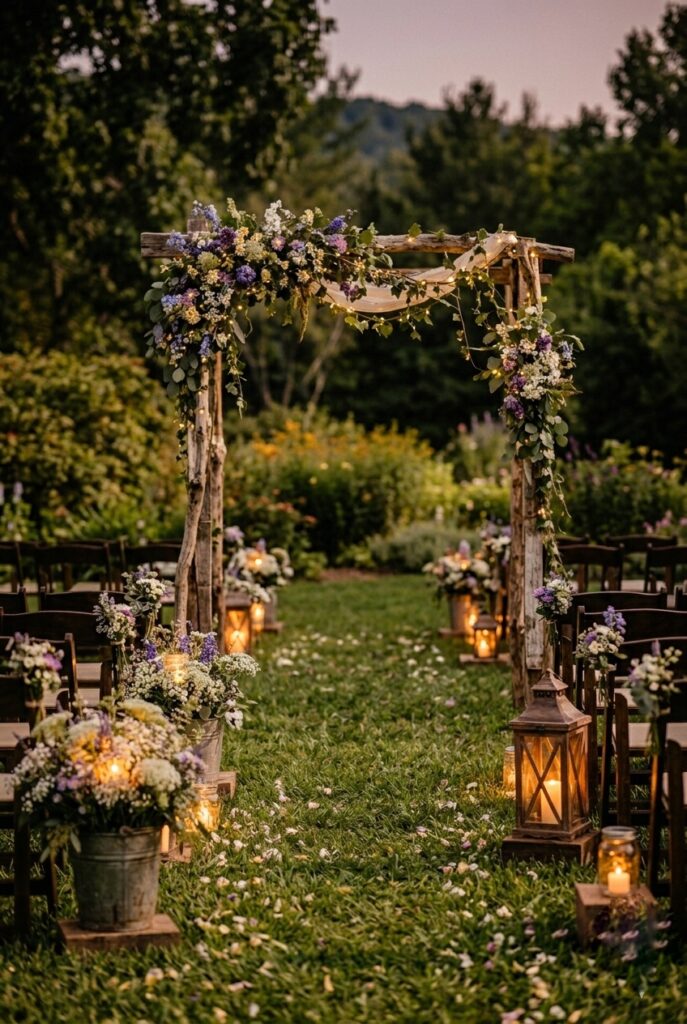
IMAGE 5 HERE Alt text: Evening photograph of a rustic aisle at dusk with warm candlelight glowing inside mason jars and lanterns along both sides, creating a soft amber pathway Image prompt: Photorealistic image of a rustic wedding aisle photographed in the golden hour or early evening, with warm candlelight as the primary light source. Mason jar lanterns, galvanized buckets, and vintage lanterns are illuminated from within by warm amber battery candles, creating a soft glowing pathway down the aisle. The candlelight is warm and inviting, not harsh. Wildflowers are visible but subtly lit by the glow. The wooden arch at the end is softly illuminated by the candle light. The overall atmosphere is romantic and intimate. The image is taken from the bride's perspective looking down the aisle toward the focal point, showing how the candlelight guides the eye. Generate in vertical portrait orientation, 2:3 aspect ratio, optimized for mobile display.

Candlelight transforms rustic aisles instantly. It doesn’t need to be real candles—battery-operated candles work perfectly and are safer.

But the light needs to be present, warm, and visible.

Place battery candles (or real pillar candles in hurricane glasses for safety) inside every mason jar, lantern, or bucket marker.

During daytime, they’ll be subtle. During an evening ceremony, they’re magical.

Avoid LED candles that are too bright white or blue-tinted; look for warm amber or soft yellow battery candles ($1–$3 each from Dollar Tree, Amazon, or Walmart).

For extra rustic impact: string lights or overhead lanterns creating a canopy above the aisle (if your venue allows).

This requires shepherd’s hooks or a frame, but a lit pathway reads immediately as “intentional celebration.”

Budget: $15–$40 for battery candles (10–15 jars), $100–$300 for overhead string lights or lantern rentals.

Where to buy: Dollar Tree (cheapest battery candles), Amazon (warm-toned, bulk options), local event rental companies (string lights, lantern rentals).


6. The Burlap Runner (Or No Runner): Intentional Choice, Not Default
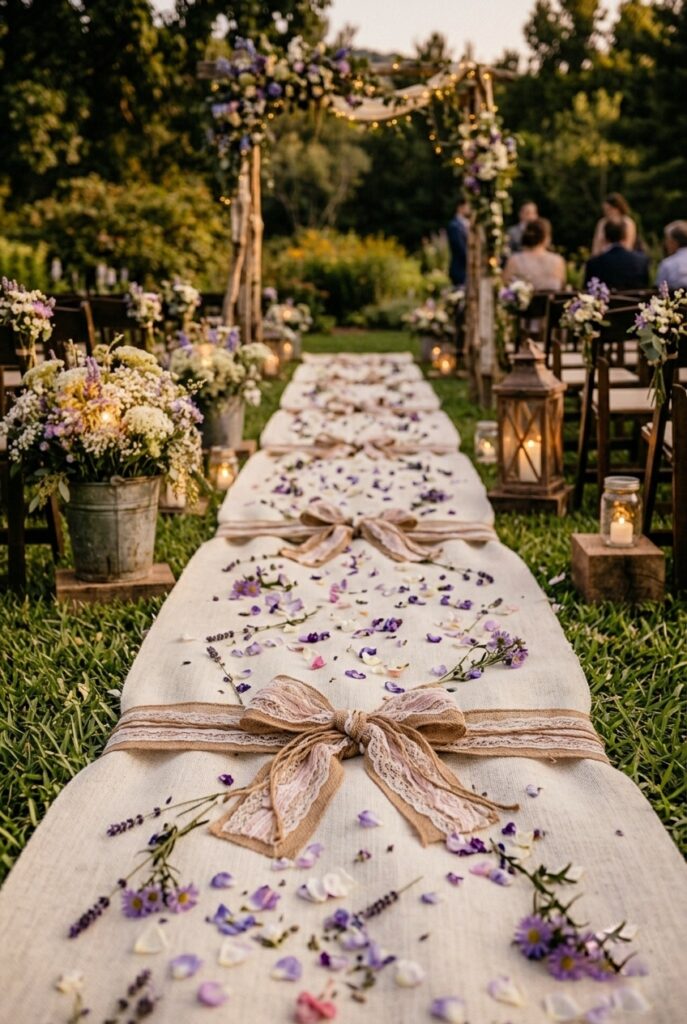
IMAGE 6 HERE Alt text: Burlap aisle runner tied with twine and lace, laid down an outdoor grass aisle, showing intentional styling with wildflower petals scattered on top Image prompt: Photorealistic image of a rustic aisle runner in warm natural light. A cream or natural burlap runner is laid down the center of a grass aisle, secured with stakes or pins. The burlap is tied at intervals with twine and lace (blush or cream lace), creating visual anchor points down the length. Wildflower petals and loose lavender stems are scattered across the burlap, adding color and movement. The burlap appears crisp and well-maintained (not wrinkled or dirty). Staggered rustic markers (mason jars, lanterns, buckets) are visible on either side of the runner, slightly out of focus. The perspective shows the full length of the runner leading toward a wooden focal point. Generate in vertical portrait orientation, 2:3 aspect ratio, optimized for mobile display.

Burlap is so associated with rustic that couples use it automatically. But burlap runners are actually optional.

The choice matters more than the material.

Use burlap if: your aisle is on concrete, indoor, or needs to define a walking path visually.

Burlap runner ($30–$80) tied with twine or lace looks intentional and rustic.

Buy or DIY with fabric paint and stencils.

Skip burlap if: your aisle is on grass or gravel. A bare grass or gravel path with wildflowers scattered directly on it reads more natural than a runner.

Runners on grass can get muddy and soggy. Instead, just let the staggered markers define the path.

The cheap-wrong version is a thin, wrinkled burlap runner that looks like it came off a shelf.

Solution: if using burlap, layer it (two runners overlapped), tie it with rope or lace, and keep it crisp—stretch it tight, secure it with stakes.

Budget: $30–$80 for a quality burlap runner; $0 if you skip it and use natural ground.

Where to buy: Etsy (custom printed or plain), Amazon (bulk), wedding supply stores.


Budget Hack #2: Thrift or Borrow Wooden Benches Instead of Renting Chairs Rustic ceremonies often use wooden benches (the kind from old churches or barns) instead of modern folding chairs. If your venue allows, rent or borrow wooden pews from local churches or estate sales ($5–$15 each vs. $3–$5 per chair). This immediately elevates the entire aesthetic without additional cost. Even plain wooden chairs tied with burlap sashes read more intentionally rustic than metal folding chairs.


7. Signage: Hand-Painted or Chalkboard (Never Printed)
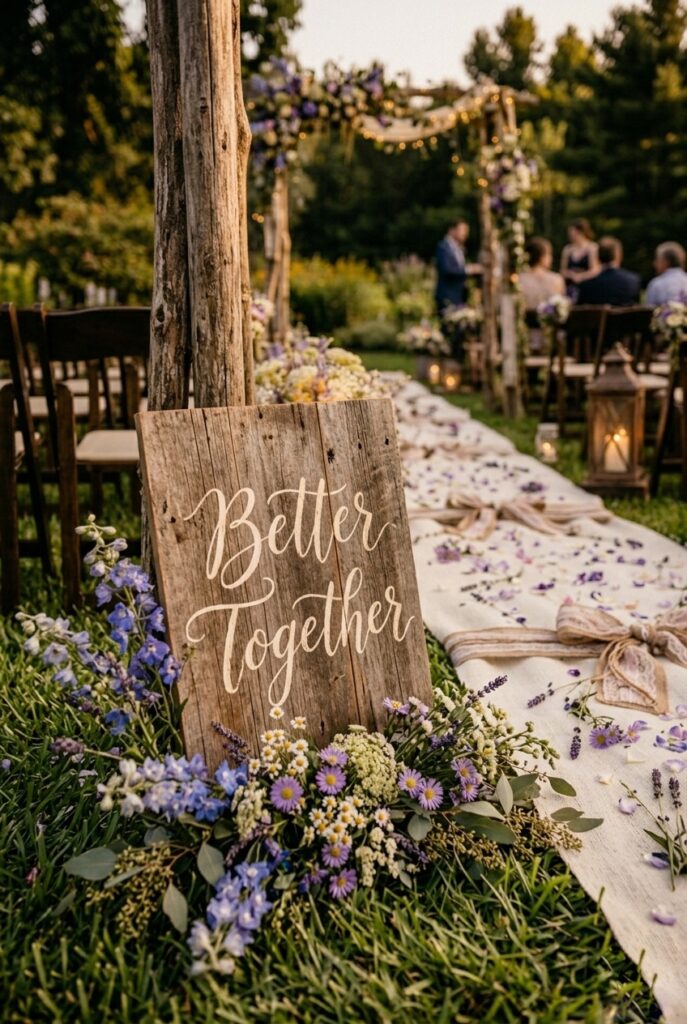
IMAGE 7 HERE Alt text: Hand-painted wooden sign leaning at the start of an aisle, displaying "Better Together" in elegant calligraphy with wildflowers tucked around the base Image prompt: Photorealistic image of a rustic wedding sign in natural light. A wooden sign (approximately 18x24 inches) with weathered or natural finish stands at the entrance of the aisle, leaning slightly against the wooden arch or a stand. The sign displays hand-painted or calligraphy text reading "Better Together" or a similar love quote in elegant script (not printed). The lettering is clearly hand-done, not digital. Fresh wildflowers and eucalyptus sprigs are arranged around the base of the sign, and the overall presentation feels curated but natural. The sign material and lettering style clearly communicate "handmade" and "intentional," not "printed on a printer." Warm natural light illuminates the sign. Generate in vertical portrait orientation, 2:3 aspect ratio, optimized for mobile display.

Rustic signage should look like it was made by human hands, not printed. Hand-painted wooden signs, chalkboards, or chalkboard easels with calligraphy feel authentic.

Printed signs feel commercial.

If you’re not a painter: buy blank wood signs ($5–$15 on Amazon or craft stores) and have a local artist or calligrapher hand-paint them ($25–$75 per sign).

Place 2–3 directional or welcome signs along the aisle entrance or at the focal point.

“Welcome,” a quote about love, or “This Way to Forever” hand-painted on wood reads authentically rustic.

The cheap-wrong version is a printed-on-printer sign laminated to cardboard.

It reads like a placeholder.

Solution: invest in actual hand-painted or calligraphy signage (even DIY with paint markers if you have decent handwriting).

Budget: $50–$150 for 2–3 hand-painted or calligraphy signs.

Where to buy: Etsy (custom hand-painted), local calligraphers, or DIY with acrylic paint on blank wood.


8. Hay Bales (When They Work, And When They Don’t)
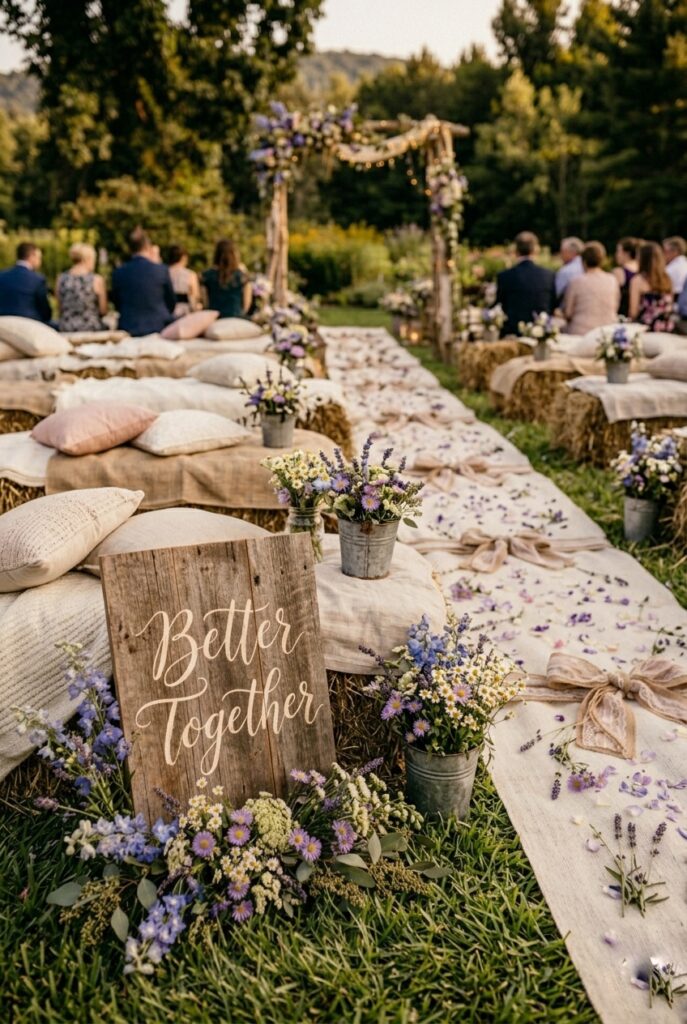
IMAGE 8 HERE Alt text: Rustic hay bale seating arrangement with cream blankets and burlap runners, flanking both sides of an aisle, with wildflower arrangements on top Image prompt: Photorealistic image of hay bales styled as rustic aisle seating. Large hay bales are stacked and arranged on both sides of an aisle, covered with cream or burlap blankets and linen runners so guests aren't sitting directly on hay. Pillows in cream, blush, or natural linen are arranged on top for comfort. Wildflower arrangements in galvanized buckets or mason jars sit on top of some bales, creating visual interest. The overall aesthetic is farmhouse-rustic and intentional—not bare hay, but styled and softened. Natural daylight illuminates the scene. The arrangement shows how hay bales can feel sophisticated when properly covered and decorated. Generate in vertical portrait orientation, 2:3 aspect ratio, optimized for mobile display.

Hay bales are iconic rustic—but they only work in specific situations. Use them if your venue is a barn, farm, or truly rural setting and guests are sitting on them.

Don’t use them as decoration if your venue is a modern barn or vineyard trying to feel rustic—they read costume-y in formal settings.

If using hay bales: Cover them with blankets, burlap throws, or linen runners so guests aren’t sitting on actual hay.

Stack them to create seating areas, and decorate them with pillows.

This softens the look and makes them functional.

Budget: $5–$15 per hay bale (rental from local farms), $20–$50 for covers/blankets.

Where to buy: local farms, event rental companies, or Craigslist.


Decision Filter

Outdoor farm or barn venue with 75+ guests? Go full rustic: staggered wooden markers, wildflower-filled buckets, string lights overhead, wooden arch, hay bales with blankets. The landscape does half the work.

Indoor barn or formal rustic space? Tone down the hay bales (skip them), use more wooden elements (arch, doors, reclaimed wood), and lean into wildflowers and candlelight. You’re framing, not competing with nature.

Backyard or intimate garden setting (under 50 guests)? Go minimal: just the arch, staggered markers (fewer of them), wildflower bunches, and clear sightlines to the couple. Less is more in small spaces.

Budget under $300 for aisle only? Thrifted lanterns and buckets, wildflowers from Costco, one wooden arch or borrowed barn doors, battery candles, and hand-painted signage. Authenticity beats newness in rustic.


The Real Reason

Rustic design’s real power is this: imperfection feels more honest than perfection. In a formal wedding, every chair matches, every flower is identical, every element is controlled.

In a rustic wedding, the markers are staggered, the flowers are mixed, the materials are found or salvaged.

This signals intentionality. The couple didn’t try too hard. They chose this aesthetic because it’s genuinely them, not because they’re trying to look effortless.

Here’s the insider observation a designer knows: couples who spend time making rustic aisles feel intentionally imperfect always have better photos and more memorable ceremonies than couples who buy matching aisle markers from a wedding supply store.

The camera sees authenticity. Guests feel it. Rustic isn’t about being cheap; it’s about being genuine.


Mistakes to Avoid

Mistake 1: Using matching elements in a rustic aisle Couples buy 10 identical mason jars, 10 identical lanterns, or 10 identical flower arrangements expecting this to look cohesive.

Instead, it reads formal and mall-like. Rustic requires intentional mixing—three different jar sizes, lanterns paired with buckets, flowers in varying fullness.

This directly contradicts formal design, which is the whole point.

Mistake 2: Sparse floral arrangements that look unfinished One couple bought wildflower bunches but didn’t buy enough.

The buckets and jars looked empty and accidental rather than intentionally gathered.

Fullness reads expensive in rustic. Buy 20–30% more flowers than you think you need and pack buckets so they’re genuinely overflowing.

Mistake 3: Forgetting the focal point entirely One couple decorated the aisle beautifully with markers and runners but placed no arch, no altar backdrop, no wooden frame at the end. The eye had nowhere to land during vows.

The aisle felt like it was just “decorated” instead of “designed.” Always anchor with one strong focal point.

Mistake 4: Mixing old and new materials in ways that read “budget” instead of “curated” Using two new galvanized buckets with eight vintage thrifted lanterns reads intentional.

Using eight brand-new shiny lanterns mixed with thrifted buckets reads accidental and mismatched in the wrong way.

Curated mixing is intentional; random mixing is confusing.

Think about the story: “I collected this over time” (old mixed strategically with a few new pieces) vs. “I grabbed whatever was on sale” (random new and old with no aesthetic thread).


FAQ

How many aisle markers do I need for a rustic aisle?

For a standard 30-foot aisle, place markers every 4–6 feet on alternating sides (left, skip, right, skip). This typically requires 8–12 markers total. Fewer markers look intentional and uncluttered; more than 12 feels overdone. In rustic design, restraint photographs better than abundance.

Can I mix real and battery candles in the same aisle?

Yes, but be consistent in placement. Don’t scatter real candles randomly with battery candles—it looks chaotic. Either use all battery candles (safer, easier), or use real candles in secure hurricane glasses in lanterns and battery candles in jars. The viewer shouldn’t be able to tell the difference from a distance.

Should I use fresh or silk wildflowers for a rustic aisle?

Fresh wildflowers from a farmers market or wholesale (Costco, FiftyFlowers) look and smell more authentic and cost the same as silk ($30–$80 for a full aisle). Silk only if your ceremony is over several days or you need zero-maintenance arrangements. Rustic favors the imperfection of fresh—wilting slightly is part of the aesthetic.

What’s the best rustic aisle runner material?

Burlap or natural linen, but only if your aisle needs visual definition. On grass, skip the runner entirely—bare grass with scattered petals is more rustic. On concrete or indoors, a burlap runner tied with twine or lace grounds the space. Avoid synthetic materials or printed runners; they read costume-y.


Budget Table

Rustic Aisle ElementBudget OptionPremium OptionWhere to Buy
Aisle Markers (8–12)$50–$100 (thrifted lanterns + new buckets)$200–$300 (rental quality)Goodwill, Amazon, event rentals
Wildflowers$30–$60 (Costco, farmers market)$100–$150 (florist bulk)Costco, farmers market, FiftyFlowers
Wooden Arch$150–$300 (DIY or rental)$400–$600 (custom built)Event rentals, local carpenter
Aisle Runner$0 (skip it on grass)$50–$100 (quality burlap)Etsy, Amazon
Candles$15–$30 (battery from Dollar Tree)$60–$100 (premium tea lights)Dollar Tree, Amazon, BHLDN
Signage$30–$50 (DIY hand-painted)$75–$150 (professional calligrapher)Local artist, Etsy
Total Realistic Rustic Aisle$275–$540$885–$1,350Mixed sources

The most memorable rustic aisles aren’t the most expensive—they’re the most intentional. Stagger everything, mix materials thoughtfully, fill buckets until they’re overflowing, and anchor with one strong wooden focal point. Skip the matching sets. Skip the precision. Let the imperfection be the design.

Start by sourcing your anchor focal point (wooden arch or barn doors) this week.

Then hit thrift stores for lanterns and buckets—you need the variety.

Finally, order wildflowers from Costco or a wholesale supplier and settle on your staggered marker placement 2 weeks before the wedding.

This gives you time to adjust without stress.

Authenticity requires less work when you plan it as the aesthetic from the start.

Leave a Comment

Your email address will not be published. Required fields are marked *

Scroll to Top