
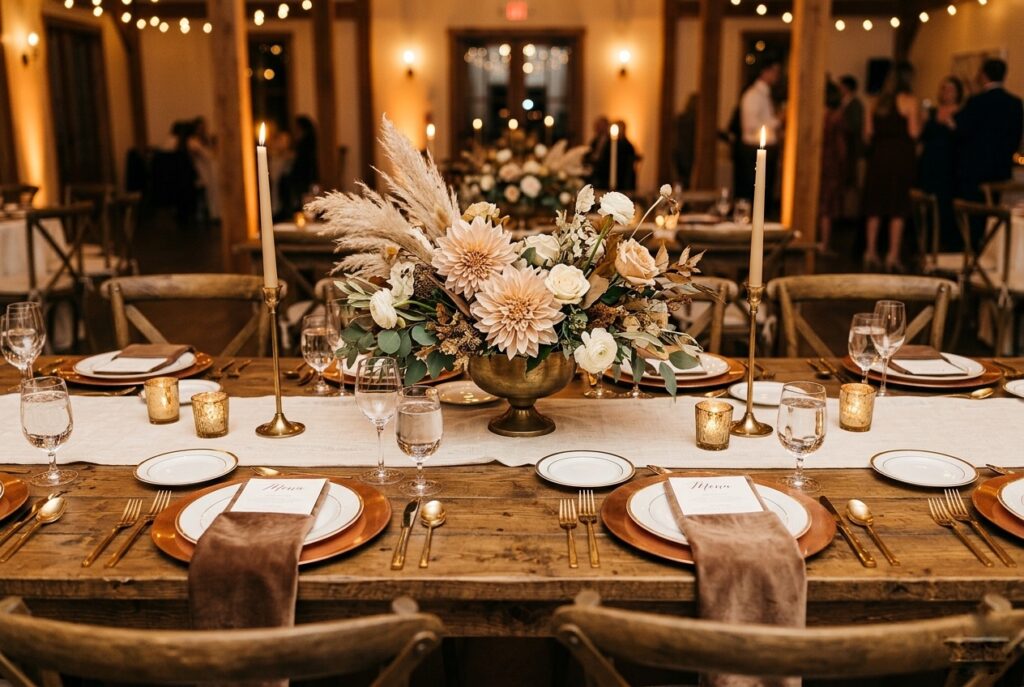
Brown is the most misread color in wedding design — couples either over-commit to it with burlap and wood slices, or they underuse it so cautiously it disappears entirely.
Neither approach tells you which shade of brown actually works, which pairings make it luminous, or why the same color that photographs as rich cognac at one wedding photographs as a dirty tablecloth at another.
This is the guide that makes those distinctions clear.
The café au lait dahlia holds its shape a day longer than the others. Its petals the color of a page left near a window, of the inside of a coat pocket, of something warm pressed between two hands on a morning in October.
The Short Answer
Brown fails on wedding tables when it is treated as a neutral and styled like one.
A truly neutral color — ivory, white, grey — recedes and lets everything around it read.
Brown does not recede. It has warmth, weight, and undertone, and if those three qualities are not working in the same direction, your tables look muddy before a single flower is placed on them.
The designers whose brown tables stop guests in the doorway are not using more brown.
They are using the right shade of brown, paired with exactly one metallic finish and one pale contrast element, and they are letting those three things do all the work.
That combination — the right shade, one metal, one pale element — is the full formula.
Every idea in this article is a variation on it.
1. Choose Your Brown Before You Buy Anything Else
This is the decision that every other wedding article skips, and it is the reason brown tables either read as rich and intentional or as dim and forgettable.
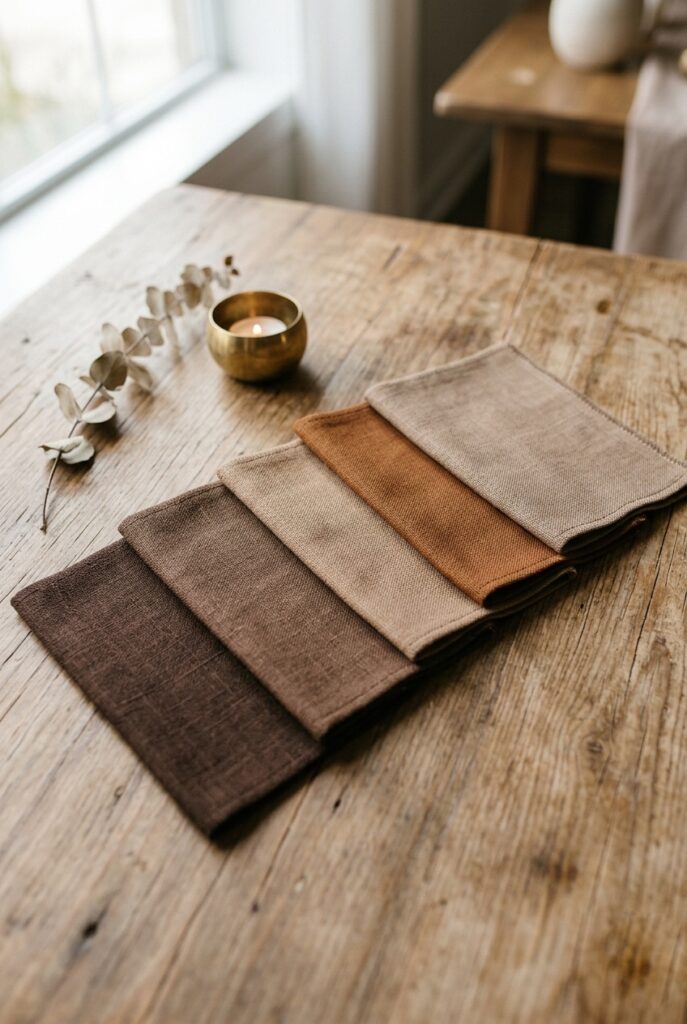
Brown is not one color. It is a spectrum with radically different photographic behaviors, and the shade you choose should be determined by your venue’s light conditions before any other factor.
Chocolate brown (deep, cool-toned) is heavy.
It absorbs venue lighting rather than reflecting it, and in photographs it creates a near-void at the table surface.
It works in direct sunlight or with aggressive pin-spot lighting. In a standard carpeted ballroom, it reads as absence.
Café au lait (warm, creamy mid-brown) is the designer’s brown. It has enough warmth to read as a color and enough lightness to let candlelight and florals pop against it.
It photographs accurately across almost every lighting condition.
Every time you see a brown wedding table that photographs beautifully, the dominant tone is almost certainly café au lait.
Mocha and cognac (medium, amber-tinted) sit between the two — versatile, safe for most venues, pairs naturally with brass and copper without looking muddy.
Tan and taupe (very light, near-neutral) work as soft grounds for bolder accent elements but offer almost no visual presence on their own.
Only do this if you are designing around a dark, dramatic aesthetic with strong venue lighting: commit fully to chocolate brown.
Otherwise, the default answer for every venue type is café au lait. Set your brown before you order a single piece of linen.
This choice costs nothing. Your florist, your linen rental company, and your Etsy sellers will all need a specific shade reference — use Pantone 16-1320 (Tan) to Pantone 18-1048 (Caramel) as your communication anchor.
2. The Ivory and Brown Base: Non-Negotiable for Most Venues
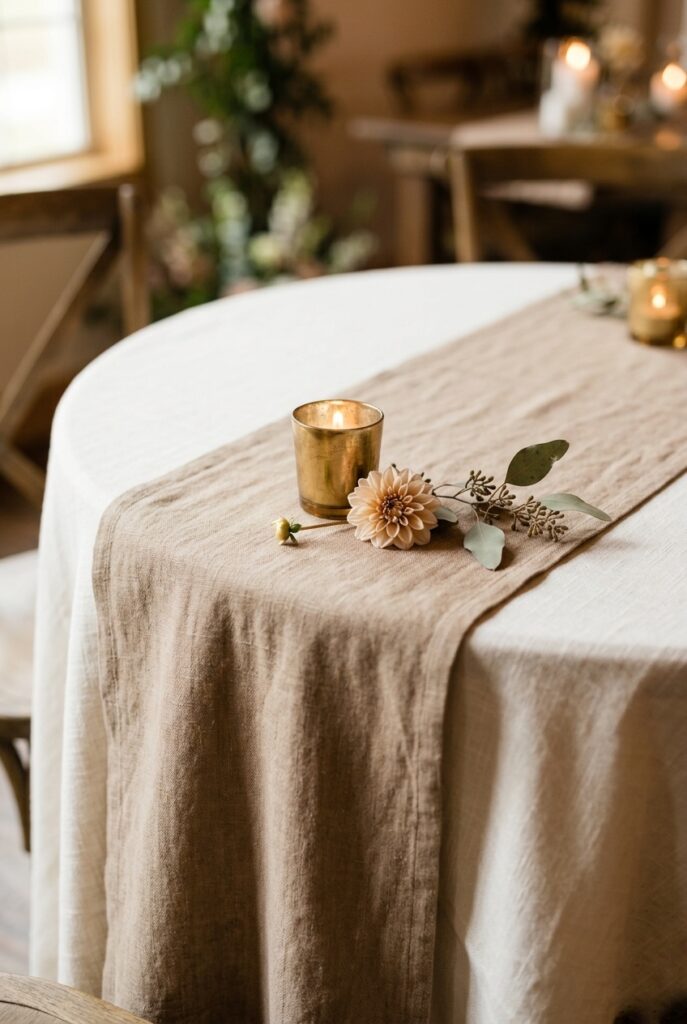
Every brown wedding table that photographs cleanly has a pale counterpoint underneath or alongside the brown. Most commonly that counterpoint is ivory — not white.
White reads as clinical next to warm brown undertones and creates a contrast that is harsh rather than elegant.
Ivory has the same warmth undertone as café au lait and mocha, which means it extends the palette rather than opposing it.
The practical application: ivory tablecloth as the base, café au lait or mocha runner as the layer, then all your decor sits on the runner.
The tablecloth shows at the edges and drop.
That ivory edge provides the breathing room that keeps the table from looking weighted-down, even if your runner is a deep mocha tone.
This is the same visual logic a designer uses when choosing trim paint for a room — the pale edge defines the shape of the darker field.
Shop ivory tablecloths from your venue rental package or from Amazon’s bulk event linen section.
For the runner, Etsy has handmade linen sellers offering café au lait and mocha washed-linen runners at $10–$18 each.
$8–$22 per table for the textile layer. Amazon’s event linen section also carries ivory polyester tablecloths at $6–$10 each for large round or banquet formats.
3. Brass, Not Gold — The Metal Distinction That Changes Everything
Gold and brass are not interchangeable, and the gap between them on a brown table is significant.
Shiny gold — the gold of metallic balloons, of cheap candle holders, of most “gold wedding” Etsy listings — has a cool, bright finish that sits in visual tension with the warm undertones of brown.
It reads as mismatched rather than complementary, especially in candlelight, where warm amber tones intensify and bright gold tips into garish.
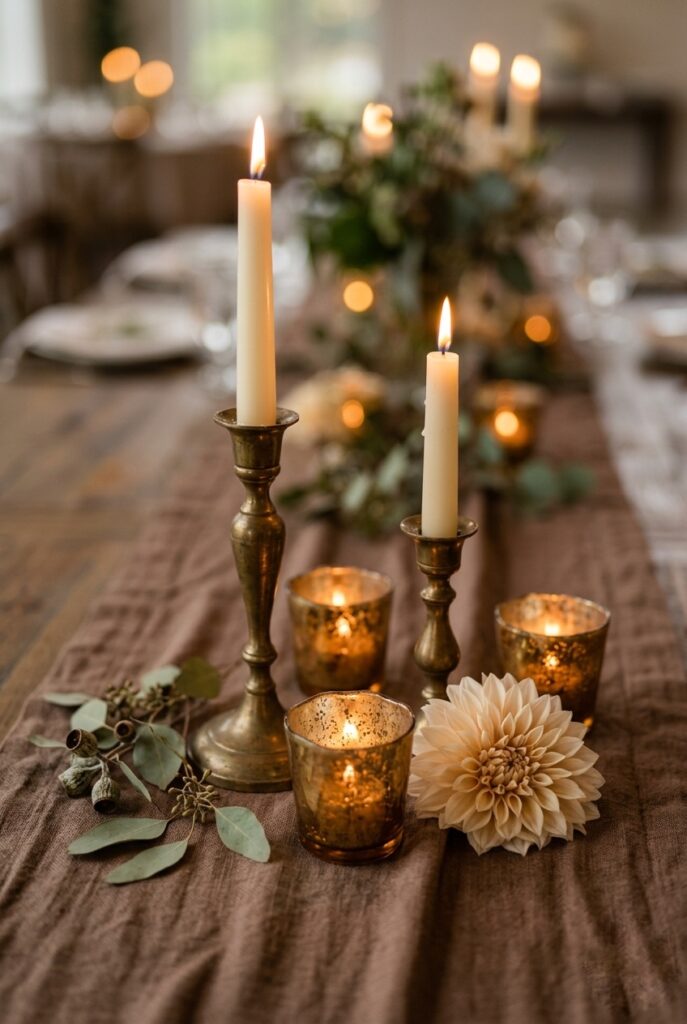
Brass has a muted, oxidized warmth that shares the same amber undertone family as café au lait and mocha brown. Under candlelight it deepens rather than sharpens.
The combination of brown linen, ivory base, and aged brass is the specific trio that makes brown tables read as designed by someone with real taste — and it is available at accessible price points.
Shop HomeGoods, TJ Maxx, and Tuesday Morning for genuine brass or brass-toned candle holders ($4–$9 each). For bulk sets, Etsy sellers offering “antique brass votives” typically have 6-piece sets at $28–$44.
Avoid anything labeled “gold metallic” — that language almost always means shiny, cold-toned finish.
$15–$35 per table for a brass candle and votive set.
For a broader look at how metallic finishes interact with table design at different elegance levels, the elegant wedding table decor ideas guide breaks this down across several palettes.
💡 Budget Hack after Idea 3: Brass candle holders at retail wedding décor sites average $12–$22 per piece. The identical aesthetic — aged brass taper holder or votive — can be found at estate sales, Goodwill, and Facebook Marketplace for $1–$4 per piece. Real brass (not brass-toned plastic) has a visible weight and a slight coolness to the touch that plastic cannot replicate, and it photographs differently under candlelight. Search Facebook Marketplace for “brass candlesticks” or “brass taper holders” in your city and set a radius of 25 miles. For a 10-table wedding needing 20 taper holders, this sourcing strategy saves $160–$360 compared to buying new from a wedding décor retailer. Buy 25% more than you need to account for height variation, then return or resell the excess.
4. Café au Lait Dahlias as the Centerpiece Anchor
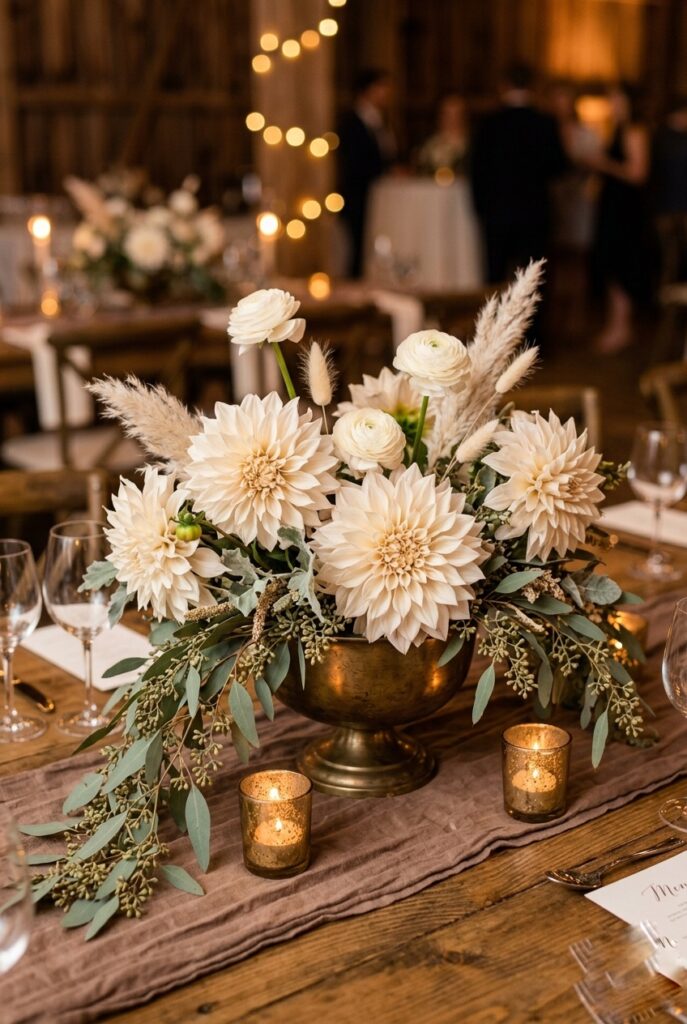
Café au lait dahlias are one of the genuinely rare florals where the flower’s name is a design instruction: they are the precise shade of warm, creamy light-brown that works as a direct palette extension on a brown-themed table rather than a contrast element.
They do not need to be paired with other flowers to read as a complete arrangement.
A dozen café au lait dahlias in a wide brass or terracotta urn, topped with a few stems of dried pampas and a loose sprig of seeded eucalyptus, reads as a fully considered centerpiece at a fraction of what a florist-arranged mixed bouquet costs.
Order in bulk from FiftyFlowers or Afloral — both ship farm-direct dahlias in seasonal availability (August through October).
Off-season, or if you want a heat-stable alternative that photographs nearly identically at table distance, substitute lisianthus in champagne or pale mocha tones.
Lisianthus holds structure in heated venues, ships easily, and costs 25–30% less per stem than dahlias. $30–$55 per table for a self-arranged dahlia centerpiece.
For fully DIY approach details including water treatment and arrangement timing, see the DIY wedding decor ideas guide.
5. Terracotta Vessels as the Designer’s Container Choice
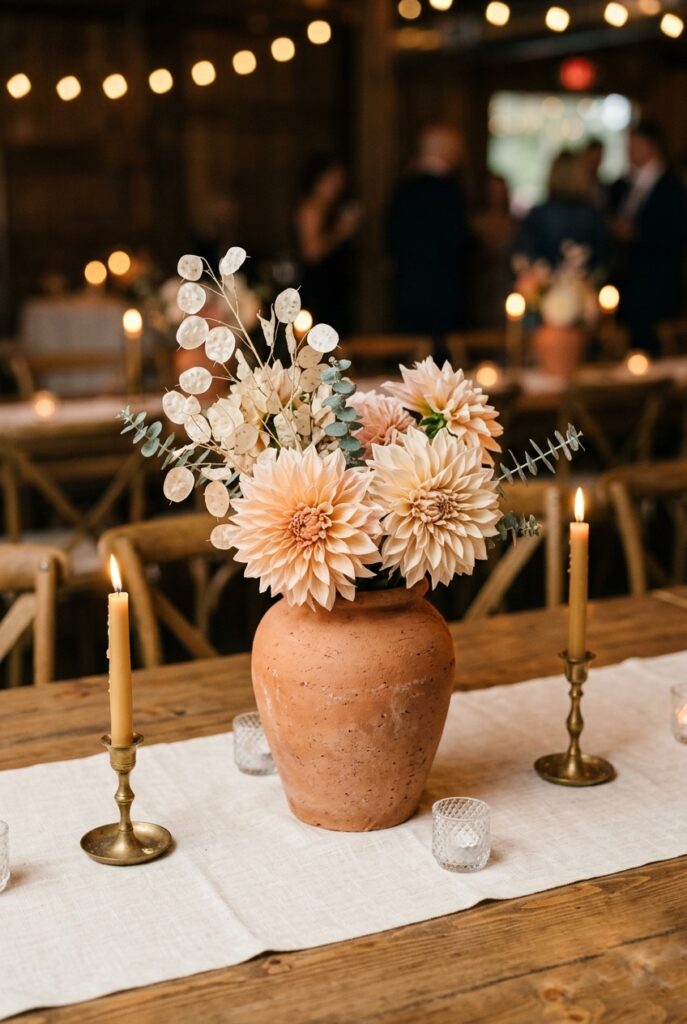
The container your centerpiece lives in matters as much as what is inside it, and on a brown-themed table the vessel choice is what separates a generic arrangement from one that looks like it was styled by someone with a real point of view.
Terracotta — not painted, not glazed, raw fired terracotta — sits in the exact same warm earth-tone family as café au lait brown and brass.
It does not compete with the palette. It extends it.
A standard terracotta pot from a garden center costs $3–$8.
A terracotta urn or wider planting pot from a garden supply store runs $12–$22.
Either works as a centerpiece vessel.
Scrub them clean, let them dry fully, and arrange directly into them with a small glass liner if using fresh florals.
The rough, fired texture of the terracotta surface absorbs candlelight beautifully and photographs with a warmth that glazed ceramic and glass cannot replicate.
This is the detail that high-end wedding designers use on brown-palette tables — raw terracotta vessel, brass votives, café au lait florals — and it is available for under $10 per table at any garden center.
$3–$22 per table for vessels. Home Depot, Lowe’s, or any nursery or garden center.
6. Wood Grain as Decor — The Right and Wrong Way to Use It
Farm tables and wooden charger plates appear in every brown wedding guide.
None of them tell you the actual rule: wood grain works as a design element when it is the table surface itself — a raw, natural farm table or harvest table rented or owned by your venue.
It does not work as a decorative addition to a standard banquet table. A wood slice placed on a white banquet linen looks like a prop.
A wood grain charger on a brown tablecloth disappears into the same tonal value and adds nothing.
If your venue has genuine wooden farm tables, your base layer is already doing its job — you need only a runner and your centerpiece elements.
No tablecloth required. The raw wood surface is your texture and your warmth.
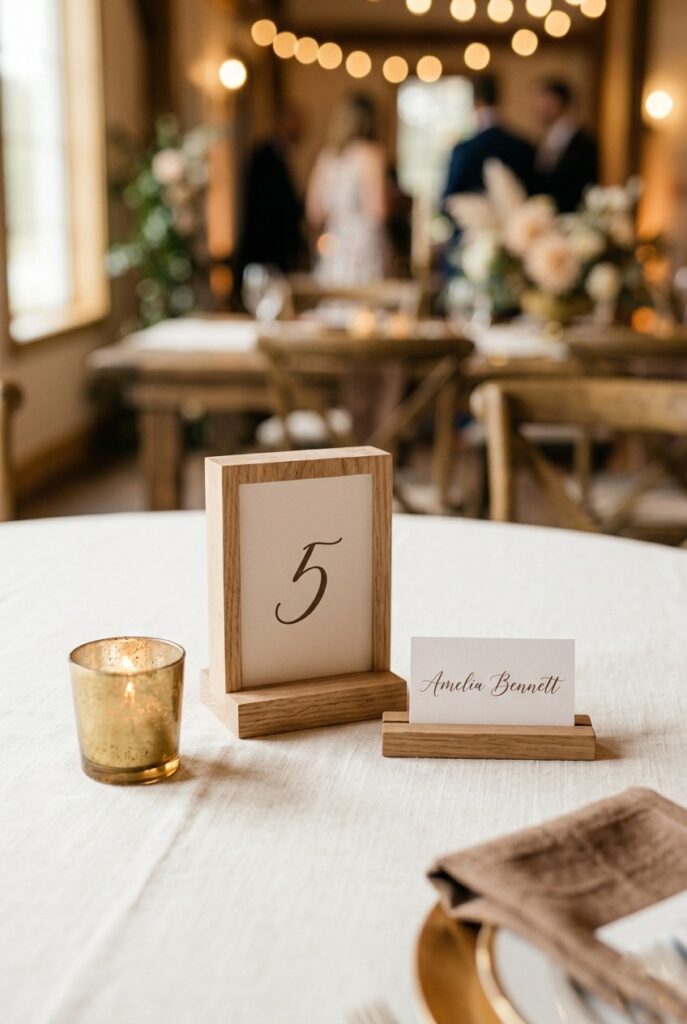
If your venue has standard white or ivory banquet linens, do not try to introduce wood as a decorative element at the table surface level. Introduce it vertically instead: a small wooden table number holder, a wood-burned menu card, a wooden place card holder.
Those vertical wood elements read against the pale linen and register as intentional without muddying the table’s tonal foundation.
$0 if your venue has farm tables. Wooden place card holders on Amazon run $15–$25 for a set of 10.
Laser-engraved wooden table numbers from Etsy sellers average $2–$4 per piece.
For how this principle applies to rustic-specific settings, see the rustic wedding decor ideas guide.
💡 Budget Hack after Idea 6: Wooden table number holders and menu stands on wedding stationery sites run $4–$8 each. The exact same product — a small flat-base wooden holder that grips a card — is sold as a “business card holder” or “recipe card stand” on Amazon for $0.80–$1.50 per piece in bulk packs of 10 or 20. Search “wooden card holder stand natural” on Amazon. For 12 tables, total cost: $10–$18 versus $48–$96 from a wedding stationer. The pieces are identical. The product category label is the only difference.
7. The Copper Charger Play
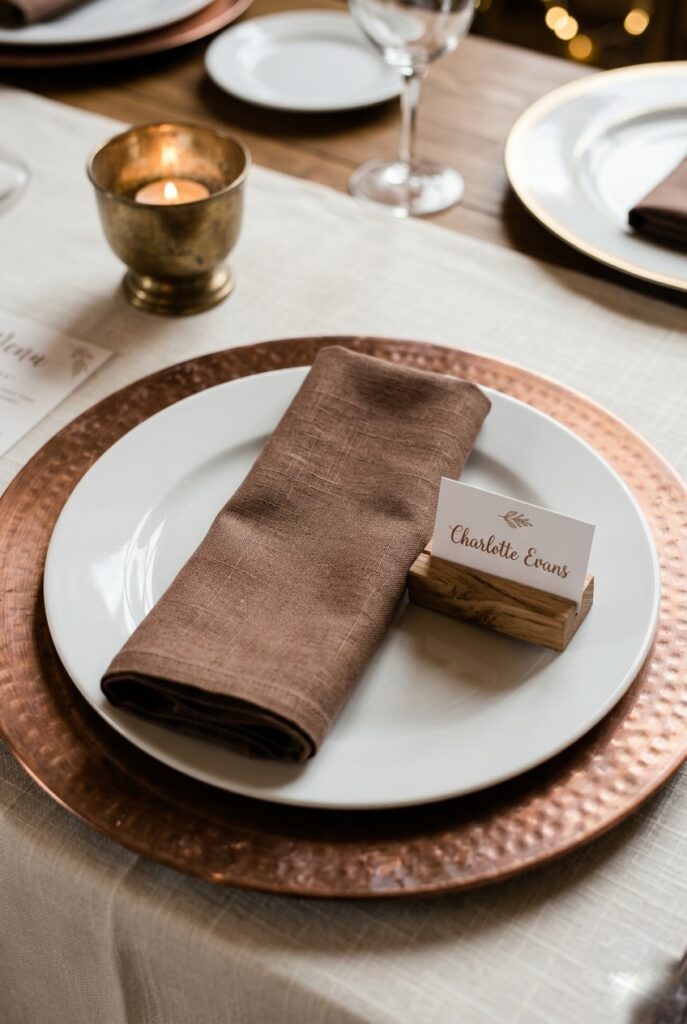
Copper charger plates sit at the intersection of the two things that make brown tables read as expensive: warmth and metal finish.
A copper charger has the reddish-amber undertone of cognac and mocha brown, which means it does not contrast with the palette — it amplifies it.
Place a copper charger under an ivory or white dinner plate, fold a mocha linen napkin on top, and that single element makes the place setting look considered and rich even before a flower or candle is placed on the table.
The version that fails: a true-brown charger plate.
Brown on brown at the place setting level creates a flat, heavy anchor with no visual definition.
A copper charger has just enough metallic reflectivity to lift the place setting off the table surface visually.
At $18–$28 for a set of four on Amazon, copper chargers are one of the most photogenic-per-dollar investments in brown table design.
Rent in bulk from an event rental company at $0.75–$1.50 per plate for larger guest counts.
$18–$28 per set of 4 (Amazon); $75–$150 total rental for 100 guests. Amazon, or rental from event supply companies like CORT Events or your local event rental.
8. The Espresso Bar Table Moment
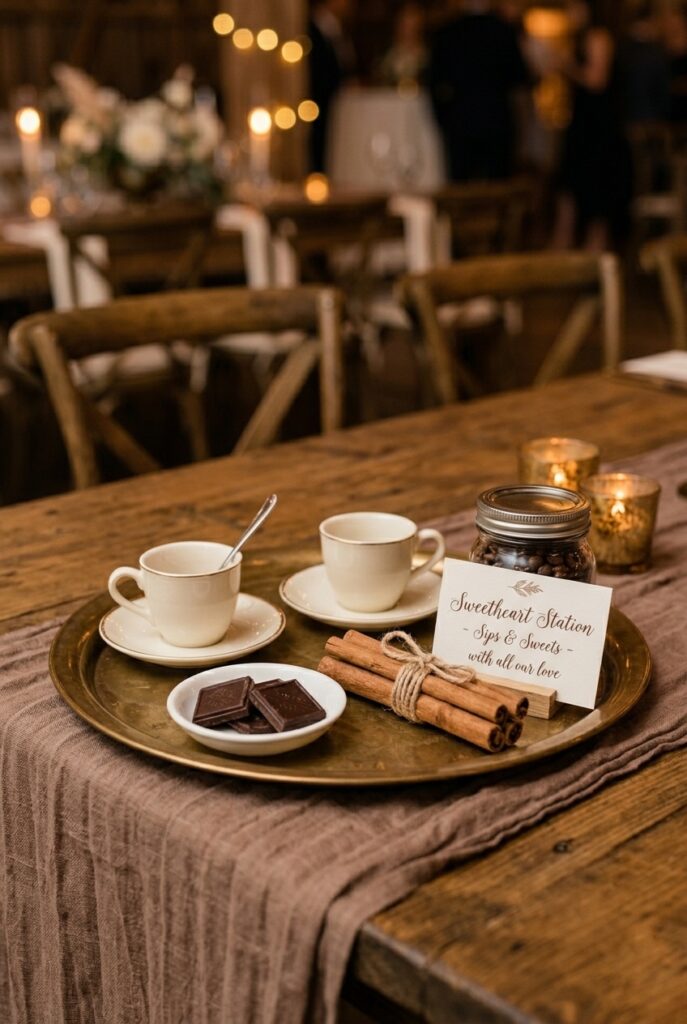
No competitor guide discusses this, and it is one of the most memorable guest-experience moves available to a brown-palette wedding.
If brown is your color family, you are in the specific sensory territory of coffee, chocolate, warm spices, and toasted grains.
Those are not just palette descriptors — they are smells and tastes that guests associate viscerally with warmth and comfort.
A small espresso station placed at or near the sweetheart table — a brass tray holding a compact milk frother, two espresso cups in café au lait or ivory, a small dish of dark chocolate squares, and a tied bundle of whole cinnamon sticks — costs under $40 total and creates a photograph and a guest experience that nobody forgets.
The smell alone changes the sensory atmosphere of the table. This is not a catering ask — it is a décor element that happens to be functional.
Place it on a dark wood tray with a handwritten note card in espresso-colored ink. Scale the concept to a guest-facing hot chocolate station for cooler months.
Pair it with Zola’s wedding planning tools to budget the station as part of your late-night snack or cocktail hour line item rather than your décor budget, which often makes it easier to justify. $35–$55 to set up.
Brass trays from HomeGoods ($12–$18). Espresso cups in ivory from Amazon ($16–$22 for a set of 4).
9. Warm Brown Napkin Folds as Structural Texture
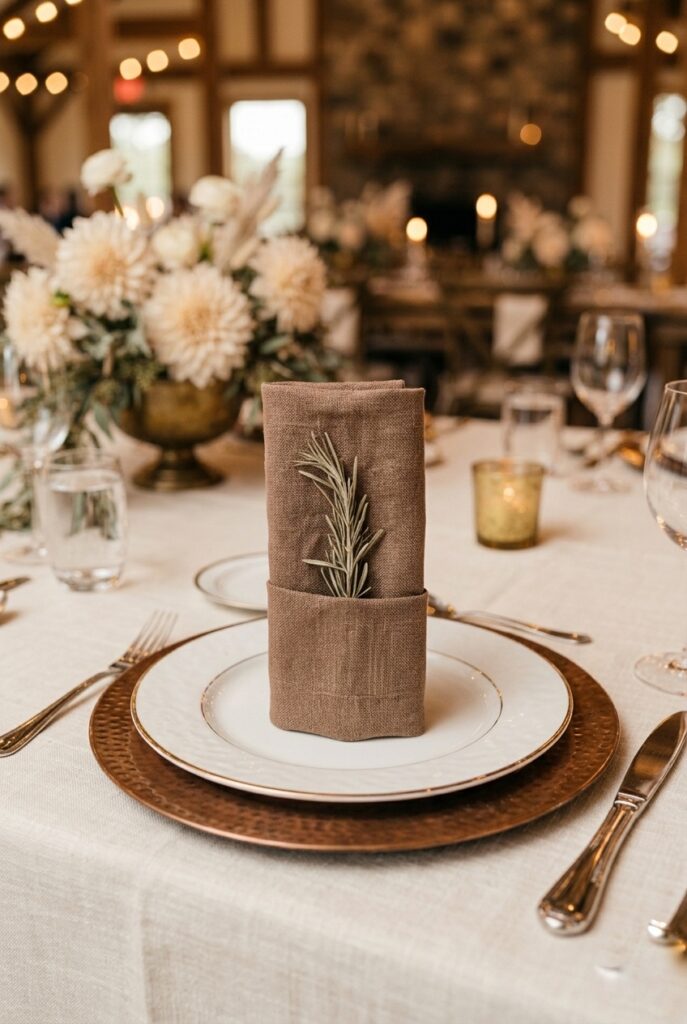
Most couples treat napkins as functional afterthoughts and fold them into a flat square.
On a brown table where the palette itself is quiet and close-toned, the napkin fold is a missed structural opportunity.
A column fold standing upright on the plate adds 5–6 inches of vertical interest at the place setting level.
A fan fold tucked into the water glass adds a layer of geometry.
Even a simple bishop’s hat fold, with a dried rosemary sprig tucked into the peak, gives the place setting a visual anchor it otherwise lacks.
The specific color instruction here: mocha or dark tan napkins on a café au lait runner create tonal layering at the table surface.
If you invert this — pale napkins against a darker runner — the visual energy moves upward toward the centerpiece, which is the photographic hierarchy you want in most table layouts.
Purchase washed-linen napkins from Etsy bulk sellers ($22–$38 for a set of 10 in mocha or hazelnut tones) or rent from your venue’s linen package.
Avoid polyester napkins in brown: the sheen under candlelight reads as an oil spill. $22–$38 for a set of 10 napkins. Etsy washed-linen sellers, or venue rental.
For how napkin and linen choices interact with the broader table layout, the wedding table decor ideas guide includes a full section on place setting hierarchy.
💡 Budget Hack after Idea 9: Washed linen napkins in warm neutral tones — tan, mocha, hazelnut — are consistently available on Facebook Marketplace and wedding resale groups for $8–$14 per set of 10, versus $22–$38 new from Etsy. Search “linen napkins wedding” on Facebook Marketplace and sort by your city, or check the r/weddingplanning subreddit “Sell/Trade” posts. Washed linen actually improves with use — the texture softens and the wrinkle pattern becomes more natural-looking. Buying once-used napkins from a prior wedding often gives you better photographic texture than buying new polyester-blend napkins from a party supply site.
10. The Skip-This: Burlap Has No Place on a Wedding Table
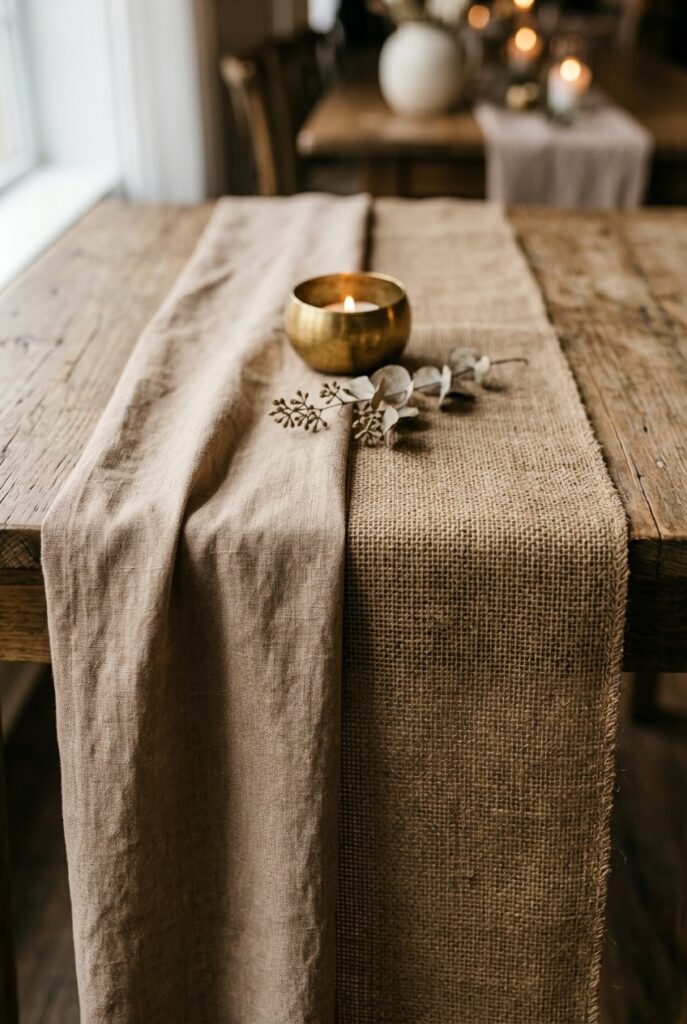
This is the hardest correction to make because burlap is everywhere in the brown and rustic wedding category, and every budget guide for brown weddings recommends it.
Here is the truth: burlap makes brown look cheap faster than any other material choice.
It is a packing and agricultural fiber, and no amount of pairing it with flowers or candles changes its fundamental visual register.
On a wedding table, burlap signals craft fair, not celebration.
If you are drawn to the texture and the rough organic quality that burlap seems to offer, that instinct is correct — textured, rough, organic material is exactly right for a brown table.
The substitute is raw washed linen. It delivers the same organic quality, the same loose weave, the same soft texture under candlelight, at nearly the same price point.
A raw washed-linen runner costs $10–$18 on Etsy. A burlap runner costs $4–$8 at a party supply store. The price gap is $6–$10. Pay the difference.
The visual gap between them is the difference between a table that reads as considered and one that reads as the décor section of a county fair vendor booth.
For approaches to brown and rustic table design that stay firmly on the right side of that line, the country wedding decor ideas guide is direct about this distinction.
Replace burlap runners: Etsy washed-linen in tan, mocha, or café au lait — $10–$18 per runner.
Decision Filter
If your venue has genuine wooden farm tables with visible grain, skip the tablecloth entirely and invest your textile budget in a wide washed-linen runner in café au lait and linen napkins in mocha.
The wood does the heavy lifting. If your venue uses standard banquet linens and you cannot upgrade them, lay your ivory base cloth and café au lait runner over whatever the venue provides — the layering system works over anything.
If your guest count is under 60 and you are working with round tables, copper chargers and taper candles per idea 7 and 4 will photograph as dramatically on an 8-top round as they do on a long farm table.
If you are designing for a ballroom with controlled lighting, be cautious with deep chocolate-brown tones at the table surface — go café au lait on the runner and let the darker brown appear only in the napkin and accent pieces where it adds depth without eating light.
For a room-level view of how these table decisions fit into a cohesive indoor reception, the indoor elegant wedding decor ideas guide addresses the full picture.
The Real Reason
Brown became a wedding color largely because of the farm wedding and rustic wedding movement, and it carried that movement’s visual vocabulary with it: burlap, wood slices, mason jars, sunflowers, string lights.
Those elements work in the environments they originated in — open barns, outdoor fields, genuine farmsteads. When they migrate into carpet-and-chandelier venues, they lose their context and become costume.
The couples whose brown tables genuinely impress guests — not because they look rustic but because they look rich — have made a different decision.
They have treated brown not as a country color but as a designer neutral with warm undertones, the same way a high-end interior designer uses cognac leather or tobacco-toned linen in a formal room.
That framing changes every purchase decision: you buy aged brass instead of shiny gold, you buy washed linen instead of burlap, you buy a terracotta urn instead of a mason jar, and the table that results looks like it cost four times more than it did.
The insider observation that most couples never hear from their vendors: florists build their centerpiece pricing around the container as much as the flowers.
A couple who brings their own terracotta urn or brass vessel to the florist and asks for a same-day arrangement placed inside it typically pays 20–35% less than a couple who asks the florist to source both the vessel and the arrangement. The vessel is where the margin lives.
Bring your own, and you change the pricing conversation immediately.
This applies to every idea in this article — the container, the linen, the metal finish are all available to you independently of your florist.
Mistakes to Avoid
Mistake 1: Using “brown and gold” when every successful reference photo is actually “brown and brass.” Every competitor article on brown wedding palettes recommends gold as the metallic pairing.
What they are actually showing in their photos, in almost every case, is aged brass — matte, warm-toned, slightly oxidized.
True shiny gold reads as cool against warm brown undertones and photographs as discordant under amber candlelight.
If you order “gold” candle holders and they arrive shiny and bright, they will fight your palette rather than completing it.
Specify “antique brass” or “aged brass finish” in every purchase, and return anything that looks metallic-gold rather than warm-toned when you open the box.
Mistake 2: Spending $45–$65 per table on florist-arranged centerpieces when the vessel is the most expensive component. A common breakdown in florist centerpiece invoices is roughly 40–50% flowers, 50–60% vessel and labor.
For a brown-palette table, the vessel is either a brass urn or a terracotta pot — both of which are available for $3–$22 at a garden center or HomeGoods.
A couple who buys their own vessels and brings them to the florist for arrangement-only service typically saves $18–$30 per centerpiece.
On a 12-table wedding, that is $216–$360 back in your pocket for a single phone call to your florist.
Mistake 3: Waiting until setup day to discover that your brown linens look nothing like the online photo. Brown is the color most dramatically distorted by screen temperature variations between a manufacturer’s product photo and the actual fabric.
A linen described as “warm mocha” on one site reads as grey-brown on arrival.
Always order a swatch before committing to a full rental or bulk purchase.
Most Etsy sellers will send a swatch for $2–$5. Most event linen rental companies will send a sample on request.
Never approve a brown linen for a wedding table without seeing it in person under the actual lighting conditions of your venue.
Mistake 4: Letting the palette do all the work without addressing table height variation. Brown is a grounding color — it visually anchors the eye at the table surface level.
This means if all your decor elements are low (runners, small centerpieces, flat place settings), the eye has nowhere to travel and the table reads as flat and undistinguished despite the warmth of the palette.
You need at least one vertical element per table that breaks 12 inches — a taper candle in a holder, a single branch arrangement, a standing menu card.
Brown tables without vertical dimension are the most common version of “it looked fine in person but flat in photos.”
The photographer cannot create depth that the table design has not provided.
FAQ
What colors go best with brown for a wedding?
Ivory and brass are the most reliable pairings — both share brown’s warm undertone family and extend the palette without contrasting it.
For a secondary accent color, forest green and dusty sage add organic depth without competing.
Blush pink softens the palette and works beautifully for spring or summer brown weddings.
Avoid cool-toned pairings like silver, white, or lavender — they create a visual temperature clash with brown’s warmth.
How do I make brown wedding tables look elegant rather than rustic?
Swap every rustic material for its elevated equivalent: burlap becomes washed linen, mason jars become terracotta urns or brass vessels, string lights become taper candles in brass holders, wood slices become copper charger plates.
The elegant version of a brown table uses the same palette, the same warm tones — it simply replaces agricultural textures with refined ones.
For more on achieving that register, the simple wedding decor ideas guide addresses how restraint in material choice creates perceived elegance.
What flowers work best on a brown wedding table?
Café au lait dahlias are the definitive choice — they match the palette rather than contrasting it and photograph exceptionally well under warm light.
Ivory ranunculus, champagne lisianthus, and dusty miller as greenery are all within the same warm-neutral family and will support rather than disrupt the palette.
Avoid bright white flowers on a brown table — the contrast is too stark. Off-white, cream, and pale champagne are the correct substitutes.
Can brown work as a wedding color in spring or summer, or is it only for fall and winter?
Brown works in every season when the shade is right.
For spring and summer, shift toward the lighter end of the spectrum — tan, sand, and warm café au lait against ivory linen with fresh greenery and pale florals.
The palette reads as organic and sun-warmed rather than heavy.
Reserve the deeper mochAs and cognacs for fall and winter reception lighting, where amber candlelight makes them glow rather than recede.
For summer-specific approaches, the summer wedding decor ideas guide covers warm-neutral palette execution in detail.
Budget Table
| Element | Self-Sourced | Florist / Rental / Vendor |
|---|---|---|
| Café au lait washed linen runner | $10–$18 (Etsy) | $22–$38 (event rental) |
| Ivory tablecloth base | $6–$10 (Amazon bulk) | $12–$20 (venue rental) |
| Brass taper holders + candles (pair) | $8–$18 (HomeGoods/TJ Maxx) | $28–$50 (event rental set) |
| Terracotta centerpiece vessel | $3–$12 (garden center) | $18–$40 (florist vessel) |
| Café au lait dahlias (bulk, 10 stems) | $18–$30 (FiftyFlowers/Afloral) | $45–$80 (florist arranged) |
| Copper charger plates (set of 4) | $18–$28 (Amazon) | $12–$24 (event rental, 4 pieces) |
| Wooden table number holders (set of 10) | $10–$18 (Amazon) | $40–$80 (wedding stationer) |
| Mocha linen napkins (set of 10) | $22–$38 (Etsy washed linen) | $15–$25 (venue rental) |
| Espresso station tray setup | $35–$55 (HomeGoods + Amazon) | N/A — DIY only |
| Full table (self-sourced) | $30–$58 per table | $110–$200+ per table |
Brown Is Not a Default — It Is a Decision
The couples who execute a brown wedding table beautifully are the ones who treated it as a deliberate color choice rather than a backdrop.
They specified their shade.
They chose their metal finish once and held it. They replaced every agricultural material with its refined equivalent.
The result looks nothing like a harvest festival.
It looks like someone who understands how warm, anchoring, deeply photogenic a single color done with precision can be.
Pick your shade from Idea 1 before you buy anything else — that is the non-negotiable first move.
Then work through the ideas that match your venue’s lighting and table format.
For the full visual picture of how all these decisions combine at a reception room level, look through the wedding decor ideas roundup and the outdoor wedding decor ideas guide if your venue has any natural light to build around — brown responds to natural light unlike almost any other palette.