
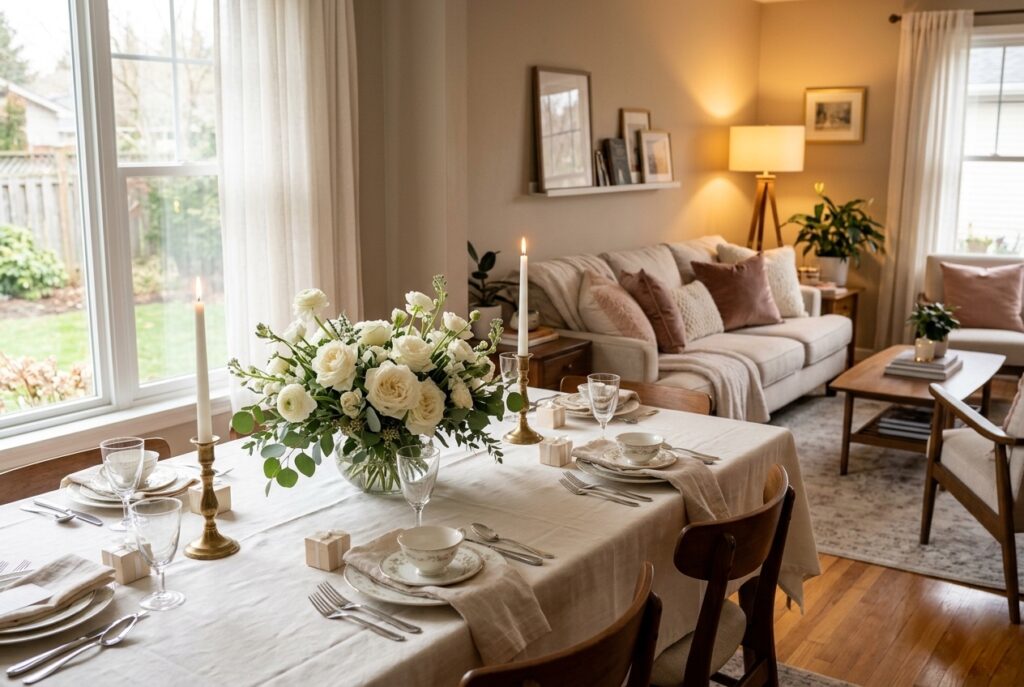
Most people hosting a bridal shower at home spend money trying to make their house look like somewhere else.
They buy backdrop stands, rent linens, hang banners from walls that already have art on them — and by the time guests arrive, the space looks like a home with decorations crammed into it, not a decorated home.
The difference matters more than you think, and fixing it costs less than you’d expect.
This article is about working with your actual house — the furniture you own, the windowsills you already have, the kitchen island that’s doing nothing — and turning them into the decoration rather than hiding them.
1. The Edit First — Clear Before You Decorate (Competitor Gap 2)
This is the step no bridal shower article tells you to do, and it’s the most important one.
Before you bring a single new decoration into the space, walk through every room being used and clear anything that doesn’t belong in the visual frame: remote controls, charging cables, mismatched everyday candles, refrigerator magnets visible from the main room, stacks of books that don’t suit the palette, pet items, and anything sitting on the surfaces you plan to style.
A home that reads as “bridal shower ready” is first a home that has been edited down to its clean bones.
That clearance takes 30–45 minutes and costs nothing — and it does more for the final look than any single decoration you could buy.
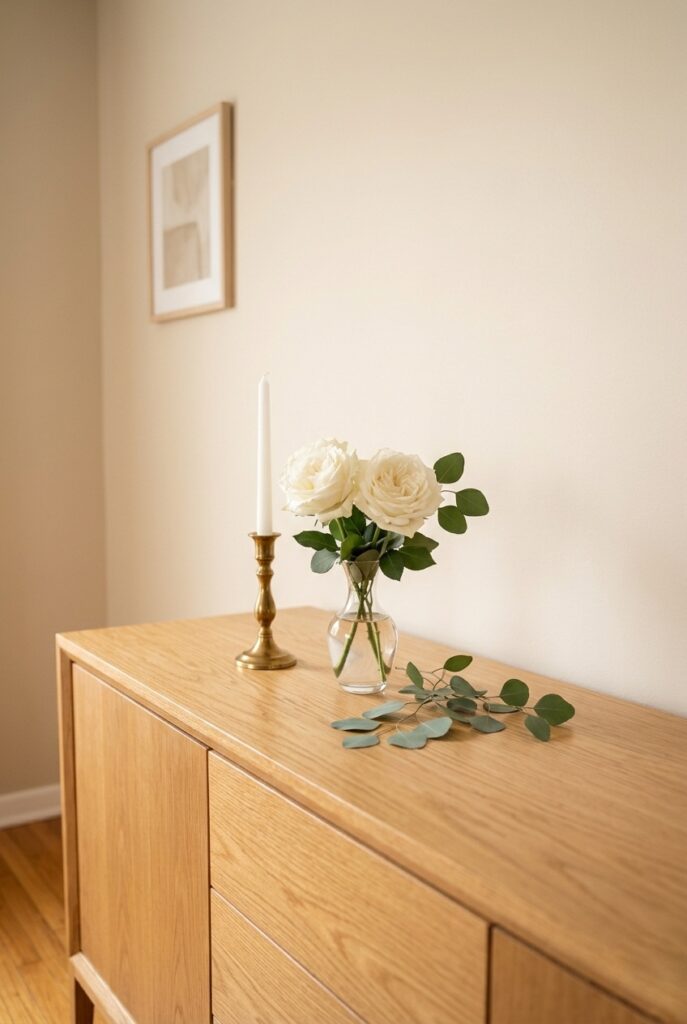
Two white roses on a cleared wooden sideboard photograph more beautifully than ten decorations competing with three framed school photos and a mail pile. Do the edit first. Every time.
2. The Mantle as the Room’s Natural Focal Point
If the space has a fireplace mantle, it is already the focal point of the room.
Competitors either ignore it or suggest hanging a banner from it — which covers the architectural detail you actually want guests to see. Instead: clear everything currently on the mantle and rebuild it with a bridal shower palette.
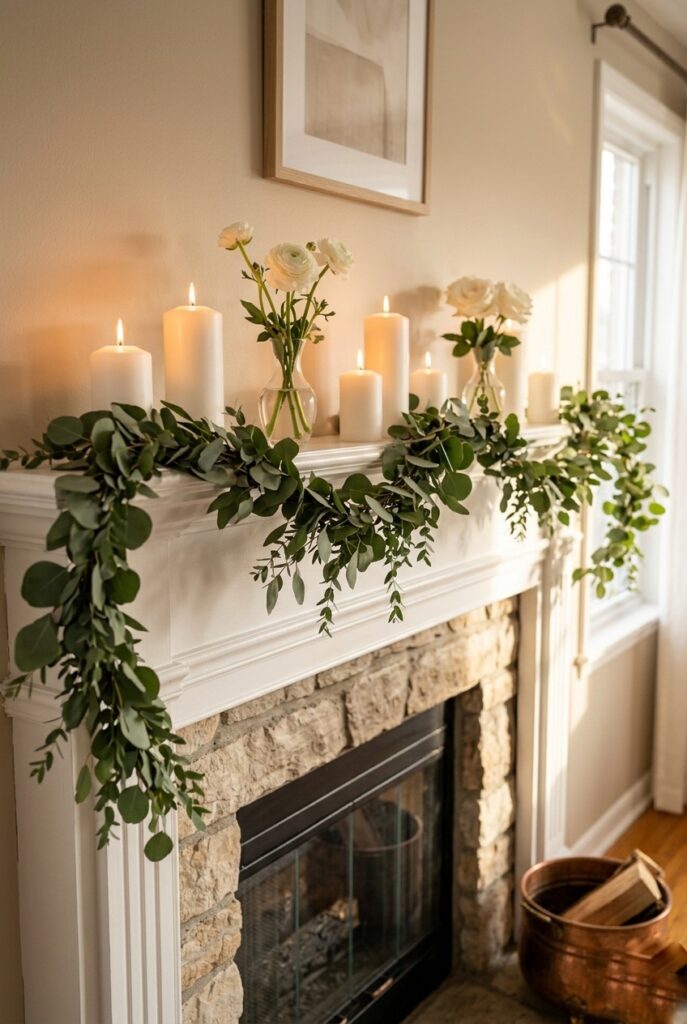
A row of 3–5 white pillar candles at varying heights ($8–$20 total at TJ Maxx or HomeGoods), two or three bud vases with white flowers, and a single eucalyptus garland draped loosely across the mantle face turns an existing home feature into the strongest visual anchor in the room.
No stand required, no installation required.
The garland ($15–$25 on Amazon or Etsy for a 6-foot preserved eucalyptus piece) stays flexible enough to drape naturally and photographs as lush greenery.
This is the kind of architectural leverage that makes elegant wedding decor ideas look expensive — using what’s already there rather than buying a structure to replace it.
3. The Kitchen Island as the Dessert and Drinks Station
At a venue, you build a dessert table from scratch — rent a table, buy a cloth, find a backdrop.
At home, you already have a kitchen island that is exactly the right height, perfectly lit, and central to where guests naturally congregate.
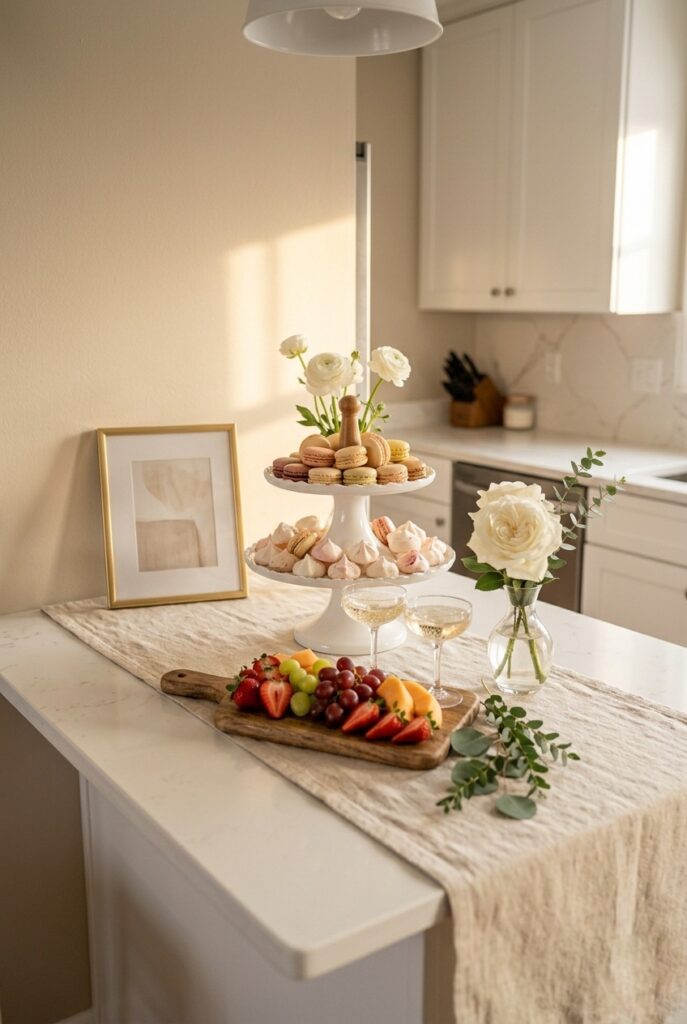
Stop fighting that instinct and style with it. Cover the island with a linen runner ($16–$20 using tea towels end-to-end as described in the previous DIY article, or a proper linen runner on Amazon for $18–$28).
Add a tiered stand at the back for height variation ($18–$30 on Amazon), your dessert items at the front, and a small bud vase of white flowers at one end.
A framed Canva-printed sign reading “Mimosa Bar” or “Eat, Drink & Be Loved” placed at the back corner ties it together.
The island becomes a fully styled dessert and drinks station for under $40 in new purchases, because the surface, the overhead lighting, and the central placement already existed.
This approach connects directly to the layering logic in simple wedding decor ideas — build on what’s already strong rather than replacing it.
💸 Budget Hack #1: Instead of buying a tiered dessert stand, use what’s already in the kitchen. Stack two or three existing plates or trays at different heights using upturned bowls or sturdy mugs as risers underneath — cover with a napkin if the riser is visible. A large dinner plate elevated on an upturned cereal bowl, topped with a smaller plate, creates a two-tier display at zero cost. Professional event stylists call this “elevation layering” and charge for the technique. You already own everything needed.
4. Window Ledges and Window Frames as Vertical Decoration
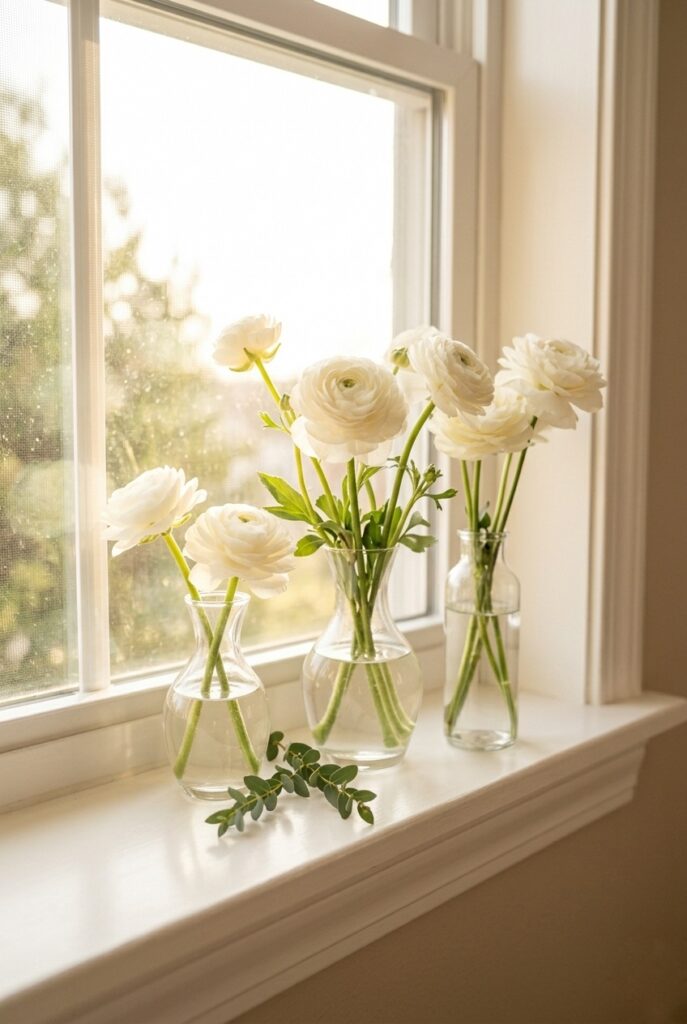
Windows are the most underused decorating surface in any home.
A deep window ledge can hold a row of bud vases with white flowers, a single white pillar candle, or a small framed print.
The window itself provides backlit natural light that makes anything placed in front of it photograph with a soft, luminous quality — the kind of light food and event photographers actively seek.
Hang sheer white curtain panels on a tension rod if the window currently has no curtains, or simply place flowers and candles on the ledge and let the natural backdrop do the work.
A window ledge moment — three bud vases, varying heights, white flowers — costs $12–$20 in flowers and uses zero wall space, zero floor space, and zero installation effort.
Only do this if your window gets natural light during the party hours.
A north-facing window in a dim room provides no backlight advantage and should be skipped in favor of a lamp-lit interior moment instead.
5. The Living Room Lounge Moment — Use Your Own Furniture
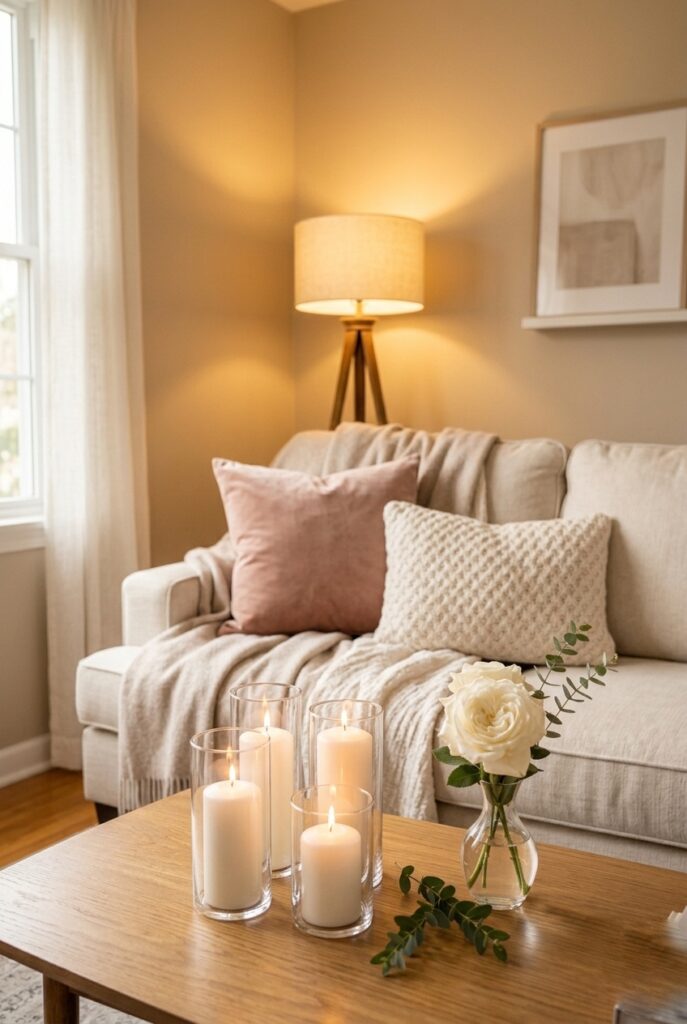
Pulling chairs and benches from different rooms and creating a lounge cluster in the living room is the at-home decorator’s most powerful move — and the one that requires the least spending.
Event planners charge $400–$800 to “create a lounge area” at a venue.
At home, you already have the furniture.
Push your sofa to face two accent chairs across a coffee table, drape a neutral-toned throw (yours or borrowed) over one chair arm, add coordinating throw pillows in the shower palette by swapping out whatever is on the sofa currently (store the everyday pillows in a bedroom), and place two or three candles on the coffee table.
The cost: zero to $20 if you need to buy one throw pillow in the right color. The result: a seating conversation area that guests gravitate toward and that photographs as a styled lounge setup.
Don’t forget to clear the coffee table of remotes, coasters, and everyday items before styling it — go back to Idea 1 if you skipped it.
6. Bookshelf or Sideboard as the Photo-Worthy Backdrop (Competitor Gap 1)
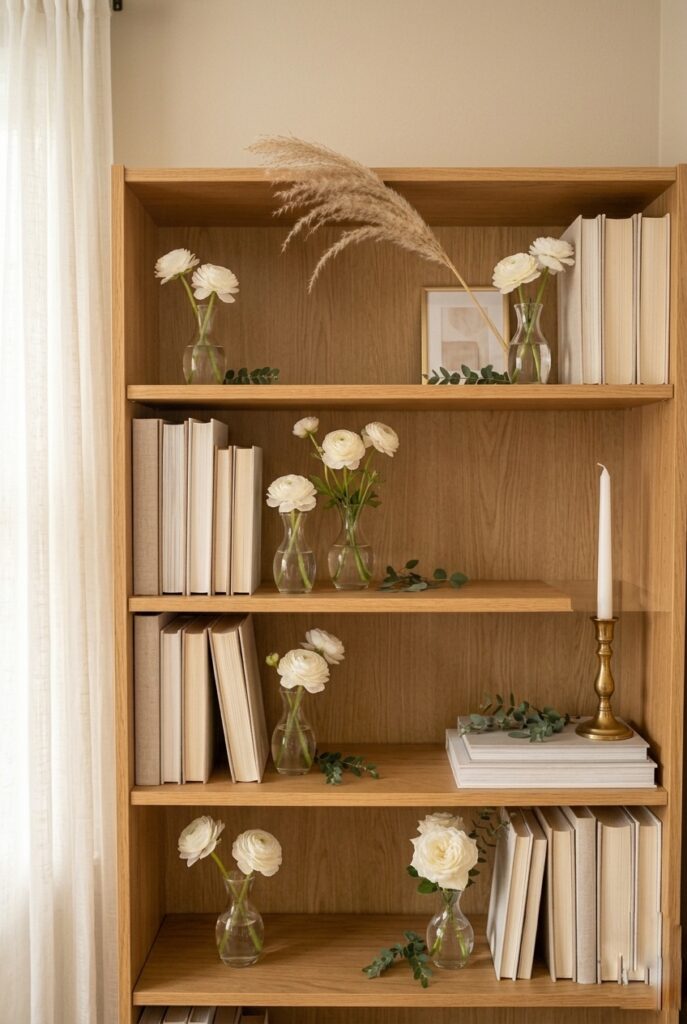
Here is the thing no competitor article makes explicit: a well-styled bookshelf or sideboard is already a designed backdrop.
You don’t need to buy a stand, hang a curtain, or build a balloon arch if your home has a bookshelf with good bones.
The transformation takes editing, not purchasing.
Remove books and items that clash with your palette — leave or reposition anything that works in white, ivory, blush, gold, or green.
Add two or three bud vases with white flowers, tuck eucalyptus stems between existing objects, and place a small taper candle in a brass holder at one end.
Place the bride’s chair in front of this styled shelf.
Every photo taken there — every gift-opening moment, every group photo — has a layered, textured backdrop that looks completely considered.
Etsy searches for “natural dried pampas grass bunch” return bundles at $12–$22 that tuck perfectly into the top shelf of a bookcase and add the height and texture an organic backdrop needs.
The mantle handles the room focal point; the bookshelf or sideboard handles the photo backdrop.
These are two different jobs, and your existing furniture can do both.
For the wider principle of using architectural features as built-in decor frames, the indoor wedding decor ideas approach is worth reading directly.
💸 Budget Hack #2: Neutral-spine books on a bookshelf cost nothing to achieve — just turn any colorful book spines to face the wall, showing the white or cream page edges instead. This takes four minutes and makes a bookshelf read as a styled prop rather than a functional storage unit. Pair this with $6–$10 in grocery store white flowers tucked into two small vases on the shelves and the transformation costs under $10 total. It’s the same technique interior photographers use when styling homes for real estate listings — the page-edge trick is specifically what makes bookshelves photograph as intentional rather than cluttered.
7. The Dining Table — Where to Spend and Where to Hold Back
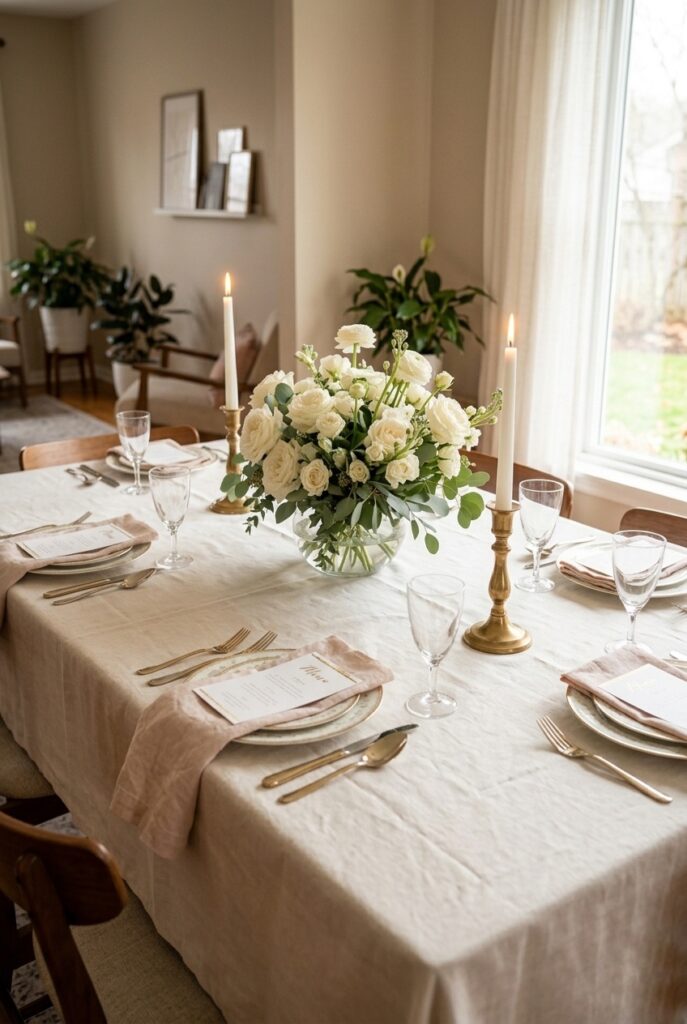
The dining table is where guests will spend most of their time, and it’s where most at-home hosts overspend on centerpieces and underspend on the fundamental element that makes everything else work: the tablecloth.
A tablecloth that fits properly — meaning it drapes at least 8–10 inches over the edge on all sides — transforms a dining table from a functional surface into an event table.
Polyester tablecloths from party supply stores crease badly in the package and reflect overhead light with a slight sheen that photographs as cheap regardless of what sits on top of them.
Linen-blend tablecloths from Amazon or Zara Home ($25–$45) drape cleanly, have natural texture, and photograph without glare.
Get the tablecloth right and the centerpiece requirement drops significantly — a single low arrangement of white flowers and a pair of taper candles on good linen reads as a complete, considered table.
On bad linen, ten decorations still can’t fix the baseline.
The full reasoning on why tablecloth quality drives the whole table’s register is in the wedding table decor ideasbreakdown — the rule applies identically at home.
8. The Front Door and Entry as the First Impression
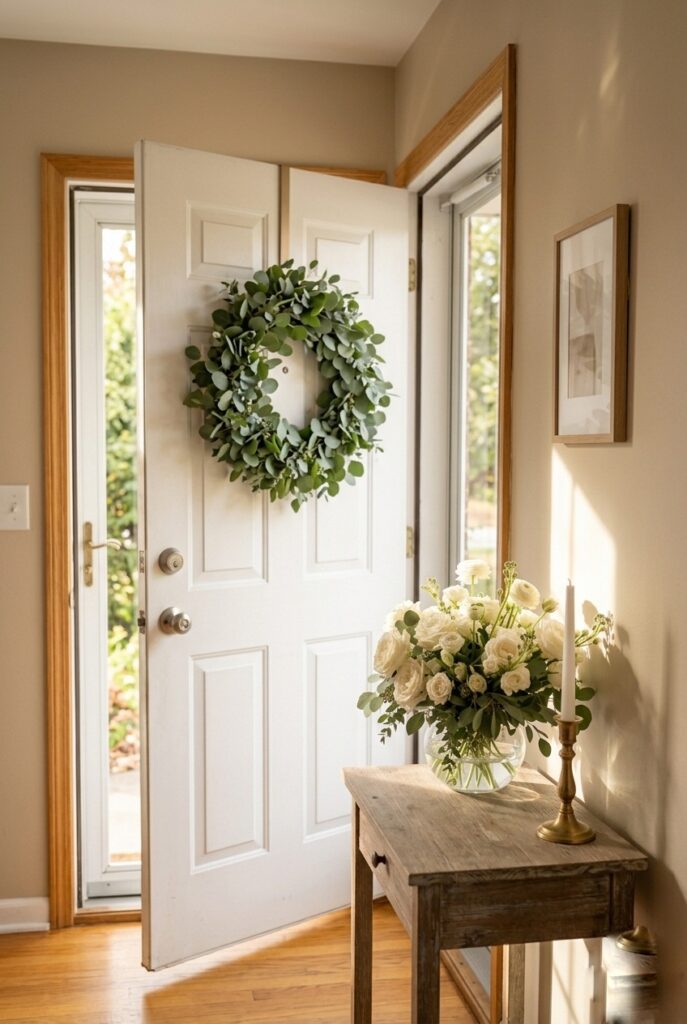
Guests arrive at your front door and walk through your entryway before they see a single decoration inside.
That first moment — door, entry table, hallway — sets the entire emotional register for the party.
Most at-home shower planning skips it entirely.
A eucalyptus wreath on the door ($18–$30 on Amazon or Etsy, or make your own with a $3 grapevine base and $6 in eucalyptus from Trader Joe’s), a small vase of white flowers on the entry table, and one taper candle in a brass holder tells guests the moment they walk in that this space has been considered.
Skip this if your entryway has no table or surface — don’t create a freestanding arrangement on the floor just for the entry.
A door wreath alone is enough to make the arrival feel intentional without requiring an interior surface to display anything on.
9. Lighting — Change What’s Already in the Room Before Buying Anything New
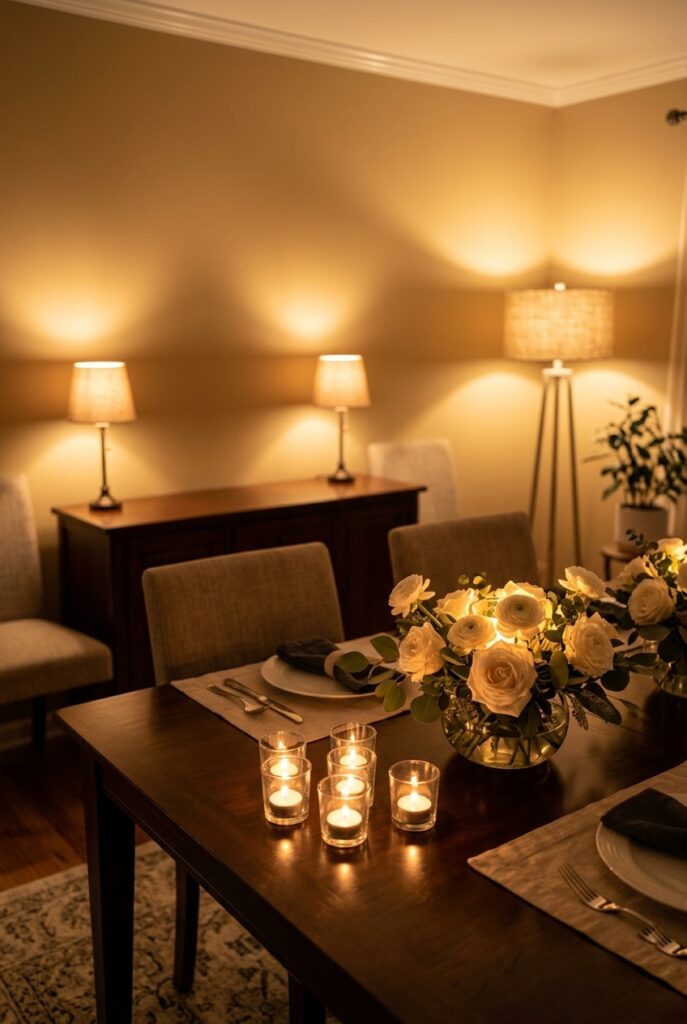
Home lighting is almost never set up for an intimate party.
Overhead can lights or ceiling fixtures tend to be bright and directional — good for daily life, harsh for an event.
Before buying any string lights or candles, walk through the space and do two things: turn off any overhead lights that cast hard downward shadows, and switch on any floor lamps, table lamps, or under-cabinet lights that produce warm, ambient glow.
Most homes have softer light sources that go unused because the overheads are habit.
A room lit by three table lamps and a cluster of candles on the dining table looks completely different from the same room lit by a central ceiling fixture — and the lamp version costs nothing.
After adjusting what’s already there, supplement with battery-operated warm white tealight votives ($10–$15 for a 24-pack on Amazon) placed on any surface with flower arrangements.
Warm white specifically — not cool white, which photographs blue and makes flowers look clinical.
Check the indoor elegant wedding decor ideas guide for how lighting decisions shift the entire perceived quality of a decorated space.
💸 Budget Hack #3: Warm Edison LED bulbs ($8–$12 for a 4-pack at Target or Amazon) swapped into existing table lamps for the day of the shower produce dramatically warmer, moodier light than standard bright-white bulbs — and they cost less than a single string light purchase. Swap them in the morning of the party and swap back afterward. The color temperature difference between a cool-white and warm-white bulb in the same lamp is visible in every single photograph taken in that room. Event photographers know this and carry spare bulbs. You can do the same for $10.
10. The Backyard or Patio — Outdoor Rooms Have Better Bones Than You Think
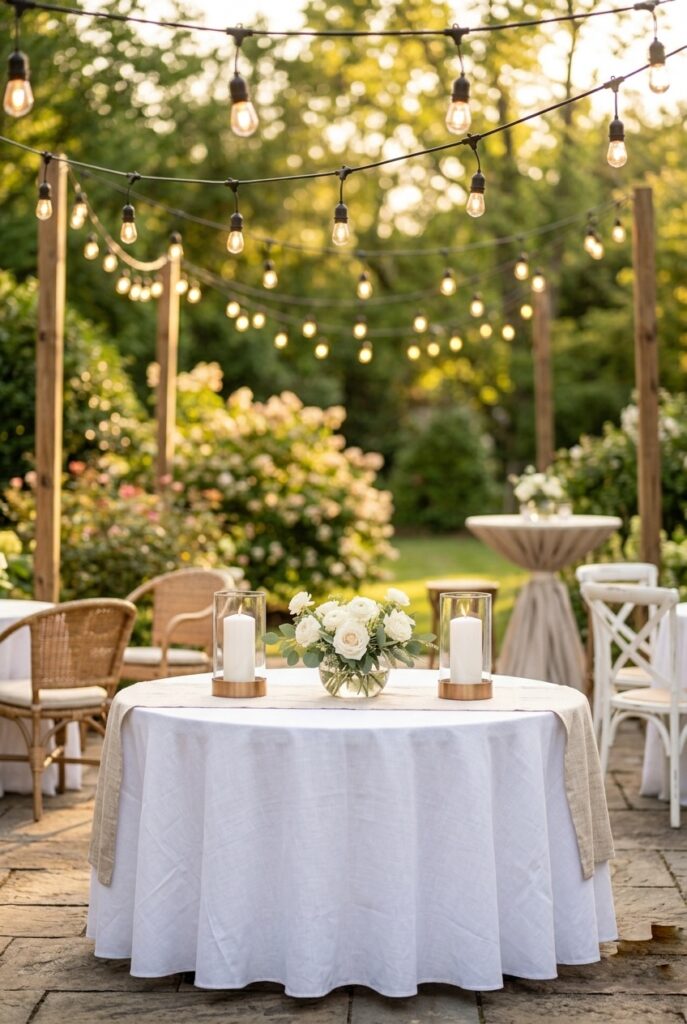
If the party has access to a backyard, patio, or even a small balcony, use it.
Outdoor spaces photograph with natural sky light in the background, which no indoor setup can replicate.
The specific advantages: a pergola or overhang creates a natural frame for hanging a garland or simple greenery drape.
Patio furniture — chairs, a table — need only a linen runner and flowers to read as a styled party setup.
And natural plant life in the garden provides free green backdrop material that costs a florist $150 to recreate indoors.
Only do this if you have a weather-safe contingency. Outdoor bridal shower decor can be ruined by wind (paper elements, light vases) and surprise humidity (balloon garlands droop, paper signs curl).
Use heavier decorative elements outside — weighted vases, potted plants, pillar candles in glass hurricanes rather than bare taper candles — and keep any paper or lightweight items indoors.
For full outdoor styling strategy, the outdoor wedding decor ideas principles scale directly down to a backyard party.
11. The Gift Table — Make It Look Intentional, Not Accidental
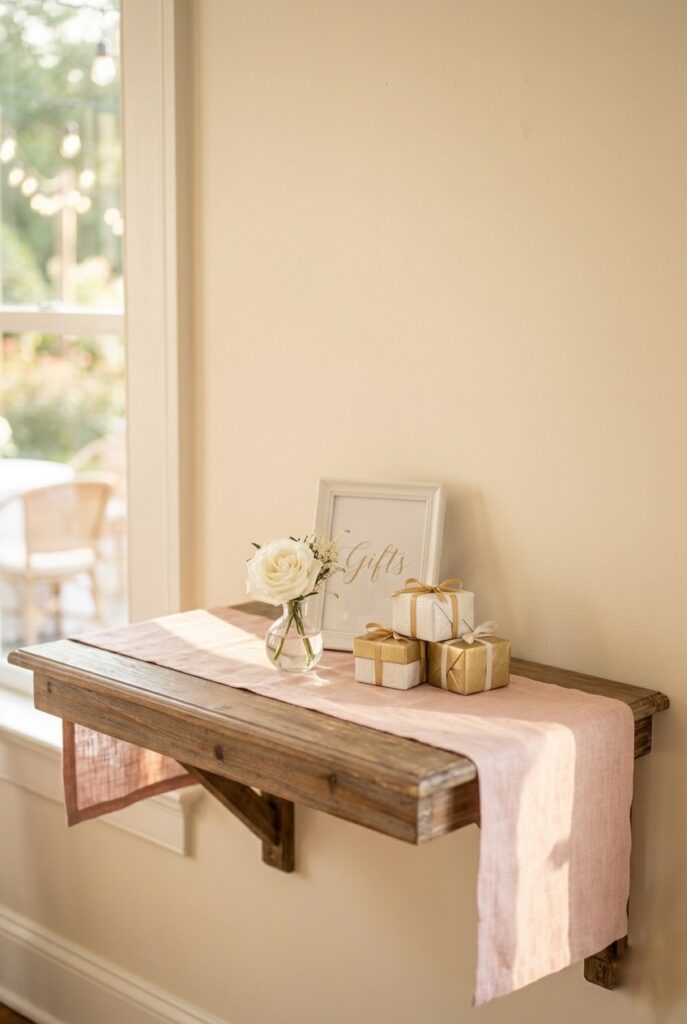
At home, the gift table is almost always a table that normally lives against a wall with different things on it.
The pile of gifts that accumulates during the party is inevitable — the question is whether that table looks styled when guests arrive or just functional.
A linen runner down the center of the gift table, one bud vase of white flowers at the corner, and a small framed “Gifts” sign is the complete setup. That’s it.
The mistake is leaving the gift table bare until the first gifts arrive, at which point it already looks like an improvised surface. Dress it before anyone arrives.
Once gifts start stacking up, the linen and flower are still visible around the edges and the table reads as intentional rather than a holding area.
Keep gifts in their wrapping — unwrapped boxes or mixed bags without tissue look messy even in small quantities.
For how this gift-table styling logic connects to the wider approach to bridal shower decorations ideas, the zone-by-zone thinking works identically at home.
Decision Filter
If your home has good natural light and existing neutral furniture, spend your entire budget on linens and fresh flowers — nothing else is needed.
If your home has dark walls or limited natural light, prioritize warm lighting (lamp bulb swap + tealight votives) before any decorative purchase, because dark rooms with beautiful flowers still photograph badly under harsh or insufficient light.
If you’re working with under $75 total, do this sequence: edit the space, swap the lightbulbs, buy one linen tablecloth, buy two bunches of white grocery store flowers and a $3 grapevine wreath base, and borrow any candles or vases from your own kitchen.
That $75 will do more than $200 spent on a backdrop stand and packaged party decor.
The Real Reason At-Home Showers Look Underdone
At-home bridal showers that fall flat aren’t underdone because of a lack of decoration — they’re underdone because the existing home clutter is still competing with every new item that’s been added.
A balloon garland in the corner next to the everyday umbrella stand and the dog leash on the hook doesn’t read as festive.
It reads as a party happening inside an un-prepared house.
The edit — removing what doesn’t belong in the frame — is the transformation, and it costs nothing.
The bold opinion: the best at-home bridal showers lean into the home’s existing character rather than trying to disguise it.
A kitchen with open shelving, a dining room with vintage wooden chairs, a living room with a worn leather sofa — these are design assets, not problems to cover.
The worst at-home showers are the ones where someone has tried to make a house look like a rental venue by covering every surface with purchased decor.
The home wins when it’s allowed to be itself, edited and layered rather than hidden and replaced.
The insider observation that wedding photographers share among themselves but rarely pass to clients directly: the moments guests and photographers actually remember from at-home showers are the candid ones — someone leaning against the kitchen counter holding a champagne flute, two bridesmaids laughing on the sofa, the bride sitting in front of a bookshelf opening a gift.
The background in those photos is your actual home.
If your home looks like itself at its best — cleared, lit well, with a few flowers and candles — those candids are the best photos from the day.
If your home is covered with party-supply-store decor fighting your existing walls, those same moments look chaotic. Style for the candids.
They’re what everyone will show each other afterward. For the budgeting side of this approach, the budget wedding decor ideas philosophy applies directly — spend where the camera lands, hold back everywhere else.
Mistakes to Avoid
Mistake 1 — Buying a Backdrop Stand for a Room That Already Has a Wall Almost every competitor article recommends a portable backdrop stand as an essential at-home bridal shower purchase ($45–$90 on Amazon).
A backdrop stand in a home living room competes with the existing walls, furniture, and ceiling height — and rarely integrates well because it’s sized for events in empty venues, not furnished home interiors.
If your home has a blank wall, a doorframe, or a bookshelf, that is your backdrop.
Add a floral hoop, hang a garland on a tension rod in the doorframe, or style the shelf.
The stand solves a problem you don’t have.
Mistake 2 — Spending $60 on a Balloon Garland Kit and Forgetting the Walls Are Already Covered At a venue, walls are blank and a balloon garland fills empty vertical space effectively.
At home, most walls already have art, mirrors, or windows. Installing a balloon garland in front of existing wall art means your décor is fighting your décor.
The dollar cost when this goes wrong — art needs to be taken down, balloon placement shifts, garland doesn’t span the revised width, extra balloons ordered last-minute — typically adds $20–$40 to the original kit cost and still produces a result that looks like it doesn’t quite belong.
Either plan the balloon garland for a specific blank wall or doorframe where nothing competes with it, or spend the $60 on linen and flowers instead.
Mistake 3 — Not Checking How the Space Photographs Before the Party The same room can photograph completely differently depending on where you stand and what’s in the background.
Walking through and taking three or four test photos with your phone the day before tells you things your eyes miss: the cluttered corner that appears in every shot, the dark patch near the gift table where the lighting drops, the window that creates a blown-out bright spot directly behind where the bride will sit.
These are fixable on the day before — reposition a lamp, move a chair, pull a curtain half-closed — but unfixable on the day of.
Spend 20 minutes the evening before taking test shots from the angles guests and you will actually be standing.
Adjust based on what you see in the photos, not what you see with your own eyes standing in the room.
Mistake 4 — Decorating the Whole House When Guests Will Only Use Two Rooms A common over-investment at at-home showers: decorating the hallway, the bathroom, the guest room, and the main living and dining spaces equally. Guests spend their time in two or three areas maximum.
The hallway decoration gets a four-second glance in each direction.
The decorated bathroom shelf gets noticed by half the guests.
Concentrate every dollar and every decoration in the spaces where guests will actually sit, eat, talk, and take photos — the dining area, the living room lounge, and wherever the dessert station lives.
Spreading effort evenly across the whole house means the rooms that matter are underfunded and the rooms that don’t are overworked.
FAQ
How do you decorate a small home for a bridal shower?
Use vertical space and existing surfaces rather than floor space. Style the mantle, windowsill, and bookshelf rather than adding freestanding furniture.
Keep the guest list proportional to the square footage — a group of 10–12 fits comfortably in a space that would feel crowded with 20.
For rooms under 200 square feet, one decorated table and a styled mantle are sufficient — resist the urge to add more elements because more decoration in a small space reads as cluttered, not festive.
The cheap wedding decor ideas approach applies perfectly here: restraint and quality over volume.
What decorations do you need for a bridal shower at home?
At minimum: a properly sized tablecloth for the dining table, fresh flowers in two or three bud vases, candles or warm lighting, and something on the wall or shelf behind where the bride will sit during gift opening.
Everything beyond that is enhancement, not requirement.
A home already has furniture, architecture, and existing light sources that a rented venue charges you to provide. Use them.
The full framework for prioritizing which elements matter most is in the bridal shower decorations ideas guide.
How much does it cost to decorate a home for a bridal shower?
A well-executed at-home bridal shower for 12–15 guests can be decorated for $40–$80 if you use the home’s existing features as the primary design assets.
The minimum effective purchase list: one linen tablecloth ($25–$45), two bunches of white flowers from a grocery store ($8–$12), a pack of battery tealights ($10–$15), and a door wreath or entry accent ($18–$25 on Amazon or Etsy). Total: $61–$97 for a complete, cohesive look.
Costs rise when people purchase backdrop stands, balloon kits, and themed decor sets that the home’s existing décor then competes with.
Use Zola’s bridal shower planning guide to map out the full event logistics alongside the decor planning.
Can you throw a nice bridal shower at home without spending a lot?
Yes — the home itself is the biggest cost saving. You don’t pay for a venue, you already have furniture and lighting, and most of the structural elements a rental venue charges for are built in.
The trap is overspending on purchased decor to make the home look like a venue.
The counter-intuitive truth: the less you spend trying to make your home look like somewhere else, and the more you spend making your home look like its best self, the better the final result.
A tablecloth, flowers, candles, and a cleared and edited space is the formula for every well-photographed at-home bridal shower, regardless of the home’s size or style.
Budget Comparison
| Decor Area | Budget Approach | Mid-Range Approach | Notes |
|---|---|---|---|
| Tablecloth | Party store polyester, $5–$8 | Linen-blend, $25–$45 | Linen is non-negotiable upgrade |
| Flowers | Grocery store, 2 bunches, $8–$12 | Florist simple arrangement, $45–$75 | Grocery store fully sufficient |
| Candles/Lighting | Battery tealights 24-pack, $10–$15 | Pillar candles + hurricanes, $25–$40 | Lightbulb swap is free; do it first |
| Entry/Door | Grocery store eucalyptus bunch, $5 | Etsy eucalyptus wreath, $18–$30 | Both work — wreath lasts longer |
| Backdrop | Bookshelf/wall (free, already exists) | Tension rod + curtain panels, $25–$40 | Only buy if no usable wall exists |
| Mantle/Sideboard | Owned candles + grocery flowers, $8–$15 | Eucalyptus garland + new candles, $25–$40 | Use existing candles first |
| Gift Table | Linen runner + 1 vase, $15–$20 | Same — no need to spend more | Keep simple |
| Total | $51–$75 | $143–$270 | — |
The $51–$75 version beats the $143–$270 version if the editing step is done correctly.
That is not a budget-shaming statement — it is a genuine design truth: cleared space with quality materials outperforms cluttered space with premium purchases, in every home, at every price point.
Your home is not a venue that needs to be transformed — it’s a backdrop that needs to be prepared.
Clear it, light it well, put white flowers and candles on every surface that matters, and let the architecture you already own do the rest.
The next step is deciding which surfaces to prioritize: start with the bridal shower decorations DIY guide for the projects that make the most of those prepared surfaces, and you’ll have the whole picture.