
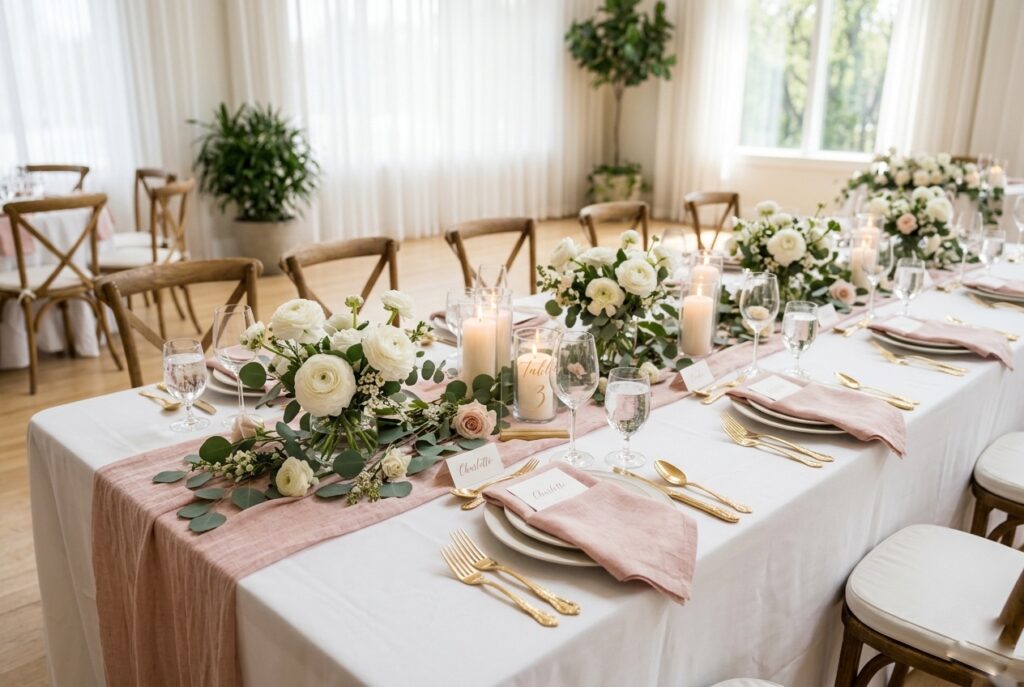
Most bridal showers look fine in the planning doc and then land flat in the actual room — because buying individual decoration pieces and having a decorated space are two completely different things.
The difference is how zones connect, how scent hits before sight does, and how one deliberate anchor point makes every surrounding choice feel intentional rather than random.
This article tells you what that looks like, exactly where each piece goes, and what to skip entirely.
1. The Bride’s Chair as the Architectural Center
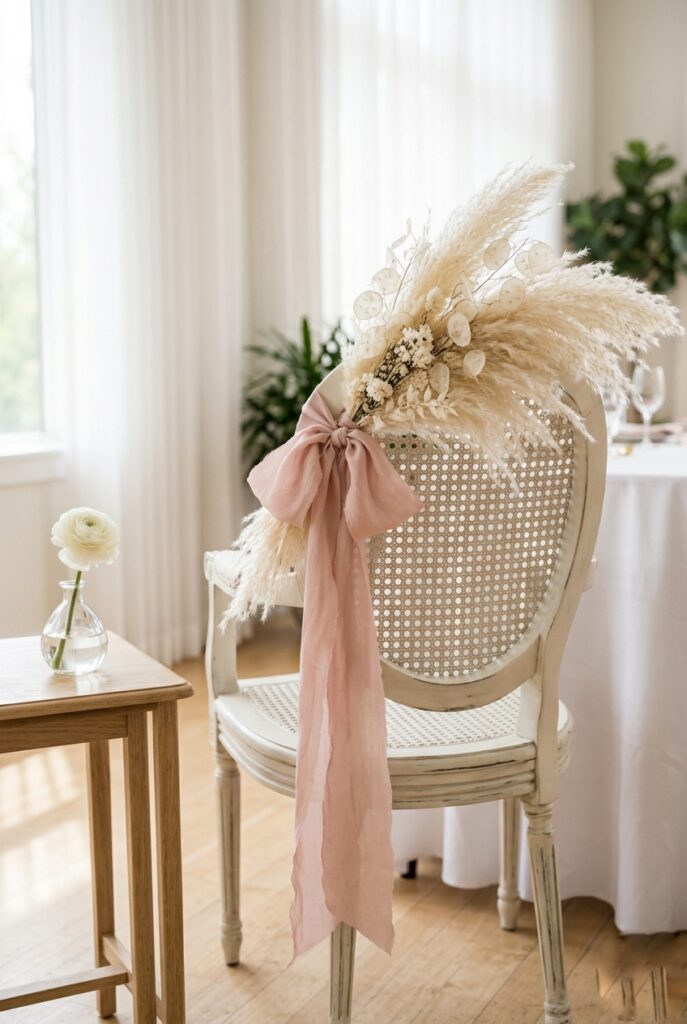
The bride’s chair is where every photo gets taken, every gift gets opened, and every guest glances across the room during the event. It’s your most photographed surface — and most hostesses treat it as an afterthought.
A white organza bow tied loosely to the back of a basic folding chair does not read as intentional.
It reads as the thing you added at the last minute.
Instead: rent or borrow a throne-style arm chair, a sculptural peacock chair, or a vintage cane chair (Etsy rental listings in most US cities, $35–$80).
Dress it with a single oversized spray of dried pampas grass and blush silk ribbon.
That chair becomes a destination. Only do this if you’re willing to place it against something — a flower wall, a fabric backdrop, or at minimum a blank wall you’ve dressed.
A decorated chair floating in the middle of the room with no backdrop behind it reads like a waiting room.
2. A Scent Layer That Arrives Before Any Guest Does
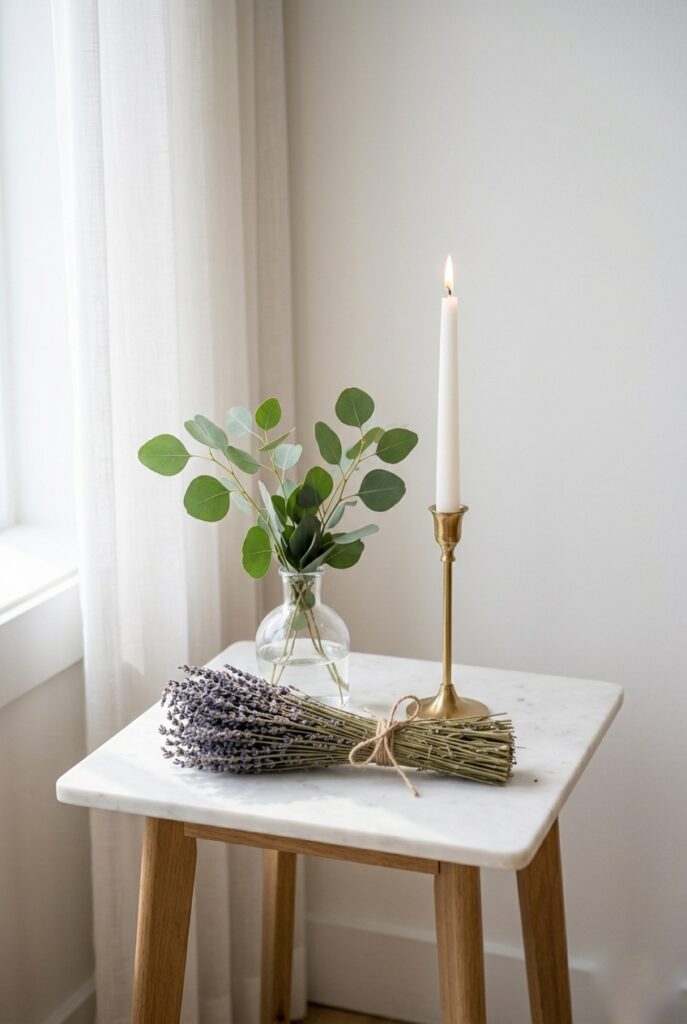
Every experienced event stylist knows that scent is the first thing guests register when they walk through a door — and the last thing they remember — yet it appears in exactly zero competitor articles on bridal shower décor.
This isn’t a small oversight. It’s the difference between a room that feels assembled and one that feels experienced.
Place three things strategically: a bunch of fresh eucalyptus tucked into any centerpiece vase (the slight medicinal green smell is clean and non-offensive to everyone), a single unscented or lightly scented candle near the dessert table, and optionally a small bundle of dried lavender laid flat on the gift table.
Together these create a layered, cohesive olfactory atmosphere that guests will describe as “so pretty in there” without being able to explain exactly why. Fresh eucalyptus bundles from Trader Joe’s run $3–$5.
Dried lavender bundles from Amazon run $8–$12 for a pack of 6. This entire layer costs under $20 and zero competitors are telling you to do it.
3. The Flower Wall or Fabric Backdrop — Done Without the Cheap Version
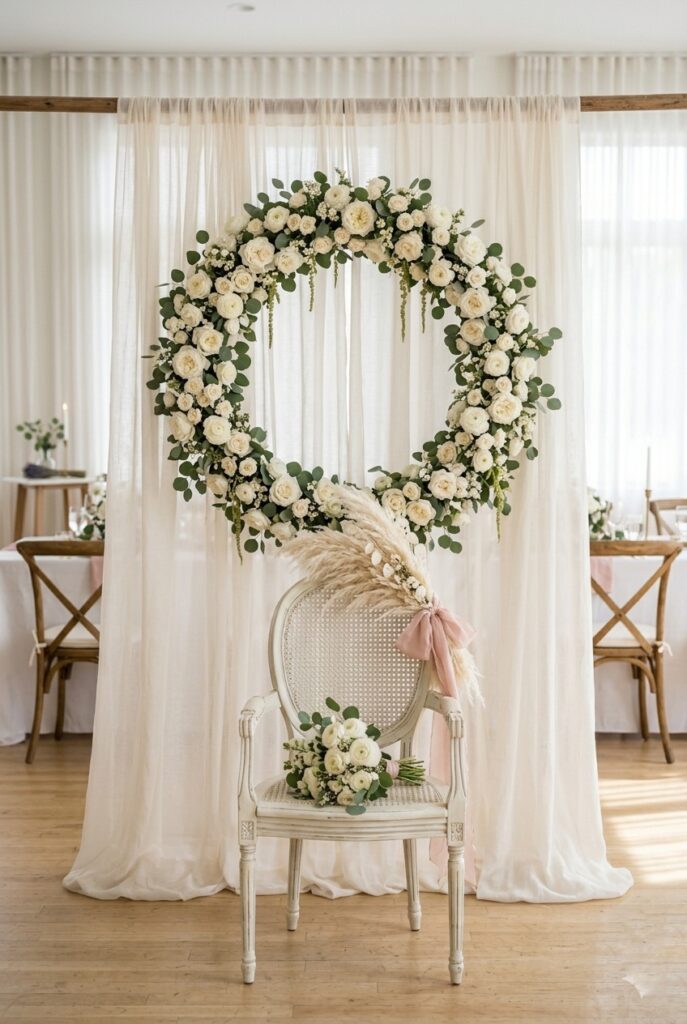
A flower wall backdrop is the most photographed element at any modern bridal shower.
It’s also one of the most frequently done wrong.
The cheap version: white plastic foam panel flower walls from Amazon (around $30–$50), where the flowers are visibly uniform, slightly shiny, and clearly silk-pressed.
They photograph exactly as fake as they are, especially in natural light where the gloss on artificial petals is unmistakable.
The right version at a real-person budget: rent a real flower wall from a local event rental company ($150–$350 depending on city), or build your own using a curtain rod, sheer white fabric panels, and 3–4 bunches of fresh flowers tucked into water-pick tubes pinned to the fabric.
The water-pick approach costs roughly $60–$90 total and photographs as genuinely lush.
Alternatively, a fabric-only backdrop in ivory or blush crepe — two curtain panels on a tension rod — styled with a single floral halo hung at eye level costs under $50 and reads as clean, editorial, and intentional.
Check The Knot Vendor Marketplace for local backdrop rental vendors in your area.
💸 Budget Hack #1: Grocery store flowers priced $8–$12 per bunch — white alstroemeria, white carnations, baby’s breath — look identical to florist flowers inside a tightly packed floral hoop or halo. Order a 12-inch foam floral hoop base from Amazon ($7) and spend $35 at Trader Joe’s or Whole Foods on white stems. Total cost: under $45 for a backdrop halo that reads as florist-quality. The key is density — pack it so no foam shows. Sparse foam shows exactly what you spent.
4. Tablecloths That Set the Register of the Whole Room
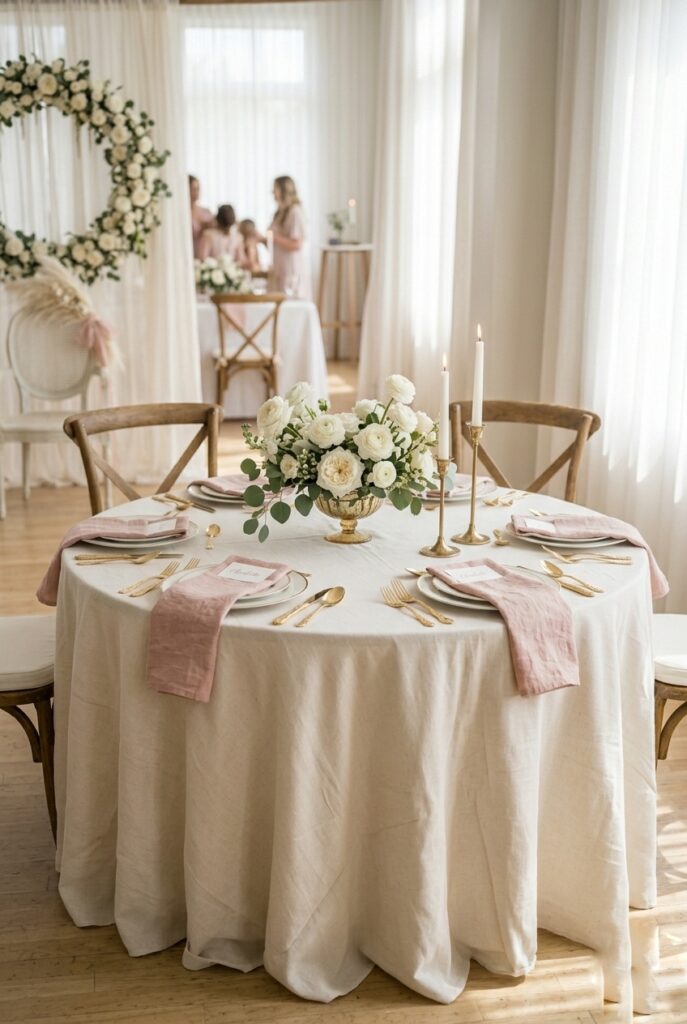
The tablecloth decision gets made first and affects every other choice.
The cheap version: polyester tablecloths from party supply stores in bright white.
They crease in the bag, photograph with a slight sheen under any overhead light, and start to wrinkle within 20 minutes of being handled. Two hours into the party they look like a crumpled shirt.
Instead: linen-blend tablecloths in ivory or warm white.
Zara Home and Amazon both carry linen-blend tablecloths in the $25–$45 range that drape cleanly, photograph without glare, and give the entire table a texture the camera reads as quality.
If budget is genuinely tight, go to a restaurant supply store — they carry heavyweight cotton-poly tablecloths in warm white for around $8–$15 each and they’re made for repeat use.
A warm ivory linen on a round table with zero other changes will elevate the entire room’s visual register simply because the fabric has weight and drape.
Think about how simple wedding decor ideas can be elevated through exactly this kind of fabric choice — the principle is identical.
5. Centerpieces: Height Strategy Over Flower Count
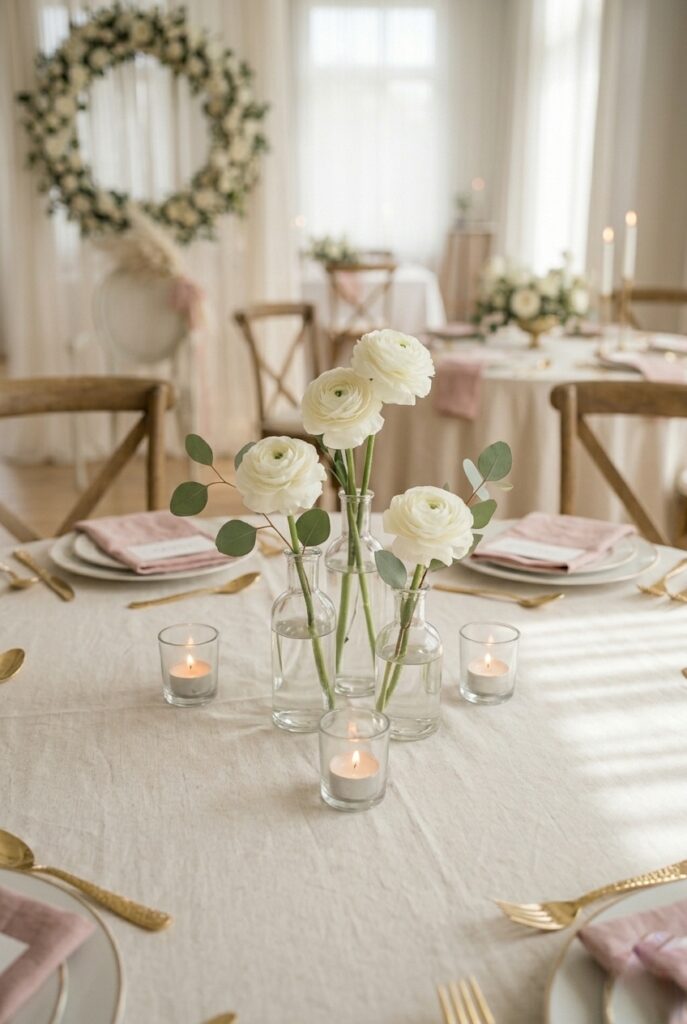
Every competitor article tells you to do floral centerpieces. None of them tell you that the height of those centerpieces determines whether guests can see, talk to, and connect with each other across the table — which is literally the point of the party.
A tall dramatic arrangement in the center of a round table of eight means those eight women will spend the whole party talking only to the two people next to them, leaning awkwardly around stems to make eye contact.
Low centerpieces — anything under 10 inches — on round tables keep conversation open.
High arrangements on long rectangular tables only work if placed at the ends or spaced at wide intervals so sight lines stay clear.
For round tables under 60 inches: a cluster of 3 varying-height bud vases ($15–$25 for a set of 6 on Amazon) filled with white ranunculus and eucalyptus reads more considered than a single large arrangement and keeps the table visually accessible.
For long rectangular tables, one low linen runner from your wedding table decor ideas playbook and paired taper candles solves more problems than any floral centerpiece.
6. The Dessert Table as a Styled Zone, Not a Flat Surface
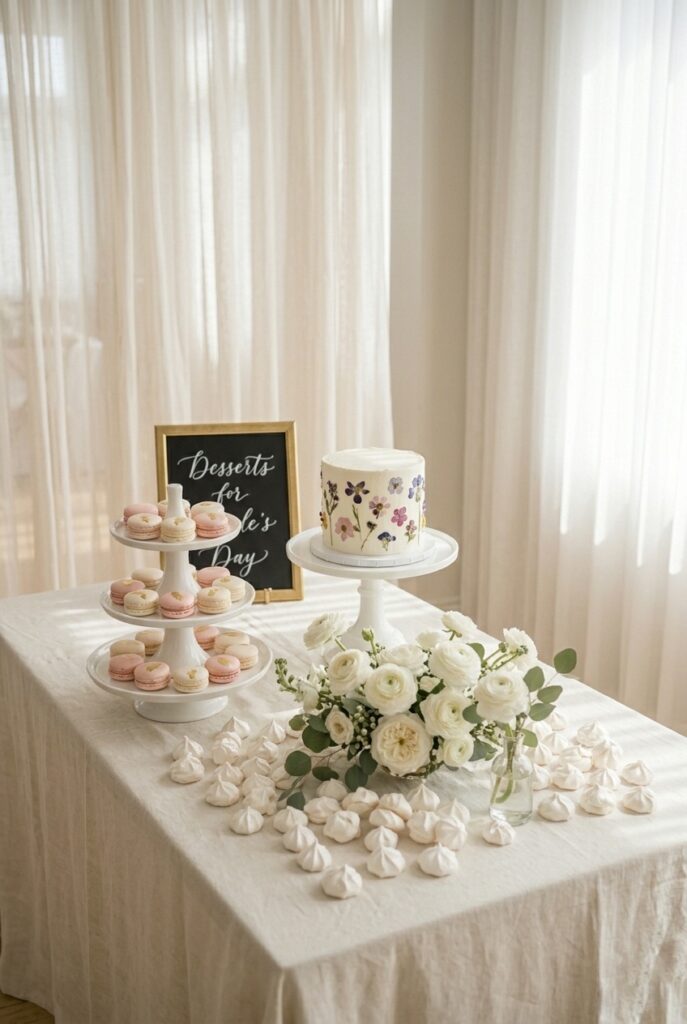
A dessert table that looks like a school bake sale and a dessert table that looks like it belongs in a magazine use the exact same food.
The difference is elevation — literally.
Flat items at a single height are the problem. Prop the back row of desserts on cake stands or stacked books wrapped in linen. Stand a framed “Eat, Drink & Be Married” sign at the back left corner.
Lay a tablecloth that contrasts slightly with the main table linen so the dessert table reads as its own intentional zone. Add a small vase of flowers at one end (left or right, not centered — centering everything makes a table look retail, not styled).
Tiered cake stands from Amazon run $18–$30 and solve the elevation problem entirely. Skip the generic “Bride to Be” banner in script font cut from glitter cardstock — it reads as dollar store regardless of what you paid for it.
Replace it with a small framed print or a handwritten chalkboard sign, which reads as considered and personal.
💸 Budget Hack #2: Dollar Tree sells clear glass cylinder vases for $1.25 each — the same shape sold at florists for $8–$12. Buy ten, fill with water, add 2–3 white carnation stems per vase (roughly $1.50/bunch from Trader Joe’s), and scatter them across the dessert table and end tables. Total investment: under $30 for 10 styled vases that photograph as florist-quality because the form of the arrangement is correct, regardless of flower variety. White carnations have been unfairly stigmatized — in a clear glass cylinder with proper stem length, they are indistinguishable from more expensive blooms in photos.
7. Welcome Signage That Actually Directs Energy
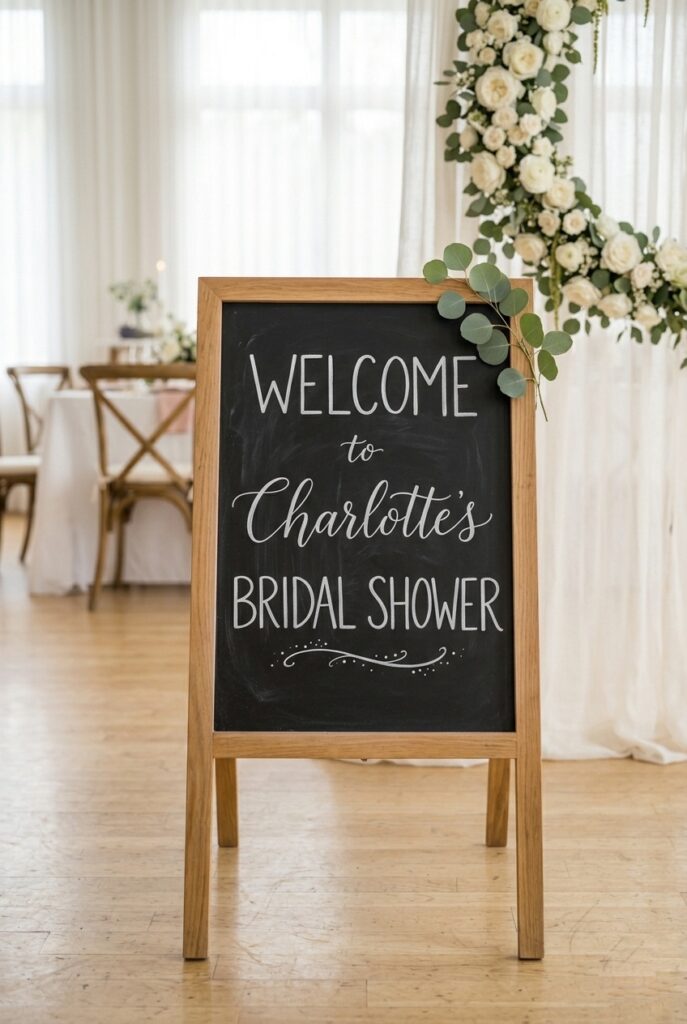
Most bridal shower welcome signs are generic — “Showered with Love” in a script font on cardstock or a $15 foam board from Amazon.
They fulfill a function but create no atmosphere.
A welcome sign is actually a tone-setter: the first piece of text a guest reads tells them how to feel about the event they just arrived at. “Showered with Love, [Bride’s Name]” with her wedding date in a calligraphy script on a linen-backed frame ($20–$35 on Etsy, search “personalized bridal shower welcome sign”) sets a specific, warm tone.
A small chalkboard easel with a handwritten message is even better because handwriting feels genuinely human in a way printed script fonts do not, even beautiful ones.
Place it at the entrance, at eye level, with a small floral sprig tucked at the corner — never flat on a table where guests have to look down.
8. Balloon Installations Done the Right Way (Skip This If)
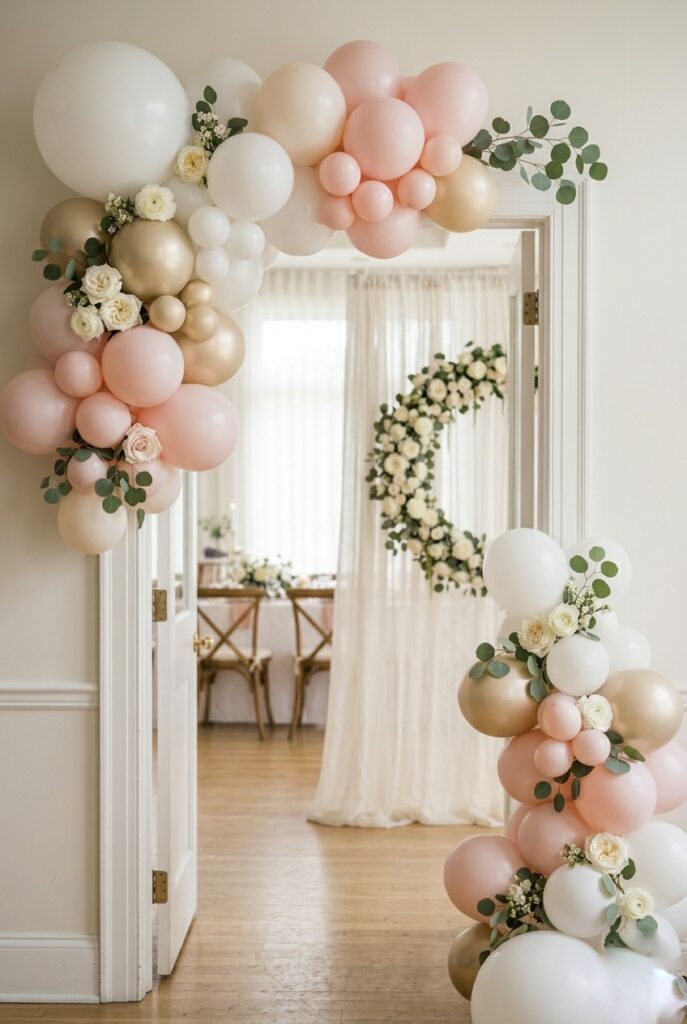
Balloon arches and organic balloon garlands remain one of the most effective ways to add scale and color to a room quickly.
Skip this if your venue has low ceilings under 9 feet — a balloon arch that brushes a low ceiling reads as cramped and makes the room feel smaller, not more festive.
For spaces with 10+ foot ceilings, an organic balloon garland in white, blush, and champagne is one of the highest visual-impact-per-dollar installations available ($30–$60 DIY with a balloon garland kit from Amazon, or $150–$300 for a local balloon artist).
The right position: flanking the entrance or framing the dessert table, never centered over the dining tables where guests will feel like they’re eating under a ceiling installation.
Double-sided tape and a balloon strip kit are all you need — no helium required for a wall or doorframe garland.
9. The Decor Zone Framework — Move Guests Through the Space (Competitor Gap 1)
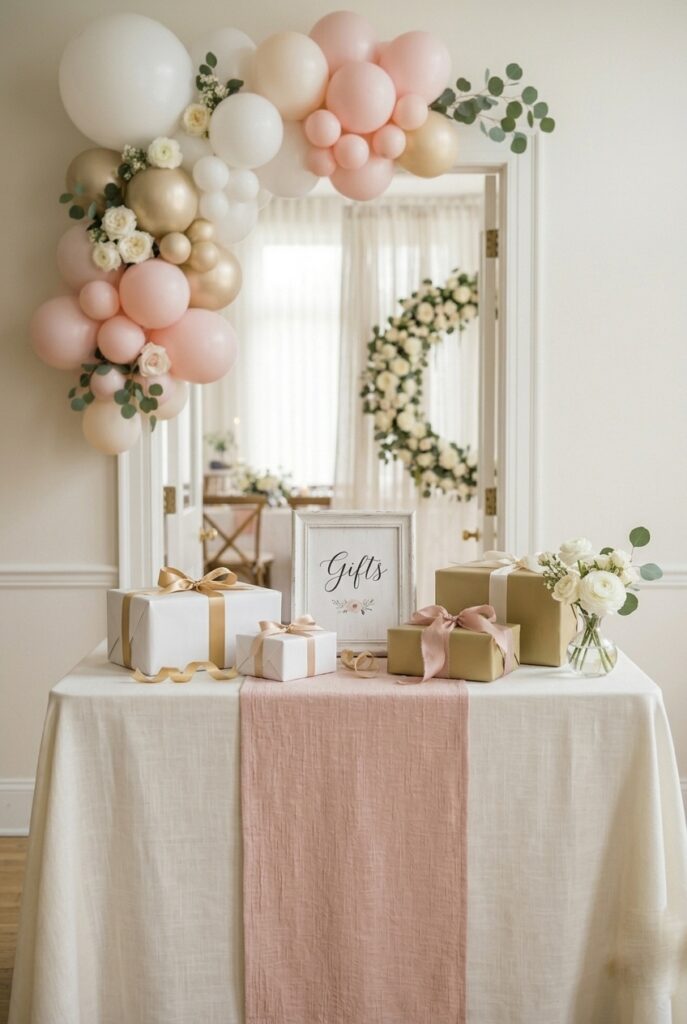
Here is the one framework no competitor article discusses: bridal shower decor should move guests through the room in a sequence, not just fill a space.
Think in four zones — arrival zone, conversation/dining zone, photo zone, gift zone — and give each one at least one visual anchor.
Arrival zone: welcome sign + scent element (eucalyptus vase or diffuser at the entrance table).
Dining zone: tablecloths + centerpieces + taper candles. Photo zone: backdrop + bride’s chair. Gift zone: a styled table with a small vase of flowers, a “Gifts” sign on a card, and a linen runner so it looks intentional rather than like a pile-accumulation surface.
When each zone has one anchor, guests move naturally through the space instead of clustering at the bar and ignoring three-quarters of your decor.
It also means photos taken anywhere in the room have a decorated background — not a bare wall.
For reference on how this zoning principle applies beautifully to the ceremony itself, the elegant wedding decor ideasplaybook uses the exact same approach.
💸 Budget Hack #3: Event rental companies and party stores often rent linen tablecloths, charger plates, and bud vases as a bundle. In most US cities, renting linens for 8–10 tables costs $40–$80 total — significantly cheaper than buying tablecloths that you will use once and store. Search “party rental linen” + your city on Google to find local rental houses. Most have minimum rental orders of $50–$75. This is also where you find real crystal charger plates ($0.75–$1.50 each rental) that would cost $8–$15 each to purchase — the kind of upgrade that makes a table look professionally styled for almost no money.
10. Personalization That Goes Beyond the Bride’s Name in Balloon Letters
Personalization is the most overused word in bridal shower planning and the least executed thing in actual bridal shower decor.
Name balloons and a custom banner with the bride’s name are personal in a surface way.
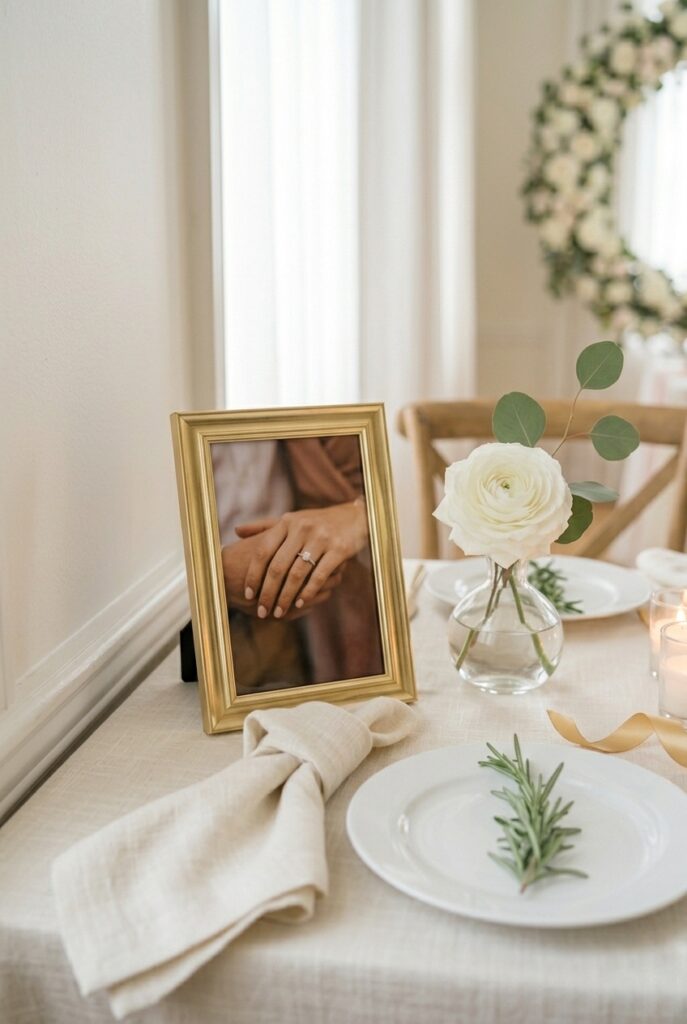
Real personalization is decorative: framing an engagement photo in a small gold frame on the dessert table, printing three favorite recipes of the bride and framing them as tabletop art for the dining tables, placing a single bloom from her wedding color palette in each bud vase so the shower feels like a preview of the wedding itself.
These are $5–$25 touches that create genuine emotional resonance and make the bride feel seen rather than generically celebrated.
Etsy has custom-printed recipe card art starting at $8–$15 (digital download, print at home or at Walgreens).
That frame on the dessert table is a $4 Target frame and a printed 4×6 photo.
11. Candles and Lighting — the Underused Variable
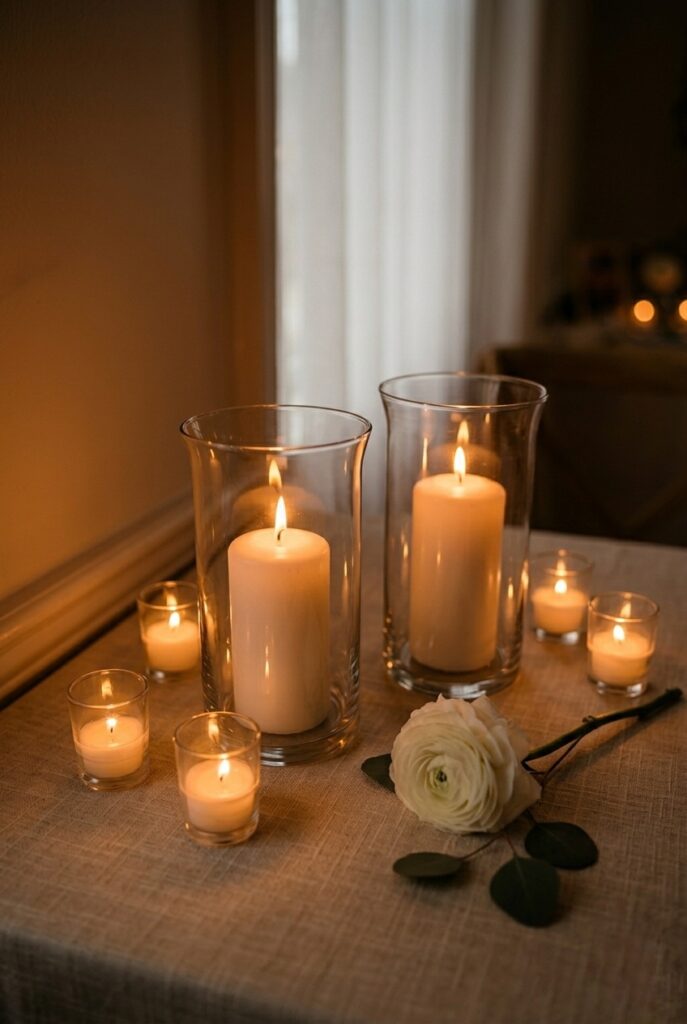
No element changes the register of a room faster than the quality of light it’s lit with. Natural daylight on fresh flowers and white linens looks clean and editorial.
Overhead fluorescent light on the exact same setup looks like a church fellowship hall. If your venue has overhead lighting you can’t control, add warm light: pillar candles in glass hurricanes ($12–$25 at HomeGoods or TJ Maxx), clusters of battery-operated tealight votives ($10–$15 for a pack of 24 on Amazon), and a string of warm Edison bulbs draped along a wall or mantle if the venue allows it.
The warm white LED tealights — not the blue-tinted cheap ones — are completely indistinguishable from real flame in photos and allow you to place them without worrying about wax, fire codes, or knocked-over candles near a dress.
Check the indoor wedding decor ideas archive for how lighting transforms indoor spaces with no structural changes.
Decision Filter
If your guest list is under 20 and you’re hosting at home, focus your entire budget on three things: a flower backdrop or fabric backdrop ($50–$90), elevated linens ($30–$50), and candles ($20–$30). Everything else can be minimal.
If you’re in a rented venue with existing tables and lighting, put the money into linens first, then centerpices, then backdrop — in that order, because linens are the largest visual surface in any room.
If the bride has a specific wedding aesthetic already locked in — garden, minimal, boho — mirror it in the shower palette exactly: that single alignment decision makes the shower feel designed rather than decorated.
The Real Reason Bridal Shower Decor Looks Cheap
The real reason most bridal showers look underfunded isn’t the budget — it’s that the money is spread across too many small items instead of concentrated into two or three high-visual-impact elements.
Forty dollars spent on a proper linen tablecloth and a real flower centerpiece reads as far more expensive than forty dollars spread across a banner, a balloon, a small vase, and a paper garland.
Professional event stylists call this “visual weight” — your eye needs something to land on, and if there’s nothing significant anywhere, the room feels cluttered with effort rather than finished with intention.
Bold opinion: you don’t need a theme. A palette is enough. “Blush and ivory with eucalyptus” is a complete design direction that requires no concept, no matching paper products, and no special signage.
A theme — “Garden Tea Party,” “She’s Getting Hitched,” “Brunch Before Vows” — adds work and coordination without adding genuine elegance.
The brides I’ve seen happiest with their showers got a palette, not a theme.
Here’s the insider observation that event photographers share with each other but almost never tell clients: the bride’s chair and backdrop are the most-photographed items in the room, but the tables during the gift-opening are what every candid photo captures.
If your dining tables look good — good linens, good light, real flowers or candles — every candid shot from the party looks intentional. If the tables are generic, even a stunning backdrop in the background won’t save the ambient photos.
Style the tables as though the photographer’s lens will live there all afternoon.
Because it will. Zola’s bridal shower planning guide has a useful bridal shower checklist if you’re planning the full event from scratch.
Mistakes to Avoid
Mistake 1 — Following the Matching Set Trap Most competitor articles recommend buying matching sets — coordinated balloons, banners, tableware, and favor bags in the same print.
This is the fastest way to make a bridal shower look like a packaged party kit from Party City.
Matching sets read as pre-assembled rather than curated.
The real approach is cohesive palette with varied textures: same color family, different sources, different materials — linen alongside glass alongside dried botanicals.
Cohesion through color, not through matching SKUs.
Mistake 2 — Spending $150 on a Balloon Arch Kit That Arrives Wrong Countless hostesses order balloon arch kits online at $60–$80 and then pay $40–$60 in rush shipping for additional balloons when the arch doesn’t fill out as shown.
The total loss can hit $150 for something that looks like a deflating archway.
If you’re going DIY balloon, buy 20% more balloons than the kit recommends — always.
Or book a local balloon artist who prices the whole thing together and guarantees the install.
At $150–$250 for a professional install, the all-in cost is often identical to the DIY disaster route.
Mistake 3 — Staging the Space and Then Moving Everything Couples and hostesses spend hours getting the space picture-perfect, then move centerpieces to make room for food, pull the tablecloth tighter, shift the bride’s chair to a more convenient angle — and the carefully considered visual relationships fall apart.
Professional stylists photograph the space before guests arrive. Do the same.
Take your hero photo of the room when it’s fully set, because by the time the party is two hours in, things have been touched and shifted.
You won’t get that composed version again, and it’s the version you’ll want for the album.
Mistake 4 — Buying Décor Based on How It Photographs in Product Listings Product photography for bridal shower decor is consistently shot against white seamless backgrounds with professional lighting.
That glittery balloon letter, that metallic fringe backdrop, that script font “Bride” banner — they all look finished and deliberate in the listing. In an actual room with natural light, normal-colored walls, and real people, cheap metallic fringe looks like mylar, glitter balloons look like plastic, and thin paper banners curl at the corners by hour two.
Read material descriptions carefully — “foil” is not the same as “fabric,” and “paper” is not the same as “card stock.”
If the weight and material aren’t listed explicitly, assume the cheapest version and adjust your expectations accordingly.
FAQ
What decorations do you need for a bridal shower?
You need five core elements: a tablecloth, a centerpiece, at least one statement backdrop or focal point, a welcome sign, and candles or lighting.
Everything beyond those five is optional enhancement.
Your budget and venue size should determine how elaborate each element gets — a focused five-element setup outperforms an overstuffed room with twelve underfunded items every time.
How do you decorate a simple bridal shower on a budget?
Start with linens — even a single linen-blend tablecloth transforms the look of any table for $25–$45.
Then add candles (battery tealights, $10–$15), grocery store white flowers in dollar store glass vases, and a handwritten chalkboard welcome sign.
Keep the color palette to two colors only — the restraint reads as intentional, not cheap.
For more ideas in this direction, the budget wedding decor ideas guide applies most of its principles directly to shower planning.
What is the most popular bridal shower theme right now?
Garden and botanical themes — eucalyptus, white flowers, neutral linen, and natural wood accents — continue to lead because they photograph well, age gracefully in an album, and require no concept commitment beyond “organic and fresh.”
Couples who want something more specific are currently drawn to the “something blue” palette and minimal Scandi-inspired setups with white, sage, and warm brass.
The strongest décor isn’t about chasing a trend theme — it’s about building a palette the bride would actually choose for her own home.
For table-level inspiration that applies equally to bridal showers, the elegant wedding table decor ideas breakdown is worth reading alongside this one.
How far in advance should you buy bridal shower decorations?
Order anything custom — signs, personalized items, printed elements — at minimum three weeks before the shower date to allow for production and shipping time.
Non-custom items (linens, vases, candles, balloon kits) can be ordered one to two weeks out.
Fresh flowers should be ordered for delivery two days before the event so they’re fully open but not past peak.
For DIY projects — floral hoops, fabric backdrops, chalkboard signs — schedule your build day at least five days before the shower so you have time to fix anything that doesn’t go as planned.
Budget Comparison
| Decor Element | Budget Option | Mid-Range Option | Elevated Option |
|---|---|---|---|
| Tablecloth | Polyester party store, $5–$8 | Linen-blend Amazon/Zara, $25–$45 | Rental linen, $8–$15 per table |
| Centerpiece | Dollar store vase + grocery flowers, $10–$15 | Bud vase cluster + ranunculus, $25–$40 | Florist low arrangement, $60–$120 |
| Backdrop | Fabric panel on rod, $20–$35 | DIY floral hoop on curtains, $50–$90 | Rental flower wall, $150–$350 |
| Bride’s Chair | Decorated folding chair, $0 (owned) | Vintage cane chair rental, $35–$80 | Throne chair rental, $75–$150 |
| Candles/Lighting | Battery tealights pack, $10–$15 | Glass hurricanes + pillars, $25–$45 | Edison string lights + hurricanes, $50–$80 |
| Welcome Sign | Printed cardstock, $5–$15 | Etsy custom sign, $20–$35 | Framed calligraphy print, $40–$75 |
| Total Estimated | $50–$88 | $180–$285 | $410–$770 |
The most honest advice in this table: the budget column looks worse in-room than any other because its individual item choices are visually inconsistent with each other.
If you’re working a tight budget, pick two elements from the mid-range column and keep everything else minimal rather than buying all six from the budget column.
The mistake almost everyone makes is treating bridal shower décor as a shopping list when it’s actually a design problem: how do you make one room feel like the right room for this particular woman on this particular day?
The answer is almost never more stuff — it’s a scent at the door, a fabric with weight, a chair that tells her where to sit, and a backdrop that tells everyone where to look.
Start with the simple wedding decor ideas philosophy as your baseline, then layer in personality.
Pick your two highest-impact elements, commit your budget there, and let everything else stay quiet.