Traditional weddings don’t have an originality problem.
They have a execution problem.
Most couples grab the same rose-and-candle formula their venue has seen four hundred times, check every box, and end up with a room that feels assembled rather than designed.
You can do traditional without doing predictable.
The difference is knowing which classic details carry visual weight — and which ones just fill space.
White petals on black marble, a candle lit before the vows were said — not everything old is borrowed. Some things are simply, quietly, the truest red. The chair sash will fade, the taper will burn down to nothing, but the room you walked into? Your grandmother will describe it for the rest of her life.
The Short Answer
Traditional wedding decor works when it’s layered, intentional, and slightly unexpected in at least one place.
The classics — white florals, candlelight, draped linens — are classics because they photograph well, age gracefully, and read as elegant to almost every guest demographic.
The mistake is treating them as a checklist.
These ten ideas will help you build a traditional aesthetic that feels designed, not default.
1. Tall White Floral Centerpieces With Mixed Bloom Heights
The centerpieces almost every competitor recommends are flat — a vase, a cluster of roses, a ribbon.
That’s not a centerpiece; that’s a placeholder.
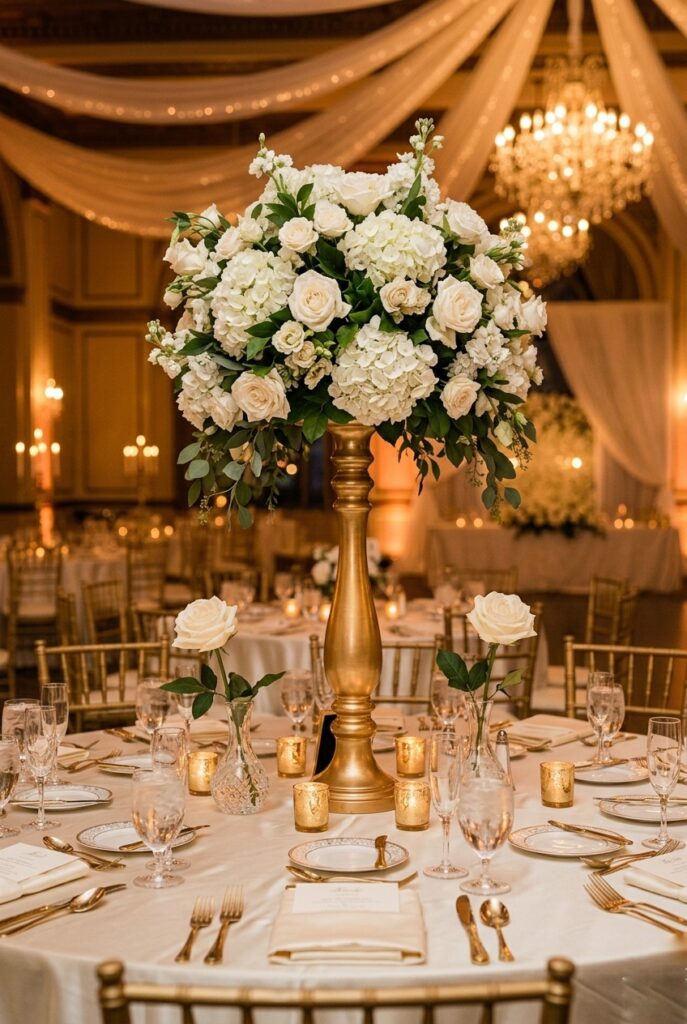
Real visual drama in a traditional ballroom comes from varied heights within the same table.
Pair one tall arrangement (24–30 inches, white roses and white hydrangea on a gold pedestal) with two low bud vases flanking it.
The eye moves. The table breathes.
It looks like a florist designed it instead of a venue coordinator who had forty minutes.
- Cost: $180–$380 per tall centerpiece setup; bud vases $12–$25 each on Amazon or Afloral.com
- Where to buy: Afloral.com for faux options, local wholesalers like FiftyFlowers.com for fresh
- Only do this if your venue has 10-foot-plus ceilings — tall arrangements in a low-ceiling room feel like they’re trying too hard.
2. Taper Candles in Gold Candelabras (Not Just Votives)
Votives are the beige of wedding decor. Safe, inoffensive, doing absolutely nothing for your photos.
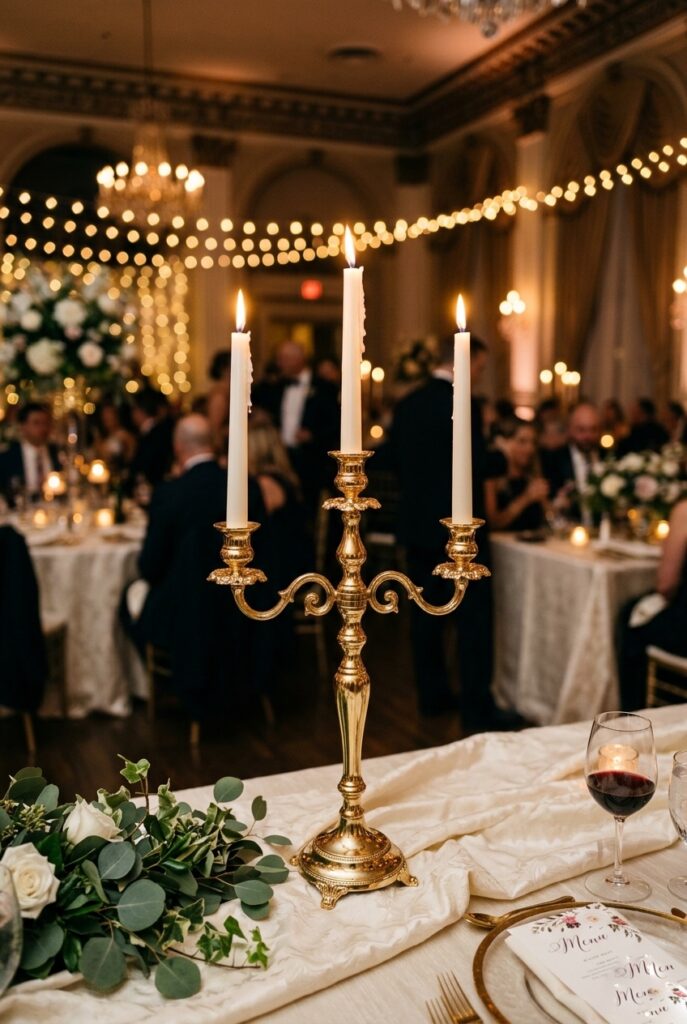
If you want traditional candlelight that actually reads as elegant rather than we had leftovers from another wedding, go with taper candles in gold candelabras — three to five arms, 18-inch white tapers, placed at the center of your table.
The vertical line of a taper candle adds formality that no votive ever will.
It’s one of the highest-impact changes you can make for the lowest cost.
- Cost: Candelabras rent for $25–$60 each; white taper candles $18–$30 for a box of 24 on Amazon
- Where to buy: Rent through your venue or event rental companies; buy tapers at IKEA or Amazon
- Skip this if your venue has strict open-flame rules — flameless LED tapers from Luminara ($18–$35 each) are genuinely convincing under dim reception lighting.
3. Draped Ceiling Fabric That Softens the Room
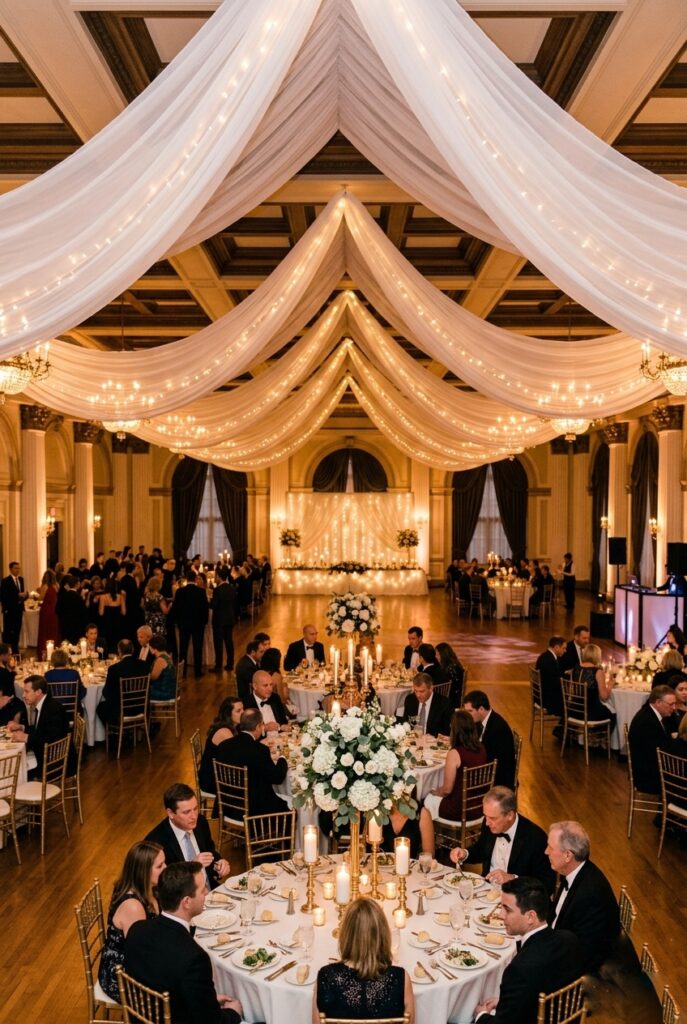
A ballroom with exposed ceiling panels is doing your photos no favors.
Draped ivory or white fabric — hung in soft swags from the ceiling — is one of those installations that transforms the spatial feeling of a room entirely.
It adds softness, reduces echo, and photographs as luxurious even when the material itself is inexpensive chiffon.
Most event rental companies offer ceiling draping packages; your florist may also coordinate this.
- Cost: $400–$1,200 depending on room size and complexity
- Where to buy: Coordinate through your venue or a local event rental company; search “ceiling draping wedding” on Thumbtack for local vendors
💰 Budget Hack #1: Ask your venue if they have house draping already installed. Many ballrooms do — you just need to ask specifically. If so, redirect that line item to your centerpieces.
4. A Ceremony Arch That Your Florist Can Strip and Reuse at Reception
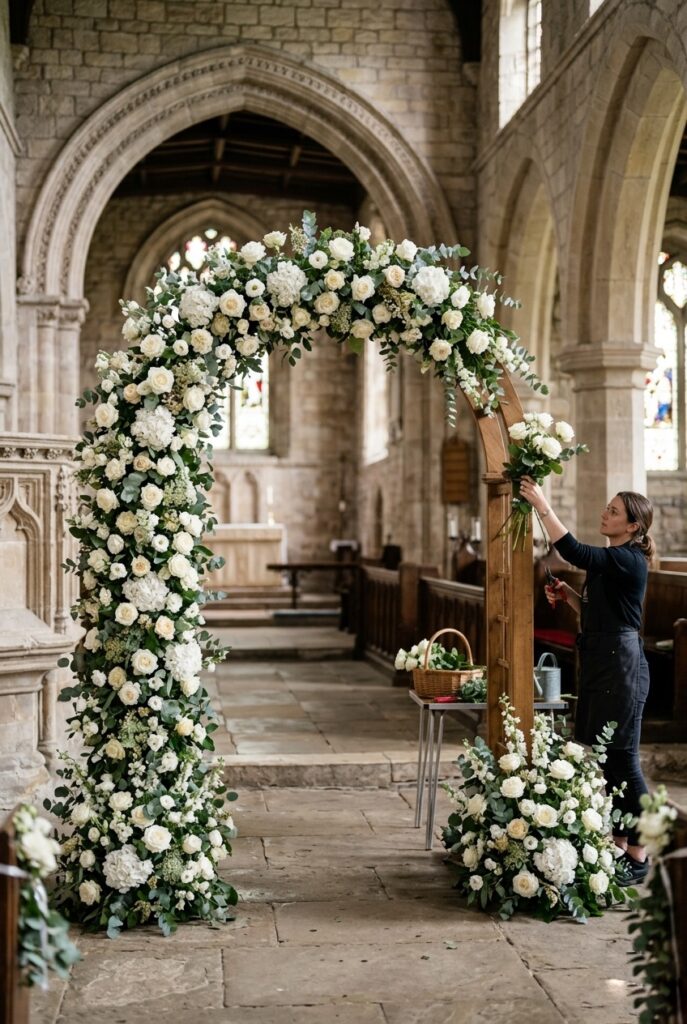
Here’s what nobody tells you: your ceremony floral arch costs $600–$2,000 in flowers.
Your reception cocktail hour table backdrop? Another $400–$800.
You’re paying twice for florals your guests will only see once each. A smarter move — and one almost no blog covers — is to brief your florist ahead of time to design the arch with removable panels.
After the ceremony while guests are cocktailing, the florist strips the arch pieces and reassigns them as sweetheart table backdrop florals, bar arrangements, or escort card table installations.
Same flowers. Half the waste.
- Cost: Arch builds run $500–$2,000 depending on bloom choices; migration adds a $150–$300 florist labor fee
- Where to buy: Through your wedding florist — ask specifically about ceremony-to-reception floral migration at your first consultation
5. Ivory or Cream Satin Tablecloths (Not White)
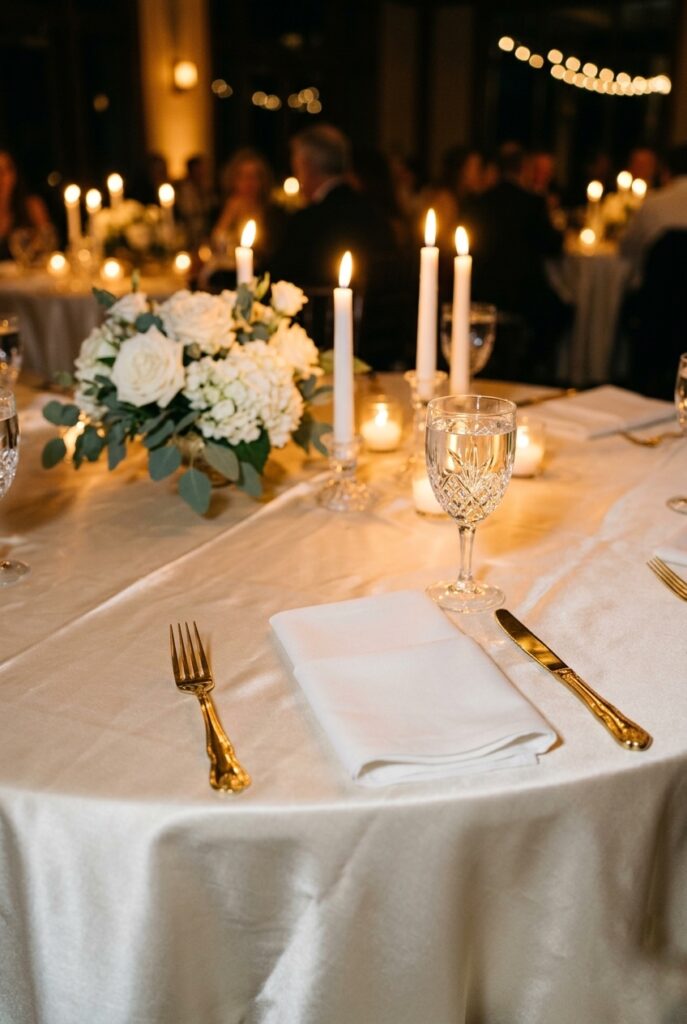
Stark white linens read as clinical under warm reception lighting. They photograph flat and make everything on the table compete visually.
Ivory or cream satin, by contrast, catches candlelight beautifully — it goes warm and golden in photos, which is exactly the feeling you’re after in a traditional setting.
This is a two-minute conversation with your rental company that will noticeably improve your photos.
Tell them you want ivory, not white. They will not volunteer this distinction unless you ask.
- Cost: $18–$35 per tablecloth through your venue or linen rental; Rent My Wedding has competitive pricing
- Where to buy: Rent from your venue or Rent My Wedding (rentmywedding.com)
6. Hand-Calligraphed Escort Cards Displayed on a Mirror or Marble Board
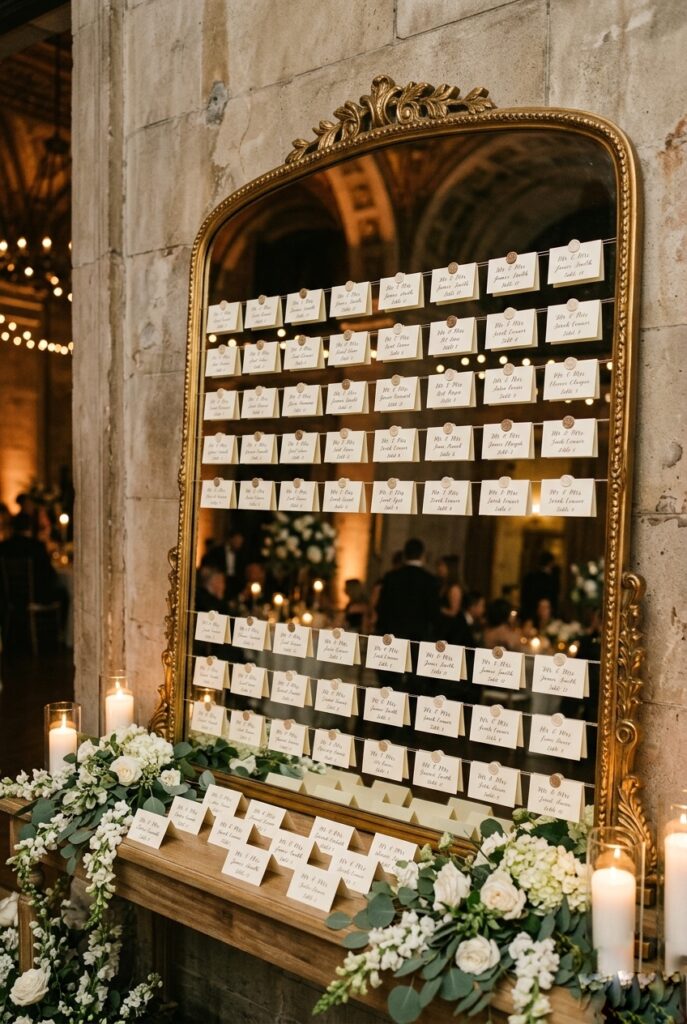
Escort card displays get about thirty seconds of guest attention — most couples waste their budget here.
But a mirror or marble slab with hand-calligraphed escort cards leaning against it is one of those details that photographs beautifully andsignals the overall taste level of your event.
Guests who haven’t seen the reception yet will form an impression at this table. Make it count.
A large ornate mirror from a thrift store costs $40–$80. Hand calligraphy runs $1.50–$3 per card. The total investment is modest; the visual return is not.
- Cost: Mirror $40–$80 (thrift/Facebook Marketplace); calligraphy escort cards $1.50–$3 each on Etsy
- Where to buy: Etsy for calligraphers (search “hand calligraphy escort cards wedding”); mirrors at thrift stores or Facebook Marketplace
💰 Budget Hack #2: Skip the gold-leaf calligraphy upgrade unless you’re doing a very close-up photo display. Standard ink calligraphy reads identically in photos.
7. Pew End Arrangements That Actually Do Something
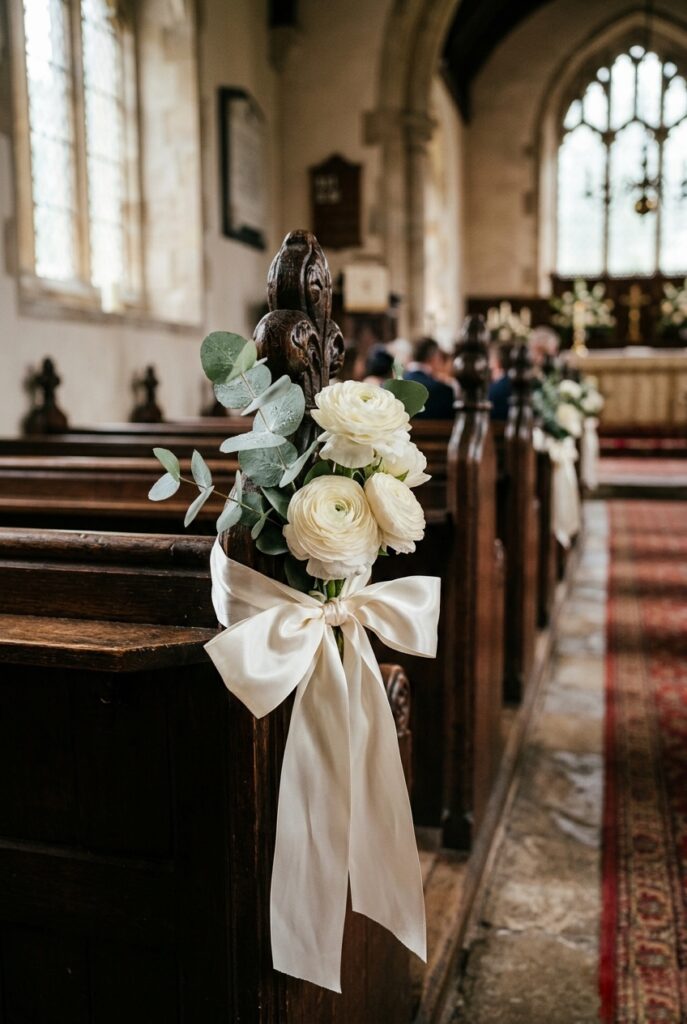
Most pew flowers are an afterthought — a sprig of baby’s breath tied with a ribbon and forgotten.
They matter more than you think because they define the entire visual corridor your guests walk through to find their seats, and they’re in the background of every ceremony photo.
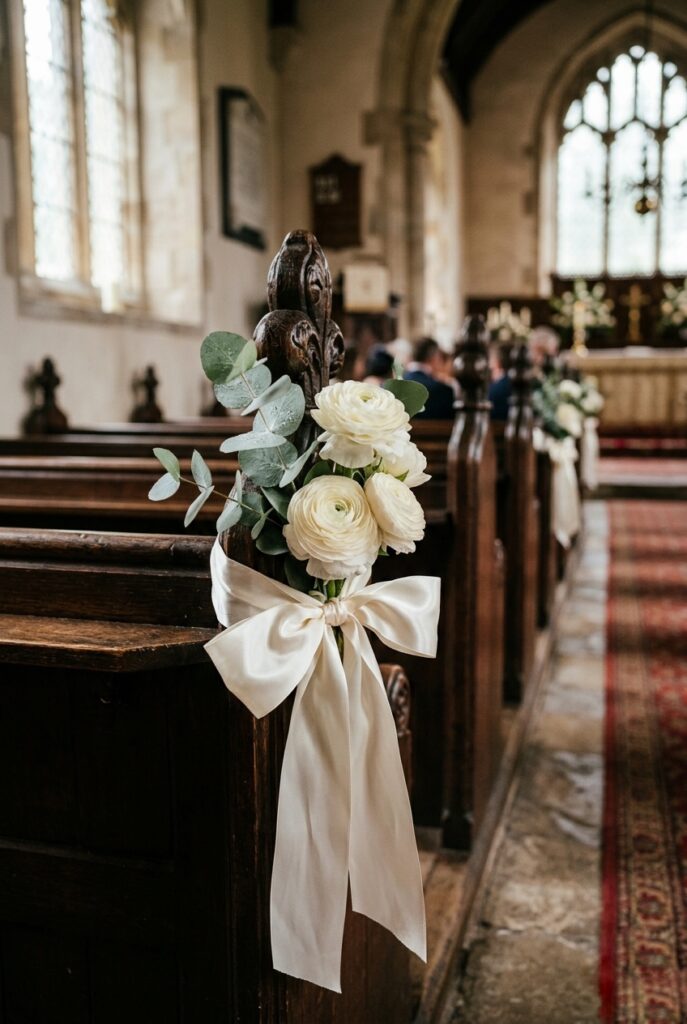
Go with small but dense arrangements: white ranunculus, a few stems of eucalyptus, a white satin ribbon.
Tied to every other pew (not every single one — spacing reads more intentional).
This is also where you can quietly introduce a secondary color: a blush ribbon instead of white, a hint of champagne.
- Cost: $15–$35 per arrangement; plan for 8–16 depending on ceremony size
- Where to buy: FiftyFlowers.com for fresh blooms; Afloral.com for faux
8. Chiavari Chairs — But Styled With a Chair Sash That Doesn’t Look Cheap
Gold Chiavari chairs are the single most reliable choice for traditional wedding reception seating.
Competitors list them; nobody tells you how to avoid the one thing that makes them look cheap: a polyester chair sash tied in a limp bow.
If you’re doing Chiavari chairs, do them correctly — either leave them completely unsashed (they’re beautiful on their own, especially against ivory linens), or use a wide, luxe satin or velvet sash tied in a full, structured bow at the back. Half-measures look like budget ran out.
- Cost: Chiavari chairs rent for $4–$10 each; velvet sashes $2–$4 each on Amazon or Etsy
- Where to buy: Rent chairs through your venue or a local event rental company; velvet sashes on Amazon
- Skip the sash entirely if your chair design is ornate — the chair already has visual detail and the sash will compete with it.
9. A Ceremony-to-Cocktail Scent Strategy (The Detail Nobody Mentions)
Every single traditional wedding decor article covers what the room looks like.
Not one of them covers what it smells like — and your guests will remember the smell of your wedding more than the color of the napkins.
If your ceremony is in a church or chapel, the ambient scent is already doing work.
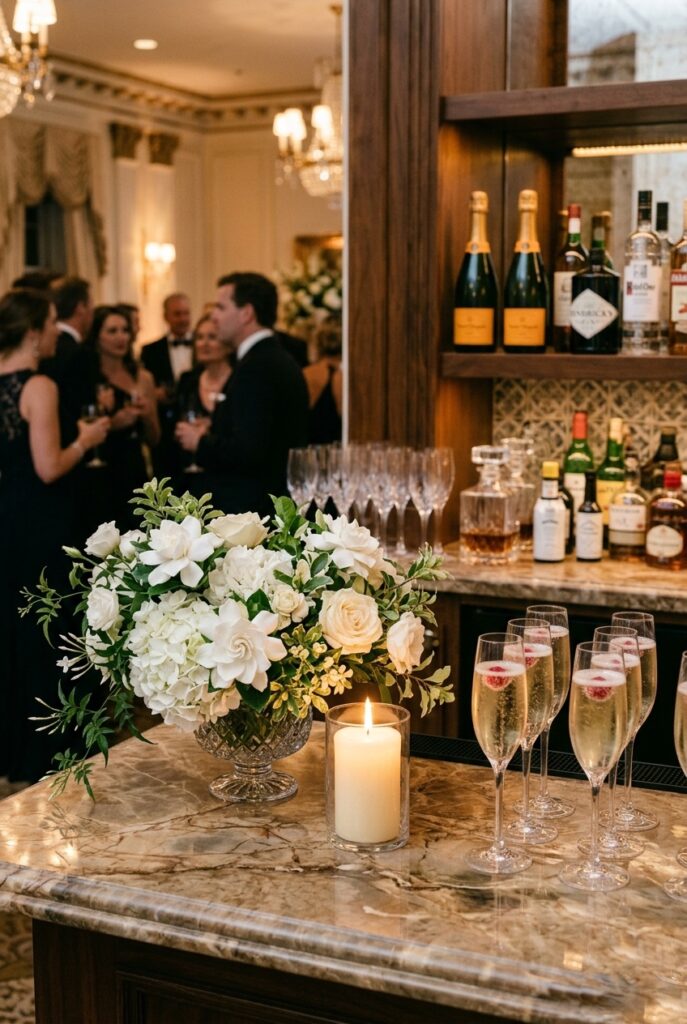
For your cocktail hour and reception, white floral arrangements naturally emit fragrance (white gardenias and white lilies are especially strong), and unscented pillar candles won’t compete.
The mistake is mixing heavily scented candles with your florals — the result is confusing, not romantic. Choose one or the other.
If your florals are fragrant, use unscented candles.
If your florals are faux or minimal scent, one or two gardenia candles at the bar will do more for your guest experience than $200 in extra ribbon.
- Cost: Gardenia pillar candles $14–$28 each on Amazon; white gardenias from FiftyFlowers.com add $2–$4 per stem
- Where to buy: Amazon, Voluspa candles at Anthropologie for premium scent, FiftyFlowers.com for florals
💰 Budget Hack #3: White gardenias at your bar arrangements specifically — high fragrance yield for the price, and bar guests linger there longest.
10. A Grand Staircase Moment With Greenery and White Blooms
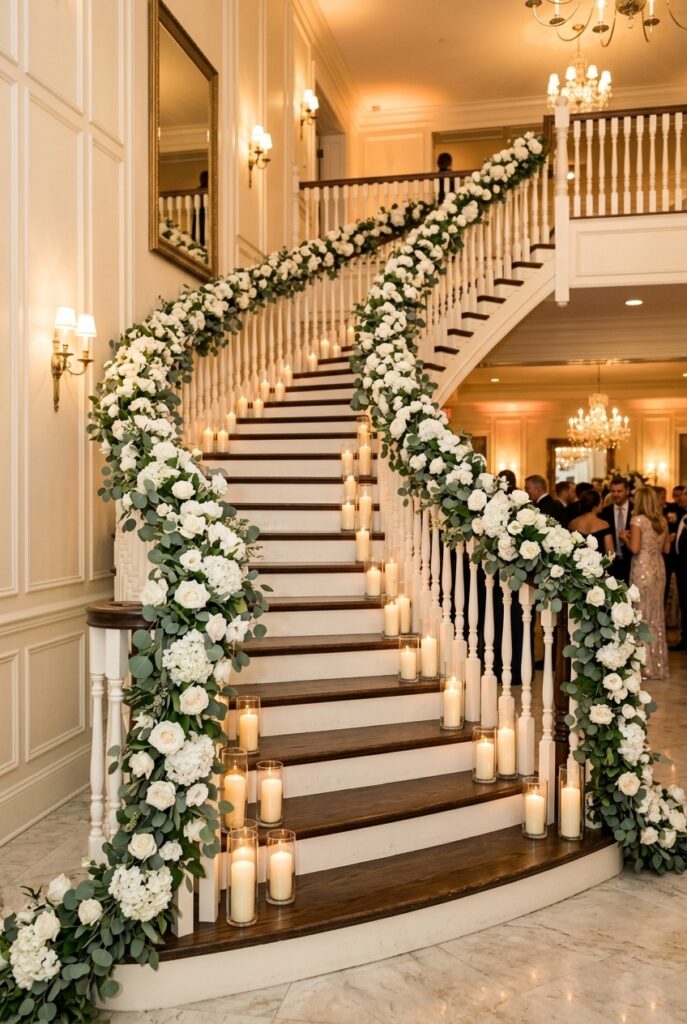
If your venue has a staircase — a hotel, a mansion, a historic estate — decorating it is one of the highest-return investments in traditional wedding decor.
A garland of eucalyptus and white roses running along the banister, flanked by pillar candles on the steps, creates one of those involuntary intake-of-breath moments guests describe for years.
This is also, strategically, one of the best places to take portraits — your photographer will thank you. Most couples walk past the staircase. Use it.
- Cost: Greenery garland and floral installation $300–$800 depending on staircase length; pillar candles $8–$15 each
- Where to buy: Through your florist; garlands also available on Etsy for DIY ($40–$90 for 6-foot sections)
How to Decide What to Prioritize
- If your venue already has architectural drama (coffered ceilings, grand windows, stone walls) → skip the ceiling draping and redirect that budget to florals and lighting.
- If your guest list skews older and traditional → Chiavari chairs, taper candles, and classic white roses will land better than any trend-adjacent choice.
- If budget is tight, choose between one tall floral centerpiece moment or the staircase installation — not both. One done well reads better than two done moderately.
The Real Reason Traditional Decor Fails at Most Weddings
The honest answer is that most traditional wedding decor fails because couples prioritize coverage over impact.
They want every table decorated, every corner acknowledged, every surface touched.
The result is a room that feels busy but doesn’t have a single moment that stops you.
Traditional design, done correctly, has hierarchy.
There’s a focal point — a sweetheart table wall, a ceremony arch, a staircase moment — and everything else serves that moment rather than competing with it.
Here’s the opinion nobody at your venue will say out loud: you are better off spending $800 on one spectacular centerpiece table for your sweetheart backdrop than $800 spread across twelve guest tables.
Guests remember what they photographed. They photograph what surprised them.
The insider truth about traditional florals specifically: white roses are the most photographed flower in wedding history not because they’re the most beautiful but because they hold their shape under venue lighting that would make any other bloom look muddy.
Your florist may push you toward something more interesting.
Listen if you love it.
But know that classic white roses are doing real structural work in your photos that trendy alternatives often can’t match.
Mistakes That Will Haunt Your Photos
Matching everything too precisely. A room where every single element is the exact same shade of ivory with the exact same gold accent reads as a catalog, not a wedding. Traditional doesn’t mean monolithic.
Allow your florals to vary slightly — ivory blooms against a white cloth, a champagne ribbon against cream.
Contrast within a palette is what makes traditional decor feel rich rather than flat.
Ordering chair sashes online without feeling them first. Polyester chair sashes look fine on your screen.
Under venue lighting, in photos, they look like the material they are.
If you’re doing sashes, request fabric swatches or go velvet. The difference in cost is $1–$2 per sash.
The difference in photos is significant.
Putting your entire floral budget in guest table centerpieces. This is the most expensive mistake in traditional wedding decor.
Guest table centerpieces get thirty seconds of attention before people move drinks and purses onto the table.
Your ceremony backdrop and sweetheart table area are in an outsized percentage of your photos. Fund accordingly.
Ignoring the cocktail hour space. Most couples spend their entire decor budget on the reception and treat cocktail hour as a transitional space.
But your guests spend an hour there — and it’s the first impression they form of your reception aesthetic.
Even two or three well-placed bar arrangements and a simple escort card display will make that hour feel intentional.
What’s the Difference Between Traditional and Classic Wedding Decor?
Traditional wedding decor leans on established cultural conventions — white florals, formal seating, structured ceremony spaces, religious or family customs woven into the design.
Classic decor is a slightly broader aesthetic umbrella — it simply means timeless over trendy, and can include traditional elements alongside vintage, Old Hollywood, or formal garden styles.
In practice, when most couples say “traditional,” they mean white and ivory color palettes, structured florals, formal venue types (ballrooms, estates, churches), and time-honored details like candelabras, Chiavari chairs, and calligraphed stationery.
The short answer: traditional is a subset of classic.
Both prioritize staying power over moment-of-the-year trends.
Budget Overview
| Decor Element | Budget Range | Mid-Range | Premium |
|---|---|---|---|
| Tall floral centerpiece (per table) | $120–$180 | $180–$320 | $320–$600+ |
| Taper candles + candelabras (per table) | $30–$55 | $55–$90 | $90–$150 |
| Ceiling draping (full room) | $400–$700 | $700–$1,100 | $1,100–$2,500 |
| Ceremony arch florals | $500–$900 | $900–$1,400 | $1,400–$2,500 |
| Chiavari chair rentals (per chair) | $4–$6 | $6–$8 | $8–$12 |
| Staircase garland installation | $250–$450 | $450–$700 | $700–$1,200 |
| Escort card display (mirror + calligraphy) | $80–$160 | $160–$280 | $280–$500 |
| Pew end arrangements (per arrangement) | $15–$25 | $25–$40 | $40–$80 |
All pricing in USD. Ranges reflect regional variation and DIY vs. vendor cost differences.
You’ll Also Love
- How to Choose Your Wedding Color Palette Without Second-Guessing Yourself
- The Honest Guide to Wedding Floral Budgets: What Things Actually Cost
- Sweetheart Table Ideas That Don’t Look Like an Afterthought
- Ceremony Decor That Works Whether You’re in a Church or an Estate
If you walked away from this with one thing, make it this: traditional wedding decor doesn’t need reinvention. It needs intention.
Pick two or three moments to make genuinely spectacular, and let everything else support them.
Your guests will remember the room. Your photos will last longer than anything trending this year.