Indian weddings in America have a problem.
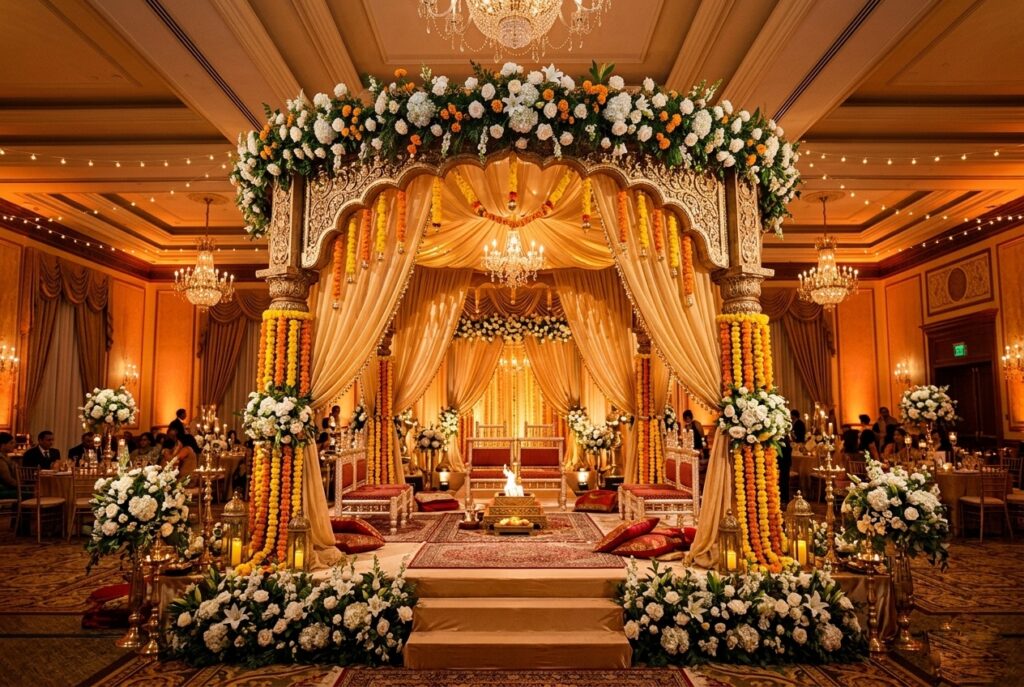
You walk into the ballroom, and it looks like the same wedding you attended in 2019.
Same backdrop. Same marigold drape. Same chandelier rental. Beautiful — but forgettable.
The couples who get it right aren’t spending more.
They’re thinking differently — choosing two or three deeply specific elements that carry meaning and letting everything else be simple.
Here’s what actually works in 2025.
Marigolds strung by someone’s mother the night before, brass diyas lined down the aisle like small suns, the priest’s Sanskrit dissolving into the ceiling lights — nobody talks about the backdrop in twenty years. They talk about how it felt.
The Short Answer
The best Indian wedding decor is built around three anchors: a mandap that photographs like a painting, an entrance that stops guests cold, and lighting that carries everything from ceremony to reception. The rest is detail.
1. Design Your Mandap Like a Photographer Would Frame It
This is the one thing worth spending real money on, and most couples spread that budget too thin.
The mandap is in every ceremony photo, every family portrait, and every reel your guests post for the next week.
The frame, the fabric, the florals — this has to be locked before anything else is decided.
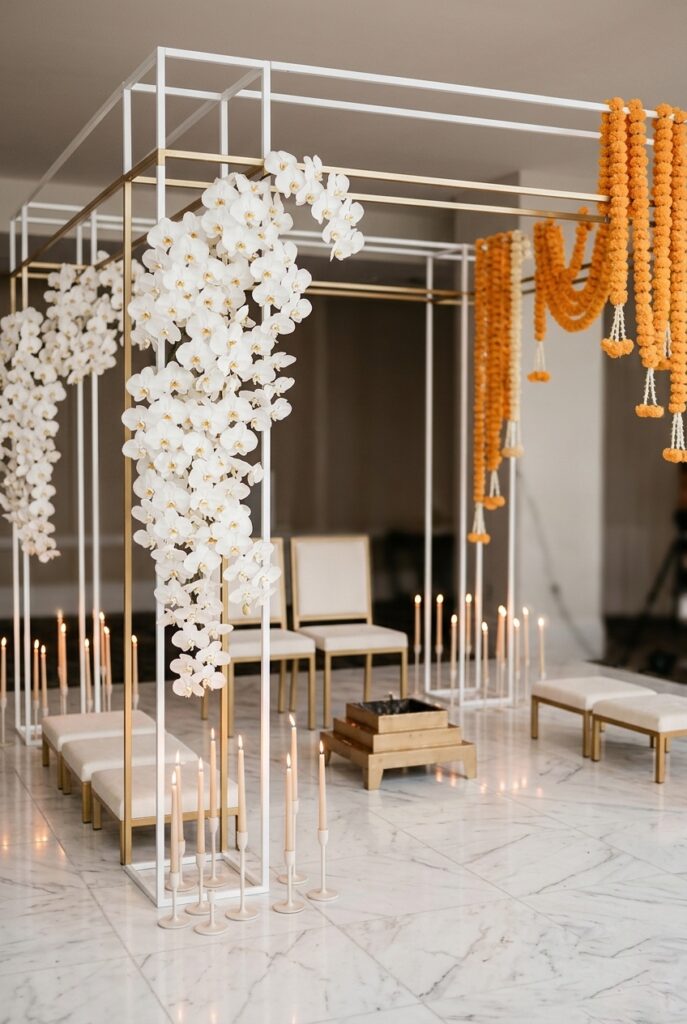
Right now, the most stunning mandaps are either deeply traditional (cascading marigolds, brass pillars, mango leaf torans) or architectural minimalist (clean metal frame, single-color draping, one dramatic floral element).
Both work. The hybrid muddle — a little of everything — is what produces forgettable results.
Only do this if you have a ceremony planner or at minimum a photo consult: what looks gorgeous in person can flatten completely in photos if depth and layering aren’t considered.
Budget: $800–$4,000 depending on rental vs. custom build | Sources: Local South Asian event decorators, LoveNspire (lovenspire.com) for DIY mandap kits
2. Lead with Marigolds — but Use Them With Restraint
Marigolds are the most powerful tool in Indian wedding décor, and they’re also the most abused.
When every single surface is covered — the arch, the tables, the aisle, the backdrop, the cake table — the eye goes numb to them.
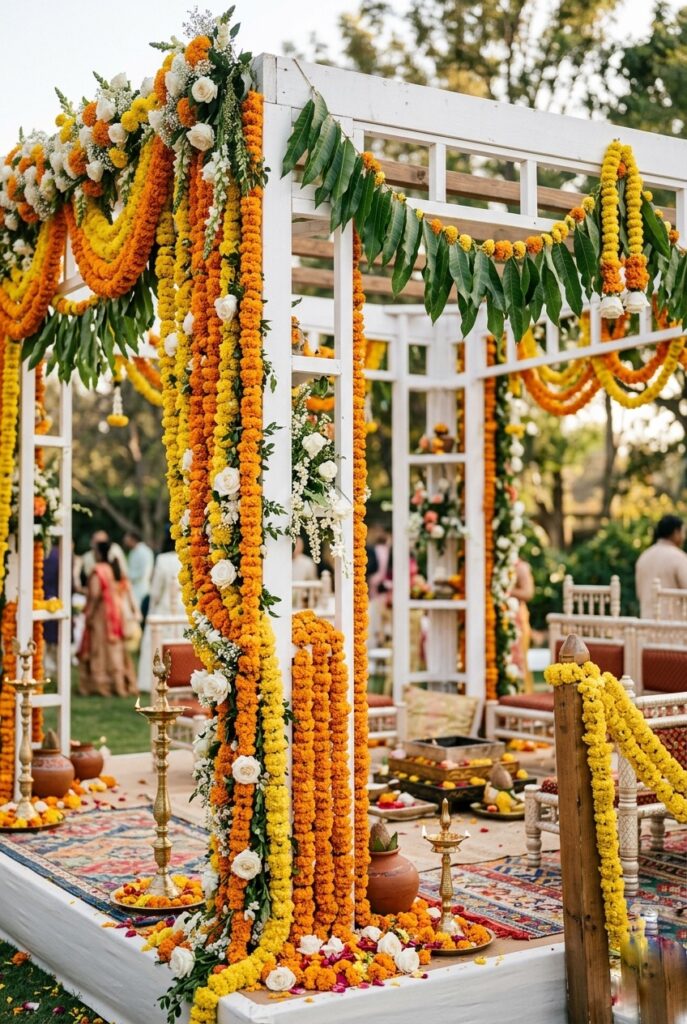
Instead, concentrate your marigold use: cascade them dramatically from the mandap ceiling, line them down the aisle in a single strand, or pile them into urlis at the entrance.
Contrast them against white florals or dark green foliage and they’ll photograph like fire. Used everywhere, they just become noise.
Budget: Fresh marigold strings from Indian grocery wholesalers: $0.50–$1.50/foot | Bulk orders from local Indian florists: $80–$200 for full ceremony coverage | Buy from: Local Indian grocery stores, ethnic wholesale flower markets
3. Make the Entrance Unforgettable — Not the Whole Venue
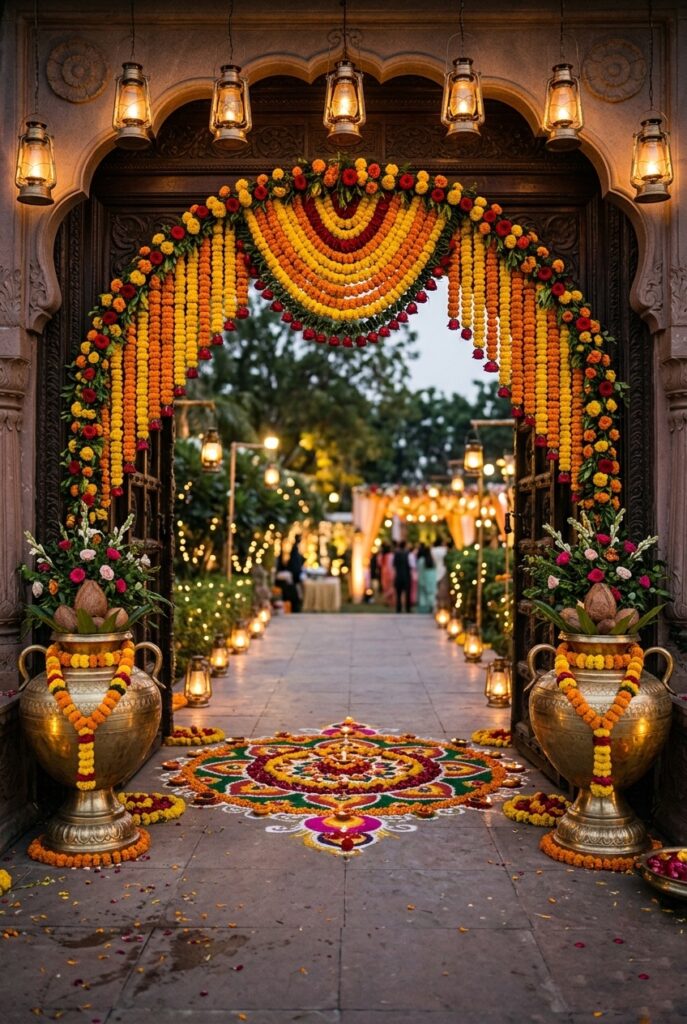
The entrance toran is one of the most underutilized moments in Indian wedding décor. Guests walk through it once, but it’s in every single arrival photo and family video.
A properly styled entrance — a marigold and rose toran arch, brass urlis or kalash pots flanking the doorway, a rangoli on the floor, warm lantern lighting — costs almost nothing compared to what most couples spend on centerpieces that guests ignore.
This is your first impression and your best photo opportunity. Treat it like the main event.
Budget: Toran arch DIY: $60–$120 | Brass urlis: $30–$80 each on Amazon or LoveNspire | Rangoli stencil kit from Amazon: $15–$25
💸 Budget Hack #1
Buy your brass diyas, urlis, and small vessels from Indian grocery stores or ethnic home décor shops rather than wedding vendors.
The same brass diya that costs $8 in a wedding catalog is $2 at a Patel Brothers or similar store.
Buy a dozen and cluster them — the effect is identical for a fraction of the price.
4. Stop Defaulting to Red and Gold — Try This Instead
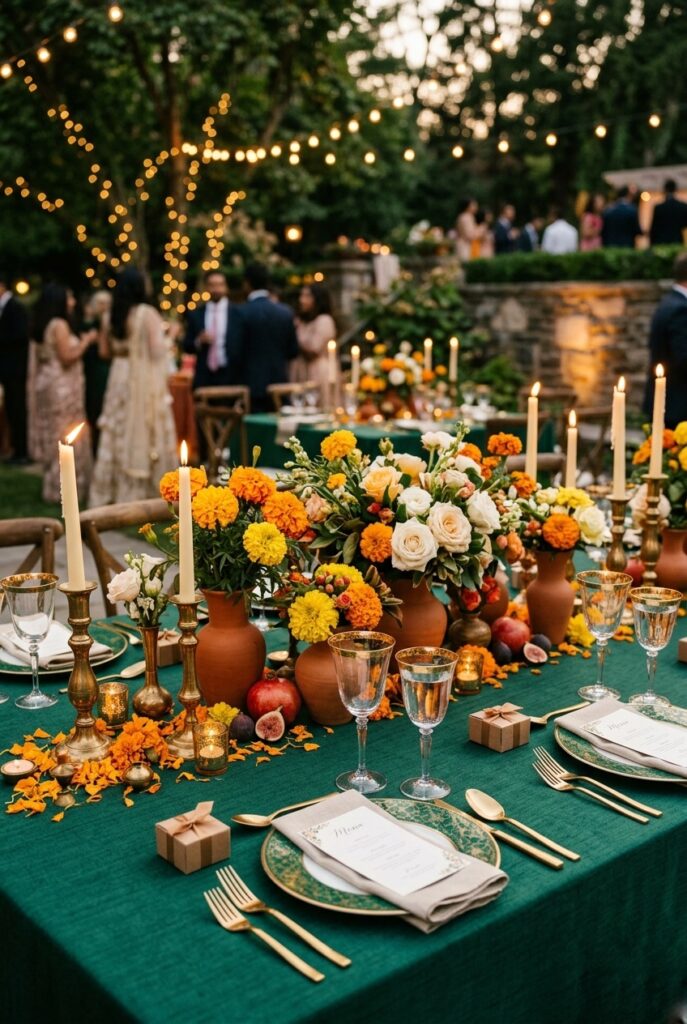
Red and gold is the default for a reason — it works.
But in 2025, the Indian weddings turning heads in America are doing something bolder: burnt orange and ivory, jewel-toned emerald with brass, terracotta and dusty rose with copper.
These palettes photograph richer in modern venues, work better with non-traditional lehengas, and stand out in every guest’s memory.
The color symbolism still holds — you’re just finding fresher expressions of it.
Burnt orange carries all the marigold energy of saffron and celebration without being predictable.
Skip this if your family has strong traditional expectations or if you’re holding a deeply religious ceremony where red and gold carry specific ritual significance.
In that case, honor the tradition fully — it’s still stunning.
Budget: Colored linen rentals: $15–$30/table | Custom color palette florals: add $50–$100 per ceremony zone to standard florals | Sources: Local South Asian event rental companies, ethnic fabric wholesalers for draping
5. Build a Dedicated Mehendi Space (Even If It’s a Corner)
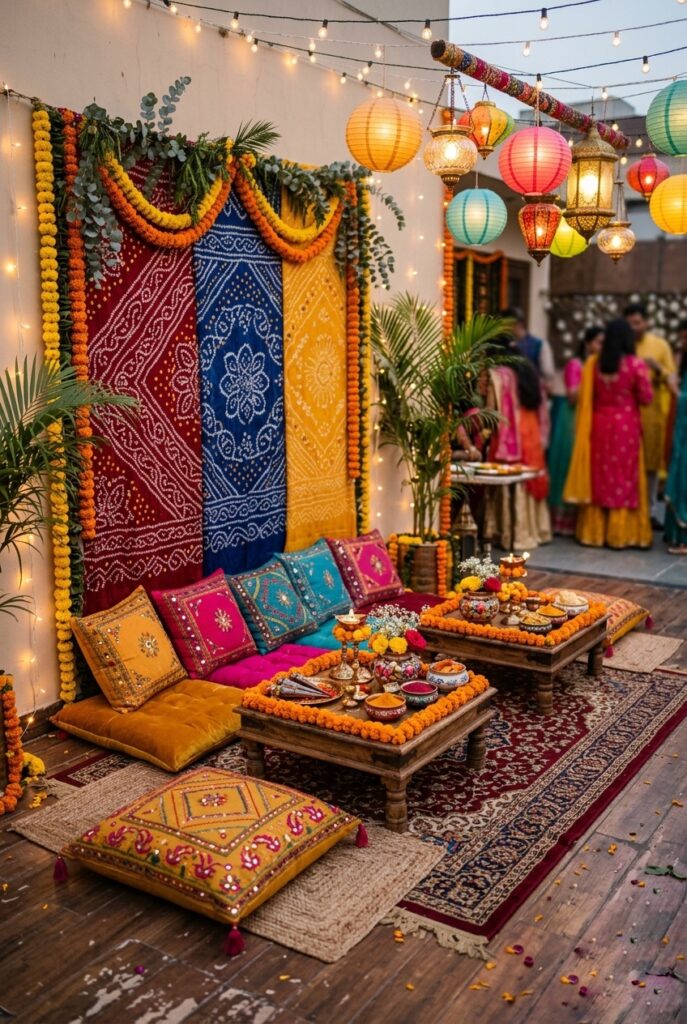
This is the most skipped element in multi-function Indian weddings in America, and it’s a mistake.
Even if your Mehendi is folded into the reception, carving out a designated zone — floor cushions, low tables, a colorful fabric backdrop, lanterns overhead, henna station — signals to every guest that this is an intentional cultural moment, not an afterthought.
It becomes the most photographed corner of the night.
Use Bandhani print fabric ($15/yard on Amazon or Etsy) draped behind the seating area. Add stacked cushions in ochre, fuchsia, and teal.
It takes two hours and $150 to build.
Budget: Floor cushion set from Amazon: $40–$80 | Bandhani fabric backdrop (3 yards): $30–$60 | Paper lanterns: $20–$40 | Buy from: Amazon, Etsy, Indian fabric wholesalers
6. Use Lighting to Do What Florals Cannot
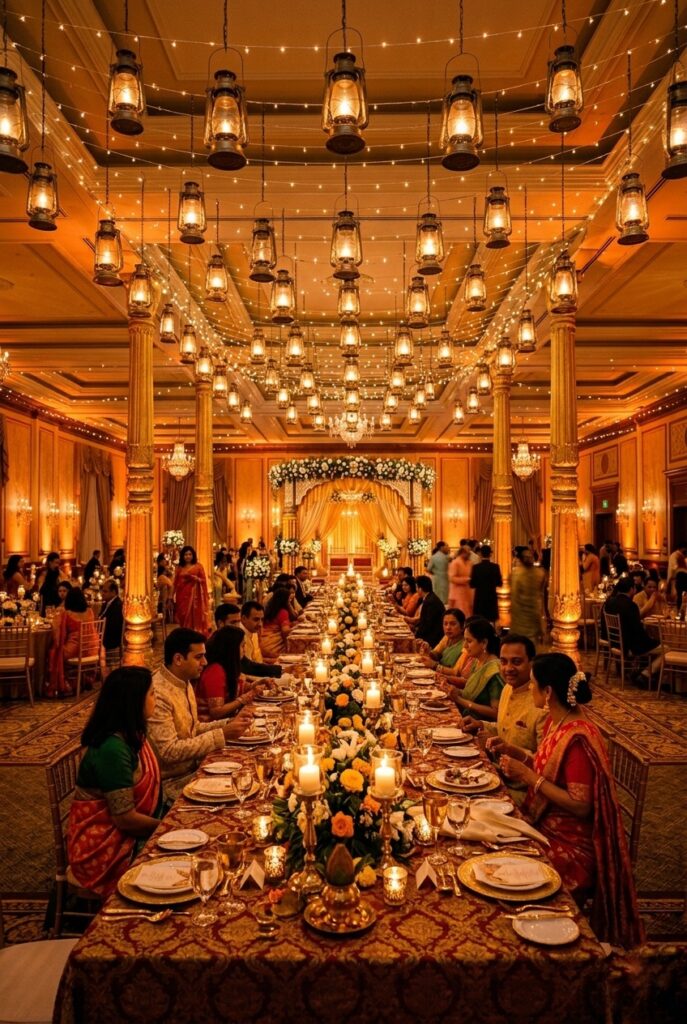
Here’s the insider truth: in a standard American ballroom or banquet hall, lighting does more work than any floral arrangement.
Uplighting in amber or saffron transforms the walls. A grid of hanging brass lanterns changes the ceiling. Candlelight on every table softens everything below.
The couples who blow the budget on florals but leave the venue’s default cold-white lighting in place get beautiful centerpieces and flat, clinical photos.
Lighting is invisible in budget conversations because it’s not “decor” — but it controls how every single piece of your décor reads in person and on camera.
Budget: String light canopy rental: $200–$500 | Uplighting (per unit): $50–$100, typically rented in packs of 8–10 | Brass lanterns (sets): $40–$150 on Amazon | Candle sets: $30–$80 from IKEA or Amazon
💸 Budget Hack #2
Rent your brass lanterns, urlis, and decorative vessels from South Asian event rental companies instead of buying them.
Most major US metro areas with an Indian population have rental companies that specialize in exactly this.
A set of ten brass lanterns that would cost $300 to buy can be rented for $60–$80. Search “[your city] + Indian wedding rental” to find them.
7. Try a Jasmine and White Floral Palette for One Zone
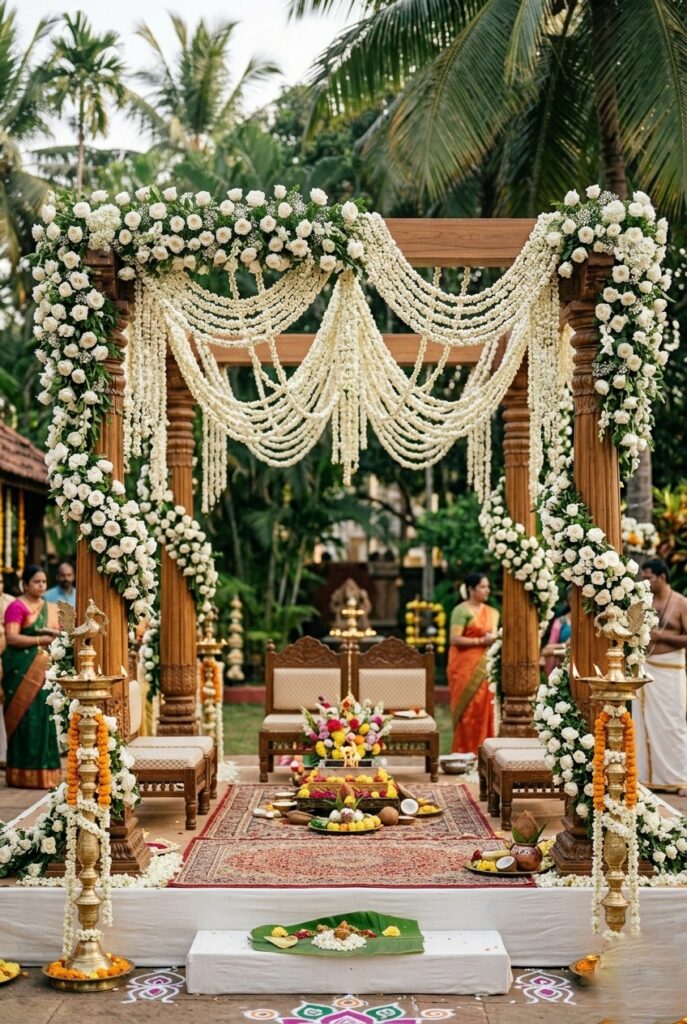
Every NRI couple with South Indian roots should know this: a jasmine and white floral palette — mogra, tuberose, white roses — is one of the most sophisticated looks in Indian wedding décor right now, and it still costs less than an elaborate marigold setup.
The fragrance alone transforms the room. White floral chandeliers suspended above the mandap or reception tables are having a serious moment in 2025 — they photograph beautifully, they’re lighter to hang than traditional floral structures, and they work in both religious and modern venue settings.
Budget: White floral chandelier (DIY hula hoop base): $70–$120 | Jasmine garlands from Indian florists: $1–$3/foot | Buy from: Local Indian florists, Asian grocery stores (jasmine), Etsy (dried white floral installations)
8. Rangoli at the Threshold — Not Just as Décor
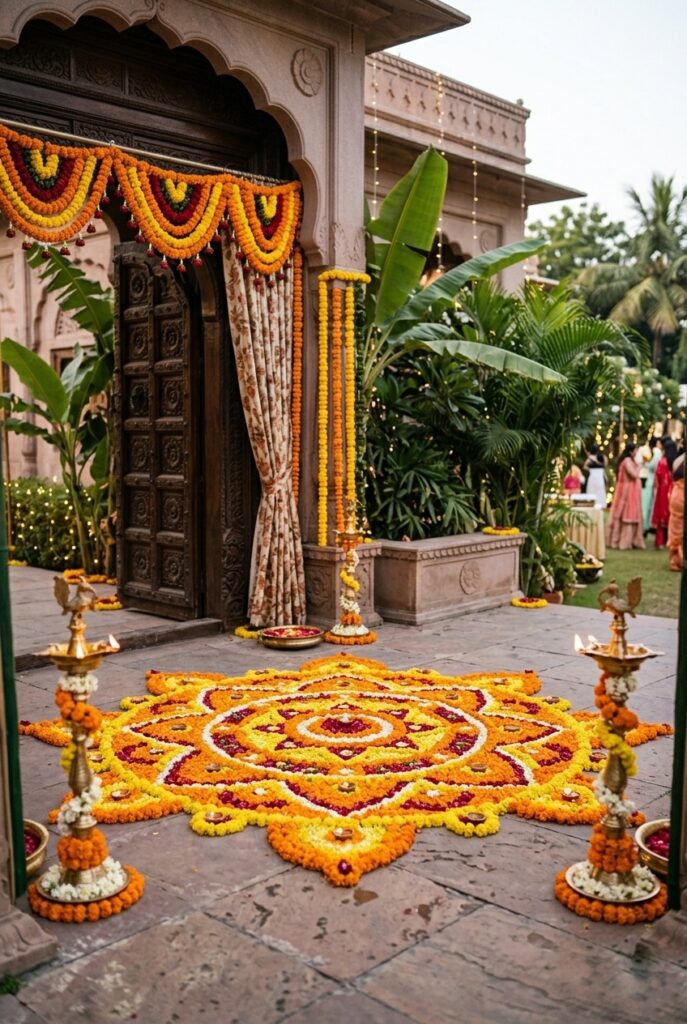
Most American-Indian weddings treat rangoli as background filler — a stenciled pattern in the corner near the gift table. That’s a missed opportunity.
The traditional placement is the threshold: the entrance to the ceremony space, the front of the mandap, or the path from the parking lot to the door.
A petal rangoli at the entrance — done in fresh marigold petals, rose heads, or even colored rice — is the most photographed arrival moment at any Indian wedding. It costs almost nothing.
A $20 bag of marigold heads and two hours the morning of creates something guests have been known to stop and photograph before they even say hello.
Skip this if the venue has carpet that can’t be cleaned or strict rules about loose materials. In that case, use a pre-made fabric rangoli mat ($25–$50 on Amazon or LoveNspire) — it photographs just as beautifully.
Budget: Fresh petal rangoli: $20–$40 in flowers | Fabric rangoli mat: $25–$50 | Buy from: Amazon, LoveNspire, local Indian grocery stores for petals
9. Create a Bar Cart or Cocktail Moment With Indian Aesthetic
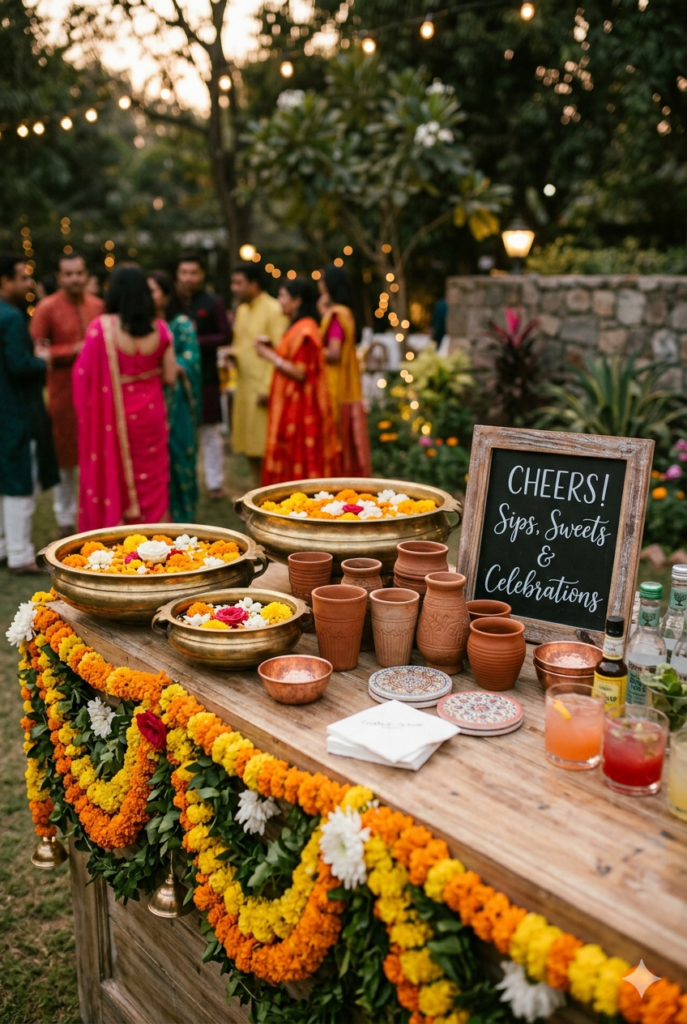
This is the one idea almost no competitor is talking about for Indian weddings, and it’s one of the highest-impact changes you can make.
Your cocktail hour is the first thing guests experience after the ceremony, and most Indian weddings default to hotel bar setup — generic, undecorated, zero personality.
Instead, style the bar table: brass urlis filled with flowers, marigold garland draped across the front edge, a small chalkboard or handwritten sign with the signature drink names, terracotta shot glasses for mocktails.
It takes $80 and thirty minutes. It photographs incredibly and your guests will post it immediately.
Budget: Brass urlis: $30–$80 | Terracotta cups from Amazon or Indian stores: $15–$25 for a set | Chalkboard sign: $10–$20 | Marigold garland: $10–$20
💸 Budget Hack #3
The most expensive single item in Indian wedding décor is usually the stage backdrop.
Before you rent an elaborate fabric-and-flower installation, ask your photographer what they actually need in the background for your portraits.
More often than not, a simple structure with a clean drape and one strong floral piece frames a portrait just as well as a $1,500 backdrop — and your photographer will tell you honestly if you ask.
10. Let the Tablescape Tell a Regional Story
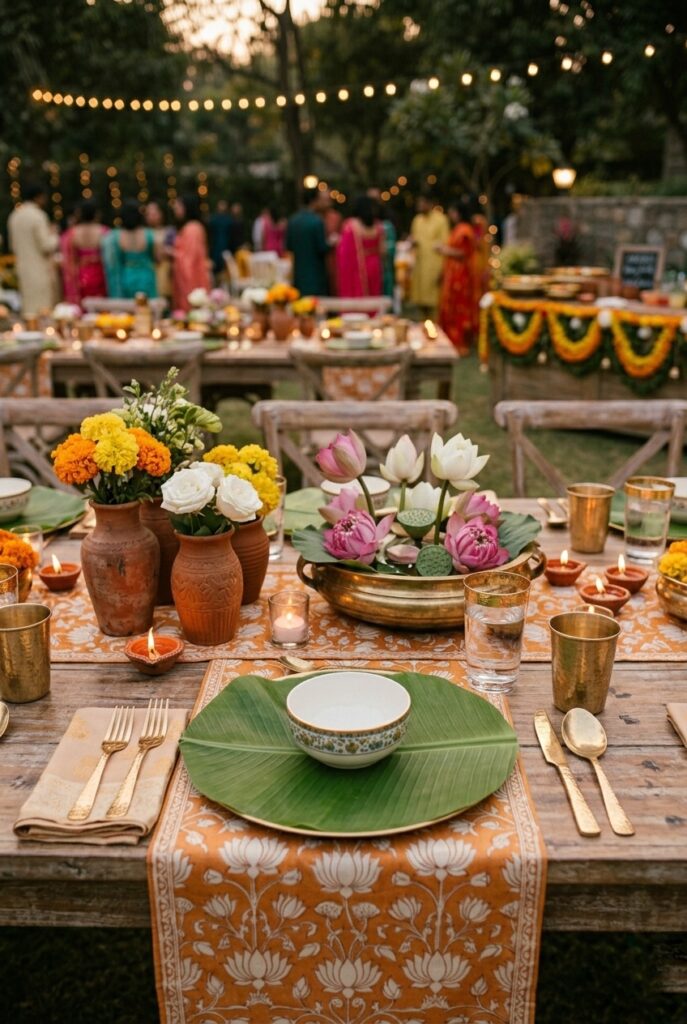
The most distinctive Indian wedding tablescapes in 2025 aren’t using generic centerpieces — they’re using regional Indian craft as their visual language.
Banana leaf charger plates for a South Indian aesthetic, Warli-inspired motif cards as menu holders, a block-printed cotton runner from Rajasthan, terracotta vessels instead of glass vases.
These details cost the same as their generic counterparts but carry ten times more cultural weight.
They show guests — many of whom may not share your specific regional heritage — something they haven’t seen before.
That specificity is what people remember.
Budget: Banana leaf charger plates: $30–$60 for a set of 10 on Amazon | Block-print fabric runners from Etsy: $15–$35 each | Terracotta vase sets: $20–$40 on Amazon or Indian home goods stores
If your venue already has dramatic ceiling architecture → skip the draping and invest instead in floor-level detail: rangoli, petal aisle, lanterns, urli clusters. Fighting a venue’s bones with fabric never wins.
If your budget is under $2,000 for all décor → put 60% into the mandap and entrance, 30% into lighting, and 10% into table details. A strong ceremony zone and entrance will outlast any amount of reception centerpiece spending in your photos.
If you’re hosting multiple events over two or more days → repurpose décor between functions. Brass vessels from the Mehendi become cocktail hour décor at the reception.
Marigold garlands from the ceremony get repurposed on the dinner tables. Plan for portability from the start.
Why Indian Wedding Décor in America Keeps Looking the Same
Here’s the honest insider truth: most South Asian wedding vendors in America work from a catalog.
They have five mandap configurations, three backdrop options, and two lighting packages.
Unless you show up with a specific reference and a willingness to push back, you will get the 2018 package with 2025 pricing.
The bold opinion: the most beautiful Indian weddings in America right now are not being done by the biggest vendors.
They’re being done by couples who hired one strong florist, one lighting rental company, and did the rest themselves or with family.
The “full-service Indian wedding decorator” model can produce extraordinary results — but it can also produce expensive sameness if you’re not actively steering.
The contrarian insight that nobody says: at an Indian wedding, fragrance matters as much as visuals.
Jasmine at the entrance, mogra near the mandap, agarbatti during the ceremony — these are the things guests remember twenty years later, and they cost almost nothing.
A $30 bunch of jasmine from a local South Asian florist will do more for the atmosphere of your mandap than a $200 floral upgrade on the backdrop.
Mistakes to Avoid
Matching every single element to your lehenga color. This feels very controlled in theory and looks strangely costume-y in practice.
Your décor should complement your look, not mirror it so precisely that you disappear into the backdrop.
A bride in deep red in front of a red and gold mandap is a less interesting photo than a bride in deep red in front of ivory and brass.
Renting a mandap that’s meant for a different ceremony type. A North Indian-style mandap at a South Indian ceremony, or vice versa, creates a visual and cultural disconnect that family members will notice immediately — even if they don’t say it out loud.
Know what your ceremony actually requires structurally and ritually, and let that drive the design.
Forgetting the aisle completely. The walk down the aisle in an Indian wedding is one of the most photographed moments of the entire day.
Most couples spend $1,000 on the mandap and $0 on the aisle.
A simple petal carpet, a few brass diyas, or ribbon-tied chair markers change that walk from functional to cinematic for almost no money.
Buying everything from the same vendor package. When the linens, the backdrop, the centerpieces, and the stage draping are all from one rental house, everything matches perfectly — and that’s exactly the problem.
Intentional variety creates the layered, editorial look.
Mix sources deliberately.
What Does It Cost to Decorate for an Indian Wedding?
Q: Can you do beautiful Indian wedding décor on a tight budget in the US?
Yes — but it requires you to be specific rather than comprehensive.
The couples who nail Indian wedding décor on a $1,500 total budget pick three signature elements and execute them beautifully: a stunning mandap (rented or DIY), a petal rangoli entrance, and warm lighting. Everything else is secondary.
The couples who fail on a tight budget try to cover every surface with something and end up with a diluted version of an expensive wedding rather than a distinct vision of their own.
Indian Wedding Décor Budget Reference
| Element | Budget | Mid-Range | Elevated |
|---|---|---|---|
| Mandap (rental/setup) | $400 DIY kit | $1,200 rental | $3,500+ custom |
| Marigold florals (ceremony) | $80 self-sourced | $200 local florist | $600+ full coverage |
| Entrance toran + rangoli | $40 DIY | $100 styled | $200+ florist install |
| Brass diyas + urlis | $30 grocery store | $80 LoveNspire | $200 rental set |
| Table linens (per table) | $15 Amazon | $25 rental | $50+ specialty |
| Lighting (uplights + canopy) | $200 string lights | $500 rental | $1,200+ full design |
| Mehendi corner setup | $80 DIY | $200 styled | $500 vendor install |
| Stage/reception backdrop | $100 fabric DIY | $400 rental | $1,500+ custom |
An Indian wedding isn’t just a wedding — it’s a visual language. Every marigold, every brass lamp, every strand of jasmine is saying something.
The couples who understand that décor is communication, not just decoration, are the ones whose weddings get pinned, shared, and remembered.
You don’t need more. You need more intentional.