
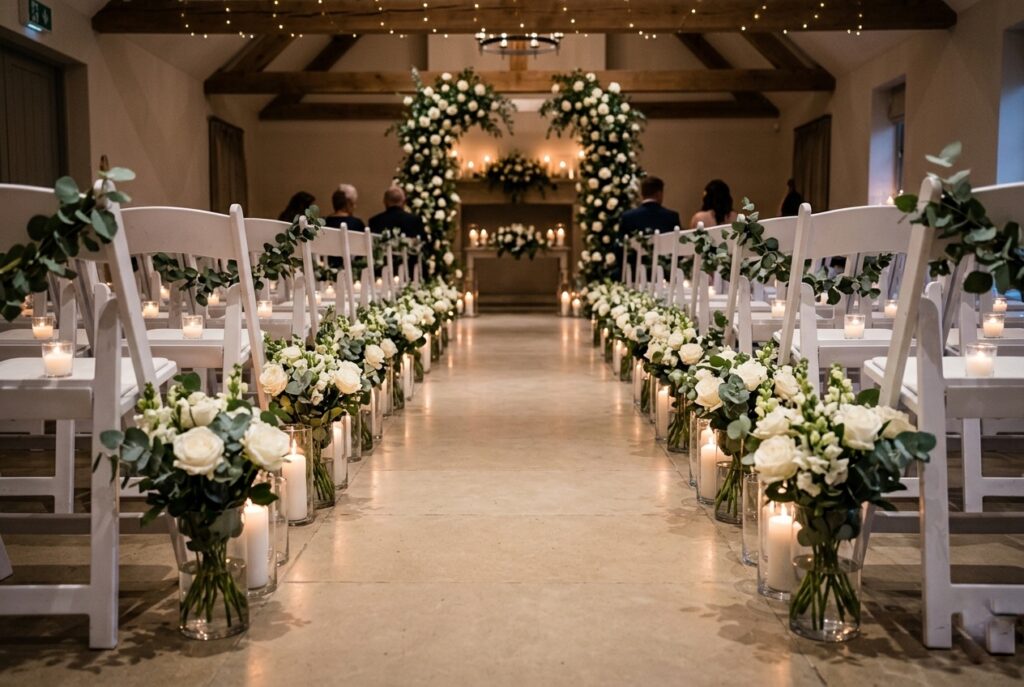
Most couples spend between $800 and $2,500 on aisle flowers alone—flowers that guests spend exactly 30 seconds looking at. Your bridesmaids obscure half of them.
The groom can’t even see them. But there’s a smarter way to approach this that I’ve seen work flawlessly.
The difference between aisle flowers that feel intentional and aisle flowers that feel like filler comes down to one decision: understanding what actually frames your walk.
Most couples treat the aisle like a museum hallway that needs decoration at every single foot. It doesn’t.
That’s how you end up with $1,200 in arrangements that blend into a green blur the moment you’re in motion.
The flowers your guests remember are the ones that anchor specific moments—your entrance, the altar, the first row of seating—not the middle rows nobody’s watching.
Reposition your budget toward impact zones, and you’ll have better photos, more memorable moments, and money left for things that matter more to your day.
White petals caught on silk ribbon,
the weight of roses in a hand,
air that smells like rain on stems—
a simple frame, nothing more.
The Short Answer
Stop treating the aisle as a blank canvas that needs filled wall-to-wall. Your guests see three zones: the entrance where you walk in, the first three rows of chairs, and the altar. Invest 70% of your aisle flower budget in these spots and skip the repetitive middle section entirely. This approach costs less, photographs better, and feels intentional rather than obligatory.
1. The Entrance Marker — Create Your First Impression Here
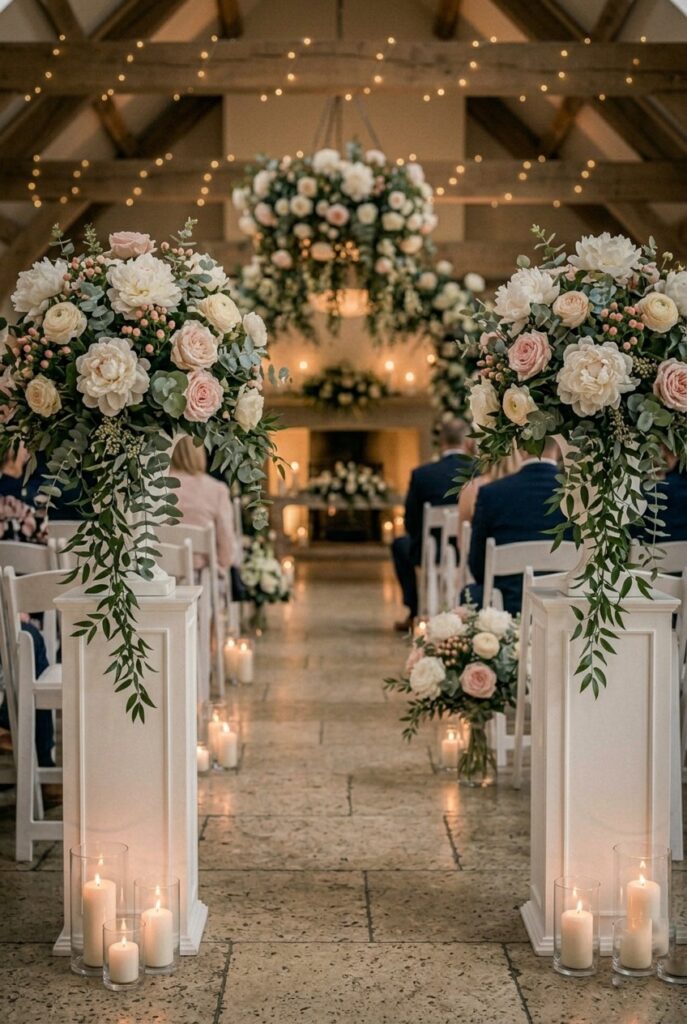
The moment guests see you is the moment aisle flowers matter. Frame the entrance with oversized arrangements on tall pedestals (24–36 inches high) so people photographing from the back of the ceremony actually capture them. Use this zone to establish color and mood.
Skip overdecorating pew chairs in the first three rows if your entrance is strong—one good focal point beats six mediocre ones.
Tall arrangements at the entrance can be moved to the reception after the ceremony, turning them into centerpieces or cocktail-hour decor. Budget: $300–$600 per side for professional pedestals or DIY with rental stands ($40–$80 from event rental companies).
Where to buy: Rent from local event rental companies or Amazon ($60–$150 for stand-alone pedestal vases).
2. Aisle Petals vs. Aisle Flowers — Know the Difference
This is where I see couples throw money away.
Fresh rose petals scattered down the aisle cost $150–$400, wilt fast in any heat, stick to heels, and disappear into the carpet.
Then you’re paying extra for someone to sweep them mid-ceremony because the altar looks cluttered.
The cheap-wrong version is a thin scattered of petals that looks accidental.
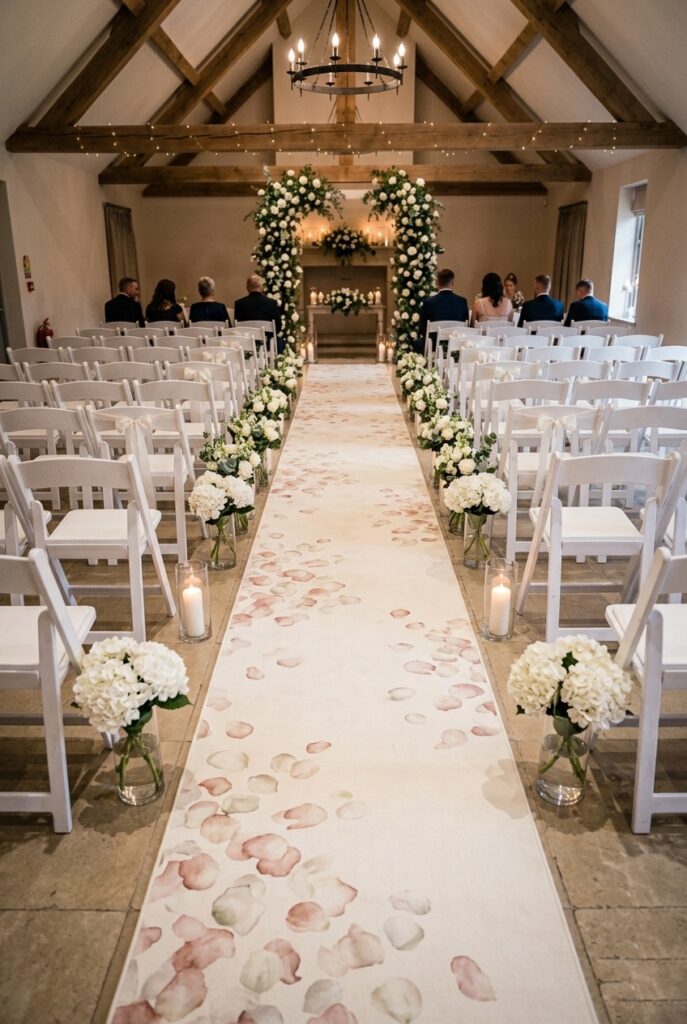
Switch instead to a linen aisle runner with a subtle petal design printed on it ($60–$150 from Etsy).
It gives the visual impact of petals, doesn’t wilt, photos beautifully, and you can repurpose it for the reception.
Or commit fully to fresh petals only if you have fewer than 50 guests and an outdoor ceremony where they won’t stick to anything.
Budget: $60–$150 for printed runner. Where to buy: Etsy sellers (search “petal aisle runner”) or Amazon.
3. Chair Flowers vs. Full-Line Arrangements — Invest Strategically
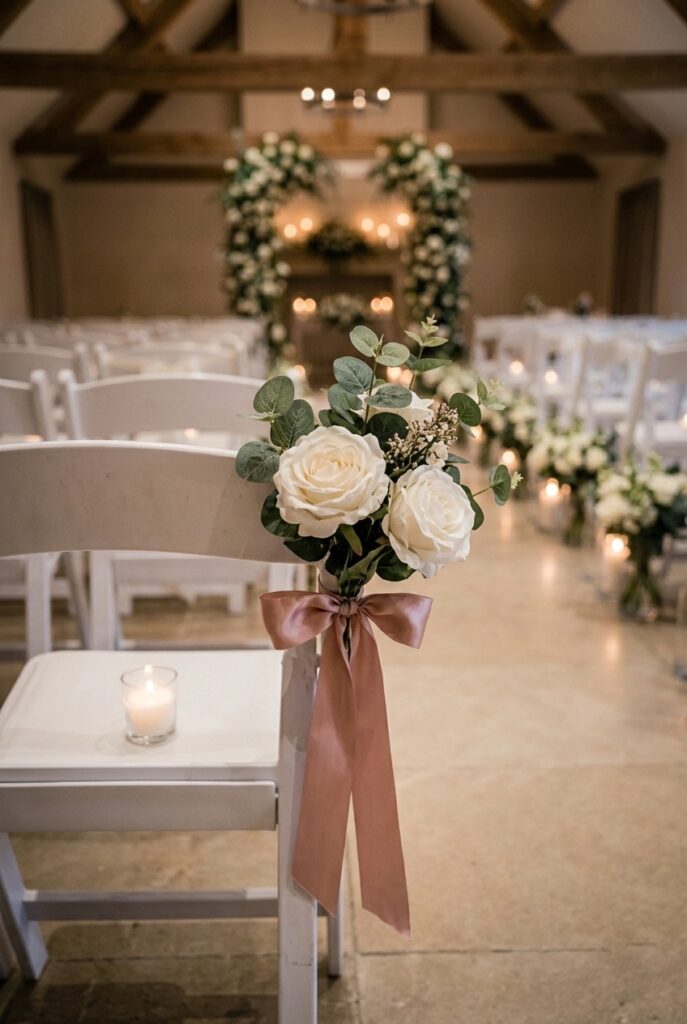
Full-line aisle arrangements mean flowers on every chair down the entire aisle.
For an aisle with 20 pairs of chairs, that’s 40 arrangements. At $35–$75 per arrangement through a florist, you’re spending $1,400–$3,000 on pieces guests barely see as they’re seated.
The cheap-wrong version is plastic chair hangers from wedding supply warehouses that scream “budget wedding” and fall off before the ceremony starts.
The smarter version is marking only the first four rows of chairs with arrangements and skipping the rest entirely.
Nobody’s looking back at row 12. Your photographer isn’t capturing it. Your guests in those seats don’t remember it.
Budget: $400–$800 for first four rows (4–6 arrangements per side, usually 8–12 total).
Where to buy: Pre-made arrangements from Etsy sellers like Lings Moment or Rinlong Flower ($25–$50 each, faster than custom florist quotes), or local florists for custom designs.
Budget Hack #1: Skip the Middle, Maximize the Ends Pre-made pew flower sets from Lings Moment cost $25–$45 per arrangement, vs. $60–$100 custom from a florist. Buying 8–10 pre-made pieces for the front rows and zero for the back saves $400–$800. Florists won’t tell you this strategy because it reduces their order value—but it’s exactly what high-end weddings do. Buy from Etsy or Amazon.
4. Greenery Aisle Runners — The Underrated Power Move

A eucalyptus or greenery runner trailing down the center of the aisle creates the illusion of a full floral installation at a fraction of the cost.
Fresh eucalyptus garlands ($150–$300 for a 20–30 foot runner from a local florist) drape elegantly and photograph like a luxury installation.
The difference between a weak greenery runner and a strong one is density and height variation. Thin, single-strand garlands look sparse.
Layered garlands with multiple eucalyptus types and accent greenery look intentional. Budget: $200–$400 for professional density.
Where to buy: Local florists (call 2–3 and compare prices), or DIY from bulk eucalyptus ordered online and assembled 12 hours before the wedding ($80–$150 of materials plus labor).
5. The Altar Focal Point — Your Real Money Should Go Here

After the aisle entrance, the altar is the second most-photographed zone. This is where a couple stands for 15+ minutes, where all the emotion lives, where the light is best.
A stunning floral backdrop or arch ($400–$1,200 depending on size and complexity) will appear in hundreds of photos and video stills.
Many couples cheap out on the altar and splurge on the aisle, which is backwards.
A simple eucalyptus arch with a few focal flowers costs $300–$600, looks magazine-worthy in photos, and frames your vows perfectly.
This is where your florist earns their fee. Budget: $400–$1,000+. Where to buy: Work with a florist directly for custom design; this isn’t an area to DIY unless you have serious skill.
6. Hanging vs. Grounded — Choose Based on Your Ceiling
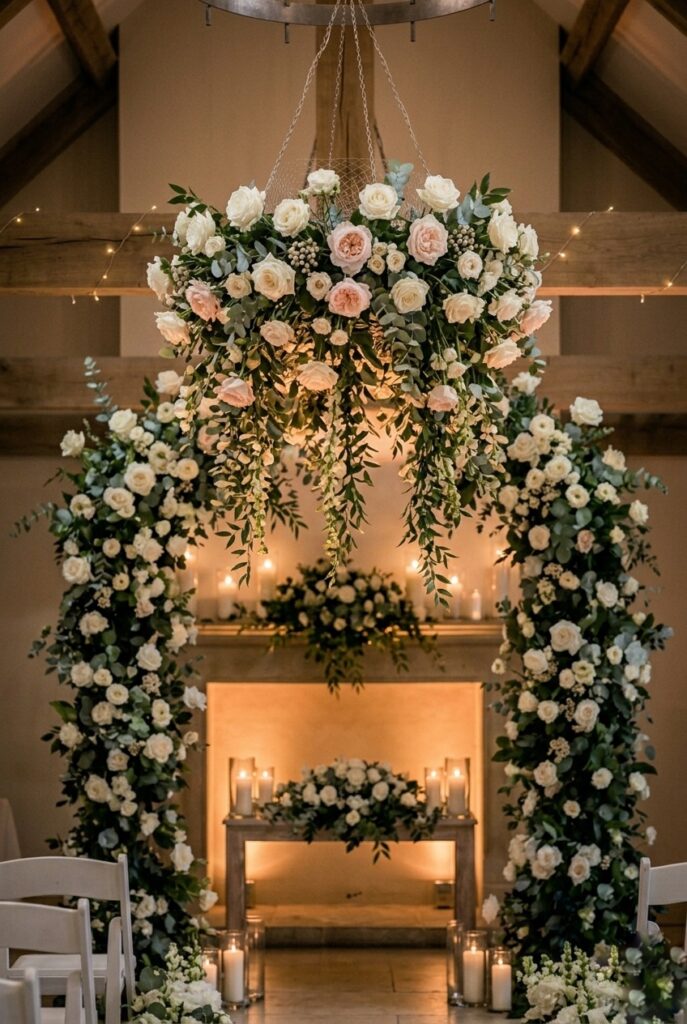
Hanging floral installations look luxe but cost more and require ceiling permission, rigging hardware, and a florist who knows what they’re doing.
If your venue has high ceilings and permits overhead design, hanging arrangements at the altar can frame the moment dramatically.
Grounded arrangements (pedestals, tall vases, floor-standing pieces) cost 30–40% less and don’t require special permits.
They’re also easier to move for photos and repurposing. For most couples on a real budget, grounded is the smarter choice.
Budget: Hanging $600–$1,500; Grounded $400–$800. Where to buy: Florist-only (this requires professional installation).
Budget Hack #2: Move Aisle Arrangements to Reception Tables Two to three arrangements used in the aisle entrance can be repurposed as tall centerpieces for cocktail hour or the head table, effectively doubling their value. Ask your florist to design pieces that work in both contexts before the wedding. This saves $300–$600.
7. Silk vs. Fresh — When Artificial Wins
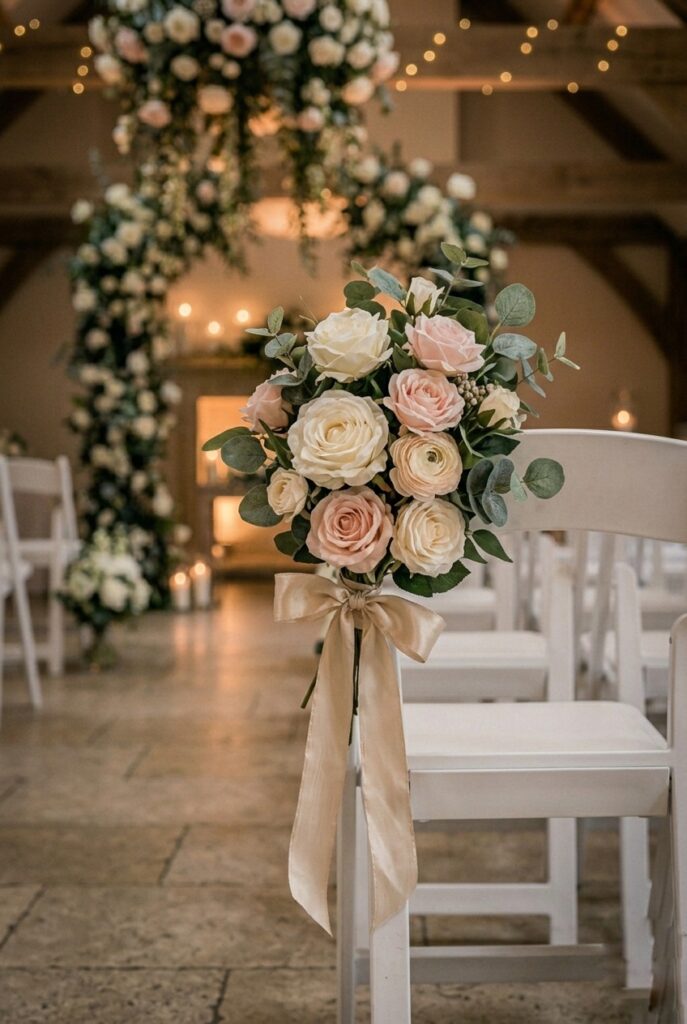
Silk flowers cost 40–60% less than fresh and don’t wilt in heat or humidity.
For outdoor summer ceremonies or aisle spaces where you can’t control temperature, silk is the realistic choice. High-quality silk (not craft-store plastic) is indistinguishable in photos.
Many vendors and florists downplay silk because they can’t charge as much.
But Lings Moment and other wedding specialists sell realistic pre-made pew markers and aisle arrangements in silk that photograph beautifully.
Budget: $20–$60 per arrangement for quality silk, vs. $50–$100 for fresh. Where to buy: Lings Moment, Rinlong Flower (Amazon), Etsy sellers specializing in wedding florals.
8. Specialty Flowers — Statement Blooms That Stand Out
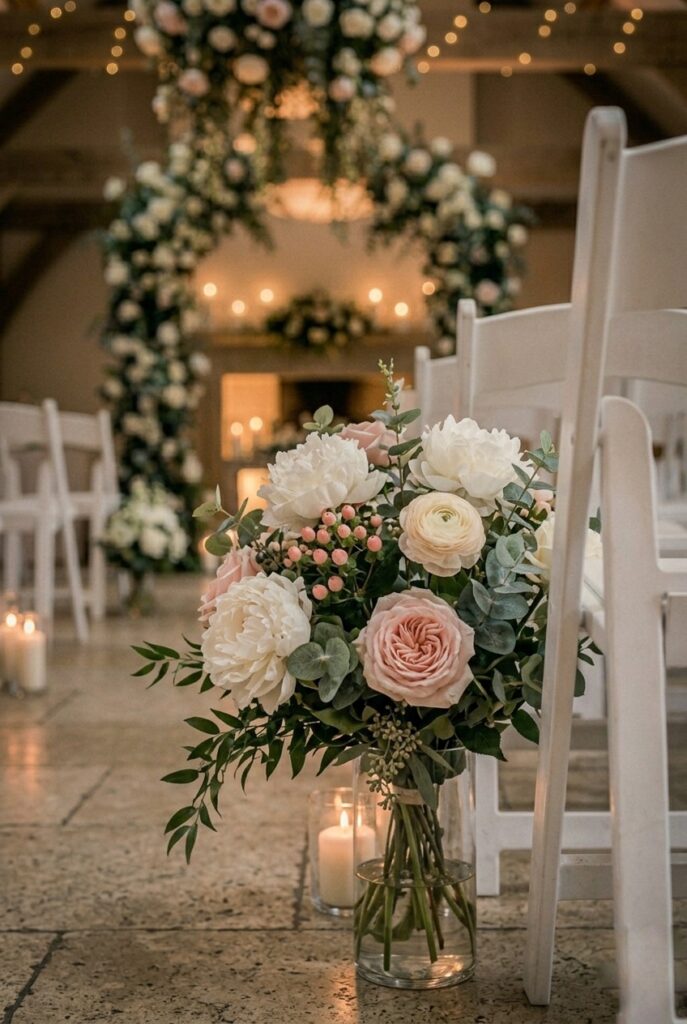
Peonies, ranunculus, and garden roses command attention and feel luxe. Cheaper alternatives like carnations or filler greenery alone feel sparse.
One statement flower mixed with greenery costs the same as a large filler arrangement but reads far more expensive.
Ask your florist for a primary bloom (peony, rose, or ranunculus), secondary bloom (hypericum berries, spray roses), and filler greenery mix.
This 3-layer approach is what high-end arrangements use. Budget: $40–$75 per arrangement.
Where to buy: Local florists (always compare 2–3 quotes), or Etsy pre-made sets with mixed bloom types.
Budget Hack #3: Buy Wholesale Flowers Direct Wholesale florists like BloomsBox or local wholesale suppliers will sell bulk flowers (50+ stems) at 40–50% below retail. If you’re DIY-ing 8–10 arrangements yourself, buy 100 stems of roses, eucalyptus, and filler greenery for $80–$150 total. You’ll have plenty for pew pieces and the entrance. Time required: 3–4 hours, do it the day before.
Decision Filter
Under 75 guests? Concentrate 80% of aisle budget on the entrance and altar. Skip pew flowers in rows 4+ entirely. A stunning entrance and altar will feel complete without line-the-whole-aisle flowers.
Outdoor summer ceremony? Use silk flowers or go 100% greenery runner with minimal blooms to avoid wilting. Heat + humidity = fresh flowers that die mid-ceremony.
Indoor ballroom or church? You have flexibility. Layer a greenery runner with grounded arrangements in the first four rows and a statement arch at the altar.
Budget under $800 total? Entrance arrangements ($200), first-row pew markers in silk ($300), greenery runner ($200), skip the rest.
The Real Reason
Here’s what florists don’t tell couples: the aisle is the lowest-ROI decor investment you make. Your guests spend 30 seconds looking at it while you’re walking.
They photograph it for 15 seconds. Then they sit down and don’t look back.
The real impact of aisle flowers is psychological—they make you feel celebrated, they frame your entrance emotionally, and they create a photo moment.
That matters. But it doesn’t require $2,000 and line-to-line repetition.
A strategically placed entrance arrangement, a solid greenery runner, and a stunning altar focal point cost $800–$1,200 and create the same memory.
Here’s the insider observation a florist won’t say out loud: couples who spend the most on aisles always regret it.
They watch the final edited video and realize the bridesmaids, ceremony programs, and guests’ heads blocked half the arrangements they paid for.
The couples who spent smart—entrance, altar, first rows, skip the rest—watch their video and see exactly what they intended to see.
Concentrate investment where you’ll actually see it. Everything else is decoration for nobody’s benefit.
Mistakes to Avoid
Mistake 1: Lining the entire aisle chair-by-chair Every wedding decor magazine and Pinterest board shows full-line aisle flowers, which is why couples assume they’re necessary. They’re not.
Competitors recommend this because it inflates florist budgets. Real couples who review their photos after the wedding see bridesmaids blocking the view, guests’ heads in the way, and dozens of invisible arrangements nobody remembers.
Concentrate pew markers in rows 1–4 only.
Mistake 2: Choosing aisle flowers over altar florals A couple spent $1,800 on aisle arrangements and $400 on altar flowers.
The aisle photos show bridesmaids obscuring most pieces. The altar photos—where they stood for 15 minutes—are sparse and forgettable.
Reverse the ratio. Invest 70% in the altar focal point where you’ll stand the longest and which appears in ceremony video and still photos continuously.
Mistake 3: Fresh flowers in a hot outdoor venue and then discovering them wilting mid-ceremony One bride chose premium peonies for an outdoor summer ceremony in direct sun. By the time guests were seated (20 minutes), the petals were wilting and curling.
Peony blooms typically last 2–3 days in a climate-controlled room.
Full sun? 4–6 hours, maximum. Heat is a hidden cost of fresh flowers most florists downplay. Silk or hardy greenery-focused arrangements are the realistic choice for outdoor heat.
Mistake 4: Assuming the aisle is a museum space that requires decor every 2 feet This mindset comes from bridal magazines that photograph entire aisles to show “the full picture.” Real guests don’t experience the aisle as a full visual.
They walk down it in 15 seconds, or sit in the first few rows and glance at neighbors’ seats.
Gaps in decoration are not failures—they’re intentional design.
A 20-foot aisle with arrangements at 0 feet, 5 feet, and 15 feet looks fuller and costs 60% less than one with flowers at every 2-foot interval.
FAQ
How much should I spend on aisle flowers?
Budget 10–15% of your total floral budget for aisle flowers, not 40–50%. If your floral budget is $1,500, spend $150–$225 on the aisle, not $600–$750.
Most couples over-allocate here because they’ve been conditioned by magazine imagery to think the aisle is the centerpiece of the ceremony space. It’s not.
The ceremony itself is.
Can I use grocery store flowers for the aisle?
Yes, but only for arrangements assembled the morning of your ceremony and only if you’re comfortable with shorter stems and less variety.
Grocery store roses are cheaper ($1–$2 per stem vs. $3–$5 wholesale) but have a 2–3 day lifespan instead of a 5–7 day lifespan.
For pew markers you’ll assemble yourself, they work fine. For entrance pedestals that sit out longer before the ceremony, use wholesale or florist-grade stems.
Should I do a greenery aisle runner or flowers?
Greenery alone costs $150–$300 for a 30-foot runner and photographs like a luxury installation.
Adding flowers to the runner (peonies, roses) costs $400–$700 and looks marginally better in photos but exponentially more expensive in person.
If your budget is under $500 total for the aisle, choose greenery. If you have $600+, add a few focal flowers to the runner.
Can I move aisle decorations to the reception?
Yes. Entrance pedestals become cocktail-hour or head-table centerpieces.
Pew markers can be consolidated into larger reception arrangements. Aisle runners can frame the dance floor or cocktail tables.
Plan these transitions with your florist before the wedding so pieces are designed to work in both spaces.
Budget Table
| Aisle Element | Budget Option | Premium Option | Where to Buy |
|---|---|---|---|
| Entrance Markers (pair) | $200 (pre-made silk sets + DIY pedestals) | $600 (custom fresh from florist) | Etsy, Amazon, local florist |
| Pew Markers (8–10 pieces) | $200–$300 (silk from Lings Moment) | $600–$750 (fresh custom) | Lings Moment, Rinlong, local florist |
| Greenery Runner (20–30 ft) | $100 (DIY bulk eucalyptus) | $300 (florist-assembled) | Wholesale supplier, local florist |
| Aisle Petals or Runner | $60 (printed linen runner) | $400 (fresh rose petals) | Etsy, Event supply rental |
| Hanging Florals (if applicable) | N/A | $800–$1,500 | Local florist only |
| Total Strategic Aisle (entrance + first 4 rows + runner + altar focal point) | $700–$900 | $2,000–$3,000 | Mixed sources |
The aisle you walk down matters—but not in the way the wedding industry has convinced you. It matters as a moment, not as a dollar amount.
Spend smart: anchor your entrance and altar, simplify the middle, and watch your photos look intentional instead of over-decorated.
Your future self will thank you when you’re not explaining away thousands spent on flowers that nobody remembers.
Start with the fresh vs. artificial flower guide from Zola to determine which realistic option works for your venue, then move 70% of your budget to the ceremony focal point—your altar—where you’ll actually stand.
Forget the rest. The best aisle is the one that frames the moment, not the one that drowns it.