Fall is the easiest wedding season to over-decorate — because the season itself is already doing so much work, couples keep adding until the tables look like a harvest festival rather than a wedding reception.
The ones that make it into editorial features are almost always the ones that removed three-quarters of what they originally planned and committed to a single color story instead.
Here is how to build fall centerpieces that feel rich, intentional, and genuinely seasonal without falling into any of the traps that cost couples hundreds of dollars and show up as clutter in photos.
The fig splits open on a cutting board in October. Its inside the color of old garnets, something you’d find wrapped in tissue. Dried oak leaves curl at the edges by afternoon. The cinnamon stick in the vase goes soft before the candle burns down. Not everything that smells like autumn needs to be seen.
The Short Answer
Fall gives you the richest natural palette of any wedding season, and most couples waste it by going literal — orange pumpkins, orange flowers, orange candles — instead of building from the depth the season actually offers.
Burgundy, plum, deep fig, smoked amber, and dark forest green read as fall without screaming Halloween.
One of those as your dominant color, layered with ivory or dusty cream, and finished with warm metals (brass, aged gold, or dark bronze) will produce centerpieces that feel elevated and seasonal at the same time.
The couples who try to use every autumn color at once end up with centerpieces that read as chaotic regardless of how much they spend.
1. Dahlias as the Anchor Bloom — Not an Accent
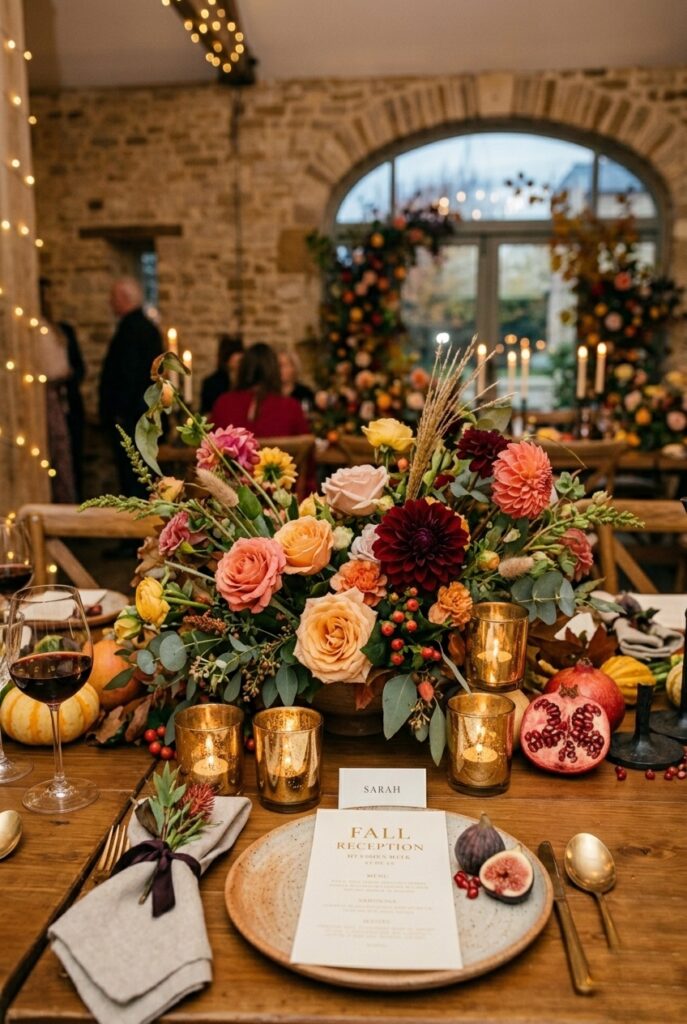
Dahlias are the single best value in fall floral centerpieces — they are enormous, they open dramatically, and three stems fill a vessel that would require fifteen roses to achieve the same visual mass.
The varieties that work hardest in fall settings are café au lait (a dusty champagne-peach that photographs as golden), dark burgundy like ‘Black Tuxedo,’ and deep plum like ‘Mystery Day.’
Source them from a local flower farm through Floret Flowers’ farm directory rather than ordering through a florist, and you’ll pay $1.50–$3.50 per stem wholesale versus $5–$9 per stem through a florist.
A centerpiece that costs a florist $65–$85 to produce runs $15–$25 in materials when you source and arrange it yourself.
Only do this if your venue has good ambient lighting — dahlias’ intricate petal structure only reads properly with directional light, whether candlelight or warm overhead fixtures. Under harsh fluorescent lighting they flatten completely.
2. Open Figs and Bosc Pears in Arrangements — The Editorial Trick Nobody Mentions
[GAP IDEA 2 — Competitors Miss the Technique Entirely]
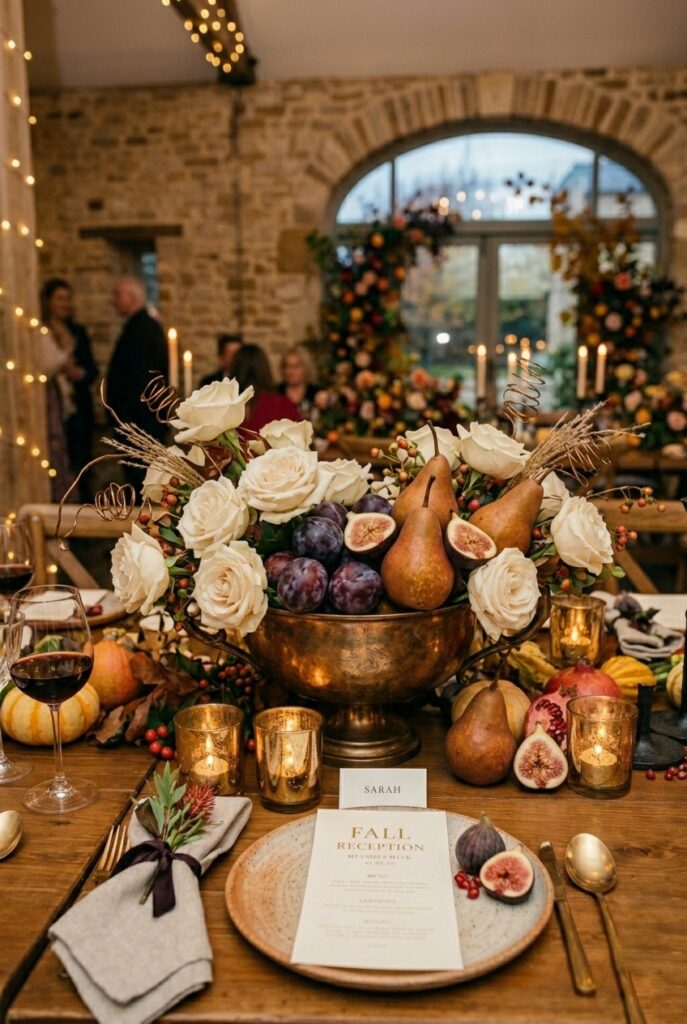
Every competitor mentions fruit as a vague fall prop. None of them tell you the technique that makes it actually work: cut the figs open. A whole fig in a floral arrangement looks like a prop.
A fig sliced open, face up, tucked between ivory roses and eucalyptus, looks like a Condé Nast still life.
The dark garnet interior, the cream flesh, the small seeds — it reads as extraordinary detail and costs $0.75–$1.50 per fig from any grocery store.
Bosc pears work the same way — their rough brown skin against ivory flowers is a textural contrast that photographs beautifully without any additional effort.
Add two or three dark plums for deep color without the cost of dark florals. Build this arrangement in a low matte bronze or cream ceramic vessel from World Market ($12–$24), and your total cost per table lands at $8–$18 including flowers.
This is the fall centerpiece that makes guests stop and ask who your florist was — and you sourced it from the produce section.
3. Tall Taper Candles in Dark Iron Holders as the Vertical Element
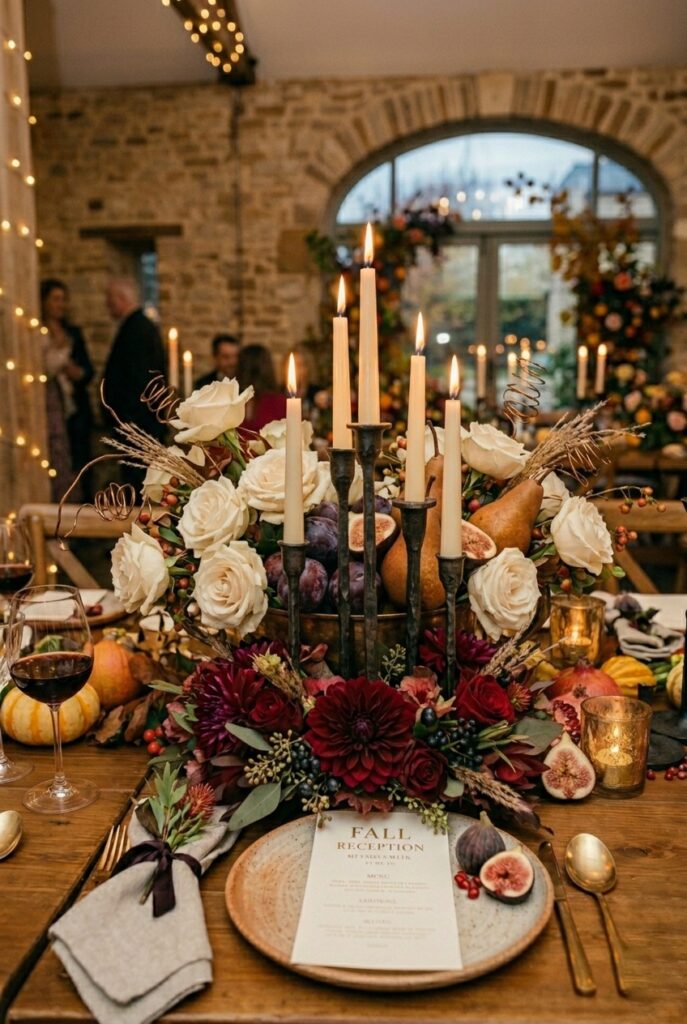
The cheap version of this look is a set of matching gold-painted metal candlesticks from a wedding supply site — they are thin, they wobble when guests brush past them, and they look obviously purchased as a set.
Dark wrought iron or aged bronze candlesticks in mismatched heights are what you are actually going for.
HomeGoods and TJ Maxx rotate iron candlesticks constantly — budget $8–$22 each and buy four to six heights per table.
The visual variety of heights at 10″, 14″, 18″, and 22″ creates the drama that makes a tablescape read as designed rather than assembled.
Build the cluster from tallest to shortest, then scatter a handful of loose dahlia heads, dried eucalyptus, and a few bittersweet branches at the base.
If your venue prohibits open flame, the Luminara brand ivory taper candles ($12–$18 each) are the only replacements worth considering — everything else looks fake under a camera flash.
This elevated approach to table composition carries through everything covered in the guide to elegant wedding table decor ideas.
BUDGET HACK #1: Instead of buying bittersweet, dried oak branches, or autumn foliage from a florist or craft store, forage it. In late September and October, roadsides, parks, and woodlands in most US states are full of bittersweet vine, dried fern fronds, and fallen oak branches with leaves still attached. Cut what you need two weeks before the wedding and dry flat between sheets of newspaper. A foraged foliage collection that would cost $40–$80 from a florist costs nothing. Confirm local foraging regulations — most public parks allow small personal-use cuttings — and never take from private property without permission.
4. Smoked Amber and Colored Glassware as the Vessel Strategy
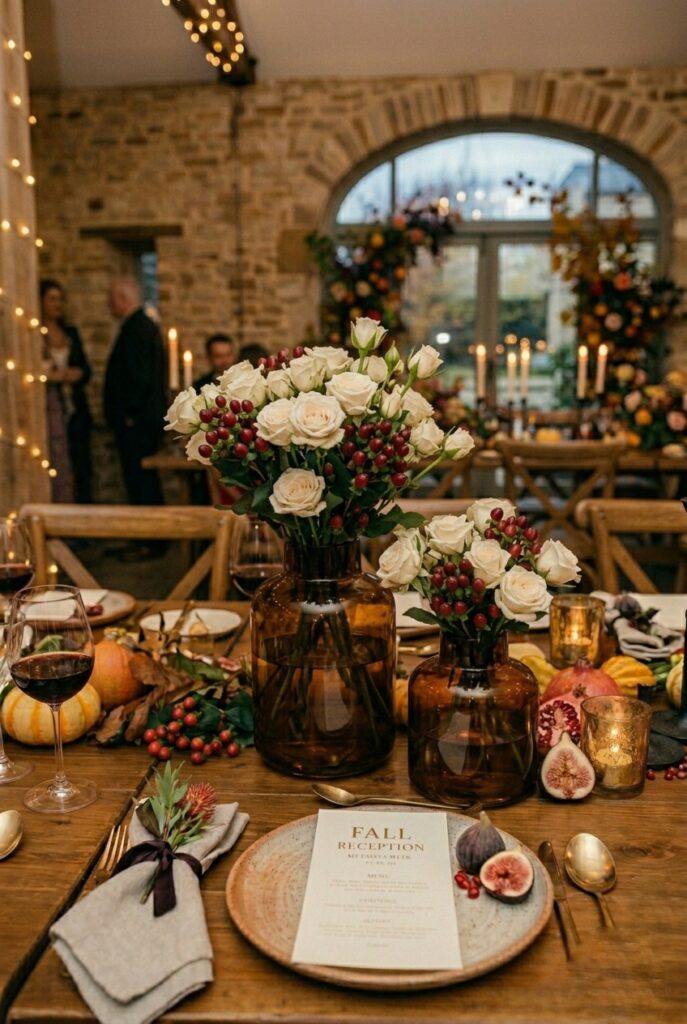
The vessel choice transforms fall centerpieces more than almost any other single decision.
Clear glass in fall reads as generic and seasonless — amber, smoked, or dark green glass absorbs and reflects the warm candlelight in a way that makes the whole table feel like it’s glowing from within.
Smoked amber glass vases are available on Amazon in sets of 6 for $28–$45, and vintage amber and dark green glassware from estate sales and Goodwill adds character for $1–$4 per piece.
The irregularity of vintage glass is a feature, not a flaw — mix three or four slightly different amber vessels at varying heights and fill each with a single flower type or small cluster rather than one elaborate mixed arrangement.
The collection reads as curated and editorial without requiring any floral design skill.
If you’re working with a tighter budget on glassware, the approaches in this guide to cheap wedding decor ideas show exactly how to build the look from thrift store sourcing.
5. Pomegranate and Dried Cotton Stem Clusters — No Flowers Required

This is the centerpiece for couples who genuinely do not want to deal with flowers — and it is one of the best-looking tables I have ever seen at a fall wedding.
Three pomegranates of varying sizes, a handful of cotton stems ($18–$28 for 50 stems on Amazon), dried rosehip branches, scattered acorns, and two amber votives on a wood slice.
The pomegranates’ deep red skin and the cotton stems’ matte ivory read as the richest possible fall palette without a single florist invoice.
Buy pomegranates at Trader Joe’s or any grocery store produce section for $1–$2 each in season (September through December).
Total cost per table: $9–$16. The arrangement assembles in under ten minutes and holds perfectly all night — pomegranates don’t wilt, cotton doesn’t drop petals, and acorns scattered loose are free from any park in October.
Only do this if your guest count is under 100 — at larger receptions, you want at least some vertical floral height to read across the room, and this arrangement stays intentionally low and intimate.
6. The Ceremony-to-Reception Transfer — Where $300–$600 Hides in Plain Sight
[GAP IDEA 1 — No Competitor in the Top 10 Addresses This System]
Here is what your florist knows and almost never volunteers: your ceremony arch florals — typically costing $400–$900 — are assembled in sections in foam-backed armatures that can be disassembled and redistributed in under 20 minutes.
During cocktail hour, your coordinator or a designated helper breaks the arch into four to six large floral clusters and places them directly into tall urns or wide-mouth vases already staged at your largest guest tables.
The dramatic arrangements that took your florist two hours to build become your statement centerpieces at zero additional cost.
This only works if you discuss it with your florist before the wedding day — they need to build the arch in transferable sections, not as a single fixed piece.
Ask for this specifically and in writing. Many florists charge a small breakdown fee of $50–$100, which still saves you $300–$800 compared to separate statement centerpieces.
Use Zola’s wedding budget calculator to model exactly how much this transfer saves against your overall decor spend.
BUDGET HACK #2: Dahlias and chrysanthemums — the two best fall centerpiece flowers — are both available at Trader Joe’s and most Whole Foods locations from September through November at $5.99–$9.99 per bunch. A bunch of dahlias typically contains 4–6 stems, each of which can anchor a small bud vase cluster or fill a mixed arrangement. For 15 tables needing three dahlia stems each, that is roughly 8 Trader Joe’s bunches at approximately $64–$80 total. The same 45 stems through a florist would run $135–$225 before design fees. Go on a Wednesday or Thursday morning — that is when most locations receive their fresh floral shipment.
7. Moody Burgundy and Dried Pampas in Low Ceramic Vessels

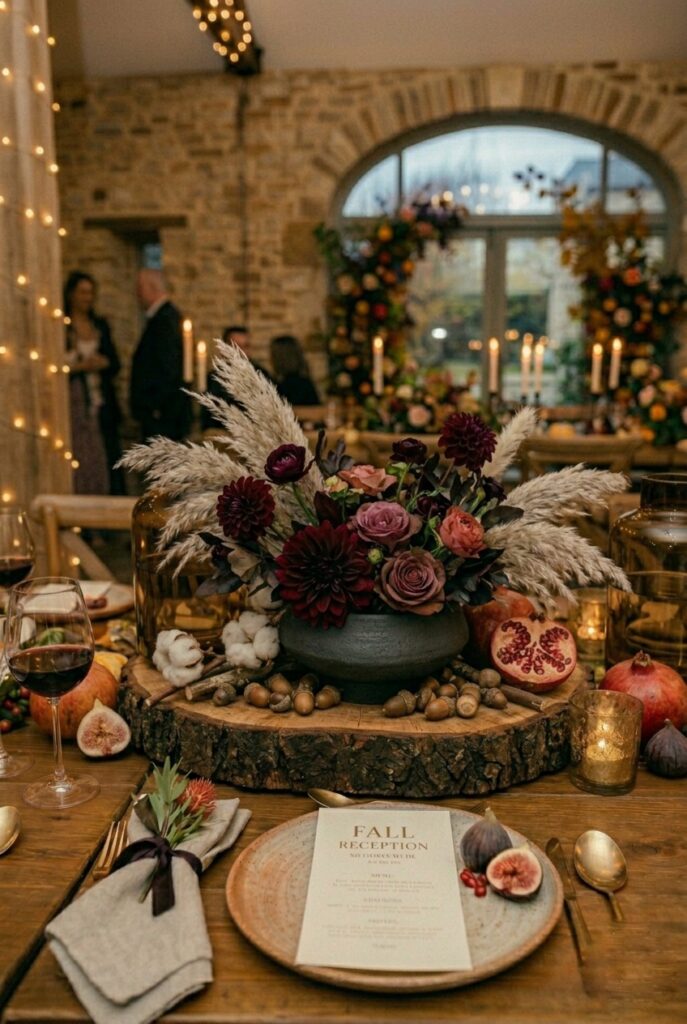
Pampas grass in a fall centerpiece does something no other filler material does: its feathery plumes catch candlelight and glow softly, creating movement in photos that static greenery never achieves.
The cheap version is a thin, sparse craft store pampas stem with bleached-out coloring and rigid plumes — it looks fake at close range and flat in photos.
The version you want is unbleached dried pampas from Etsy shops like PampasGrassDecor or WildBohoDecor, where full-plume stems run $2.50–$5 each.
Pair two or three plumes with two large burgundy dahlias and trailing dried amaranth (Amazon, $14–$22 for a bundle) in a low ceramic vessel from CB2 or World Market ($15–$28).
The whole arrangement reads as florist-designed and costs $18–$28 per table.
For more ways to use this style across the full fall venue, the guide to fall-aligned outdoor wedding decor ideas covers how to carry the look through ceremony and cocktail spaces.
8. Warm Lighting Correction — The Color Palette Decision Competitors Never Address
[GAP IDEA 1 — Competitors Miss the Lighting Science]
Every fall wedding article tells you to use orange, amber, and rust tones. Here is the problem: most fall venues are lit with Edison bulbs, string lights, or warm incandescent uplighting — all of which produce orange-amber light themselves.
When you put orange flowers under orange ambient lighting, the flowers disappear.
They read as a warm blur in photographs and lose all their structural detail.
The colors that actually pop under warm fall venue lighting are deep burgundy (it reads as almost black-red and becomes dramatic), plum and eggplant (they pull cool against the warm light and create contrast), ivory and cream (they glow luminously), and deep forest green (it provides dark structure that makes everything else stand out).
If you want orange in your palette — and orange dahlias are genuinely beautiful — put them on the sweetheart table under a targeted spot, not at round guest tables lit by ambient warm string lights.
This is the single insight your wedding photographer would tell you upfront if you asked, and almost nobody asks.
9. Acorn and Pinecone Scatter as the Table Detail That Costs Nothing
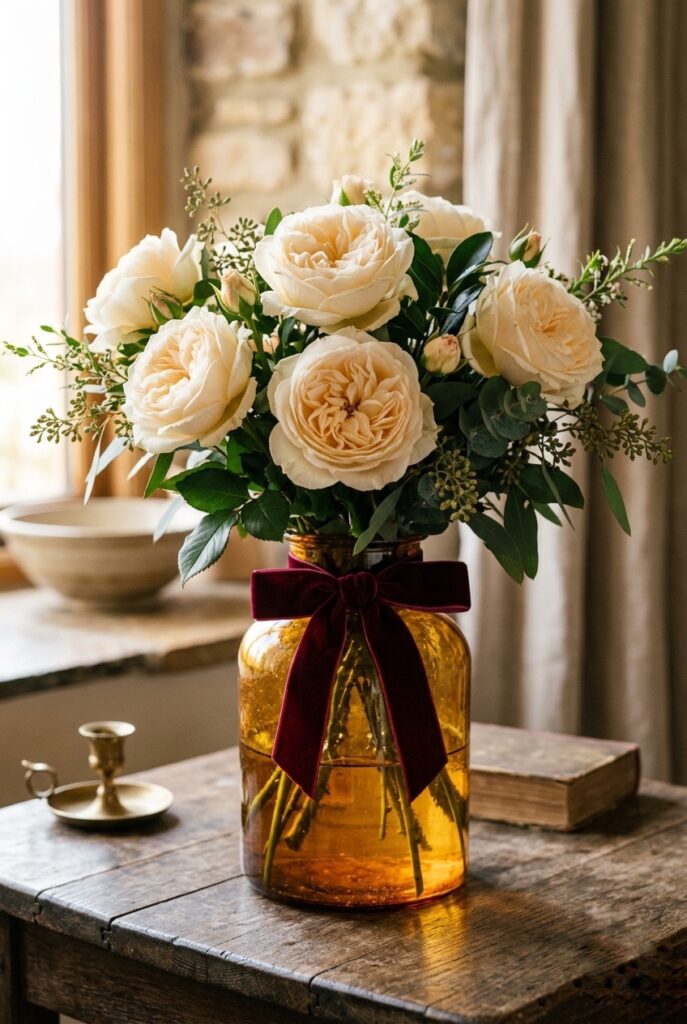
Scatter elements on the table surface are the difference between a centerpiece and a tablescape — and fall gives you the scatter elements for free.
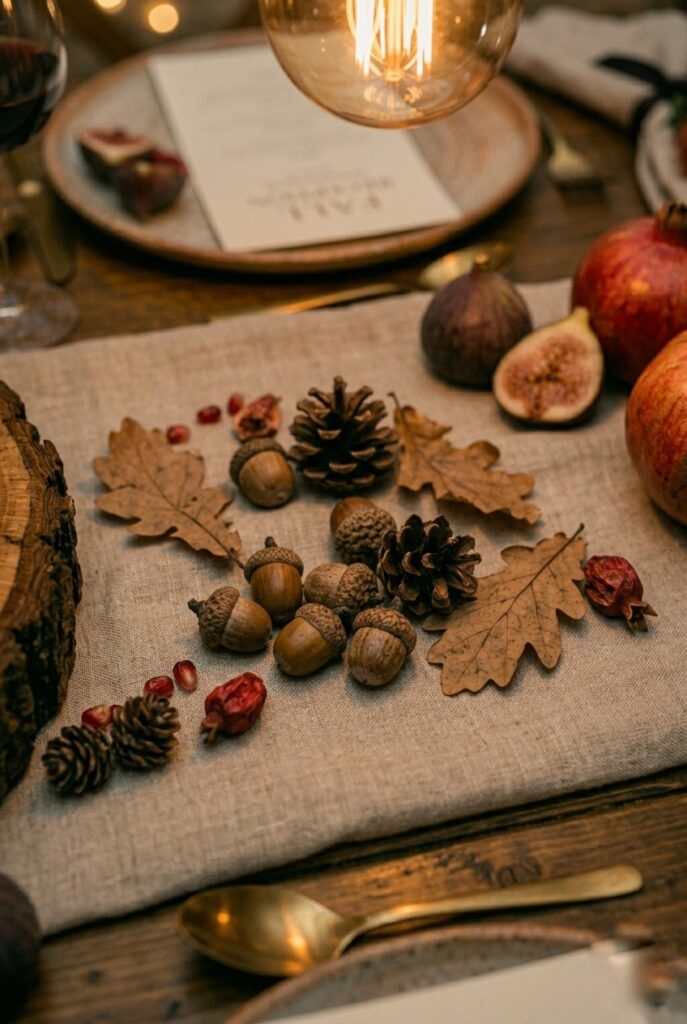
Acorns, small pinecones, dried oak leaves, and sweetgum seed pods scattered organically around the base of your centerpiece add texture and seasonal grounding that no amount of additional flowers achieves.
Collect acorns and pinecones from any park or wooded area in September and spread them on a baking sheet at 250°F for 30 minutes to kill any insects before bringing them inside.
Dried oak leaves can be pressed flat between books two weeks before the wedding and hold their shape and color well.
The total investment: zero dollars and an afternoon in October.
Pair this with a raw linen runner ($3–$7 per yard from IKEA’s fabric section or Fabricwholesaledirect.com) rather than a synthetic table cloth, and the whole table reads as considered rather than purchased.
For a complete guide to building the table from scratch, wedding table decor ideas covers every layer from linen to place setting.
BUDGET HACK #3: For fall centerpiece vessels, skip the wedding supply websites entirely and go to HomeGoods or TJ Maxx in September — both transition their seasonal home decor to fall inventory by late August, and you will find matte ceramic vases, smoked glass, amber vessels, and dark iron candlesticks at 40–60% below comparable items on wedding-specific websites. A ceramic vessel that runs $35 on a wedding decor site sells for $12–$18 at HomeGoods. Shop in person rather than online — the inventory rotates constantly and the best pieces sell quickly. Go with a list of exactly what you need by height and approximate diameter so you can make fast decisions.
10. Velvet Ribbon as the Finishing Touch That Changes Everything
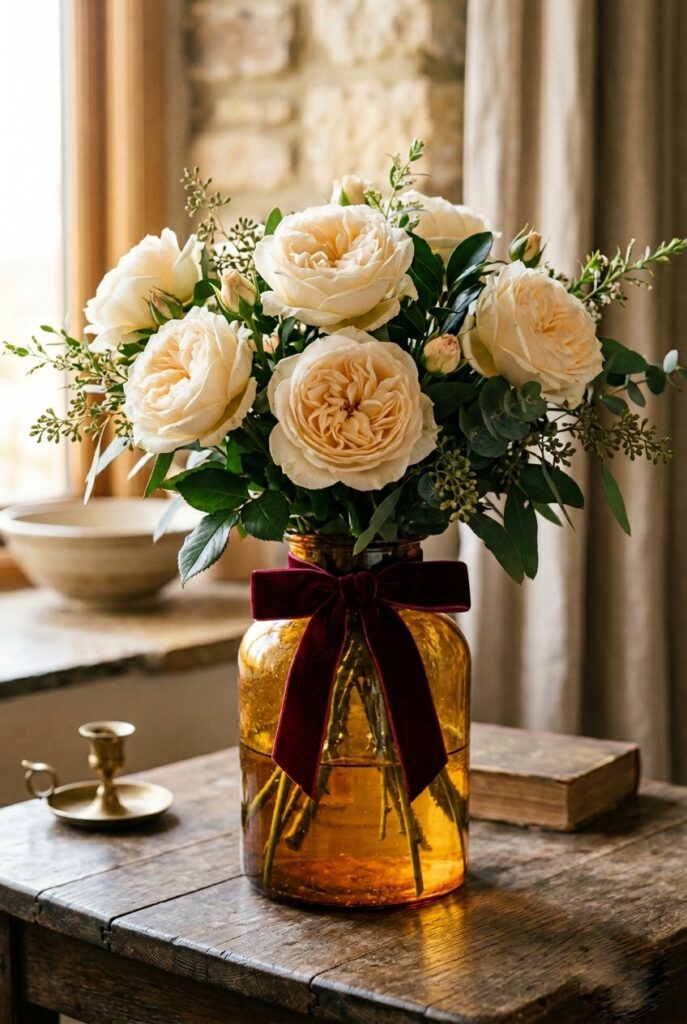
Velvet is the fall texture that elevates anything it touches — a $4 length of 2″ velvet ribbon tied around a vase neck transforms a grocery store arrangement into something that looks styled.
The key is the width and the tie: wide ribbon (1.5″–3″) in burgundy, plum, or forest green, tied in one loose loop rather than a bow, and allowed to trail one end down the side of the vessel.
Thin craft store satin ribbon reads as cheap immediately; velvet reads as deliberate.
Buy velvet ribbon by the yard from Michaels or from Etsy ribbon shops like LovettaRibbons for $0.80–$1.80 per yard — you need roughly 24″ per vessel.
Applied to five or six vessels per table, the velvet ties add a tactile warmth that guests actually reach out to touch, which is the sign of a detail that genuinely worked.
For additional simple detail ideas that translate across a full fall reception, the simple wedding decor ideas guide covers approaches at every scale.
Decision Filter
If your guest count is under 75 and you have long farm tables, ideas 2 and 9 together — the produce-and-flower arrangements with organic scatter elements — create the most intimate, fragrant, editorial fall tablescape at the lowest cost.
If your venue has high ceilings and round tables for 100+, invest in ideas 3 and 6: tall iron candlestick clusters and the ceremony-to-reception floral transfer give you the visual height and statement scale that read across a large room.
On a strict budget under $12 per table, ideas 5 and 9 — pomegranate-and-cotton centerpieces with foraged scatter elements — deliver fall depth without a single florist call.
If you have an outdoor evening ceremony with Edison string lights, re-read idea 8 before finalizing your flower colors — it will change what you order.
The Real Reason Fall Centerpieces Disappoint Couples in Photos
The contrarian truth about fall wedding decor is that the season’s abundance works against you if you let it.
When everything is seasonal and rich and warm-toned, nothing stands out — the tables read as one undifferentiated harvest scene rather than a designed event.
The couples whose fall receptions photograph beautifully are the ones who built contrast into every table: one dark element against light, one tall element against low, one matte texture against something reflective.
The strong opinion: stop using orange as your primary fall wedding color.
It is the most overused choice in fall wedding decor, it competes with the venue’s ambient lighting, and it photographs as the flattest of all autumn shades.
Burgundy, plum, or a deep fig tone does everything orange promises and photographs three times better.
The insider observation — this is something photographers and coordinators know but rarely say before you finalize your decor: fall wedding receptions frequently start in daylight and end under candlelight, and centerpieces that look one way at 5pm look completely different at 8pm.
Any centerpiece with deep-toned flowers (burgundy, plum, deep red) becomes dramatically more beautiful as the natural light fades and candlelight takes over — the dark petals deepen, the warm glow intensifies, and the whole table transforms.
Any centerpiece built around light-colored blooms and pale foliage peaks at setup and fades as the evening progresses.
Build for how your tables will look at hour three, not hour one — that is when your guests are seated and your photographer is shooting reception details.
Mistakes to Avoid
Mistake 1: Centering your fall palette on orange when every competitor article recommends it. Orange is the first color every fall wedding article suggests, and it is consistently the hardest fall color to execute well.
It clashes with burgundy (the most flattering bridesmaid color for fall), it photographs as flat under warm venue lighting, and it reads as Halloween rather than harvest in most arrangements.
Burgundy, fig, and plum deliver autumn depth without the seasonal clichés.
Mistake 2: Spending $45–$65 per table on mixed seasonal floral arrangements when the same visual impact is achievable for $10–$20. The produce-plus-flowers technique in idea 2, the pomegranate-plus-cotton approach in idea 5, and the ceremony transfer system in idea 6 collectively represent $400–$800 in savings for a 20-table reception that couples hand directly to florists because they didn’t know these options existed.
Use The Knot’s florist finder to get at least three quotes and specifically ask each florist what the materials-only cost would be if you sourced and arranged yourself.
Mistake 3: Not testing the centerpiece under venue lighting conditions before the wedding day. Most couples assemble a sample centerpiece at home under daylight or indoor household lighting — which is neutral-to-cool in temperature — then are surprised when the centerpiece looks and reads completely differently under the warm amber lighting of their actual venue.
A 30-minute visit to your venue during setup of a different event, or a conversation with your venue coordinator about fixture color temperature, gives you information that saves you from reprinting the entire centerpiece design six weeks before the wedding.
Mistake 4: Trusting that pumpkins as vases will hold fresh flowers through a four-hour reception. Scooped pumpkins filled with flowers lose structural integrity within two to three hours at room temperature — the pumpkin walls soften, the arrangement tilts, and by the time guests are cutting cake the centerpiece is listing sideways.
If you want to use pumpkins with flowers, keep the flowers in a small plastic cup with water liner inside the pumpkin, not in direct contact with the pumpkin flesh, and accept that this still works best for ceremonies and cocktail hour rather than full reception centerpieces that need to hold for four or more hours.
FAQ
What flowers are in season for a fall wedding?
Dahlias, chrysanthemums, garden roses, marigolds, lisianthus, and chocolate cosmos are all genuinely in season for fall weddings.
Locally grown dahlias and mums specifically peak September through October and are significantly cheaper than out-of-season imports.
Supplementing with dried elements like pampas grass, cotton stems, and preserved eucalyptus extends your palette without adding cost.
How do I make fall wedding centerpieces look expensive on a budget?
Vessel choice and color restraint do more than flower volume.
A smoked amber vase, three dahlia stems, and a velvet ribbon reads as styled; fifteen mixed stems in a clear glass cylinder reads as DIY.
Keep the palette to two colors maximum, add one matte textural element like velvet or linen, and let empty space in the arrangement work.
The DIY wedding decor ideas guide covers the full technique from sourcing to assembly.
What are good non-floral fall wedding centerpiece ideas?
Pomegranate-and-cotton-stem clusters, stacked books with pumpkins, wooden lantern groupings with scattered acorns, and tall branch arrangements in wide-mouth jars all work beautifully without any fresh flowers.
The advantage beyond cost is that non-floral arrangements require zero water management, hold all night without wilting, and can be assembled weeks in advance.
How far in advance can I make fall wedding centerpieces?
Dried arrangements — pampas grass, cotton stems, wheat, preserved eucalyptus — can be assembled four to six weeks ahead and stored in a cool, dry space.
Fresh flower arrangements should be built 24–36 hours before the wedding with stems cut at an angle and kept in fresh water.
Produce-based centerpieces (figs, pomegranates, pears) can be staged up to 12 hours ahead if kept in a cool room. For a full timeline breakdown, the easy wedding decor ideas guide includes a preparation schedule.
Budget Table
| Centerpiece Style | DIY Cost Per Table | Florist Cost Per Table | Best Source |
|---|---|---|---|
| Dahlia anchor arrangement | $15–$28 | $55–$85 | Trader Joe’s, flower farm direct |
| Produce + ivory flowers (figs, pears) | $8–$18 | N/A — florists rarely offer | Grocery store + Trader Joe’s |
| Iron candlestick cluster + foliage | $18–$35 | $45–$70 | HomeGoods, Amazon |
| Smoked amber bud vase cluster | $10–$22 | $40–$65 | Amazon, Goodwill |
| Pomegranate + cotton stem (no flowers) | $9–$16 | N/A — rarely offered | Trader Joe’s + Amazon |
| Moody pampas + burgundy dahlia | $18–$28 | $50–$80 | Etsy, Trader Joe’s |
| Ceremony arch transfer | $50–$100 breakdown fee | Saves $300–$600 vs new centerpieces | Discuss with your florist |
| Velvet ribbon + any arrangement | $3–$6 add-on | +$15–$25 florist upcharge | Michaels, Etsy |
The Fall Table Is Already Working for You — Stop Adding to It
Autumn’s color and texture are so strong that every extra element you add past a certain point starts competing with everything else.
The couples with the most beautiful fall reception photos are almost always the ones who chose two colors, one vessel type, and one light source — and then stopped.
Spent what they saved on a second photographer, a better lighting package, or a longer bar service. The table’s job is to set a mood, not tell the whole story.
Go back through the ideas here, build your sample table two weeks before the wedding under your actual venue’s lighting conditions, and cut whatever doesn’t hold up under that warm amber glow.
Then read the full guide to rustic fall wedding centerpieces if you are working within a barn or outdoor venue — the material choices there overlap with fall in specific ways that will save you another sourcing decision.