
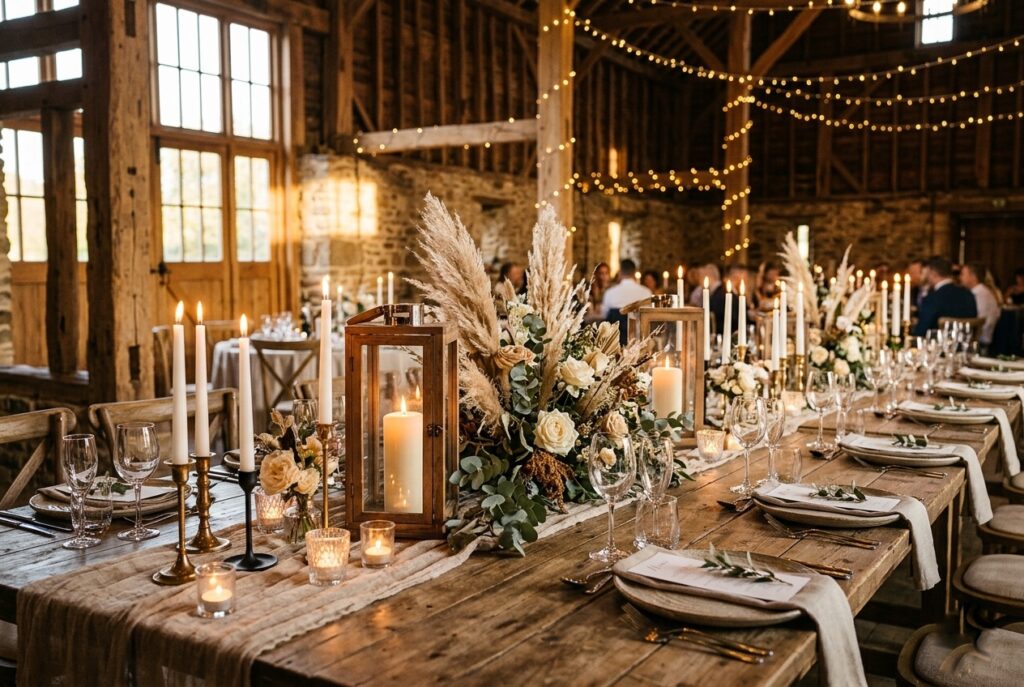
Most couples planning a rustic wedding walk into a craft store, grab burlap and mason jars, and call it a vision.
The table ends up looking like a Pinterest mood board exploded — and not in a good way.
What actually makes a rustic centerpiece feel expensive and intentional is knowing which three elements do the heavy lifting and which twenty you can skip entirely.
Dried chamomile stems press flat between pages.
The jar still smells like the lavender you bundled in July, its rubber-banded stems leaving a ring on the kitchen counter. Linen holds a crease differently than cotton.
It remembers being folded.
The Short Answer
Rustic centerpieces fail when they try to use everything associated with the aesthetic instead of choosing two or three materials and committing to them completely.
I’ve watched couples spend $800 on seventeen different elements — wood slices, burlap, mason jars, baby’s breath, twine, lanterns, river rocks, antlers, moss, AND candles — and the table reads as chaotic and cheap.
The centerpieces that photograph well and feel genuinely expensive are the ones that edit ruthlessly: one vessel type, one dominant texture, one light source.
1. Dried Pampas and Wheat Grass in Terracotta Pots
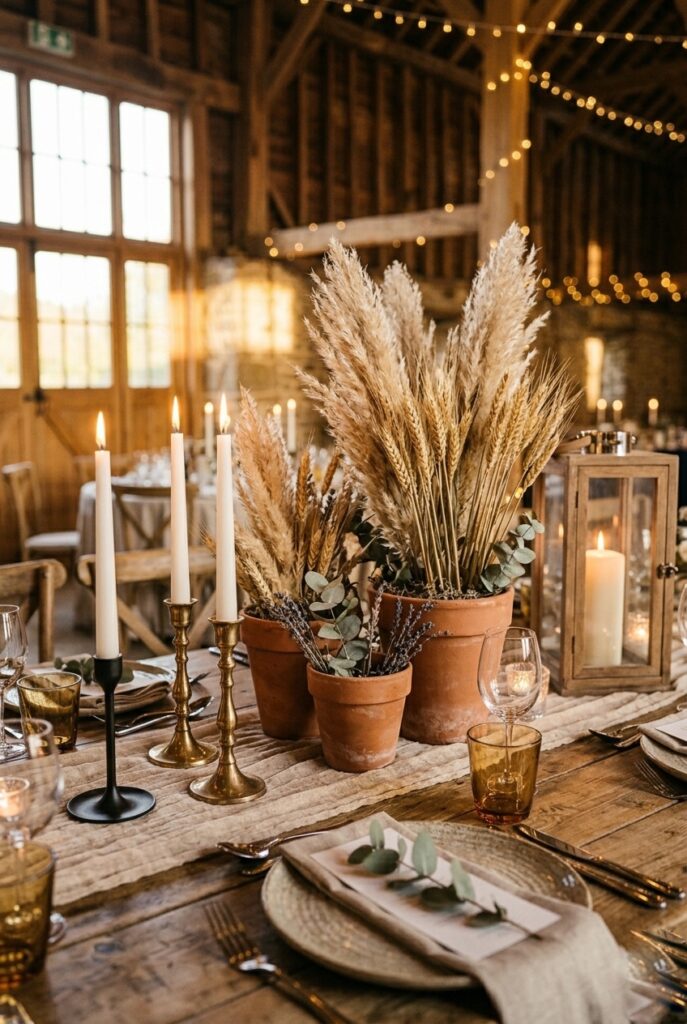
Terracotta is having a serious moment, and for good reason — it costs almost nothing and reads as curated rather than budget.
A cluster of three pots at varying heights (4″, 6″, and 8″) filled with dried pampas and wheat grass holds up all night without wilting, which is something your florist will never volunteer.
Sourced from Amazon in sets of 12 for $18–$35, or from Terrain for more refined shapes at $8–$16 each.
Only do this if your venue has warm-toned wood or exposed brick — terracotta against cool gray concrete or white-washed walls loses the magic entirely.
2. Wooden Lanterns with Pillar Candles and Loose Eucalyptus
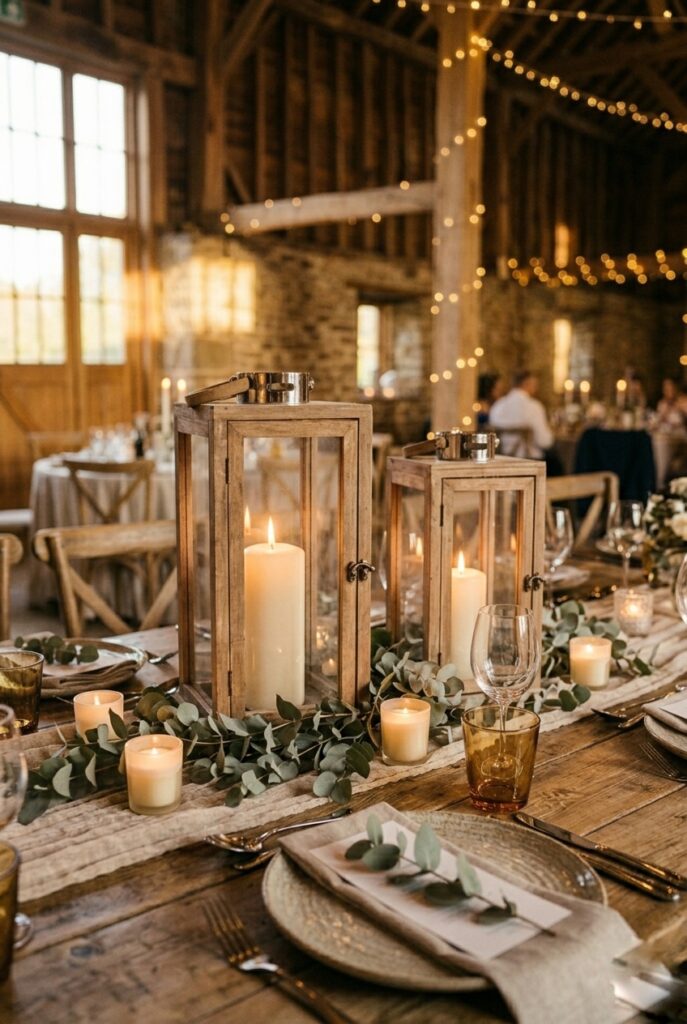
The cheap version of this idea is a flimsy painted-black metal lantern from a wedding supply website — they’re wobbly, the finish chips, and in photos they look like Halloween decorations.
Switch to actual wood-frame lanterns (natural pine or cedar finish) from Pottery Barn, where they run $49–$89, or Etsy shops like WoodlandDecorCo at $28–$55.
The warmth of real wood grain next to candlelight is categorically different from painted metal.
Tuck four to five loose eucalyptus stems around the base rather than stuffing them inside, and add two smaller votives flanking the lantern to create a glow cluster instead of a single focal point.
If your venue prohibits open flame — and more do every year — LED pillar candles from Luminara ($18–$35 each) are the only ones worth using.
Anything else reads as obviously fake in photos.
This idea pairs naturally with the simple wedding decor ideas approach: let the candlelight do the work.
3. Bud Vase Clusters in Mismatched Amber and Green Glass
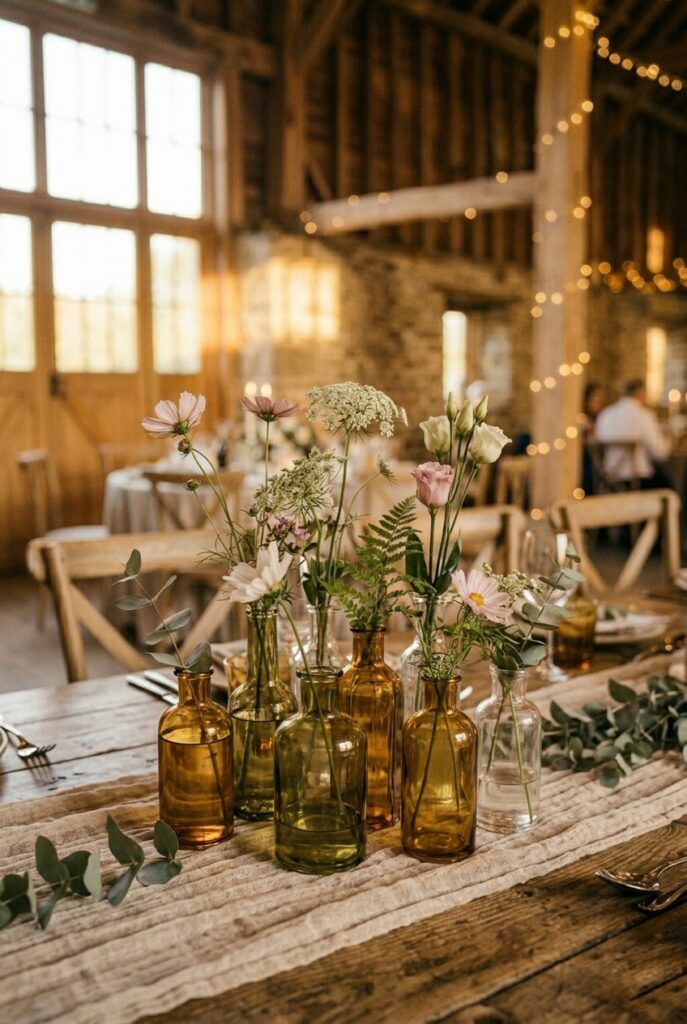
Collecting mismatched vintage glass takes time but the payoff is substantial — seven to nine bud vases in amber, green, and clear glass clustered together look like a styled editorial shot and cost almost nothing per stem to fill.
Hit Goodwill and estate sales two months before the wedding and spend $0.50–$3 per vase, or buy pre-curated sets on Etsy from shops like VintageVaseCo for $45–$90 per set of ten.
The key is variation in height, not just color — group them so no two identical heights sit directly next to each other.
Fill with whatever is in season locally: cosmos, lisianthus, Queen Anne’s lace, or even grocery store chamomile.
These also work brilliantly on long farm tables, which you can read more about in this guide to wedding table decor ideas.
BUDGET HACK #1: Skip ordering bud vases from Amazon or Etsy and go directly to a restaurant supply store like Restaurant Depot or WebstaurantStore. Individual bud vases there run $0.60–$1.20 each, and you can buy exactly the quantity you need with no minimums on many items. For 20 tables needing five vases each, that’s $60–$120 total versus $180–$300 on retail wedding sites. Walk in with a business card or simply say you’re catering an event — many locations don’t require a membership to browse.
4. Potted Herb Living Centerpieces — The One Nobody Talks About
[GAP IDEA 1 — Competitors Miss This Completely]
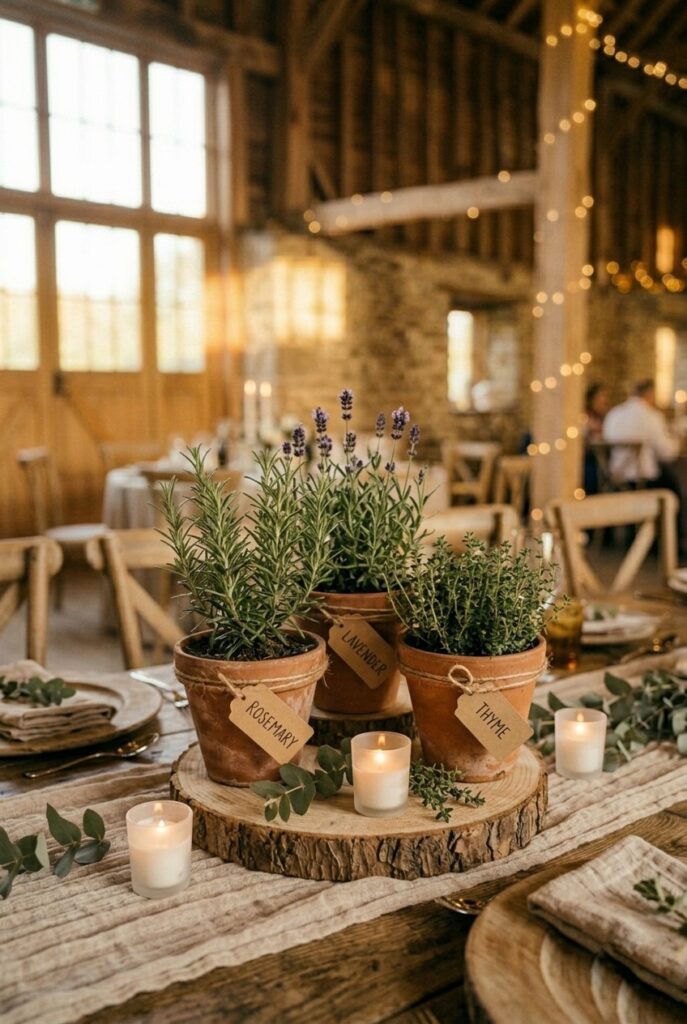
Here is something almost no article about rustic centerpieces mentions: living herb plants are the best-value centerpiece at any price point.
Rosemary, lavender, and thyme in 4″ terracotta pots cost $3–$6 each at most garden centers, require zero arranging, smell extraordinary, and double as guest favors.
Set three pots of different heights on a wood slice, tuck in two votive candles, add a kraft paper tag with the herb name, and you have a centerpiece that is warm, scented, personal, and completely unlike anything else in the room.
Lavender in particular gives off enough fragrance to perfume the immediate table without overwhelming food.
Buy in bulk from a local nursery or from a wholesale supplier like AmericanMeadows.com, where 18-packs of lavender plugs run $29–$45.
Guests take them home and plant them — you’ll get texts about them blooming two years later.
That is the kind of centerpiece that gets remembered.
5. Birch Log Candle Holders with White Taper Candles
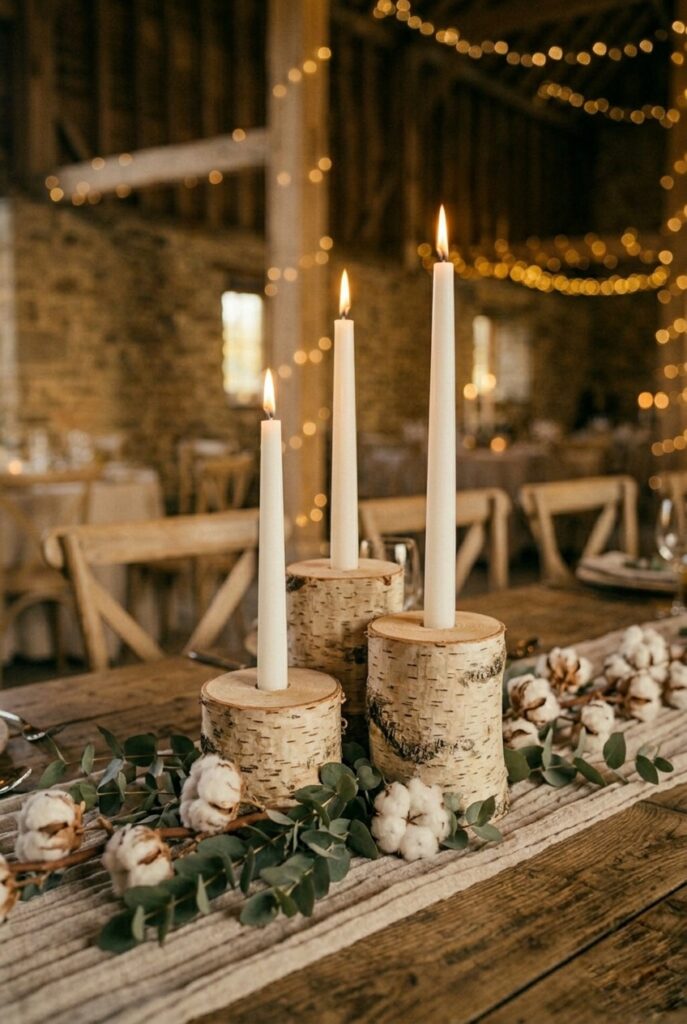
Birch wood reads as intentional in a way that MDF or painted wood never will — the grain, the natural color variation, the bark edge.
Buy pre-drilled birch log rounds from Etsy (search: birch candle holder wedding) for $3–$8 each, or make your own by drilling a 7/8″ hole into 4″–6″ sections of birch firewood.
Group three logs of different heights and fit white taper candles directly into the drilled holes — no holders needed.
Finish with loose cotton stems, dried eucalyptus, or a single sprig of dried lavender at the base.
Total cost per table: $12–$22. These pair especially well with the overall ideas on rustic wedding decor if you’re building a full cohesive theme.
Skip this if you’re in a venue with fire code restrictions that prohibit unenclosed open flames — many barns and indoor venues require enclosed candle holders.
6. Wooden Crates with Galvanized Buckets and Wildflowers
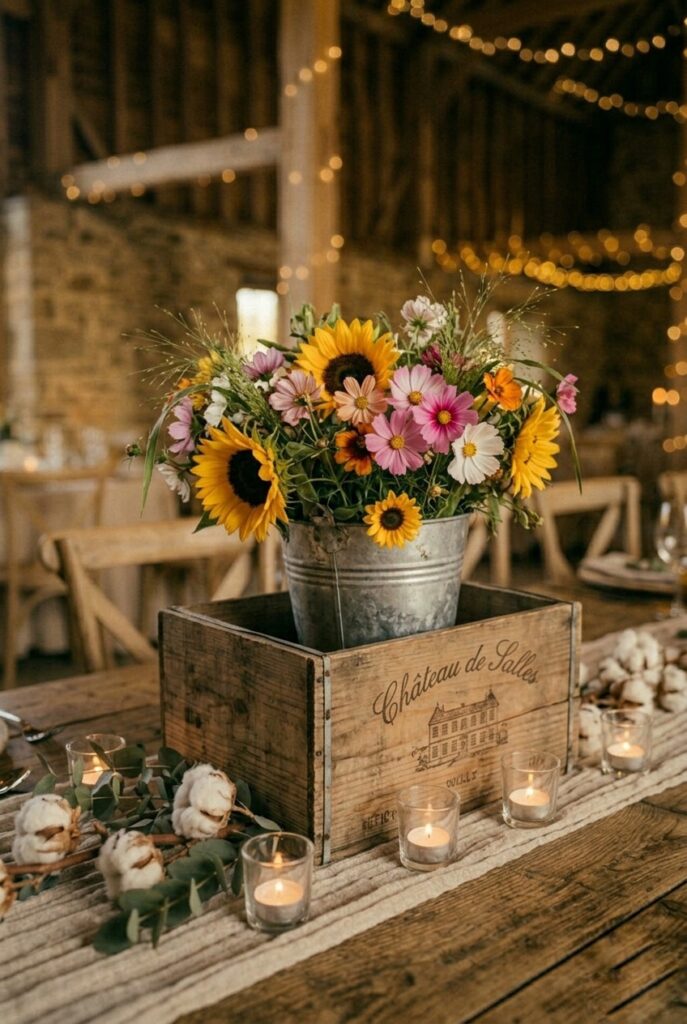
Galvanized metal + worn wood is the combination that signals “rustic done correctly” rather than “rustic from a party supply store.”
The cheap version of this is a shiny new silver tin bucket from a craft store — the finish is too uniform and too bright, and it reflects harshly in photos.
Source actual galvanized buckets from farm supply stores like Tractor Supply Co., where they run $8–$18, and use genuine worn wine crates from local wineries or restaurant supply auctions ($2–$8 each).
Fill the bucket with sunflowers, cosmos, or any seasonal wildflower mix — do not overstuff.
Three to five stems per bucket with greenery is plenty.
The restraint is what makes it look expensive.
If you want to go further on this direction, the guide to country wedding decor ideas has complementary ideas that work alongside this look.
BUDGET HACK #2: Order your centerpiece flowers not from a florist but directly from Whole Foods floral or Costco Business Center if one is near you. Costco Business Center (different from regular Costco) sells 100-stem bunches of fresh flowers wholesale — a 100-stem bunch of sunflowers runs approximately $28–$45 and is enough for 10–15 centerpiece buckets. Compare that to a florist sourcing fee where those same stems would cost $120–$200 before labor. Call ahead — not all Costco Business Centers carry the same floral inventory, and pre-ordering by two weeks is standard.
7. Slate Tile and Iron as Dark Contrast Elements — The Photographer’s Secret
[GAP IDEA 2 — No Competitor Mentions This]
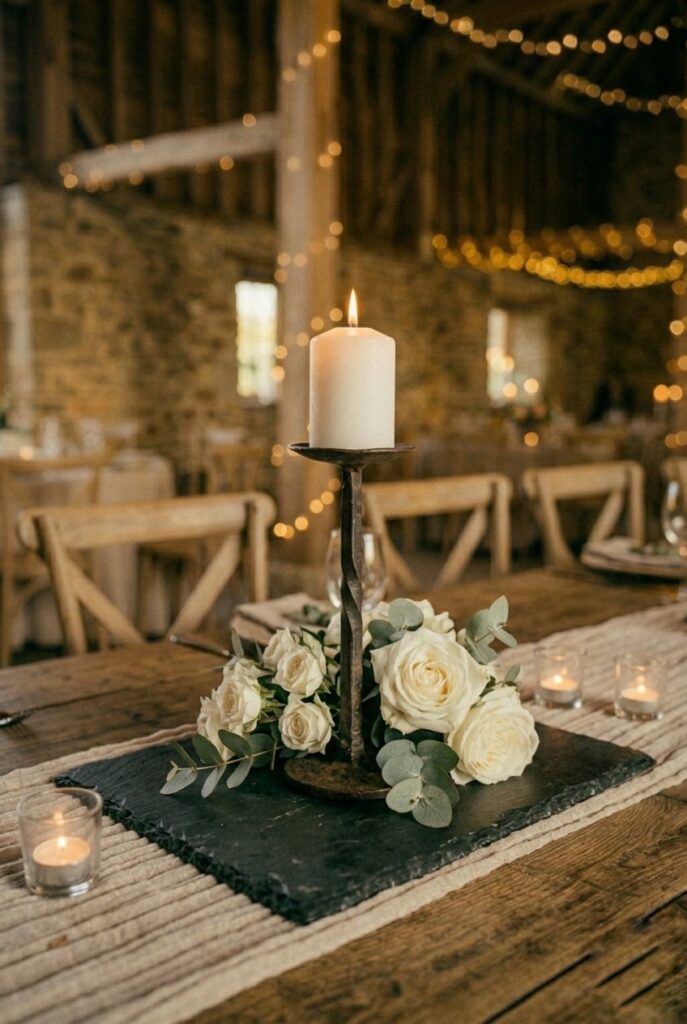
Every photographer I’ve ever talked to says the same thing: all-light rustic centerpieces — cream flowers, white candles, pale wood, ivory linen — wash out into a pale blob in photos, especially at evening receptions.
The fix is adding one dark, matte element to ground the arrangement.
Slate tiles ($0.80–$2.50 each at Home Depot, sold individually in the flooring section) make exceptional bases for centerpieces — set your lantern or candle cluster directly on a 12″ slate tile and watch how much richer the table reads in photographs.
Black river rocks scattered between votives serve the same purpose.
Wrought or cast iron candlesticks ($12–$30 at HomeGoods or Amazon) add the vertical dark element that prevents the whole centerpiece from looking flat.
This is the detail your wedding photographer will thank you for.
This principle applies equally to the table overall — if you need more ideas for building a table that photographs beautifully, the guide to elegant wedding table decor ideas covers this in depth.
8. Dried Cotton and Wheat Stem Arrangements in Ceramic Jugs
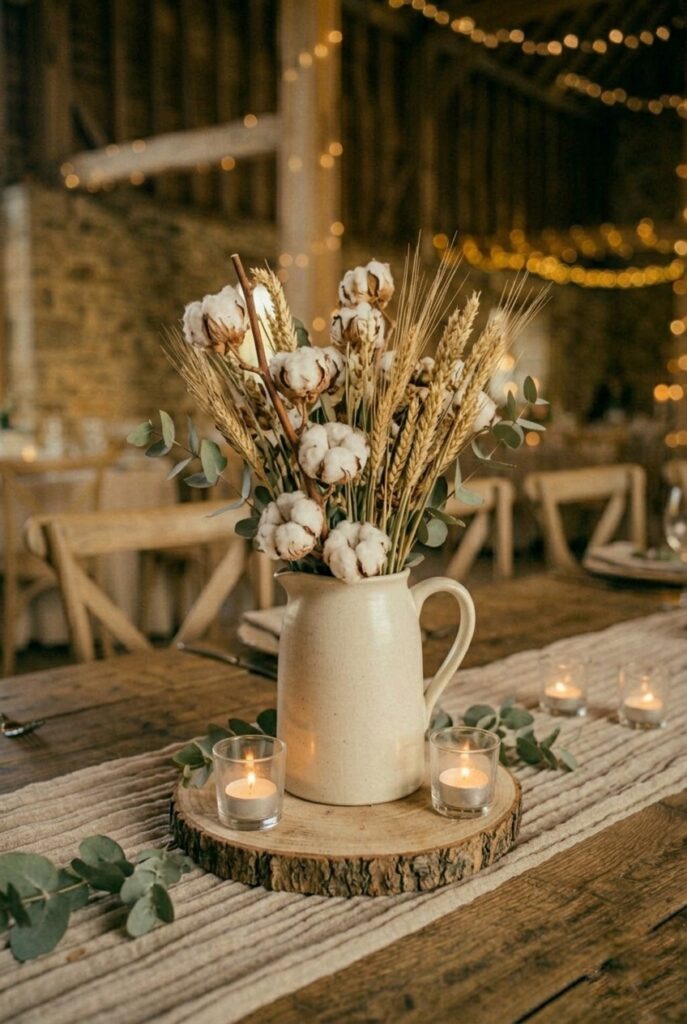
Dried cotton bolls have a texture — round, slightly fuzzy, cream-white — that plays beautifully against the roughness of a ceramic or stoneware vessel.
Unlike fresh flowers, they require zero water, zero setup day-of, and can be assembled weeks in advance.
A bundle of 50 dried cotton stems runs $18–$35 on Amazon or Etsy.
Mix with dried wheat stalks and three or four eucalyptus sprigs for fragrance.
Ceramic jugs in matte cream or warm gray run $15–$40 each from World Market.
This is also one of the few centerpiece styles that works equally well for winter wedding decor and warm-season barn weddings.
9. Wood Slice Bases as the Foundation Everything Else Sits On
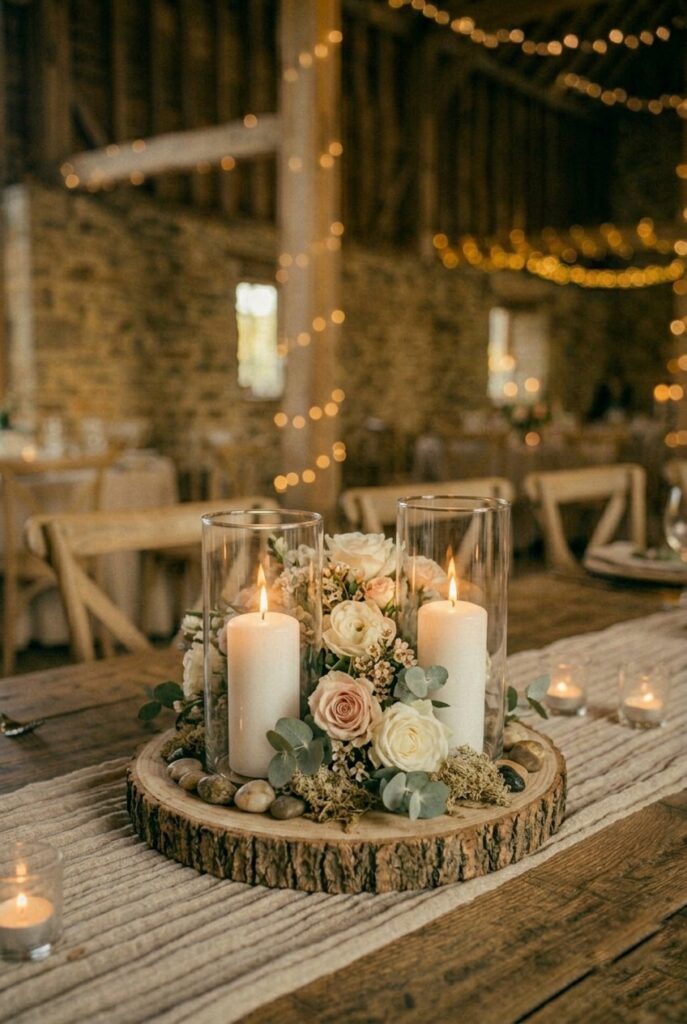
Wood slices are the most versatile $4 investment in rustic wedding decor — they anchor any centerpiece, ground the look, and add texture without competing with anything above them.
Buy 10″–14″ slices from Etsy shops like WildWoodSlices or ForestFloorDecor for $3–$7 each, or saw them yourself from firewood rounds with a chainsaw or hand saw.
Place your lantern, candle cluster, or small arrangement directly on the slice and scatter three to five small river rocks or a pinch of dried moss around the base.
The slice tells the eye where the centerpiece begins and ends — without it, arrangements can look like they’re floating awkwardly on the tablecloth.
For DIY approaches to the full table, the DIY wedding decor ideasguide walks through exactly how to execute these from scratch.
BUDGET HACK #3: If you need 20 or more wood slices, do not buy them individually on Etsy — you’ll pay $5–$10 each. Instead, contact a local tree service company directly and ask if they can cut rounds from removed trees. Many will do it for free or charge $20–$40 for an entire batch, because it saves them wood disposal fees. Specify that you need slices 1.5″–2″ thick and 10″–14″ diameter, dried for at least two weeks to prevent cracking. You’ll spend $0–$40 total versus $100–$200 retail. Call three or four local companies — this works roughly 60–70% of the time.
10. Tall Branch Arrangements in Canning Jars — Only If You Edit Hard
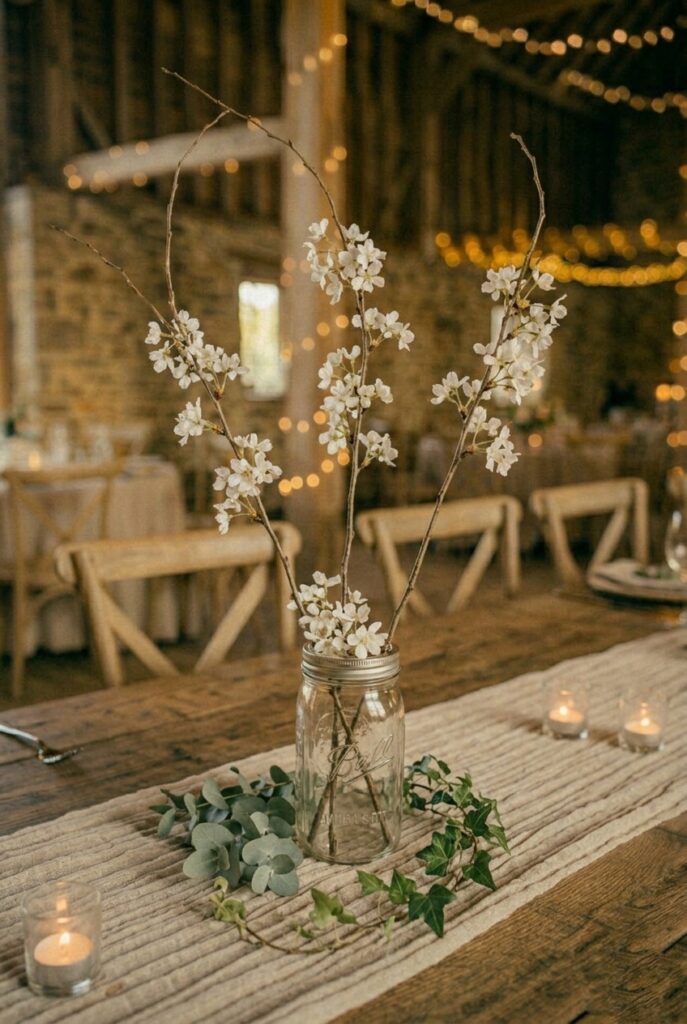
A single tall branch arrangement in a large canning jar creates vertical drama without the cost of tall floral centerpieces — but only if you resist the urge to overfill it.
One branch variety, two to three stems max, and one trailing greenery element.
If you add more than that, the arrangement reads as messy rather than architectural. Branches from dogwood, cherry, or birch work best — dogwood cuttings are free if you have access to a yard or local park, cherry branches can be forced to bloom early by keeping them in warm water indoors for two weeks.
Large 1/2-gallon wide-mouth canning jars are $3–$5 each at Ball or from any grocery store.
Skip this if your guest count is over 120 — at that scale, you need centerpieces that read clearly from across a room, and a single branch arrangement doesn’t project enough visual weight.
For full backyard barn settings where this look performs especially well, see the complete breakdown on backyard wedding decor ideas.
Decision Filter
If your guest count is under 80 and you have long farm tables, focus every dollar on ideas 3 and 4 — the bud vase clusters and living herb pots create a lush, personal experience at close range that is perfect for intimate seating.
If you’re in a barn with high ceilings and round tables for 100+ guests, invest in idea 2 (wooden lanterns) and idea 7 (slate contrast elements) because they read from a distance and photograph in the dark.
On a strict budget under $15 per table, ideas 1, 5, and 9 together — terracotta dried pampas, birch candle logs, and wood slice bases — deliver the highest visual return for the spend and can be assembled entirely without a florist.
The Real Reason Rustic Centerpieces Fail
The contrarian truth about rustic style is that it is not actually low-effort.
Genuine rustic centerpieces require more intentional curation than formal florals do, because you’re working with materials that have no built-in elegance — they only look right when edited down to their essential form.
Couples who treat “rustic” as permission to grab anything natural and pile it on a table end up with cluttered tables that feel like a craft store’s clearance section.
The strong opinion I’ll stand behind: if you’re using more than three material types in a single centerpiece, cut one.
Every time.
The restraint is what separates the weddings that appear in editorial features from the ones that don’t.
The insider observation — and this is something your floral designer or event coordinator knows but often doesn’t say directly: the centerpieces that get photographed and shared are almost always the ones that have the right light temperature.
Warm candlelight and warm-toned vessels (terracotta, amber glass, wood, iron) create a cohesive golden tone across the whole table that looks extraordinary on camera.
Cool-toned materials — white mason jars, silver buckets, chrome finishes, fluorescent venue lighting — read as flat and lifeless in wedding photography.
Your photographer can’t fix the light temperature at your tables after the fact.
You can fix it for $8 a table by choosing the right vessels before the wedding day.
Mistakes to Avoid
Mistake 1: Buying everything from a single wedding decor supplier. Every competitor article recommends shopping Etsy and Amazon — and both are fine — but they never tell you that buying a curated set of “rustic wedding centerpieces” from a single supplier makes every table look identical in a way that reads as catered rather than personal.
Mixed sourcing (estate sales, farm supply, restaurant supply, garden centers) creates the visual variety that makes a room feel like it was designed rather than ordered from a catalog.
Mistake 2: Spending $35–$50 per table on fresh florals from a florist when the same centerpiece exists for $8–$12 if you source ingredients separately. A florist charging $40 per rustic centerpiece is often using $6–$10 in wholesale flowers and charging the remainder for design time and markup.
For wildflower and dried arrangements specifically — which don’t require specialized cutting or wiring — sourcing wholesale and assembling yourself is almost always worth doing.
Couples who outsource simple wildflower-in-jug centerpieces to a florist frequently spend $1,200–$1,800 on centerpieces that could have cost $200–$350 total.
Use The Knot’s budget planning tool to benchmark what florist centerpiece quotes in your area are actually covering.
Mistake 3: Using greenery that wilts by 6pm. Eucalyptus, dried cotton, and pampas grass hold all day and all night without water.
Fresh herbs hold well in water. Baby’s breath wilts and browns within six hours in a warm venue.
Fern fronds are even worse — they look limp by cocktail hour.
Most couples don’t realize this until they see their reception photos and notice the centerpieces looking dramatically worse than they did during setup.
If you’re using any fresh greenery, test it in your actual venue conditions — temperature and humidity both matter — at least two weeks before the wedding.
Mistake 4: Treating the table runner as a background element when it’s actually the single highest-impact visual decision. A burlap runner in 2024 reads as dated. A cheap satin runner in “ivory” reads as hotel banquet.
A raw linen runner, a genuine leather strip, or even a length of undyed muslin transformed the same centerpieces from mid to excellent in every table mockup I’ve ever done.
The runner signals quality before a guest gets close enough to see the flowers. Spend $3–$8 per yard on natural linen from IKEA’s fabric section or Fabric.com and cut your own — it is the most overlooked $40 upgrade in rustic wedding table design.
FAQ
How much do rustic wedding centerpieces cost on average?
Rustic centerpieces typically run $8–$45 per table depending on whether you DIY or hire a florist.
DIY versions using dried flowers, terracotta, and candles can come in under $15 per table.
Florist-designed rustic arrangements generally run $35–$80 per table before delivery.
For a detailed breakdown of how to stretch your overall decor budget, the guide to wedding decor ideas on a budget covers exactly where to spend and where to cut.
What flowers are best for rustic wedding centerpieces?
Sunflowers, garden roses, cosmos, lisianthus, and Queen Anne’s lace perform best for rustic settings.
Dried options — pampas grass, cotton bolls, dried lavender, and wheat stems — have the advantage of holding perfectly all day without water.
Wildflowers sourced locally in season will always look more authentic than imported roses trying to read as rustic.
Can you DIY rustic wedding centerpieces without floral experience?
Yes — several of the best rustic centerpiece styles require no floral skills at all.
Terracotta herb pots, lantern clusters, bud vase groups, and birch log candle holders involve zero cutting or wiring and are fully assembable by anyone.
The easy wedding decor ideas guide covers the fastest no-skill approaches in detail.
What containers work best for rustic centerpieces?
Terracotta pots, galvanized metal buckets, ceramic stoneware jugs, large canning jars, and wooden crates all work well for rustic styling.
The material matters more than the shape — warm, matte, natural surfaces consistently outperform shiny, chrome, or painted finishes in both real life and photography.
Budget Table
| Centerpiece Style | DIY Cost Per Table | Florist Cost Per Table | Where to Buy |
|---|---|---|---|
| Terracotta herb pots | $9–$18 | Not typically offered | Garden centers, Amazon |
| Wooden lanterns + eucalyptus | $18–$35 | $45–$75 | Pottery Barn, Etsy |
| Bud vase cluster (mismatched) | $8–$20 | $40–$65 | Goodwill, Etsy, Restaurant Depot |
| Birch log candle holders | $12–$22 | $35–$55 | Etsy, local firewood |
| Galvanized bucket + wildflowers | $10–$20 | $38–$60 | Tractor Supply, Costco Business Center |
| Dried cotton + ceramic jug | $14–$28 | $40–$65 | Amazon, World Market |
| Wood slice base + candle cluster | $8–$16 | $30–$50 | Etsy, local tree service |
| Tall branch in canning jar | $4–$10 | $35–$55 | Ball/grocery store, garden |
The One Thing That Actually Separates Good Rustic Centerpieces From Forgettable Ones
Rustic decor works when every element on the table was chosen rather than defaulted to.
The couples whose receptions end up feeling warm and considered are the ones who made three deliberate choices — a vessel, a light source, and a texture — and didn’t add a fourth “just in case.”
The ones who end up disappointed grabbed every rustic item they could find and hoped the volume would make up for the lack of direction. It never does.
Go back through the ideas here, pick the two that fit your venue and your budget, source the materials from the specific places listed, and stop at two.
Then put the rest of your energy toward your table runner and your lighting.
If you’re still building out the full picture of what a cohesive rustic reception looks like from ceremony to farewell, start with the complete guide to rustic wedding decor ideas — it covers everything that frames and supports what you’ll build at the table.